Robotics Papers — 2026

557 papers with open-source code, published in 2026.

A Biomimetic Gaze Control to Restore Head-Neck Movements
arXiv preprint

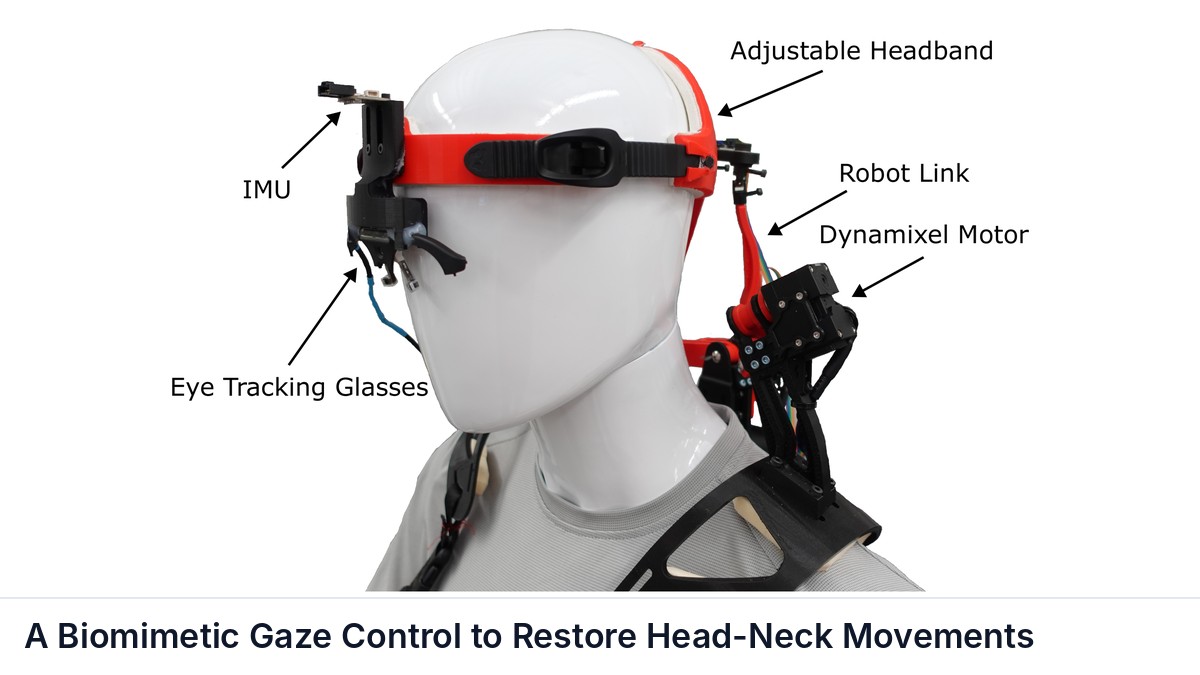
A Biomimetic Gaze Control to Restore Head-Neck Movements

Colin Rubow, Haohan Zhang

Powered neck exoskeletons are developed to restore head-neck motions for those with neck muscle weakness. Current methods using hand-held input devices to control these robotic systems are unintuitive or non-viable for these populations.

vision control
PDF Intermediate
A Review Of Robotic World Models For Dynamic Environments Based On Factor And Scene Graphs
arXiv preprint

A Review Of Robotic World Models For Dynamic Environments Based On Factor And Scene Graphs

Marco Giberna, Miguel Fernandez-Cortizas, Jose Luis Sanchez Lopez et al.

Models based on graphs have emerged in robotics as a powerful foundation for internal world representations, where factor and scene graphs are among the most prominent model types found in the related literature and in successful robotic solutions.

vision reinforcement-learning benchmark
PDF Beginner
A Two-Echelon Covering Tour Vehicle Routing Problem with Drones for Post-Disaster Relief
arXiv preprint

A Two-Echelon Covering Tour Vehicle Routing Problem with Drones for Post-Disaster Relief

Dang Viet Anh Nguyen, Rajesh Piplani, Aldy Gunawan

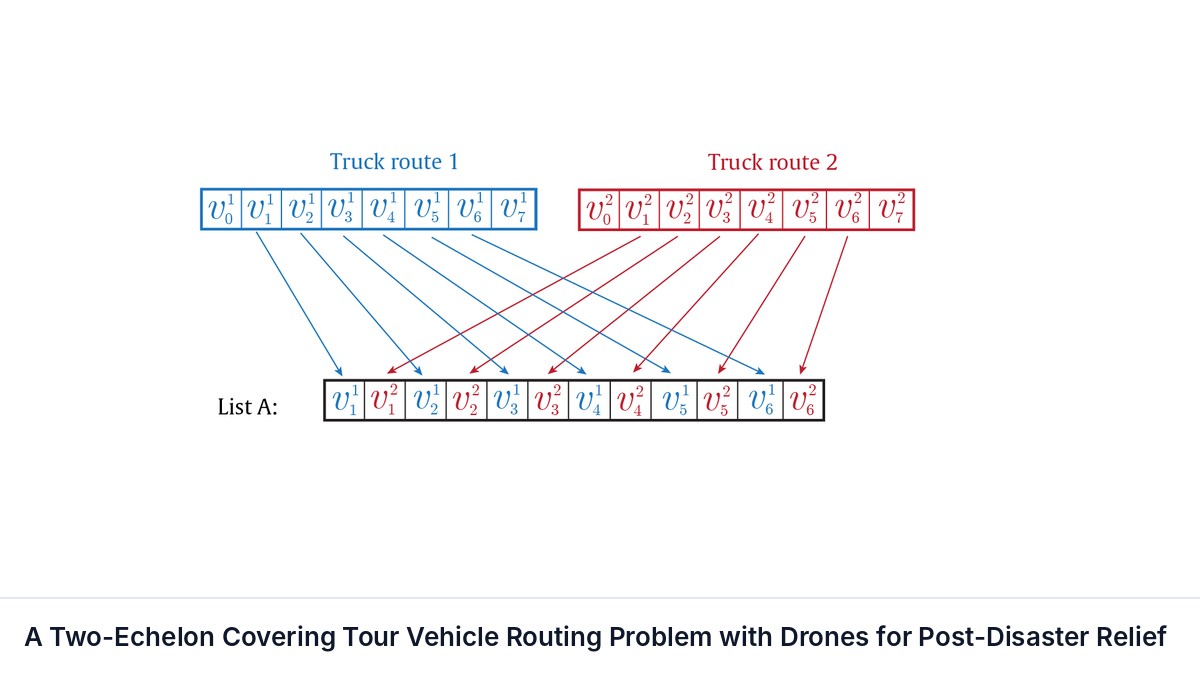
We introduce the two-echelon covering tour vehicle routing problem (2E-CTVRP) for the distribution of relief supplies after a disaster. In the first echelon, a fleet of trucks transports supplies and drones from a central depot to satellites at the periphery of the affected area.

manipulation reinforcement-learning benchmark
Code PDF Intermediate
GitHub ★ —
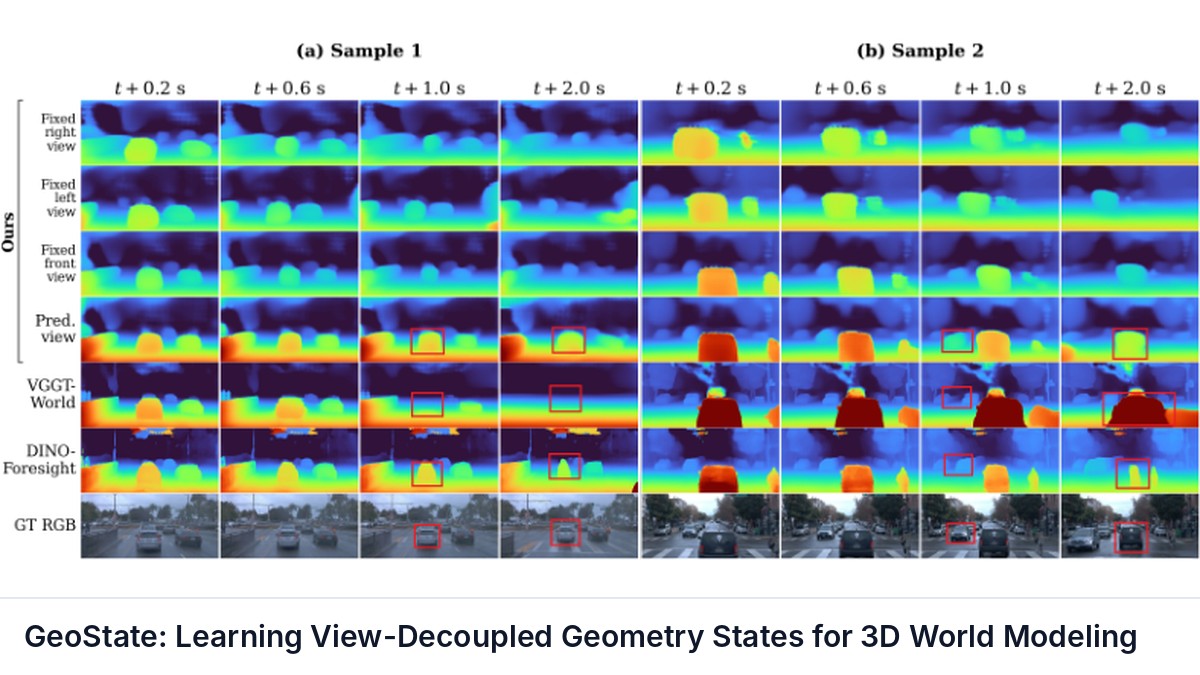
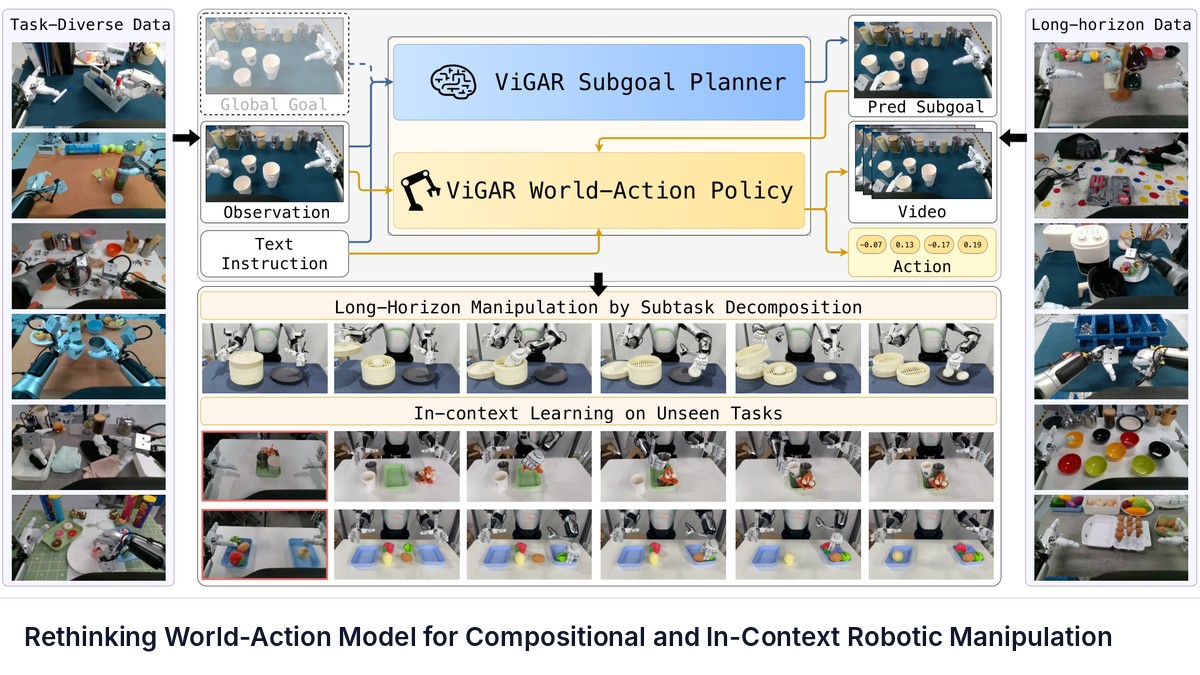
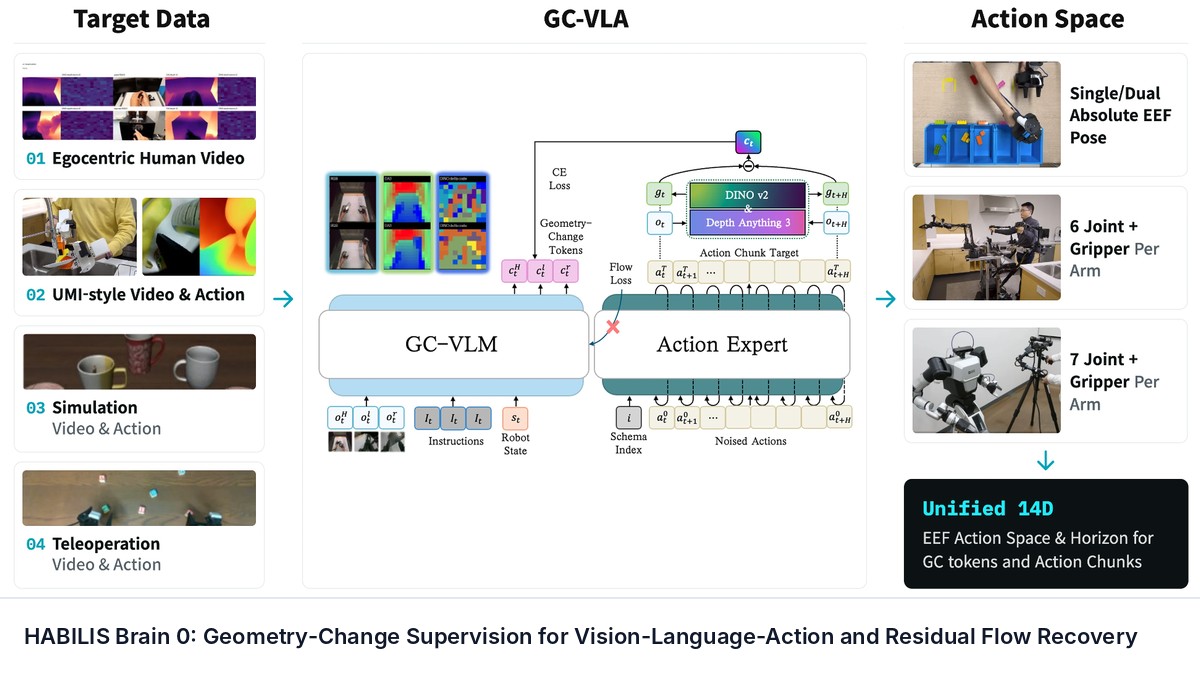
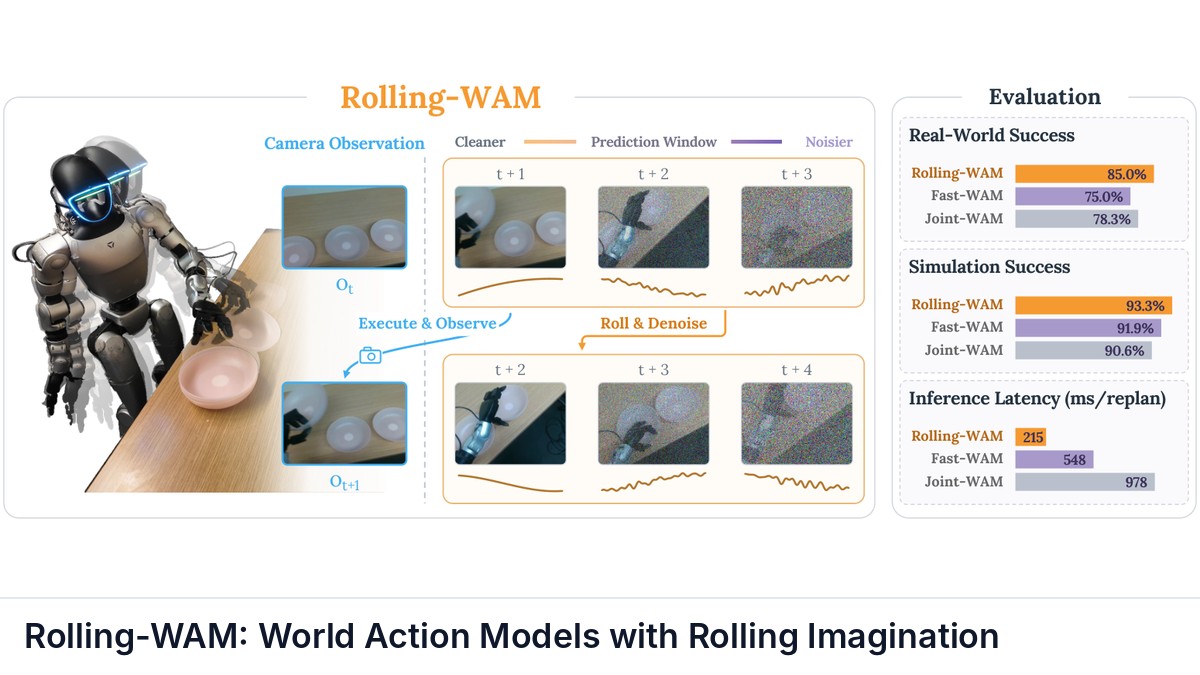
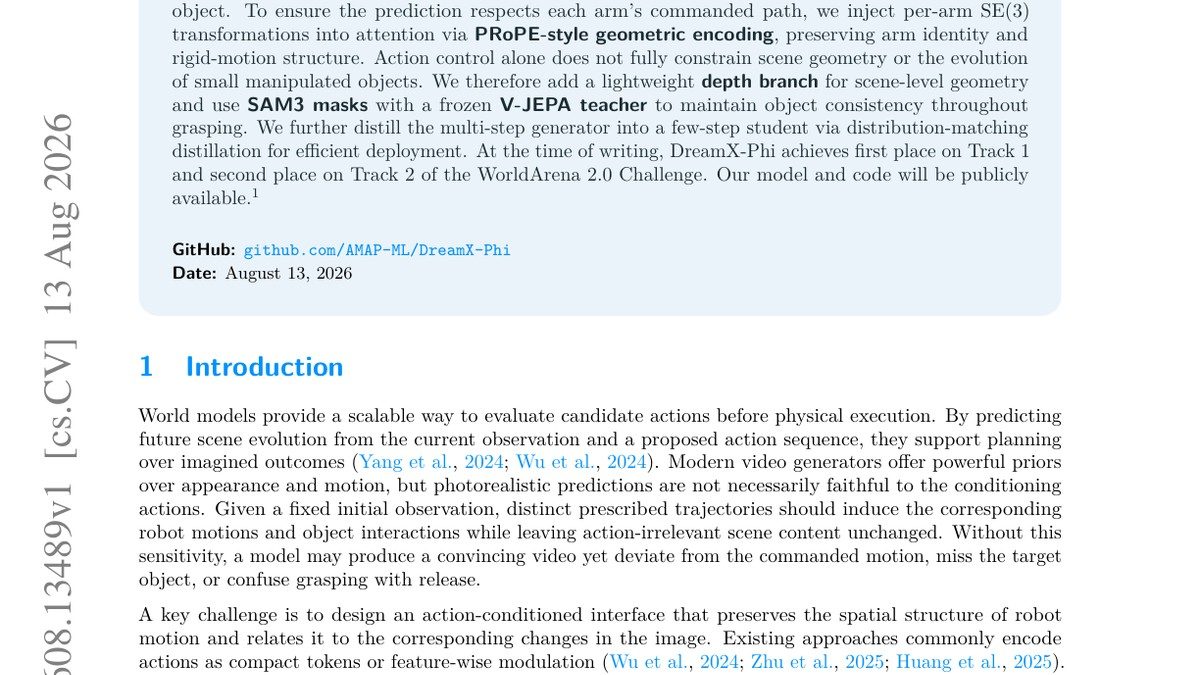
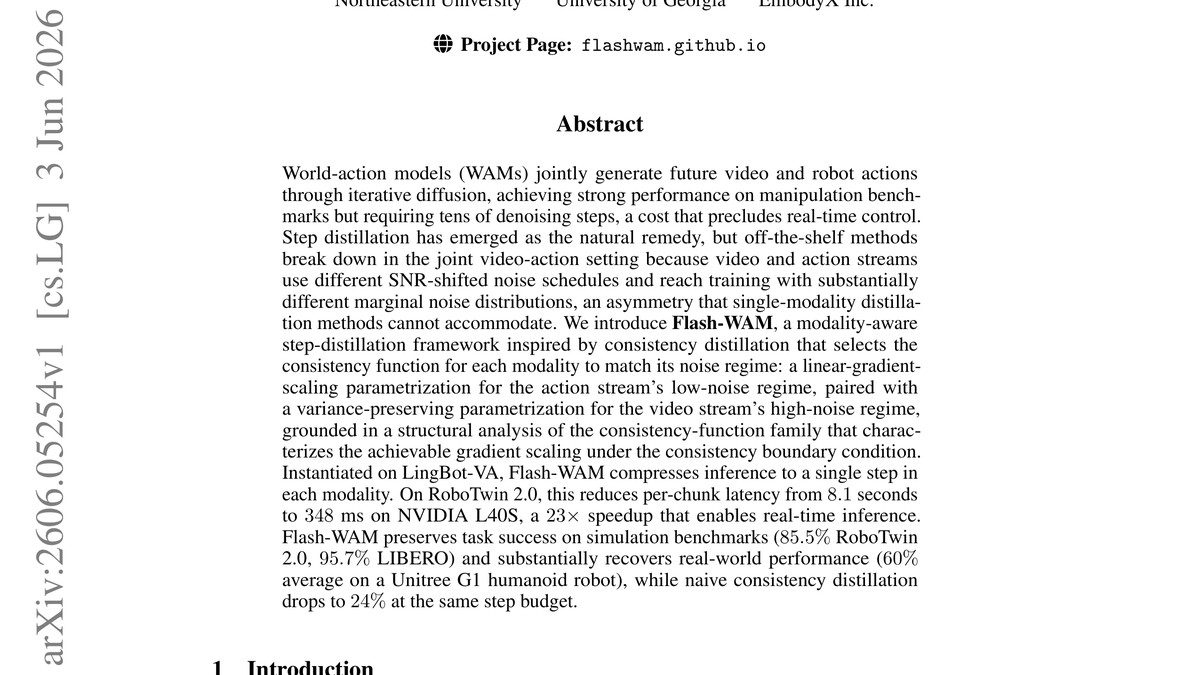
ACG-WAM: World-Action Modeling via Action-Conditioned Geometric Latent Prediction
arXiv preprint

ACG-WAM: World-Action Modeling via Action-Conditioned Geometric Latent Prediction

Jiangtao Liu, Zishang Xiang, Yage He et al.

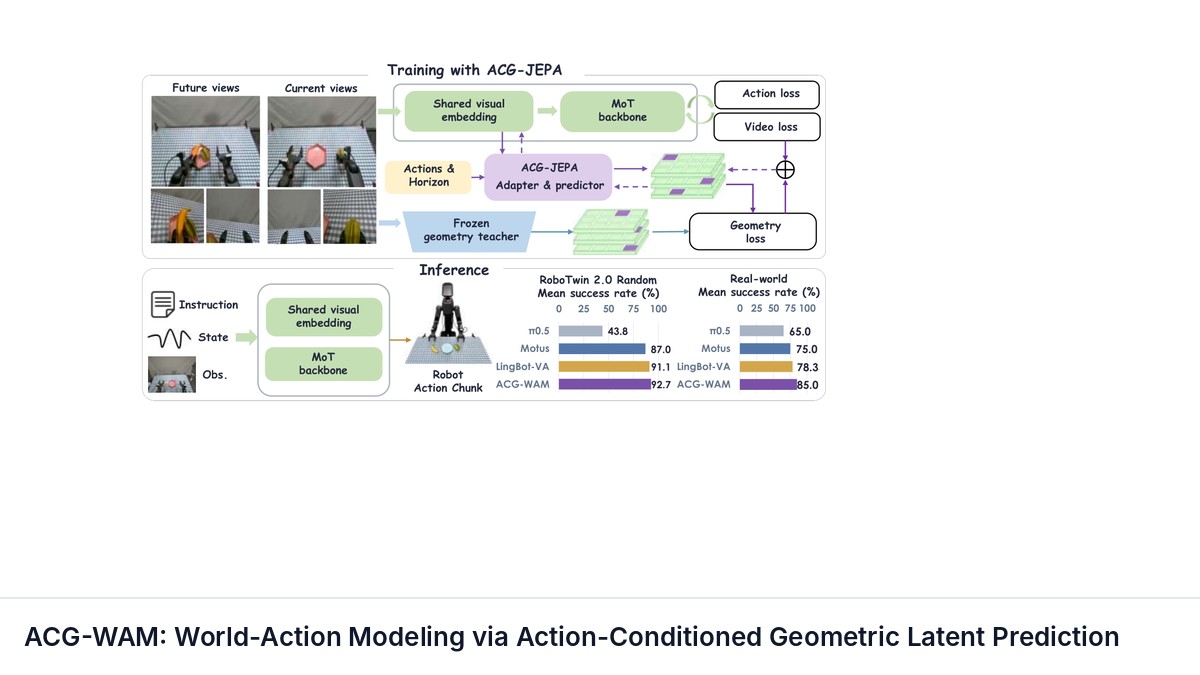
World action models jointly learn visual predictionand robot actions, providing a way to use observations ofscene evolution for policy learning. Their video and actionlosses, however, provide no explicit target for the geometricconsequences of a demonstrated action sequence.

vision reinforcement-learning
Code PDF Intermediate
GitHub ★ —
Adaptive Rejection of Unknown Hybrid Sinusoidal Disturbances with Application to Humanoid Walking under Unknown Ground Motion
arXiv preprint

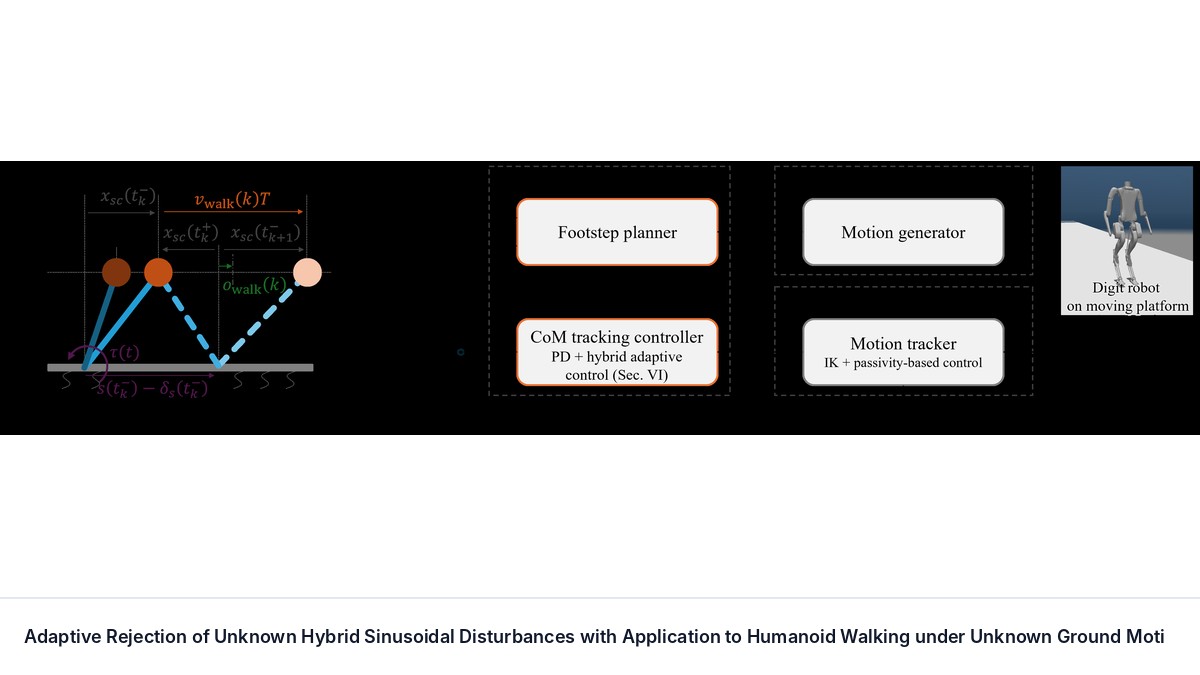
Adaptive Rejection of Unknown Hybrid Sinusoidal Disturbances with Application to Humanoid Walking under Unknown Ground Motion

I-Chia Chang, Jacob Stewart, Petros A. Ioannou et al.

Legged robot control is not yet practical in non-inertial environments, where the ground and surroundings accelerate in the inertial Earth frame, mainly because of the unknown, time-varying, persistent perturbations caused by environmental motion, compounded by the associated hybrid robotic dynamics.

locomotion reinforcement-learning control
PDF Intermediate
ARC: A Reasoning Recipe for Robot Foundation Models
arXiv preprint

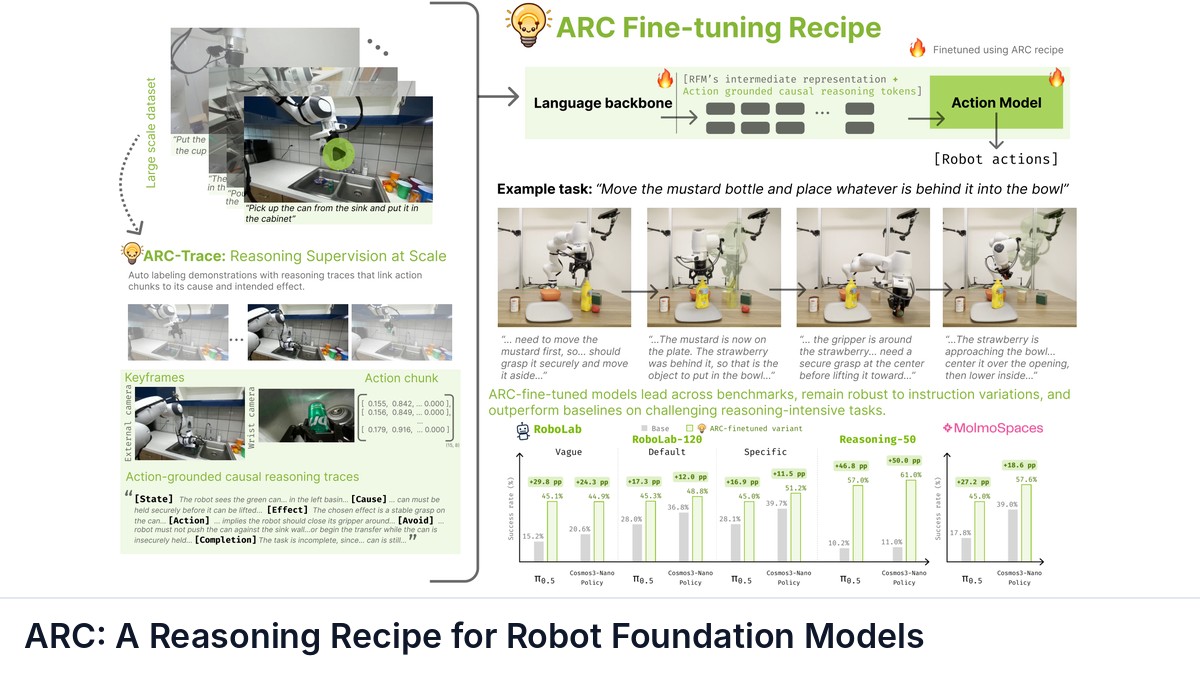
ARC: A Reasoning Recipe for Robot Foundation Models

Gokul Puthumanaillam, Tao Sun, Elie Aljalbout et al.

The prevailing approach to improving robot foundation models (RFMs) relies on larger models, more robot demonstrations, and costly training at scale.

vla reinforcement-learning control learning-from-demonstration
PDF Advanced
Attention-Based Surface Representation Learning for Robot State Prediction and Open-Ended Surface Classification
arXiv preprint

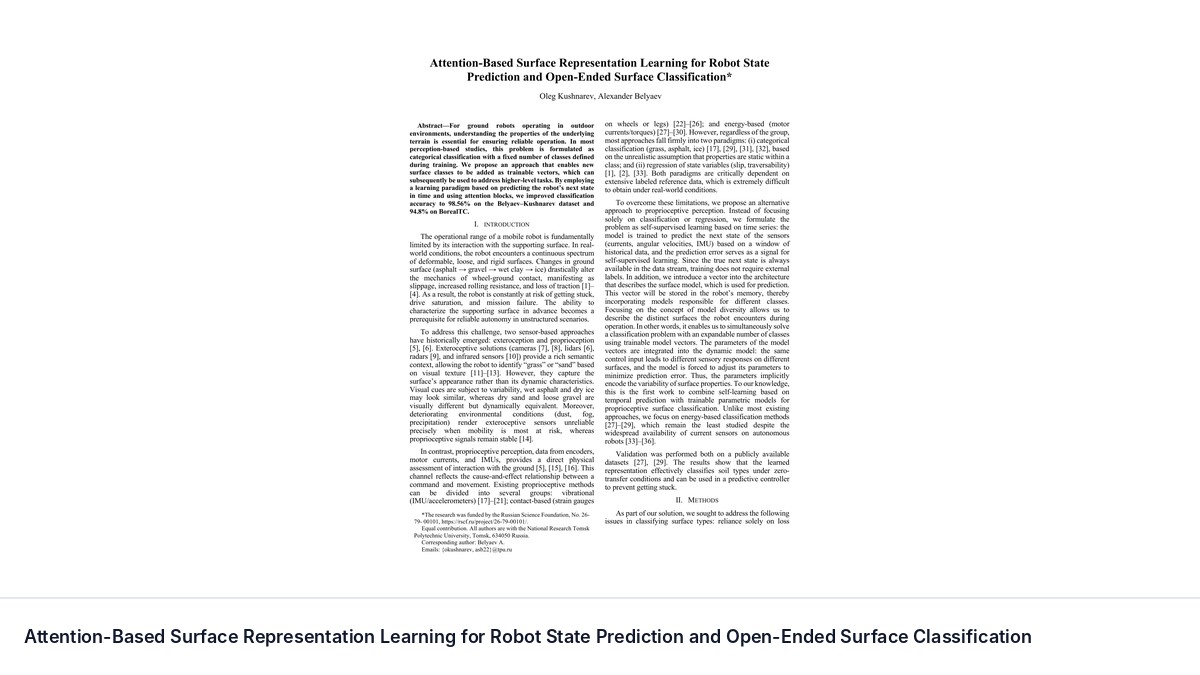
Attention-Based Surface Representation Learning for Robot State Prediction and Open-Ended Surface Classification

Oleg Kushnarev, Alexander Belyaev

For ground robots operating in outdoor environments, understanding the properties of the underlying terrain is essential for ensuring reliable operation. In most perception-based studies, this problem is formulated as categorical classification with a fixed number of classes defined during training.

vision reinforcement-learning benchmark
Code PDF Intermediate
GitHub ★ —
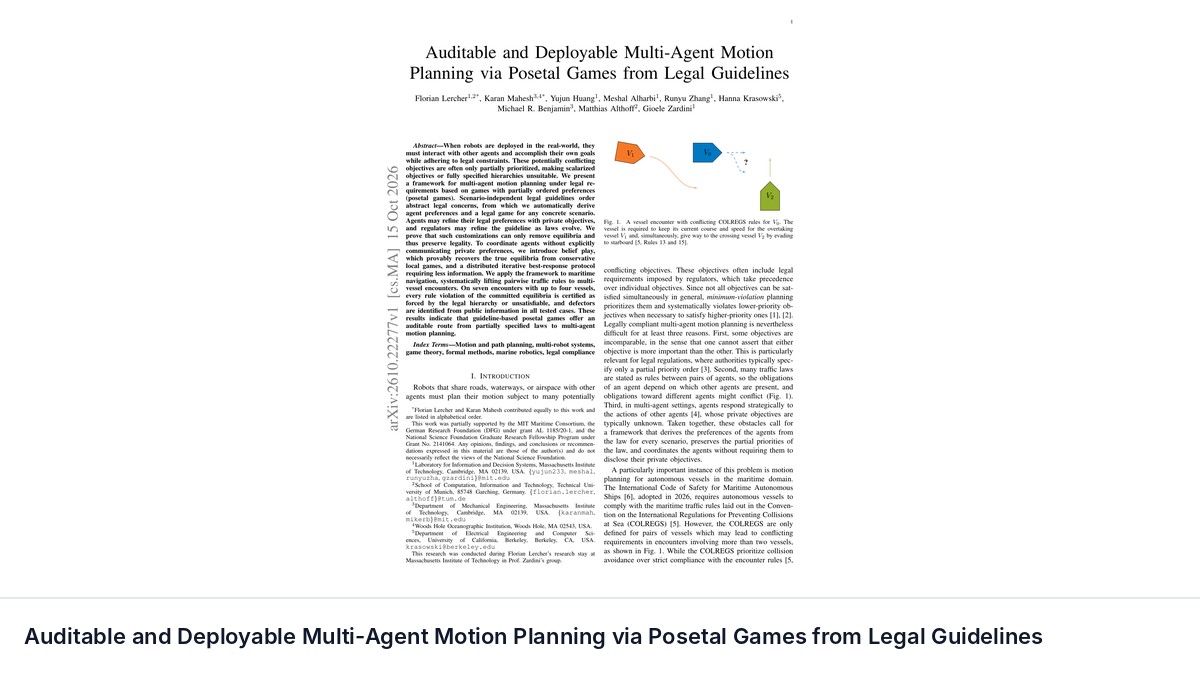
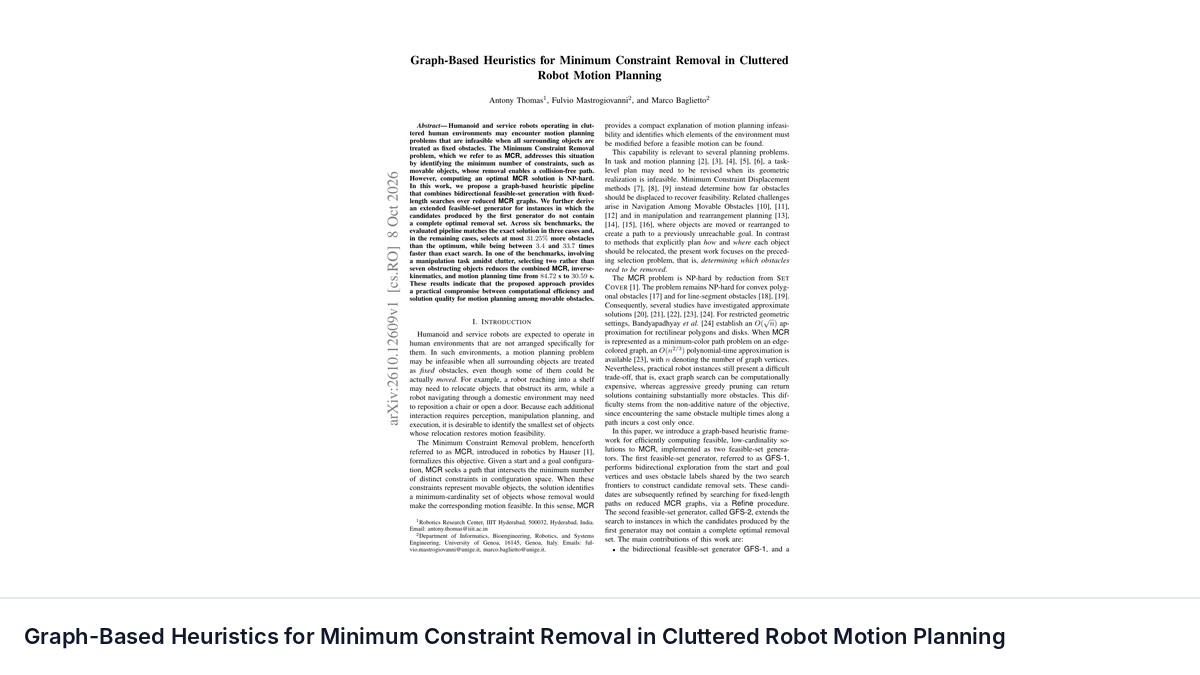
Auditable and Deployable Multi-Agent Motion Planning via Posetal Games from Legal Guidelines
arXiv preprint

Auditable and Deployable Multi-Agent Motion Planning via Posetal Games from Legal Guidelines

Florian Lercher, Karan Mahesh, Yujun Huang et al.

When robots are deployed in the real-world, they must interact with other agents and accomplish their own goals while adhering to legal constraints. These potentially conflicting objectives are often only partially prioritized, making scalarized objectives or fully specified hierarchies unsuitable.

reinforcement-learning planning
PDF Advanced
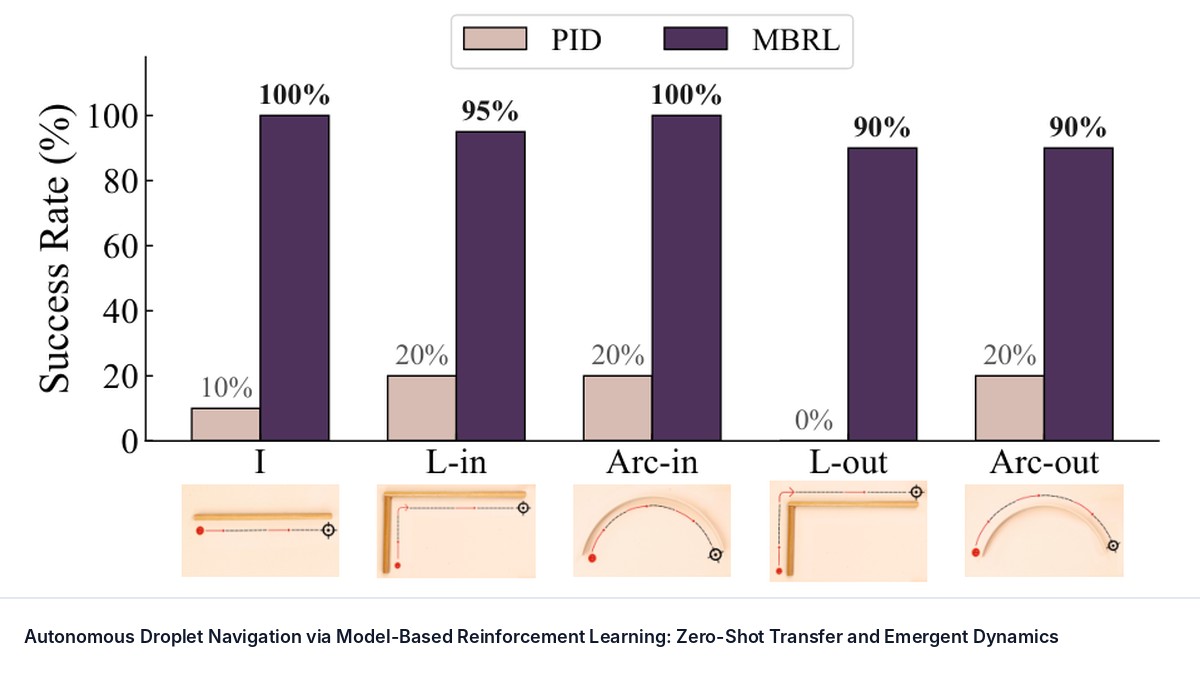
Autonomous Droplet Navigation via Model-Based Reinforcement Learning: Zero-Shot Transfer and Emergent Dynamics
arXiv preprint

Autonomous Droplet Navigation via Model-Based Reinforcement Learning: Zero-Shot Transfer and Emergent Dynamics

Rajneesh Anand, Mayuresh V. Kothare

Self-driving laboratories (SDLs) are transforming chemical and materials discovery through closed-loop automation, yet automated infrastructure for physical manipulation of soft, deformable matter remains beyond current robotic platforms.

manipulation vision reinforcement-learning planning control
Code PDF Intermediate
GitHub ★ —
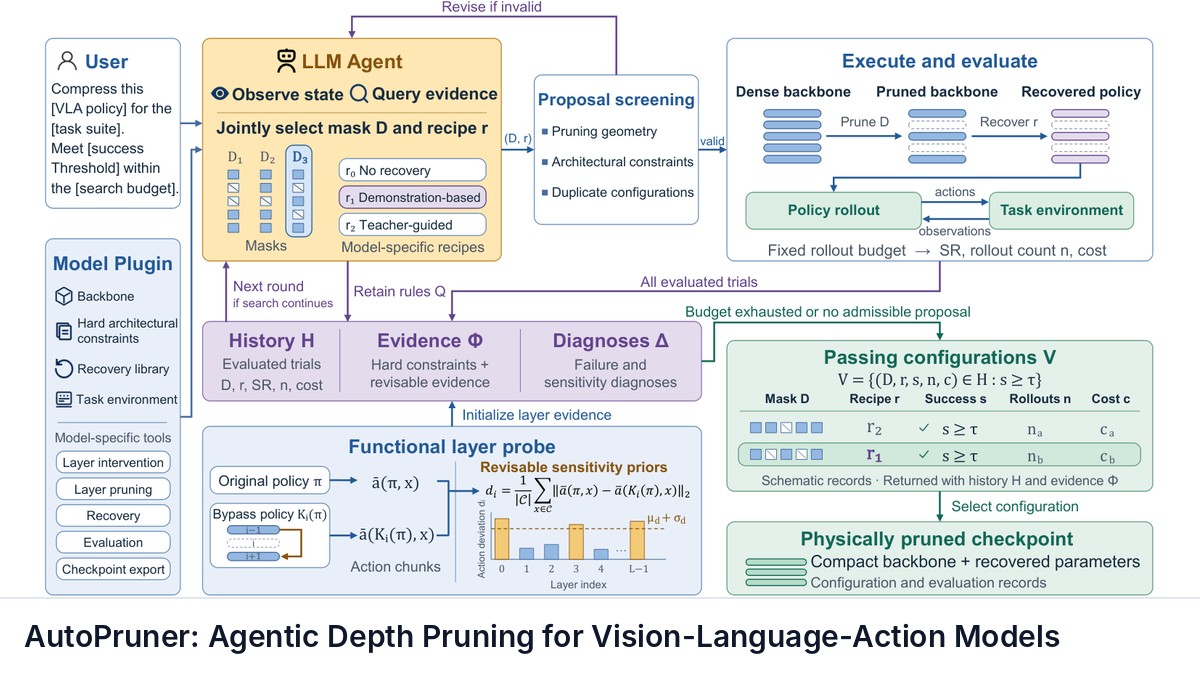
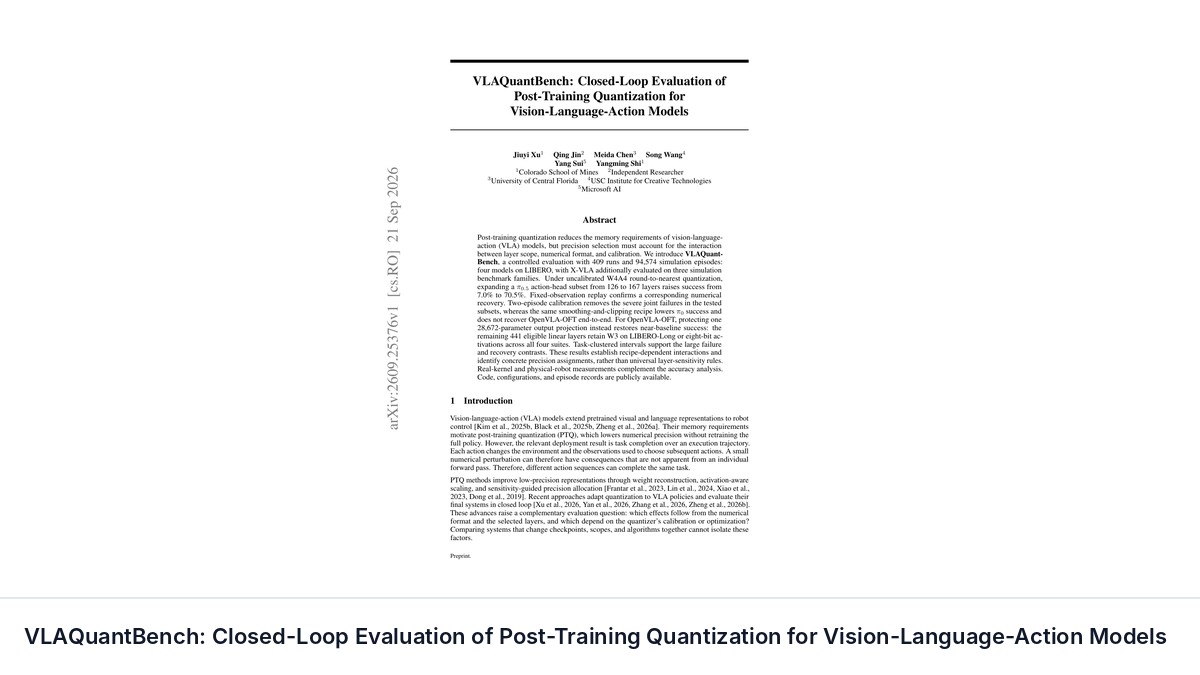
AutoPruner: Agentic Depth Pruning for Vision-Language-Action Models
arXiv preprint

AutoPruner: Agentic Depth Pruning for Vision-Language-Action Models

Tao Lin, Yikeng Chen, Qiwei Liang et al.

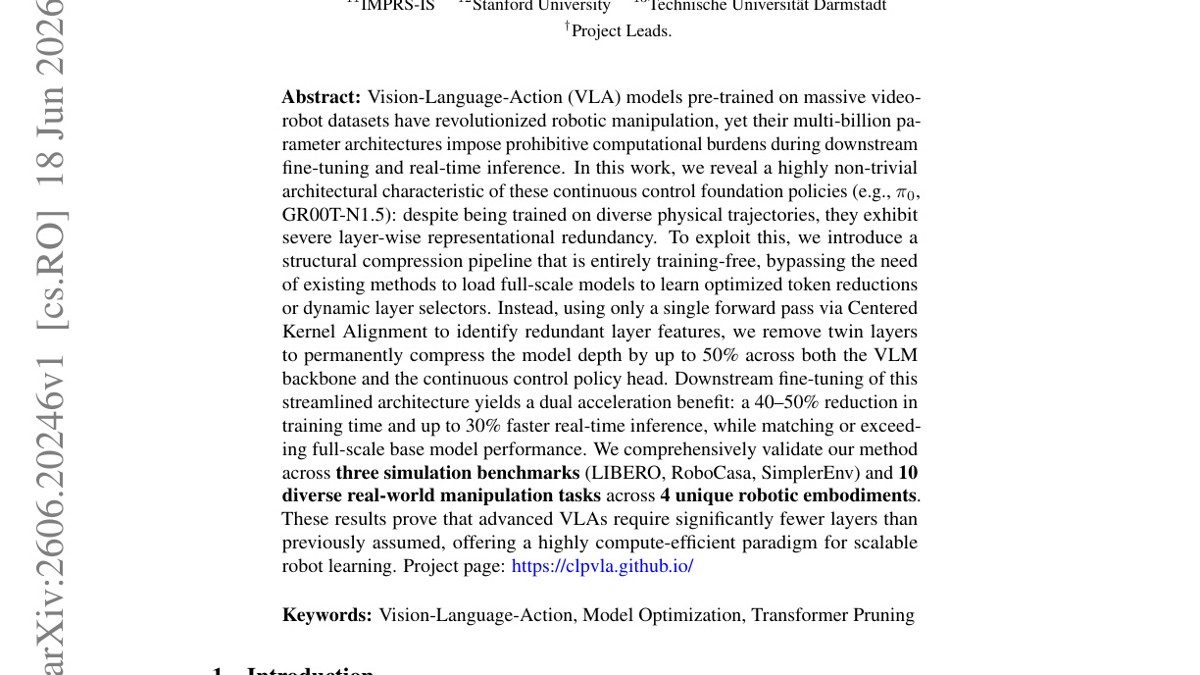
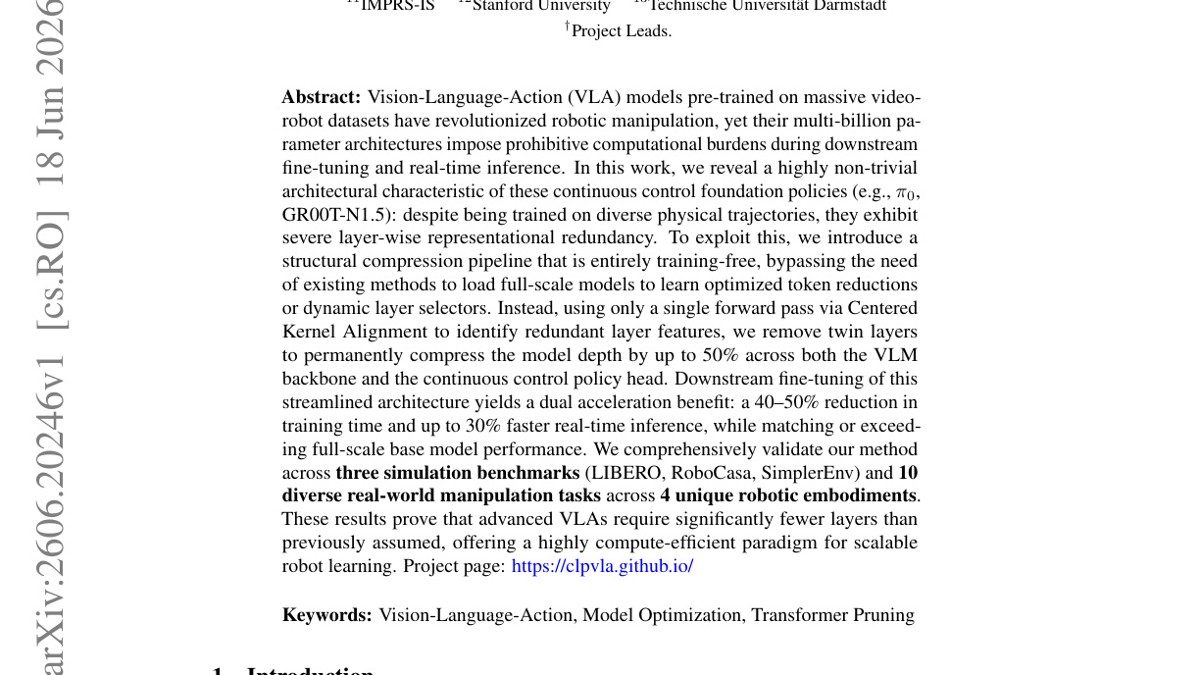
Layer pruning reduces the size and inference cost of vision-language-action (VLA) models, but selecting a deployable configuration requires deciding both which layers to remove and how to recover task performance.

vision vla benchmark
PDF Intermediate
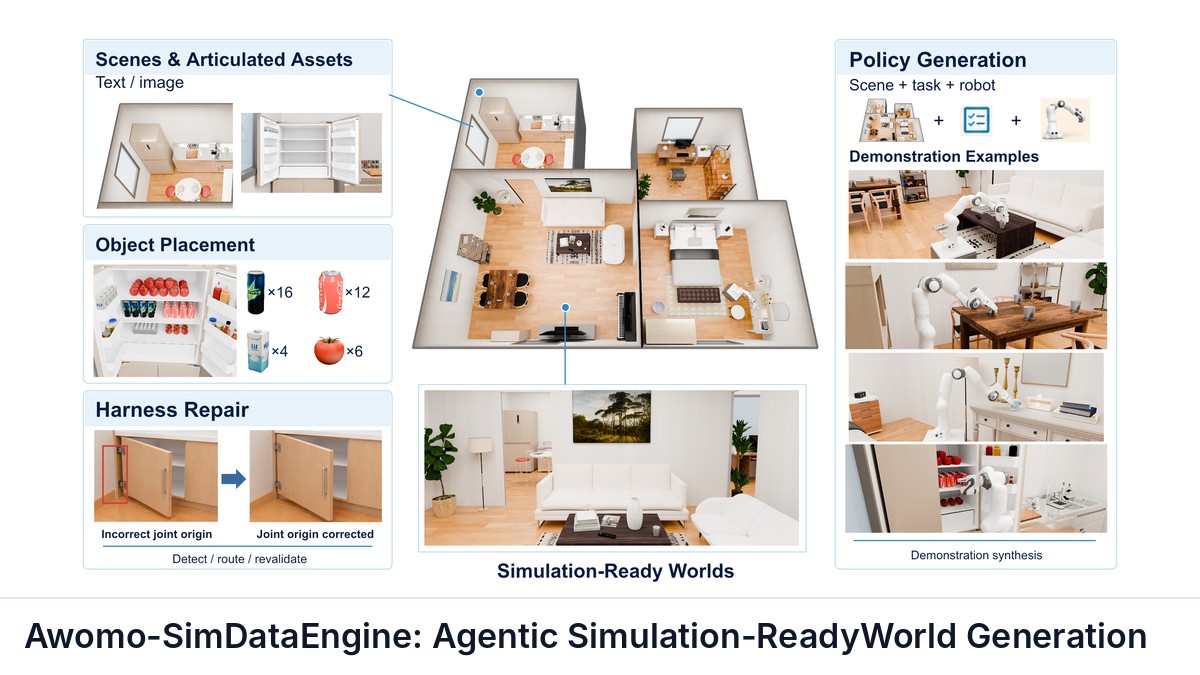
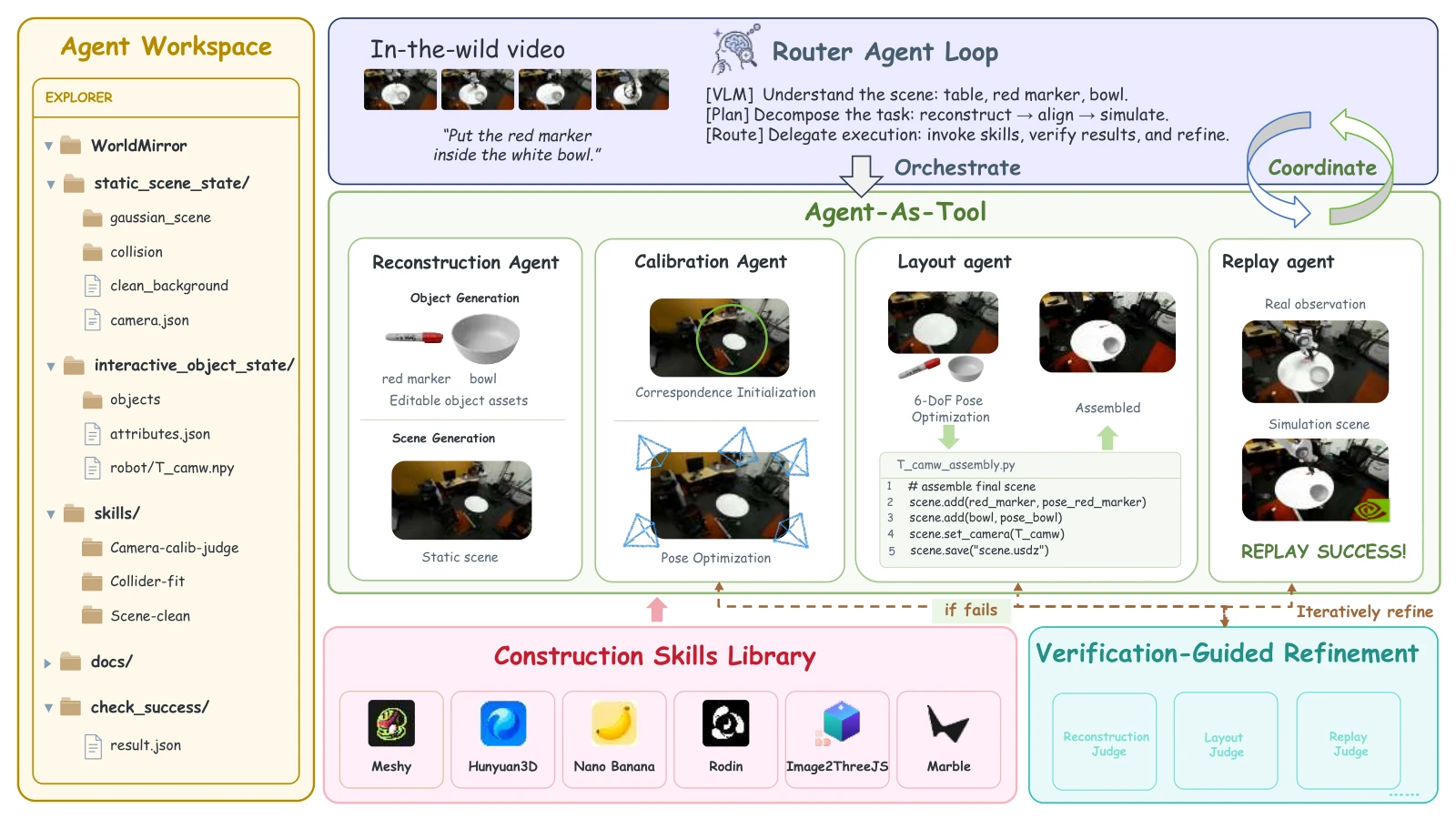
Awomo-SimDataEngine: Agentic Simulation-ReadyWorld Generation
arXiv preprint

Awomo-SimDataEngine: Agentic Simulation-ReadyWorld Generation

PhysicalRSI Team, Danjiao Ma, Enhui Ma et al.

Generating useful robot-training data requires more than visually plausiblescenes: objects must support interaction, placements must remain physicallyvalid, and tasks must admit repeatable execution.

vision reinforcement-learning learning-from-demonstration benchmark
PDF Intermediate
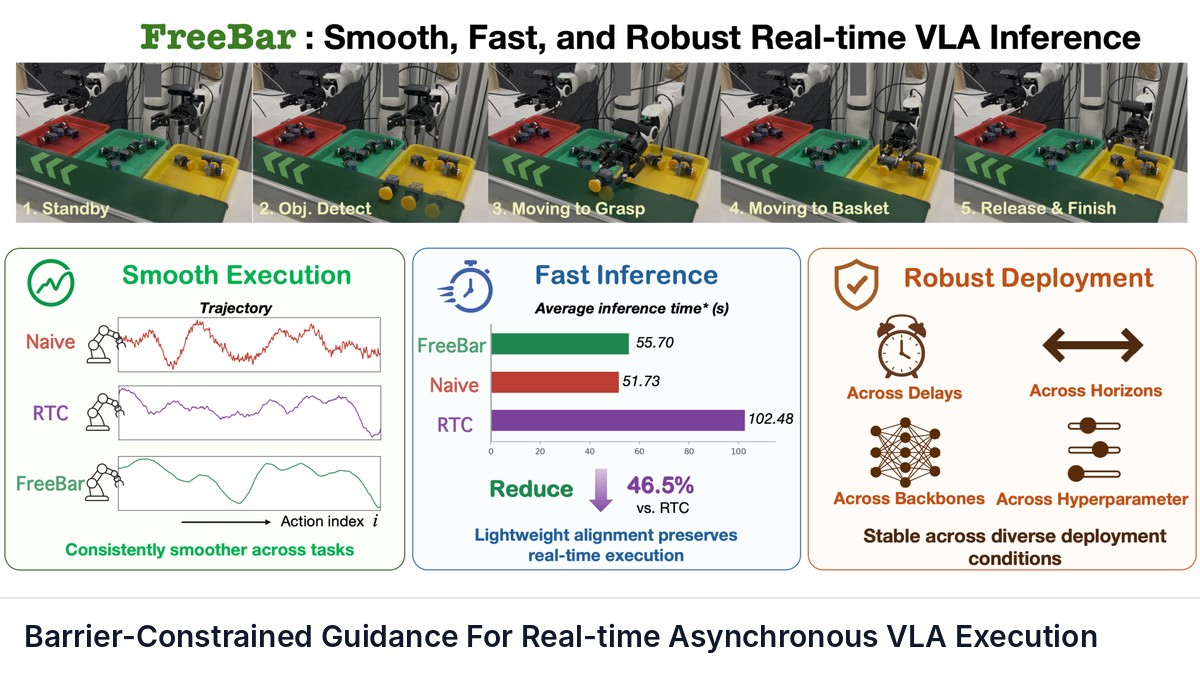
Barrier-Constrained Guidance For Real-time Asynchronous VLA Execution
arXiv preprint

Barrier-Constrained Guidance For Real-time Asynchronous VLA Execution

Wenbo Yu, Jifan Li, Wenke Xia et al.

While asynchronous execution enables VLA models to operate in real-time environments by predicting the next chunk during execution, it inevitably introduces boundary misalignment with the committed action stream.

vla reinforcement-learning control
Code PDF Intermediate
GitHub ★ —
Behavioral Cloning Mystery
arXiv preprint

Behavioral Cloning Mystery

Seohong Park, Sergey Levine

Behavioral cloning (BC), despite its simplicity, exhibits many counterintuitive phenomena in the real world. For example, the performance of BC often keeps increasing as the model overfits more to the dataset, and fully closed-loop policies often completely fail without action chunking.

manipulation reinforcement-learning control learning-from-demonstration benchmark
Code PDF Intermediate
GitHub ★ —
Beyond Reconstruction: What Matters in Action Tokenization for Robot Policies?
arXiv preprint

Beyond Reconstruction: What Matters in Action Tokenization for Robot Policies?

Haoran Chen, Jingtian Ji, Samuel Wheeler et al.

Autoregressive action-token policies such as vision-language-action models require action tokenizers to translate discrete token sequences into precise control actions in continuous space. Many action tokenizers learn the mapping between tokens and actions via a reconstruction objective.

manipulation vision vla reinforcement-learning control benchmark
PDF Intermediate
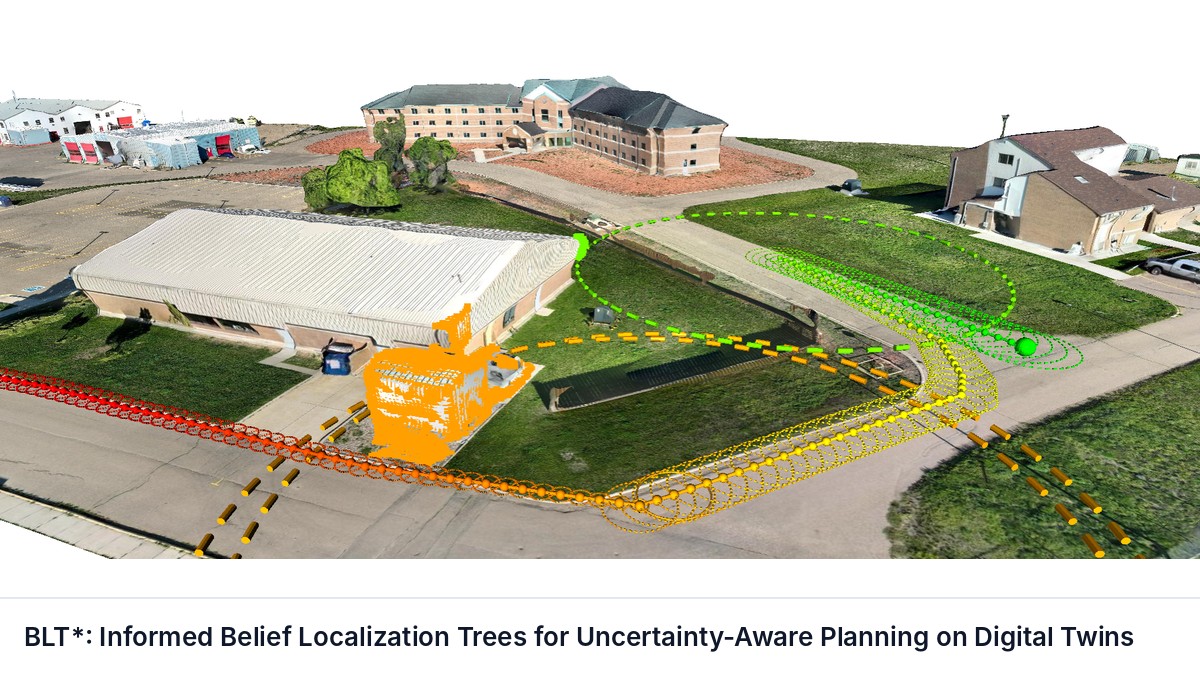
BLT*: Informed Belief Localization Trees for Uncertainty-Aware Planning on Digital Twins
arXiv preprint

BLT*: Informed Belief Localization Trees for Uncertainty-Aware Planning on Digital Twins

Elliot Preston-Krebs, Abhishek Goudar, Timothy D. Barfoot

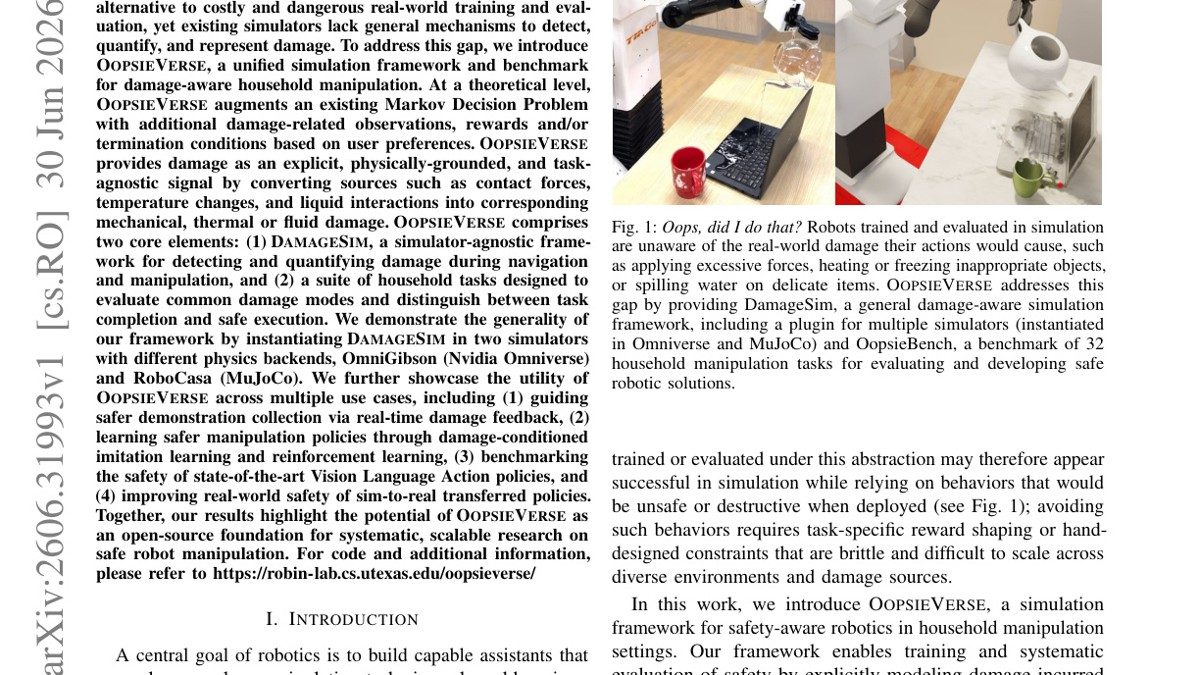
We present Informed Belief Localization Trees* (Informed BLT*), a sampling-based belief space planning (BSP) algorithm that scales to large outdoor digital twins with point-cloud observations. We adapt RRT* and Informed RRT* to belief space using the $2$-Wasserstein ($W_2$) metric.

reinforcement-learning planning
PDF Intermediate
BRACE: Adapting Whole-Body References for Force and Terrain Aware Humanoid Motion Tracking
arXiv preprint

BRACE: Adapting Whole-Body References for Force and Terrain Aware Humanoid Motion Tracking

Sudarshan Harithas, Chen Yu, Juan Borbon et al.

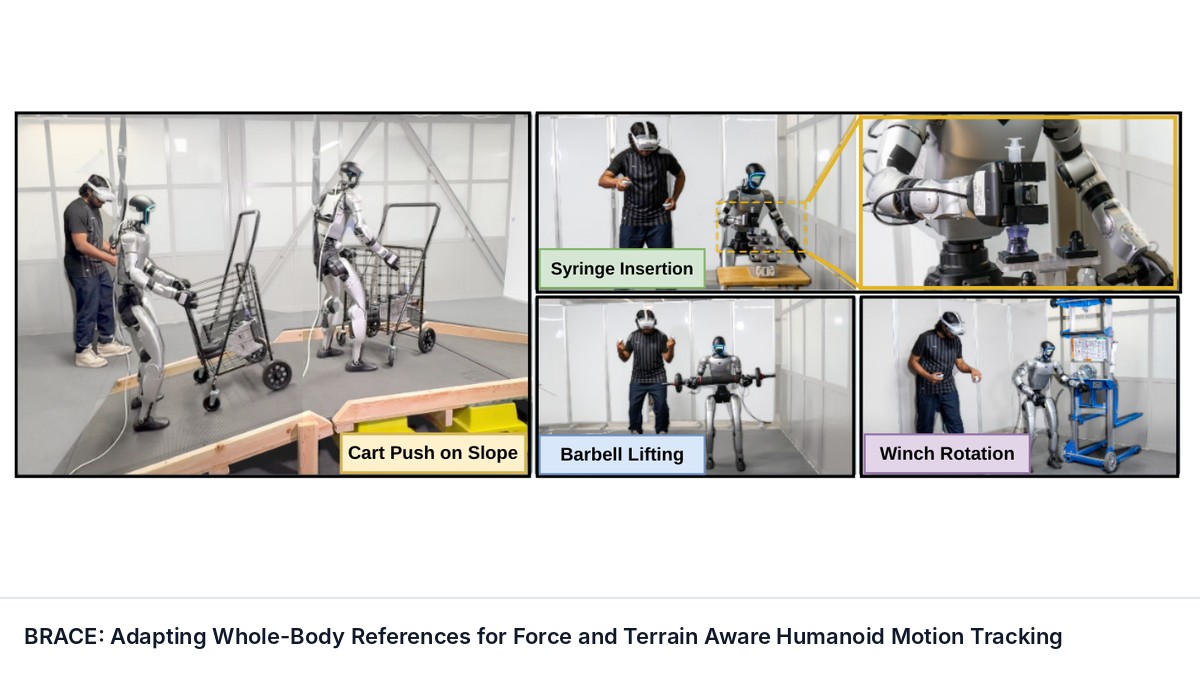
Whole-body tracking has become the interface through which operators drive humanoid robots, yet the references it consumes are recorded on level ground and carrying nothing, so the tracker is aware of neither the forces the robot must exchange with objects nor the terrain it must stand on.

control
Code PDF Intermediate
GitHub ★ —
Building Trustworthy Household Robots through Open-World Safety
arXiv preprint

Building Trustworthy Household Robots through Open-World Safety

Yu-Lin Tsai, Muxi Lyu, Roei Herzig et al.

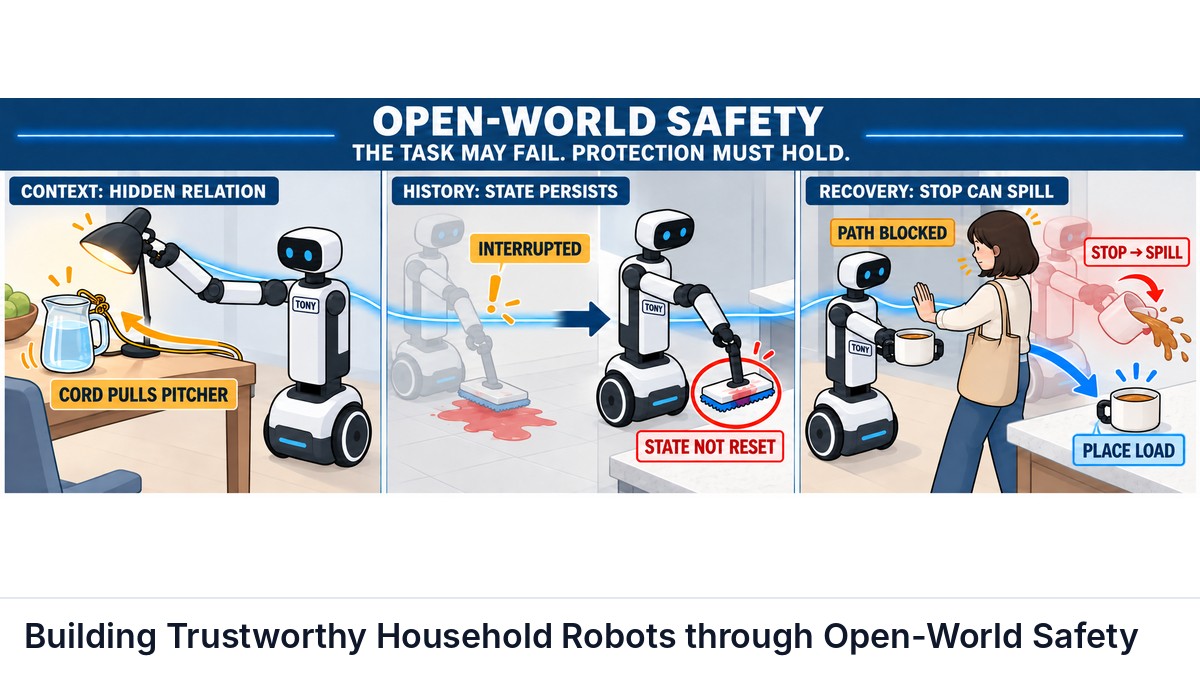
Foundation models are expanding robot capabilities, enabling robots to handle more diverse objects, follow sophisticated instructions, and operate in complex environments. These advances bring us to a future in which robots become part of everyday household life.

reinforcement-learning
Code PDF Advanced
GitHub ★ —
CFG-Policy: Unified Diffusion Policy Learning Framework via Classifier-free Guidance
arXiv preprint

CFG-Policy: Unified Diffusion Policy Learning Framework via Classifier-free Guidance

Shutong Ding, Zhaoyang Liu, Yimiao Zhou et al.

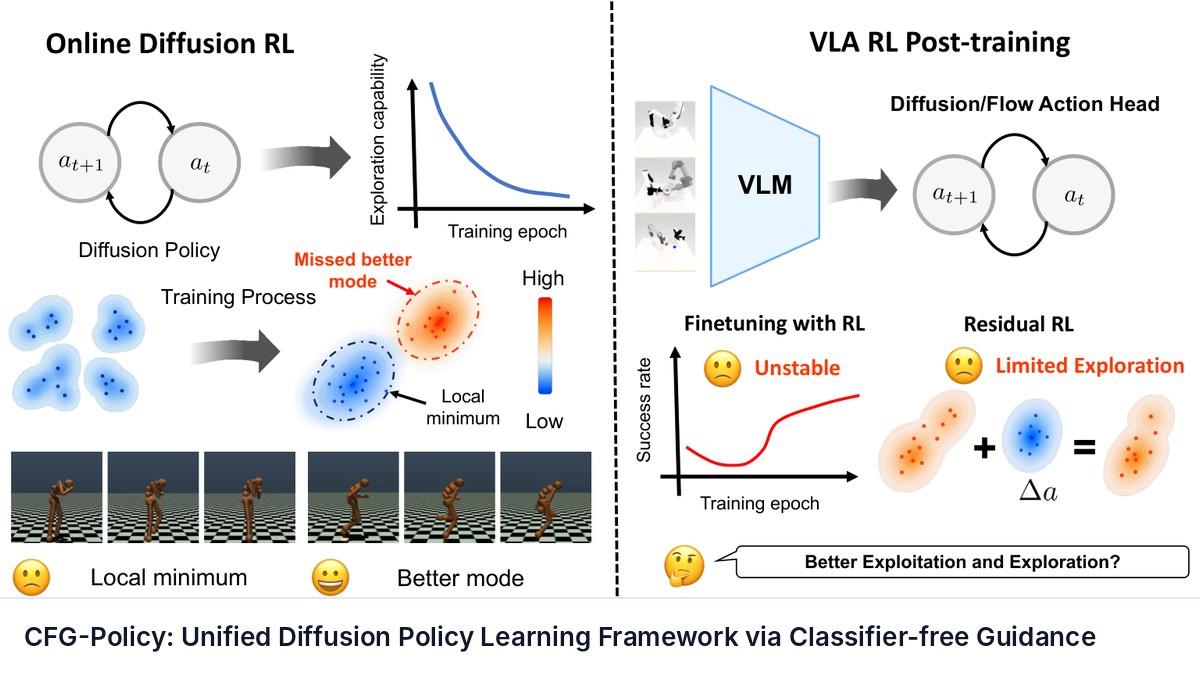
Diffusion policies are increasingly used in robotic control and manipulation, vision-language-action models, and world-model-based agents. Their ability to represent multimodal action distributions offers rich opportunities for exploration in reinforcement learning (RL).

manipulation vision vla reinforcement-learning control
Code PDF Advanced
GitHub ★ —
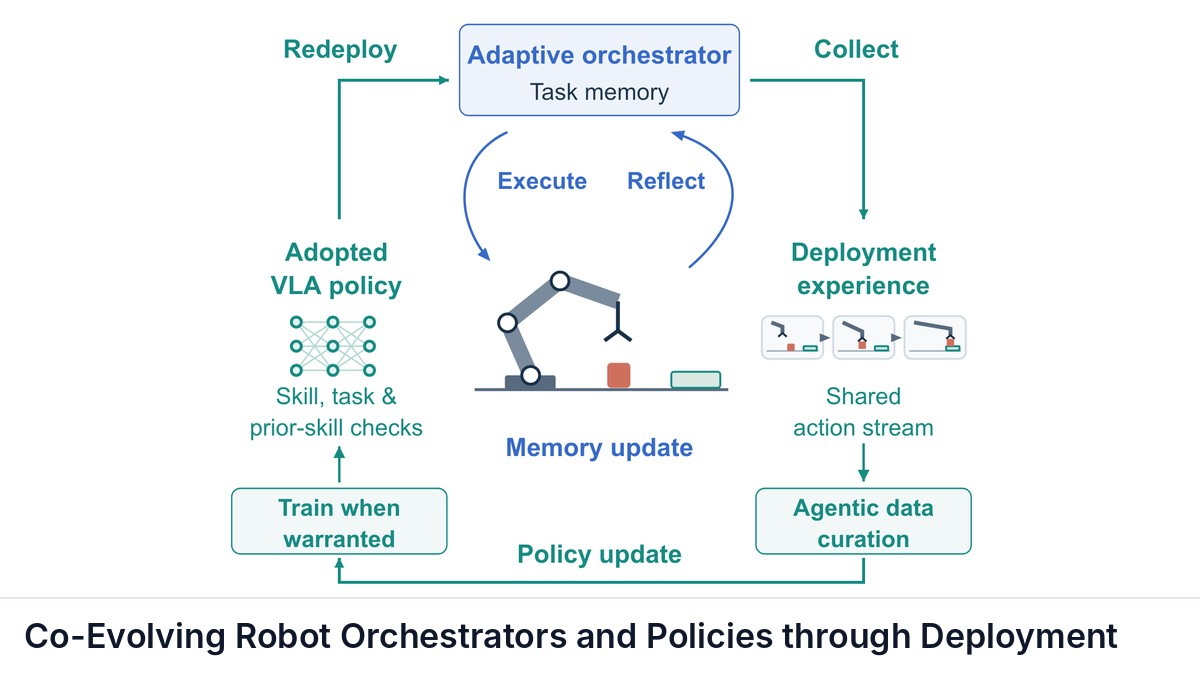
Co-Evolving Robot Orchestrators and Policies through Deployment
arXiv preprint

Co-Evolving Robot Orchestrators and Policies through Deployment

Xilun Zhang, Maggie Wang, Erik Bauer et al.

Vision-language-action (VLA) policies trained on large datasets are capable within their training domains, yet they still fail to generalize to the variety of situations a robot meets in real-world deployment.

vision vla reinforcement-learning learning-from-demonstration benchmark
PDF Intermediate
CoDA: Co-Evolution of Data Engines and Action Policies
arXiv preprint

CoDA: Co-Evolution of Data Engines and Action Policies

Tianjiao Yu, Zhilin Ou, Yifan Shen et al.

Generative simulation can automate robot environment construction, but physically valid environments are not necessarily useful for training. The challenge is to identify environments that address a policy's failures and supervision that helps it overcome them.

manipulation vision reinforcement-learning
PDF Intermediate
Context-Aware RGB-Thermal-Radar Obstacle Perception for Resource-Constrained ASVs
arXiv preprint

Context-Aware RGB-Thermal-Radar Obstacle Perception for Resource-Constrained ASVs

Pranav Kedia, Edwin Redhead, Heiko Hamann

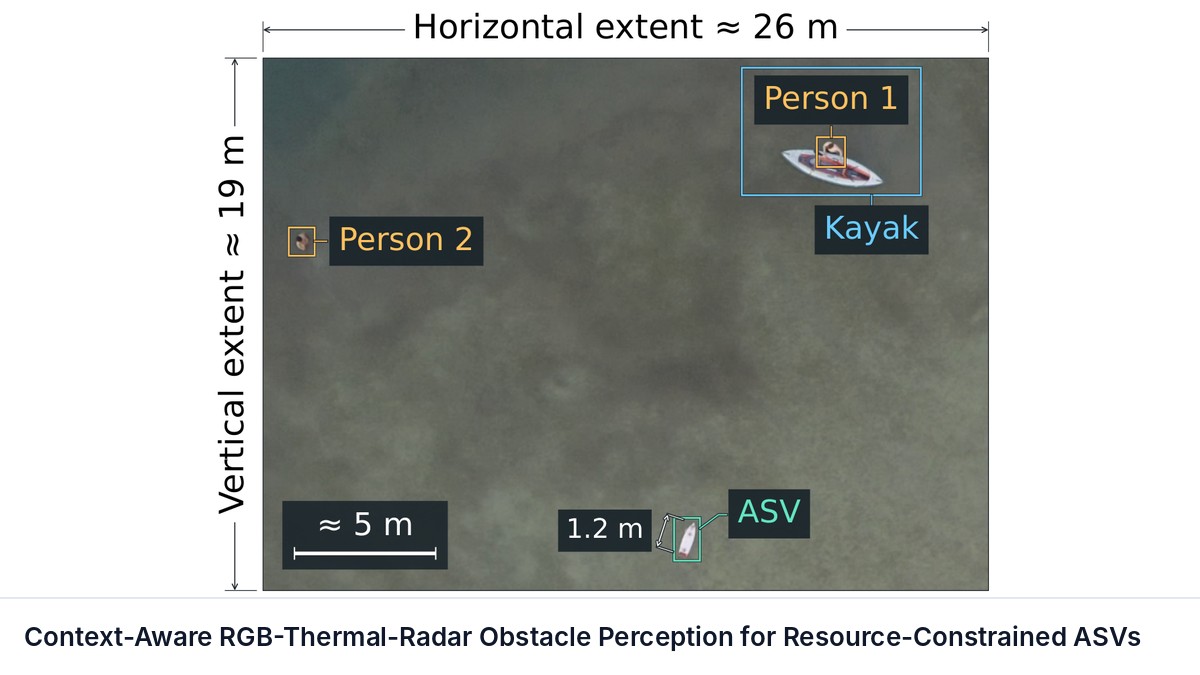
Reliable obstacle perception is challenging for small autonomous surface vessels (ASVs): reflections and glare confound visible-light cameras, vessel motion shifts the apparent waterline, and darkness removes the dominant sensing modality altogether.

vision reinforcement-learning planning control
PDF Intermediate
Continual Humanoid Motion Learning
arXiv preprint

Continual Humanoid Motion Learning

Zhewen He, Hao Huang, Geeta Chandra Raju Bethala et al.

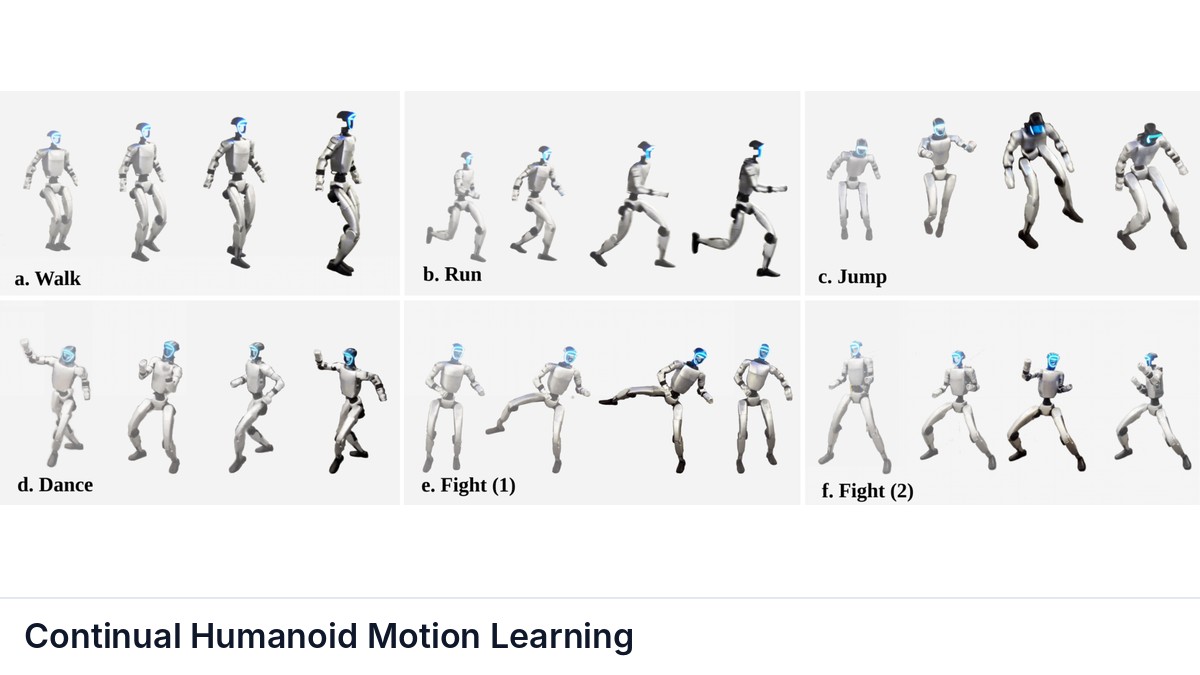
Humanoid whole-body controllers can now track a diverse set of dynamic motions, but they are typically trained offline and then frozen, so teaching such a controller a new skill tends to erode the skills it already mastered.

reinforcement-learning control
PDF Intermediate
Control-Ready Uncertainty for Trajectory Diffusion
arXiv preprint

Control-Ready Uncertainty for Trajectory Diffusion

Zhiwei Xue, Jia Yue Kam, Jinhang Qiu et al.

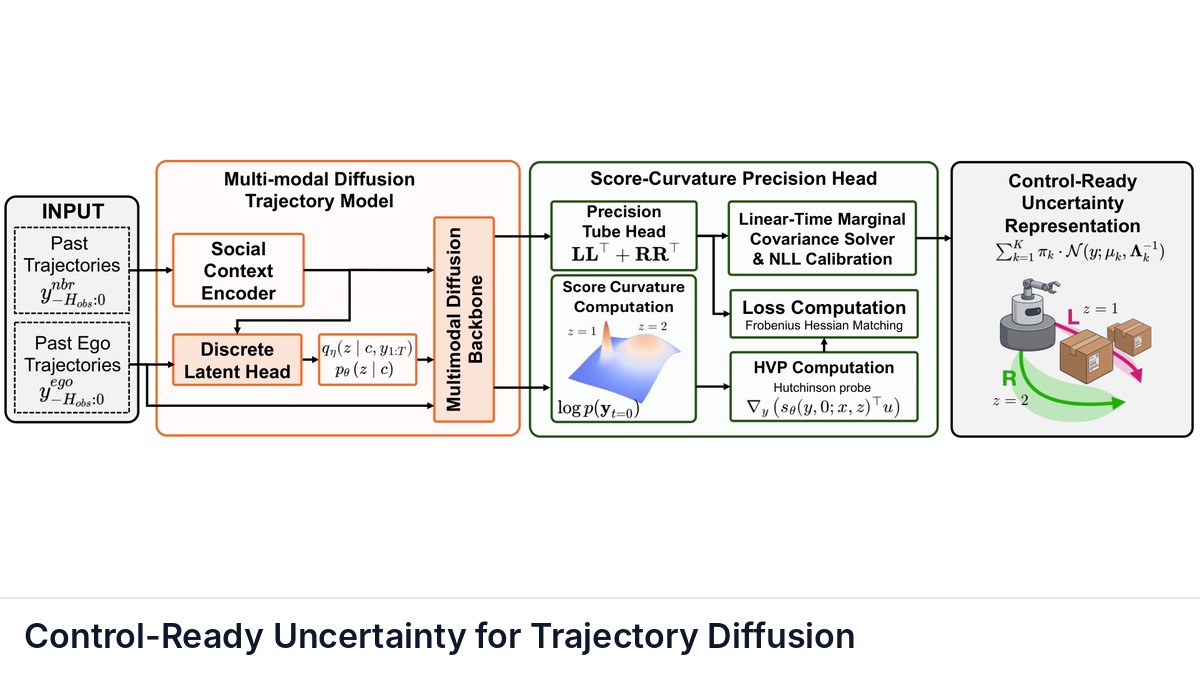
Diffusion models can represent complex, multimodal trajectory distributions, but extracting uncertainty from them typically requires costly Monte Carlo sampling. This limits their use in real-time control, where robots must rapidly assess risk and maintain safety margins.

manipulation reinforcement-learning planning control
PDF Advanced
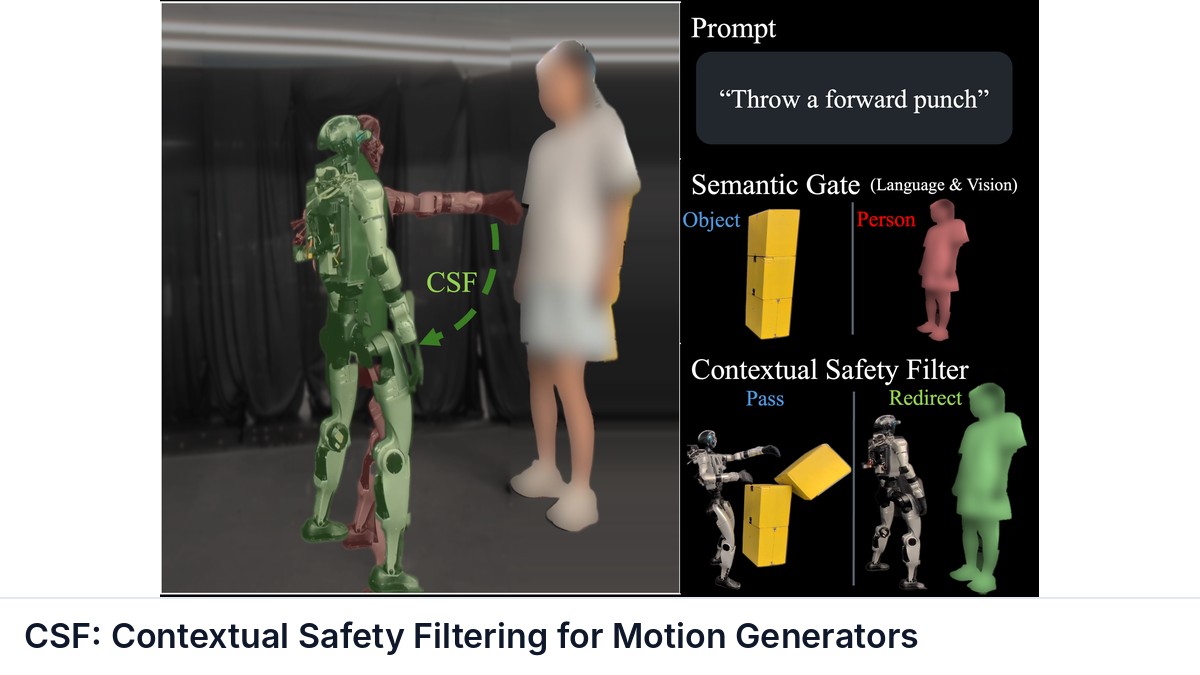
CSF: Contextual Safety Filtering for Motion Generators
arXiv preprint

CSF: Contextual Safety Filtering for Motion Generators

Lizhi Yang, Yiling Hou, Yao Tang et al.

Text-conditioned motion generators produce trackable whole-body motion, but they have no notion of scene-dependent safety: the same action may target an object or a person.

reinforcement-learning
PDF Intermediate
DexPort: A Hand-Held Skill Interface for Dexterous Hand Data Collection
arXiv preprint

DexPort: A Hand-Held Skill Interface for Dexterous Hand Data Collection

Amber Xie, Jiawei Fu, Xiaofeng Guo et al.

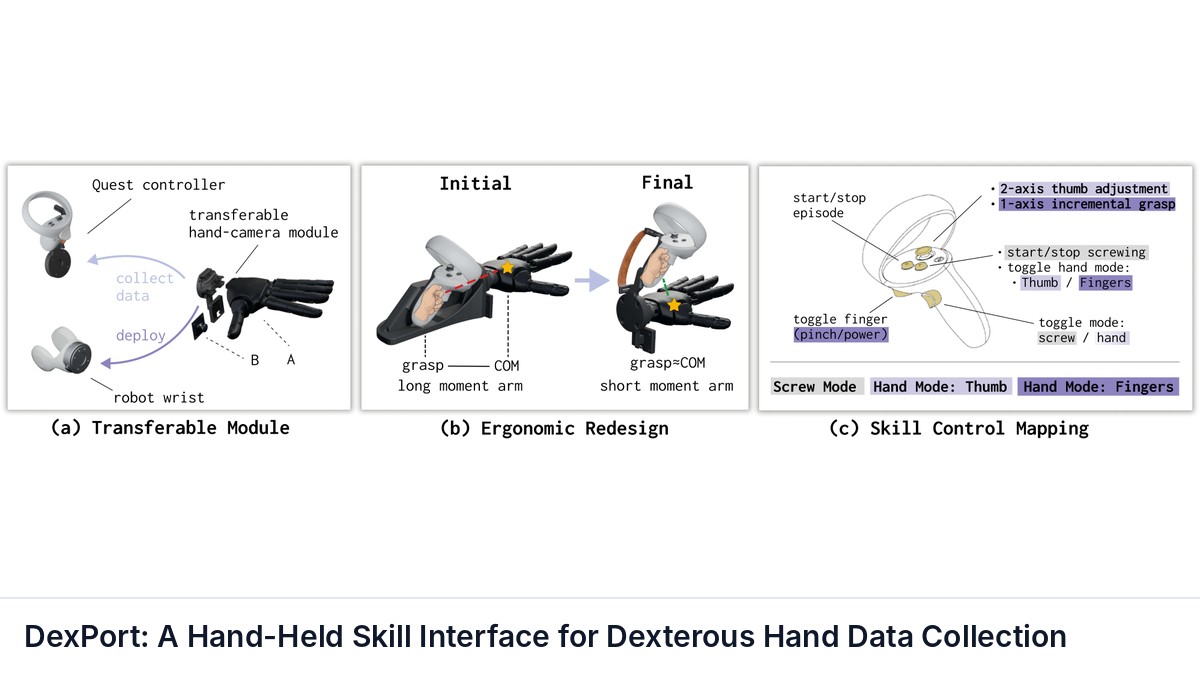
Collecting high-quality demonstrations remains a central bottleneck for learning dexterous manipulation. Teleoperation records executable robot actions, but it requires a complete robot setup and places the burden of coordinating many finger joints on the operator.

manipulation reinforcement-learning control learning-from-demonstration
PDF Intermediate
Dexterity from Supervised Play
arXiv preprint

Dexterity from Supervised Play

Botao He, Yiming Dou, Yiannis Aloimonos et al.

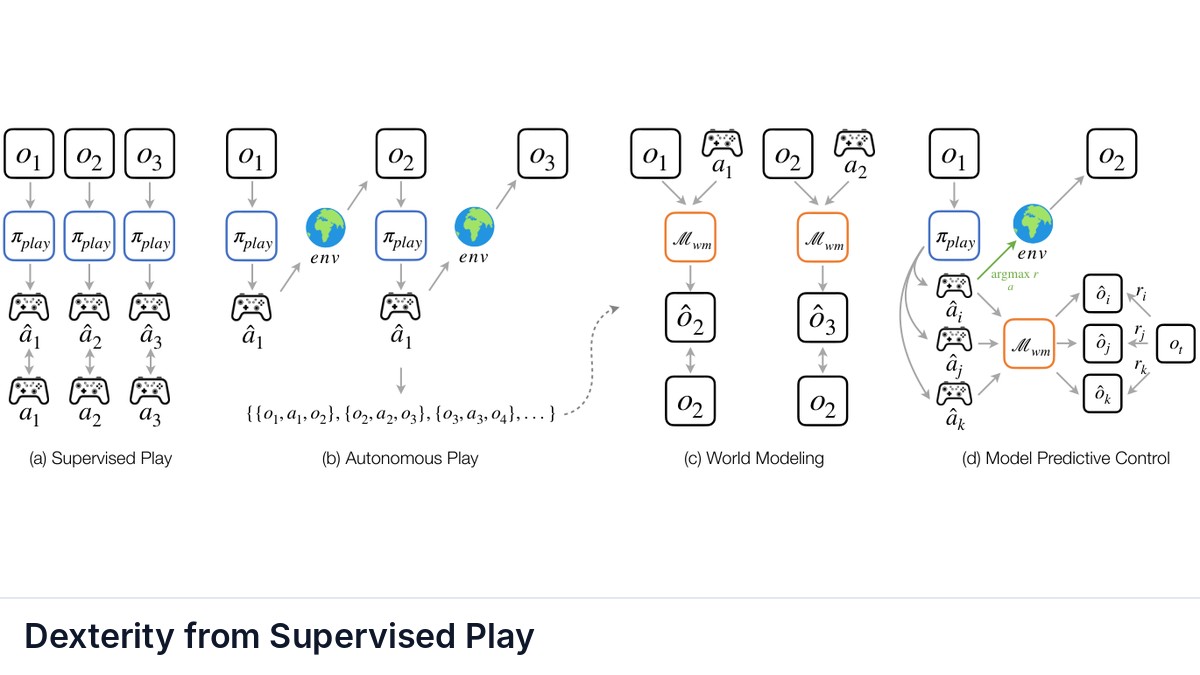
How can robots autonomously collect the contact-rich experience needed to learn dexterous manipulation?

manipulation reinforcement-learning sim-to-real planning control learning-from-demonstration benchmark
Code PDF Intermediate
GitHub ★ —
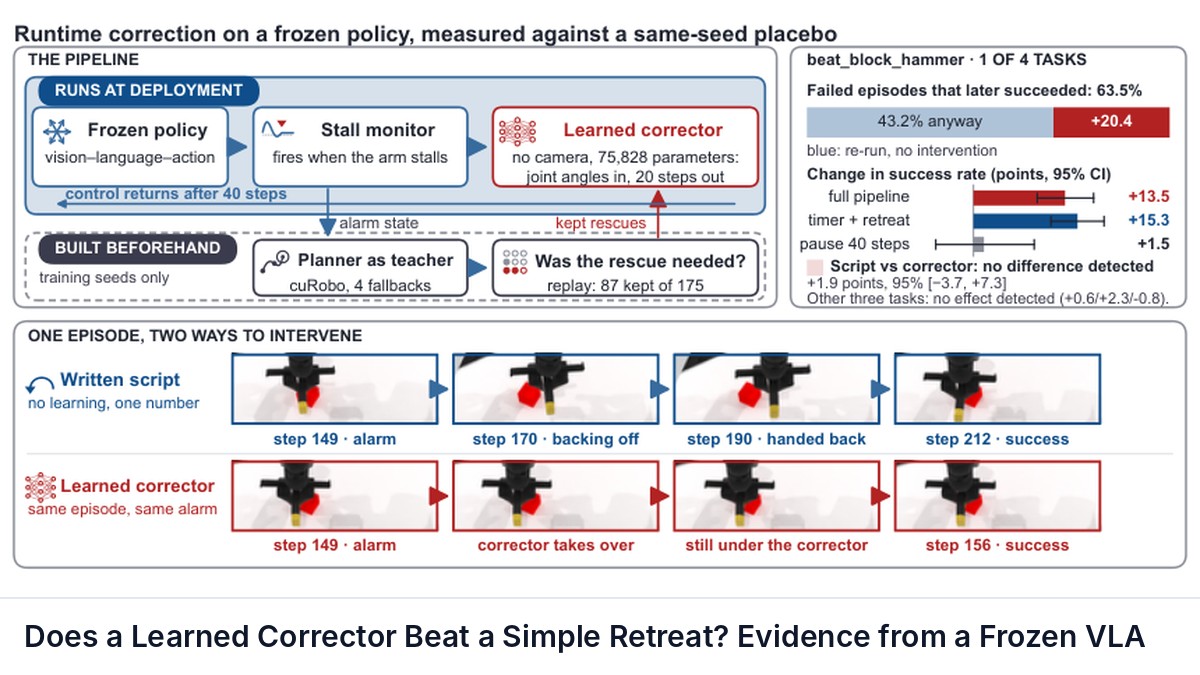
Does a Learned Corrector Beat a Simple Retreat? Evidence from a Frozen VLA
arXiv preprint

Does a Learned Corrector Beat a Simple Retreat? Evidence from a Frozen VLA

Chenchao Sheng, Zhuang Jiang, Liuhaichen Yang et al.

Before deploying runtime recovery for a frozen vision-language-action (VLA) policy, one must establish that an intervention improves success beyond ordinary run-to-run variation and that its complexity adds value over a simple action.

vision vla reinforcement-learning control benchmark
PDF Intermediate
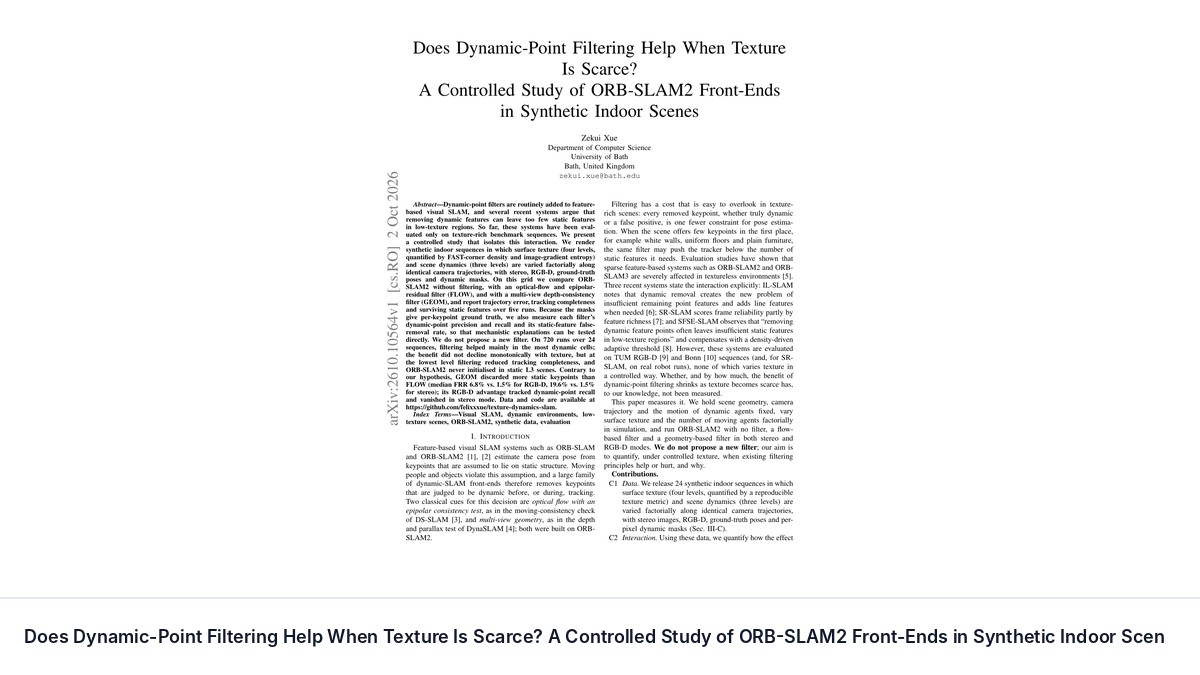
Does Dynamic-Point Filtering Help When Texture Is Scarce? A Controlled Study of ORB-SLAM2 Front-Ends in Synthetic Indoor Scenes
arXiv preprint

Does Dynamic-Point Filtering Help When Texture Is Scarce? A Controlled Study of ORB-SLAM2 Front-Ends in Synthetic Indoor Scenes

Zekui Xue

Dynamic-point filters are routinely added to feature-based visual SLAM, and several recent systems argue that removing dynamic features can leave too few static features in low-texture regions. So far, these systems have been evaluated only on texture-rich benchmark sequences.

vision planning control benchmark
Code PDF Intermediate
GitHub ★ —
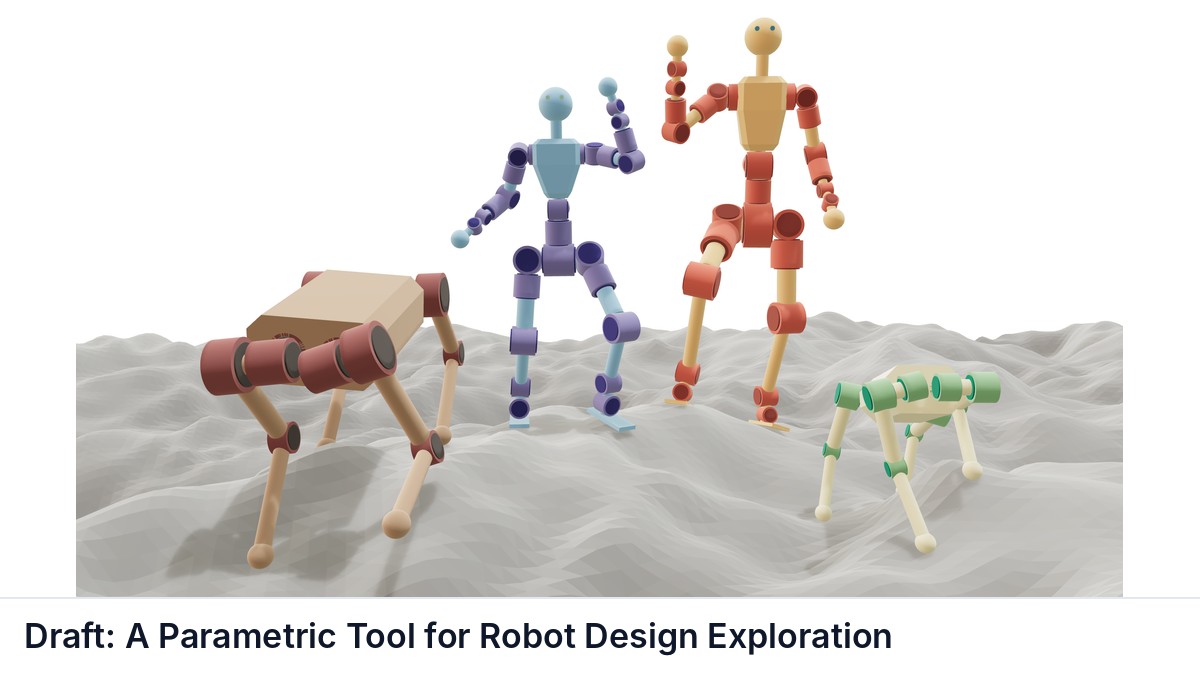
Draft: A Parametric Tool for Robot Design Exploration
arXiv preprint

Draft: A Parametric Tool for Robot Design Exploration

David Nguyen, Marcelo Coelho, Sangbae Kim

Robot performance is often limited by the cost of iterating on morphology and control together, since every computer-aided design (CAD) change has to be carried into a simulation-ready model before control work begins.

locomotion reinforcement-learning control
PDF Beginner
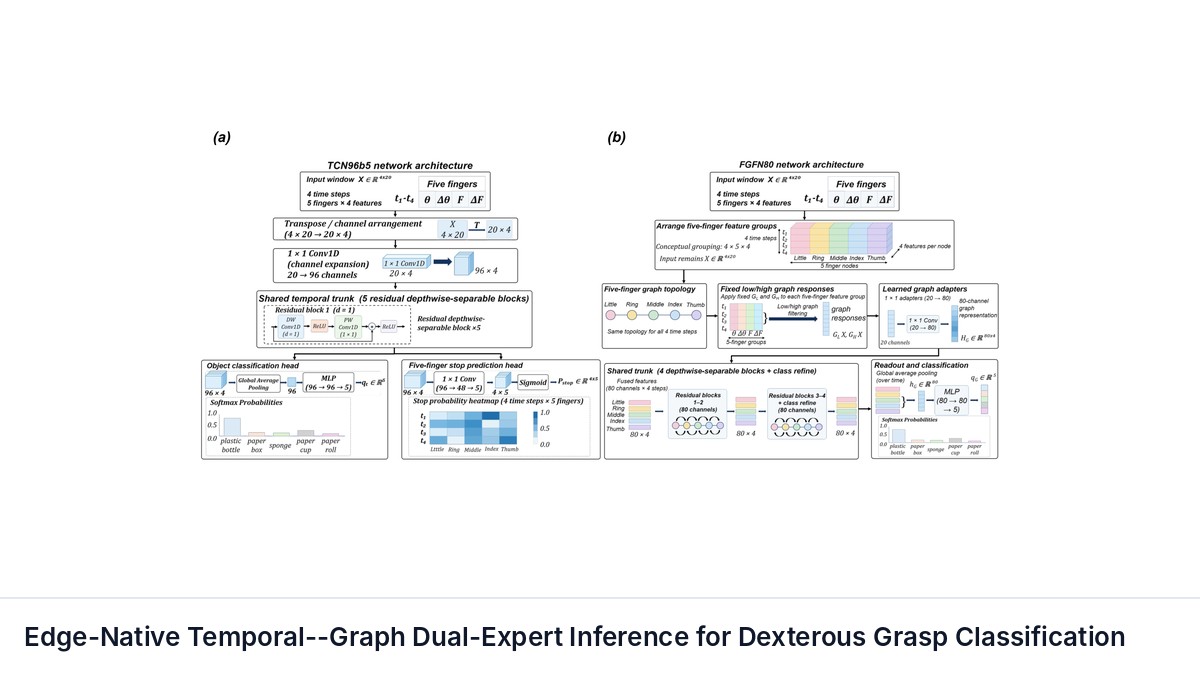
Edge-Native Temporal--Graph Dual-Expert Inference for Dexterous Grasp Classification
arXiv preprint

Edge-Native Temporal--Graph Dual-Expert Inference for Dexterous Grasp Classification

Jiajian Zheng, Bin Zhang, Wen Fan et al.

Multi-finger hands contact objects at different times, so a global close command can overload early-contact fingers while others are still moving. Dense tactile arrays address this problem but add hardware, calibration, bandwidth, and computation.

manipulation reinforcement-learning tactile benchmark
PDF Intermediate
Fast Planning for Multi-object Multi-target Throwing
arXiv preprint

Fast Planning for Multi-object Multi-target Throwing

Zhengming Zhu, Yang Liu, Xiao Gao et al.

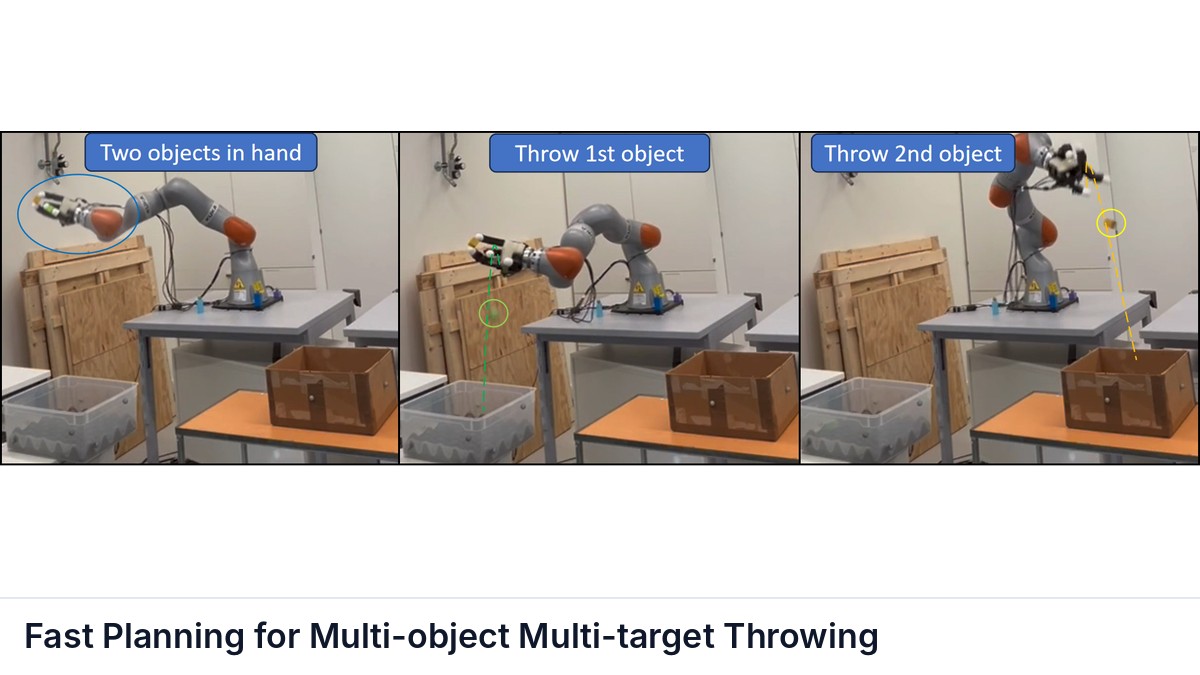
Robot throwing has emerged as a promising technique for improving efficiency in logistics and warehouse automation, by enlarging the workspace and speeding up the process. To significantly increase the throwing system's throughput, we develop strategies for throwing multiple objects in one swipe.

manipulation reinforcement-learning planning
Code PDF Intermediate
GitHub ★ —
FERPO: Forward Entropy-Regularized Policy Optimization
arXiv preprint

FERPO: Forward Entropy-Regularized Policy Optimization

Sebastian Sanokowski, Alireza Sarmadi, Majid Khadiv

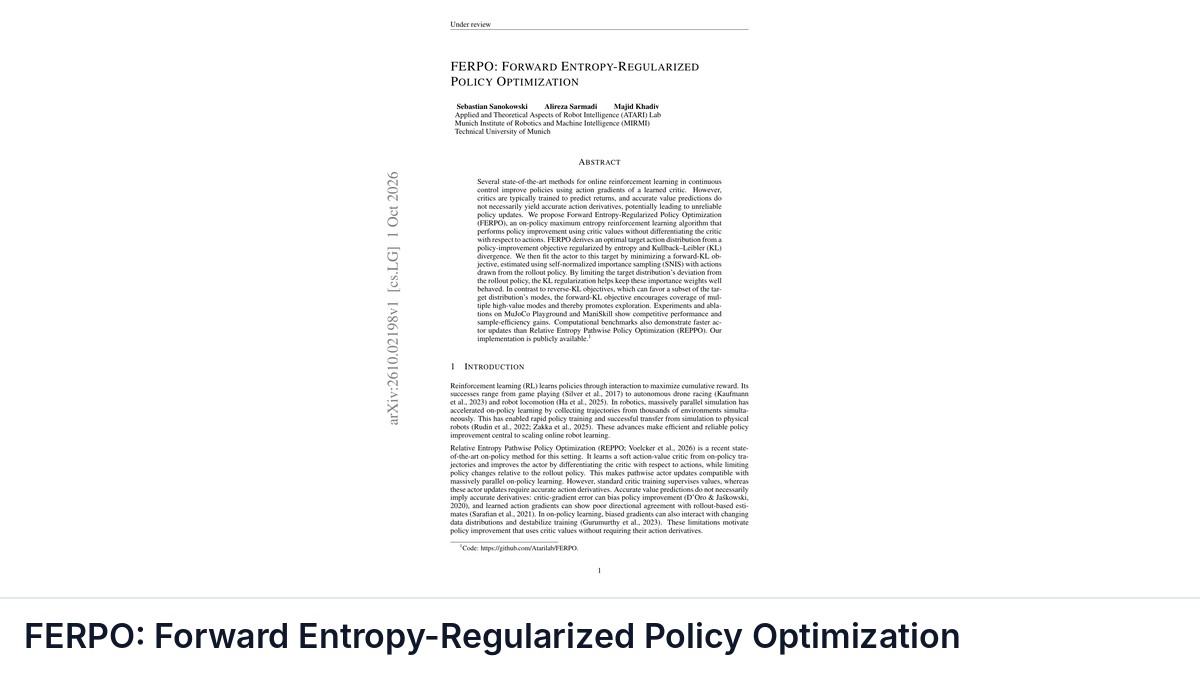
Several state-of-the-art methods for online reinforcement learning in continuous control improve policies using action gradients of a learned critic.

reinforcement-learning control benchmark
Code PDF Intermediate
GitHub ★ —
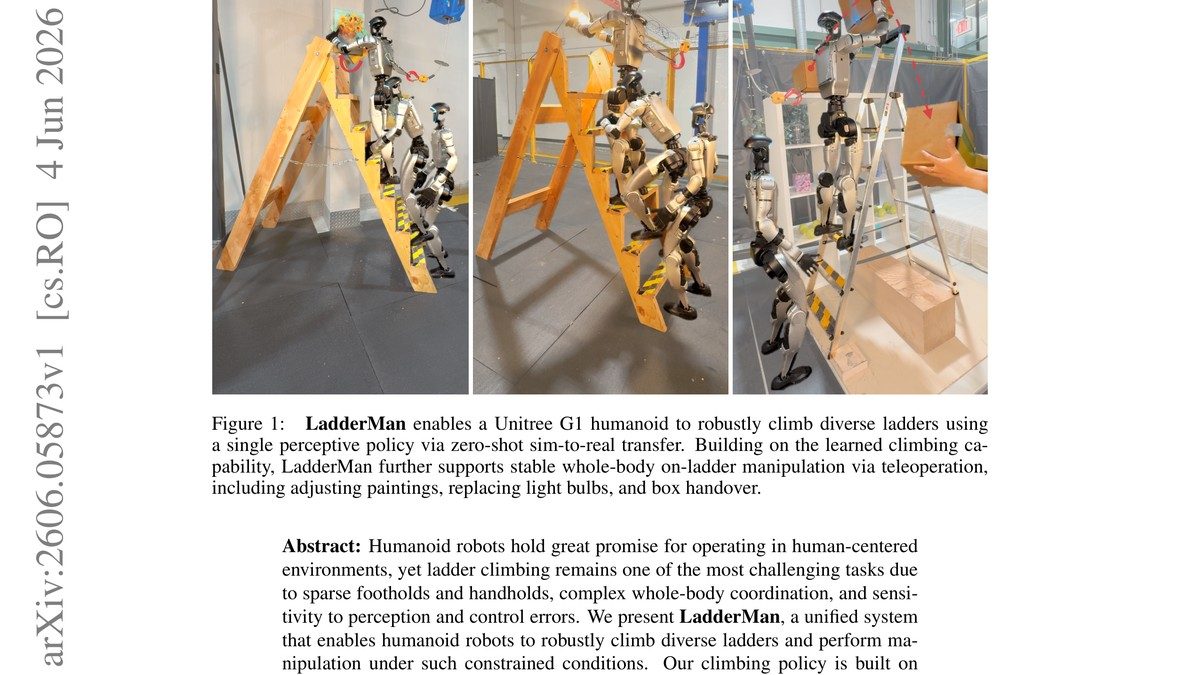
Fiatlux: A Long-Horizon Benchmark for Humanoid Ladder Climbing and Light-Bulb Replacement
arXiv preprint

Fiatlux: A Long-Horizon Benchmark for Humanoid Ladder Climbing and Light-Bulb Replacement

Pavel Bushuyeu, Yujin Chen, Anton Nikolaev et al.

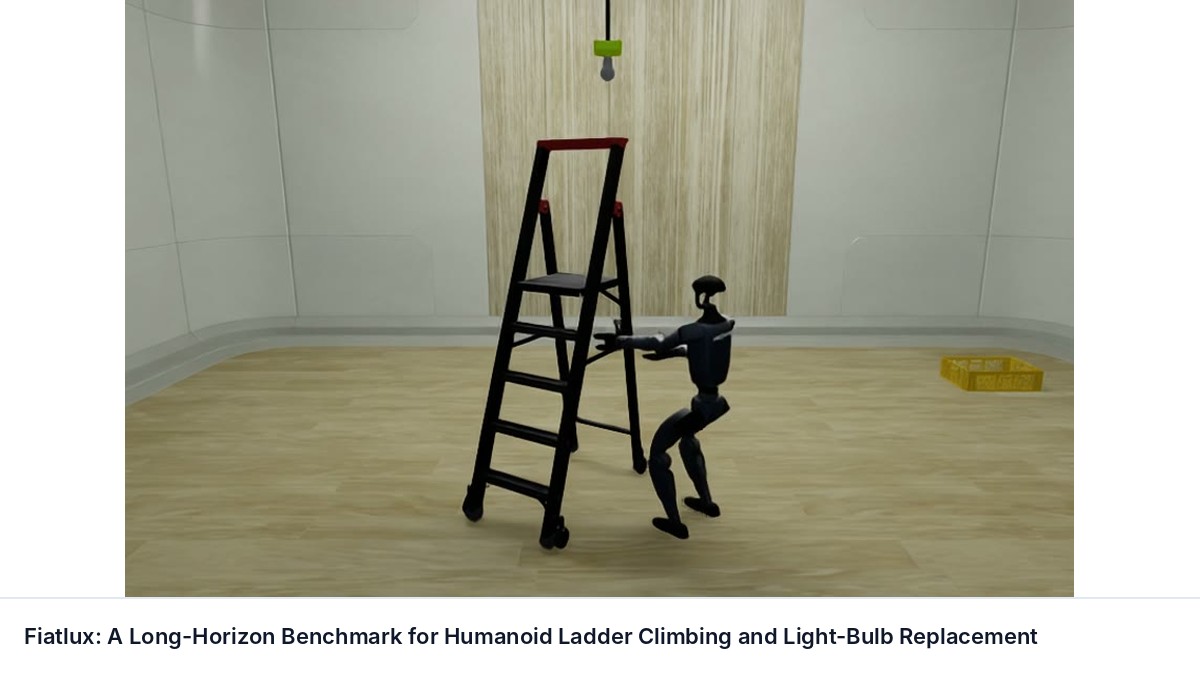
Existing benchmarks evaluate tabletop manipulation, flat-floor household activity, or humanoid locomotion and manipulation as separate task groups; none scores vertical mobility and dexterous work on a fragile payload in one long-horizon episode.

manipulation locomotion vision vla reinforcement-learning control benchmark
PDF Intermediate
FlashNeRD: Performance-First Contact-Rich Neural Robot Dynamics
arXiv preprint

FlashNeRD: Performance-First Contact-Rich Neural Robot Dynamics

Mohammadmehdi Ataei, Mohammad Amin Nabian, Jie Xu et al.

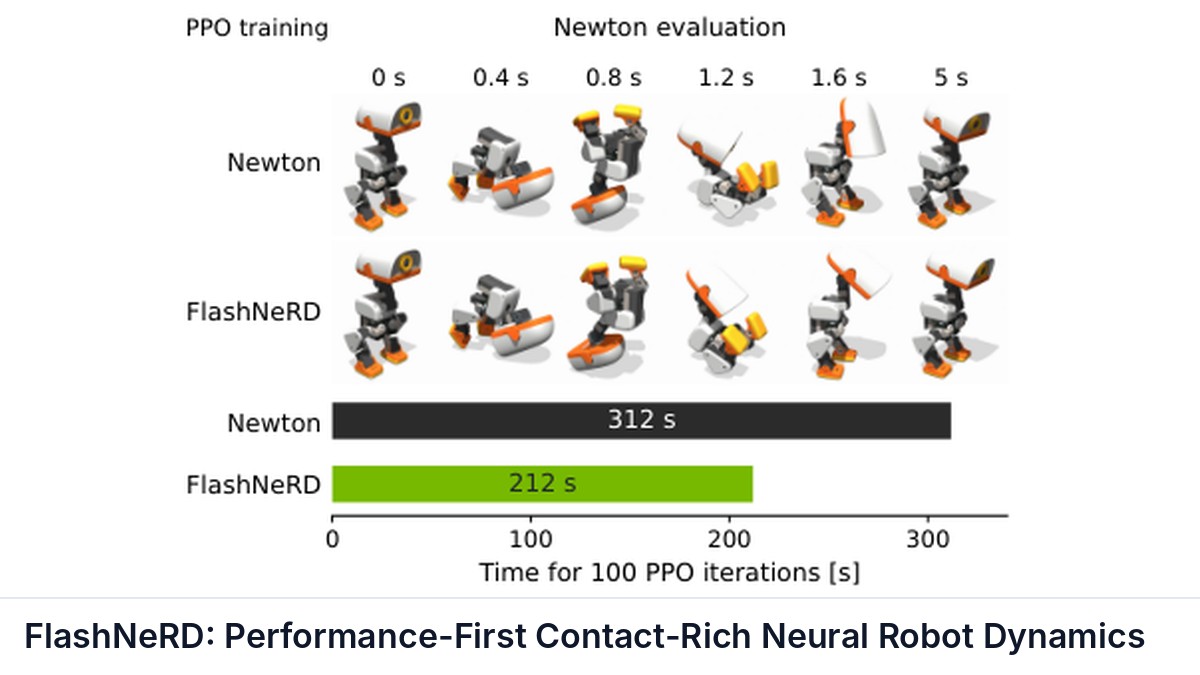
Compared with analytical physics, learned dynamics models promise robot simulation that is faster, inherently differentiable, and easily adaptable to real data.

locomotion vision reinforcement-learning planning control
PDF Intermediate
FLORA: An Open Model Suite for Scaling Robotics Data Engines
arXiv preprint

FLORA: An Open Model Suite for Scaling Robotics Data Engines

Sicong Leng, Yunze Man, Zhiqi Li et al.

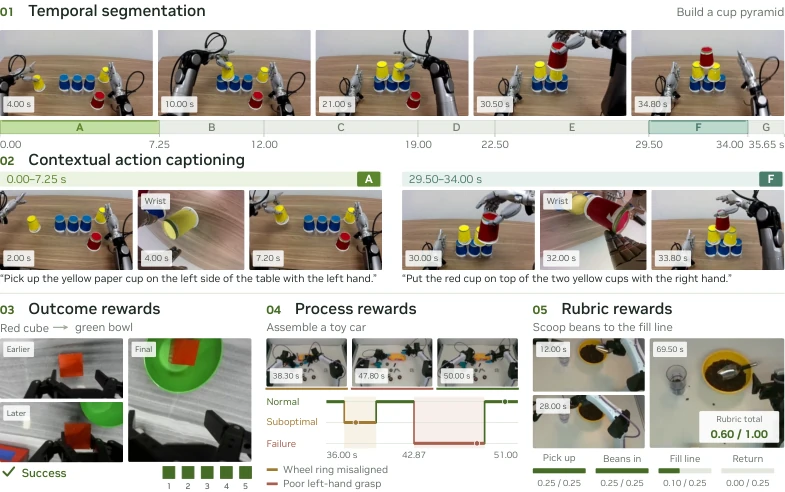
Flora bundles three open models, for segmentation, captioning and reward, so one data engine can produce timestamped captions, process rewards and outcome rewards for robot datasets.

reinforcement-learning benchmark
PDF Advanced
FORCA: A Force-Aware Coding Agent for Contact-Rich Robot Manipulation
arXiv preprint

FORCA: A Force-Aware Coding Agent for Contact-Rich Robot Manipulation

Xiao Tan, Yixuan Wang, Zhexi Wang et al.

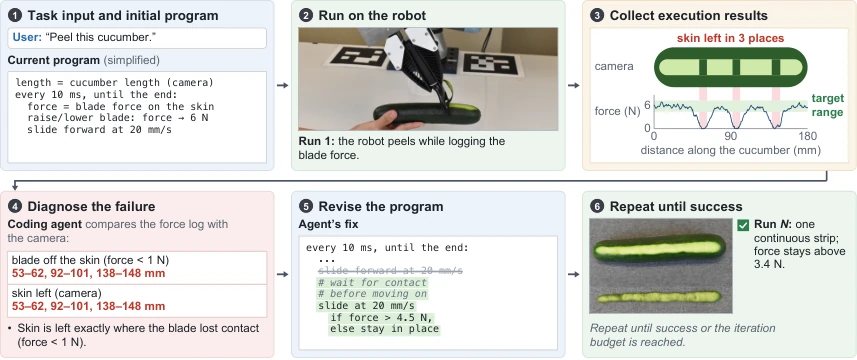
FORCA lets a coding agent use wrist force/torque readings both while its robot program runs and when it revises that program between real-robot attempts, without demonstrations or task-specific training.

manipulation vision control learning-from-demonstration
PDF Intermediate
Full-Order Safety for Nonlinear Reduced-Order MPC
arXiv preprint

Full-Order Safety for Nonlinear Reduced-Order MPC

Luis Pabon, Johannes K\"{o}hler, Revant Kasichainula et al.

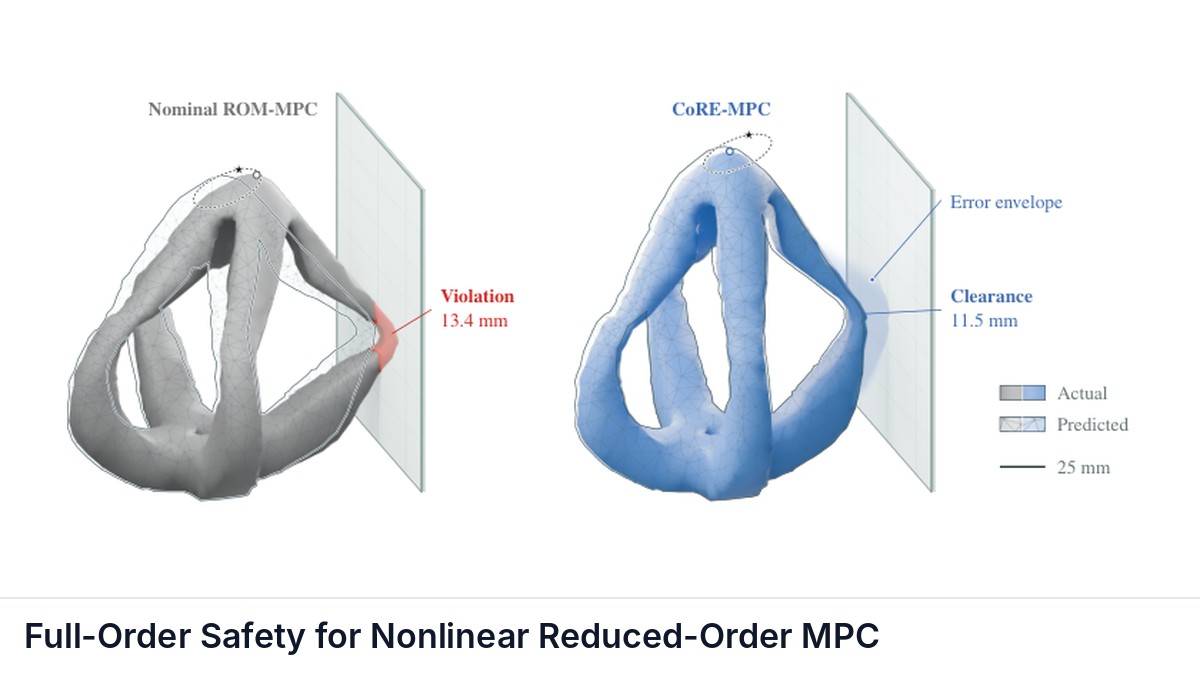
Reduced-order models (ROMs) make model predictive control (MPC) of high-dimensional nonlinear systems tractable, but the resulting modeling error can lead to constraint violations on the real system.

control
PDF Intermediate
Generative Neural Retargeting for Human-to-Robot Dexterous Manipulation
arXiv preprint

Generative Neural Retargeting for Human-to-Robot Dexterous Manipulation

Dechen Gao, Yue Yang, Ben Abbatematteo et al.

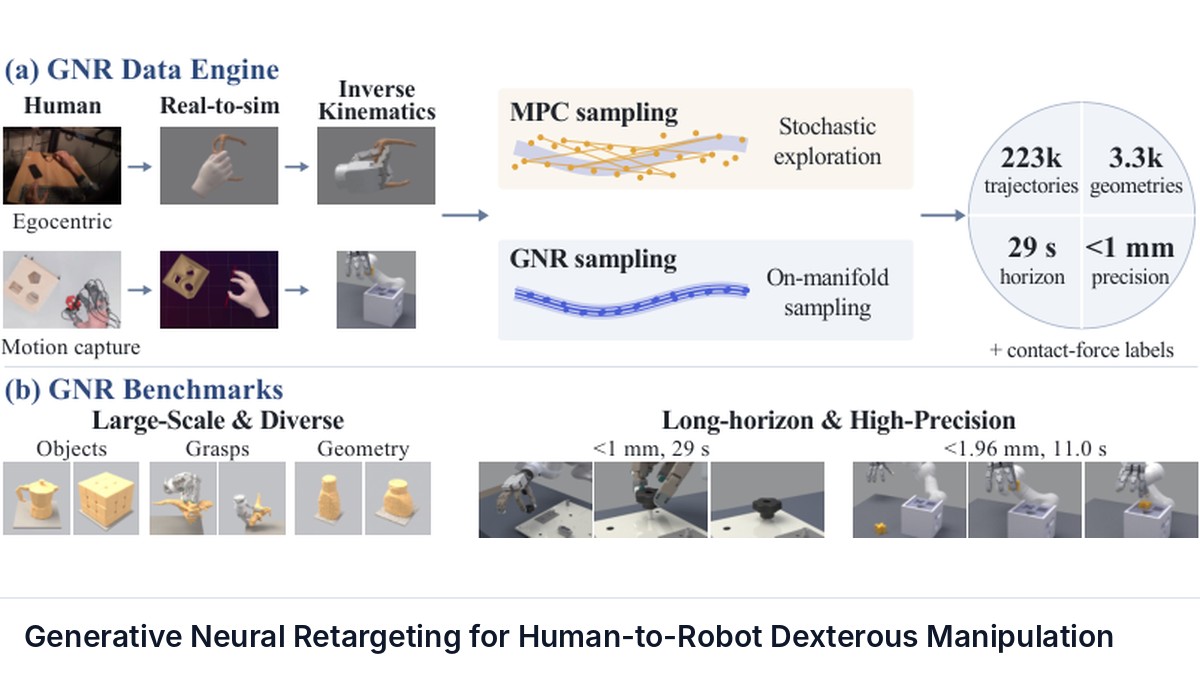
Human demonstrations are a scalable data source for learning dexterous manipulation, but the embodiment gap prevents human motion from being executed directly on robots. Inverse kinematics (IK) retargets human motion to robots efficiently but ignores dynamics, often producing infeasible motions.

manipulation reinforcement-learning control learning-from-demonstration benchmark
PDF Advanced
geodex: A Library for Motion Planning on Riemannian Manifolds
arXiv preprint

geodex: A Library for Motion Planning on Riemannian Manifolds

Phone Thiha Kyaw, Ben Wei, Sepehr Samavi et al.

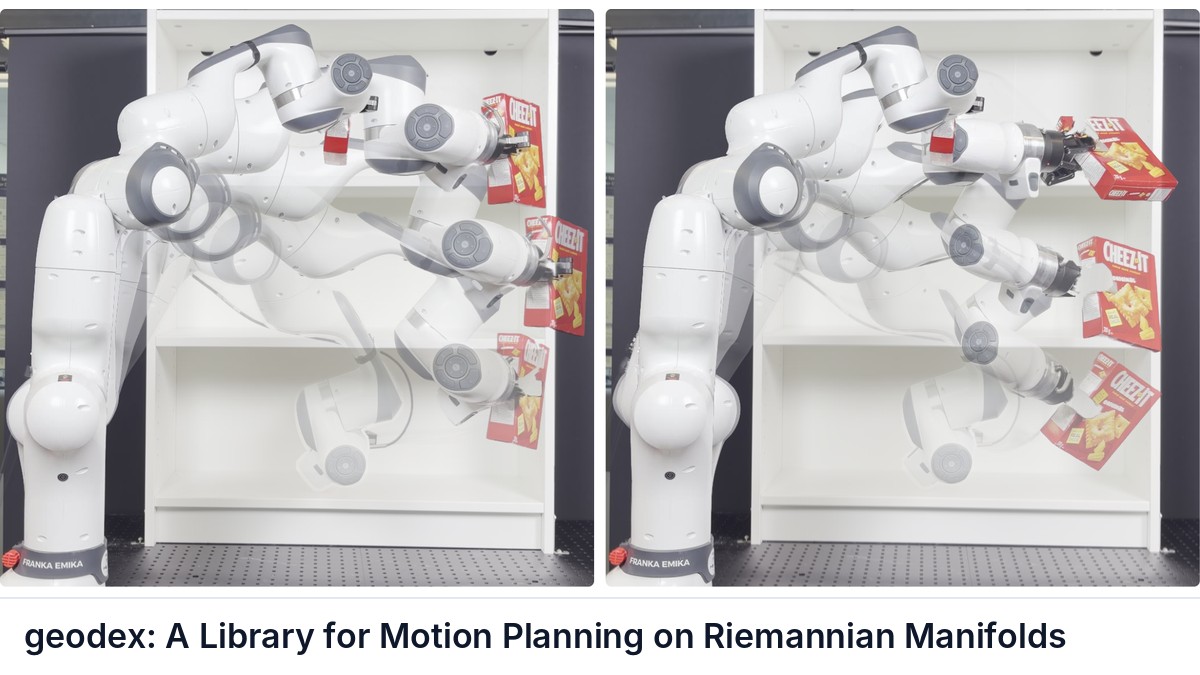
Planning motions that respect the intrinsic geometry of a robot's configuration space, including its curvature and a configuration-dependent notion of cost, yields shorter, lower-energy, and more natural trajectories than planning under the ambient flat metric.

reinforcement-learning planning benchmark
PDF Intermediate
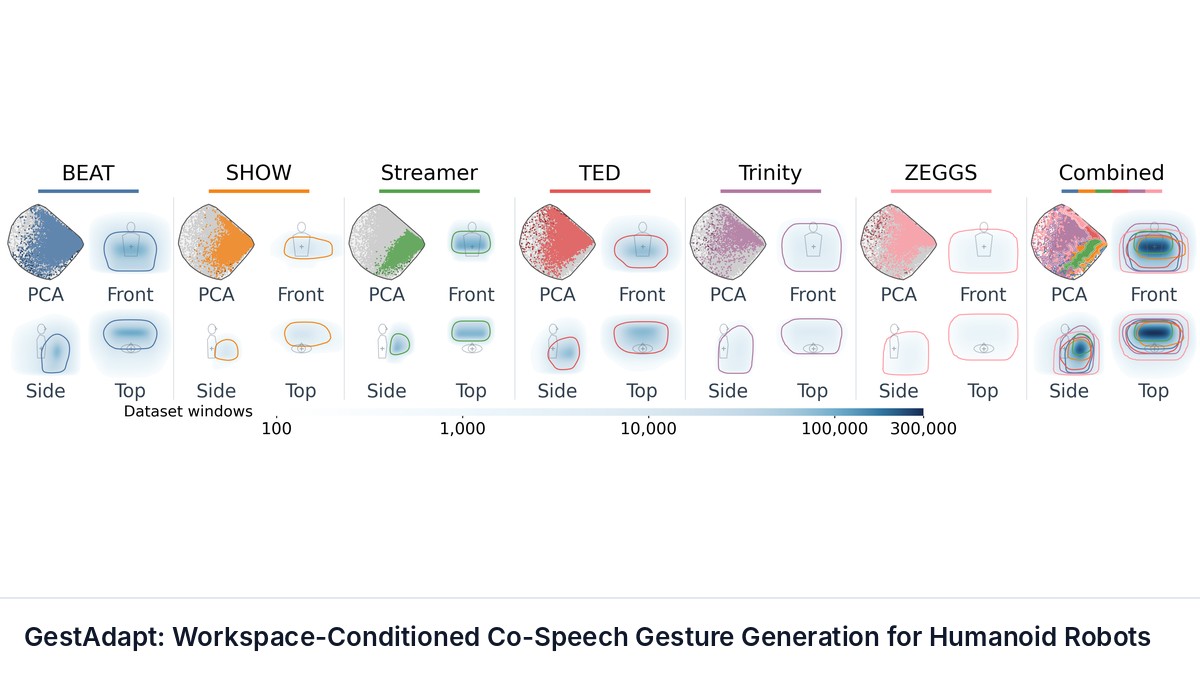
GestAdapt: Workspace-Conditioned Co-Speech Gesture Generation for Humanoid Robots
arXiv preprint

GestAdapt: Workspace-Conditioned Co-Speech Gesture Generation for Humanoid Robots

Bosong Ding, Xianglin Zhang, Miao Xin et al.

Co-speech gestures for robots must adapt not only to speech and embodiment, but also to the workspace available for performing the motion. Since the same speech can be accompanied by different gestures, a robot can respond to workspace constraints, e.g., gestures for speech next to a wall.

reinforcement-learning benchmark
PDF Intermediate
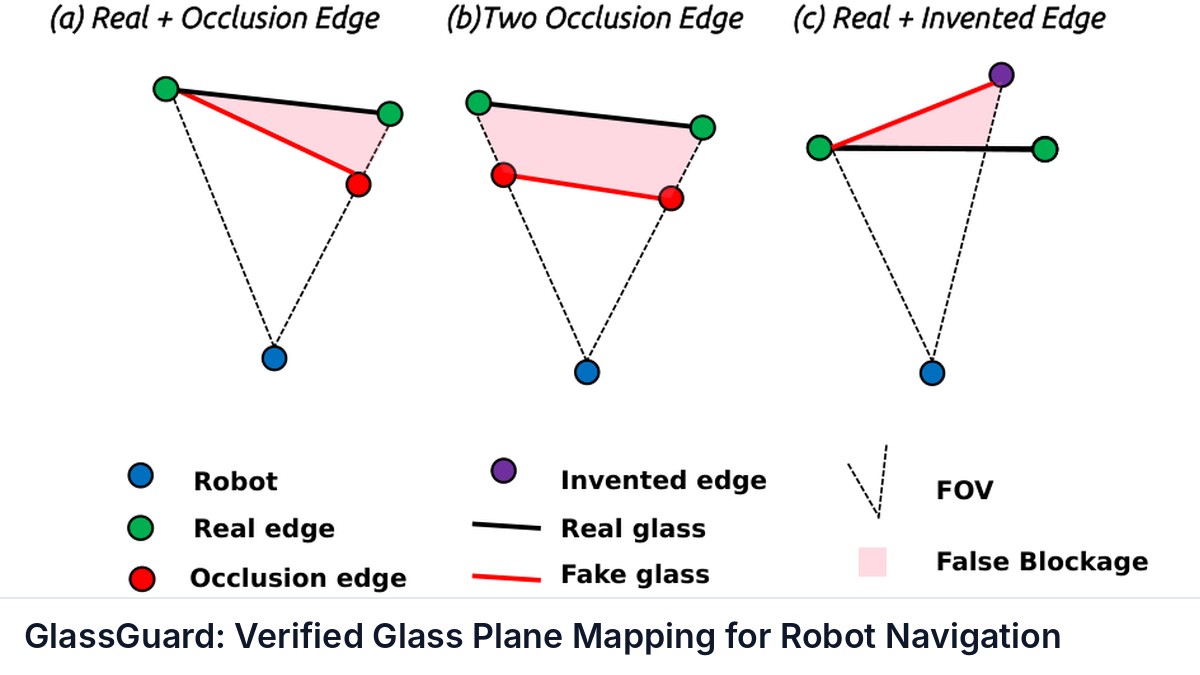
GlassGuard: Verified Glass Plane Mapping for Robot Navigation
arXiv preprint

GlassGuard: Verified Glass Plane Mapping for Robot Navigation

Hanwen Guo, Zhengzhi Lin, Yusen Xie et al.

Transparent and specular surfaces pose a serious challenge to LiDAR-based SLAM and navigation because laser returns may pass through glass, leaving collision boundaries absent from the map.

vision reinforcement-learning planning
Code PDF Intermediate
GitHub ★ —
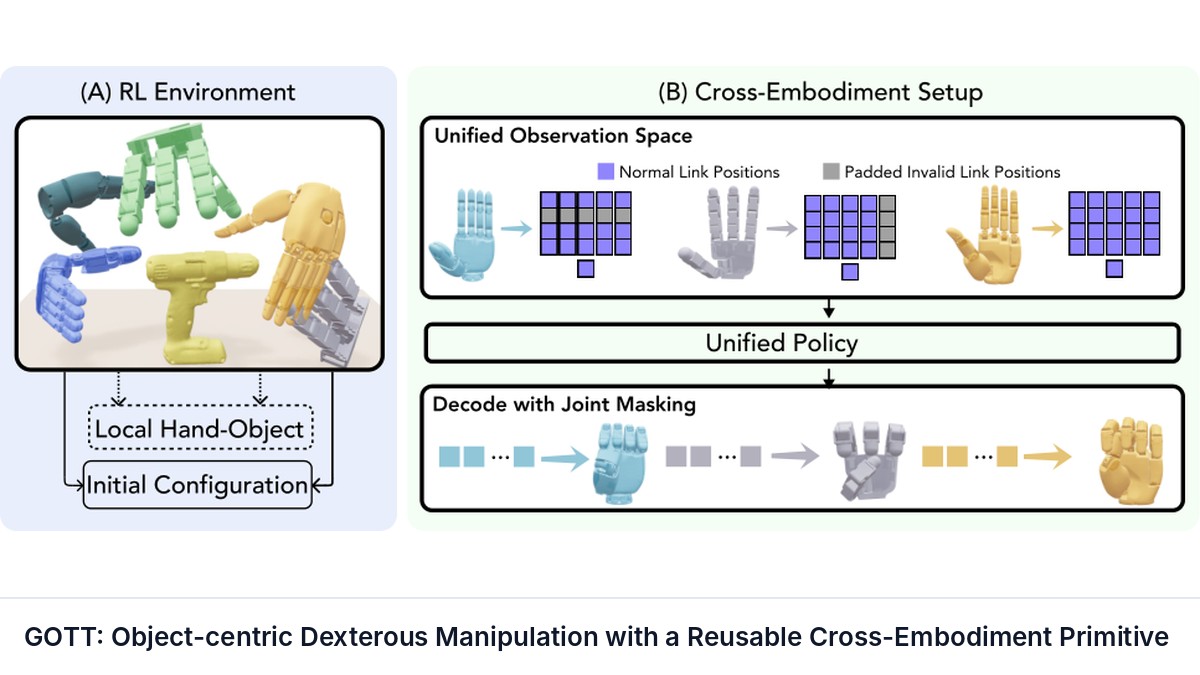
GOTT: Object-centric Dexterous Manipulation with a Reusable Cross-Embodiment Primitive
arXiv preprint

GOTT: Object-centric Dexterous Manipulation with a Reusable Cross-Embodiment Primitive

Yulin Liu, Lai Wei, Yen-Jen Wang et al.

Foundation models and large-scale human data provide rich sources of manipulation intent, but translating this intent into multi-fingered robot behavior remains difficult. Dexterous hands still lack a reusable low-level primitive that reliably establishes contact across tasks and embodiments.

manipulation reinforcement-learning planning control learning-from-demonstration
PDF Advanced
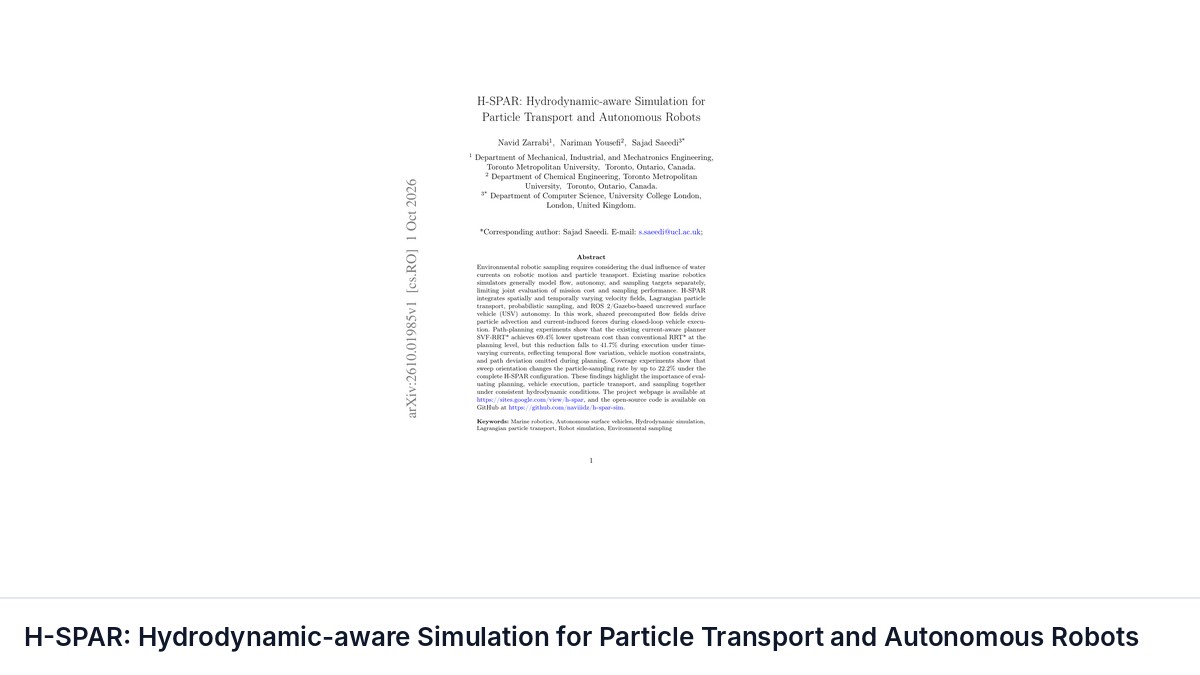
H-SPAR: Hydrodynamic-aware Simulation for Particle Transport and Autonomous Robots
arXiv preprint

H-SPAR: Hydrodynamic-aware Simulation for Particle Transport and Autonomous Robots

Navid Zarrabi, Nariman Yousefi, Sajad Saeedi

Environmental robotic sampling requires considering the dual influence of water currents on robotic motion and particle transport. Existing marine robotics simulators generally model flow, autonomy, and sampling targets separately, limiting joint evaluation of mission cost and sampling performance.

planning benchmark
Code PDF Intermediate
GitHub ★ —
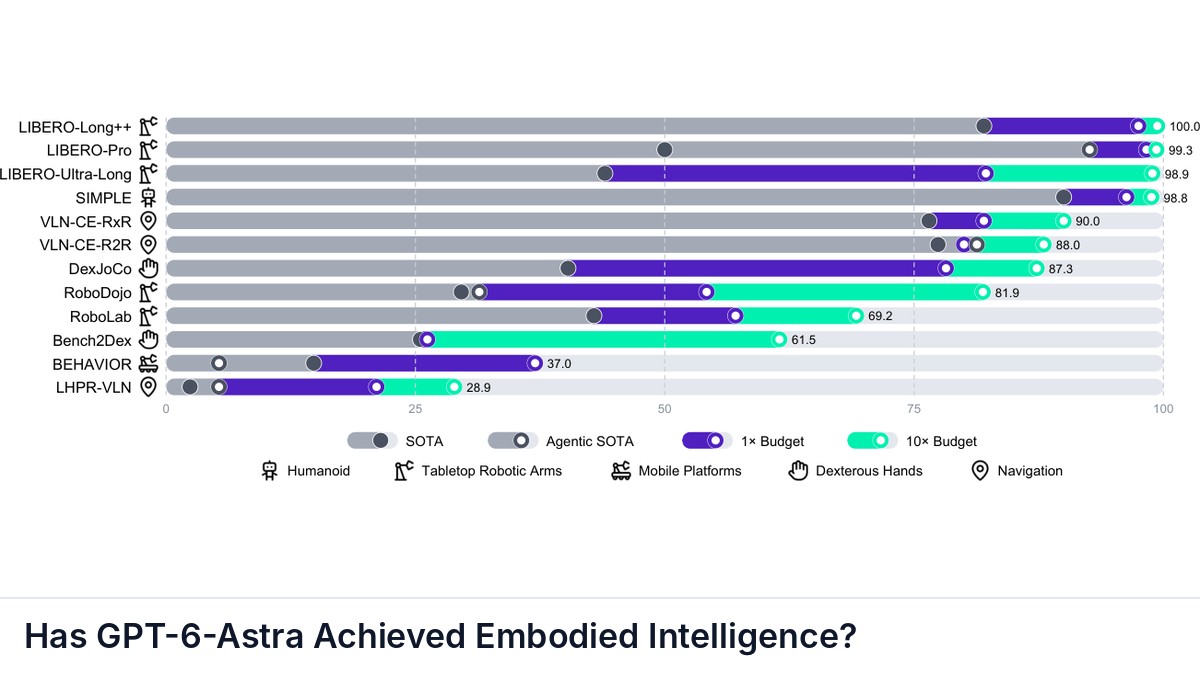
Has GPT-6-Astra Achieved Embodied Intelligence?
arXiv preprint

Has GPT-6-Astra Achieved Embodied Intelligence?

SenseNova, Joint Research Team, : et al.

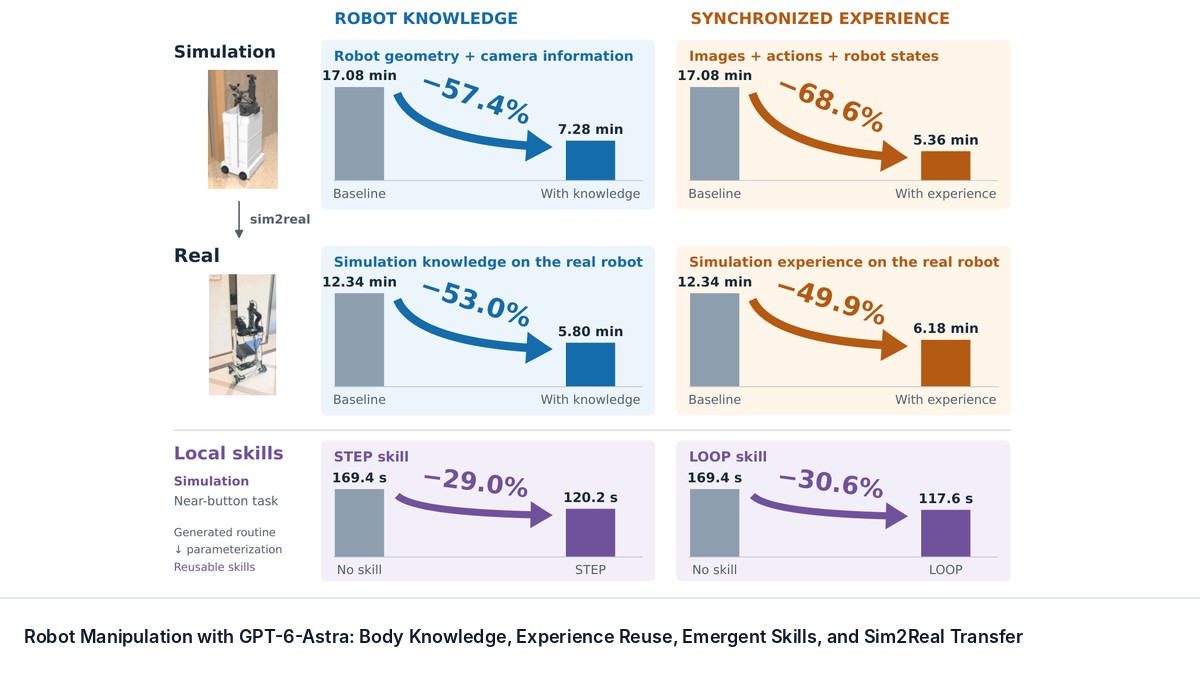
GPT-6-Astra demonstrates a level of competence in robotic manipulation and navigation that challenges the conventional paradigm of building specialized models for individual tasks and embodiments.

manipulation locomotion vision reinforcement-learning planning control learning-from-demonstration benchmark
Code PDF Advanced
GitHub ★ —
HoloBoxing: A Simple Recipe for Humanoid Boxing with 7 Minutes of Single-GPU Training
arXiv preprint

HoloBoxing: A Simple Recipe for Humanoid Boxing with 7 Minutes of Single-GPU Training

Xihan Ma, Bo Zhang, Boxiong Li et al.

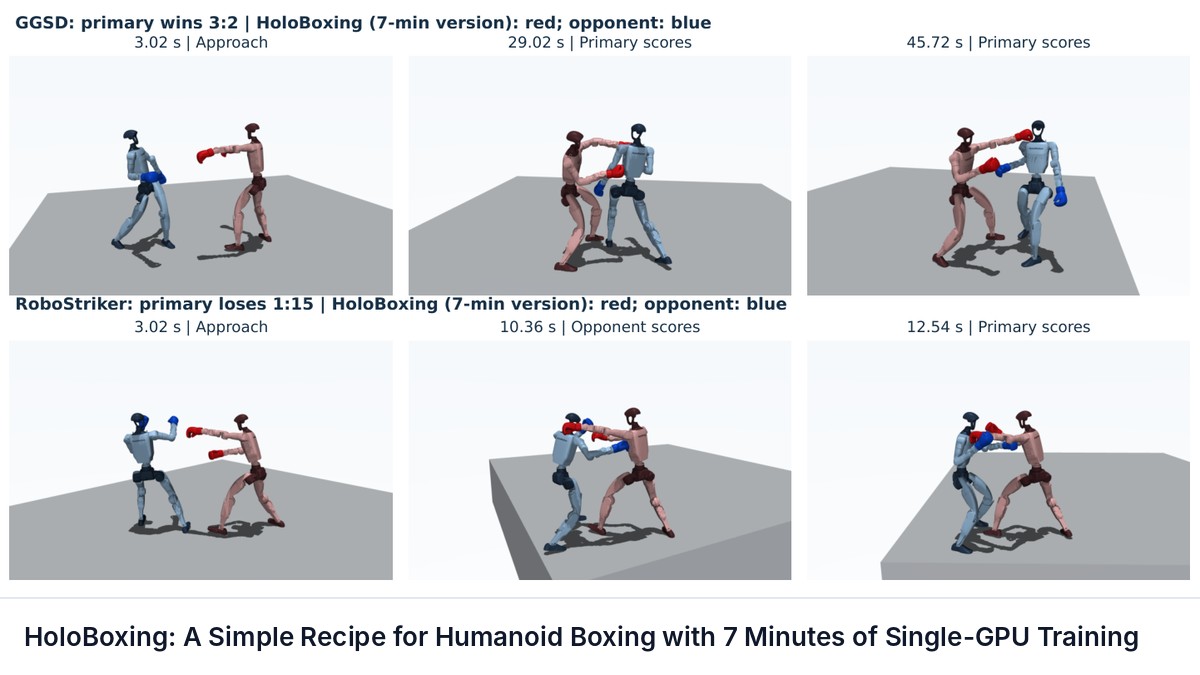
HoloBoxing presents a simple recipe for learning humanoid boxing by building on a pretrained whole-body controller. The recipe separates reusable motor skills from task decisions: a compact planner requests future body-point targets, while the frozen controller handles joint-level execution.

reinforcement-learning control benchmark
Code PDF Intermediate
GitHub ★ —
HULK: Learning Whole-Body Forceful Loco-Manipulation for Humanoids
arXiv preprint

HULK: Learning Whole-Body Forceful Loco-Manipulation for Humanoids

An Dang, Arturo Flores Alvarez, Yu-Ming Chen et al.

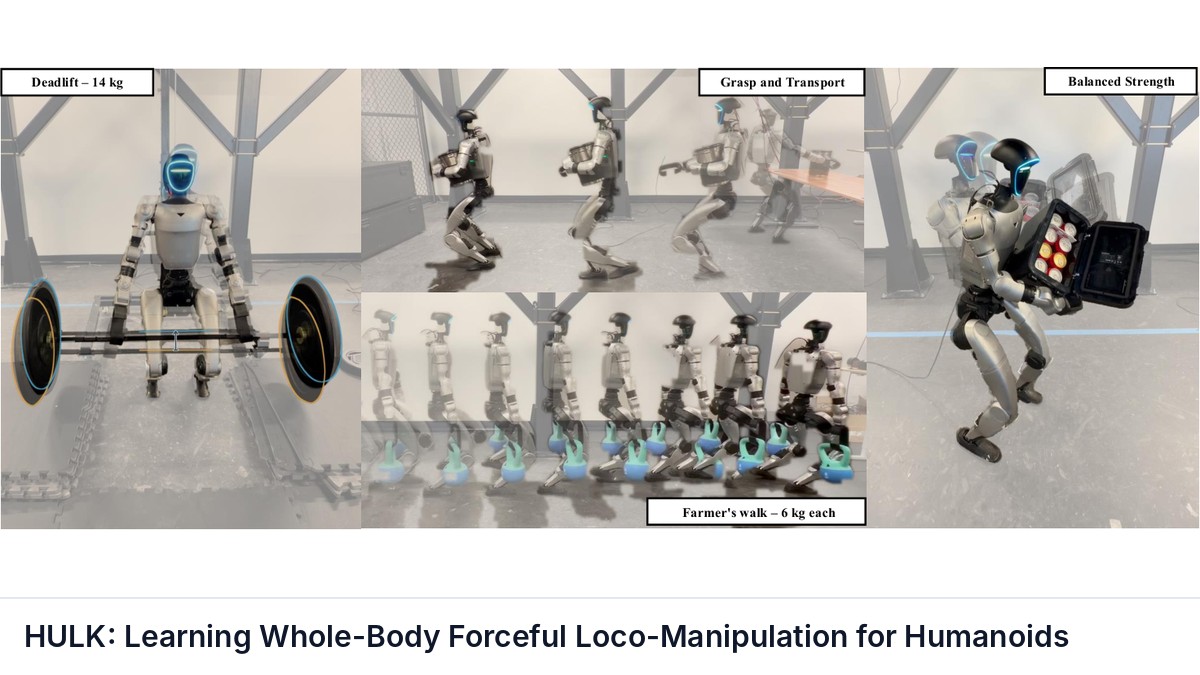
Humanoid loco-manipulation of large, heavy objects demands forceful interaction across the entire body. However, such payloads shift a humanoid's center of mass and impose sustained loads across the upper body, challenging balance and command tracking.

manipulation reinforcement-learning control benchmark
PDF Intermediate
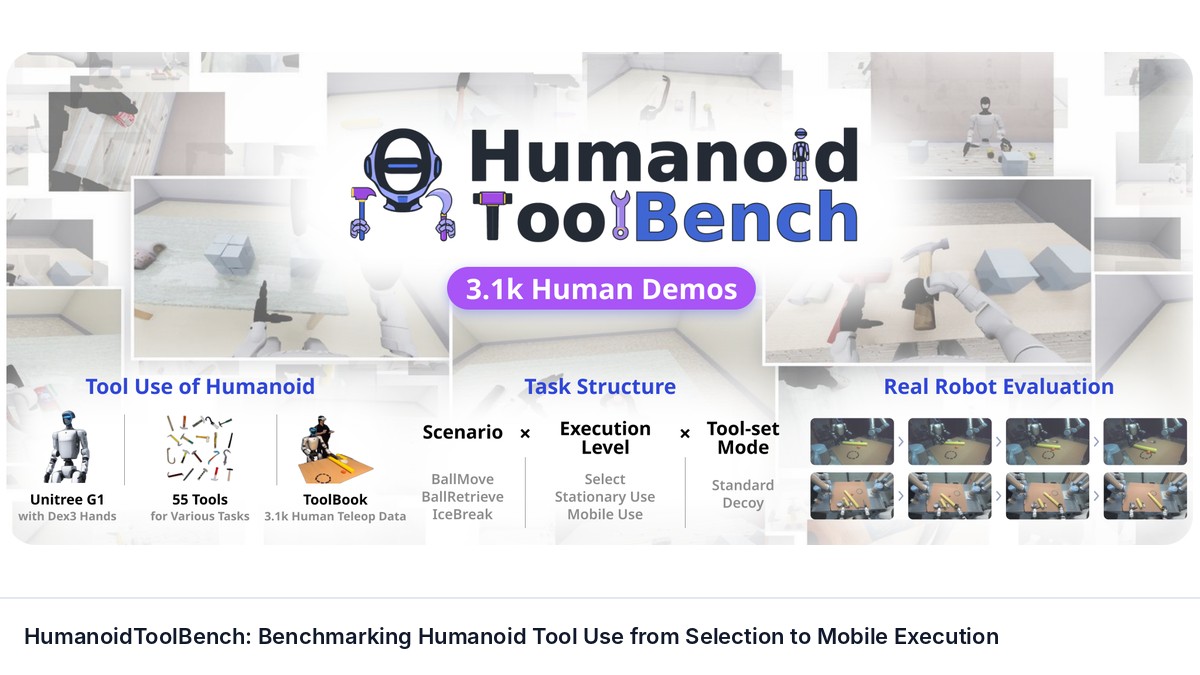
HumanoidToolBench: Benchmarking Humanoid Tool Use from Selection to Mobile Execution
arXiv preprint

HumanoidToolBench: Benchmarking Humanoid Tool Use from Selection to Mobile Execution

Kyochul Jang, Seohyeon Park, Ohchul Kwon et al.

As robotic hardware and learning methods advance, humanoids need tools to perform tasks beyond their inherent physical limits. Successful tool use requires selecting a suitable tool and coordinating manipulation and, when needed, locomotion to complete the task.

manipulation locomotion learning-from-demonstration benchmark
Code PDF Intermediate
GitHub ★ —
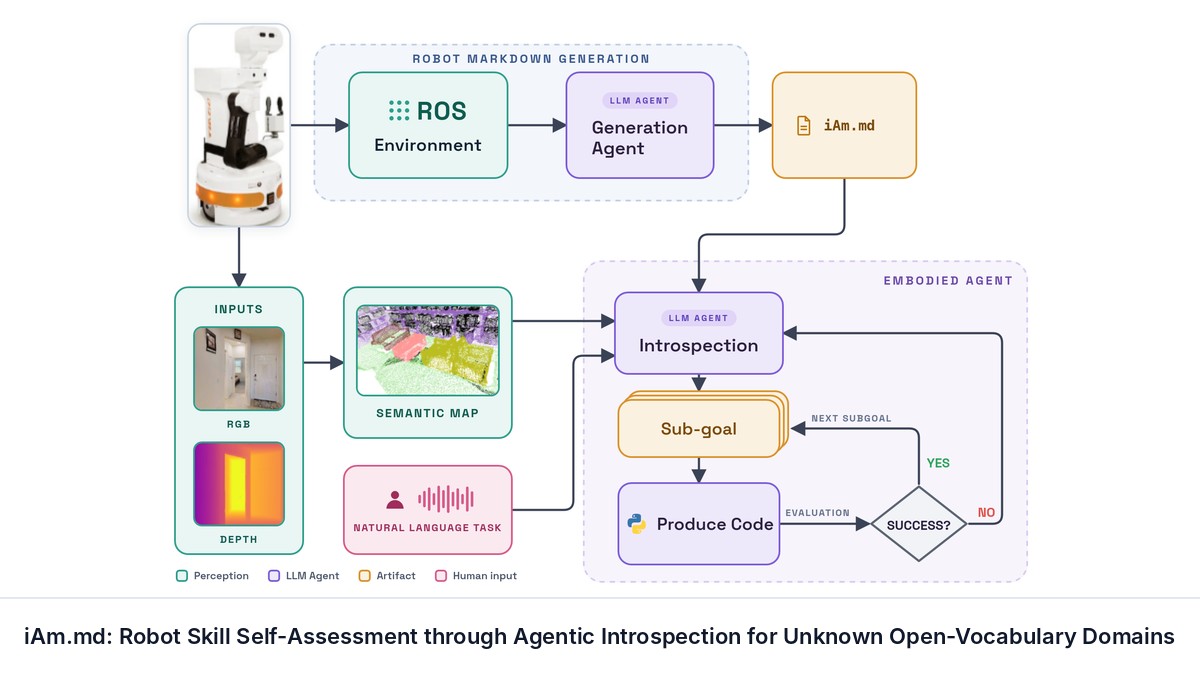
iAm.md: Robot Skill Self-Assessment through Agentic Introspection for Unknown Open-Vocabulary Domains
arXiv preprint

iAm.md: Robot Skill Self-Assessment through Agentic Introspection for Unknown Open-Vocabulary Domains

Vincenzo Guarino, Emanuele Musumeci, Vincenzo Suriani et al.

Agentic AI based on Large Language Model generalization capabilities offers a wide range of potential applications, including planning for embodied tasks. For example, embodied agents based on Foundation models can generate plausible plans in autonomous robotics scenarios.

manipulation vision reinforcement-learning planning
PDF Advanced
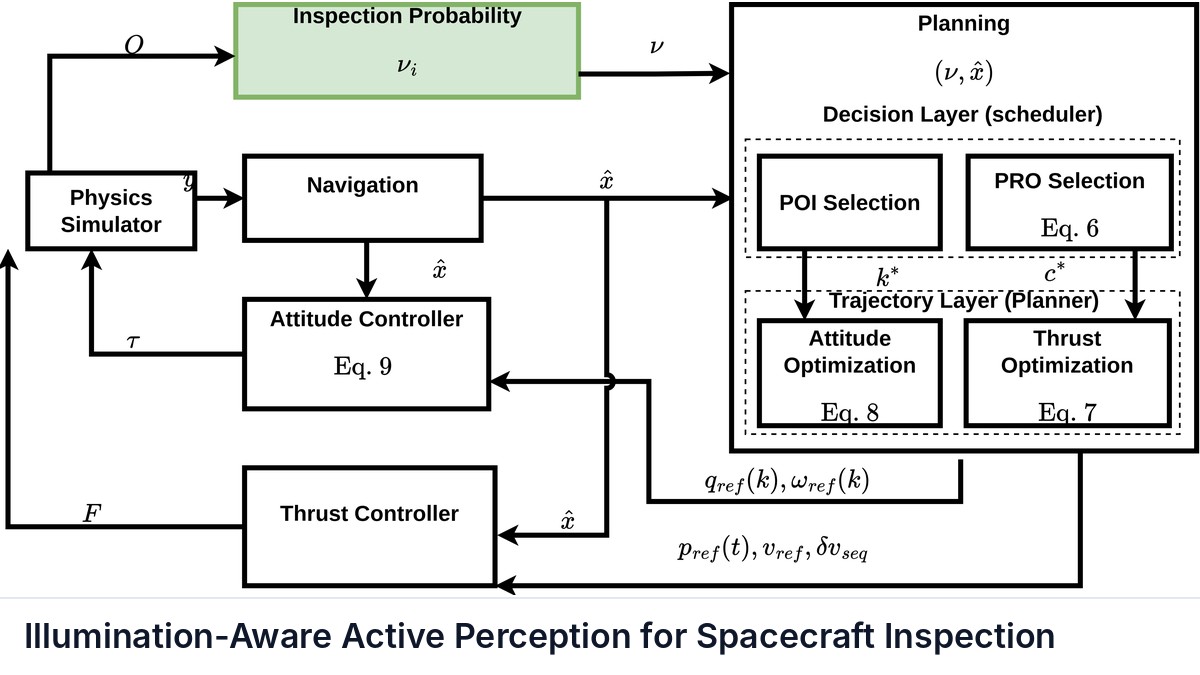
Illumination-Aware Active Perception for Spacecraft Inspection
arXiv preprint

Illumination-Aware Active Perception for Spacecraft Inspection

Sagarika Rao Valluri, Benjamin Riviere

Harsh and rapidly varying orbital illumination introduces failure modes during spacecraft inspection. Existing planners rely on line-of-sight inspection metrics which perform occlusion checks against a known target and conflate geometric visibility with task-relevant information.

vision reinforcement-learning planning control
PDF Intermediate
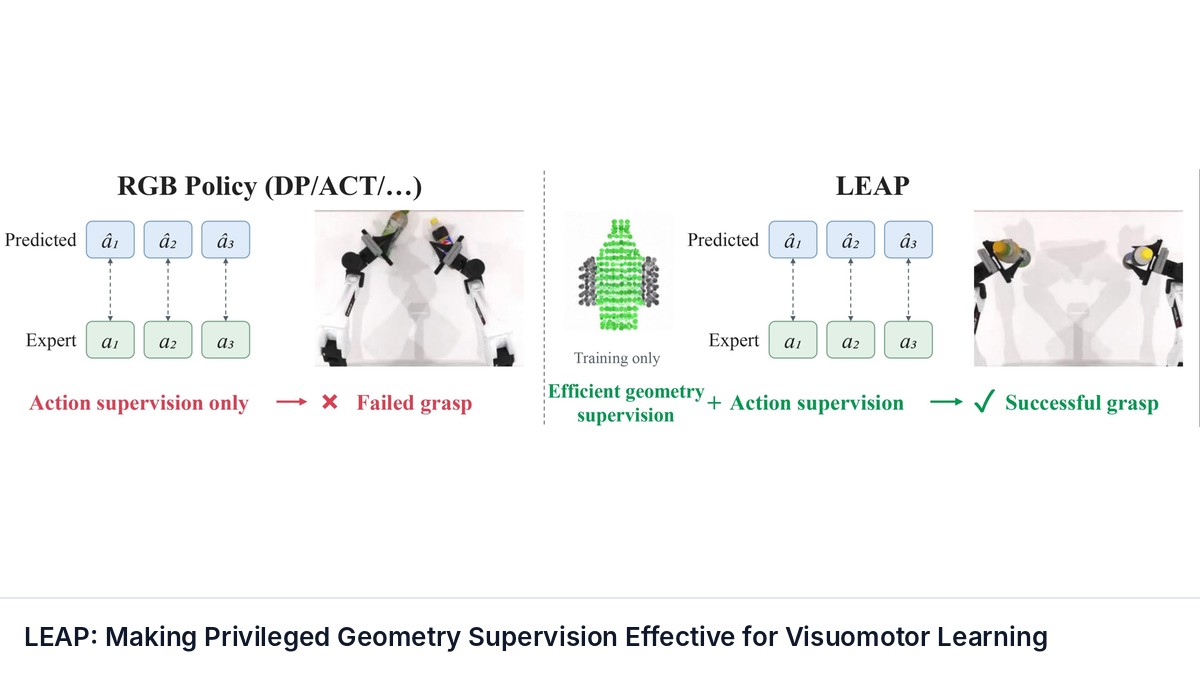
LEAP: Making Privileged Geometry Supervision Effective for Visuomotor Learning
arXiv preprint

LEAP: Making Privileged Geometry Supervision Effective for Visuomotor Learning

Han Fang, Yunpeng Jiang, Jianshu Hu et al.

Privileged 3D supervision uses additional geometric information during training to guide RGB-based visuomotor policy learning, without requiring geometric inputs at deployment. However, low reconstruction error does not ensure that visual representations capture geometry useful for control.

manipulation vision reinforcement-learning control
PDF Advanced
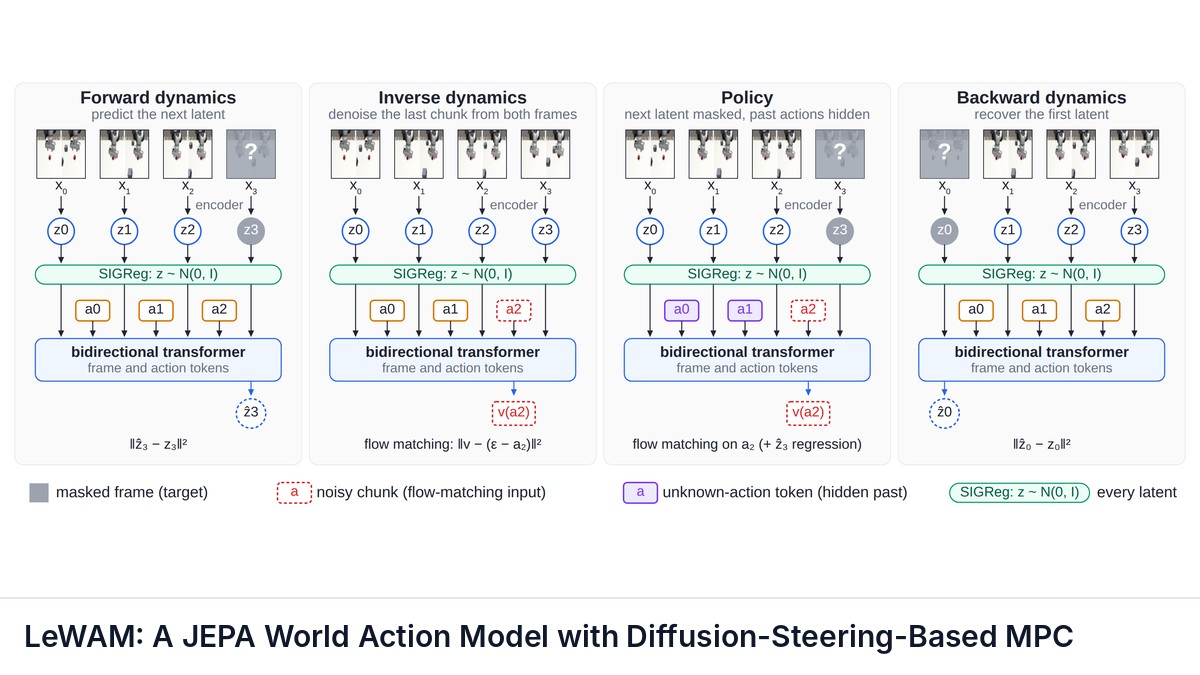
LeWAM: A JEPA World Action Model with Diffusion-Steering-Based MPC
arXiv preprint

LeWAM: A JEPA World Action Model with Diffusion-Steering-Based MPC

Shashank Hegde, Alexander Popov, Elie Aljalbout et al.

World action models (WAMs) predict actions and future observations, typically from a reconstruction-based representation that carries noisy, redundant information which can complicate downstream predictions.

vision reinforcement-learning planning control benchmark
PDF Advanced
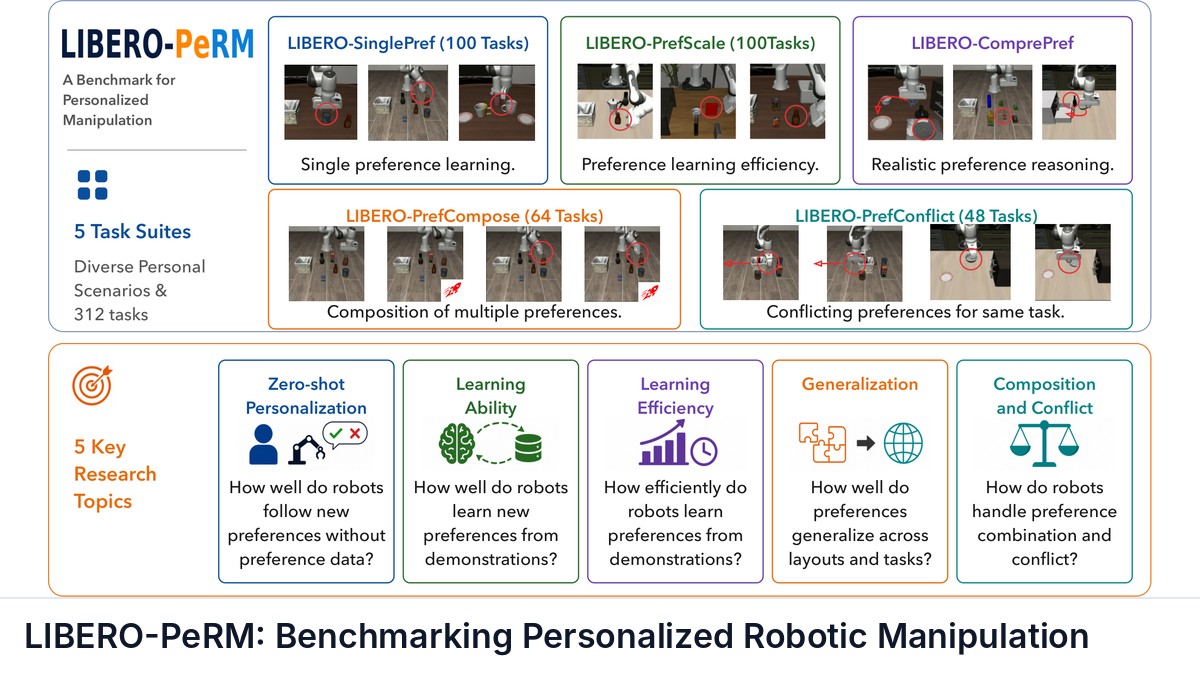
LIBERO-PeRM: Benchmarking Personalized Robotic Manipulation
arXiv preprint

LIBERO-PeRM: Benchmarking Personalized Robotic Manipulation

Zhixu Li, Keqian Tang, Litian Gong et al.

Personalization is essential for general-purpose robots to transition into household environments and achieve true practicality.

manipulation vla control learning-from-demonstration benchmark
PDF Intermediate
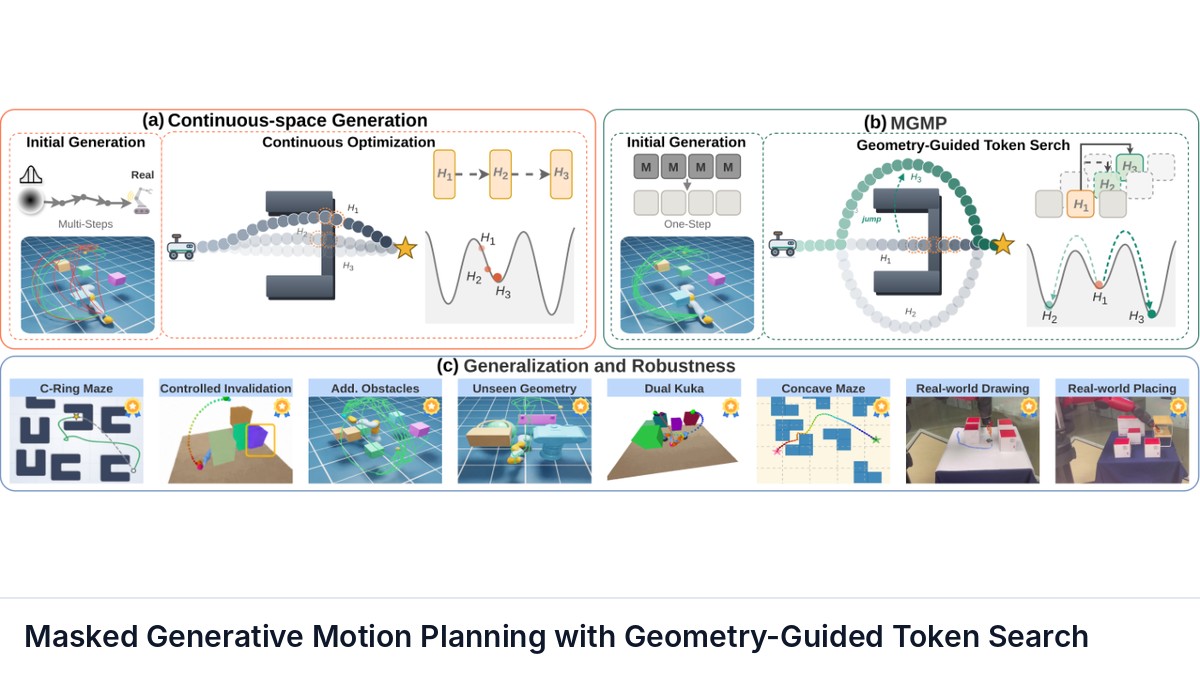
Masked Generative Motion Planning with Geometry-Guided Token Search
arXiv preprint

Masked Generative Motion Planning with Geometry-Guided Token Search

Lipeng Zhuang, Yingdong Ru, Shiyu Fan et al.

Generative motion planners typically use learned trajectory priors for initial generation, while leaving test-time repair to local continuous refinement. We introduce Masked Generative Motion Planning (MGMP), which extends the learned prior from efficient parallel generation to structural repair.

reinforcement-learning planning control
PDF Intermediate
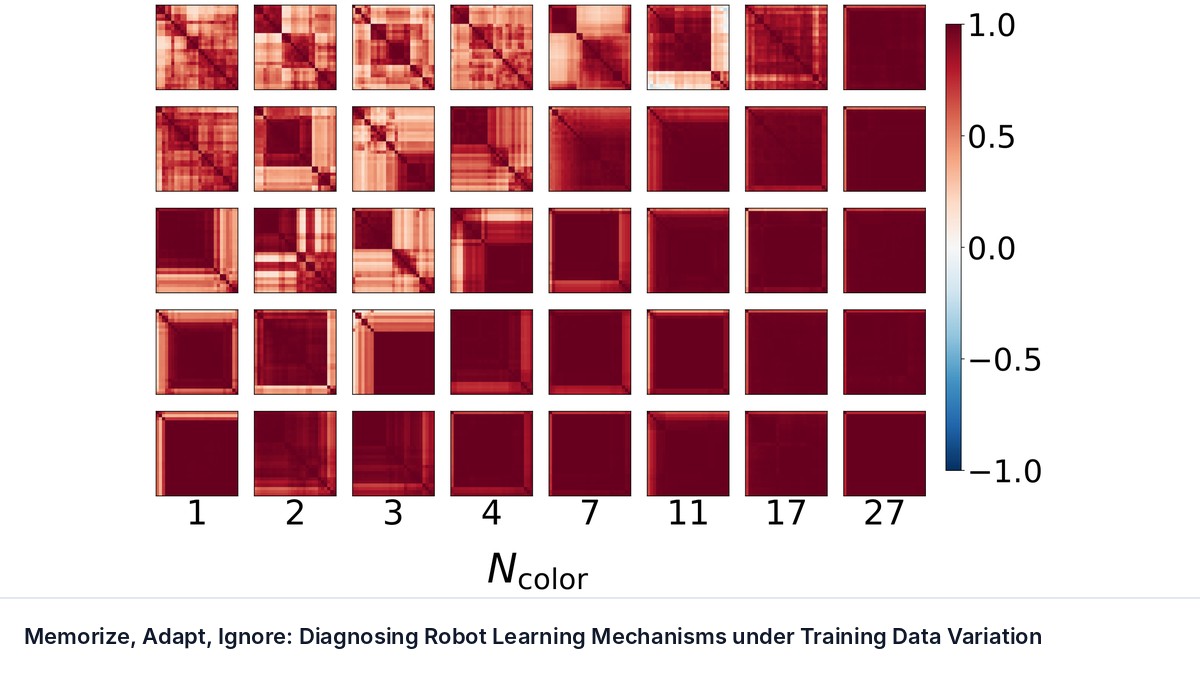
Memorize, Adapt, Ignore: Diagnosing Robot Learning Mechanisms under Training Data Variation
arXiv preprint

Memorize, Adapt, Ignore: Diagnosing Robot Learning Mechanisms under Training Data Variation

Ke Zhang, Danica J. Sutherland, Chao Liu

Training data variation, whether through designing a domain randomization (DR) scheme in simulation or curating demonstrations for imitation learning, is a primary lever for improving the robustness of robotic manipulation policies.

manipulation vision vla reinforcement-learning sim-to-real learning-from-demonstration
PDF Intermediate
MOSS: Mode-Oriented Source Shaping for Robot Flow Matching Policies
arXiv preprint

MOSS: Mode-Oriented Source Shaping for Robot Flow Matching Policies

Zirun Ma, Jindou Jia, Tuo An et al.

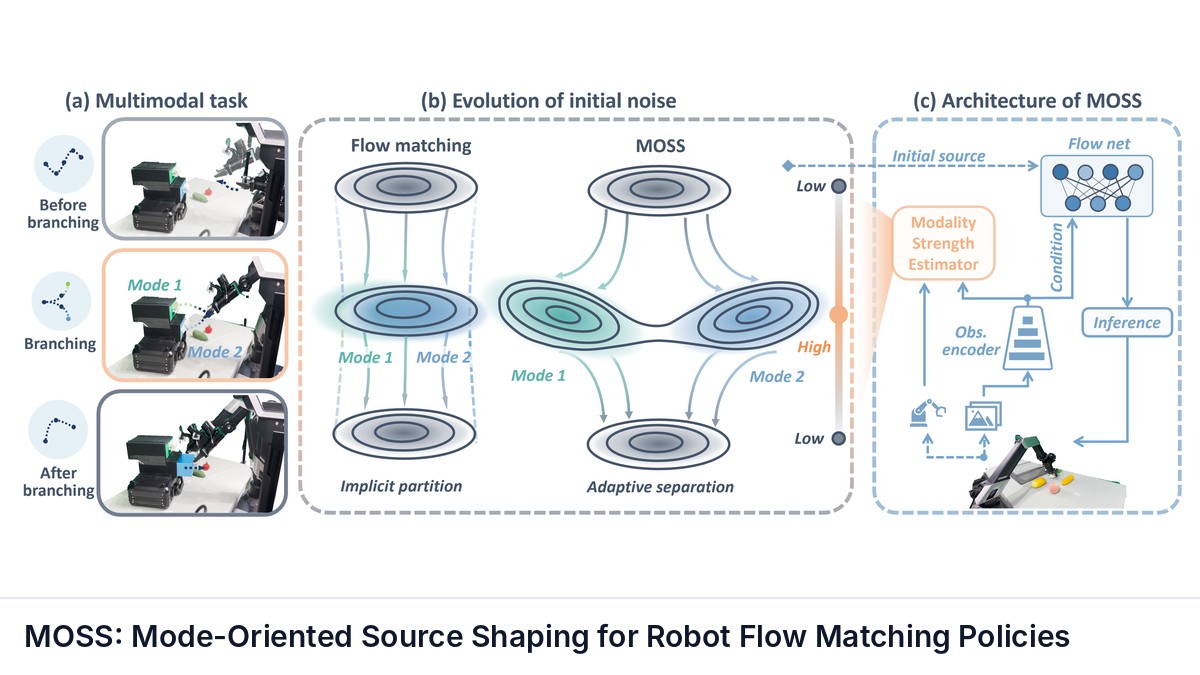
In robotic manipulation, the same observation often admits multiple feasible actions. Generative policies such as diffusion and flow matching naturally capture such multimodal behaviors, yet which mode is executed is left to random sampling and cannot be actively controlled.

manipulation vision reinforcement-learning control benchmark
Code PDF Advanced
GitHub ★ —
Multi-Dimensional Featurizers Yield Fine-Grained Steering and Data Shaping in Robot Foundation Models
arXiv preprint

Multi-Dimensional Featurizers Yield Fine-Grained Steering and Data Shaping in Robot Foundation Models

Aiden Swann, Mozes Jacobs, Mathilde Papillon et al.

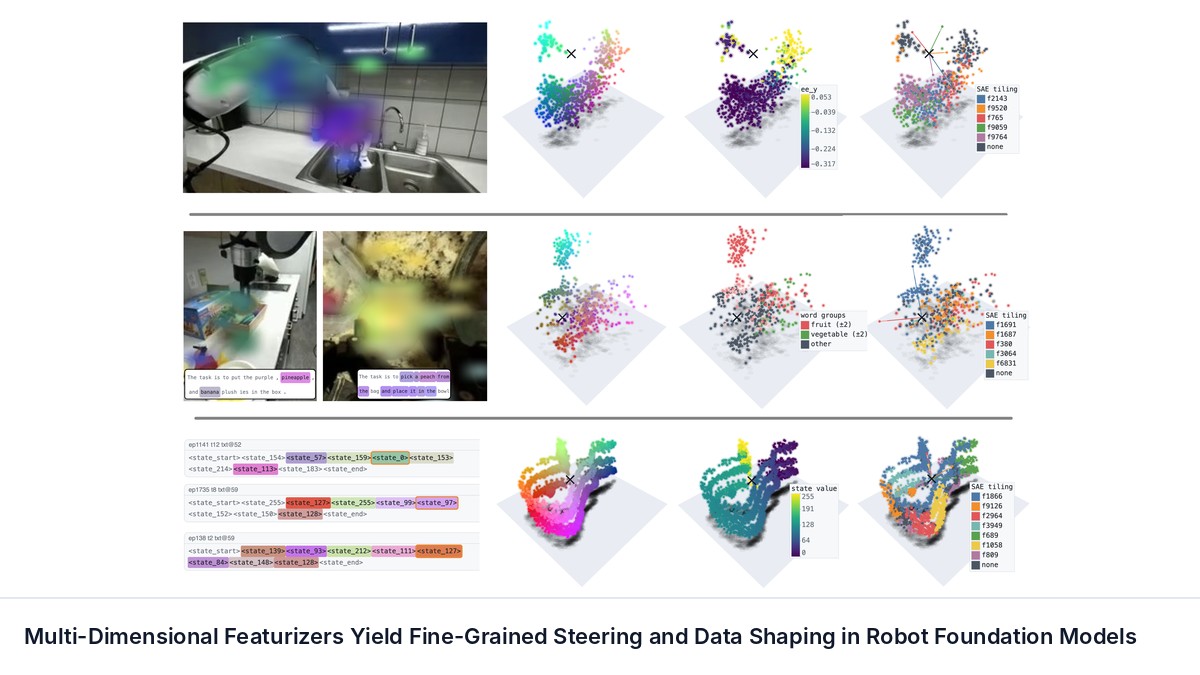
Can better feature discovery improve control over robot behavior through internal interventions and training data? Recent work in vision and language models reveals multidimensional features, motivating block-sparse featurizers (BSFs), which represent each feature in a low-dimensional subspace.

vision vla reinforcement-learning control benchmark
Code PDF Advanced
GitHub ★ —
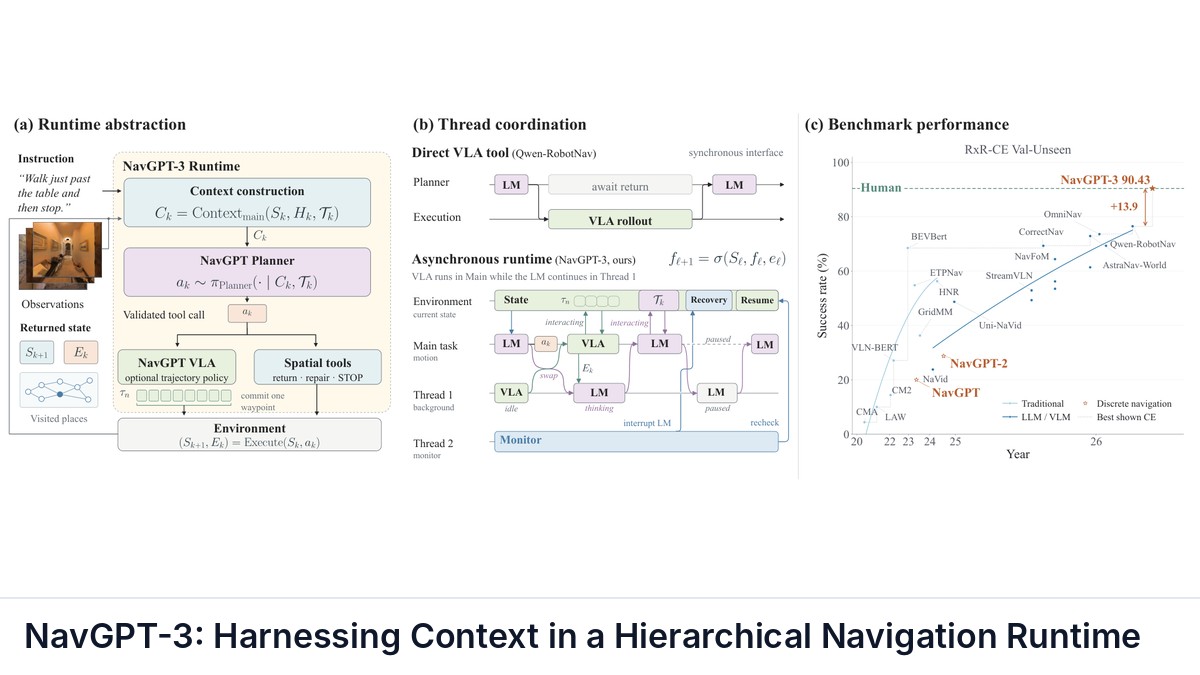
NavGPT-3: Harnessing Context in a Hierarchical Navigation Runtime
arXiv preprint

NavGPT-3: Harnessing Context in a Hierarchical Navigation Runtime

Gengze Zhou, Yicong Hong, Jiazhao Zhang et al.

Language models trained with long-horizon agentic reinforcement learning can generalize knowledge through reasoning, express precise actions, and pursue goals over many steps, raising the ceiling on what an embodied agent can understand and decide.

vision vla reinforcement-learning planning control benchmark
Code PDF Intermediate
GitHub ★ —
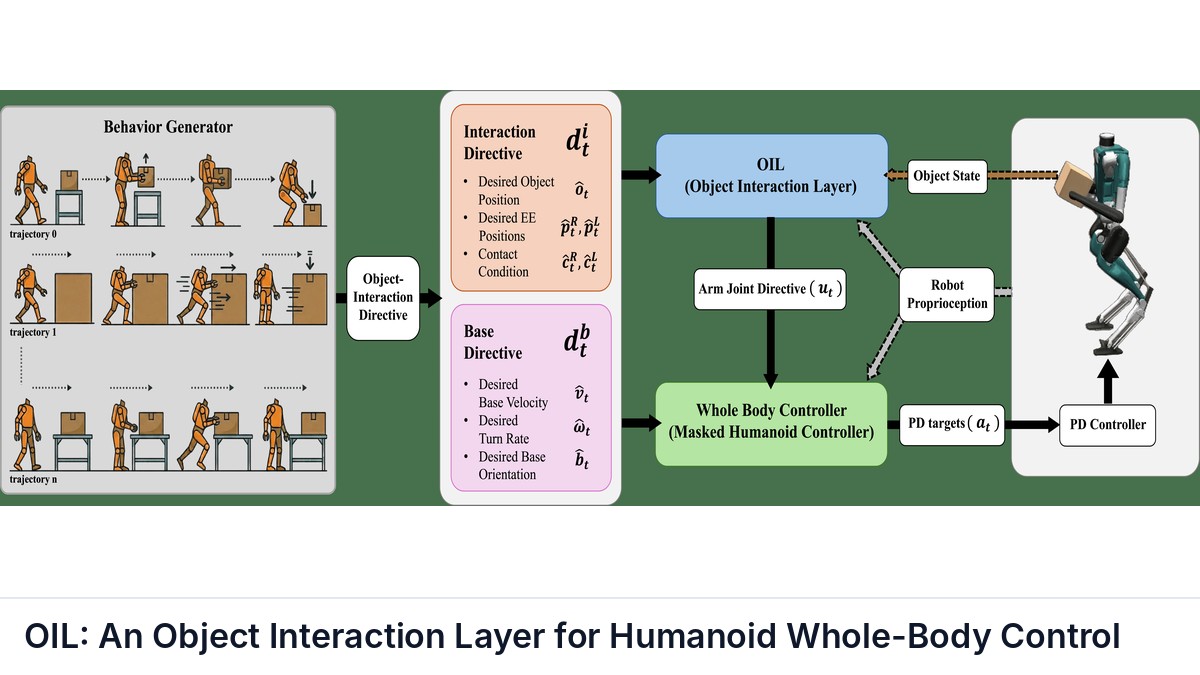
OIL: An Object Interaction Layer for Humanoid Whole-Body Control
arXiv preprint

OIL: An Object Interaction Layer for Humanoid Whole-Body Control

Pranay Dugar, Mohitvishnu S. Gadde, Rajesh Mangannavar et al.

Recent progress in learned whole-body controllers for humanoid robots has enabled robust free-space motion by tracking kinematic targets such as joint or end-effector trajectories.

manipulation locomotion reinforcement-learning sim-to-real control learning-from-demonstration
PDF Intermediate
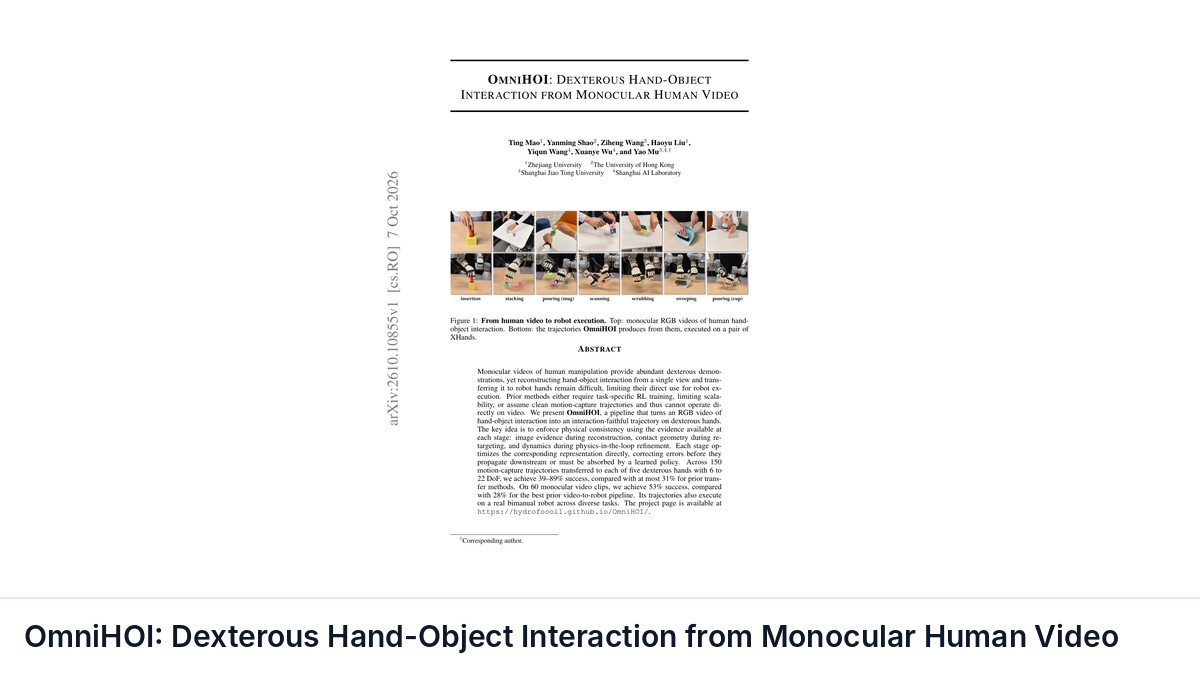
OmniHOI: Dexterous Hand-Object Interaction from Monocular Human Video
arXiv preprint

OmniHOI: Dexterous Hand-Object Interaction from Monocular Human Video

Ting Mao, Yanming Shao, Ziheng Wang et al.

Monocular videos of human manipulation provide abundant dexterous demonstrations, yet reconstructing hand-object interaction from a single view and transferring it to robot hands remain difficult, limiting their direct use for robot execution.

manipulation vision reinforcement-learning learning-from-demonstration
PDF Intermediate
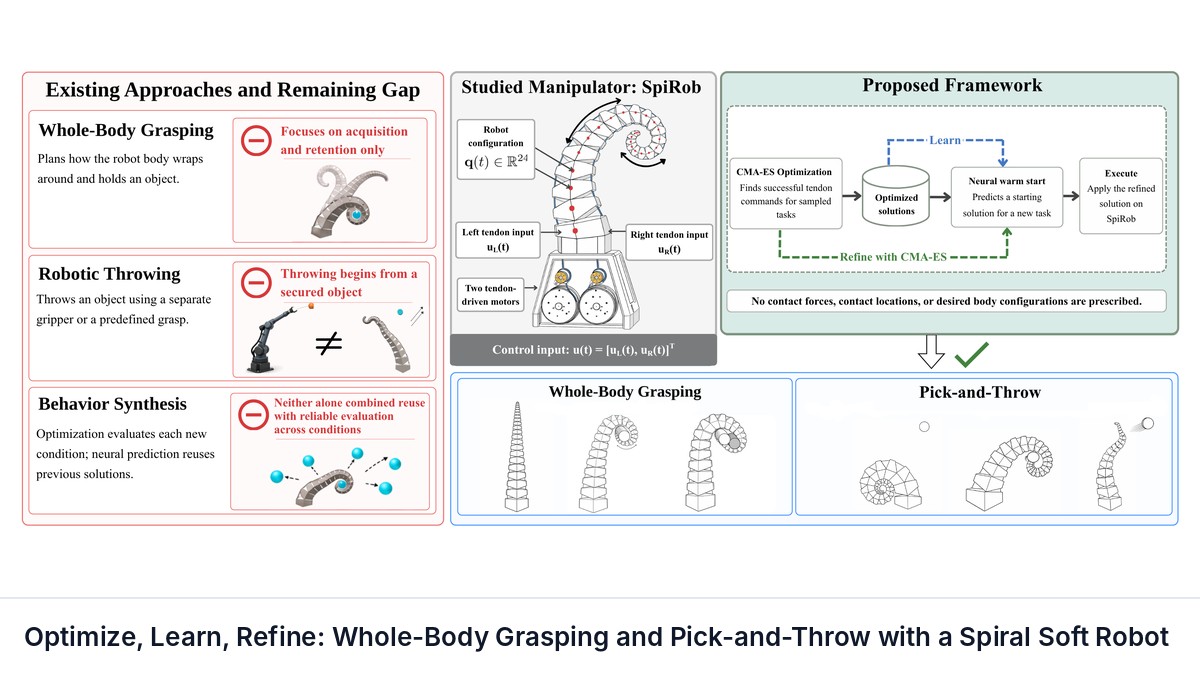
Optimize, Learn, Refine: Whole-Body Grasping and Pick-and-Throw with a Spiral Soft Robot
arXiv preprint

Optimize, Learn, Refine: Whole-Body Grasping and Pick-and-Throw with a Spiral Soft Robot

Marwah Basuhai, Tingcong Liu, Ibrahim Alsarraj et al.

Soft continuum robots can exploit distributed compliance for whole-body manipulation, but synthesizing behavior through changing contacts remains difficult. We address whole-body grasping and pick-and-throw from an initially ungrasped state through outcome-based actuation-space optimization.

manipulation
PDF Advanced
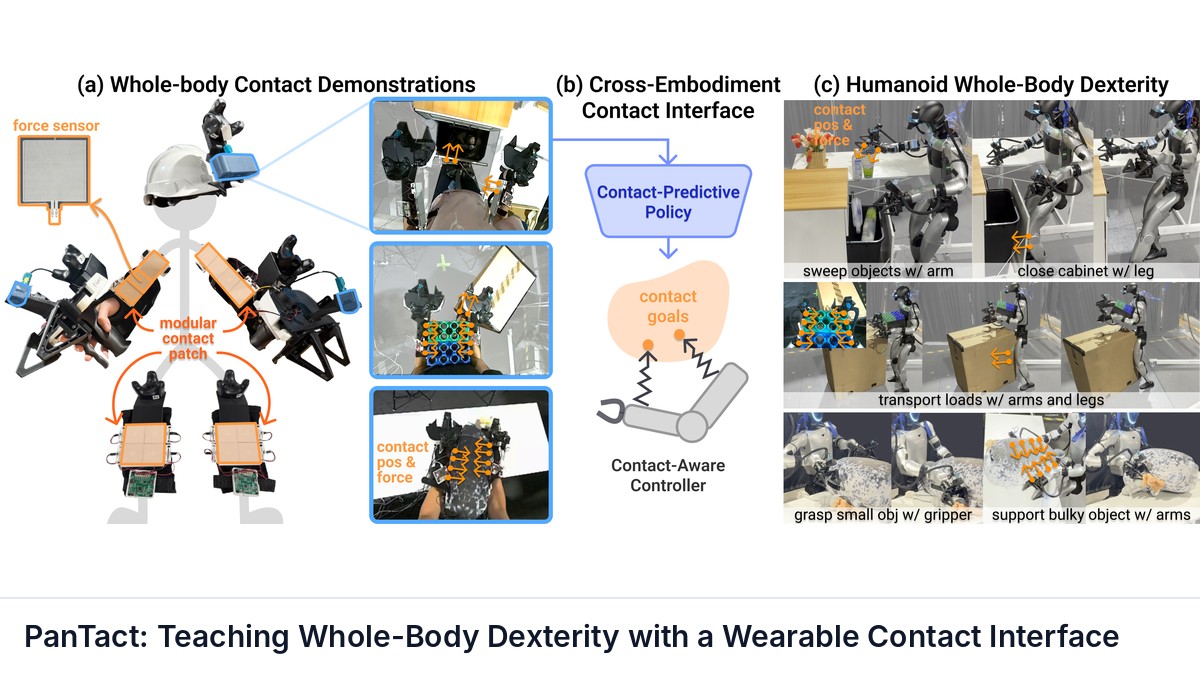
PanTact: Teaching Whole-Body Dexterity with a Wearable Contact Interface
arXiv preprint

PanTact: Teaching Whole-Body Dexterity with a Wearable Contact Interface

Xiaomeng Xu, Han Zhang, Zhian Ruan et al.

Humanoid robots have many degrees of freedom and contact surfaces, yet most loco-manipulation research restricts manipulation to the hands and avoids other body contacts with the environment.

manipulation vision reinforcement-learning control learning-from-demonstration
PDF Intermediate
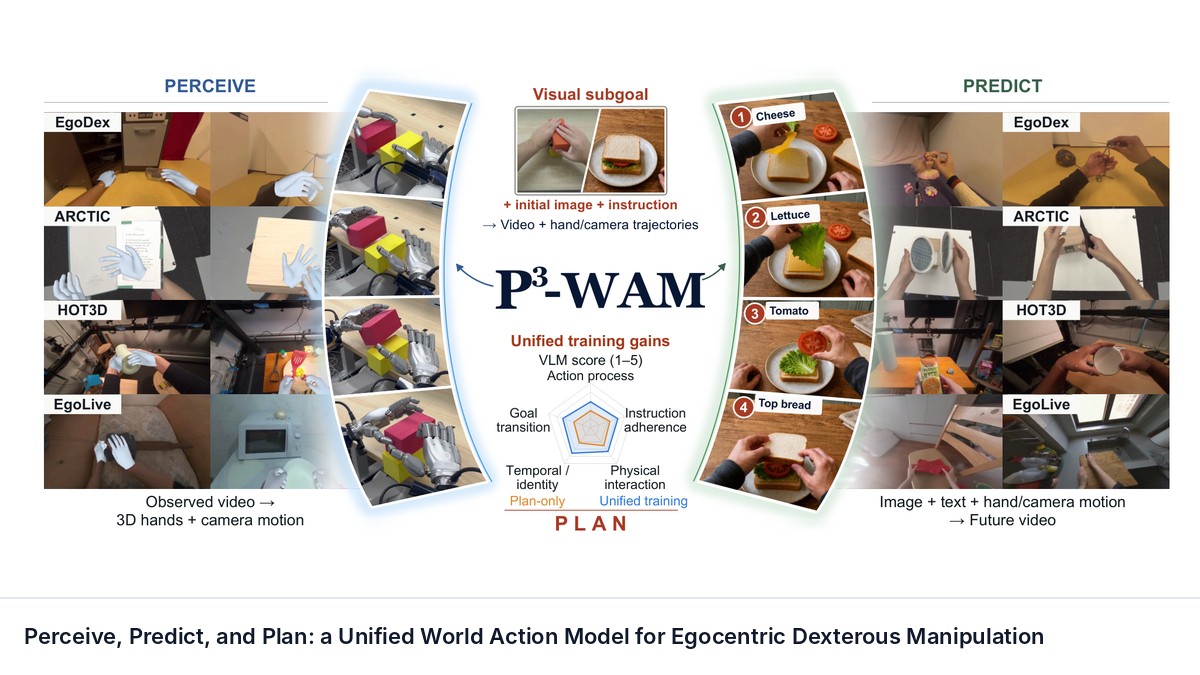
Perceive, Predict, and Plan: a Unified World Action Model for Egocentric Dexterous Manipulation
arXiv preprint

Perceive, Predict, and Plan: a Unified World Action Model for Egocentric Dexterous Manipulation

Zirui Wu, Chen Guo, Tianjian Jiang et al.

We introduce P$^{3}$-WAM, a unified world action model for egocentric dexterous manipulation that learns 3D perception, action-conditioned prediction, and goal-directed planning through three complementary modes: Perceive, which reconstructs articulated hand motion and camera trajectories from video; Predict, which generates visual futures under prescribed actions; and Plan, which jointly generates action trajectories and their anticipated visual consequences conditioned on an initial image, a language instruction, and an optional visual goal.

manipulation vision reinforcement-learning planning benchmark
Code PDF Advanced
GitHub ★ —
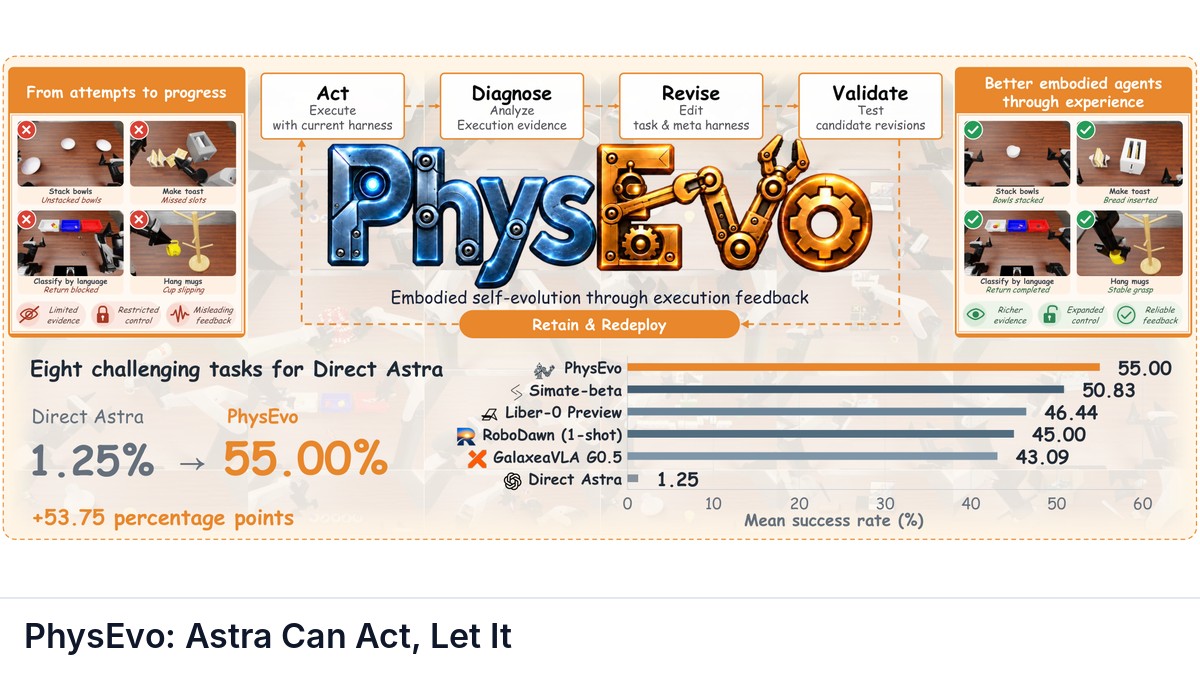
PhysEvo: Astra Can Act, Let It
arXiv preprint

PhysEvo: Astra Can Act, Let It

Wenqing Tian, Zeyu Zhang, Zhaocheng Liu et al.

Astra can act, yet reliable manipulation depends on the system through which it observes and controls the world. We introduce PhysEvo, a framework for physical recursive self-improvement (RSI) around a single frozen model.

manipulation vision reinforcement-learning control benchmark
Code PDF Intermediate
GitHub ★ —
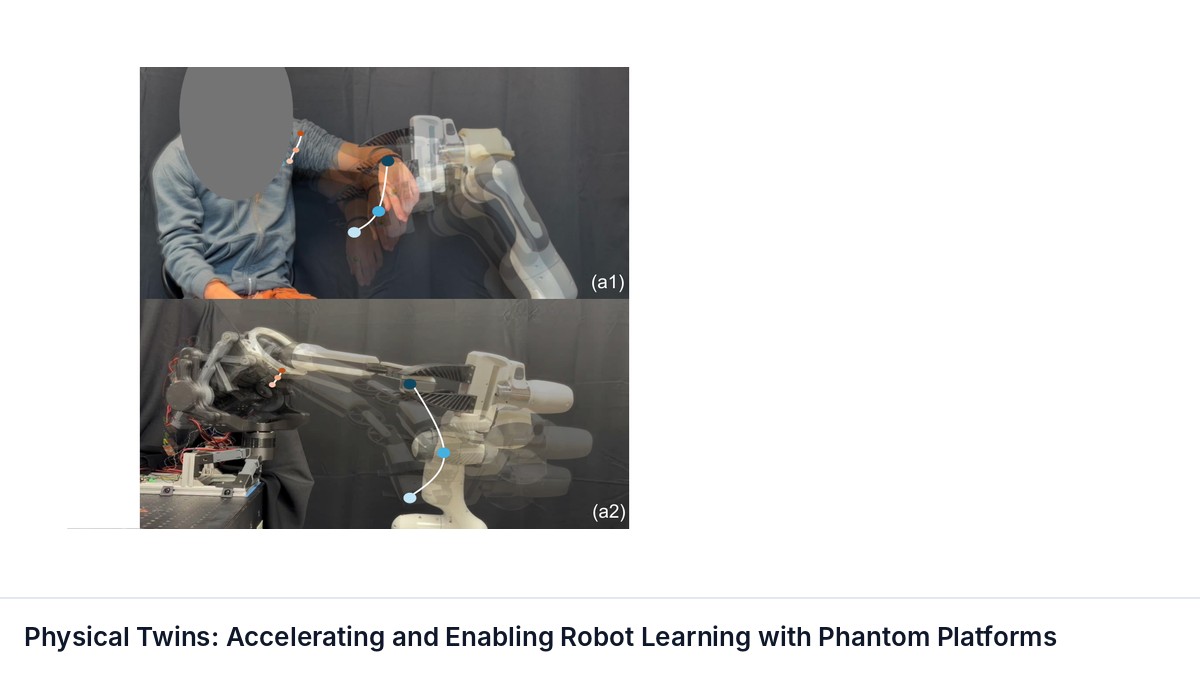
Physical Twins: Accelerating and Enabling Robot Learning with Phantom Platforms
arXiv preprint

Physical Twins: Accelerating and Enabling Robot Learning with Phantom Platforms

Elizabeth Peiros, Derek Chen, Lucas Yager et al.

Improvements in human-robot physical interaction (pHRI) can have major implications for physical therapy, search and rescue, and telemedicine. However, a major challenge concerns human constraints and safety in human-robot physical experiments.

reinforcement-learning human-robot-interaction
PDF Intermediate
Race to Recovery: Designing Advanced Safety Systems for Autonomous Driving via Learning Autonomous Racing
arXiv preprint

Race to Recovery: Designing Advanced Safety Systems for Autonomous Driving via Learning Autonomous Racing

Teodor Ilie, Kleber Cabral, Sidney Givigi

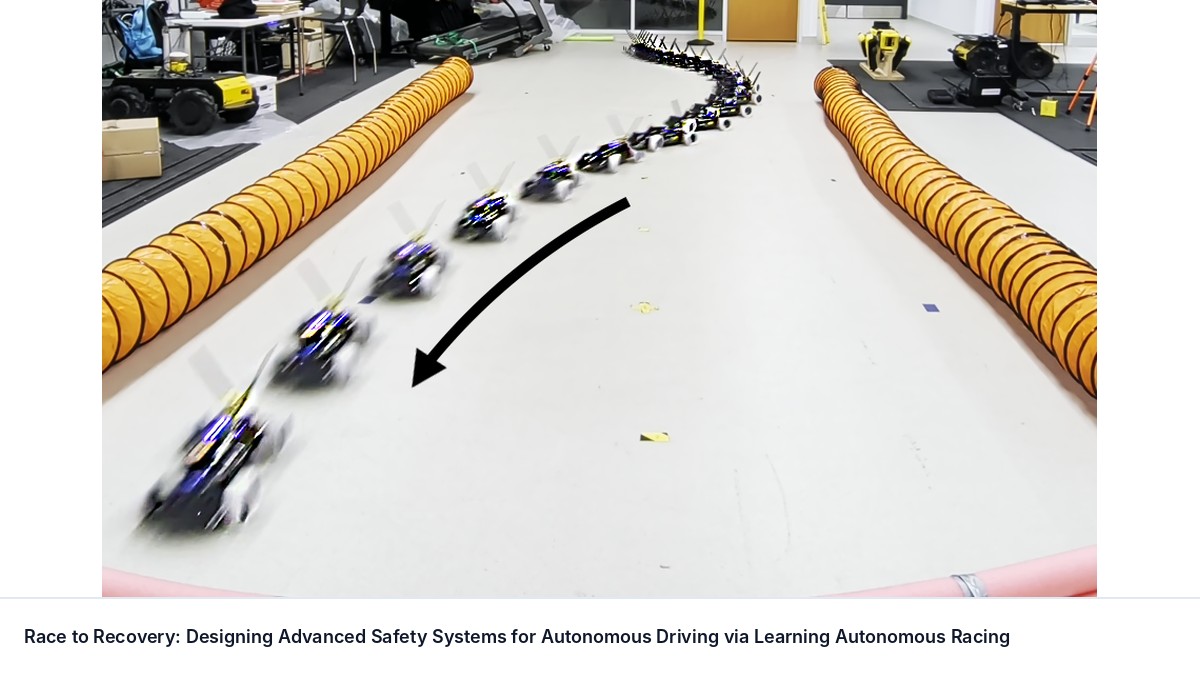
Vehicles that lose control at the handling limit through icing, hydroplaning, or an abrupt evasive maneuver fall outside the operating envelope of production safety systems such as electronic stability control, which focus on preventing instability rather than recovering from it.

reinforcement-learning sim-to-real control benchmark
Code PDF Intermediate
GitHub ★ —
RAIN: Robotic Task Generalization with Region-Aware Interaction Networks
arXiv preprint

RAIN: Robotic Task Generalization with Region-Aware Interaction Networks

Seunghun Lee, Kyuhwan Shim, Yeogyeong Song et al.

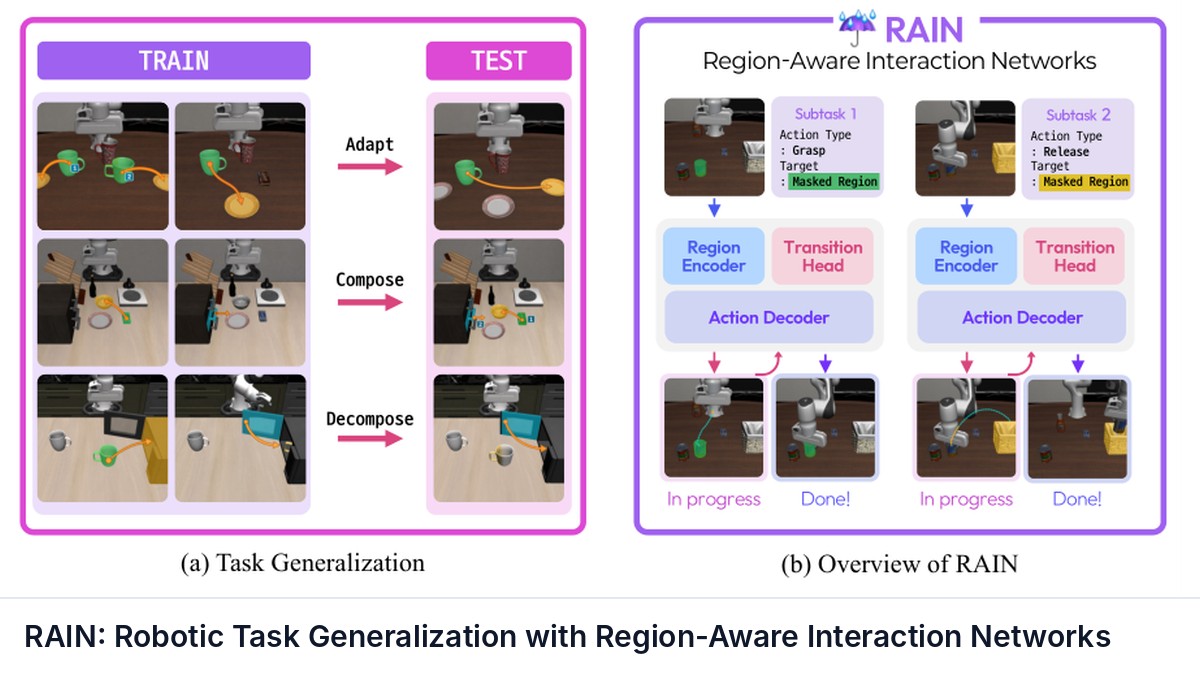
Existing vision-language-action (VLA) models benefit from large-scale vision-language pretraining, but tend to memorize training trajectories, limiting their ability to adapt learned interactions to new task and scene configurations.

vision vla reinforcement-learning benchmark
Code PDF Advanced
GitHub ★ —
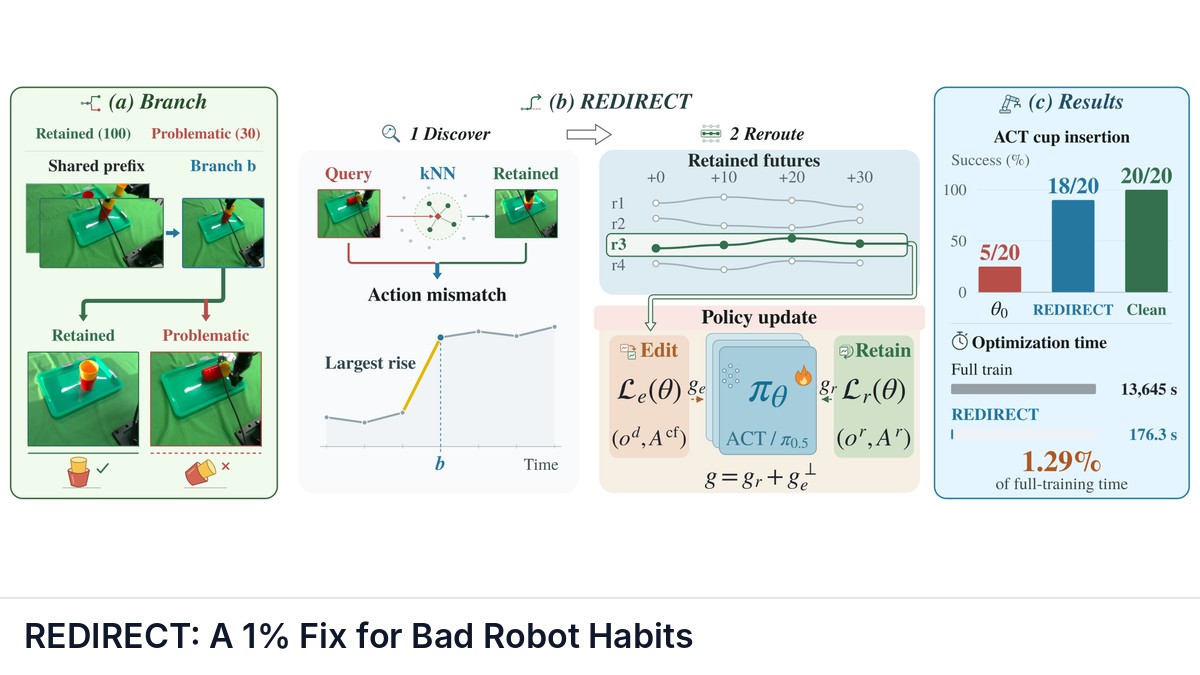
REDIRECT: A 1% Fix for Bad Robot Habits
arXiv preprint

REDIRECT: A 1% Fix for Bad Robot Habits

Yu Zhang, Jiazhuo Li, Yancong Wei et al.

Robots can acquire bad habits from a few defective moments in otherwise useful teleoperation. In mixed-quality robot data, normal and problematic demonstrations share most task behavior and differ only at a local action continuation.

learning-from-demonstration
PDF Intermediate
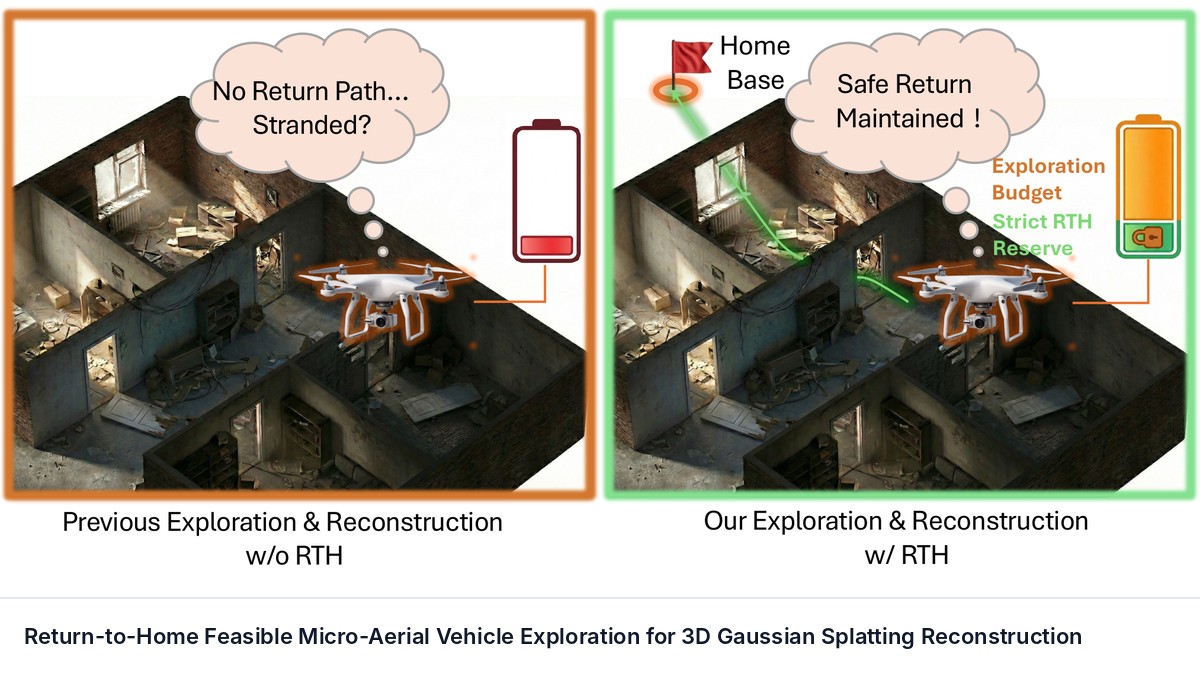
Return-to-Home Feasible Micro-Aerial Vehicle Exploration for 3D Gaussian Splatting Reconstruction
arXiv preprint

Return-to-Home Feasible Micro-Aerial Vehicle Exploration for 3D Gaussian Splatting Reconstruction

Prajit Krisshnakumar, Fan Yang, Koichiro Niinuma

Micro aerial vehicles (MAVs) enable rapid indoor 3D reconstruction for inspection and time-critical situational awareness, but must operate under strict flight-time budgets and safety constraints that require explicit return-to-home (RTH) feasibility with a conservative margin.

reinforcement-learning planning control benchmark
PDF Intermediate
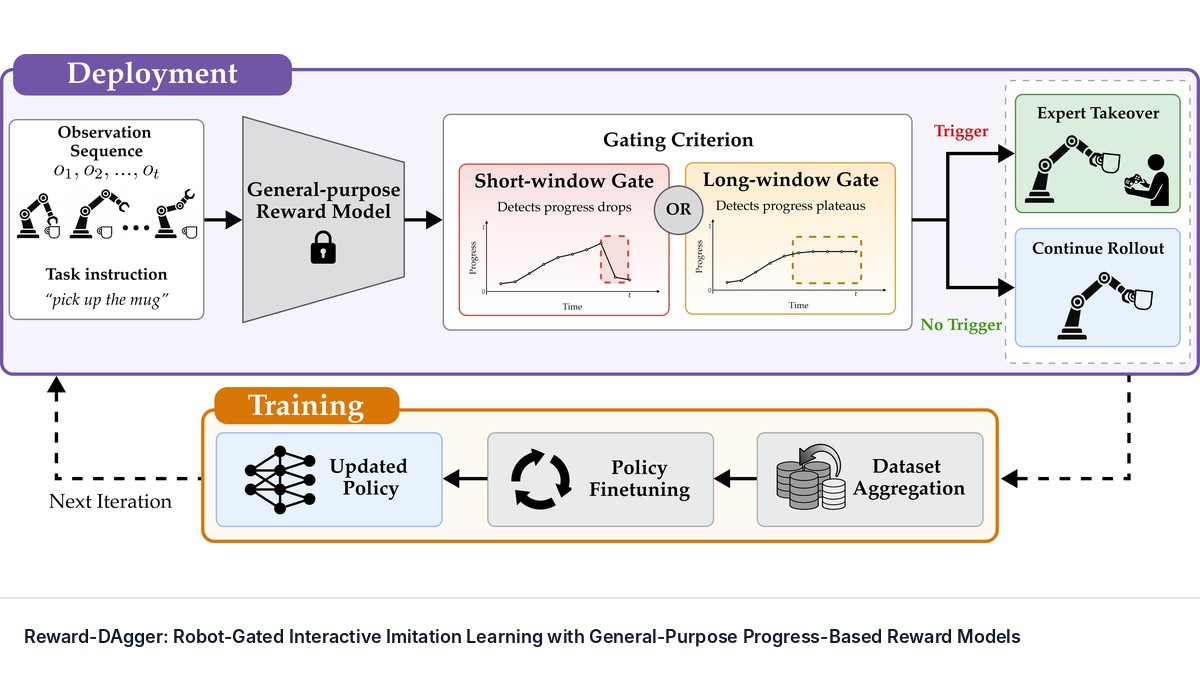
Reward-DAgger: Robot-Gated Interactive Imitation Learning with General-Purpose Progress-Based Reward Models
arXiv preprint

Reward-DAgger: Robot-Gated Interactive Imitation Learning with General-Purpose Progress-Based Reward Models

Ryan Li, Yigit Korkmaz, Erdem B{\i}y{\i}k

Recent advances in robot learning have enabled generalist control policies capable of completing a wide range of tasks. However, their performance degrades when deployed in unseen environments, making it critical to detect failures and teach recovery behaviors.

vision reinforcement-learning control learning-from-demonstration
PDF Intermediate
Robot Learning on Discrete Surfaces: Theory and Applications
arXiv preprint

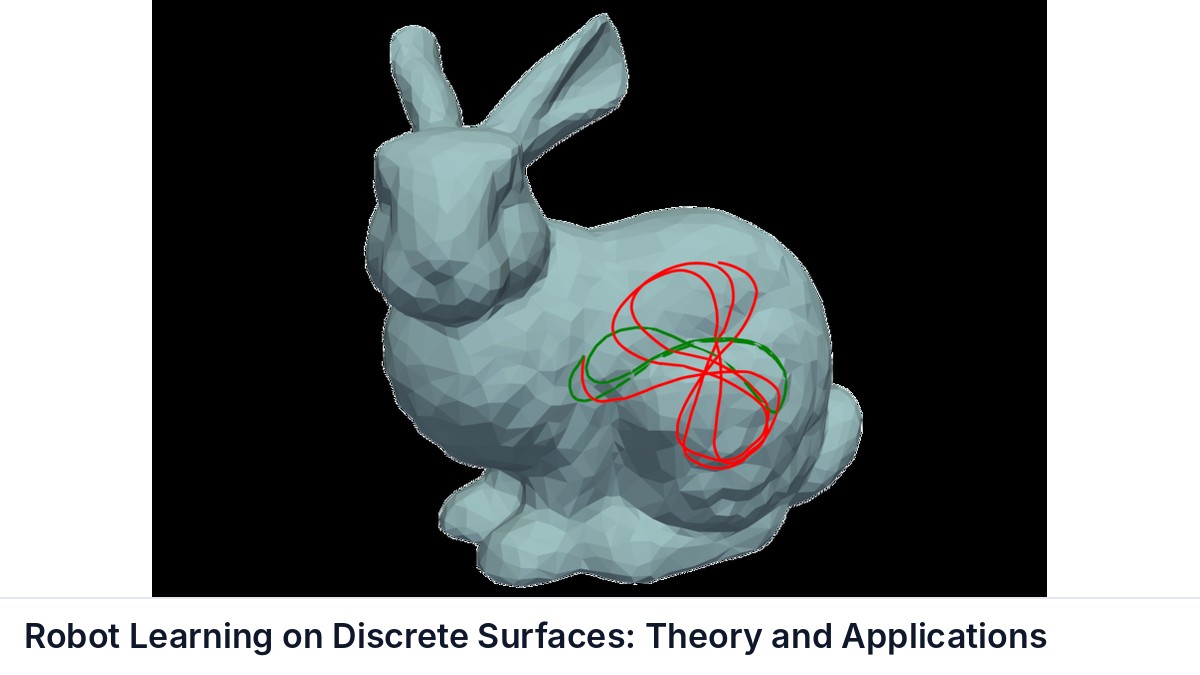
Robot Learning on Discrete Surfaces: Theory and Applications

Matteo Dalle Vedove, Fares J. Abu-Dakka, Luigi Palopoli et al.

All the objects composing our world are enclosed within surfaces. Yet, most robot learning and motion generation frameworks treat surfaces as constraints ignoring their intrinsic geometry.

reinforcement-learning planning control
PDF Intermediate
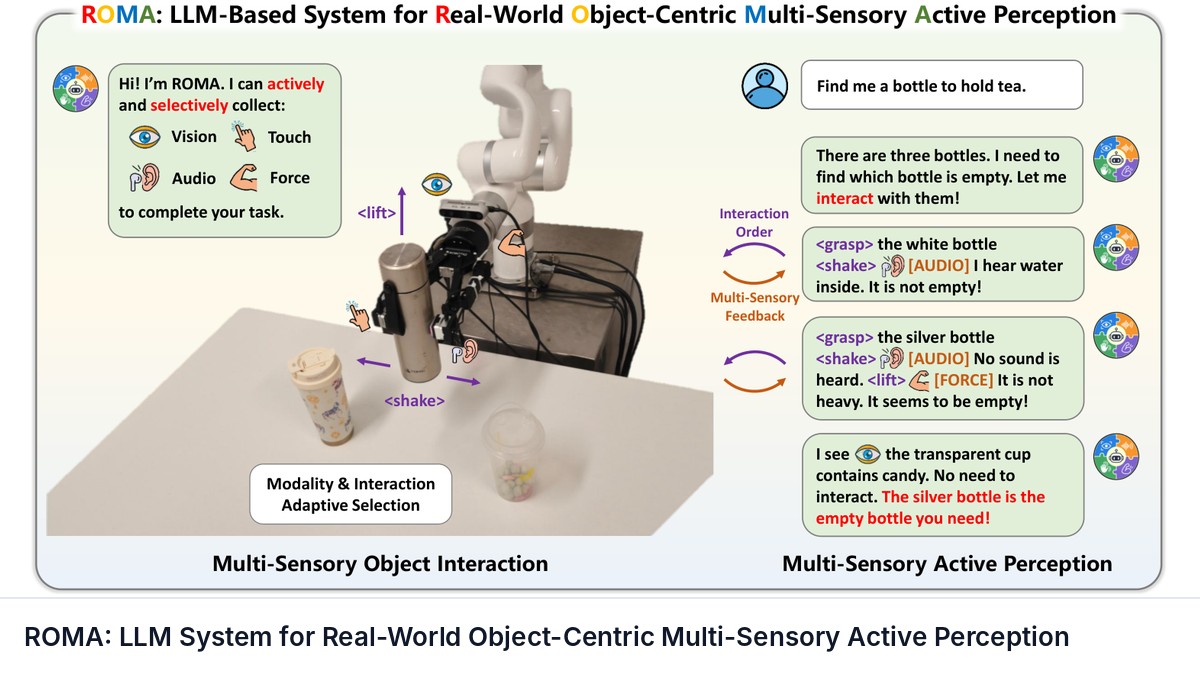
ROMA: LLM System for Real-World Object-Centric Multi-Sensory Active Perception
arXiv preprint

ROMA: LLM System for Real-World Object-Centric Multi-Sensory Active Perception

Ruoxuan Feng, Yutong Chen, Ruihua Song et al.

Humans inherently understand the physical world through an active process. When sensory evidence is insufficient to infer physical properties, we naturally interact with the environment by deciding what information is missing, how to acquire it, and when sufficient evidence has been obtained.

vision vla reinforcement-learning tactile benchmark
Code PDF Advanced
GitHub ★ —
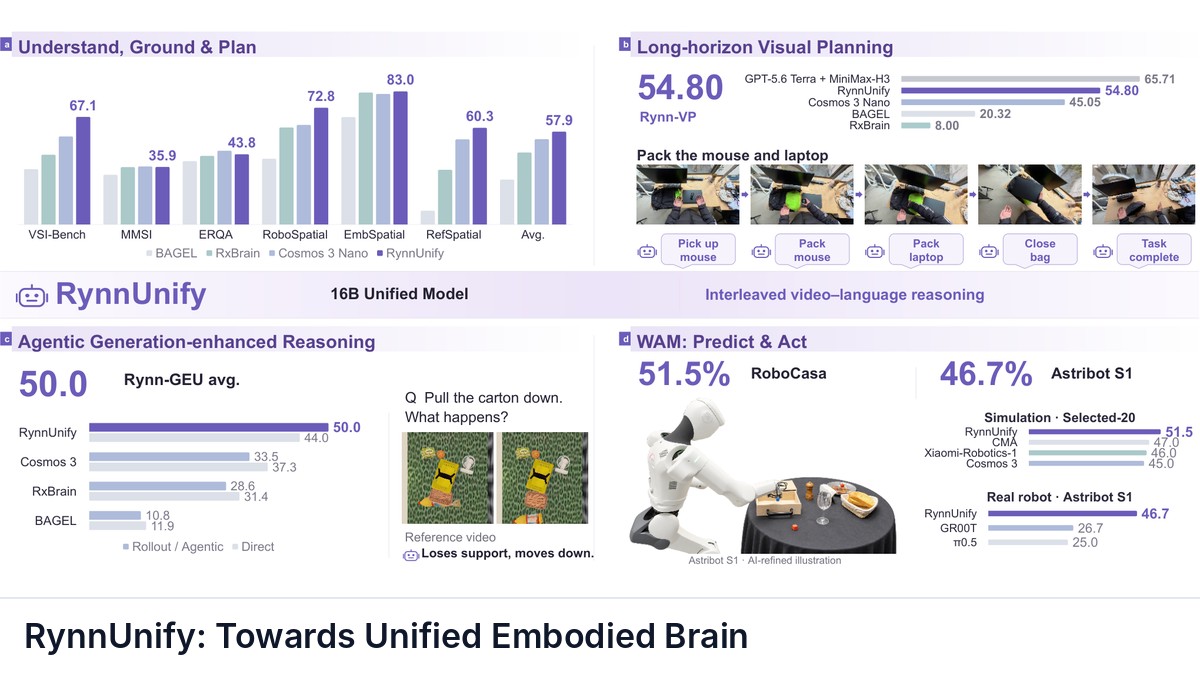
RynnUnify: Towards Unified Embodied Brain
arXiv preprint

RynnUnify: Towards Unified Embodied Brain

Minghao Zhu, Bohan Hou, Kun Xiang et al.

We introduce RynnUnify, a 16B unified embodied model that combines strong embodied understanding with long-horizon visual planning through interleaved video--language reasoning.

vision reinforcement-learning planning control
Code PDF Intermediate
GitHub ★ —
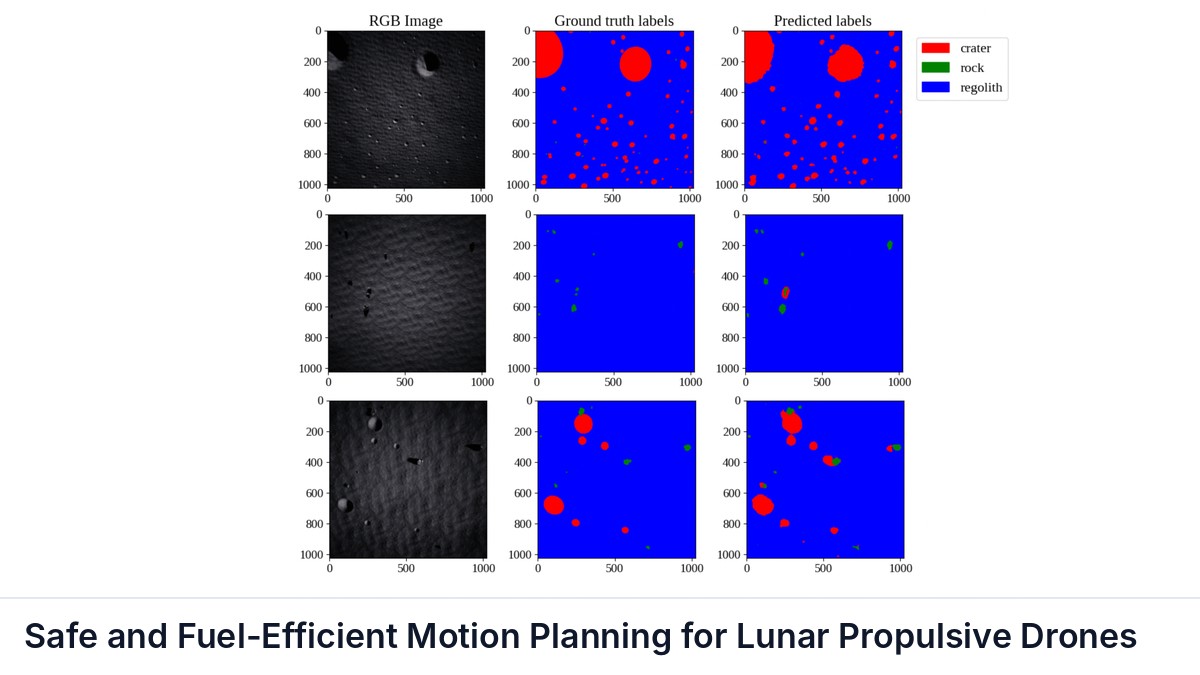
Safe and Fuel-Efficient Motion Planning for Lunar Propulsive Drones
arXiv preprint

Safe and Fuel-Efficient Motion Planning for Lunar Propulsive Drones

Elena Wittemyer, Graco Gao

Propulsive drones are a promising new technology for generating high-resolution terrain models of the Moon. In future lunar missions, propulsive drones will complete a series of hops across the lunar surface while capturing images with downward-facing cameras.

vision planning control
PDF Intermediate
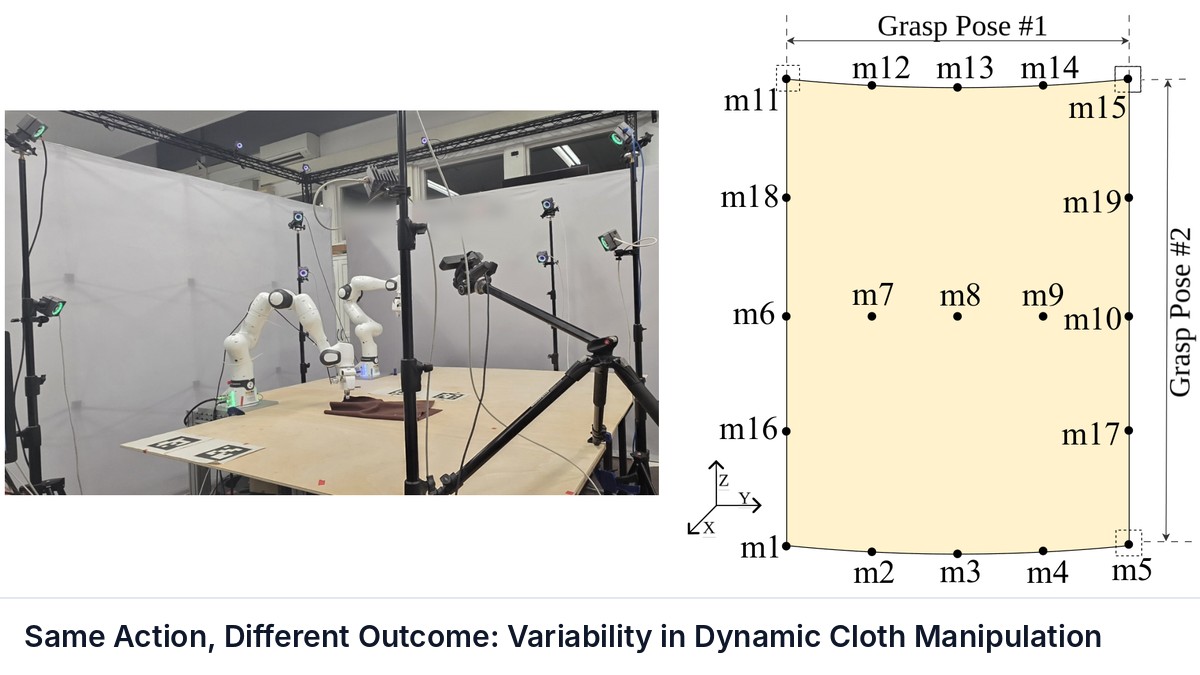
Same Action, Different Outcome: Variability in Dynamic Cloth Manipulation
arXiv preprint

Same Action, Different Outcome: Variability in Dynamic Cloth Manipulation

Mahed Dadgostar, Guillem Aleny\`a, J\'ulia Borr\`as

Although cloth is known to exhibit different outcomes under repeated fast dynamic motions, even when the same trajectory is applied, this variability has not yet been systematically characterized.

manipulation vision reinforcement-learning benchmark
Code PDF Intermediate
GitHub ★ —
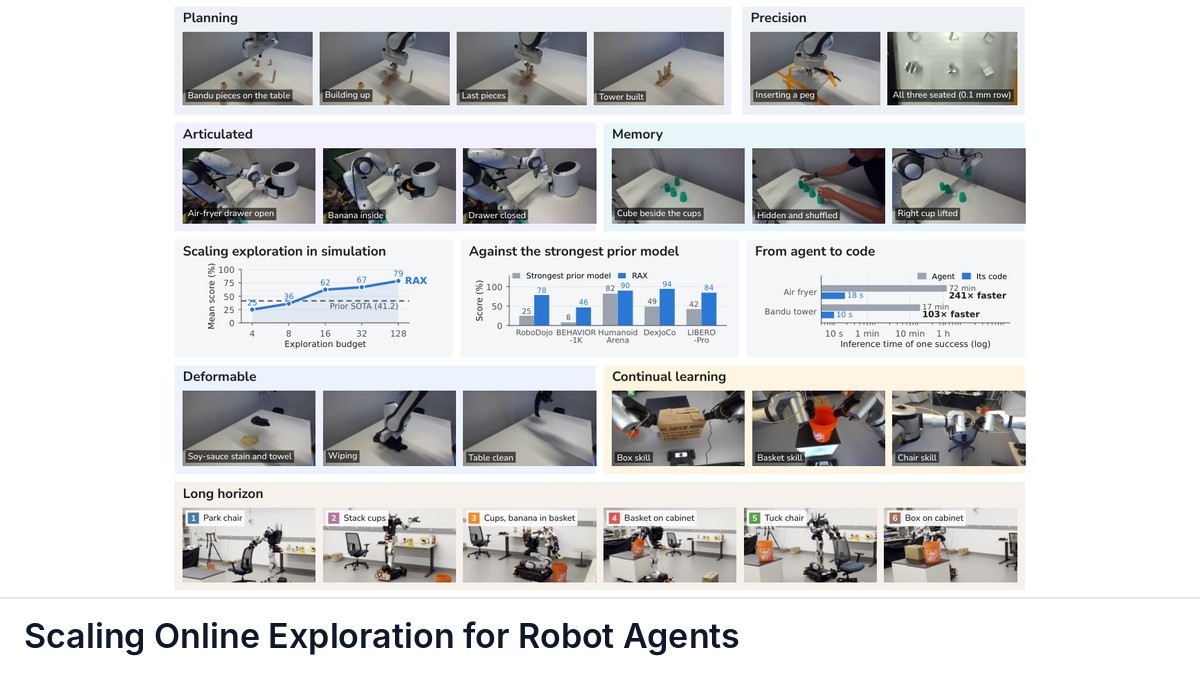
Scaling Online Exploration for Robot Agents
arXiv preprint

Scaling Online Exploration for Robot Agents

Runhan Huang, Xiangcheng Zhang, Haoyu Chen et al.

Robot learning has advanced by scaling demonstration datasets and model capacity; however, deploying a new robot embodiment or task typically necessitates a dedicated teleoperation corpus.

manipulation vision reinforcement-learning planning control learning-from-demonstration benchmark
PDF Intermediate
SEVI: Safe Evidential Real-World Reinforcement Learning
arXiv preprint

SEVI: Safe Evidential Real-World Reinforcement Learning

Shaekh Mohammad Shithil, Lantao Liu

SEVI targets unsafe interactions during online reinforcement learning on physical robots by deciding when a proposed action should be replaced with a recovery behavior.

manipulation reinforcement-learning
PDF Intermediate
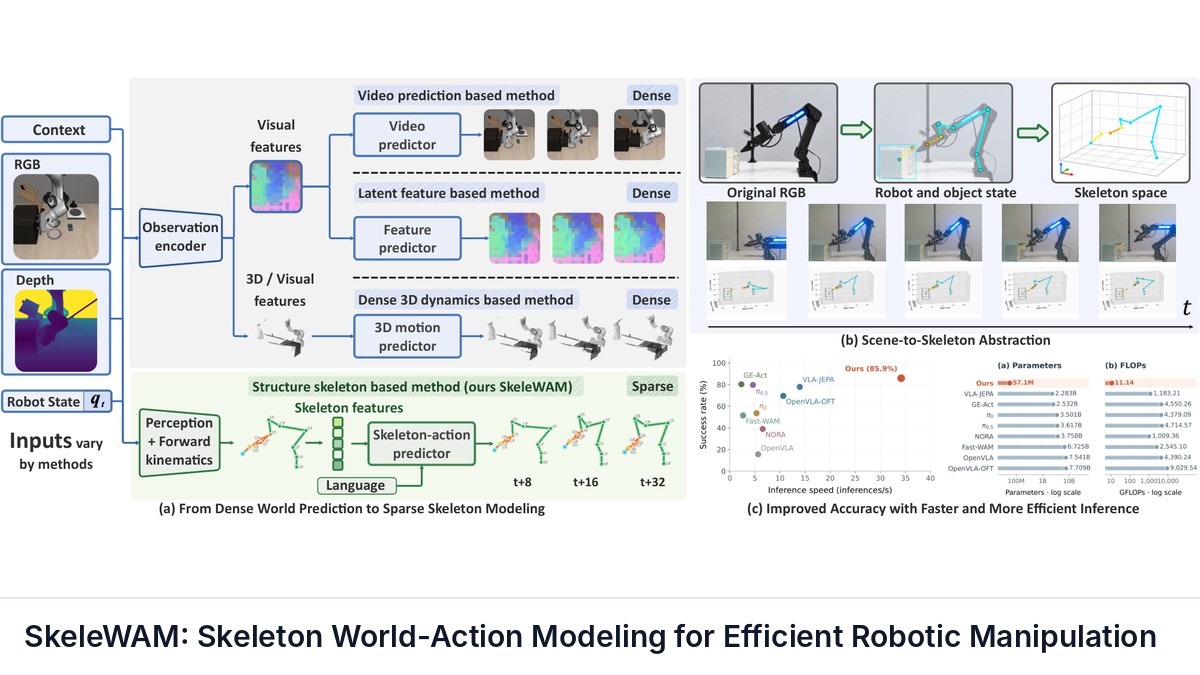
SkeleWAM: Skeleton World-Action Modeling for Efficient Robotic Manipulation
arXiv preprint

SkeleWAM: Skeleton World-Action Modeling for Efficient Robotic Manipulation

Juyi Sheng, Hua Wang, Mengyuan Liu

World action models (WAMs) combine robot action generation with future state prediction. Existing WAMs typically predict videos or learned visual latents, which represent interaction geometry only implicitly and may retain appearance information unrelated to control.

manipulation vision reinforcement-learning control
PDF Intermediate
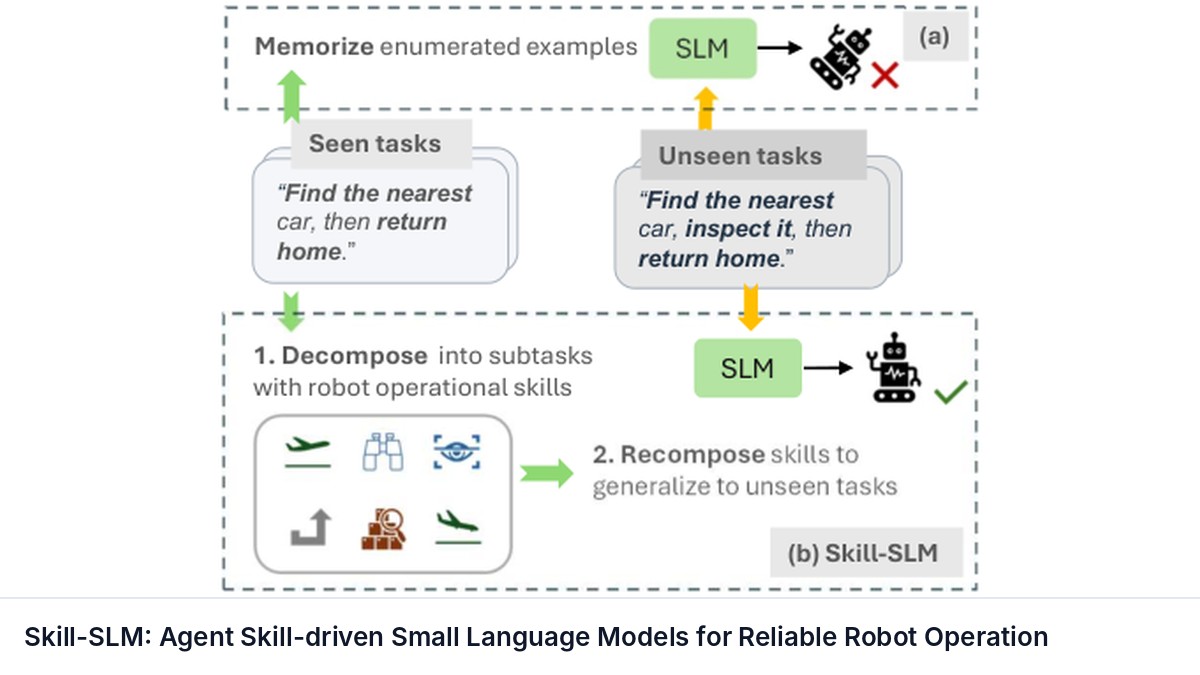
Skill-SLM: Agent Skill-driven Small Language Models for Reliable Robot Operation
arXiv preprint

Skill-SLM: Agent Skill-driven Small Language Models for Reliable Robot Operation

Wenhao Wang, Yanyan Li, Jiawei Yuan

Small language models (SLMs) have been increasingly adopted for onboard robot operation because they enable intelligent decision-making. However, existing approaches are mainly distillation-oriented and rely on enumerating representative task-solution pairs.

vla reinforcement-learning control benchmark
PDF Intermediate
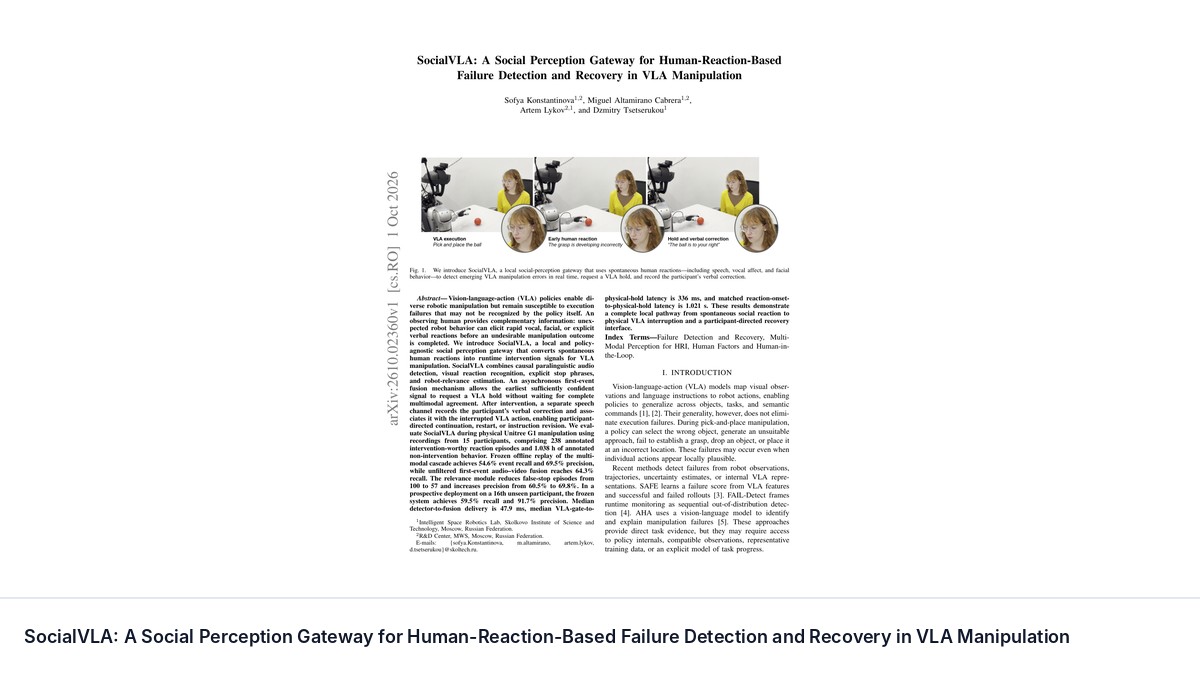
SocialVLA: A Social Perception Gateway for Human-Reaction-Based Failure Detection and Recovery in VLA Manipulation
arXiv preprint

SocialVLA: A Social Perception Gateway for Human-Reaction-Based Failure Detection and Recovery in VLA Manipulation

Sofya Konstantinova, Miguel Altamirano Cabrera, Artem Lykov et al.

Vision-language-action (VLA) policies enable diverse robotic manipulation but can fail during execution without recognizing their own errors. Human observers provide complementary signals, as unexpected robot behavior can trigger rapid vocal, facial, or verbal reactions before failure is completed.

manipulation vision vla reinforcement-learning control
Code PDF Intermediate
GitHub ★ —
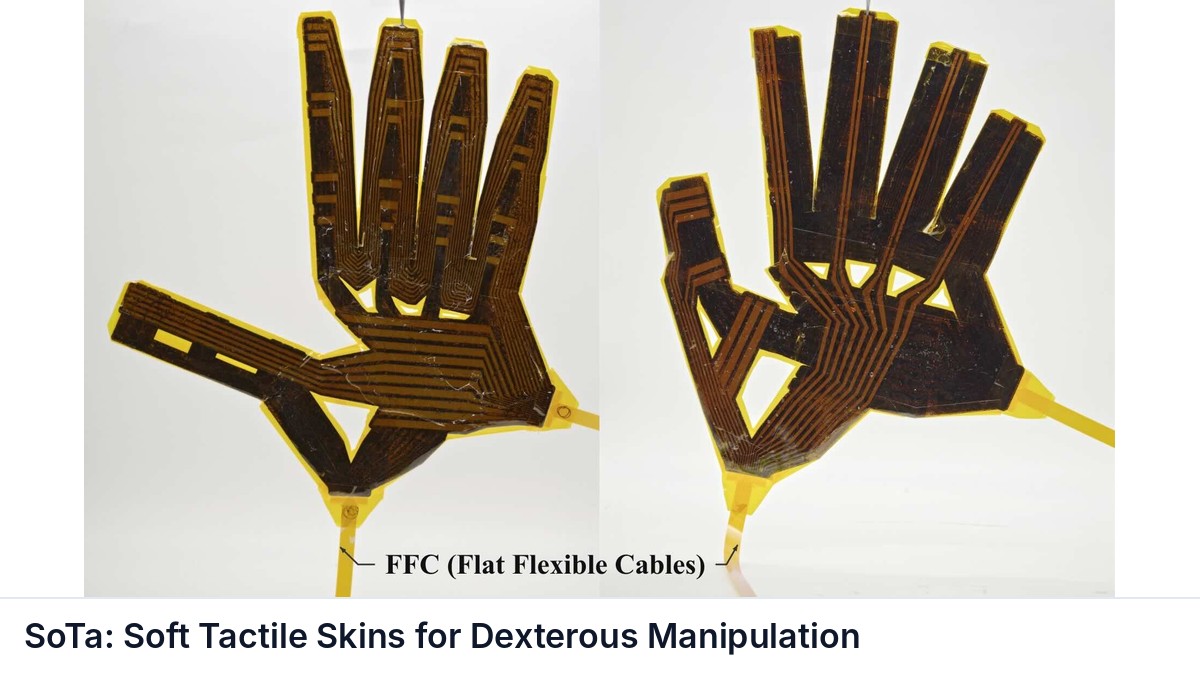
SoTa: Soft Tactile Skins for Dexterous Manipulation
arXiv preprint

SoTa: Soft Tactile Skins for Dexterous Manipulation

Jingyun Yang, Baiyu Shi, Timothy Yu et al.

A growing body of work suggests that tactile sensing gives robot policies contact information that complements vision in dexterous manipulation. However, visuo-tactile robot data remains scarce: dexterous demonstrations require teleoperating robots, which limits dataset scale.

manipulation vision reinforcement-learning learning-from-demonstration tactile benchmark
PDF Intermediate
SUAVE: Unified Video-Action Models via Masked Diffusion
arXiv preprint

SUAVE: Unified Video-Action Models via Masked Diffusion

Rhythm Syed, Jean Mercat, Sedrick Keh et al.

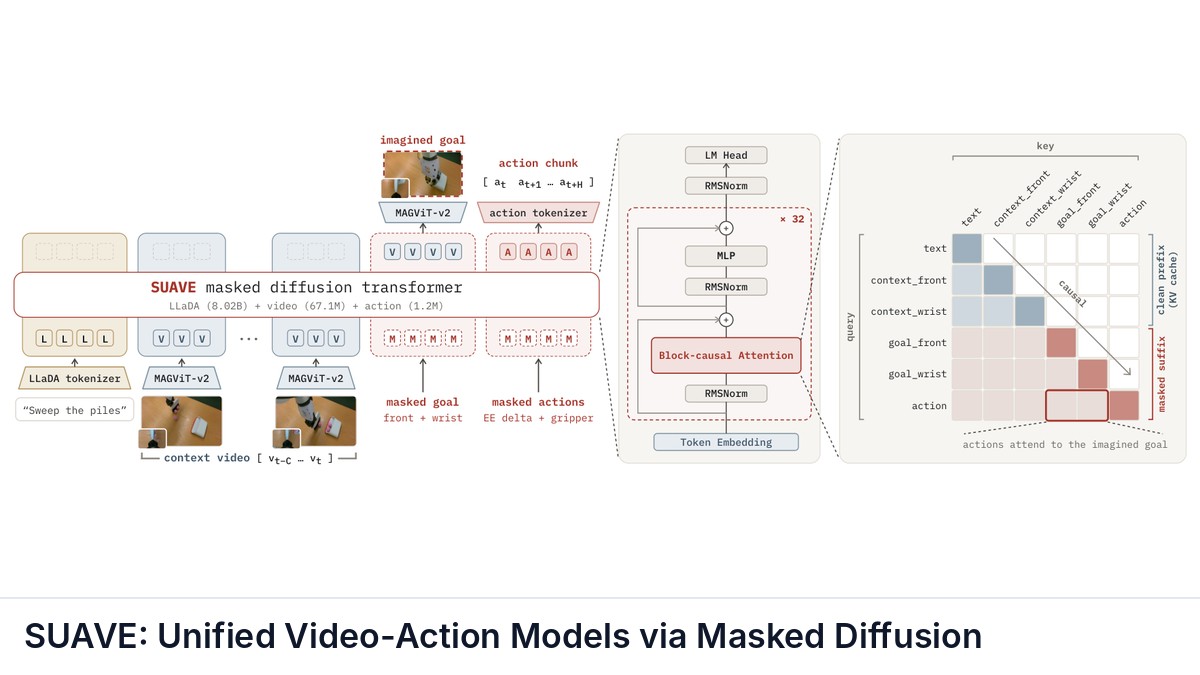
Vision-language-action models (VLAs) inherit strong semantic grounding from pretrained vision-language backbones but are typically optimized for predicting actions rather than future observations. They can see and act, but they do not imagine the future before acting.

manipulation vision vla reinforcement-learning control
PDF Advanced
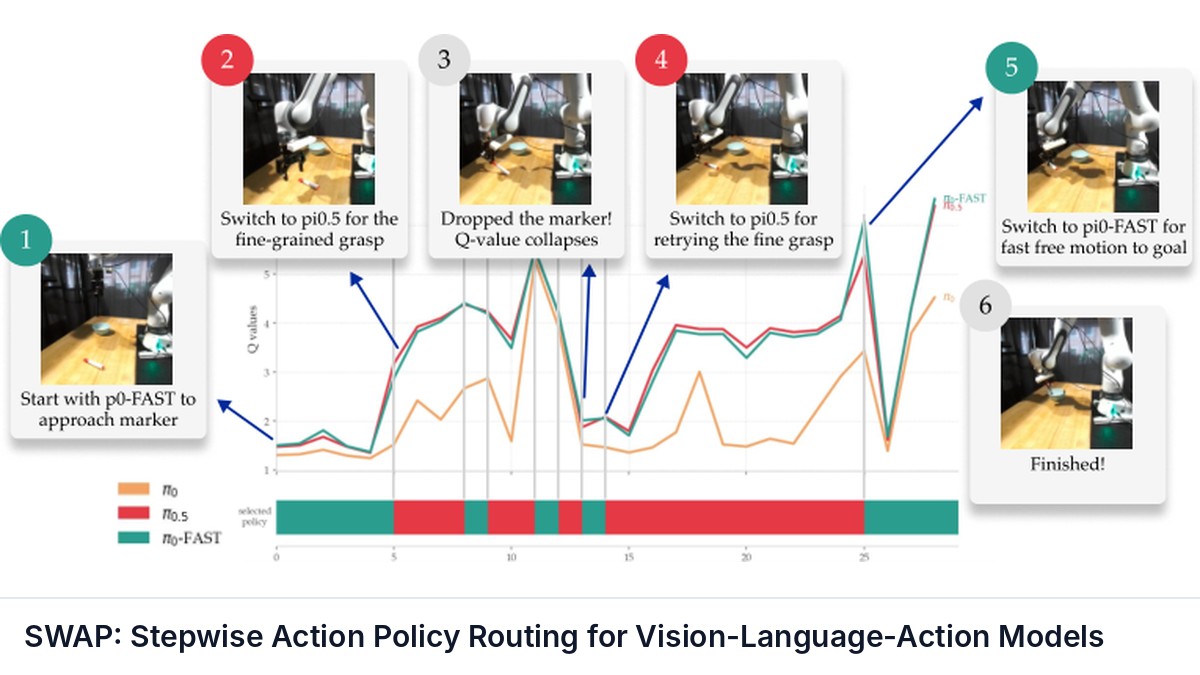
SWAP: Stepwise Action Policy Routing for Vision-Language-Action Models
arXiv preprint

SWAP: Stepwise Action Policy Routing for Vision-Language-Action Models

Mousumi Das, Aditeya Prajapati, Abrar Anwar et al.

Robot manipulation systems using Vision-Language-Action (VLA) model backbones typically use just one VLA for task execution. However, individual VLAs do not perform well across different task states and environments.

manipulation vision vla reinforcement-learning
Code PDF Intermediate
GitHub ★ —
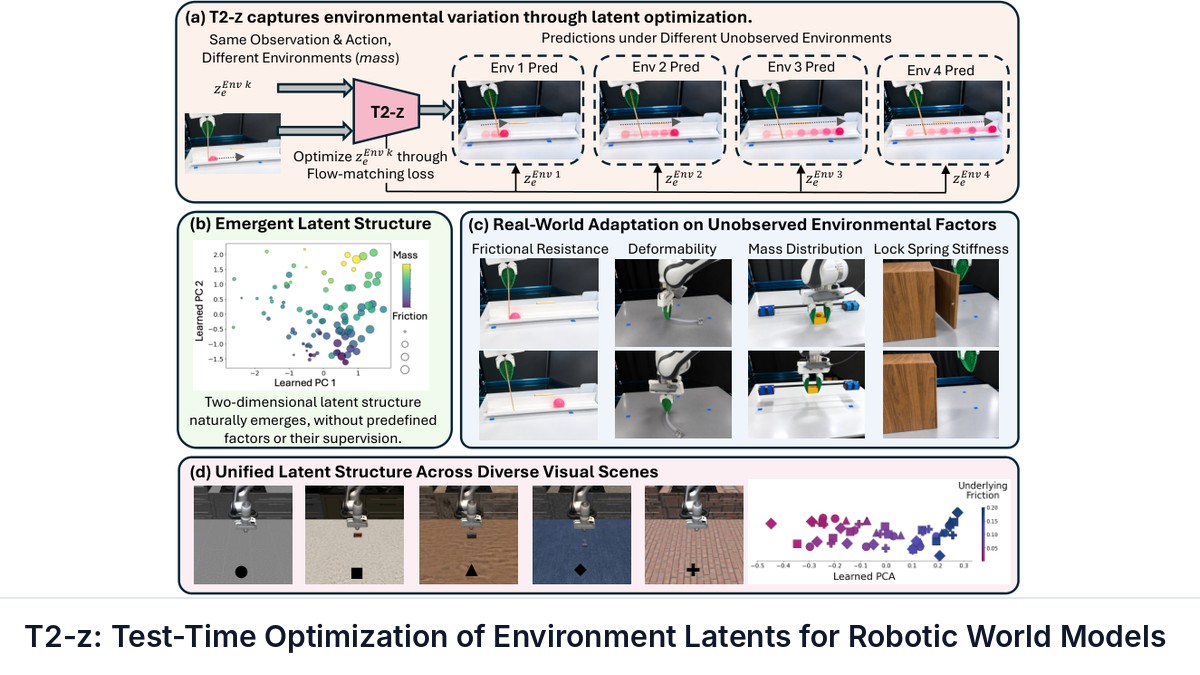
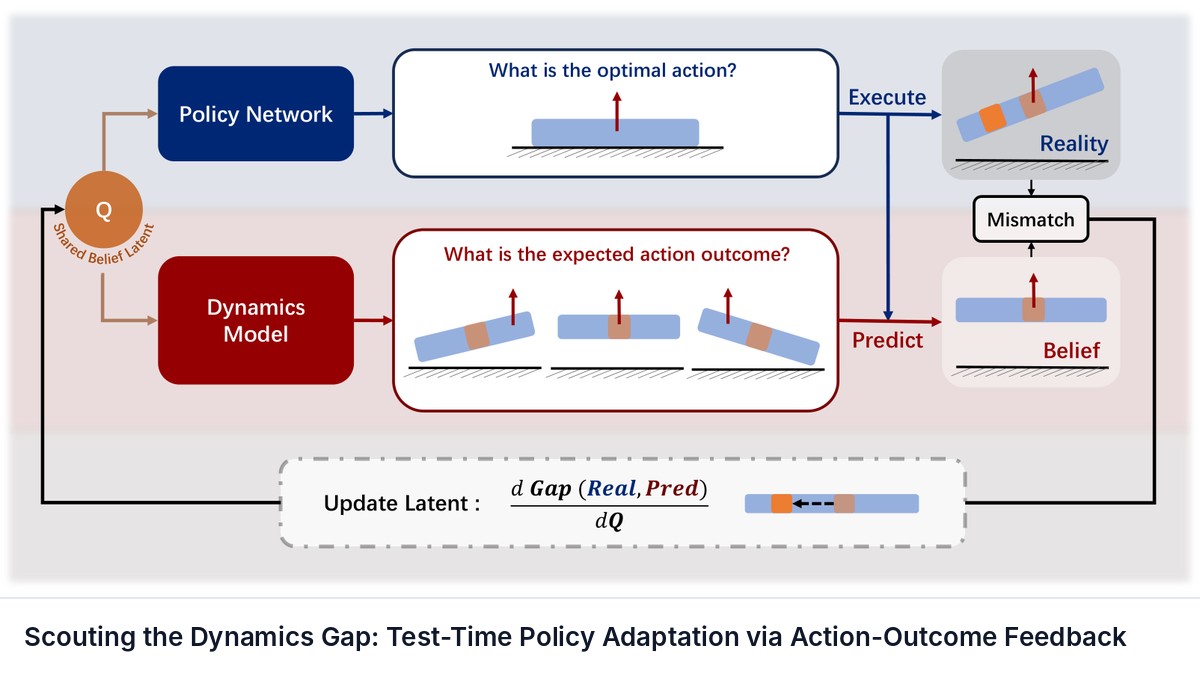
T2-z: Test-Time Optimization of Environment Latents for Robotic World Models
arXiv preprint

T2-z: Test-Time Optimization of Environment Latents for Robotic World Models

Chenyuan Zhou, Yining Hong, Huang Huang et al.

Predicting how the world responds to an action requires more than what can be seen: robots must account for environmental factors that are neither directly observable nor explicitly specified, from physical properties such as friction and mass to human-defined environmental rules.

vision reinforcement-learning
Code PDF Intermediate
GitHub ★ —
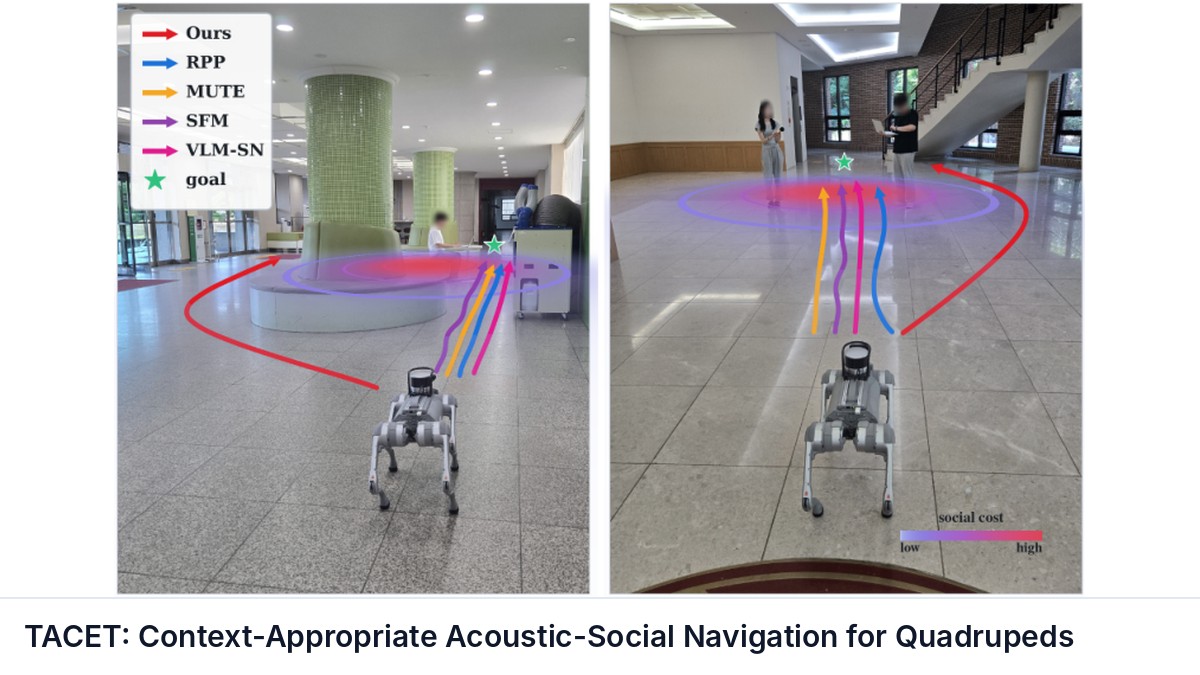
TACET: Context-Appropriate Acoustic-Social Navigation for Quadrupeds
arXiv preprint

TACET: Context-Appropriate Acoustic-Social Navigation for Quadrupeds

Sungsan Park, Young-Sik Shin, Sanghyun Kim

Quadruped robots entering hospitals, care homes, and quiet offices must be context-appropriate not only in where they move but in how loudly they move: a legged robot's locomotion noise, dominated by foot-ground impacts, is itself a social variable.

locomotion vision reinforcement-learning planning control
Code PDF Intermediate
GitHub ★ —
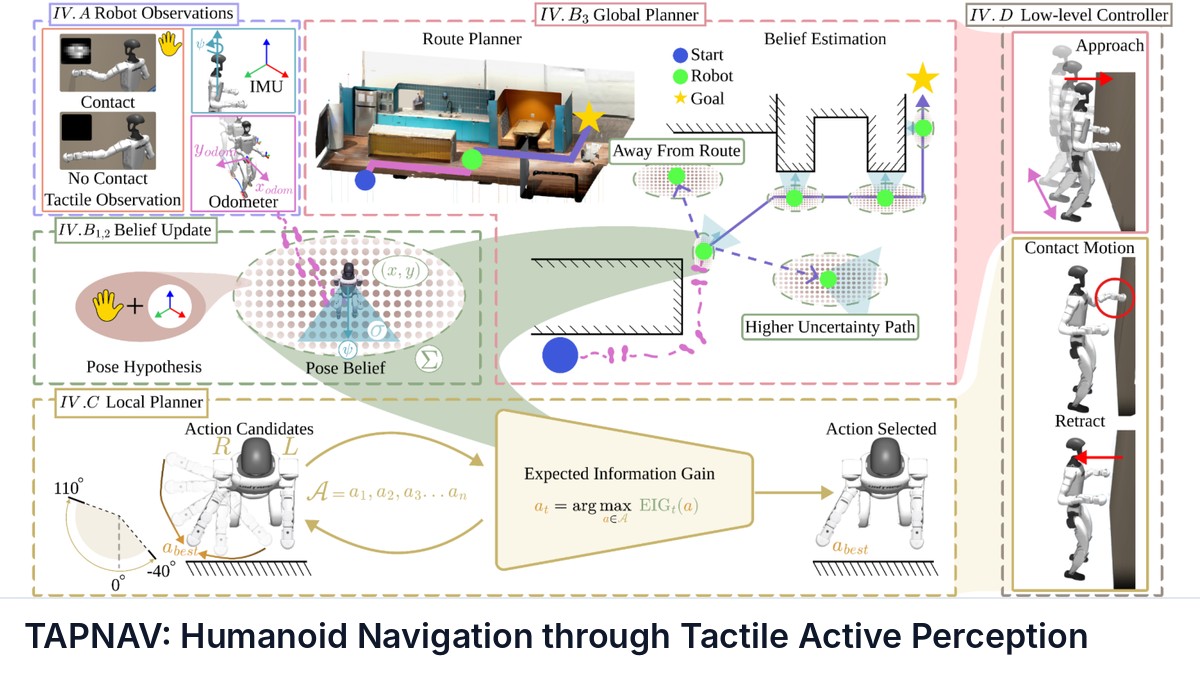
TAPNAV: Humanoid Navigation through Tactile Active Perception
arXiv preprint

TAPNAV: Humanoid Navigation through Tactile Active Perception

Huaze Liu, Zhenyu Wu, Jaehwi Jang et al.

Navigation in vision-denied environments is challenging for humanoid robots because proprioceptive odometry drifts and localization uncertainty accumulates rapidly.

locomotion vision reinforcement-learning planning control tactile
PDF Intermediate
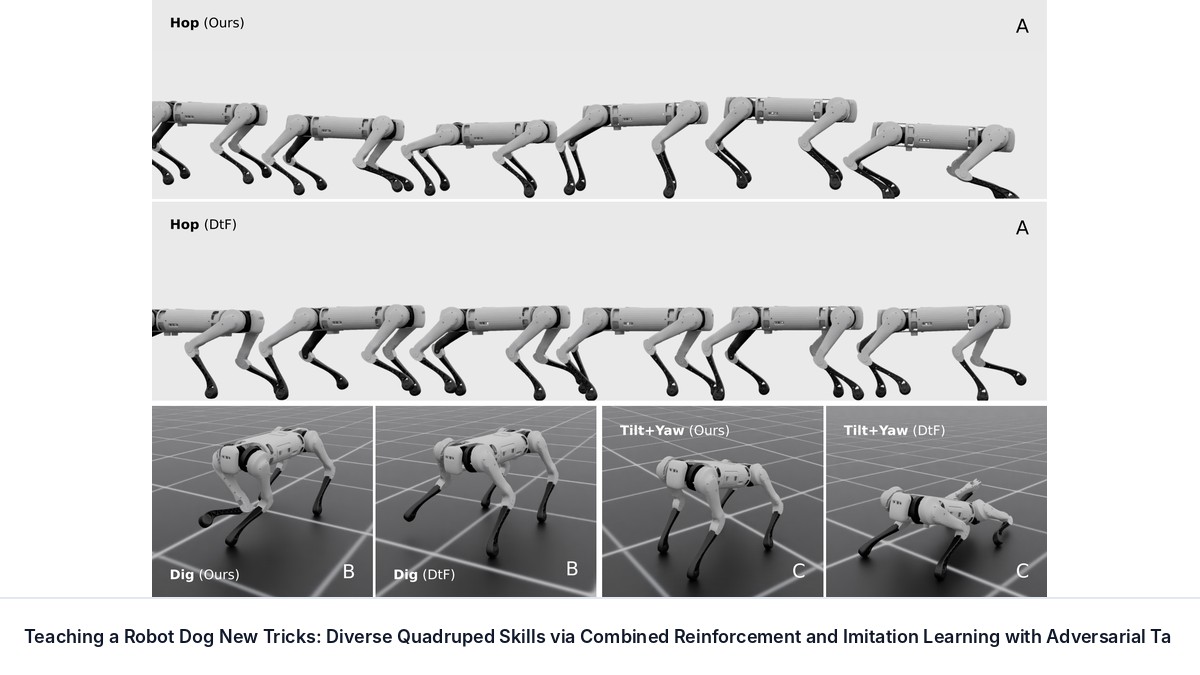
Teaching a Robot Dog New Tricks: Diverse Quadruped Skills via Combined Reinforcement and Imitation Learning with Adversarial Task Selection
arXiv preprint

Teaching a Robot Dog New Tricks: Diverse Quadruped Skills via Combined Reinforcement and Imitation Learning with Adversarial Task Selection

Lemon Foxmere, Anthony Furman, Yizheng Du et al.

Reinforcement Learning (RL) has enabled legged robots to perform a range of skills in single-task settings. However, applications such as farm robotics or space exploration require diverse skills such as locomotion, digging, or close-range surveying.

locomotion reinforcement-learning learning-from-demonstration benchmark
PDF Advanced
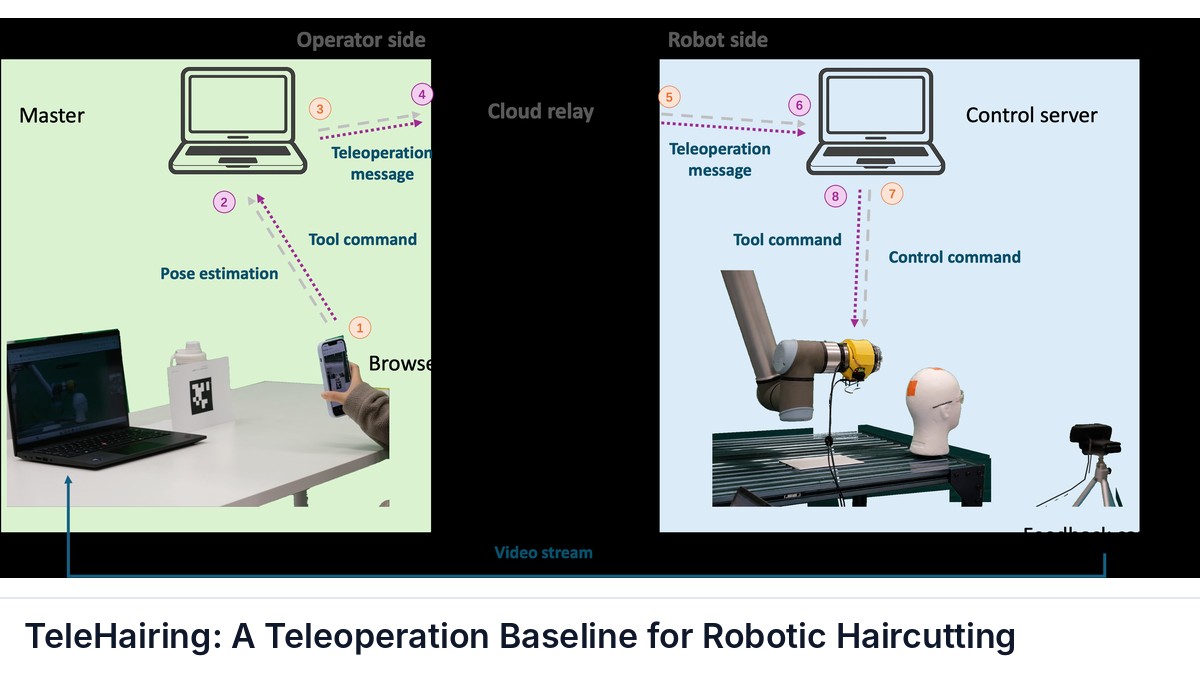
TeleHairing: A Teleoperation Baseline for Robotic Haircutting
arXiv preprint

TeleHairing: A Teleoperation Baseline for Robotic Haircutting

Zhendai Huang, Aleksi Vilkki, Jianan Huang et al.

Robotic haircutting requires controlled tool motion near the head while simultaneously accounting for communication, visual feedback, tool actuation, and interruption handling.

vision control learning-from-demonstration benchmark
PDF Intermediate
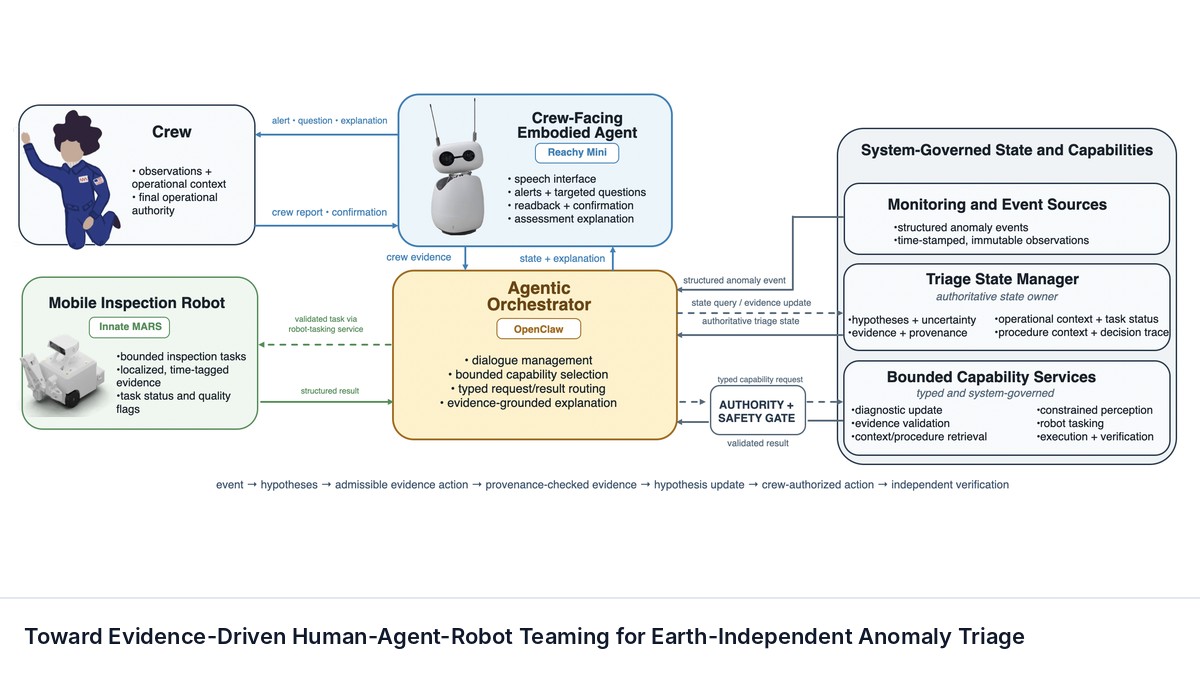
Toward Evidence-Driven Human-Agent-Robot Teaming for Earth-Independent Anomaly Triage
arXiv preprint

Toward Evidence-Driven Human-Agent-Robot Teaming for Earth-Independent Anomaly Triage

Ignacio G Lopez-Francos, Alexis Gallagher, Samira Shalal

Deep-space crews cannot rely on real-time ground support for urgent off-nominal events. Initial alerts may underdetermine cause, while discriminating evidence may reside in crew observations or at locations that are unsafe, costly, or unavailable for crew inspection.

reinforcement-learning control
PDF Intermediate
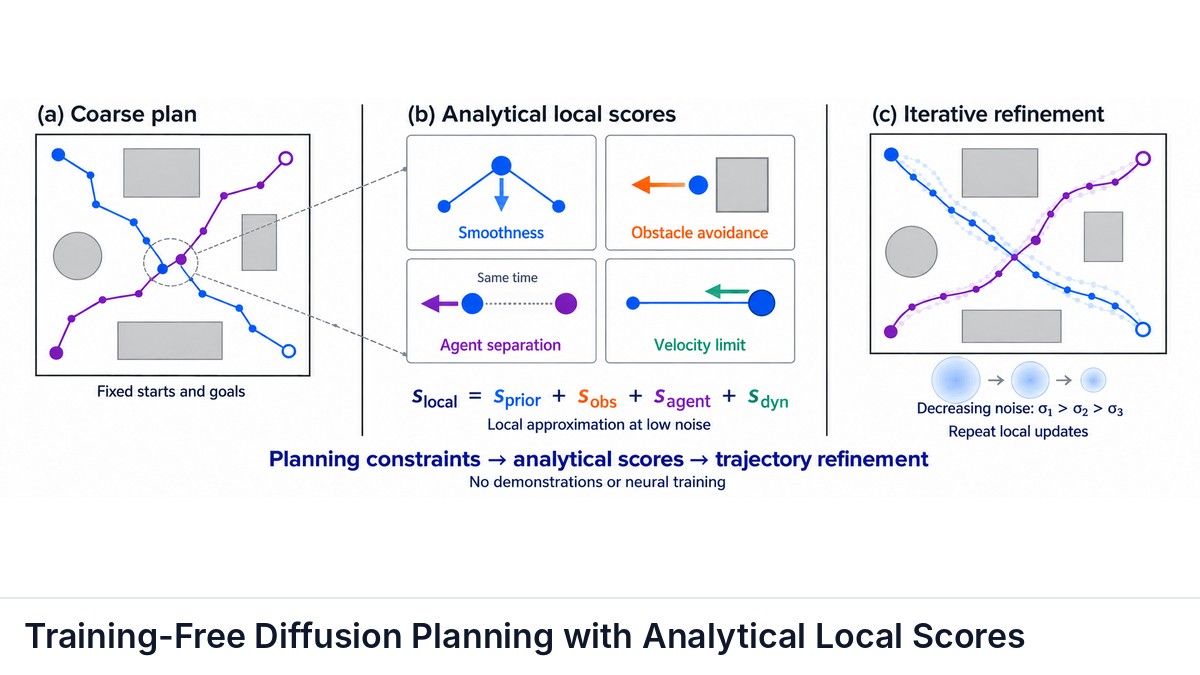
Training-Free Diffusion Planning with Analytical Local Scores
arXiv preprint

Training-Free Diffusion Planning with Analytical Local Scores

Michael Y. Fatemi, Jinhao Liang, Ferdinando Fioretto

Path finding and multi-robot motion planning require trajectories that are smooth, goal-directed, and collision-free in environments with complex geometric constraints.

planning learning-from-demonstration
PDF Advanced
Trajectory Planning without Trajectory Data: A Manifold-Guided Approach
arXiv preprint

Trajectory Planning without Trajectory Data: A Manifold-Guided Approach

Silong Yong, Anji Liu, Cunxi Dai et al.

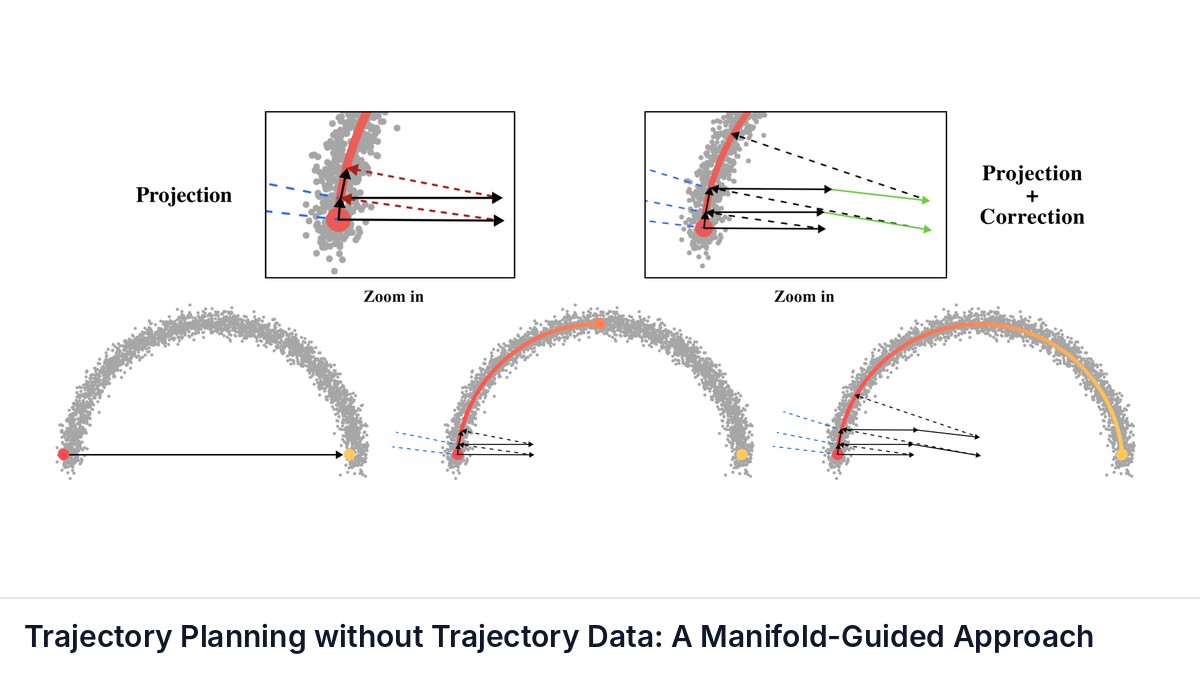
A common way for trajectory planning is to leverage generative models trained on large collections of expert trajectories. At inference time, the model generates executable trajectories by conditioning on task goal constraints.

vision reinforcement-learning planning benchmark
Code PDF Intermediate
GitHub ★ —
UniWAM: Unified World-Action Model
arXiv preprint

UniWAM: Unified World-Action Model

Jiayi Chen, Wenxuan Song, Jingbo Wang et al.

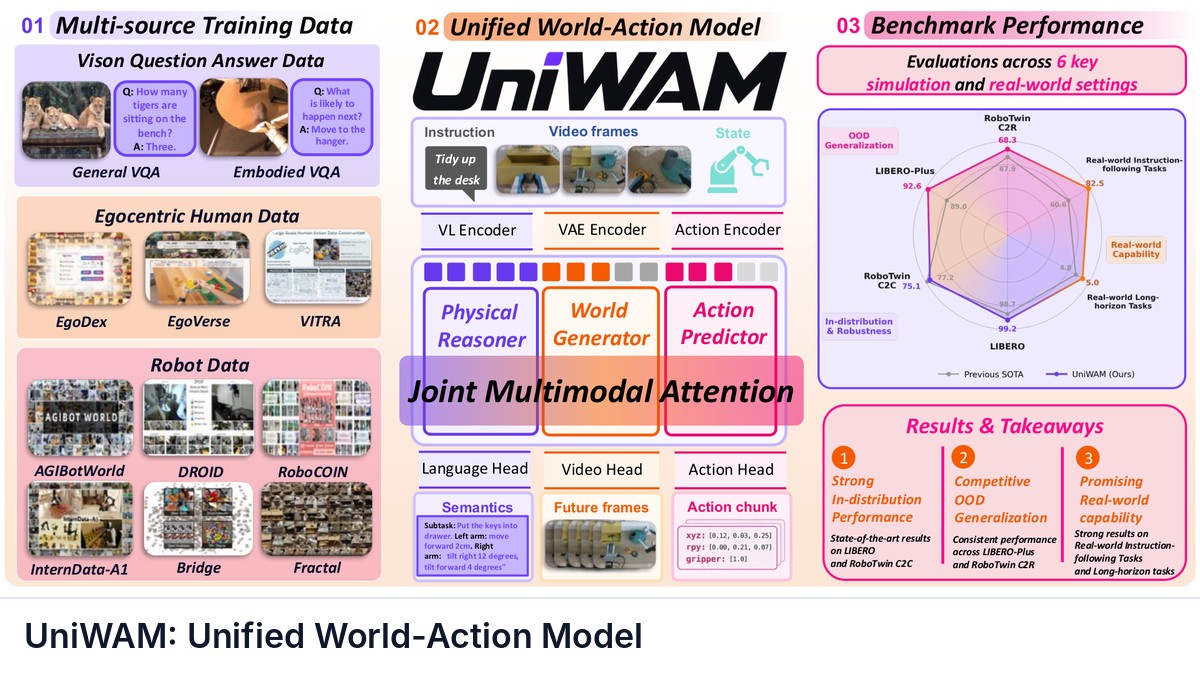
Vision-language-action models benefit from the understanding and reasoning capabilities of pretrained vision-language models, but action-only supervision provides limited grounding in world dynamics.

vision vla reinforcement-learning learning-from-demonstration benchmark
Code PDF Advanced
GitHub ★ —
Value as Memory: Online Value-Guided Post-training for General Robot Policies
arXiv preprint

Value as Memory: Online Value-Guided Post-training for General Robot Policies

Wenye Yu, Yijin Chen, Kaiyi Xiong et al.

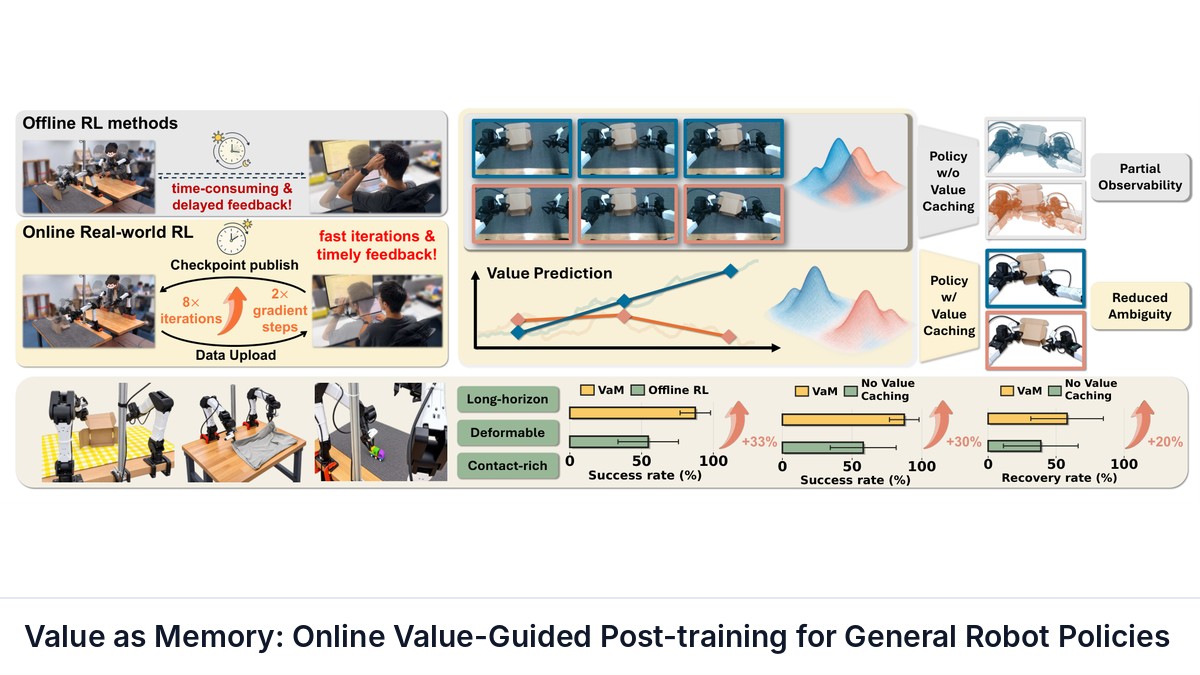
Real-world post-training of generalist robot policies faces two challenges: partial observability makes action selection ambiguous, while offline post-training methods delay feedback from deployment experience.

manipulation reinforcement-learning learning-from-demonstration
Code PDF Intermediate
GitHub ★ —
VersaCamVLA: Camera-Configurable VLA Policies for Robotic Manipulation
arXiv preprint

VersaCamVLA: Camera-Configurable VLA Policies for Robotic Manipulation

Boyao Han, Chen Shi, Jingjing Qian et al.

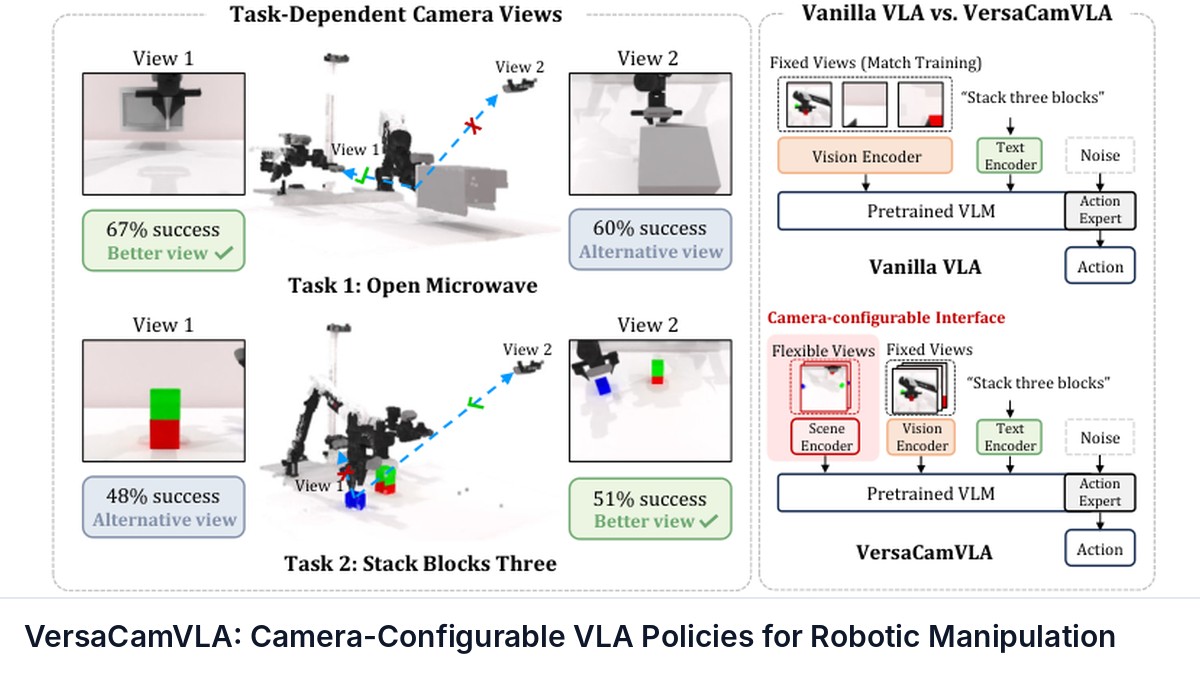
Vision-Language-Action (VLA) models have emerged as powerful foundations for robotic manipulation, but their reliance on fixed camera configurations during training makes them brittle to changes in camera count or pose during deployment.

manipulation vision vla reinforcement-learning
Code PDF Intermediate
GitHub ★ —
VioLA: Learning Generalist Humanoid Control Policies from Human Data
arXiv preprint

VioLA: Learning Generalist Humanoid Control Policies from Human Data

Mert Albaba, Jens Beißwenger, Anna Manasyan et al.

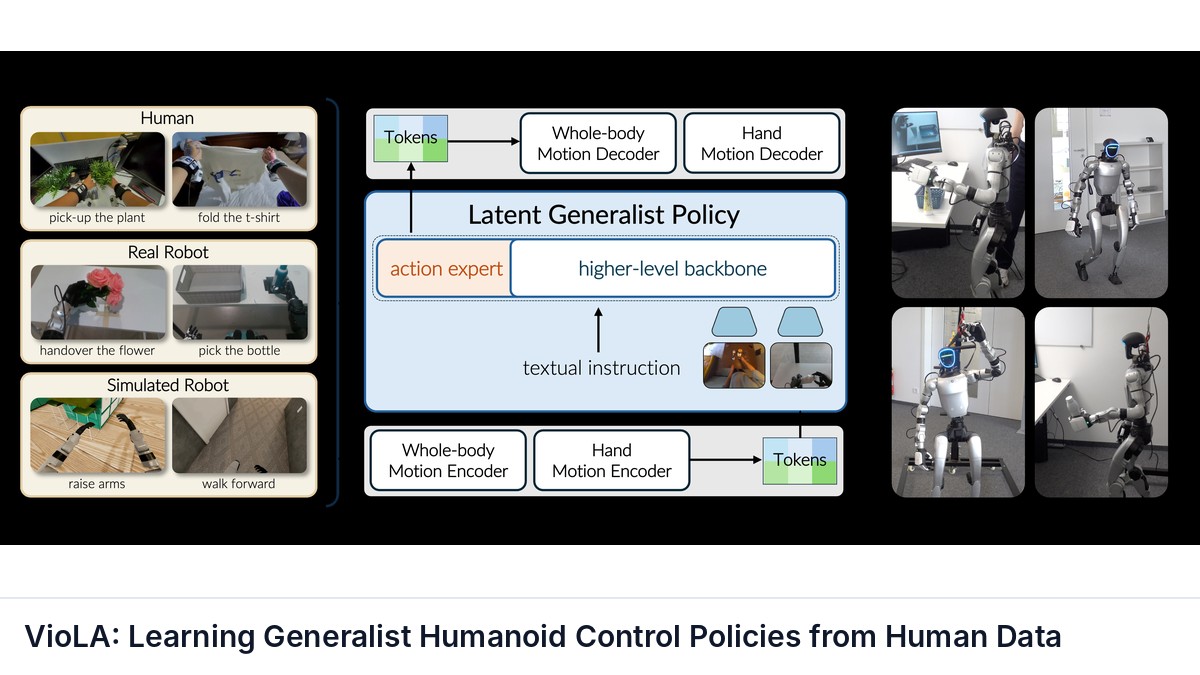
Teaching a humanoid to follow instructions with its whole body runs into two obstacles. Its action space is large and tightly coupled: legs, arms, and fingers must move together while the robot keeps its balance, which makes joint-level actions hard to learn.

manipulation locomotion vla reinforcement-learning control learning-from-demonstration
Code PDF Intermediate
GitHub ★ —
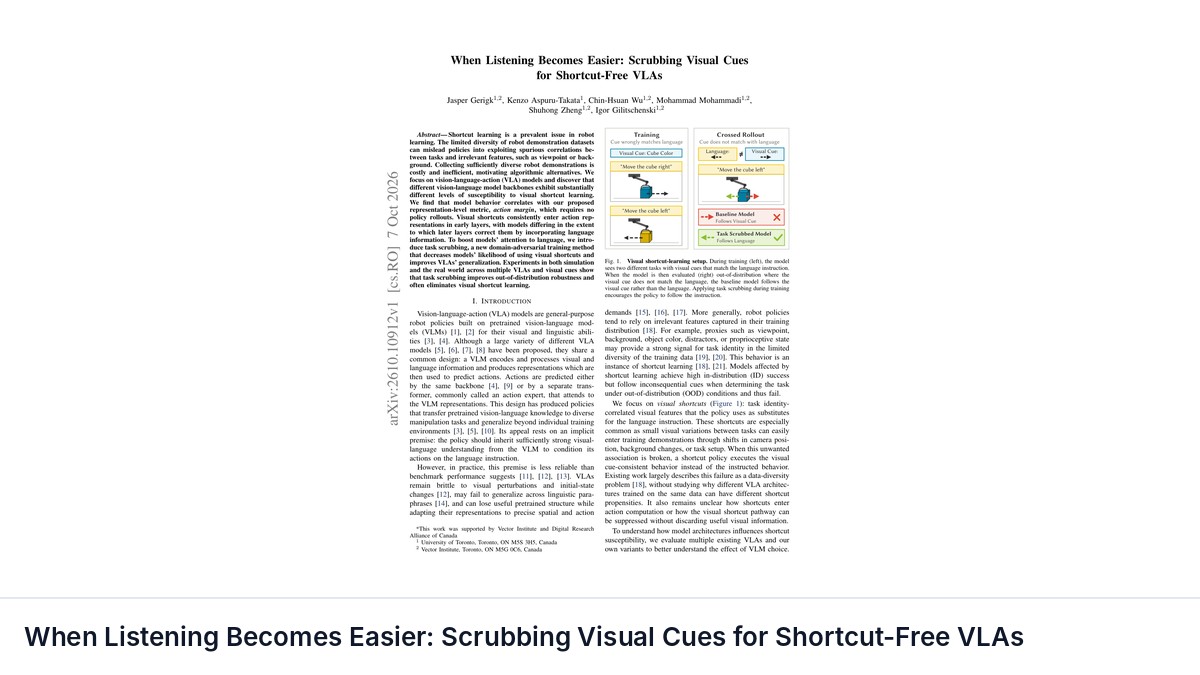
When Listening Becomes Easier: Scrubbing Visual Cues for Shortcut-Free VLAs
arXiv preprint

When Listening Becomes Easier: Scrubbing Visual Cues for Shortcut-Free VLAs

Jasper Gerigk, Kenzo Aspuru-Takata, Chin-Hsuan Wu et al.

Shortcut learning is a prevalent issue in robot learning. The limited diversity of robot demonstration datasets can mislead policies into exploiting spurious correlations between tasks and irrelevant features, such as viewpoint or background.

vision vla reinforcement-learning learning-from-demonstration benchmark
PDF Intermediate
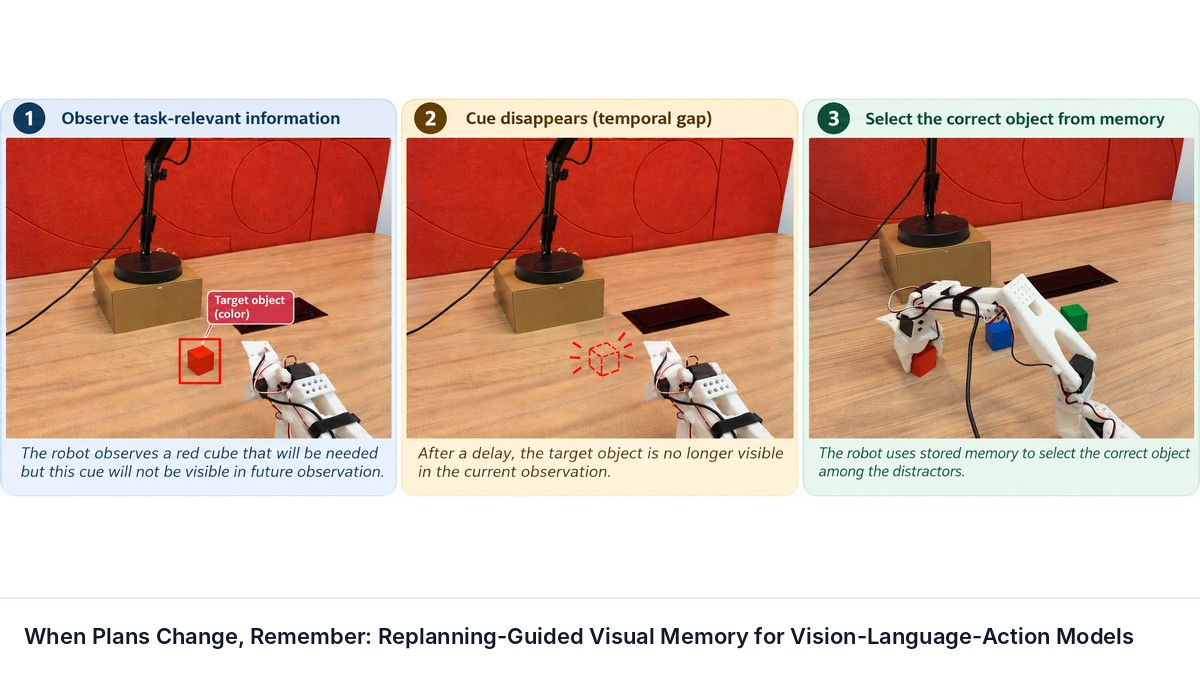
When Plans Change, Remember: Replanning-Guided Visual Memory for Vision-Language-Action Models
arXiv preprint

When Plans Change, Remember: Replanning-Guided Visual Memory for Vision-Language-Action Models

Victoria Smelova, Daniil Kazachkov, Georgiy Kazantsev et al.

Long-horizon, multi-stage Vision-Language-Action (VLA) policies often require visual information that is no longer present in the current observation. Retaining the complete observation history is computationally expensive and highly redundant, motivating selective visual memory.

vision vla reinforcement-learning planning control
PDF Intermediate
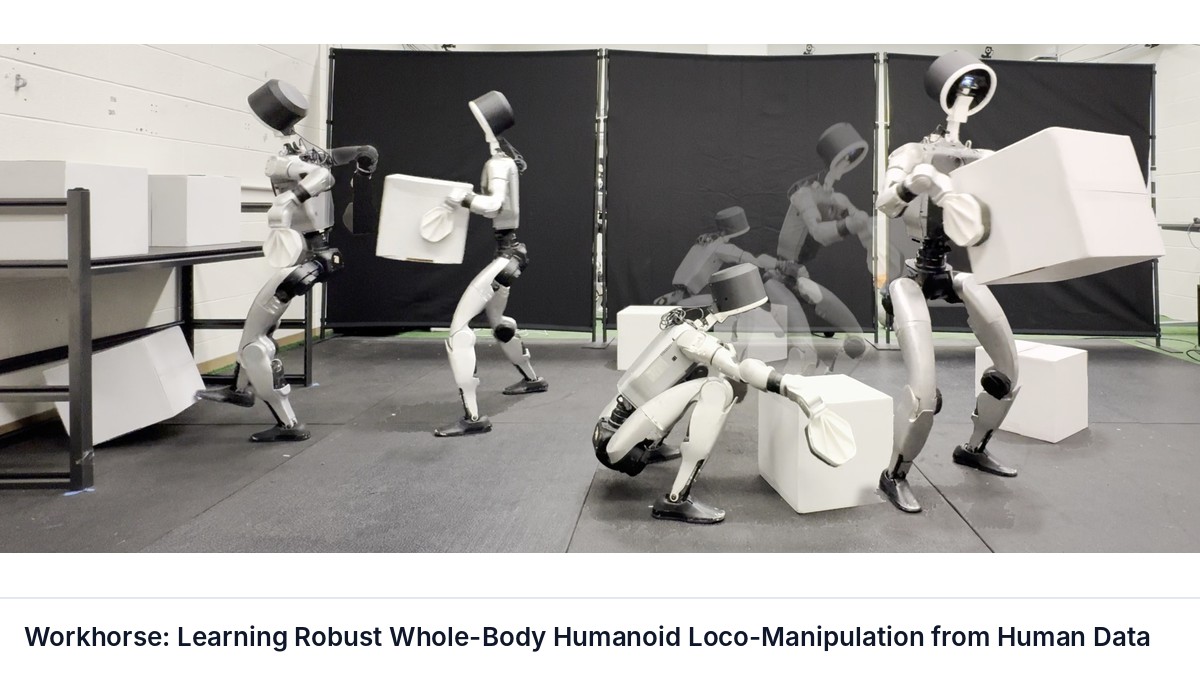
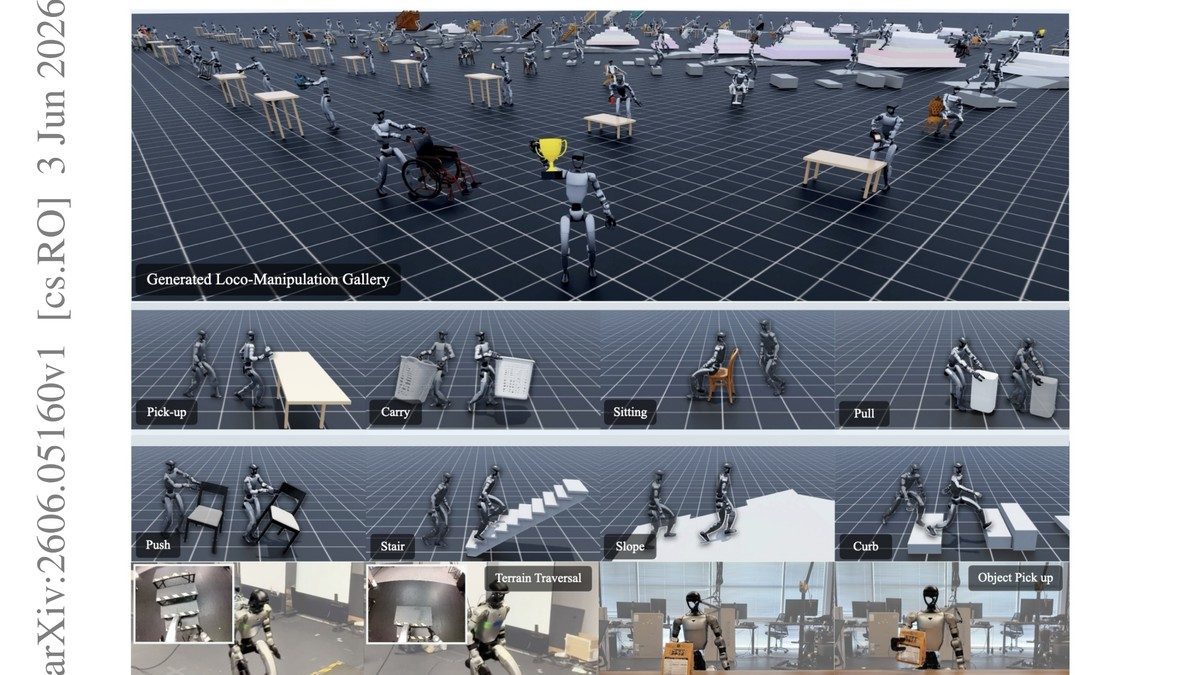
Workhorse: Learning Robust Whole-Body Humanoid Loco-Manipulation from Human Data
ICRA (under review)

Workhorse: Learning Robust Whole-Body Humanoid Loco-Manipulation from Human Data

Hu, Songbo, Liao, Qiayuan, Chi, Yufeng et al.

Humanoid robots still struggle to plan contact-rich whole-body manipulation from egocentric RGB and proprioception. Workhorse learns such manipulation from robot-free human demonstrations. A visual planner predicts five-link targets: the poses of the torso, both wrists, and both feet.

manipulation vision reinforcement-learning learning-from-demonstration
PDF Intermediate
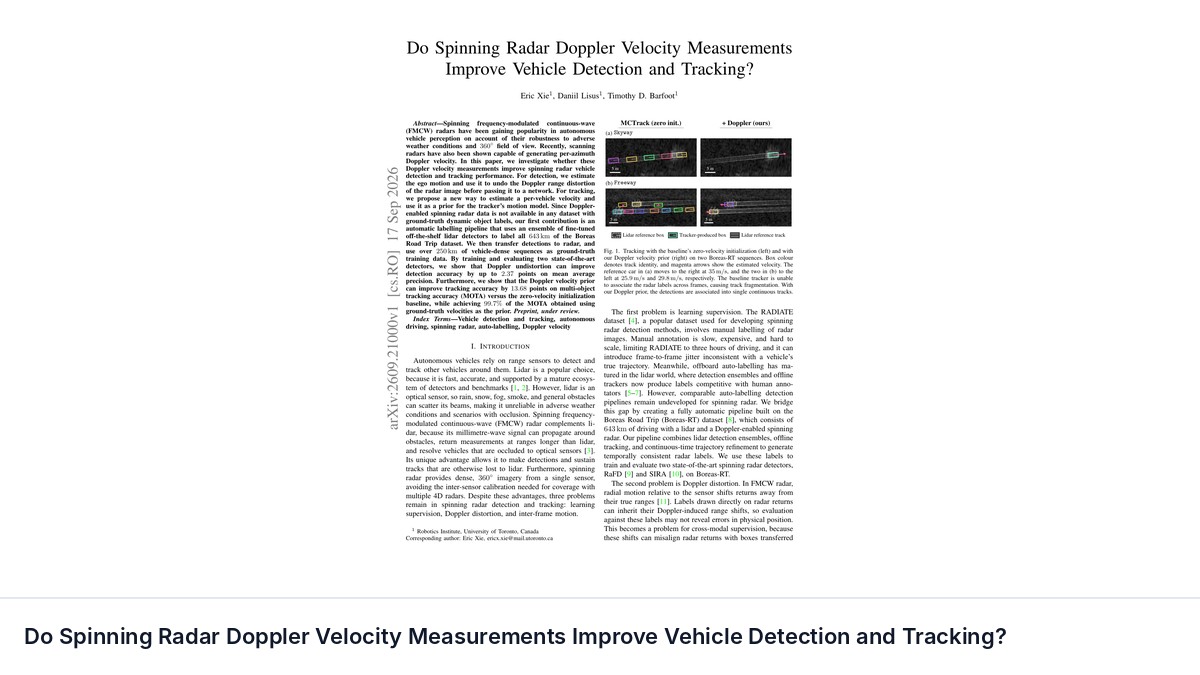
4D Radar Perception Algorithms for Autonomous Driving: A Review
arXiv preprint

4D Radar Perception Algorithms for Autonomous Driving: A Review

Xumin Wu, Jun Zhou, Jilin Mei et al.

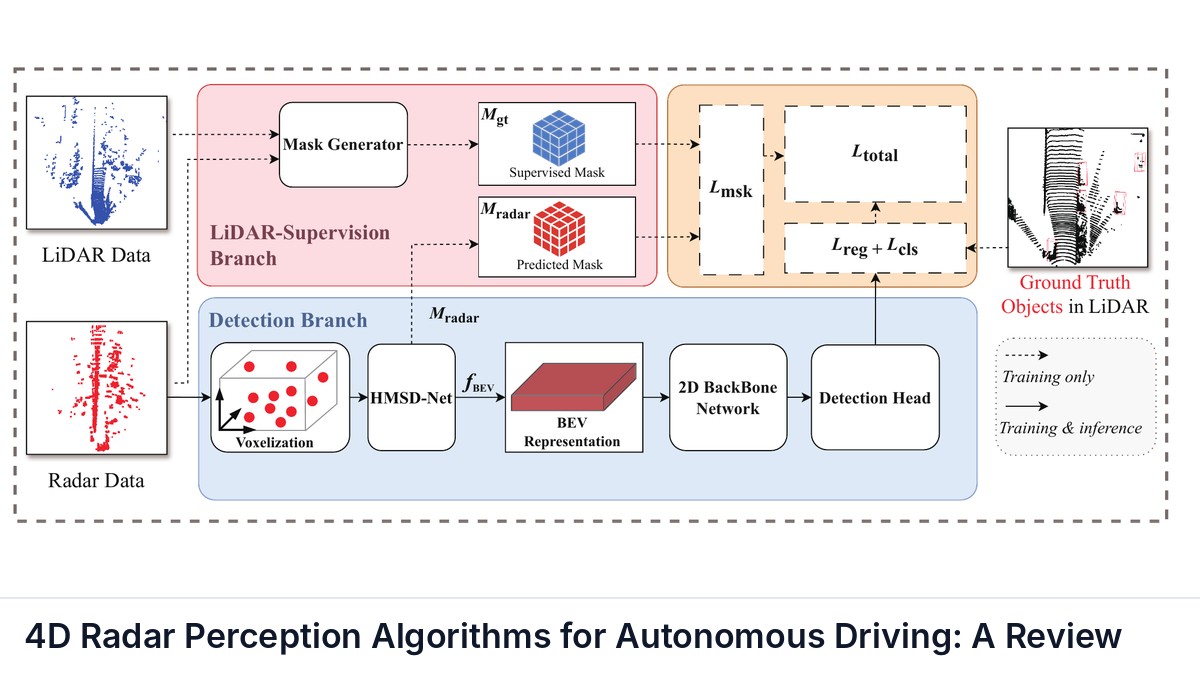
Research on 4D millimeter-wave radar perception algorithms has flourished in recent years, extending from signal processing and object detection to semantic segmentation, motion estimation, occupancy prediction, and dynamic scene reconstruction.

vision reinforcement-learning benchmark
PDF Beginner
A Confidence-Aware Multimodal Fusion Framework for Industrial Human-Robot Collaboration
arXiv preprint

A Confidence-Aware Multimodal Fusion Framework for Industrial Human-Robot Collaboration

Xinyu Liu, Qiqi Dong, Boya Jia et al.

A confidence-aware multimodal fusion framework (CAMF) is proposed to realize reliable human intention prediction for industrial human-robot collaboration. This framework fuses four heterogeneous modalities including object 6D pose, gaze, skeletal motion and IMU-based hand motion.

human-robot-interaction
PDF Intermediate
A Sim-to-Real Integration Pipeline for Training and Deployment of Chunk-Based VLA Manipulation Policies
arXiv preprint

A Sim-to-Real Integration Pipeline for Training and Deployment of Chunk-Based VLA Manipulation Policies

Mathilde Kappel, Clémence Grislain, Mohamed Chetouani et al.

Vision-Language-Action (VLA) models have become a prominent paradigm for mapping multimodal inputs, including semantic instructions, visual observations of the scene, and proprioceptive observations, to robot actions.

manipulation vision vla reinforcement-learning sim-to-real control learning-from-demonstration benchmark
PDF Advanced
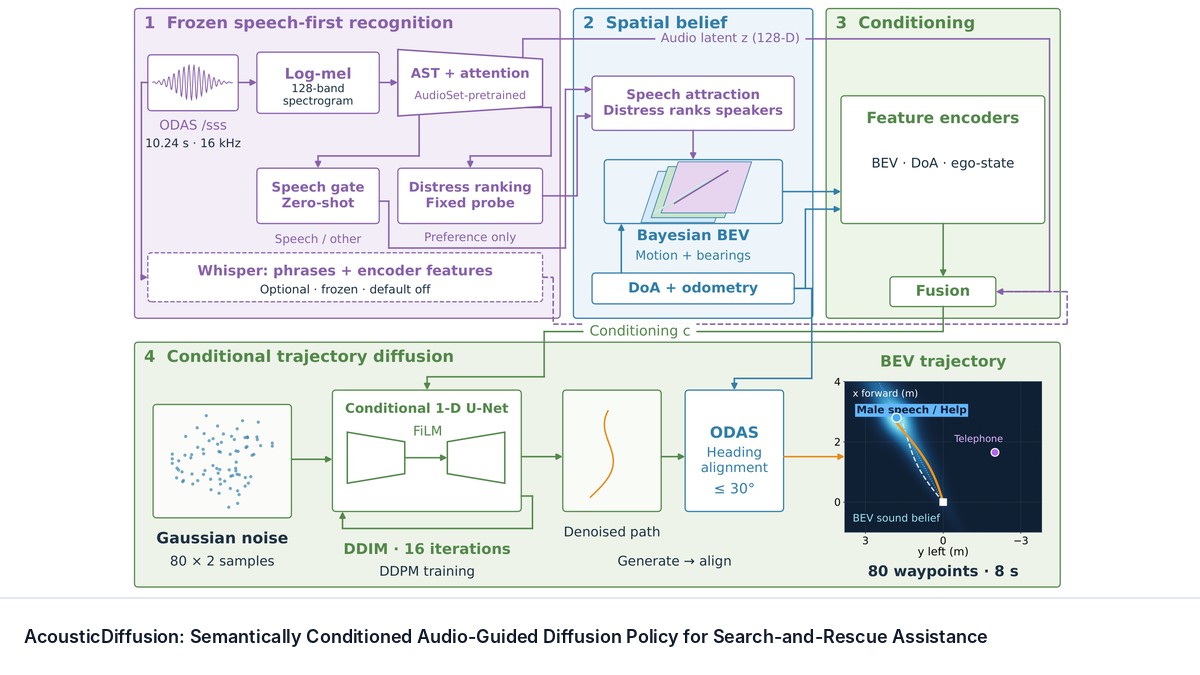
AcousticDiffusion: Semantically Conditioned Audio-Guided Diffusion Policy for Search-and-Rescue Assistance
arXiv preprint

AcousticDiffusion: Semantically Conditioned Audio-Guided Diffusion Policy for Search-and-Rescue Assistance

Iana Zhura, Didar Seyidov, Dmitrii Plotnikov et al.

Navigating toward human callers is an important capability for rescue robots operating where visual contact is degraded or occluded. We present AcousticDiffusion, a semantically conditioned, audio-guided diffusion policy for human-directed navigation.

locomotion vision reinforcement-learning planning
PDF Advanced
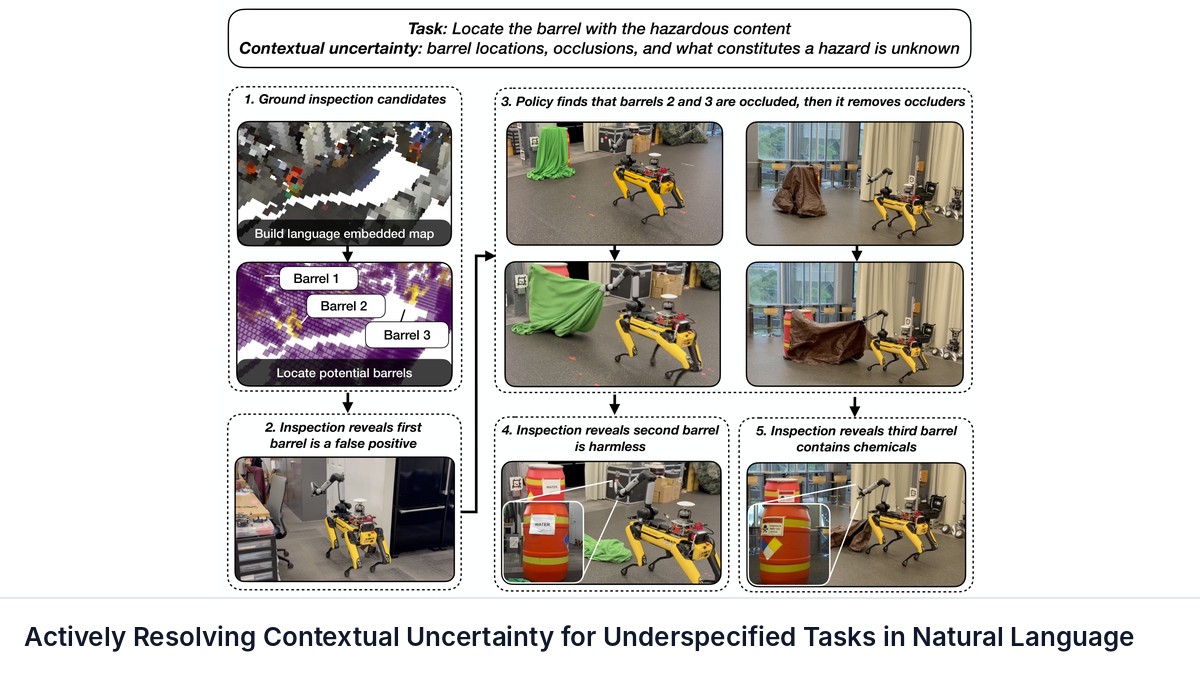
Actively Resolving Contextual Uncertainty for Underspecified Tasks in Natural Language
arXiv preprint

Actively Resolving Contextual Uncertainty for Underspecified Tasks in Natural Language

Zachary Ravichandran, Jonathan Diller, Fernando Cladera et al.

Foundation models provide robots with the ability to interpret natural language and reason about environmental context, yet most language-conditioned policies assume that goals are well-specified and that task-relevant information is provided upfront via a prior map.

vla reinforcement-learning planning
Code PDF Advanced
GitHub ★ —
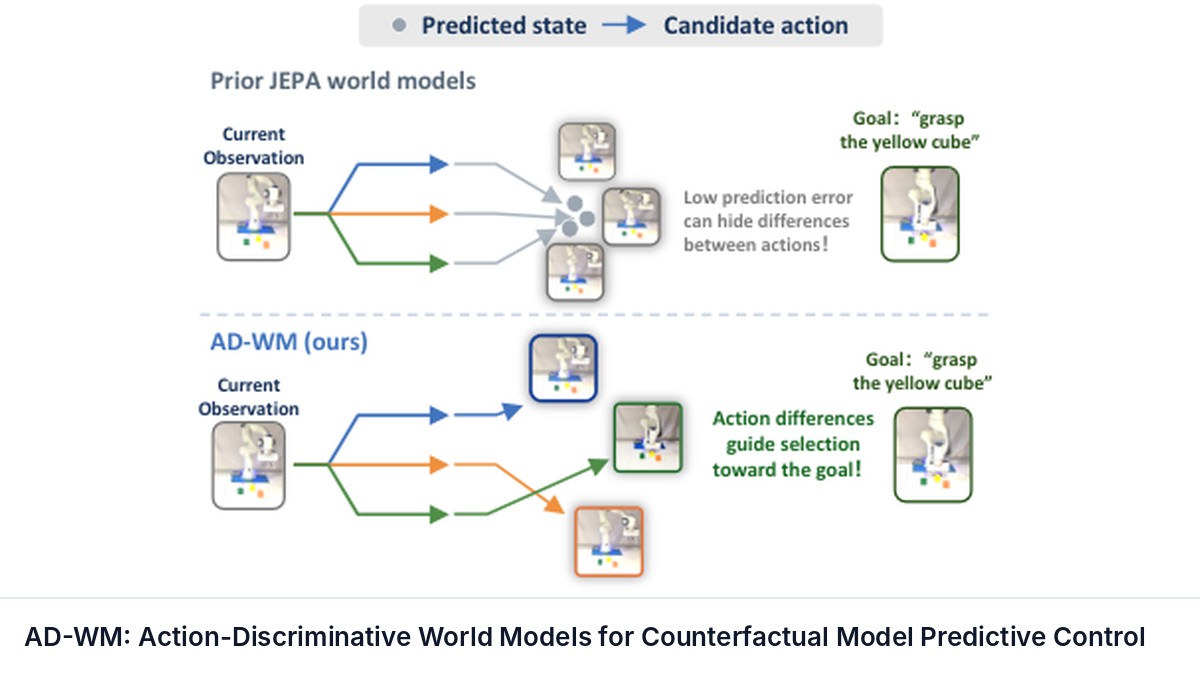
AD-WM: Action-Discriminative World Models for Counterfactual Model Predictive Control
arXiv preprint

AD-WM: Action-Discriminative World Models for Counterfactual Model Predictive Control

Jiabin Qiu, Zixuan Chen, Hongye Cao et al.

Latent world models are typically trained to predict factual transitions, whereas model predictive control (MPC) must compare alternative actions from the same state. A model can therefore achieve low factual prediction error yet poorly distinguish candidate actions.

manipulation reinforcement-learning planning control
Code PDF Intermediate
GitHub ★ —
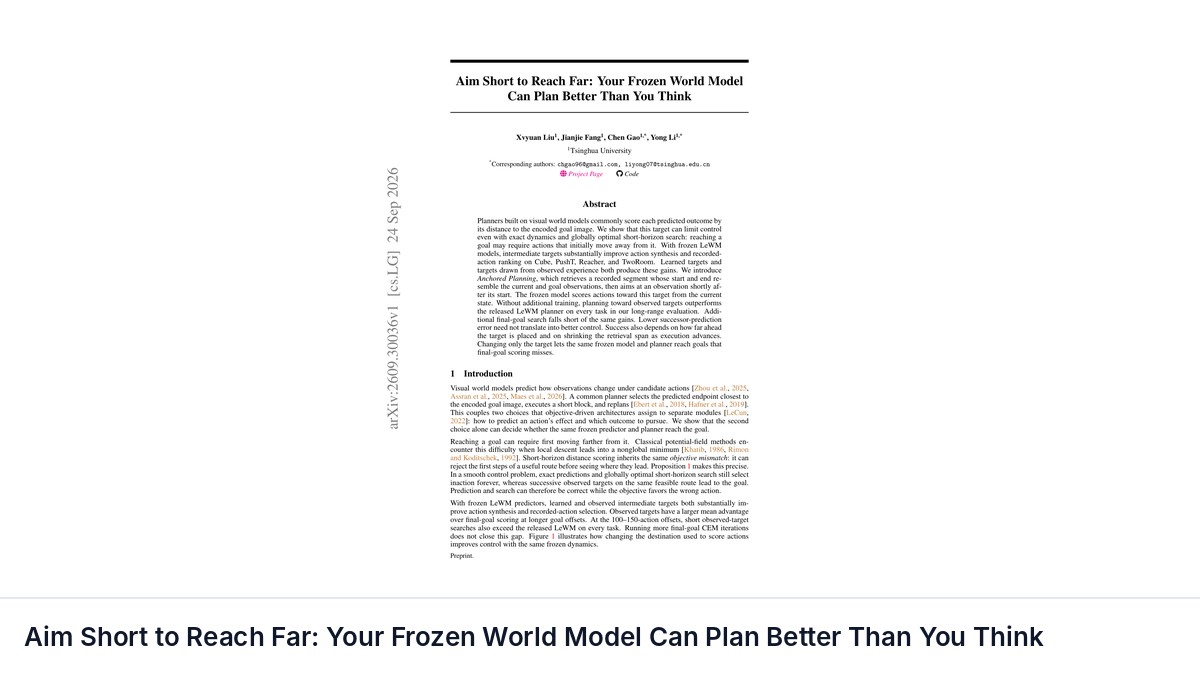
Aim Short to Reach Far: Your Frozen World Model Can Plan Better Than You Think
arXiv preprint

Aim Short to Reach Far: Your Frozen World Model Can Plan Better Than You Think

Xvyuan Liu, Jianjie Fang, Chen Gao et al.

Planners built on visual world models commonly score each predicted outcome by its distance to the encoded goal image. We show that this target can limit control even with exact dynamics and globally optimal short-horizon search: reaching a goal may require actions that initially move away from it.

vision reinforcement-learning planning control human-robot-interaction benchmark
PDF Intermediate
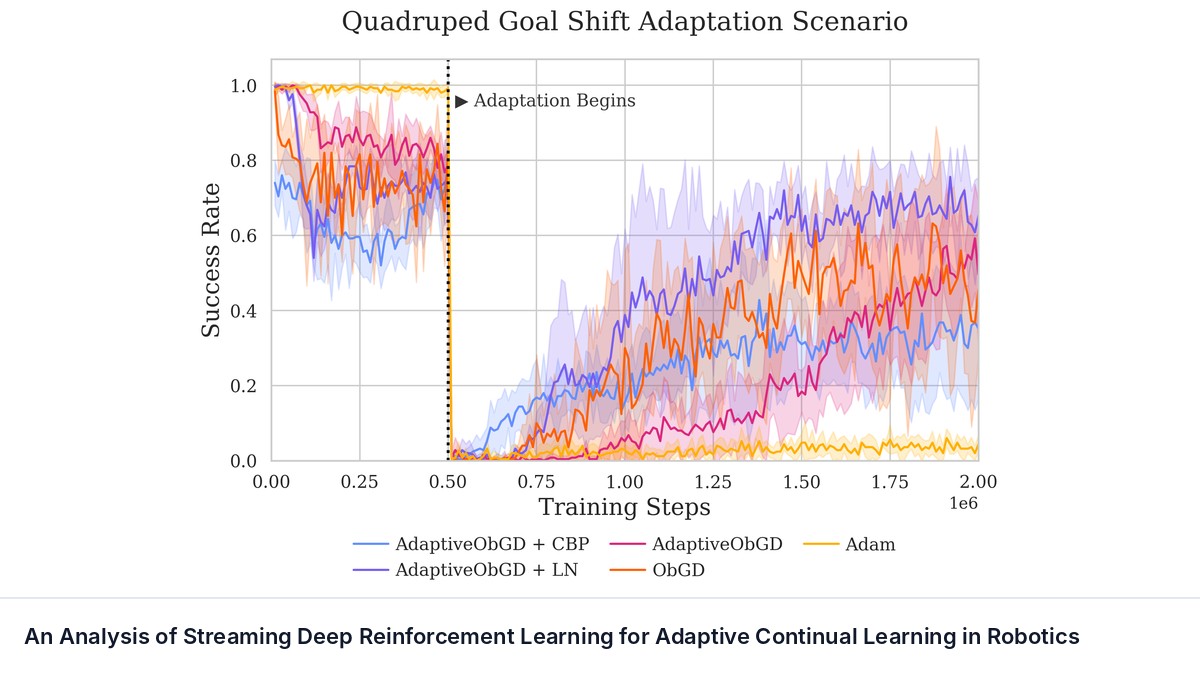
An Analysis of Streaming Deep Reinforcement Learning for Adaptive Continual Learning in Robotics
arXiv preprint

An Analysis of Streaming Deep Reinforcement Learning for Adaptive Continual Learning in Robotics

Teeratham Vitchutripop, Alyssa Quarles, Wenhe Zhang et al.

Over the course of a lifetime, robots may encounter novel scenarios unaccounted for in its original training that result in performance degradation. One common approach to mitigating this issue is to further grow the offline training dataset in hopes of producing a policy robust to these changes.

manipulation locomotion reinforcement-learning benchmark
PDF Intermediate
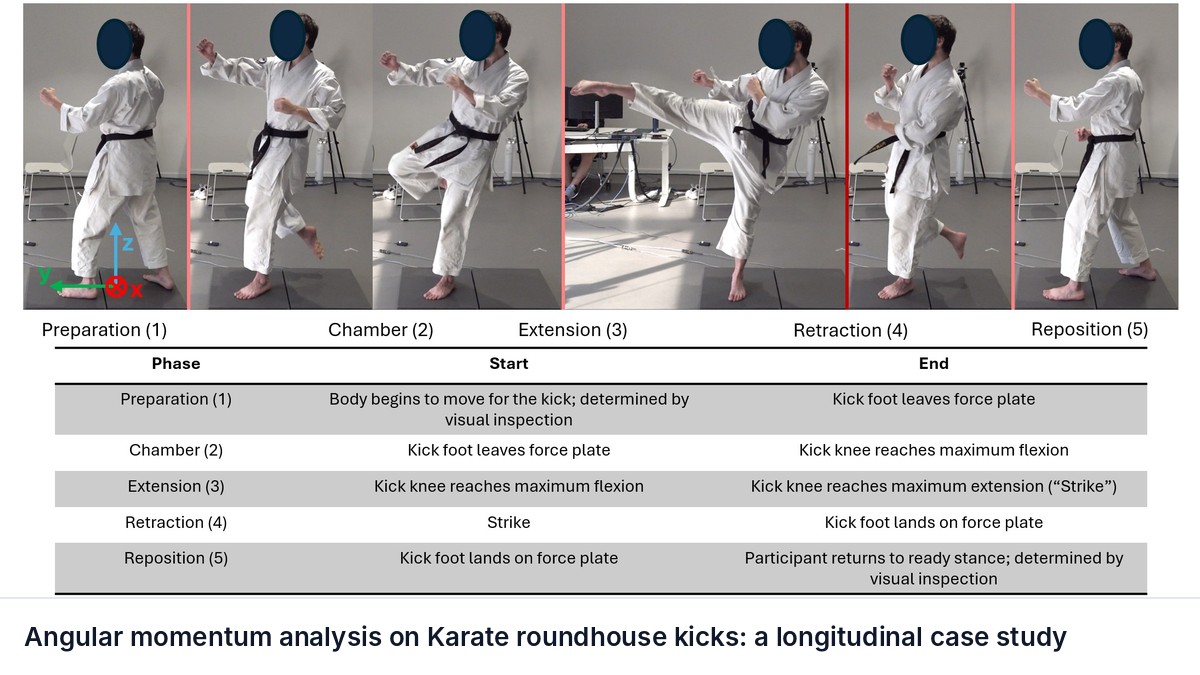
Angular momentum analysis on Karate roundhouse kicks: a longitudinal case study
arXiv preprint

Angular momentum analysis on Karate roundhouse kicks: a longitudinal case study

Jan C. L. Lau, Christian Mele, Jonathan Feng-Shun Lin et al.

Human gait in reality extends beyond straight-line walking, with some situations even requiring drastic back-and-forth rotations. A smooth and stable execution may seem intuitive, but the underlying mechanics remains unknown.

locomotion reinforcement-learning
PDF Intermediate
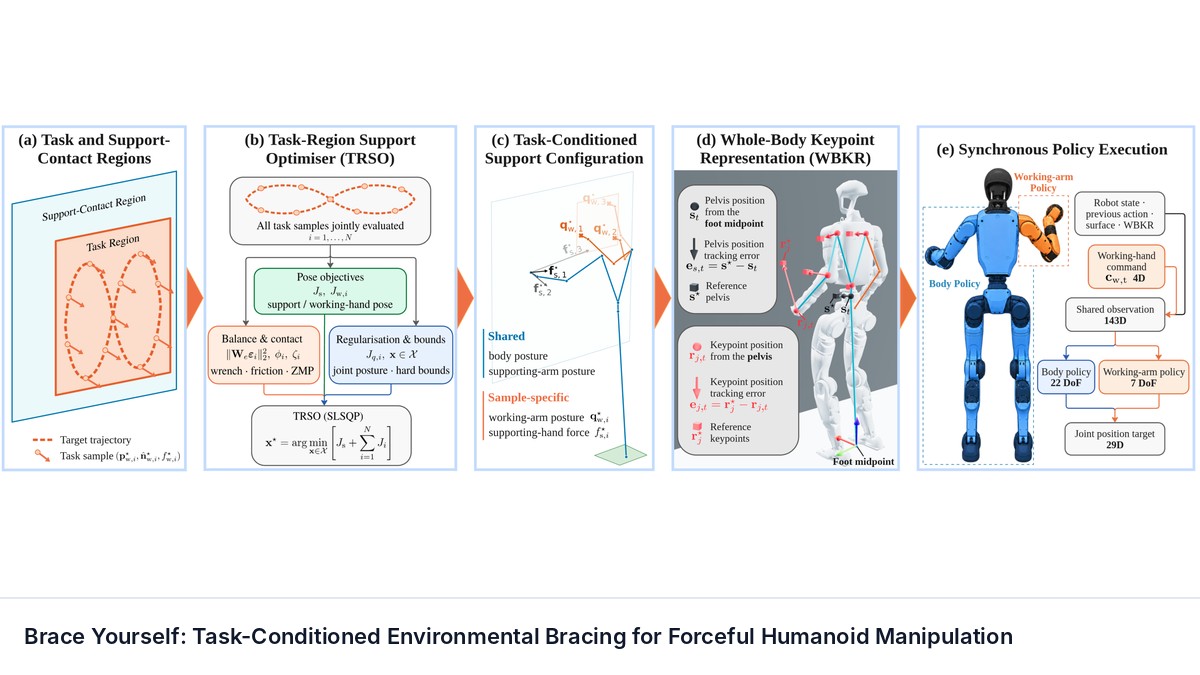
Brace Yourself: Task-Conditioned Environmental Bracing for Forceful Humanoid Manipulation
arXiv preprint

Brace Yourself: Task-Conditioned Environmental Bracing for Forceful Humanoid Manipulation

Zongyuan Zhang, Christopher Lehnert, Will N. Browne et al.

Forceful manipulation is challenging for humanoid robots because interaction forces can disturb whole-body balance. We introduce the Supporting Hand Strategy (SHS), which enables a humanoid to brace against the environment with one hand while performing forceful manipulation with the other.

manipulation reinforcement-learning planning
PDF Intermediate
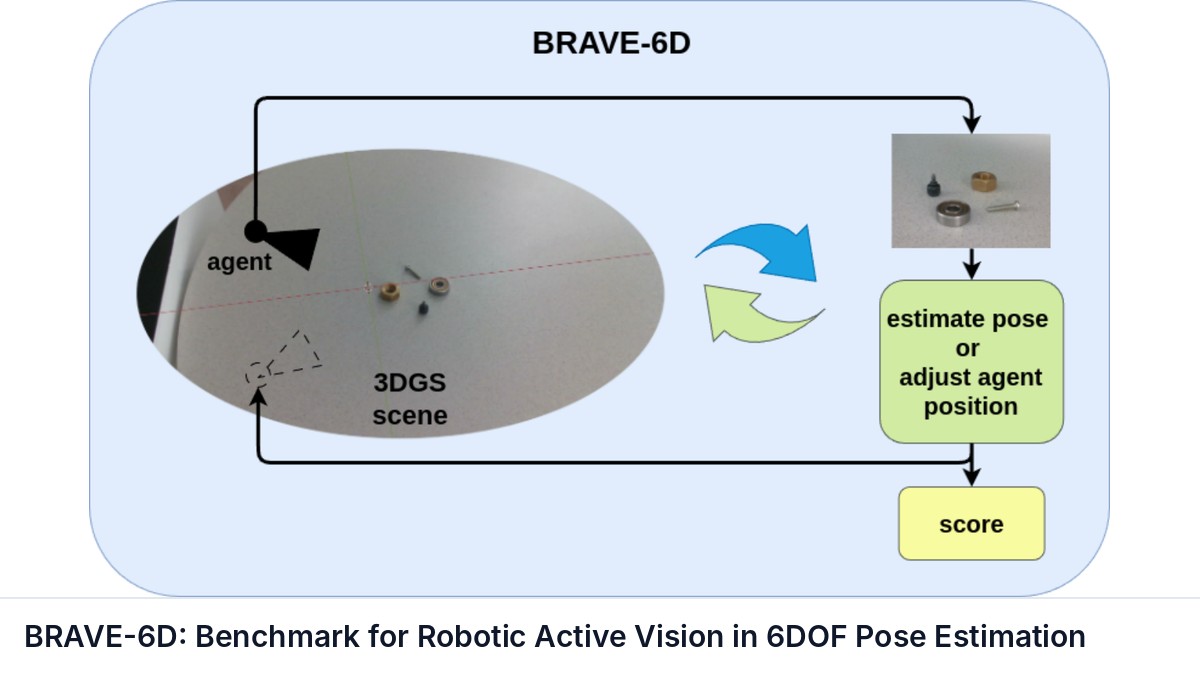
BRAVE-6D: Benchmark for Robotic Active Vision in 6DOF Pose Estimation
arXiv preprint

BRAVE-6D: Benchmark for Robotic Active Vision in 6DOF Pose Estimation

Philipp Ausserlechner, Bernhard Neuberger, Alessandro Scherl et al.

Detecting and grasping small objects remains a significant challenge in robotics. Active vision, where the robot moves closer to the object, is an intuitive solution, yet comparing approaches on common ground is difficult since identical physical scene setups are required.

manipulation vision benchmark
PDF Intermediate
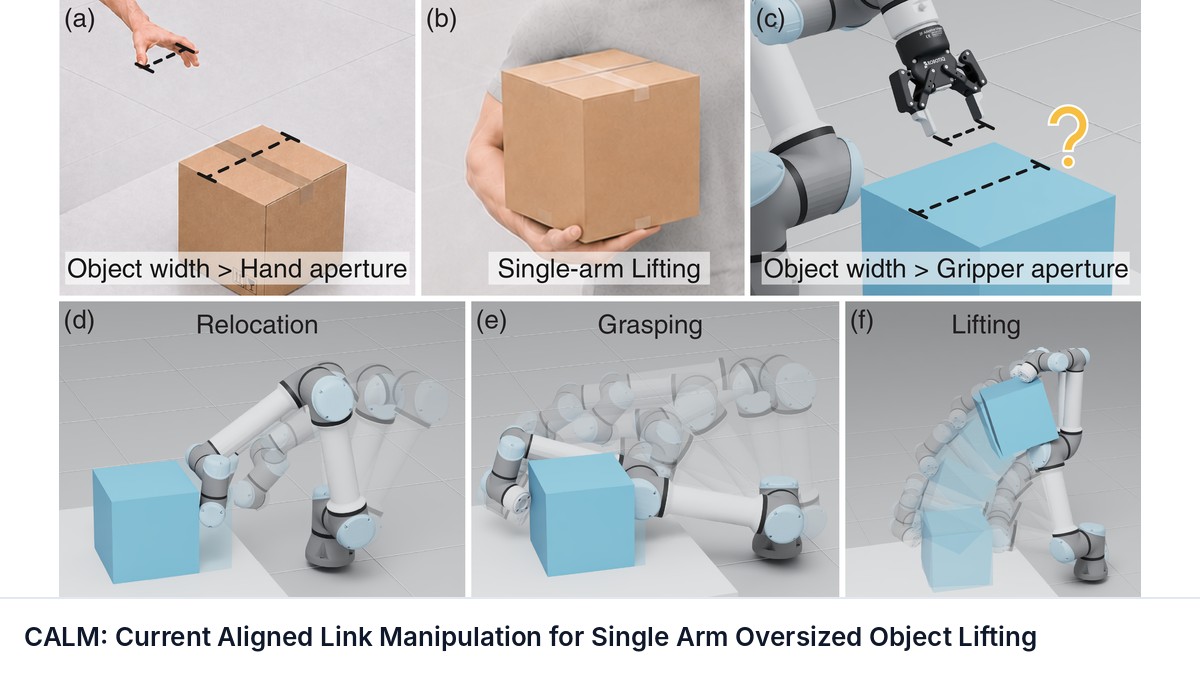
CALM: Current Aligned Link Manipulation for Single Arm Oversized Object Lifting
arXiv preprint

CALM: Current Aligned Link Manipulation for Single Arm Oversized Object Lifting

Hu, Jun, Chen, Sihan, Jovanovic, Kosta et al.

Most robots manipulate objects solely with their end effectors, whereas humans flexibly leverage different body parts, such as the forearm and elbow, especially when handling oversized objects.

manipulation reinforcement-learning sim-to-real learning-from-demonstration
PDF Intermediate
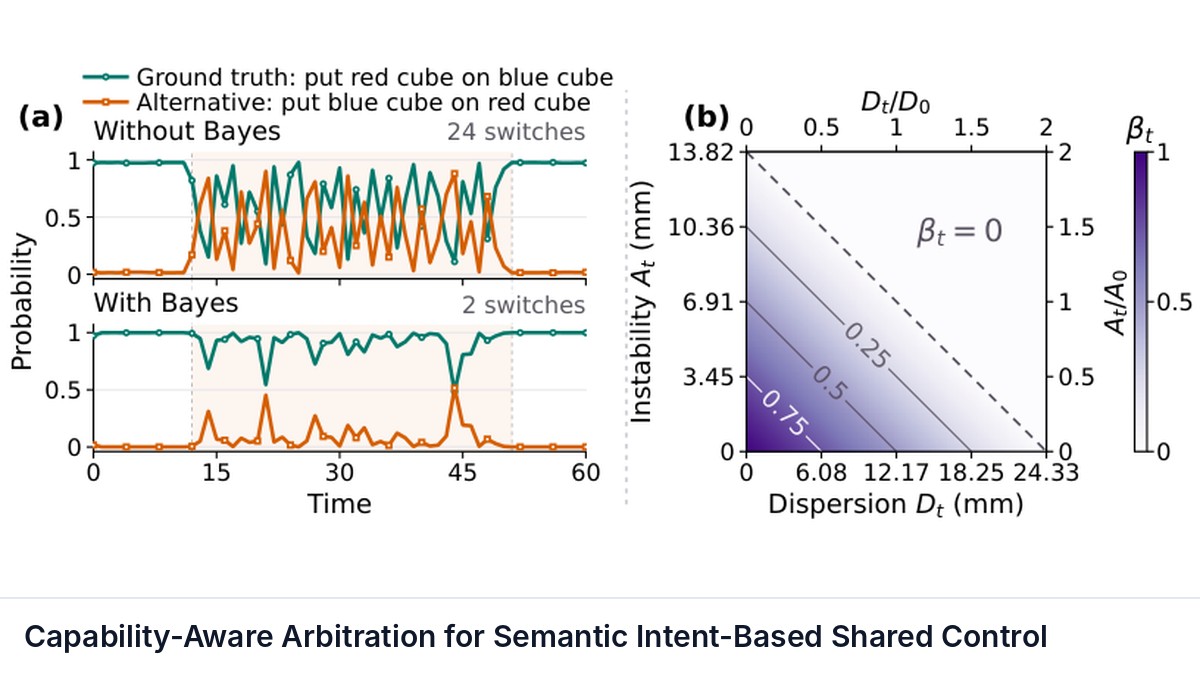
Capability-Aware Arbitration for Semantic Intent-Based Shared Control
arXiv preprint

Capability-Aware Arbitration for Semantic Intent-Based Shared Control

Zhaoda Du, Michael Bowman, Xiaoli Zhang

Shared control often allocates robot authority based on confidence in inferred human intent, assuming reliable autonomous execution. When this assumption fails, high intent confidence can cause over-helping.

manipulation vision vla reinforcement-learning control learning-from-demonstration benchmark
Code PDF Intermediate
GitHub ★ —
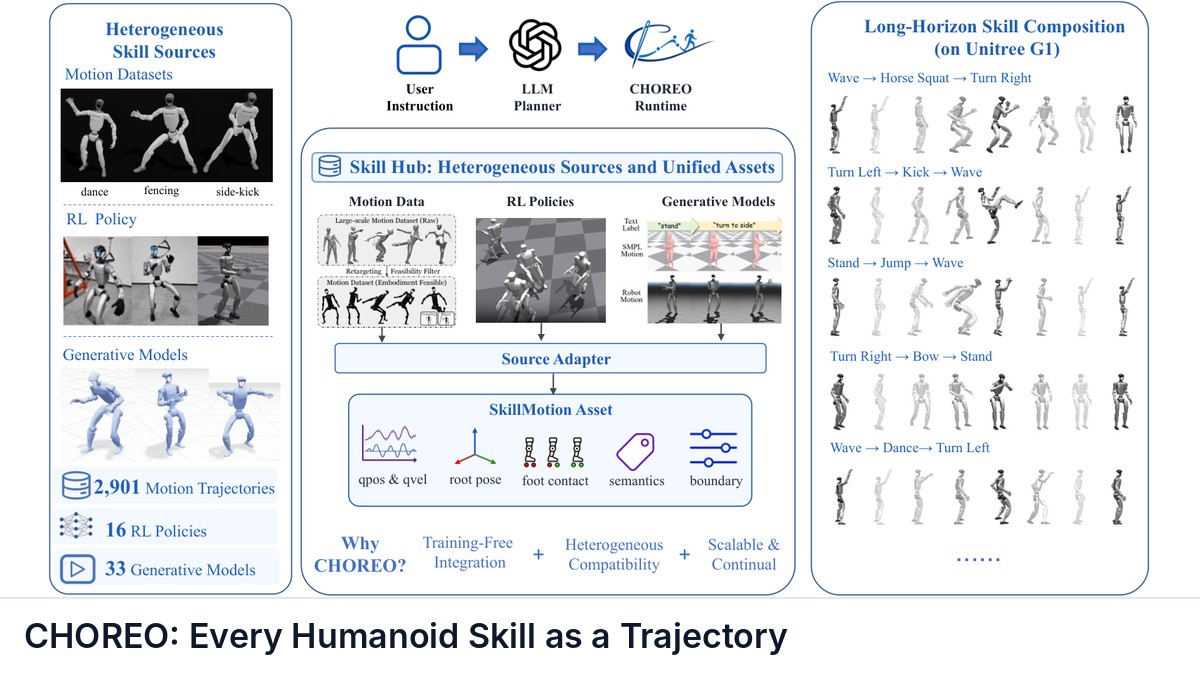
CHOREO: Every Humanoid Skill as a Trajectory
arXiv preprint

CHOREO: Every Humanoid Skill as a Trajectory

Ziyi Sun, Jingwen Chen, Yuxi Wang et al.

Recent advances in humanoid robotics have produced diverse skills through reinforcement learning, motion imitation, and generative modeling. Yet these capabilities remain siloed because they are built around incompatible representations, interfaces, and controllers.

vla reinforcement-learning control
PDF Intermediate
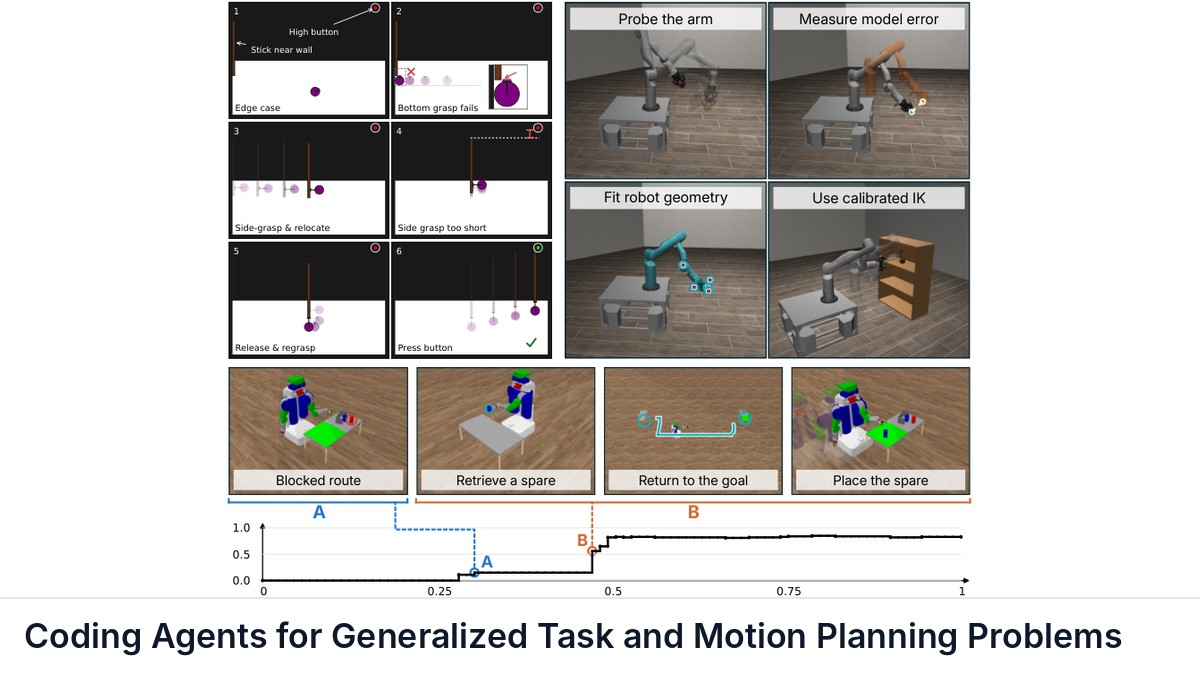
Coding Agents for Generalized Task and Motion Planning Problems
arXiv preprint

Coding Agents for Generalized Task and Motion Planning Problems

Matteo Merler, Bowen Li, Josh Roy et al.

Task and motion planning (TAMP) problems remain difficult even with full observability and object-centric states because discrete decisions are tightly coupled to geometric, kinematic, and dynamic constraints.

vla planning benchmark
PDF Intermediate
Contact-Rich Motion Planning via GPU-Parallel Mode Evaluation
arXiv preprint

Contact-Rich Motion Planning via GPU-Parallel Mode Evaluation

Jiayun Li, Georgia Chalvatzaki

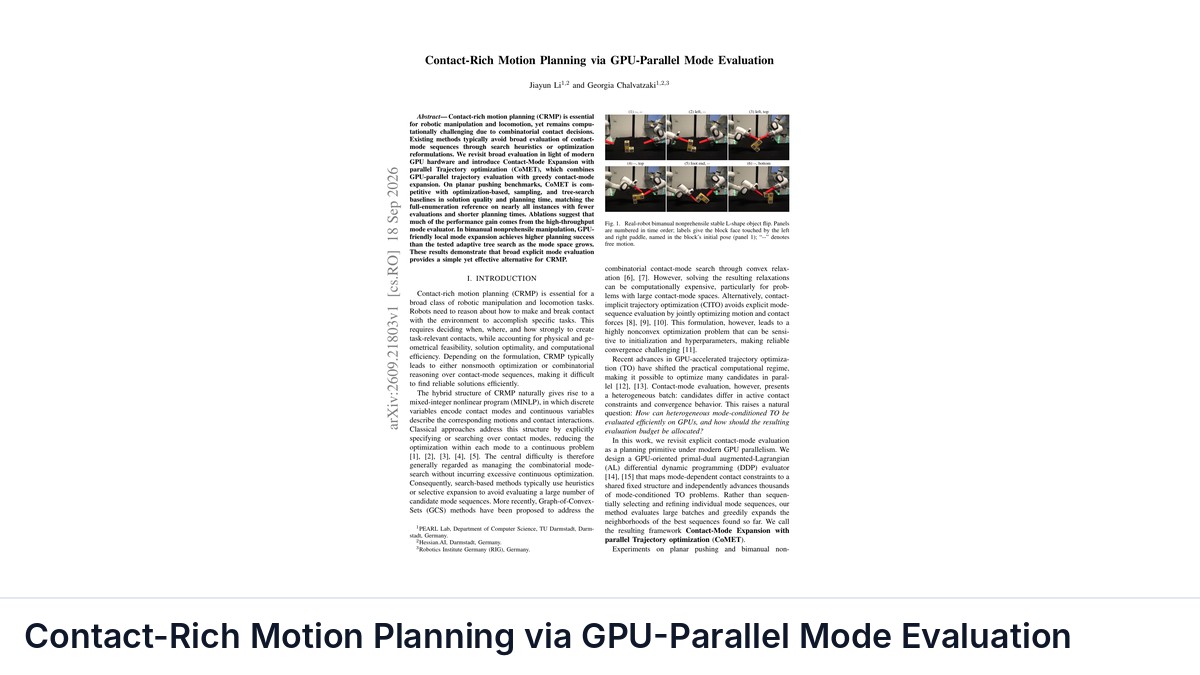
Contact-rich motion planning (CRMP) is essential for robotic manipulation and locomotion, yet remains computationally challenging due to combinatorial contact decisions.

manipulation locomotion reinforcement-learning planning benchmark
PDF Intermediate
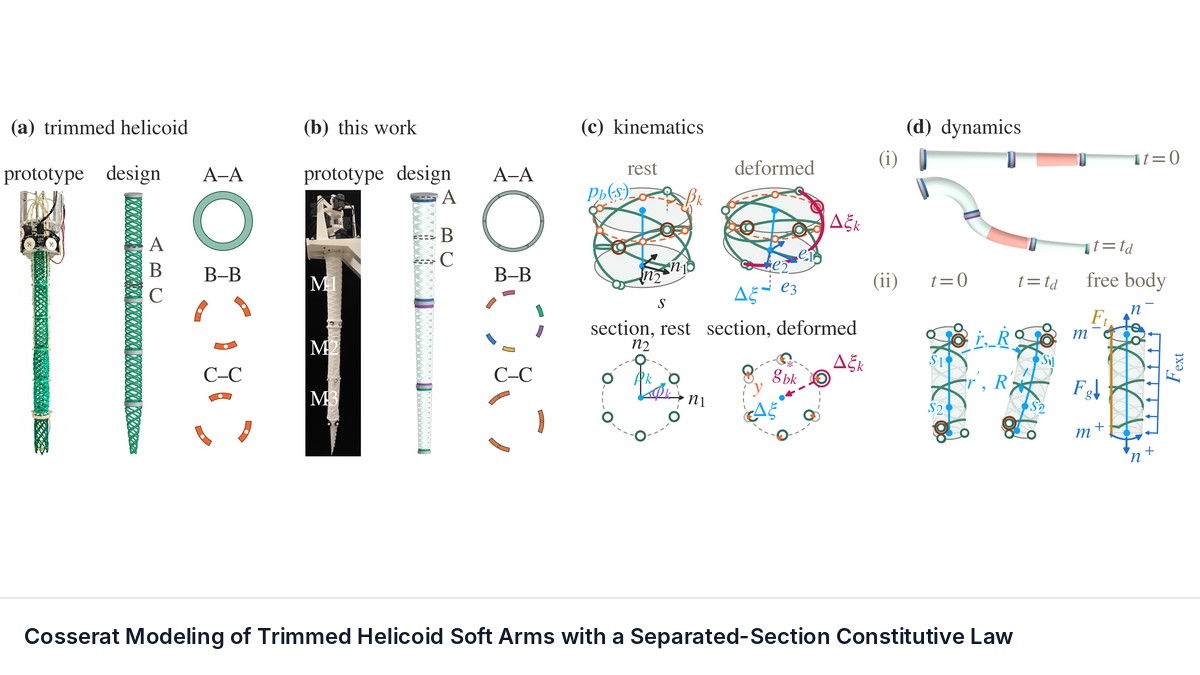
Cosserat Modeling of Trimmed Helicoid Soft Arms with a Separated-Section Constitutive Law
arXiv preprint

Cosserat Modeling of Trimmed Helicoid Soft Arms with a Separated-Section Constitutive Law

Zhihang Qin, Linxin Hou, Zeyu Zhong et al.

Cosserat rod models for soft robots usually construct sectional stiffness by summing material properties over a common cross-section. This assumption becomes inaccurate for trimmed helicoid arms, where load-bearing helix domains are separated and connected only through sparse fused crossings.

planning control benchmark
PDF Intermediate
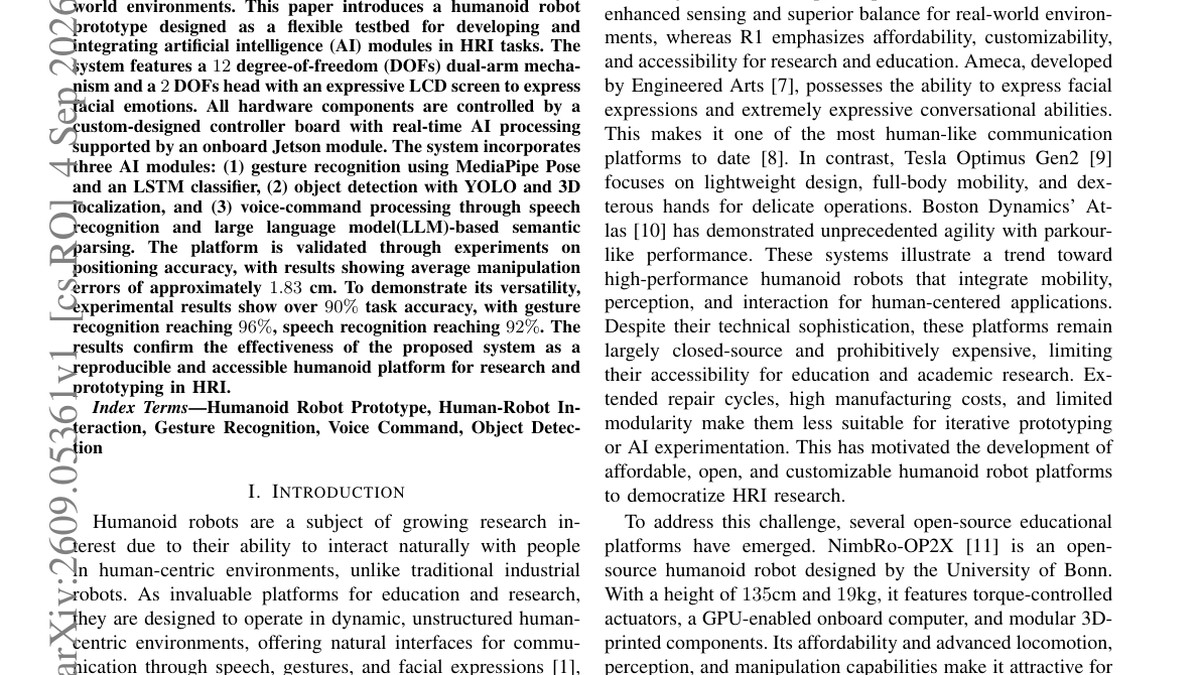
Development of a Humanoid Robot Prototype for Multimodal Human-Robot Interaction
arXiv preprint

Development of a Humanoid Robot Prototype for Multimodal Human-Robot Interaction

Thang Tran Viet, Thanh Nguyen Canh, Huy Uong Gia et al.

Human-robot interaction (HRI) enables intuitive and intelligent collaboration between humans and robots in real-world environments. This paper introduces a humanoid robot prototype designed as a flexible testbed for developing and integrating artificial intelligence (AI) modules in HRI tasks.

manipulation vision vla reinforcement-learning control human-robot-interaction
Code PDF Intermediate
GitHub ★ —
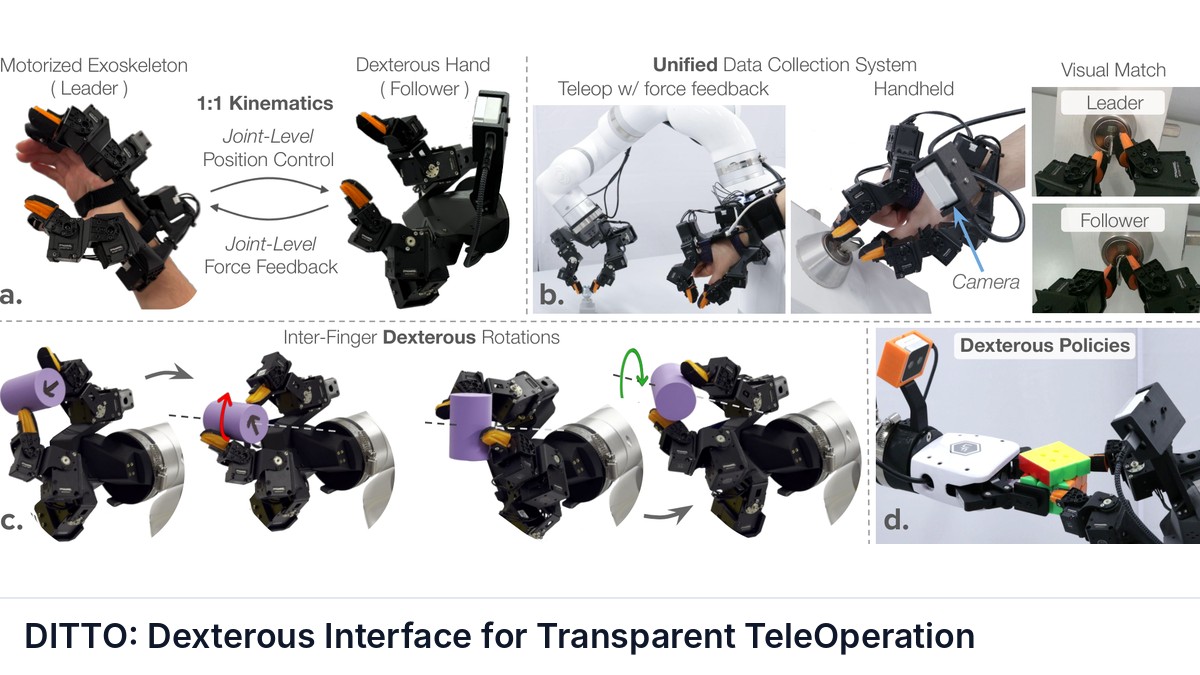
DITTO: Dexterous Interface for Transparent TeleOperation
arXiv preprint

DITTO: Dexterous Interface for Transparent TeleOperation

Joaquin Palacios, Katelyn Lee, Cheng Zhang et al.

Collecting data for manipulation with high-DOF hands is challenging, as interfaces must capture rich hand motion while rendering the contact interactions essential for precise manipulation.

manipulation vision learning-from-demonstration
Code PDF Intermediate
GitHub ★ —
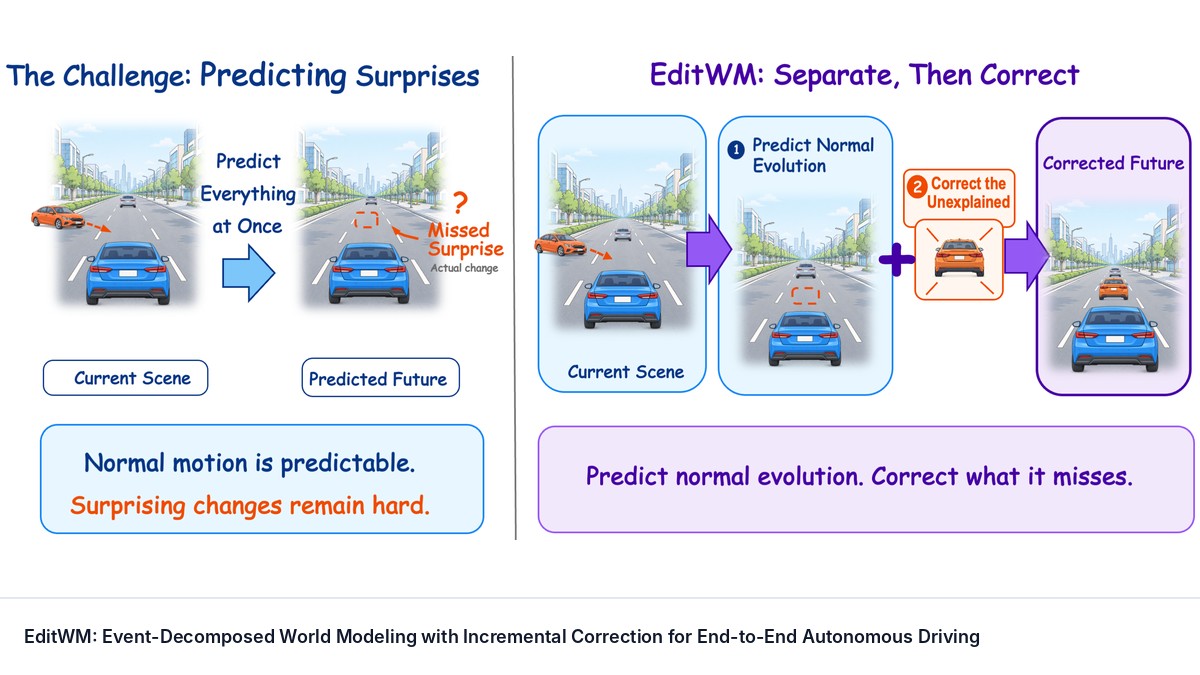
EditWM: Event-Decomposed World Modeling with Incremental Correction for End-to-End Autonomous Driving
arXiv preprint

EditWM: Event-Decomposed World Modeling with Incremental Correction for End-to-End Autonomous Driving

Junjie Yang, Qingwei Zeng, Youyou Li et al.

World models support autonomous driving by predicting the scene evolution associated with candidate trajectories. Driving dynamics differ in predictability, motivating a distinction between regular evolution and event-induced deviations that call for selective correction.

vision reinforcement-learning planning benchmark
PDF Advanced
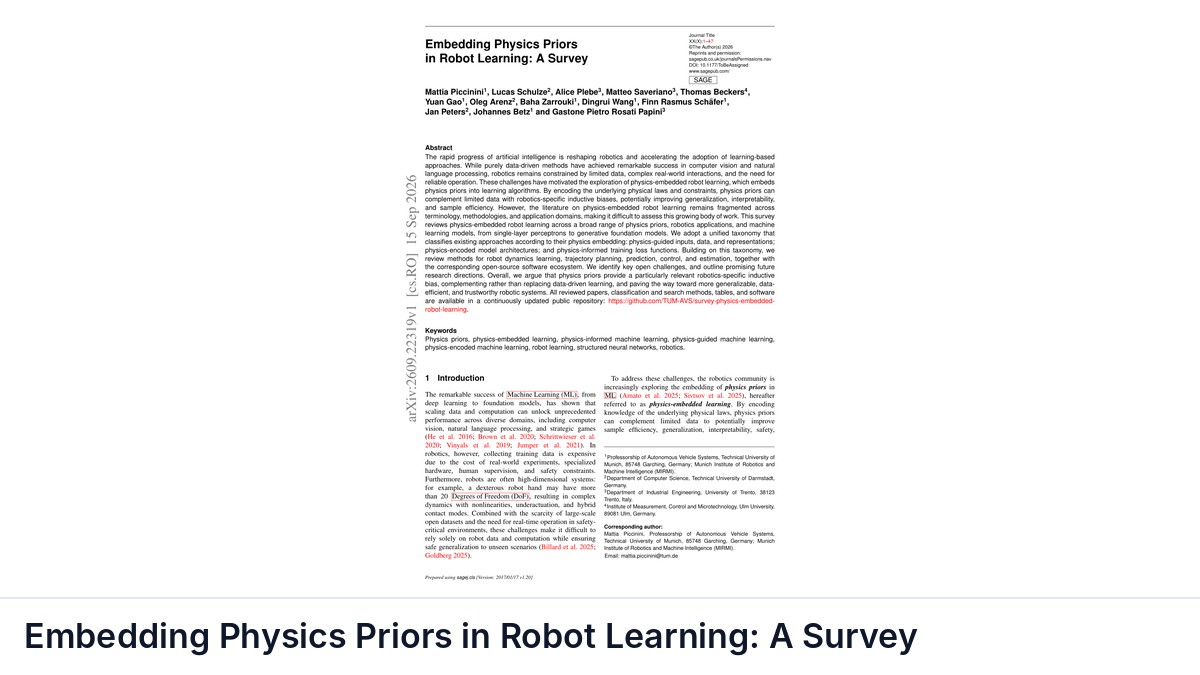
Embedding Physics Priors in Robot Learning: A Survey
arXiv preprint

Embedding Physics Priors in Robot Learning: A Survey

Mattia Piccinini, Lucas Schulze, Alice Plebe et al.

The rapid progress of artificial intelligence is reshaping robotics and accelerating the adoption of learning-based approaches.

vision reinforcement-learning planning control
Code PDF Beginner
GitHub ★ —
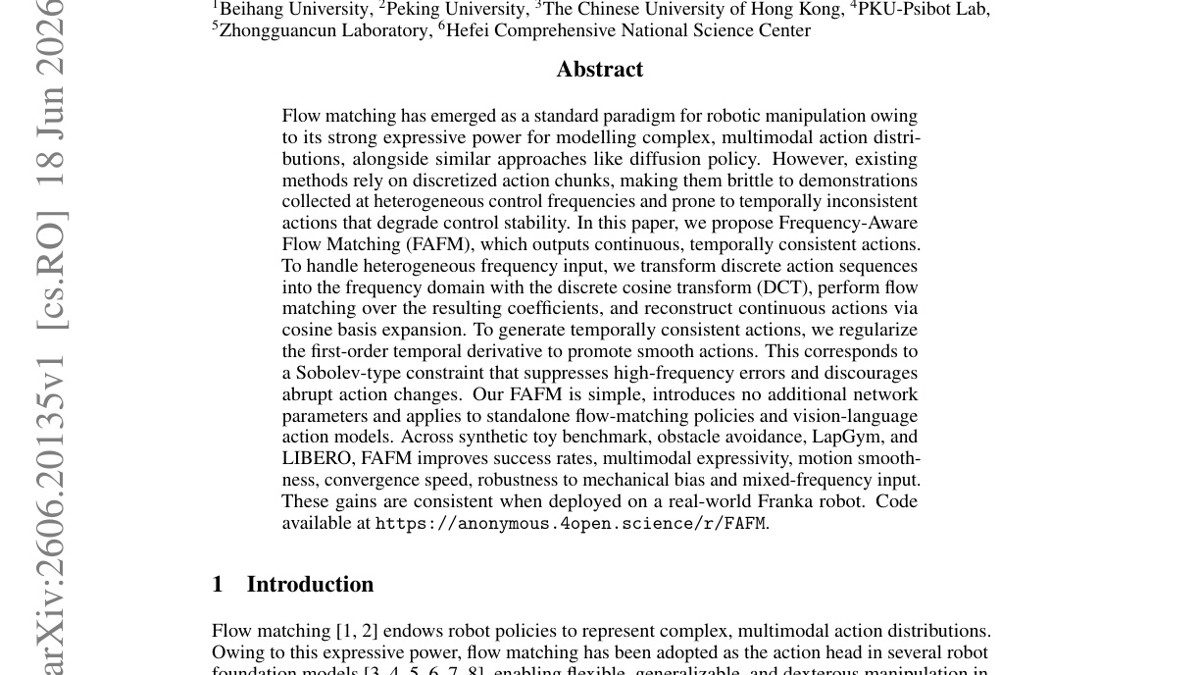
Faster Visuomotor Policy Learning on Action Manifolds via Riemannian MeanFlow
arXiv preprint

Faster Visuomotor Policy Learning on Action Manifolds via Riemannian MeanFlow

S. Talha Bukhari, Austin Garrett, Yi Wei et al.

Visuomotor policies learn a direct map from raw sensory observations to robot action sequences. Policies based on Diffusion and Flow Matching capture the multimodal distribution over action sequences in an end-to-end manner.

manipulation reinforcement-learning control benchmark
PDF Advanced
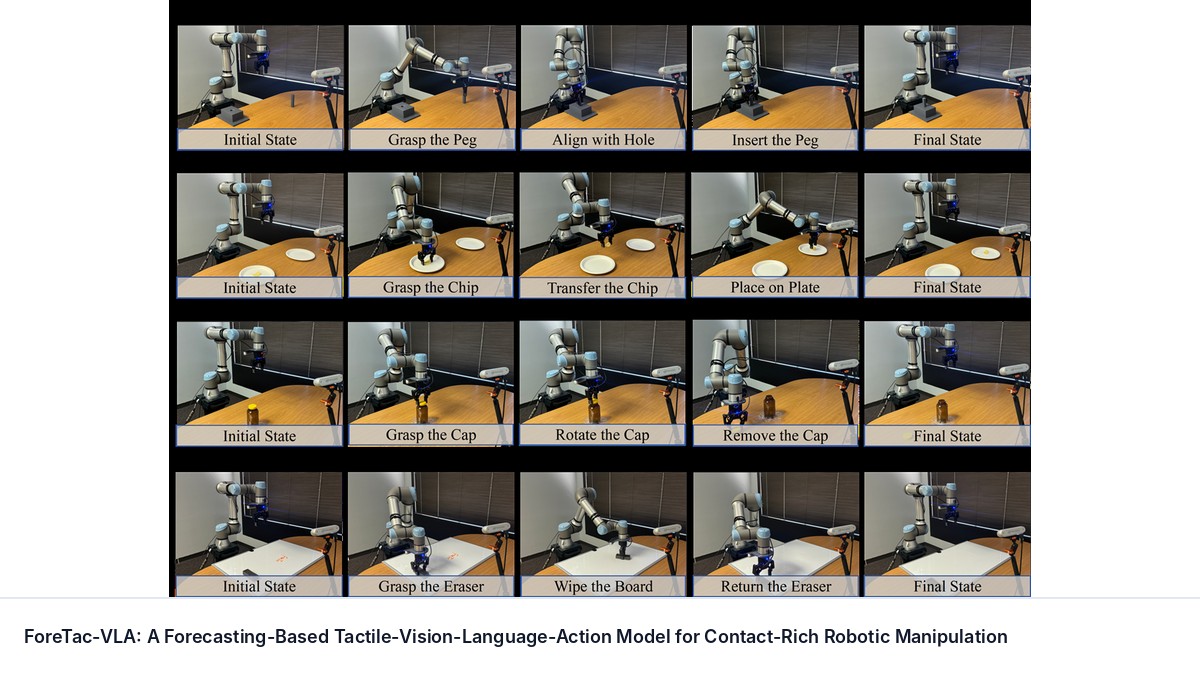
ForeTac-VLA: A Forecasting-Based Tactile-Vision-Language-Action Model for Contact-Rich Robotic Manipulation
arXiv preprint

ForeTac-VLA: A Forecasting-Based Tactile-Vision-Language-Action Model for Contact-Rich Robotic Manipulation

Zhengyu Tao, Xin Li, Xin Wang

Vision-language-action (VLA) models have demonstrated strong capabilities in robotic manipulation, yet their reliance on visual perception limits robustness in contact-rich environments, where critical physical interaction states may not be visually observable.

manipulation vision vla reinforcement-learning learning-from-demonstration tactile
PDF Intermediate
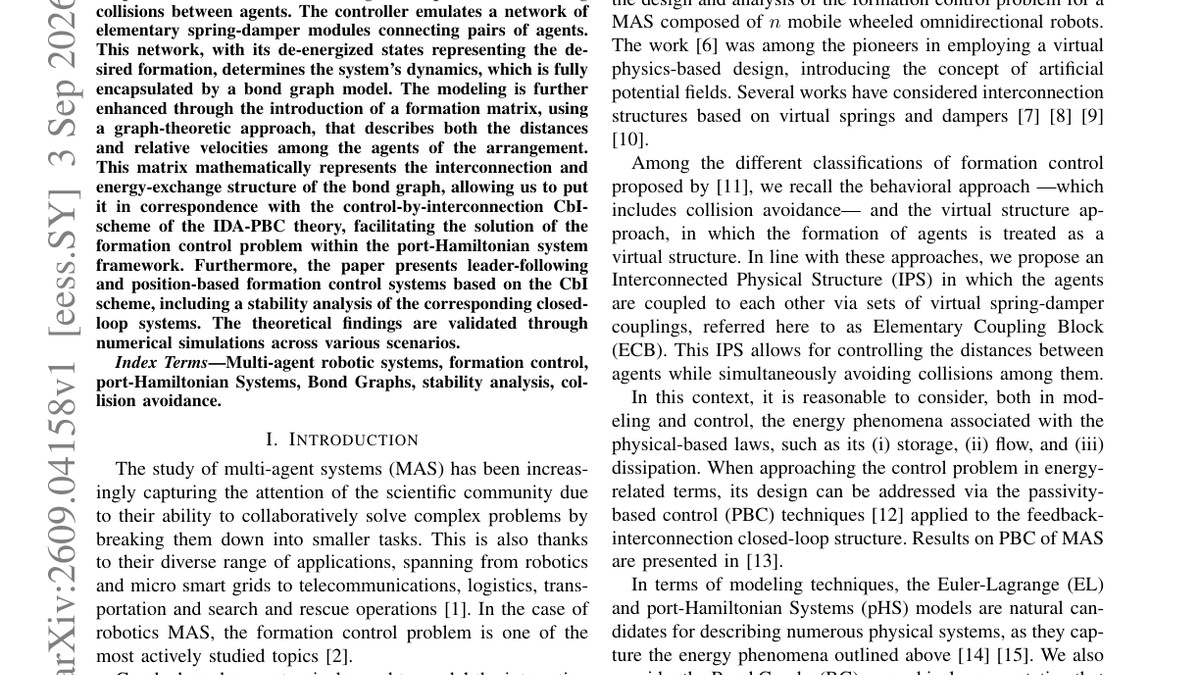
Formation Matrix and Energy-based Control of Multi-Agent Systems
arXiv preprint

Formation Matrix and Energy-based Control of Multi-Agent Systems

Martín Crespo, Sergio Junco, Matías Nacusse

This paper presents an energy-based controller for a multiagent robotic system designed to achieve and maintain a specific formation while moving on a plane and avoiding collisions between agents. The controller emulates a network of elementary spring-damper modules connecting pairs of agents.

control
PDF Intermediate
Frame-Coded Legged Locomotion over Noisy Terrain
arXiv preprint

Frame-Coded Legged Locomotion over Noisy Terrain

Lav R. Varshney

Open-loop multilegged locomotion over rough terrain has been interpreted as matter transport over a noisy channel: leg-ground interactions are discrete basic active contacts, terrain deletes or perturbs those contacts, and spatial redundancy concentrates the resulting thrust and arrival time.

locomotion
PDF Intermediate
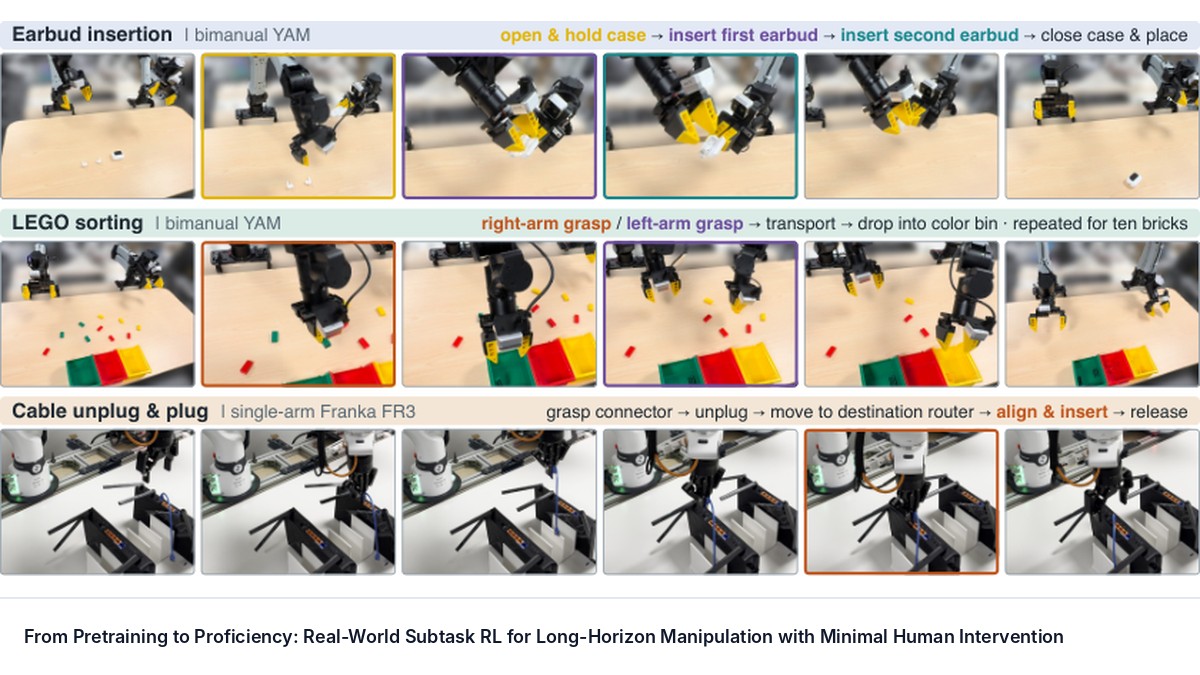
From Pretraining to Proficiency: Real-World Subtask RL for Long-Horizon Manipulation with Minimal Human Intervention
arXiv preprint

From Pretraining to Proficiency: Real-World Subtask RL for Long-Horizon Manipulation with Minimal Human Intervention

Sichang Su, Benjamin Yang, Zhiyun Deng et al.

A pretrained robot foundation policy may execute most of a long-horizon task yet repeatedly fail at a few critical subtasks. Collecting additional full-task demonstrations for supervised fine-tuning (SFT) requires operators to repeat behaviors the policy already performs well.

manipulation reinforcement-learning learning-from-demonstration
Code PDF Intermediate
GitHub ★ —
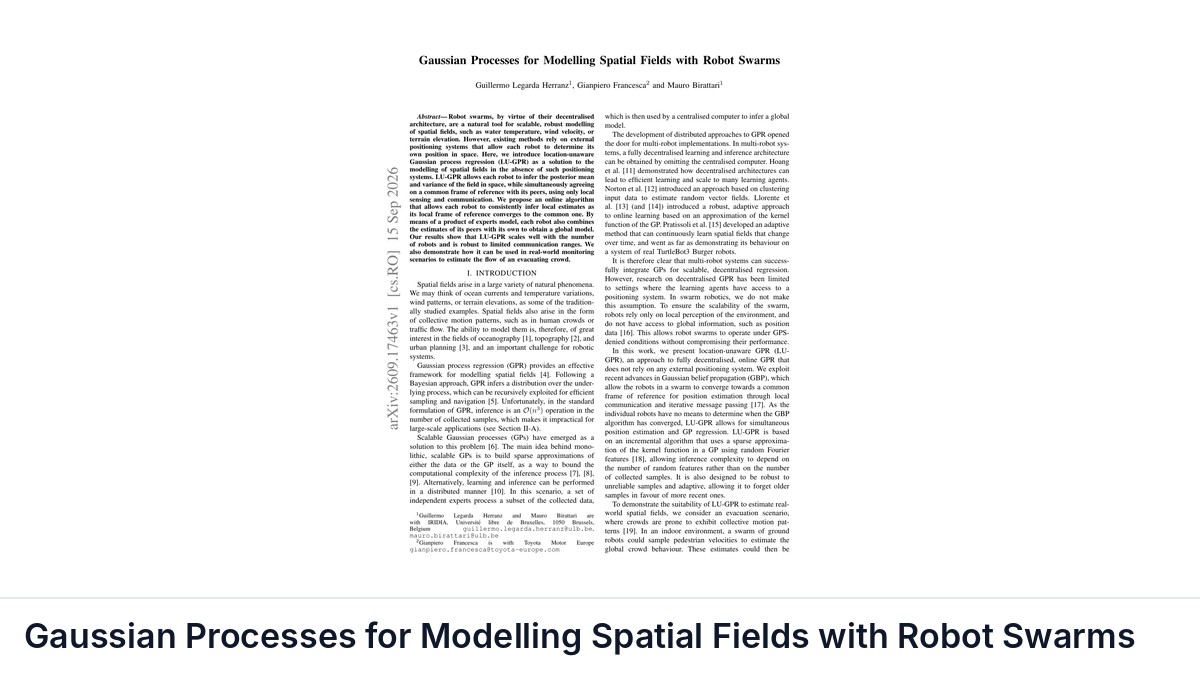
Gaussian Processes for Modelling Spatial Fields with Robot Swarms
arXiv preprint

Gaussian Processes for Modelling Spatial Fields with Robot Swarms

Guillermo Legarda Herranz, Gianpiero Francesca, Mauro Birattari

Robot swarms, by virtue of their decentralised architecture, are a natural tool for scalable, robust modelling of spatial fields, such as water temperature, wind velocity, or terrain elevation.

reinforcement-learning
PDF Intermediate
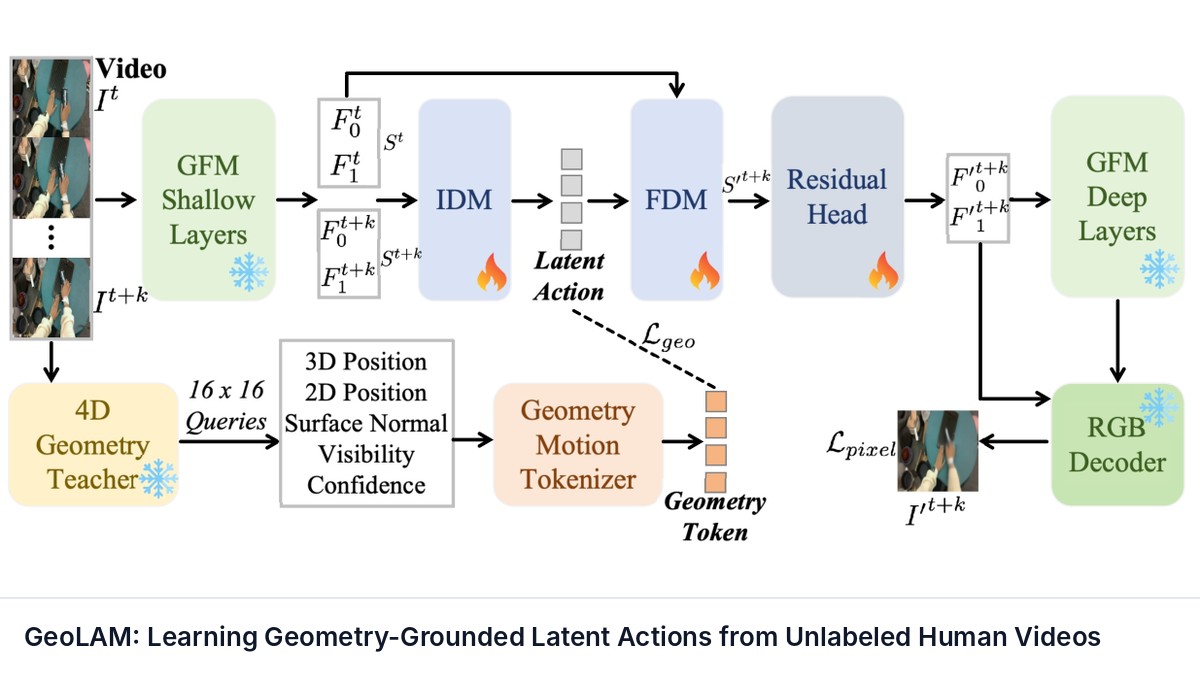
GeoLAM: Learning Geometry-Grounded Latent Actions from Unlabeled Human Videos
arXiv preprint

GeoLAM: Learning Geometry-Grounded Latent Actions from Unlabeled Human Videos

Yifan Xie, Hekun Tian, Jinkun Liu et al.

Human videos provide rich manipulation experience, but extracting action representations that preserve useful motion remains challenging. Visual reconstruction alone can entangle manipulation-related motion with appearance changes and camera movement.

manipulation vision reinforcement-learning learning-from-demonstration benchmark
PDF Intermediate
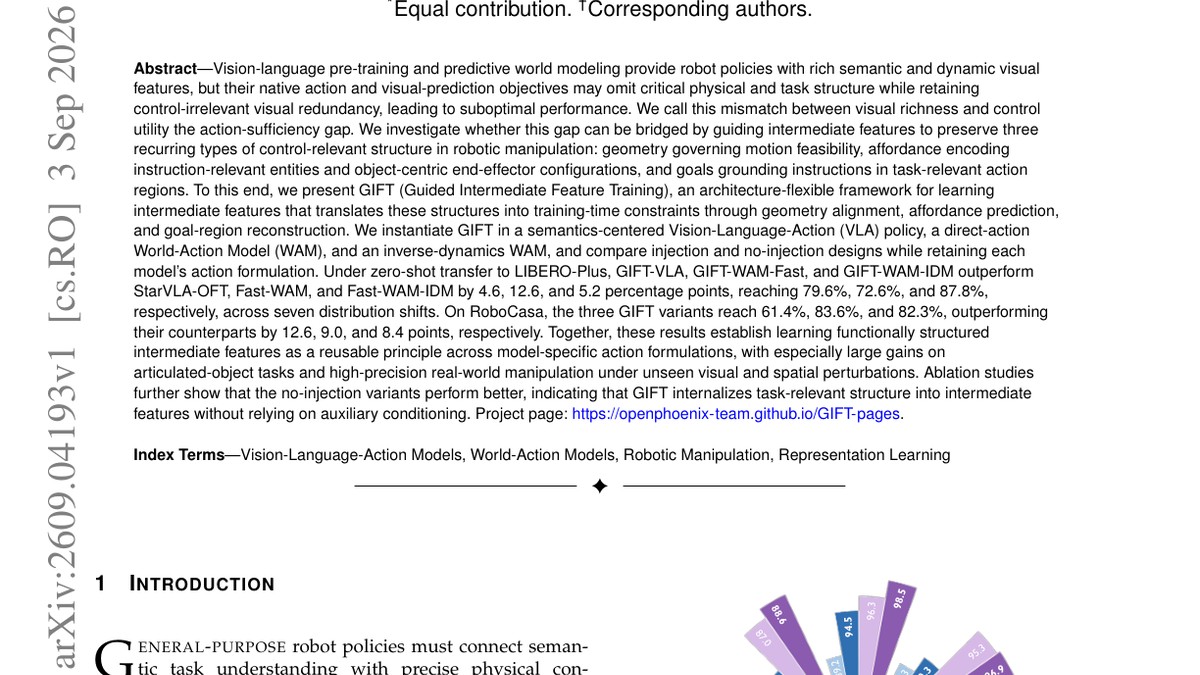
GIFT: Guided Intermediate Feature Training via Action-Oriented Structural Supervision for Robotic Manipulation
arXiv preprint

GIFT: Guided Intermediate Feature Training via Action-Oriented Structural Supervision for Robotic Manipulation

Yupeng Zheng, Xiang Li, Songen Gu et al.

Vision-language pre-training and predictive world modeling provide robot policies with rich semantic and dynamic visual features, but their native action and visual-prediction objectives may omit critical physical and task structure while retaining control-irrelevant visual redundancy.

manipulation vision vla reinforcement-learning control
PDF Intermediate
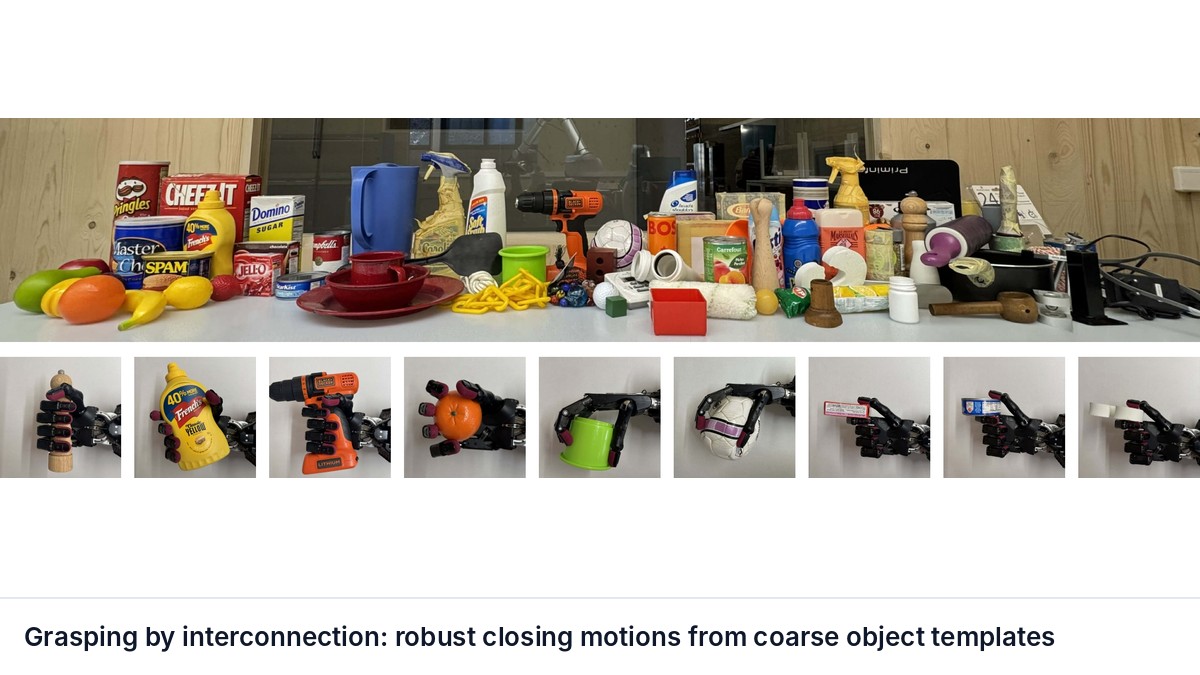
Grasping by interconnection: robust closing motions from coarse object templates
arXiv preprint

Grasping by interconnection: robust closing motions from coarse object templates

Julien Vanderheyden, Guillaume Drion, Fulvio Forni et al.

Dexterous robot hands must often grasp objects whose shape, size, and pose are known only approximately. Grasp planners typically require accurate object models or correct errors with feedback, but how much inaccuracy a closing motion can tolerate on its own remains unclear.

manipulation control benchmark
PDF Intermediate
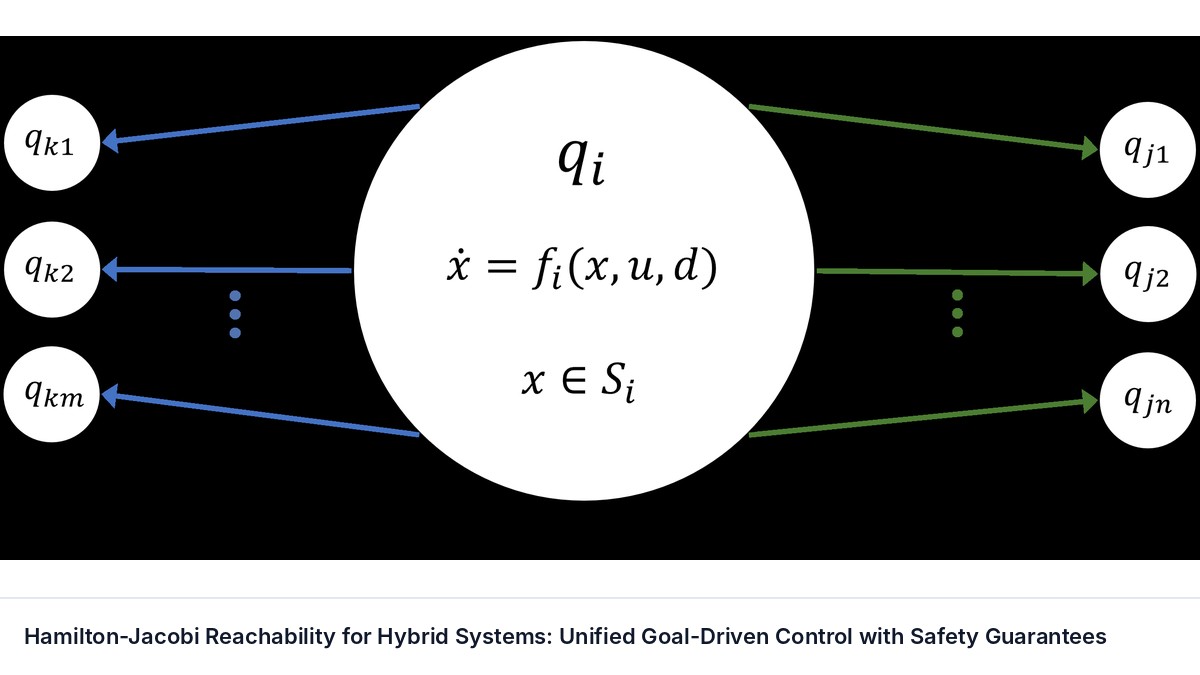
Hamilton-Jacobi Reachability for Hybrid Systems: Unified Goal-Driven Control with Safety Guarantees
arXiv preprint

Hamilton-Jacobi Reachability for Hybrid Systems: Unified Goal-Driven Control with Safety Guarantees

Javier Borquez, Shuang Peng, Somil Bansal

Hybrid dynamical systems provide a powerful modeling framework for robotic systems, particularly in contact-rich environments. However, ensuring safety and performance in such systems remains challenging due to the intricate coupling between continuous dynamics and discrete mode transitions.

locomotion reinforcement-learning planning control
PDF Intermediate
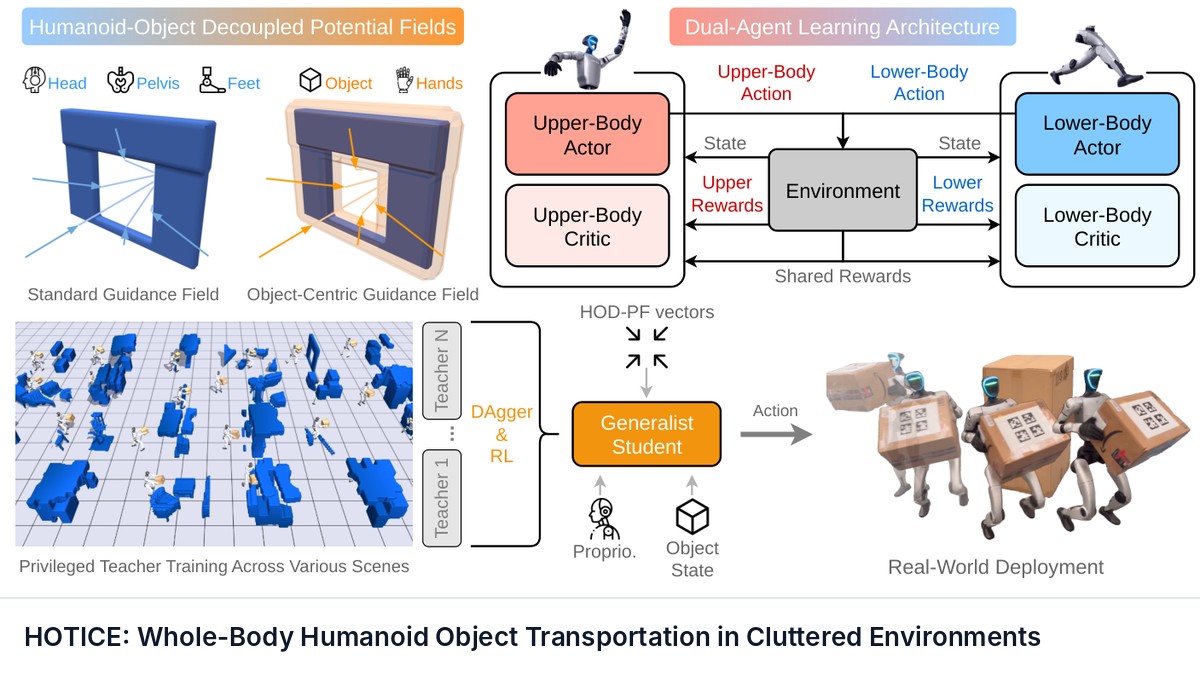
HOTICE: Whole-Body Humanoid Object Transportation in Cluttered Environments
arXiv preprint

HOTICE: Whole-Body Humanoid Object Transportation in Cluttered Environments

Toan Nguyen, Weiduo Yuan, Siheng Zhao et al.

Object transportation is a fundamental capability for humanoid robots operating in real-world, human-centric environments, yet existing methods struggle when clutter constrains free space around both the robot and its carried payload.

manipulation reinforcement-learning control
PDF Intermediate
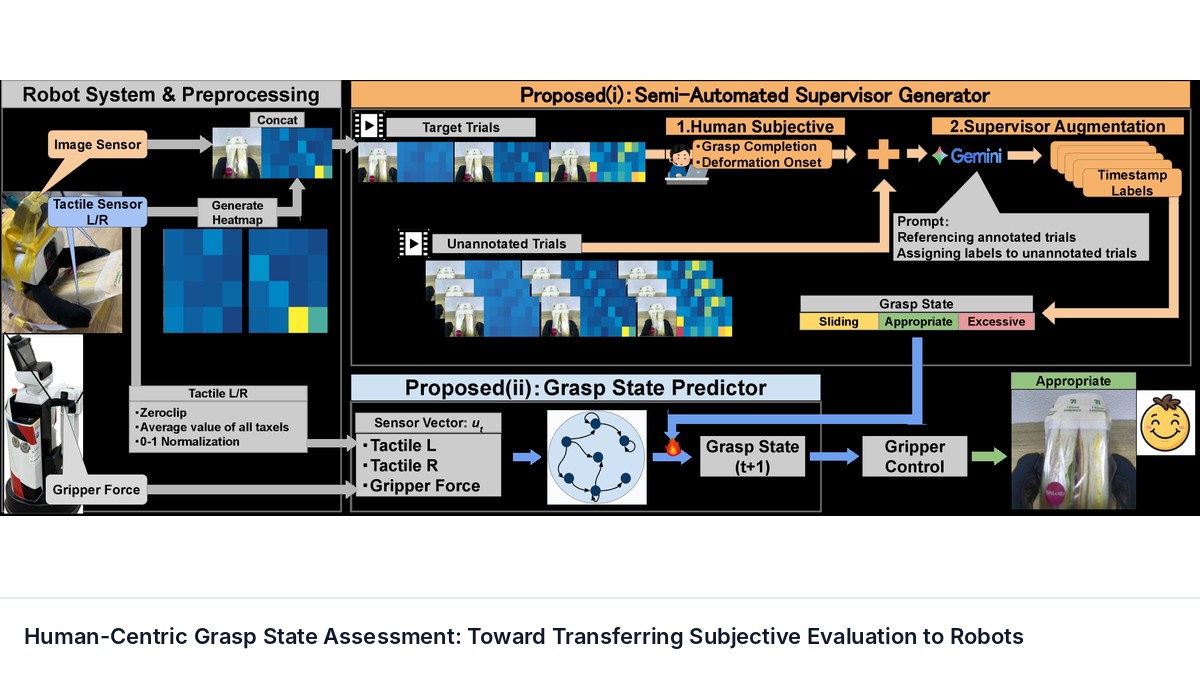
Human-Centric Grasp State Assessment: Toward Transferring Subjective Evaluation to Robots
arXiv preprint

Human-Centric Grasp State Assessment: Toward Transferring Subjective Evaluation to Robots

Ryohei Kobayashi, Kosei Isomoto, Yuga Yano et al.

We propose a framework that transfers tacit human subjective criteria to robotic systems for the appropriate grasping of deformable objects. Achieving such behavior is challenging because a semantic gap exists between qualitative human expectations and quantitative robotic measurements.

manipulation vision vla control tactile benchmark
PDF Intermediate
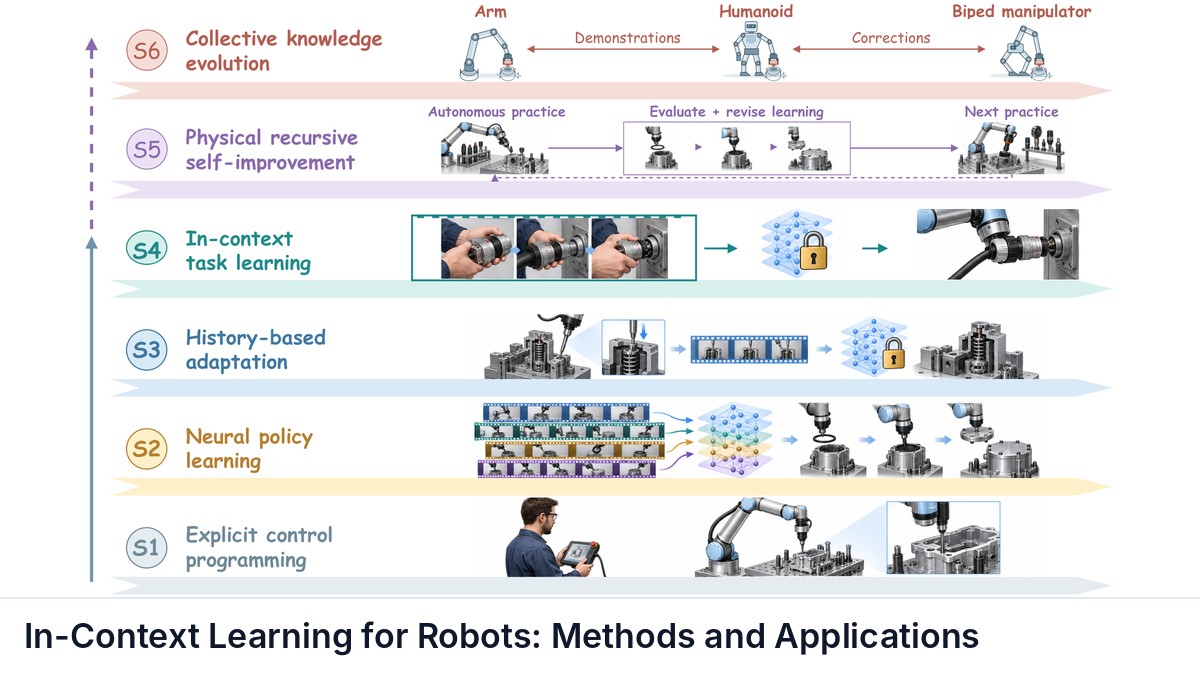
In-Context Learning for Robots: Methods and Applications
arXiv preprint

In-Context Learning for Robots: Methods and Applications

Haojian Huang, Zexi Li, Junhao Guo et al.

General-purpose robots must infer what a new task requires and translate that understanding into appropriate physical action.

manipulation reinforcement-learning planning control learning-from-demonstration benchmark
Code PDF Beginner
GitHub ★ —
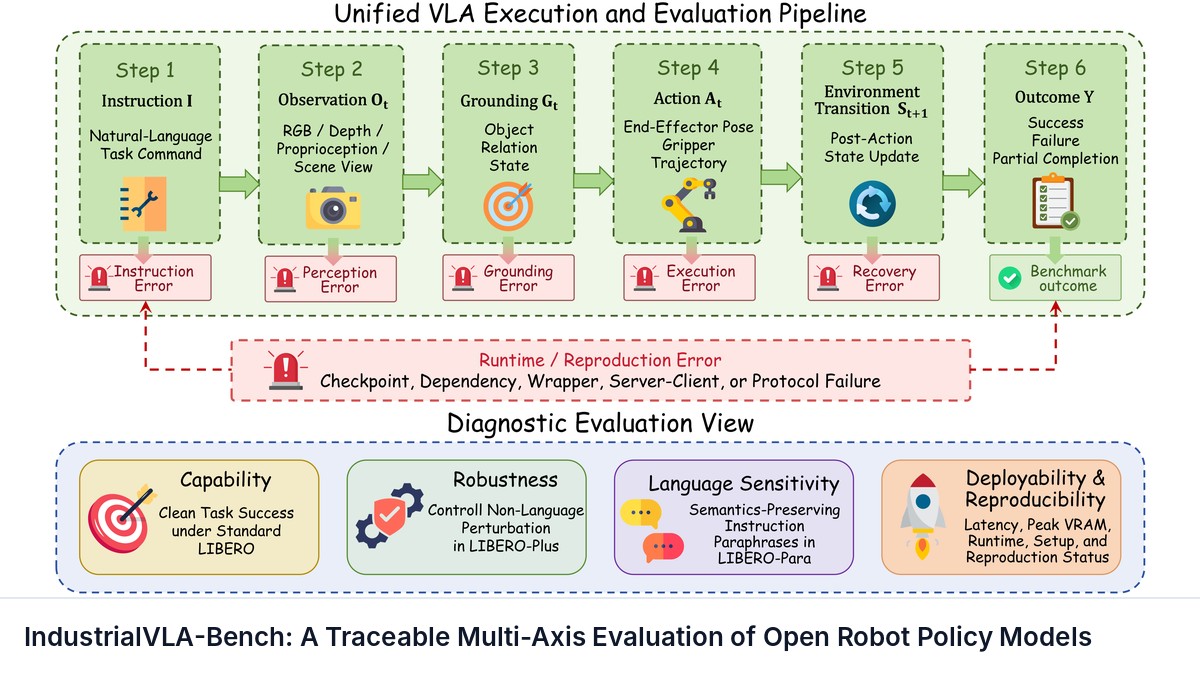
IndustrialVLA-Bench: A Traceable Multi-Axis Evaluation of Open Robot Policy Models
arXiv preprint

IndustrialVLA-Bench: A Traceable Multi-Axis Evaluation of Open Robot Policy Models

Yiqi Wang, Zhifeng Rao, Jiaqi Zhang et al.

Open robot policies increasingly follow two paradigms: vision-language-action models (VLAs) directly map observations and instructions to actions, whereas world-action models (WAMs) incorporate learned video or world dynamics into policy learning or action generation.

manipulation vision vla reinforcement-learning benchmark
Code PDF Intermediate
GitHub ★ —
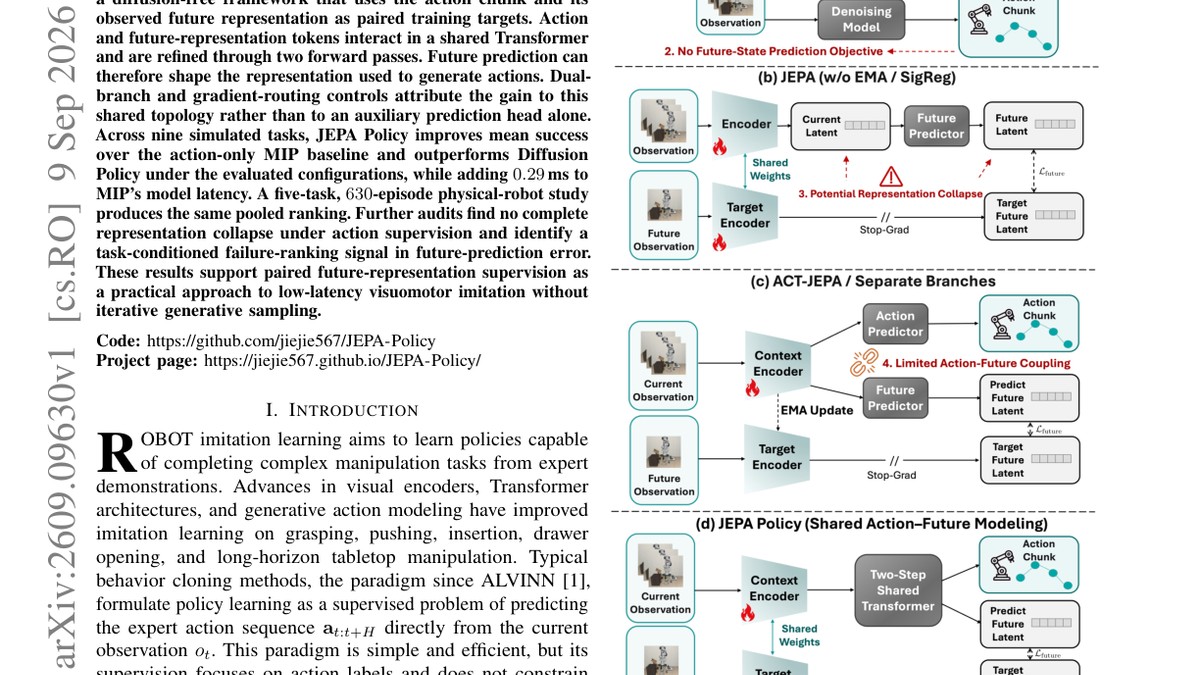
JEPA Policy: Diffusion-Free Imitation Learning via Paired Action and Future Representation Prediction
arXiv preprint

JEPA Policy: Diffusion-Free Imitation Learning via Paired Action and Future Representation Prediction

Jie Xu, Kangjin Yu, Ziyi Jin et al.

Standard behavior cloning supervises actions without explicitly constraining the future representation paired with each demonstrated action chunk. We introduce JEPA Policy, a diffusion-free framework that uses the action chunk and its observed future representation as paired training targets.

vision reinforcement-learning control learning-from-demonstration
Code PDF Advanced
GitHub ★ —
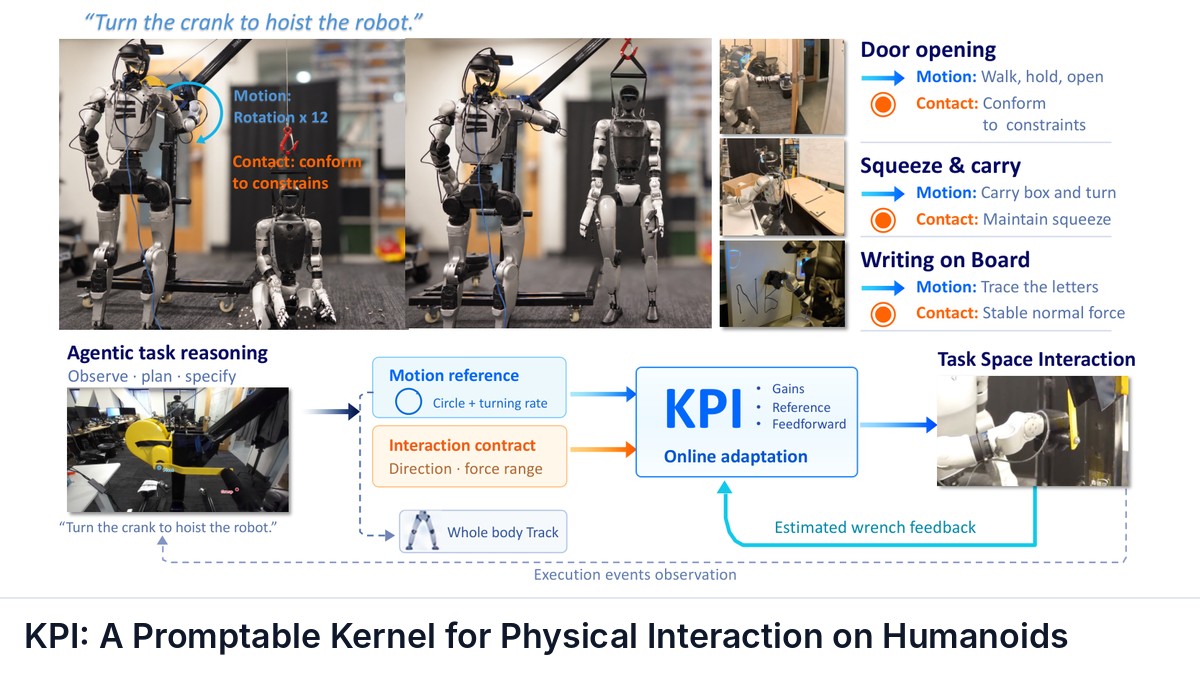
KPI: A Promptable Kernel for Physical Interaction on Humanoids
arXiv preprint

KPI: A Promptable Kernel for Physical Interaction on Humanoids

Yikai Wang, Honghao Zhu, Xiao Hu et al.

Humanoids now walk, balance and reach with remarkable generality: one whole-body tracking policy follows references from a human, or from an end-to-end policy.

vision reinforcement-learning control learning-from-demonstration
PDF Advanced
LEAP: Learning Emergent Active Perception for Quadruped Navigation
arXiv preprint

LEAP: Learning Emergent Active Perception for Quadruped Navigation

\"U. Bora G\"okbakan (WILLOW), St\'ephane Caron (ISIR), Philippe Sou\`eres (LAAS-GEPETTO)

Active perception allows autonomous agents to select their viewpoints rather than passively process the viewpoints given to them, enabling them to target where to reduce uncertainty about their environment.

locomotion vision planning control benchmark
PDF Intermediate
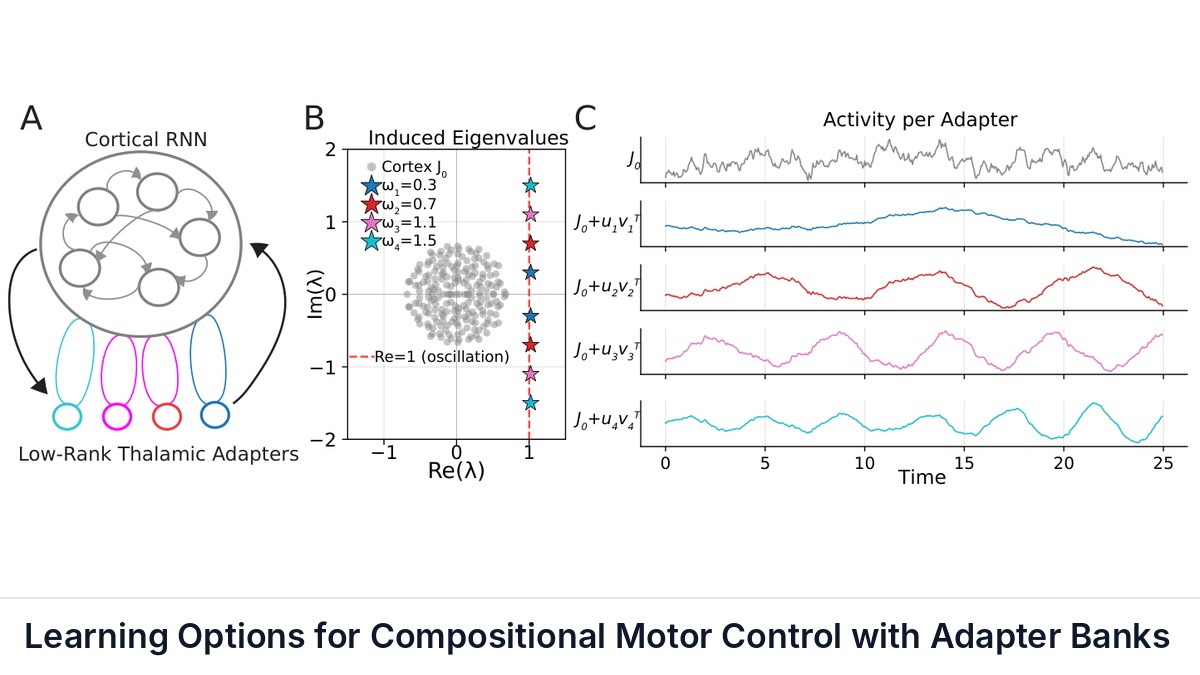
Learning Options for Compositional Motor Control with Adapter Banks
arXiv preprint

Learning Options for Compositional Motor Control with Adapter Banks

Sreejan Kumar, Marcelo Mattar, Lea Duncker

Learning flexible motor primitives is a hallmark of skilled motor control. Recent neuroscience theory proposes that motor primitives may be implemented as low-rank perturbations of a shared recurrent network, but leaves open how such a system is learned.

vla reinforcement-learning control
PDF Advanced
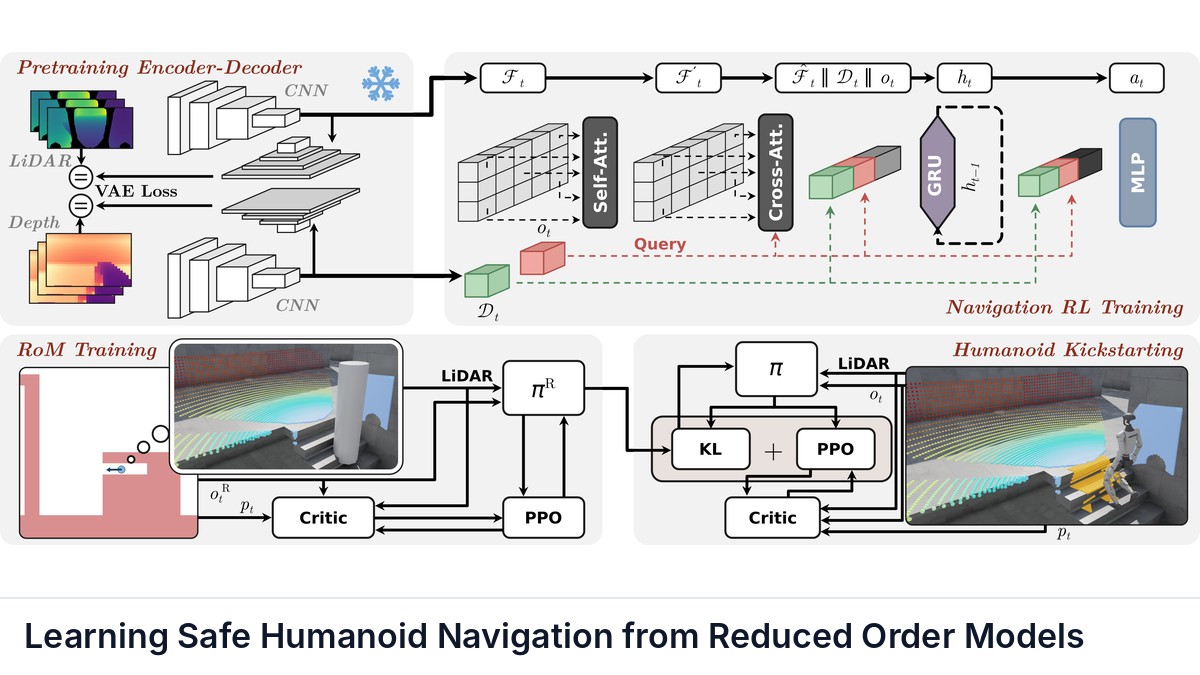
Learning Safe Humanoid Navigation from Reduced Order Models
arXiv preprint

Learning Safe Humanoid Navigation from Reduced Order Models

William D. Compton, Zachary Olkin, Ryan Bena et al.

Research in humanoid robotics has achieved rapid progress in locomotion, and recent results have pushed the boundary on autonomous navigation.

locomotion reinforcement-learning planning control
PDF Intermediate
Learning Terrain-Adaptive Humanoid Locomotion on Granular Terrain
arXiv preprint

Learning Terrain-Adaptive Humanoid Locomotion on Granular Terrain

Junnosuke Kamohara, Feiyang Wu, Andy Ningan Zong et al.

Humanoid locomotion on granular terrain remains a significant challenge due to its complex foot-terrain interaction dynamics that are difficult to model. Existing approaches either ignore granular contact dynamics or incorporate simplified normal force models with heuristic tangential components.

locomotion reinforcement-learning control learning-from-demonstration
PDF Intermediate
LOTUSim-Energy: A Maritime Simulator for Human-Drone Interaction in Autonomous Offshore Operation \& Maintenance
arXiv preprint

LOTUSim-Energy: A Maritime Simulator for Human-Drone Interaction in Autonomous Offshore Operation \& Maintenance

Juliette Grosset, Marie Dubromel, Hélène Lechêne et al.

Offshore maintenance requires operations in the air, the surface, and the subsea domain and include human supervision. This paper presents LOTUSim-Energy, a real-time maritime simulator designed for multi-domain human--drone interaction for offshore operation and maintenance.

vision reinforcement-learning benchmark
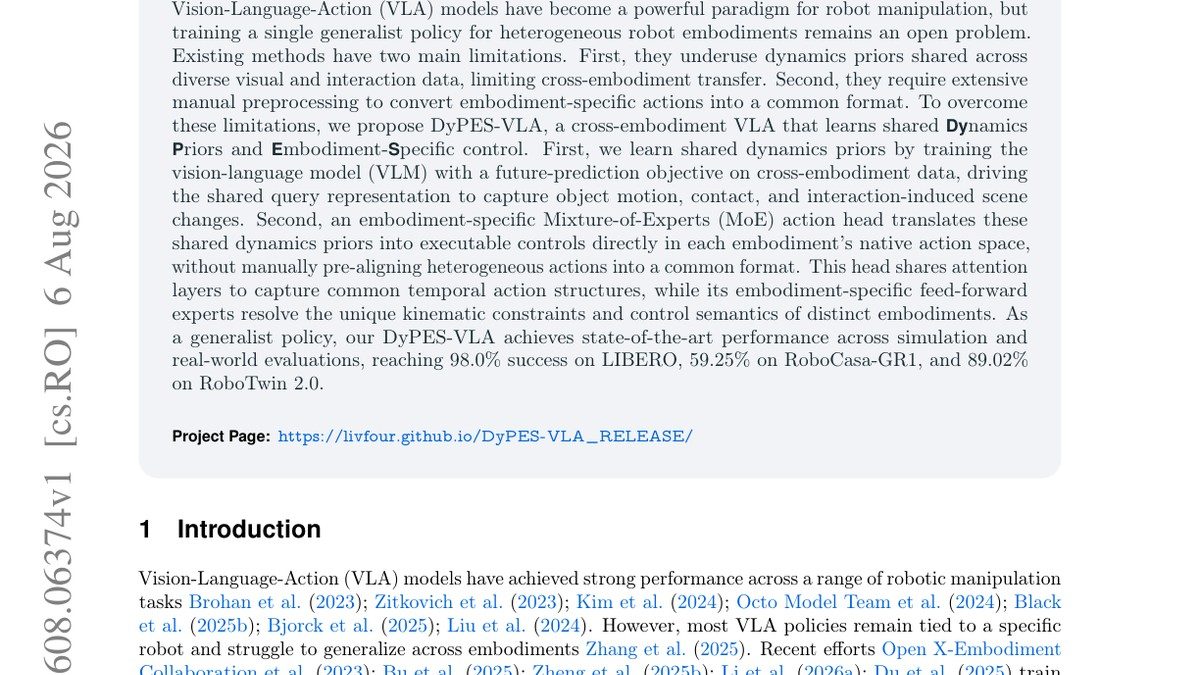
PDF Advanced
MagNav: A Dual-Core Magnetic Track Guidance Framework for Lighting-Invariant Navigation in Two-Wheeled Robots
arXiv preprint

MagNav: A Dual-Core Magnetic Track Guidance Framework for Lighting-Invariant Navigation in Two-Wheeled Robots

Arpita Kumari, Anupam Chatterjee, Richa Srivastava

Two-Wheeled Inverted Pendulum (TWIP) robots are useful for studying how to control systems that are naturally unstable and have fewer actuators than degrees of freedom. Adding autonomous line-following to these robots is challenging because steering and balancing are closely linked.

planning control
PDF Intermediate
Memory as Plans: World-Action Modeling with Memory-Grounded Planning
arXiv preprint

Memory as Plans: World-Action Modeling with Memory-Grounded Planning

Sizhe Zhao, Haozhe Xie, Weiyu Zhao et al.

Mainstream robotic policies often adopt a Markovian formulation, but many complex real-world manipulation tasks are inherently non-Markovian, requiring long-horizon memory beyond the current observation.

manipulation vision reinforcement-learning planning
PDF Intermediate
Modality-Autoregressive World-Action Models
arXiv preprint

Modality-Autoregressive World-Action Models

Adam Hung, Bardienus P. Duisterhof, Deva Ramanan et al.

World-action models (WAMs) jointly model future observations and actions, typically predicting the future as RGB images. Other visual modalities such as depth, pretrained visual features, and point tracks can more efficiently capture geometric, semantic, and motion features.

vision reinforcement-learning benchmark
Code PDF Intermediate
GitHub ★ —
Morphometric Imitation: From Morphology and Contact Aware Hand Retargeting to Sim-to-Real Visuomotor Policy
arXiv preprint

Morphometric Imitation: From Morphology and Contact Aware Hand Retargeting to Sim-to-Real Visuomotor Policy

Tara Sadjadpour, Siming He, C. K. Wolfe et al.

Human hand-object interactions (HOIs) provide a rich source of demonstrations for dexterous manipulation, but learning directly from them presents challenges in bridging morphology gaps, ensuring dynamical feasibility, and sim-to-real deployment.

manipulation reinforcement-learning sim-to-real learning-from-demonstration
PDF Intermediate
Norm2Tex: Augmenting Visuo-Tactile Simulations with Texture
arXiv preprint

Norm2Tex: Augmenting Visuo-Tactile Simulations with Texture

Seongjin Bien, D\'ebora Oliveira Makowski, Roberto Calandra et al.

Large-scale datasets are essential for training generalist robot control policies. Collecting real-world tactile data is costly and time-consuming, motivating the use of tactile simulations. However, current tactile simulators capture only overall contact geometry and miss fine details like texture.

vision reinforcement-learning sim-to-real control tactile benchmark
PDF Advanced
Odometer-Agnostic Drift Correction Using OpenStreetMap Lane Geometry
arXiv preprint

Odometer-Agnostic Drift Correction Using OpenStreetMap Lane Geometry

Joaquin Caballero, Emilio Garcia-Fidalgo, Alberto Ortiz et al.

Despite significant progress in odometry estimation, long-term drift remains a fundamental limitation of incremental pose integration, especially in large-scale or loop-free environments.

vision reinforcement-learning
PDF Advanced
OHRID-Retail: An Open Multimodal Dataset of Human Activity in Retail Environments
arXiv preprint

OHRID-Retail: An Open Multimodal Dataset of Human Activity in Retail Environments

Xiangrui Wang, Yuetong Wu, Jalen Beeman et al.

Open datasets describing human behavior in environments shared with mobile robots remain limited, particularly for retail activities that combine locomotion, reaching, object handling, and robot guided movement.

locomotion reinforcement-learning planning human-robot-interaction benchmark
PDF Intermediate
ORDER: A Fictitious-World Benchmark for Domain-Adaptive Embodied AI
arXiv preprint

ORDER: A Fictitious-World Benchmark for Domain-Adaptive Embodied AI

Sai Krishna Reddy Sathi, Anuj Tiwari

Adapting language models to new domains via continual pre-training raises a basic evaluation problem: if the training corpus overlaps with what the model already knows, performance gains cannot be cleanly attributed to new learning rather than pre-existing knowledge.

manipulation vision reinforcement-learning benchmark
PDF Intermediate
Passive-Dynamic-Walking-Inspired Dynamics Guidance for Energy-Efficient Humanoid Locomotion
arXiv preprint

Passive-Dynamic-Walking-Inspired Dynamics Guidance for Energy-Efficient Humanoid Locomotion

Hyeonjin Choi, Joongheon Kim, Daekyum Kim

Learning energy-efficient humanoid locomotion requires discovering mechanically economical gait coordination, not merely reducing actuator effort. Reinforcement learning promotes efficiency through effort-related reward penalties, which guide the step-to-step mechanics of walking only indirectly.

locomotion reinforcement-learning
PDF Intermediate
PIVOT: Physically Informed Vision-Language Off-Road Traversability for Field Robot Navigation
arXiv preprint

PIVOT: Physically Informed Vision-Language Off-Road Traversability for Field Robot Navigation

Aoran Jiao, Wenda Zhao, Hshmat Sahak et al.

Terrain assessment is a critical capability for off-road mobile robots, enabling safe and reliable navigation through unstructured and geometrically complex environments. Conventional geometry-based terrain assessment is fast to compute but often overly conservative in unstructured environments.

vision vla reinforcement-learning planning
PDF Intermediate
Policy-Calibrated DAgger: Offline Calibrated Noise Injection for Imitation Learning
arXiv preprint

Policy-Calibrated DAgger: Offline Calibrated Noise Injection for Imitation Learning

Jenny Wang, George Kantor

Policies trained with imitation learning can accumulate errors over time, causing the robot to drift outside the training distribution. Existing methods mitigate this covariate shift by collecting additional data where the policy fails or is likely to fail.

reinforcement-learning control learning-from-demonstration benchmark
PDF Advanced
Predictive Varanus: Combining CSP Conformance Monitoring with Predictive LTL Runtime Verification
arXiv preprint

Predictive Varanus: Combining CSP Conformance Monitoring with Predictive LTL Runtime Verification

Angelo Ferrando, Matt Luckcuck, Pedro Ribeiro

Runtime Verification is well suited to autonomous and robotic systems because it checks the behaviour that is actually observed during execution. Its main limitation, however, is that it is usually reactive: the monitor detects a violation only after the system has already performed a bad event.

reinforcement-learning
PDF Intermediate
Project SCOUT: Interceptor Drone for Perimeter Defense
arXiv preprint

Project SCOUT: Interceptor Drone for Perimeter Defense

Azmain Yousuf, Siwei Cai, Knut Peterson et al.

The rapid proliferation of unauthorized unmanned aerial vehicles (UAVs) has created a growing need for robust, jamming-resistant counter-UAV systems for perimeter defense.

vision reinforcement-learning control learning-from-demonstration
PDF Advanced
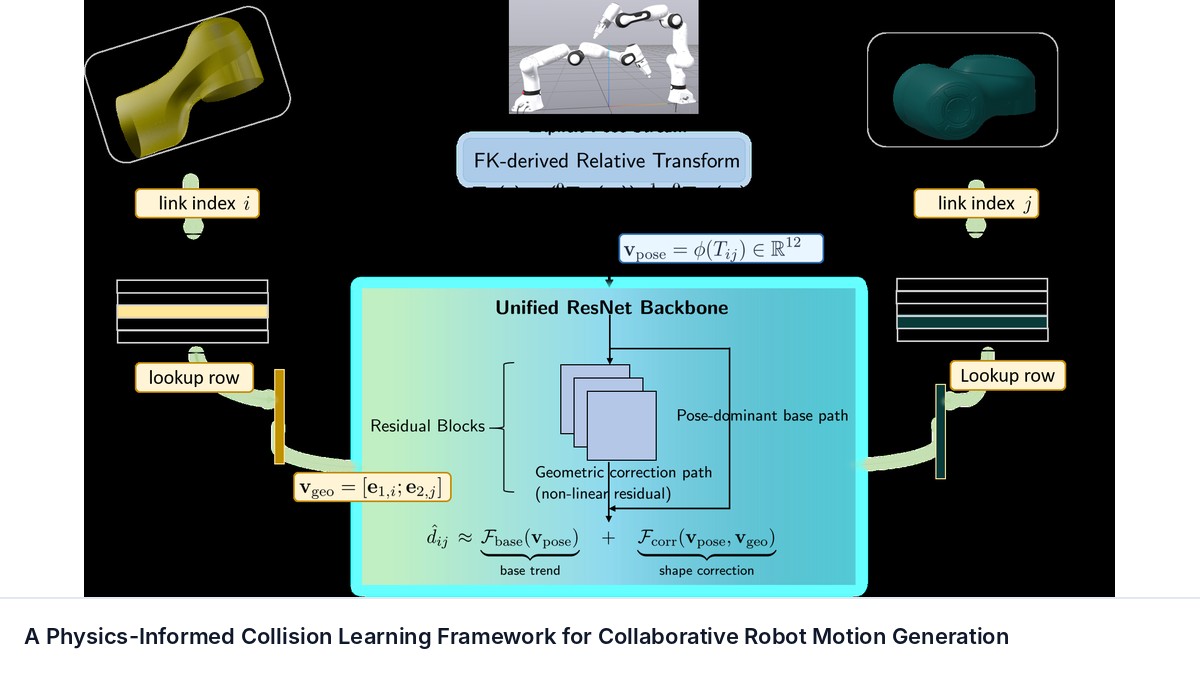
Rapid Learning of Dexterous In-Hand Pen Writing through Real-Time Jacobian Estimation
arXiv preprint

Rapid Learning of Dexterous In-Hand Pen Writing through Real-Time Jacobian Estimation

Kai Stewart, Yasunori Toshimitsu, Robert K. Katzschmann

Dexterous in-hand manipulation of a grasped object with an anthropomorphic hand is an unsolved frontier for robot dexterity. The contact-richness and highly dynamic nature of object-hand interactions tend to require extensive modeling or data-collection efforts for learning-based approaches.

manipulation reinforcement-learning control learning-from-demonstration
Code PDF Intermediate
GitHub ★ —
RAPID: Robot Agentic Programming from Demonstrations
arXiv preprint

RAPID: Robot Agentic Programming from Demonstrations

Yuyao Liu, Jiayuan Mao, David Hsu et al.

Coding agents have demonstrated enormous success in solving complex programming problems.

manipulation vision reinforcement-learning control learning-from-demonstration benchmark
PDF Intermediate
Real-Time Force Regulation for Whole-Hand Dexterous Grasping
arXiv preprint

Real-Time Force Regulation for Whole-Hand Dexterous Grasping

Sang Min Kim, Alexander Alexiev, Tzu-Yuan Lin et al.

Robust dexterous grasping requires maintaining physical stability despite contacts interactively evolving across the entire hand. A precomputed force distribution can easily fail under object motion, modeling errors, or external disturbances.

manipulation reinforcement-learning control tactile
PDF Intermediate
Real-Time Service Robot Replanning via Simple Button Interaction for Improved Task Success and User Experience
arXiv preprint

Real-Time Service Robot Replanning via Simple Button Interaction for Improved Task Success and User Experience

Ryo Terashima, Yuga Yano, Koshun Arimura et al.

Service robots must respond to unexpected instructions in real-world environments. However, robots cannot detect all failures and exceptions during a task. To address these issues, we propose a real-time feedback function that enables robots to modify their behavior based on human feedback.

reinforcement-learning planning
PDF Intermediate
Realizability Is Not Enough: Encoding, Liveness, and Auditing of Synthesized Robot Supervisors
arXiv preprint

Realizability Is Not Enough: Encoding, Liveness, and Auditing of Synthesized Robot Supervisors

David C. Conner, Joshua Luzier, William J. Doyle et al.

High-level robotic supervisors coordinate capabilities whose reported outcomes determine the robot's next action. Reactive synthesis can generate such supervisors with formal guarantees, but deployment requires more than proving a Generalized Reactivity (1) (GR(1)) specification realizable.

control
Code PDF Intermediate
GitHub ★ —
Recording Hand-Held Laparoscopic Instrument Motion in the Operating Room: Magnetometer-Free Fusion of Inertial, Range and Visual Sensing
arXiv preprint

Recording Hand-Held Laparoscopic Instrument Motion in the Operating Room: Magnetometer-Free Fusion of Inertial, Range and Visual Sensing

Jiyul Lee, Dongho Yee, Juahn Oh et al.

Most minimally invasive procedures are still performed with hand-held laparoscopic instruments, yet only the endoscopic video is retained; the instrument motion that expresses surgical skill, and that could support skill assessment and robot learning, is lost.

vision reinforcement-learning
PDF Intermediate
REDACT: Robust Perceptive Locomotion under Unseen Visual Corruption
arXiv preprint

REDACT: Robust Perceptive Locomotion under Unseen Visual Corruption

Natapat Kirdwichai, Tobias Driskell-Poole, Andrei Sontea et al.

Depth-conditioned locomotion policies have demonstrated impressive agile maneuvers, but can be steered to unpredictable actions when observations are outside their training distribution.

locomotion vision reinforcement-learning benchmark
PDF Intermediate
Reflex-Informed Neuromuscular Reinforcement Learning for Muscle-Driven Locomotion
arXiv preprint

Reflex-Informed Neuromuscular Reinforcement Learning for Muscle-Driven Locomotion

Jian Zhou, Xingyu Zhang, Rui Ma et al.

Muscle-driven locomotion provides a physically grounded approach to generating realistic human movement. However, achieving both physiological plausibility and adaptability to changes in musculoskeletal capacity and external disturbances remains a fundamental challenge.

locomotion reinforcement-learning control
PDF Intermediate
ReVAMP: Vector-Accelerated Motion Planning for Kinematically-Constrained Systems via Reparameterization
arXiv preprint

ReVAMP: Vector-Accelerated Motion Planning for Kinematically-Constrained Systems via Reparameterization

Shrutheesh R. Iyer, Thomas Cohn, Zachary Kingston

Robots often must satisfy one or more constraints during motion planning for real-world tasks. When such constraints reduce the valid configuration space to a measure-zero subset, sampling based planning algorithms require modifications to draw feasible samples.

manipulation reinforcement-learning planning
PDF Intermediate
Rolling-WAM: World Action Models with Rolling Imagination
arXiv preprint

Rolling-WAM: World Action Models with Rolling Imagination

Yinghua Zhou, Junjie Ye, Yiqi Zhao et al.

World Action Models (WAMs) couple action generation with future visual prediction for robotic manipulation. However, completing the joint video-action denoising process at each replanning cycle incurs substantial latency, delaying action updates and limiting closed-loop responsiveness.

manipulation vision reinforcement-learning planning benchmark
Code PDF Intermediate
GitHub ★ —
SAKI: Skill Assembly and Kinematic Imitation from Human Videos for Long-Horizon Mobile Manipulation
arXiv preprint

SAKI: Skill Assembly and Kinematic Imitation from Human Videos for Long-Horizon Mobile Manipulation

Yijie Lu, James Zhao, Weiming Zhi

Learning from human videos offers a promising route to acquiring diverse manipulation skills. Extending this capability beyond tabletop settings to long-horizon mobile manipulation requires adapting and composing demonstrated interactions across changing scenes and robot configurations.

manipulation vision learning-from-demonstration
PDF Intermediate
Same Trajectory, Contradictory Rewards (ROBORMBENCH): Paraphrase Fragility in Vision Language Reward Models
arXiv preprint

Same Trajectory, Contradictory Rewards (ROBORMBENCH): Paraphrase Fragility in Vision Language Reward Models

Wonje Jeung, Sangyeon Yoon, Hyesoo Hong et al.

Vision-language models are increasingly used as reward functions for robotic learning, but this role requires paraphrase invariance: the same trajectory should receive the same reward under semantically equivalent goal descriptions. We show that current VLM reward models often violate this property.

vision vla benchmark
PDF Intermediate
Self-Adaptive VLA for Robust Robot Deployment
arXiv preprint

Self-Adaptive VLA for Robust Robot Deployment

Hongxin Zhang, Chunru Lin, Tsun-Hsuan Wang et al.

While Vision-Language-Action (VLA) models demonstrate impressive capabilities in robotic manipulation, their memoryless nature renders them brittle to test-time environment shifts, particularly hardware shifts caused by wear or imperfect calibration.

manipulation vision vla reinforcement-learning learning-from-demonstration
Code PDF Advanced
GitHub ★ —
SPARROW: Survival-POMCP for Adaptive Robot Routing, Observation, and Waiting
arXiv preprint

SPARROW: Survival-POMCP for Adaptive Robot Routing, Observation, and Waiting

Hshmat Sahak, Aoran Jiao, Nicholas Rhinehart et al.

Temporary obstacles that may block a robot's planned route create a sequential navigation problem: a robot must decide whether to wait for a blockage to clear, reroute, or acquire more information about the obstacle before acting.

reinforcement-learning planning
PDF Intermediate
Subspace Inference Enables Efficient Active Reward Learning from Preferences
arXiv preprint

Subspace Inference Enables Efficient Active Reward Learning from Preferences

Yutai Zhou, Erdem Bıyık

Reinforcement learning from human feedback (RLHF) has emerged as a powerful yet sample-inefficient approach for learning reward models from human preferences, making active learning a critical component in synthesizing informative preference queries.

reinforcement-learning benchmark
Code PDF Intermediate
GitHub ★ —
SWIM: Vision-Language-Grounded Soft Whole-Body Interactive Manipulation
arXiv preprint

SWIM: Vision-Language-Grounded Soft Whole-Body Interactive Manipulation

Tingcong Liu, Aye Phyu Phyu Aung, Junjie Xiong et al.

Soft and continuum robots enable manipulation through distributed body deformation and contact, yet translating language and visual context into executable whole-body actuation remains a fundamental challenge.

manipulation vision vla reinforcement-learning control learning-from-demonstration
PDF Advanced
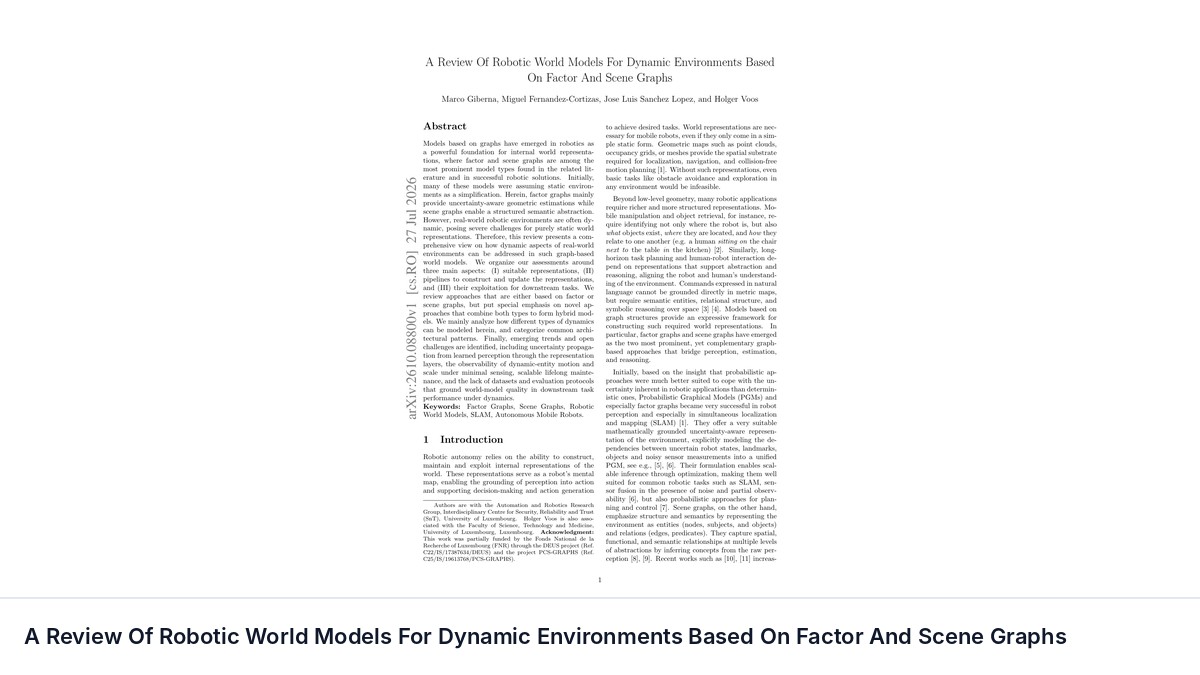
SwingBot: Learning Whole-Body Brachiation for Humanoid Robots
arXiv preprint

SwingBot: Learning Whole-Body Brachiation for Humanoid Robots

Yujie Xiong, Peng Zhai, Taixian Hou et al.

Brachiation enables primates to move across overhead supports when ground paths are blocked, suggesting a complementary locomotion mode for robots operating in cluttered or hazardous environments.

locomotion reinforcement-learning control
PDF Intermediate
TinyCVIO: A Constellation-Aided Visual-Inertial Odometry System for Nanodrones
arXiv preprint

TinyCVIO: A Constellation-Aided Visual-Inertial Odometry System for Nanodrones

Derin Ozturk, Kaan Akan, Irwin Wang et al.

Nanodrones require accurate, real-time state estimation under severe sensing and computational constraints. We present TinyCVIO, a visual-inertial odometry system that co-designs miniature sensing, visual processing, and estimation for a commodity dual-core microcontroller with 520 kB SRAM.

vision control benchmark
PDF Beginner
Towards Neuro-Symbolic Procedural Reasoning for Long-Horizon Vision-Language-Action Manipulation
arXiv preprint

Towards Neuro-Symbolic Procedural Reasoning for Long-Horizon Vision-Language-Action Manipulation

Vivek Chavan, Yahuan Shi, Oliver Heimann et al.

Vision-language-action (VLA) models can execute short manipulation skills, but remain brittle in long-horizon procedures requiring persistent task state, dependency-aware reasoning, conditional decisions, and reliable grounding.

manipulation vision vla reinforcement-learning control learning-from-demonstration
PDF Intermediate
TRACE: Coverage Path Planning for Unknown Environments Using Hierarchical Coverage Tree
arXiv preprint

TRACE: Coverage Path Planning for Unknown Environments Using Hierarchical Coverage Tree

Zongyuan Shen, Haodong Liu, Gao Wang et al.

This paper presents a novel online coverage path planning (CPP) algorithm, called TRACE, for real-time coverage of unknown environments. TRACE is built upon a hierarchical coverage tree that provides a global representation of the evolving connectivity of the uncovered space.

reinforcement-learning planning benchmark
PDF Intermediate
Training-free Behavior Cloning
arXiv preprint

Training-free Behavior Cloning

Maximilian Adang, Timothy Chen, Lars Osterberg et al.

Neural behavior cloning compresses demonstrations into large models, making individual actions difficult to trace and policy updates costly. Retrieval policies retain access to demonstrations but struggle with mismatch between recorded and live behavior.

vision reinforcement-learning control learning-from-demonstration benchmark
PDF Advanced
ULOHA: An Underwater Bimanual Robot System for Robot Learning
arXiv preprint

ULOHA: An Underwater Bimanual Robot System for Robot Learning

Masato Kobayashi, Takeru Tsunoori

Underwater visuomotor policy learning has focused primarily on single manipulators, while bimanual imitation learning has been studied largely in air.

manipulation vision vla reinforcement-learning learning-from-demonstration
Code PDF Advanced
GitHub ★ —
Visual-SLAM for the detection of hidden tomatoes in greenhouses by Hierarchical Localization and GLOMAPfor robotized harvesting
arXiv preprint

Visual-SLAM for the detection of hidden tomatoes in greenhouses by Hierarchical Localization and GLOMAPfor robotized harvesting

Fernando Cañadas-Aránega, José C. Moreno, José L. Blanco-Claraco et al.

Advanced crop monitoring inside greenhouses is becoming one of the primary objectives of research centers. High-performance sensors, such as LiDAR or stereo cameras, have traditionally been employed for this purpose, though these often have a high cost.

vision planning
Code PDF Intermediate
GitHub ★ —
VLA-Corrector: Stage-Aware Observable State Understanding for Prompt-Based Closed-Loop Recovery of Vision-Language-Action Policies
arXiv preprint

VLA-Corrector: Stage-Aware Observable State Understanding for Prompt-Based Closed-Loop Recovery of Vision-Language-Action Policies

Chang Song, Bin Qian, Yan Feng et al.

Long-horizon robot manipulation with Vision-Language-Action (VLA) policies remains vulnerable to execution-time deviations, as final task success provides little information for diagnosing and correcting failures caused by action noise, object displacement, or goal misalignment.

manipulation vision vla reinforcement-learning benchmark
PDF Intermediate
WALT: Learning World-Model-Aligned Latent Trajectories for Autonomous Driving
arXiv preprint

WALT: Learning World-Model-Aligned Latent Trajectories for Autonomous Driving

Mingkai Jia, Jiaxin Guo, Zhijian Shu et al.

Driving world models learn rich predictive representations of the surrounding environment from visual observations, yet accurate visual prediction does not necessarily translate into effective trajectory planning.

vision reinforcement-learning planning benchmark
PDF Intermediate
A Master-Salve Robot Manipulator for Needle-Based Teleoperation in MRI Chamber
arXiv preprint

A Master-Salve Robot Manipulator for Needle-Based Teleoperation in MRI Chamber

Omar Curiel, Jing-Yuan Huang, Po-Chih Chen et al.

We present a MR safe, master-slave robot manipulator for abdominal interventions in the MRI chamber. A human operated 2+1-DoF master controller manipulator transmits motion and force to a 2+1-DoF slave manipulator via fluid transmission.

control learning-from-demonstration
PDF Intermediate
Attention from Action, for Action: Emergent Visual Bottlenecks for Policy Learning
arXiv preprint

Attention from Action, for Action: Emergent Visual Bottlenecks for Policy Learning

Zheyu Zhuang, Ruiyu Wang, Nick Heppert et al.

Visual bottlenecks that focus policy inputs on regions of interest (ROIs) can improve data-efficient visuomotor learning by separating where to look from how to act. Many ROI interfaces rely on external spatial labels, such as gaze, object classes, or affordance annotations.

vision reinforcement-learning control
PDF Intermediate
CORAL: Curriculum-Optimized Reward Adaptation for LiDAR-Based Goal-Directed Urban Driving
arXiv preprint

CORAL: Curriculum-Optimized Reward Adaptation for LiDAR-Based Goal-Directed Urban Driving

Anisa Saleem, Duksu Kim

Reinforcement learning is promising for autonomous urban driving, but long-horizon goal-directed navigation asks a policy to acquire several competing behaviors at once--reaching a distant goal, tracking a route, avoiding obstacles, obeying signals--and a fixed objective gives no order in which to learn them.

reinforcement-learning planning benchmark
PDF Intermediate
DART-S: Reachability-Audited Active-Suspension Preconditioning for Off-Road Vehicle Jumps
arXiv preprint

DART-S: Reachability-Audited Active-Suspension Preconditioning for Off-Road Vehicle Jumps

Yu Hu, Fangzhou Zhao, Liang Chen et al.

Airborne torque reaction cannot recover takeoff errors beyond the wheel angular-momentum budget. DART-S applies ramp-face suspension preconditioning to change pitch, pitch rate, and wheel spin before liftoff, thereby shifting the queried state and altering the remaining authority budget.

reinforcement-learning tactile
Code PDF Intermediate
GitHub ★ —
Decoding Task Progress from VLA Representations
arXiv preprint

Decoding Task Progress from VLA Representations

Atiksh Bhardwaj, Edward Weiyi Duan, Prithwish Dan et al.

Vision-language-action models (VLAs) are moving rapidly towards deployment as general-purpose manipulation policies, but we currently lack basic tools for understanding what these models represent internally or for monitoring them at runtime.

manipulation vision vla reinforcement-learning control
PDF Intermediate
DECOWAM: Decoupled Whole-Body World-Action Model for Legged Mobile Manipulation
arXiv preprint

DECOWAM: Decoupled Whole-Body World-Action Model for Legged Mobile Manipulation

Siyuan Ma, Boshi Zhang, Yutian Zhang et al.

Mobile manipulation requires a robot to predict how locomotion and arm motion jointly alter future observations and control. Existing world-action models, developed largely for fixed-base platforms, do not explicitly distinguish camera ego-motion from base and arm actions.

manipulation locomotion vision reinforcement-learning control benchmark
PDF Intermediate
Deliberate Practice: Learning Robot Skills under a Budget
arXiv preprint

Deliberate Practice: Learning Robot Skills under a Budget

Shivam Vats, Sudarshan Harithas, Mete Tuluhan Akbulut et al.

We consider the problem of autonomously learning robot skills under a limited practice budget for sequential tasks.

manipulation reinforcement-learning planning
PDF Intermediate
DreamX-Phi 1.0: Action-Conditioned Video World Model for Robotic Manipulation
arXiv preprint

DreamX-Phi 1.0: Action-Conditioned Video World Model for Robotic Manipulation

DreamX Team, Rui Chen, Xiangxiang Chu et al.

We present \textbf{DreamX-Phi 1.0}, an action-conditioned video world model for robotic manipulation that, given an observed frame, a language instruction, and a prescribed action sequence comprising end-effector poses and gripper states, predicts the resulting future observations.

manipulation reinforcement-learning control
PDF Intermediate
Effect of Twisted-Yarn Architecture on Pressure and Proximity Sensing Characteristics of Textile Capacitive Sensors for Robotic Skin
arXiv preprint

Effect of Twisted-Yarn Architecture on Pressure and Proximity Sensing Characteristics of Textile Capacitive Sensors for Robotic Skin

Ishtia Zahir, Eslam Saleh, Maryam Rezayati et al.

Textile-integrated capacitive sensors offer flexible and conformable tactile sensing for wearable electronics and human-robot interaction; however, the influence of yarn-level architecture on capacitive transduction characteristics remains insufficiently quantified.

vision reinforcement-learning human-robot-interaction tactile
PDF Advanced
Embodied Scene Rearrangement Planning
arXiv preprint

Embodied Scene Rearrangement Planning

Canzhi Chen, Zan Wang, Siqi Zhu et al.

This paper introduces Embodied Scene Rearrangement Planning (ESRP), a novel task requiring embodied agents to rearrange furniture in 3D scenes to match a target configuration using only egocentric observations and a top-down target layout.

vision reinforcement-learning planning benchmark
Code PDF Intermediate
GitHub ★ —
Ensuring Safe Physical AI in Urban Mobility via Hazard-Informed Synthesized Envelopes
arXiv preprint

Ensuring Safe Physical AI in Urban Mobility via Hazard-Informed Synthesized Envelopes

Alexei Odinokov, Rostislav Yavorskiy

As heterogeneous robotic systems deploy across diverse urban zones, maintaining safety amid complex human-robot interactions remains a critical challenge. We present a unified framework that bridges systematic hazard analysis and runtime enforcement using hazard-informed safety envelopes.

reinforcement-learning human-robot-interaction
PDF Intermediate
ErgoSurf: Ergodic Control for the Coverage of Unknown Surfaces
arXiv preprint

ErgoSurf: Ergodic Control for the Coverage of Unknown Surfaces

Stefan Schneyer, Timo Bachmann, Maged Iskandar et al.

Contact-centric tasks on surfaces, ranging from inspection and cleaning to sanding and polishing, require robots to systematically cover the surface while maintaining stable contact.

vision reinforcement-learning planning control tactile
PDF Advanced
Evidence-Gated Task and Motion Planning with Vision-Language Models
arXiv preprint

Evidence-Gated Task and Motion Planning with Vision-Language Models

Tsunehiko Tanaka, Matthew Stephenson, Alistair Macvicar et al.

Robots executing long-horizon manipulation tasks from natural-language instructions must reason about both semantic task structure and geometric feasibility. However, under partial observability, the availability of goal-relevant objects may be uncertain.

manipulation vision vla reinforcement-learning planning
PDF Intermediate
Expected Free Energy-based Informative Path Planning for Robotic Mars Exploration
arXiv preprint

Expected Free Energy-based Informative Path Planning for Robotic Mars Exploration

Ajith Anil Meera, Pablo Lanillos, Wouter Kouw

An autonomous robot efficiently exploring an unknown environment, such as looking for water sources on Mars, faces two simultaneous demands: building an accurate information map while quickly finding the regions of greatest value, and paying for every meter of travel and the cost of every measurement it takes.

planning
PDF Intermediate
GeniWorld: A Generalizable Interactive World Model for Robotic Manipulation via Visual Actions
arXiv preprint

GeniWorld: A Generalizable Interactive World Model for Robotic Manipulation via Visual Actions

Chenghao Gu, Hanyang Yu, Jingbo Zhang et al.

Generalist robot policies exhibit strong capabilities, but their robustness in complex and unseen environments remains limited. Scaling robot learning and evaluation in diverse real-world environments remains costly and challenging.

manipulation vision reinforcement-learning control learning-from-demonstration benchmark
PDF Intermediate
Mind the Context: Continual Learning of Socially Appropriate Robot Actions via Environmental-Social Disentanglement
arXiv preprint

Mind the Context: Continual Learning of Socially Appropriate Robot Actions via Environmental-Social Disentanglement

Rafal Robert Karpinski, Fethiye Irmak Dogan, Nikhil Churamani et al.

Social robots are expected to operate across diverse environments, where similar arrangements can imply different socially appropriate actions, e.g., starting a conversation may be acceptable in a crowded home but disruptive in an office meeting.

human-robot-interaction
Code PDF Intermediate
GitHub ★ —
Reflex: Enabling Fast and Predictive Vision-Language-Action Models for Reaction-Critical Manipulation
arXiv preprint

Reflex: Enabling Fast and Predictive Vision-Language-Action Models for Reaction-Critical Manipulation

Yuxuan Chen, Wanruo Zhang, Xiao Li

Vision-Language-Action (VLA) models have recently achieved promising performance in robotic manipulation. However, existing benchmarks mainly evaluate generalization on static manipulation tasks and largely overlook dynamic interaction scenarios.

manipulation vision vla reinforcement-learning control benchmark
Code PDF Advanced
GitHub ★ —
Robot Learning from Human Demonstrations: Handwritten Alphabet Trajectories and Human-Likeness Evaluation
arXiv preprint

Robot Learning from Human Demonstrations: Handwritten Alphabet Trajectories and Human-Likeness Evaluation

Alperen Kenan, Paul Bremner, Manuel Giuliani

Learning from demonstration (LfD) provides a developmental framework through which robots can develop motor skills by observing and imitating human dynamics, reducing reliance on explicit programming to teach a skill to a robot.

human-robot-interaction learning-from-demonstration tactile benchmark
Code PDF Intermediate
GitHub ★ —
Task-space model-based control of pneumatic soft actuators
arXiv preprint

Task-space model-based control of pneumatic soft actuators

Nithin S. Kumar, Joshua Gaston, D. Caleb Rucker et al.

Soft actuators enable dexterous and compliant interaction, but closed-loop task-space control remains challenging due to strong nonlinearities, distributed deformation, and uncertainty in their dynamics.

manipulation control
PDF Advanced
THRIVE: Therapeutic Humanoid Robot In Virtual Environment
arXiv preprint

THRIVE: Therapeutic Humanoid Robot In Virtual Environment

Jin Xu, Yu-Ping Chen, Ayanna Howard

This paper presents THRIVE (Therapeutic Humanoid Robot In Virtual Environment), an at-home rehabilitation platform that integrates a suite of virtual-reality upper-body rehabilitation games, a real-time camera-based motion-tracking system, and a socially interactive robot therapist.

manipulation vision reinforcement-learning human-robot-interaction
PDF Intermediate
Towards Surgical World-Action Modeling: A Preliminary Joint Visual-Trajectory Forecasting for Surgical Motion Planning
arXiv preprint

Towards Surgical World-Action Modeling: A Preliminary Joint Visual-Trajectory Forecasting for Surgical Motion Planning

Weiliang Huang, Huanrong Liu, Bob Zhang et al.

Reliable surgical planning requires models to anticipate not only how instruments will move, but also how the operative visual state will evolve together with such motion. Existing approaches typically treat future scene generation and instrument trajectory prediction as two separate tasks.

vision reinforcement-learning planning benchmark
Code PDF Intermediate
GitHub ★ —
Video2DoorTraversal: Push Door Traversal via Simulated Door Twins
arXiv preprint

Video2DoorTraversal: Push Door Traversal via Simulated Door Twins

Xincheng Tang, Yiji Chen, Youhan Xie et al.

Door opening and traversal is a long-horizon loco-manipulation task that requires precise handle interaction and coordinated base-arm control. We present Video2DoorTraversal, a single-video real-to-sim-to-real framework for wheel-legged mobile manipulators.

manipulation locomotion vision reinforcement-learning sim-to-real control learning-from-demonstration
PDF Intermediate
AHEAD: Anticipatory Hand-Driven Teleoperation via Human Intent Prediction
arXiv preprint

AHEAD: Anticipatory Hand-Driven Teleoperation via Human Intent Prediction

Seok Joon Kim, Junho Lee, Federica Spinola et al.

Direct hand-driven teleoperation maps an operator's hand motion to robot end-effector commands at every frame, enabling precise control, but it requires constant monitoring and correction during approach, grasp, and placement, which can be slow and fatiguing.

manipulation reinforcement-learning planning control learning-from-demonstration
PDF Intermediate
Assessing Physical Frailty and Fall-Risk Indicators with Social Robots: An in situ Evaluation with Older Adults
arXiv preprint

Assessing Physical Frailty and Fall-Risk Indicators with Social Robots: An in situ Evaluation with Older Adults

Aniol Civit, Antonio Andriella, Alba Martínez et al.

Frailty assessments are crucial to evaluate the risk of adverse events and the health and social care needs of older adults, yet their administration remains resource-intensive and typically relies on coarse clinical outcomes, such as task completion times, which may overlook biomechanical indicators of functional decline.

vision reinforcement-learning human-robot-interaction benchmark
PDF Intermediate
AXIS: A Growable Community-Driven Data Engine for Scalable Robot Manipulation
arXiv preprint

AXIS: A Growable Community-Driven Data Engine for Scalable Robot Manipulation

Mengfei Zhao, Dihong Huang, Yikai Tang et al.

Learning effective robot manipulation policies requires diverse, high-quality demonstrations, yet existing data pipelines are often difficult to scale because they rely on specialized hardware, centralized operators, or fixed task suites.

manipulation vision vla learning-from-demonstration benchmark
PDF Advanced
BadWAM: When World-Action Models Dream Right but Act Wrong
arXiv preprint

BadWAM: When World-Action Models Dream Right but Act Wrong

Qi Li, Xingyi Yang, Xinchao Wang

World-action models (WAMs) are emerging as a promising foundation for embodied control: rather than predicting actions alone, they learn representations that couple action generation with future world prediction.

vision reinforcement-learning control
PDF Intermediate
Catch, Throw, Repeat: Planning for Human-Robot Partner Juggling
arXiv preprint

Catch, Throw, Repeat: Planning for Human-Robot Partner Juggling

Jonathan Rainer Lippert, Kai Ploeger, Abir Chowdhury et al.

Dynamic object exchange between humans and robots remains a challenging problem due to uncertainty in perception, timing, and contact-rich interaction.

vision reinforcement-learning planning control human-robot-interaction
PDF Intermediate
Compact Latent Coordination for Autonomous Vehicles at Unsignalized Intersections
arXiv preprint

Compact Latent Coordination for Autonomous Vehicles at Unsignalized Intersections

Gil Lifshits, Igal Bilik, Gilad Katz

Coordinating autonomous vehicles at unsignalized intersections remains a critical challenge for multi-agent reinforcement learning (MARL) systems, which typically struggle with combinatorial action spaces, reliance on privileged information, or rigid agent designs.

reinforcement-learning planning control benchmark
PDF Intermediate
ContactMimic: Humanoid Object Interaction via Contact Control
arXiv preprint

ContactMimic: Humanoid Object Interaction via Contact Control

Xinyao Li, Xialin He, Runpei Dong et al.

Keypoint tracking alone is insufficient for object interaction tasks such as sitting on a chair, wiping a board, or pushing furniture, where the robot can reach the correct pose without making meaningful physical contact with the object.

manipulation reinforcement-learning control
PDF Intermediate
DexVerse: A Modular Benchmark for Multi-Task, Multi-Embodiment Dexterous Manipulation
arXiv preprint

DexVerse: A Modular Benchmark for Multi-Task, Multi-Embodiment Dexterous Manipulation

Yunchao Yao, Zhuxiu Xu, Tianqi Zhang et al.

Building general-purpose dexterous manipulation policies requires benchmarks that go beyond isolated tasks to systematically evaluate policies across diverse interaction modes, sensory conditions, and robot embodiments.

manipulation vision vla reinforcement-learning control learning-from-demonstration benchmark
PDF Advanced
GLAM-SLAM: Real-time Gaussian Large-scale Mapping via Flow Densification and Spatial Decomposition
arXiv preprint

GLAM-SLAM: Real-time Gaussian Large-scale Mapping via Flow Densification and Spatial Decomposition

Panagiotis Mermigkas, Argyris Manetas, Petros Maragos

Existing Gaussian-splatting-based monocular Simultaneous Localization and Mapping (SLAM) systems are either tailored to short sequences, are not real-time, or suffer from prohibitive GPU memory requirements, limiting their applicability in realistic, long-horizon scenarios.

planning benchmark
Code PDF Advanced
GitHub ★ —
Grasp, Handover, Rotate: Bimanual Object Reorientation via Compositional Diffusion and Energy-Based Optimization
arXiv preprint

Grasp, Handover, Rotate: Bimanual Object Reorientation via Compositional Diffusion and Energy-Based Optimization

Wun Lam Yeung, Wenjun Liu, Yui Cheung Yu et al.

Bimanual object reorientation - picking an object, handing it over between two arms, and placing it in a desired target pose - is valuable when direct placement from the initial grasp is infeasible due to collisions, kinematic constraints, or poor final orientation.

manipulation reinforcement-learning sim-to-real planning
PDF Advanced
GS-Agent: Creating 4D Physical Worlds With Generative Simulation
arXiv preprint

GS-Agent: Creating 4D Physical Worlds With Generative Simulation

Hongxin Zhang, Chunru Lin, Junyan Li et al.

Creating dynamic and physically realistic 4D worlds from natural language descriptions is both fascinating and challenging. Traditional computer graphics methods rely on manual creation, requiring extensive human effort to fine-tune materials, motions, and visual fidelity.

manipulation vision reinforcement-learning control
Code PDF Advanced
GitHub ★ —
Native Video-Action Pretraining for Generalizable Robot Control
arXiv preprint

Native Video-Action Pretraining for Generalizable Robot Control

Qihang Zhang, Lin Li, Luyao Zhang et al.

The advent of video-action models offers a promising path for robot control. Nevertheless, we argue that repurposing video generative models designed for digital content creation is inherently inadequate for physical environments.

manipulation vision reinforcement-learning control
PDF Advanced
QQWorld: Quantile-Quantile Matching for World Model Regularization
arXiv preprint

QQWorld: Quantile-Quantile Matching for World Model Regularization

Zhoushun Yu, Xiaoyu Hu, Xiangyu Xu

Latent world models enable efficient planning by predicting future states in a compact representation space, but their performance depends critically on the quality of the learned latent distribution.

reinforcement-learning planning control
PDF Intermediate
RoboTTT: Context Scaling for Robot Policies
arXiv preprint

RoboTTT: Context Scaling for Robot Policies

Yunfan Jiang, Yevgen Chebotar, Ruijie Zheng et al.

Recent robot foundation models operate with single-step or short-history visuomotor context.

manipulation vision vla reinforcement-learning learning-from-demonstration
Code PDF Advanced
GitHub ★ —
Scaling Behavior Foundation Model for Humanoid Robots
arXiv preprint

Scaling Behavior Foundation Model for Humanoid Robots

Weishuai Zeng, Kangning Yin, Xiaojie Niu et al.

Humanoid control requires natural whole-body coordination, precise real-time responses to control signals, and robust generalization across diverse environmental contexts, making it a cornerstone for generalist embodied agents.

reinforcement-learning control
Code PDF Advanced
GitHub ★ —
WorldSample: Closed-loop Real-robot RL with World Modelling
arXiv preprint

WorldSample: Closed-loop Real-robot RL with World Modelling

Yuquan Xue, Le Xu, Zeyi Liu et al.

Reinforcement learning (RL) can overcome the demonstration-coverage limitation of imitation learning (IL) by allowing robots to improve through trial-and-error interaction beyond the states observed in demonstrations.

ar-vr generation imitation-learning
PDF Intermediate
Scalable Behavior Cloning with Open Data, Training, and Evaluation
arXiv

Scalable Behavior Cloning with Open Data, Training, and Evaluation

Arthur Allshire, Himanshu Gaurav Singh, Ritvik Singh et al.

We introduce ABC, a fully open-source stack for manipulation with behavior cloning. At its core is ABC-130K: the largest open-source teleoperation dataset to date, featuring 3,500 hours of data spanning over 130K episodes across 195 diverse tasks.

Manipulation VLA Models Reinforcement Learning Imitation Learning Sensing & Perception
Code PDF Intermediate
GitHub ★ 200 Updated Jun 2026
Accelerating and Scaling MPC-Guided Reinforcement Learning for Humanoid Locomotion and Manipulation
arXiv preprint

Accelerating and Scaling MPC-Guided Reinforcement Learning for Humanoid Locomotion and Manipulation

Junheng Li, Liang Wu, Sergio A. Esteban et al.

In humanoid motion control, model predictive control (MPC) offers physically grounded prediction and constraint handling, while reinforcement learning (RL) enables robust whole-body skills through large-scale simulation. However, using MPC inside RL often requires time-consuming problem construction or excessive training overhead, making such frameworks difficult to justify in practice. This work studies efficient training-time MPC guidance for humanoid locomotion and manipulation, termed MPC-RL. We introduce a centroidal-dynamics MPC reward formulation that leverages guidance from MPC trajectories in training time. To make this practical in massively parallel RL, we develop π^nMPC, a parallel-in-horizon and construction-free batched GPU MPC solver that operates directly on time-varying dynamics to avoid high memory usage and pre-compilation. Through a variety of comparative studies and hardware validations, we have found that MPC-RL achieves superior performance in locomotion and manipulation skills.

humanoid reinforcement-learning model-predictive-control locomotion manipulation
Code PDF Advanced
GitHub ★ —
Dual Advantage Fields
ICML 2026

Dual Advantage Fields

Alexey Zemtsov, Maxim Bobrin, Alexander Nikulin et al.

Offline goal-conditioned reinforcement learning requires both long-horizon reachability estimates and local action comparisons. Dual goal representations provide value fields that capture global goal reachability, but they do not directly specify which action should be preferred at a given state.

reinforcement-learning manipulation locomotion
PDF Advanced
Finetuning Vision-Language-Action Models Requires Fewer Layers Than You Think
arXiv preprint

Finetuning Vision-Language-Action Models Requires Fewer Layers Than You Think

Gia-Binh Nguyen, Trong-Bao Ho, Thien-Loc Ha et al.

Vision-Language-Action (VLA) models pre-trained on massive video-robot datasets have revolutionized robotic manipulation, yet their multi-billion parameter architectures impose prohibitive computational burdens during downstream fine-tuning and real-time inference.

ar-vr evaluation manipulation
PDF Intermediate
Finetuning Vision-Language-Action Models Requires Fewer Layers Than You Think
arXiv preprint

Finetuning Vision-Language-Action Models Requires Fewer Layers Than You Think

Gia-Binh Nguyen, Trong-Bao Ho, Thien-Loc Ha et al.

Vision-Language-Action (VLA) models pre-trained on massive video-robot datasets have revolutionized robotic manipulation, yet their multi-billion parameter architectures impose prohibitive computational burdens during downstream fine-tuning and real-time inference.

ar-vr evaluation manipulation
PDF Intermediate
Flash-WAM: Modality-Aware Distillation for World Action Models
arXiv preprint

Flash-WAM: Modality-Aware Distillation for World Action Models

Arman Akbari, Ci Zhang, Arash Akbari et al.

World-action models (WAMs) jointly generate future video and robot actions through iterative diffusion, achieving strong performance on manipulation benchmarks but requiring tens of denoising steps, a cost that precludes real-time control.

sim-to-real reinforcement-learning diffusion-policy manipulation humanoid
PDF Intermediate
GRAIL: Generating Humanoid Loco-Manipulation from 3D Assets and Video Priors
arXiv preprint

GRAIL: Generating Humanoid Loco-Manipulation from 3D Assets and Video Priors

Tianyi Xie, Haotian Zhang, Jinhyung Park et al.

Scaling humanoid loco-manipulation requires robot-compatible demonstrations across diverse objects, whole-body motions, and scene geometries, but teleoperation and motion capture are difficult to scale because each collection depends on physical setups, instrumented actors, and robot operation.

sim-to-real reinforcement-learning vision manipulation humanoid
Code PDF Advanced
GitHub ★ 275 Updated Jun 2026
Improving Robotic Generalist Policies via Flow Reversal Steering
arXiv preprint

Improving Robotic Generalist Policies via Flow Reversal Steering

Andy Tang, William Chen, Andrew Wagenmaker et al.

Generalist policies can learn a wide range of skills from diverse robot datasets. In order to solve or improve on challenging news tasks, we need a way to infer and invoke the appropriate actions from the policy's rich behavioral prior, especially when directly commanding the policy fails.

manipulation vla world-models
PDF Advanced
Invertible Neural Network Adapter for One-Step Flow Matching in Robot Manipulation
arXiv preprint

Invertible Neural Network Adapter for One-Step Flow Matching in Robot Manipulation

Yu Zhang, Kangyi Ji, Yongxiang Zou et al.

This paper presents an invertible neural network adapter for general robotic manipulation, designed to generate precise high-dimensional actions conditioned on multimodal observations, including visual, linguistic, and proprioceptive inputs, through a one-step denoising process.

ar-vr evaluation generation
PDF Intermediate
Invertible Neural Network Adapter for One-Step Flow Matching in Robot Manipulation
arXiv preprint

Invertible Neural Network Adapter for One-Step Flow Matching in Robot Manipulation

Yu Zhang, Kangyi Ji, Yongxiang Zou et al.

This paper presents an invertible neural network adapter for general robotic manipulation, designed to generate precise high-dimensional actions conditioned on multimodal observations, including visual, linguistic, and proprioceptive inputs, through a one-step denoising process.

ar-vr evaluation generation
PDF Intermediate
LA4VLA: Learning to Act without Seeing via Language-Action Pretraining
arXiv

LA4VLA: Learning to Act without Seeing via Language-Action Pretraining

Tao Lin, Yuxin Du, Yiran Mao et al.

Vision-Language-Action (VLA) models are commonly pretrained on robot demonstrations by jointly mapping visual observations and language instructions to actions. However, dense visual-action supervision can dominate the comparatively sparse language-action signal.

Manipulation VLA Models Reinforcement Learning Imitation Learning Sensing & Perception
PDF Intermediate
LadderMan: Learning Humanoid Perceptive Ladder Climbing
arXiv preprint

LadderMan: Learning Humanoid Perceptive Ladder Climbing

Siheng Zhao, Yuanhang Zhang, Ziqi Lu et al.

Humanoid robots hold great promise for operating in human-centered environments, yet ladder climbing remains one of the most challenging tasks due to sparse footholds and handholds, complex whole-body coordination, and sensitivity to perception and control errors.

sim-to-real reinforcement-learning vision manipulation humanoid
PDF Advanced
Learning to Fold: prizewinning solution at LeHome Challenge 2026 (1st place online, 2nd offline)
arXiv

Learning to Fold: prizewinning solution at LeHome Challenge 2026 (1st place online, 2nd offline)

Ilia Larchenko

I describe my solution to the LeHome Challenge 2026, an ICRA 2026 competition on bimanual garment folding. The system placed 1st of 62 teams in the online (simulation) round and 2nd in the real-world final. It improves a vision-language-action (VLA) policy with a reinforcement-learning loop.

Manipulation VLA Models Reinforcement Learning Sensing & Perception Sim-to-Real Transfer
PDF Intermediate
Object-Centric Residual RL for Zero-Shot Sim-to-Real VLA Enhancement
arXiv preprint

Object-Centric Residual RL for Zero-Shot Sim-to-Real VLA Enhancement

Kinam Kim, Namiko Saito, Heecheol Kim et al.

Vision-Language-Action (VLA) models can generalize across diverse manipulation tasks, but their imitation-learning-based policies remain brittle in precise physical interactions due to compounding execution errors; Can a reinforcement learning policy trained purely in simulation improve the robustness of real-world VLAs zero-shot?

ar-vr manipulation rl
PDF Intermediate
OMG: Omni-Modal Motion Generation for Generalist Humanoid Control
arXiv preprint

OMG: Omni-Modal Motion Generation for Generalist Humanoid Control

Siqiao Huang, Kun-Ying Lee, Dongming Qiao et al.

Humanoid whole-body control has made significant progress in recent years, yet existing approaches remain limited to few-skill policies with heavy reward engineering, or motion trackers that are difficult to extend to new input modalities.

humanoid diffusion-models generation
PDF Advanced
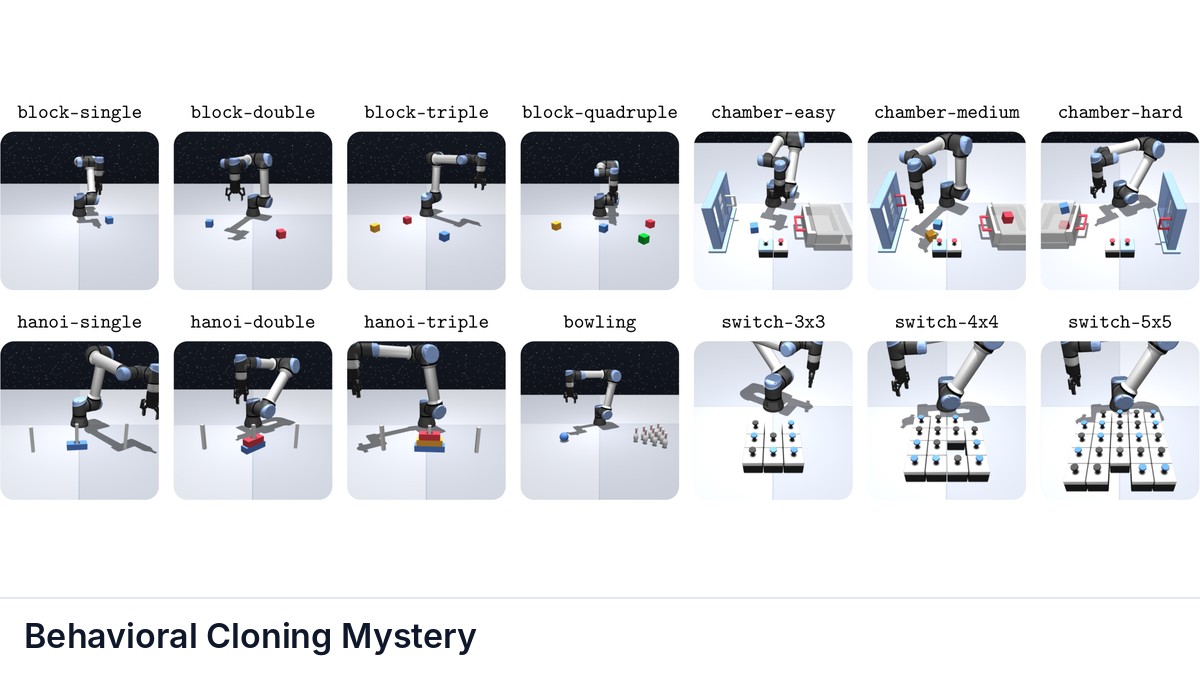
Advancing Omnimodal Embodied Agents from Isolated Skills to Everyday Physical Autonomy
arXiv

Advancing Omnimodal Embodied Agents from Isolated Skills to Everyday Physical Autonomy

Junhao Shi, Zezheng Huai, Siyin Wang et al.

Building persistent embodied agents in unstructured environments demands unified orchestration of heterogeneous tools spanning both cyber (APIs, IoT) and physical (manipulation, navigation) domains, coupled with autonomous recovery from physical failures that inevitably arise over extended operation.

Manipulation VLA Models Reinforcement Learning Locomotion & Navigation
Code PDF Advanced
GitHub ★ 1 Updated Jun 2026
Uncertainty Quantification for Flow-Based Vision-Language-Action Models
RSS 2026 — Best Paper Award

Uncertainty Quantification for Flow-Based Vision-Language-Action Models

Ralf Römer, Maximilian Seeliger, Saida Liu et al.

Quantifies epistemic uncertainty in flow-matching VLAs using velocity-field disagreement (VFD) across a small ensemble, enabling failure detection at deployment and sample-efficient active fine-tuning (SAVE).

vla foundation-models safety manipulation
Code PDF Advanced
GitHub ★ —
A Heterogeneous Architecture for Robot RL Beyond GPU-Dominant Paradigms
arXiv preprint

A Heterogeneous Architecture for Robot RL Beyond GPU-Dominant Paradigms

Yufei Jia, Zhanxiang Cao, Mingrui Yu et al.

Simulation-based RL for contemporary robot control is increasingly organized around GPU-resident simulation: physics, rollout collection, and learning are placed on a single GPU-centric execution path

reinforcement-learning simulation system-design locomotion
PDF Intermediate
EgoForce: Forearm-Guided Camera-Space 3D Hand Pose from a Monocular Egocentric Camera
SIGGRAPH 2026

EgoForce: Forearm-Guided Camera-Space 3D Hand Pose from a Monocular Egocentric Camera

Christen Millerdurai, Shaoxiang Wang, Yaxu Xie et al.

Reconstructing the absolute 3D pose and shape of the hands from the user's viewpoint using a single head-mounted camera is crucial for practical egocentric interaction in AR/VR, telepresence, and hand-centric manipulation tasks, where sensing must remain compact and unobtrusive.

manipulation manipulation simulation
Code PDF Intermediate
Code ★ 0
Aligning Flow Map Policies with Optimal Q-Guidance
arXiv

Aligning Flow Map Policies with Optimal Q-Guidance

Christos Ziakas, Alessandra Russo, Avishek Joey Bose

Generative policies based on expressive model classes, such as diffusion-models and flow matching, are well-suited to complex control problems with highly multimodal action distributions.

rl diffusion-models manipulation
PDF Advanced
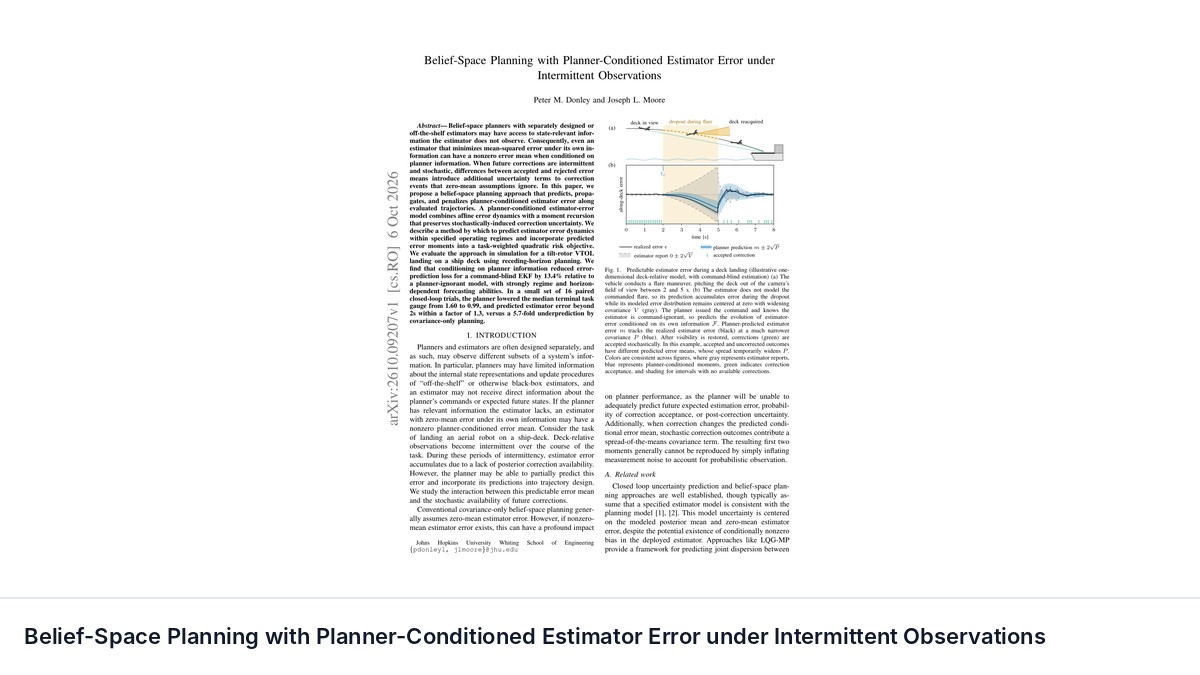
GesVLA: Gesture-Aware Vision-Language-Action Model
arXiv preprint

GesVLA: Gesture-Aware Vision-Language-Action Model

Wenxuan Guo, Ziyuan Li, Meng Zhang et al.

GesVLA augments standard VLA models with gesture awareness, enabling robots to interpret verbal instructions alongside human hand gestures for disambiguated manipulation.

vla manipulation hand-tracking
Code PDF Intermediate
GitHub ★ 18 Updated May 2026
HarmoWAM: Harmonizing Generalizable and Precise Manipulation via Adaptive World Action Models
arXiv

HarmoWAM: Harmonizing Generalizable and Precise Manipulation via Adaptive World Action Models

Qiuxuan Feng, Jiale Yu, Jiaming Liu et al.

World Action Models (WAMs) have emerged as a promising paradigm for robot control by modeling physical dynamics. Current WAMs generally follow two paradigms: generalizable but imprecise models learned from diverse data, or precise but specialized models fitted to specific tasks.

foundation-models manipulation
Code PDF Intermediate
GitHub ★ 7 Updated May 2026
IntentVLA: Short-Horizon Intent Modeling for Aliased Robot Manipulation
arXiv

IntentVLA: Short-Horizon Intent Modeling for Aliased Robot Manipulation

Shijie Lian, Bin Yu, Xiaopeng Lin et al.

Robot imitation data are often multimodal: similar visual-language observations may be followed by different action chunks because human demonstrators act with different short-horizon intents, task phases, or recent context.

Imitation Learning VLA Models
Code PDF Advanced
GitHub ★ 8 Updated May 2026
MonoDuo: Using One Robot Arm to Learn Bimanual Policies
ICRA 2026

MonoDuo: Using One Robot Arm to Learn Bimanual Policies

Sandeep Bajamahal, Lawrence Yunliang Chen, Toru Lin et al.

Bimanual coordination is essential for many real-world manipulation tasks, yet learning bimanual robot policies is limited by the scarcity of bimanual robots and datasets. Single-arm robots, however,

manipulation bimanual imitation-learning dataset
PDF Intermediate
PhAIL: A Real-Robot VLA Benchmark and Distributional Methodology
arXiv preprint

PhAIL: A Real-Robot VLA Benchmark and Distributional Methodology

Sergey Arkhangelskiy

Real-world evaluation of vision-language-action (VLA) policies still rests on binary success rate at a fixed timeout with N <= 25 rollouts per condition, almost always without confidence intervals or

benchmarking vla manipulation evaluation
PDF Intermediate
RotVLA: Rotational Latent Action for Vision-Language-Action Model
arXiv

RotVLA: Rotational Latent Action for Vision-Language-Action Model

Qiwei Li, Xicheng Gong, Xinghang Li et al.

Latent Action Models (LAMs) have emerged as an effective paradigm for handling heterogeneous datasets during Vision-Language-Action (VLA) model pretraining, offering a unified action space across embodiments.

Manipulation Reinforcement Learning VLA Models Sensing & Perception
Code PDF Advanced
GitHub ★ 7 Updated May 2026
Safe Aerial 3D Path Planning for Autonomous UAVs using Magnetic Potential Fields
arXiv

Safe Aerial 3D Path Planning for Autonomous UAVs using Magnetic Potential Fields

Haechan Mark Bong, Giovanni Beltrame

Safe autonomous Uncrewed Aerial Vehicle (UAV) navigation in urban environments requires real-time path planning that avoids obstacles. MaxConvNet is a potential-field planner that leverages properties of Maxwell's equations to generate a path to the goal without local minima.

uav navigation
PDF Intermediate
Safety-Critical Control for Smoothed Implicit Contact Dynamics
IEEE RA-L

Safety-Critical Control for Smoothed Implicit Contact Dynamics

Lee, Haegu, Kim, Yitaek, Sloth, Christoffer

Smoothed implicit contact dynamics enables gradient-based planning and control for contact-rich tasks without predefined mode sequences. However, safety-critical control remains challenging because implicit contact dynamics makes safety-filter design nontrivial.

reinforcement-learning planning control
Code PDF Intermediate
GitHub ★ —
Sample-Efficient Diffusion-based Reinforcement Learning with Critic Guidance
ICML 2026

Sample-Efficient Diffusion-based Reinforcement Learning with Critic Guidance

Shutong Ding, Zejia Zhong, Zhongyi Wang et al.

Recent advances in reinforcement learning (RL) have achieved great successes by leveraging the multimodality and exploration capability of diffusion policies. Among these approaches, one representativ

diffusion-policy reinforcement-learning locomotion manipulation
PDF Advanced
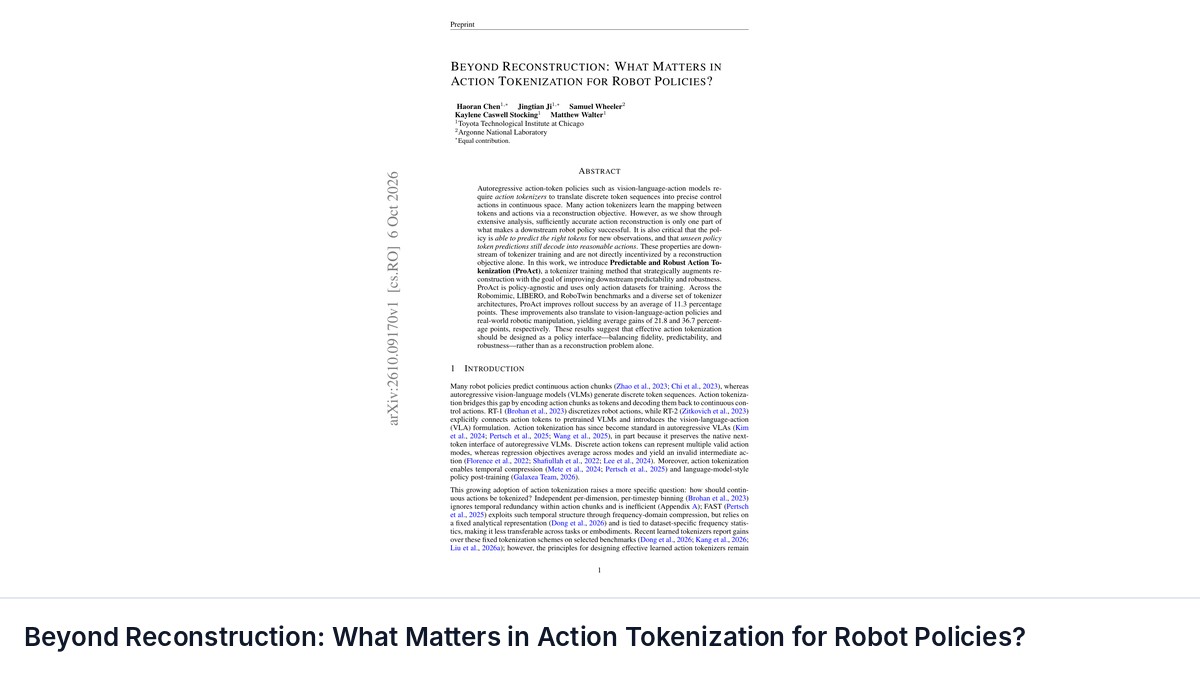
What Limits Vision-and-Language Navigation ?
arXiv

What Limits Vision-and-Language Navigation ?

Yunheng Wang, Yuetong Fang, Taowen Wang et al.

Vision-and-Language Navigation (VLN) is a cornerstone of embodied intelligence.
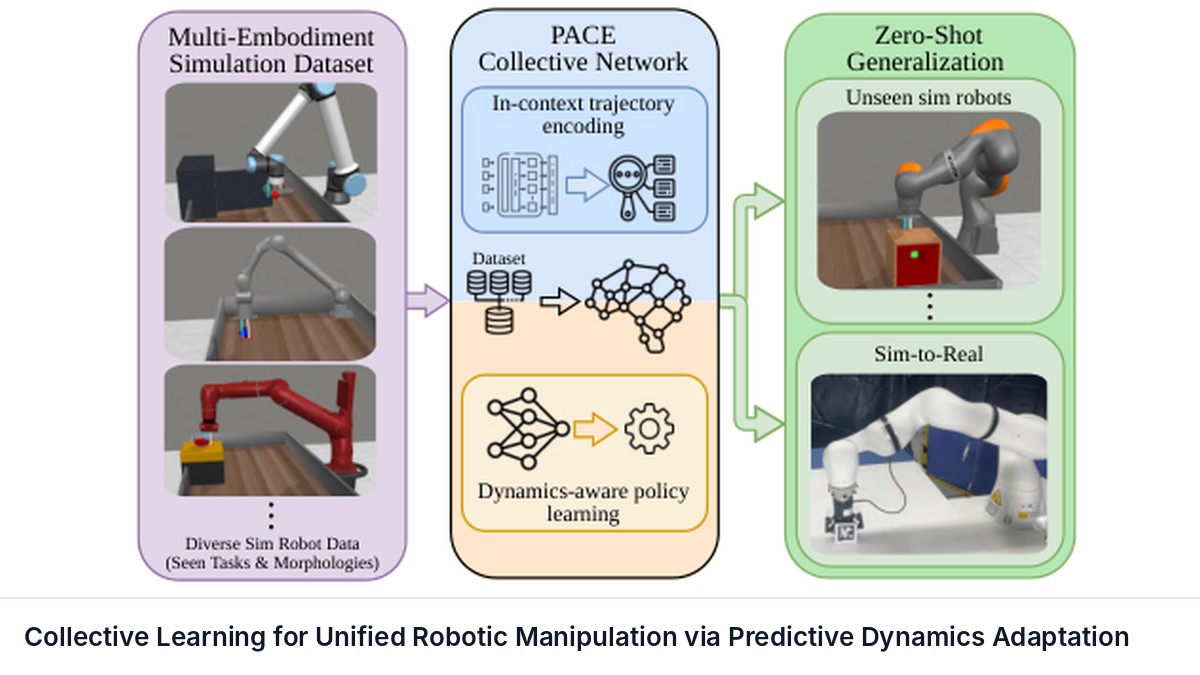
Navigation Reinforcement Learning VLA Models Sensing & Perception
Code PDF Intermediate
GitHub ★ 17 Updated May 2026