
Brace Yourself: Task-Conditioned Environmental Bracing for Forceful Humanoid Manipulation
Zongyuan Zhang, Christopher Lehnert, Will N. Browne, Jonathan M. Roberts · N/A · 2026
Framework
N/A
License
N/A
Stars
N/A
Summary
Forceful manipulation is challenging for humanoid robots because interaction forces can disturb whole-body balance. We introduce the Supporting Hand Strategy (SHS), which enables a humanoid to brace against the environment with one hand while performing forceful manipulation with the other.
Abstract Summary
Key Points
- Forceful manipulation is challenging for humanoid robots because interaction forces can disturb whole-body balance.
- We introduce the Supporting Hand Strategy (SHS), which enables a humanoid to brace against the environment with one hand while performing forceful manipulation with the other.
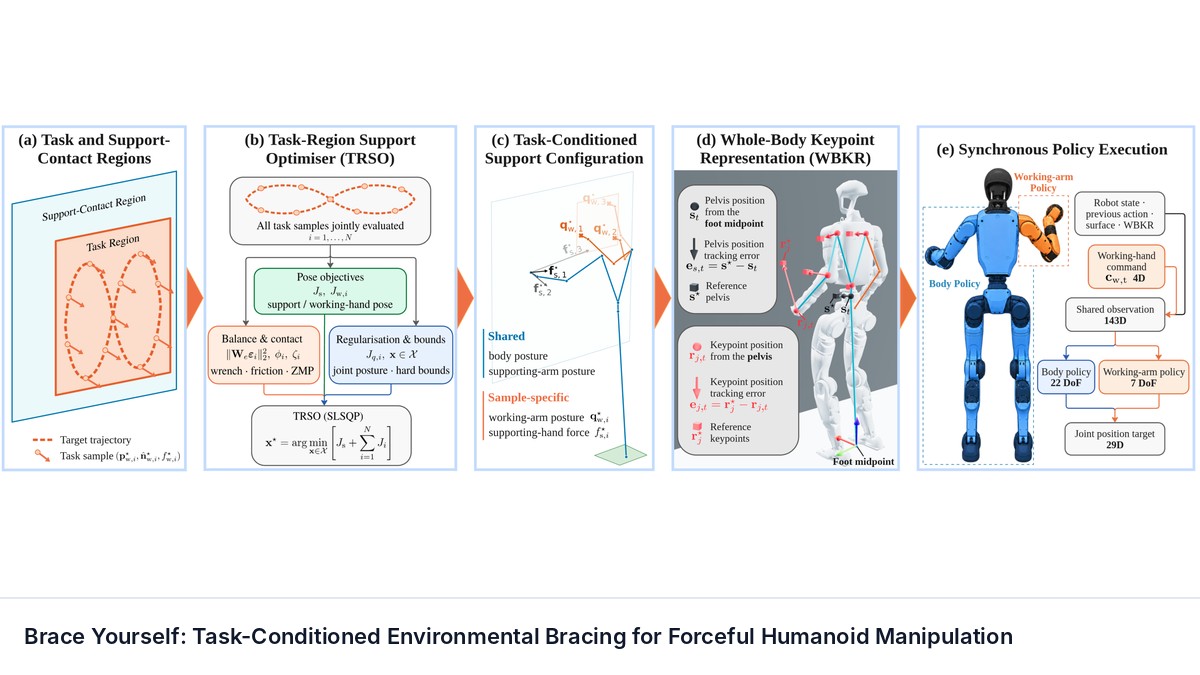
- SHS optimises a task-conditioned support configuration that guides two synchronous reinforcement-learning policies, without human motion data or online whole-body trajectory planning.
- On a Unitree G1, SHS achieved usable contact forces up to 60 N, compared with a maximum sustained force of 13.5 N without environmental bracing, while substantially improving force tracking over a task-independent support configuration.
- The same policies generalised to different task regions without retraining
Supporting Hand Strategy
SHS separates forceful manipulation into offline support-configuration optimisation and RL policy execution. It uses three components: the Task-Region Support Optimiser (TRSO), the Whole-Body Keypoint Representation (WBKR), and synchronous body and working-arm policies.
TRSO finds one support configuration that accommodates the working-hand position–force requirements across a task region while placing the supporting hand within an admissible support-contact region. WBKR encodes this configuration geometrically for policy input.
Experimental Design
The ablations isolate three components of SHS: task-conditioned support configuration, WBKR guidance, and environmental bracing. Table I summarises the comparisons. The four RL methods share the same dual-policy architecture, task distribution, dynamics, PPO settings, and training budget; ablated inputs and reward terms differ only as described below.
Results
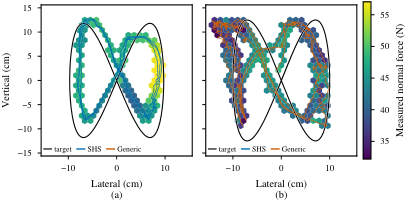
Across 30 paired simulation runs, SHS outperformed No-bracing in every pair: environmental bracing raised episode success rate from $0.020$ to $0.666$ and mean stable-contact hold ratio from $0.069$ to $0.950$ (Fig. 3 (a,b)). In Experiment 1, SHS reached usable forces of 60 N at the centre and upper positions and 40 N at the lower positions, compared with 40–50 N for Generic (Fig. 4 (a)).
Modular, the unsupported hardware baseline, was usable only at 10 N at the lower-right position and never sustained more than 13.5 N for one second.
Sources and Demonstrations
Figures are reproduced from Zhang et al. See the full paper for experimental details and the project page, when the paper links one, for demonstrations and videos.
Related Papers
AD-WM: Action-Discriminative World Models for Counterfactual Model Predictive Control
Jiabin Qiu, Zixuan Chen, Hongye Cao et al.
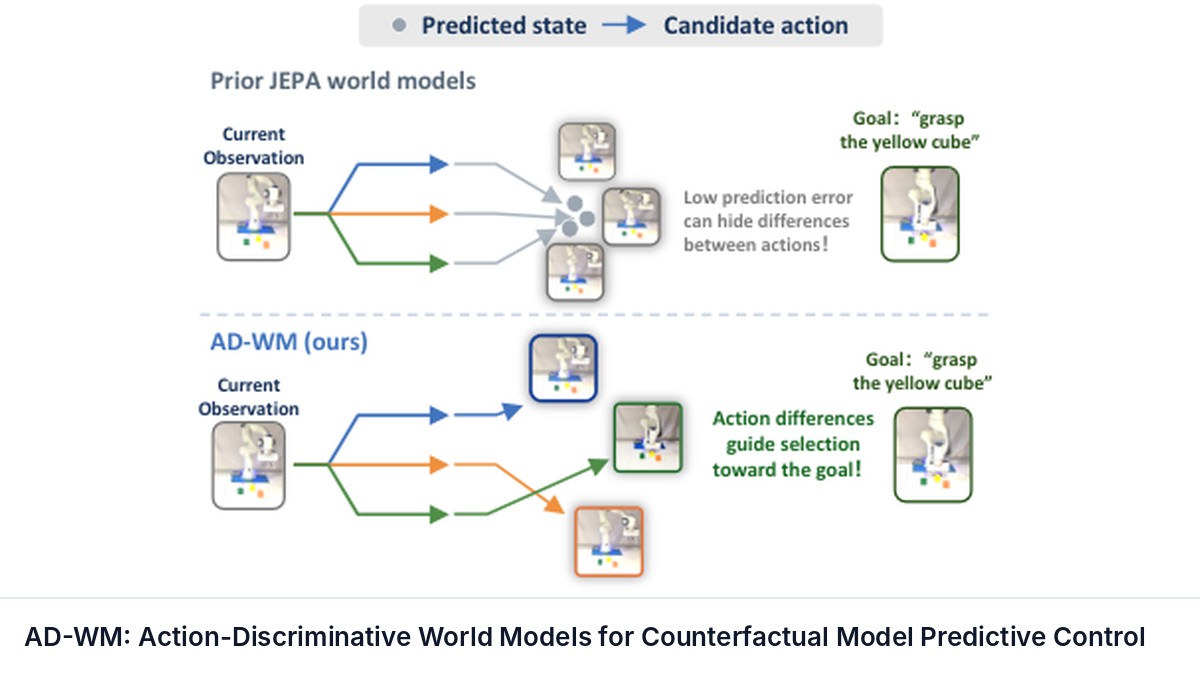
Latent world models are typically trained to predict factual transitions, whereas model predictive control (MPC) must compare alternative actions from the same state. A model can therefore achieve low factual prediction error yet poorly distinguish candidate actions.
AHEAD: Anticipatory Hand-Driven Teleoperation via Human Intent Prediction
Seok Joon Kim, Junho Lee, Federica Spinola et al.
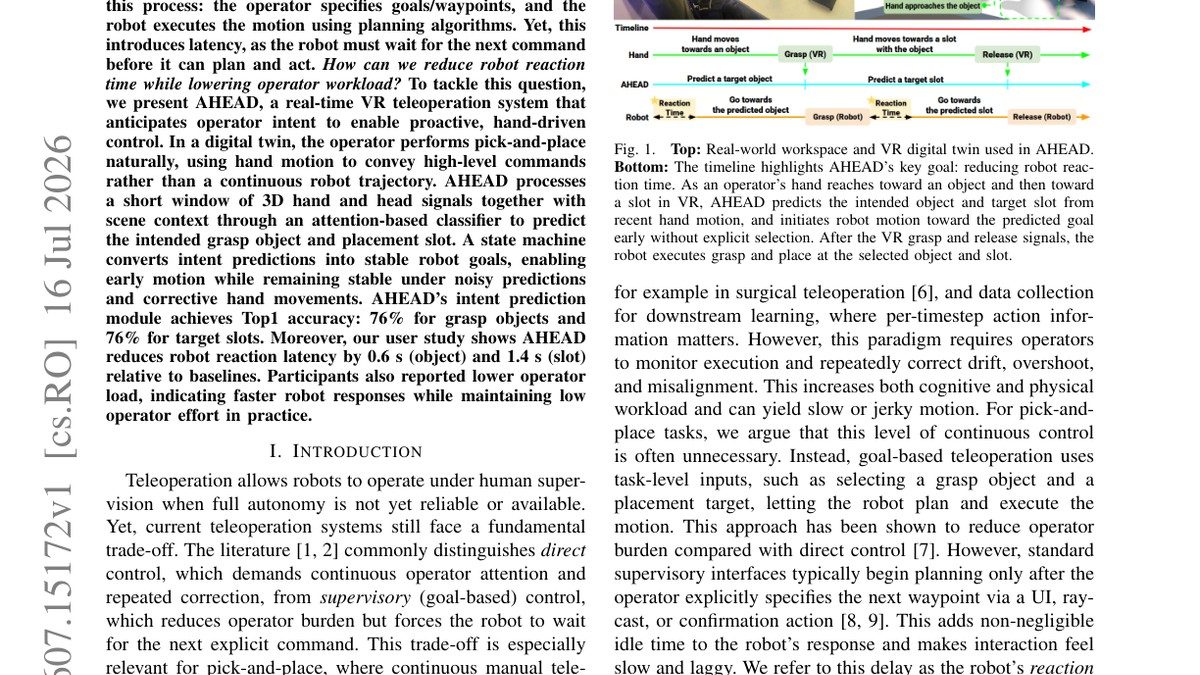
Direct hand-driven teleoperation maps an operator's hand motion to robot end-effector commands at every frame, enabling precise control, but it requires constant monitoring and correction during approach, grasp, and placement, which can be slow and fatiguing.
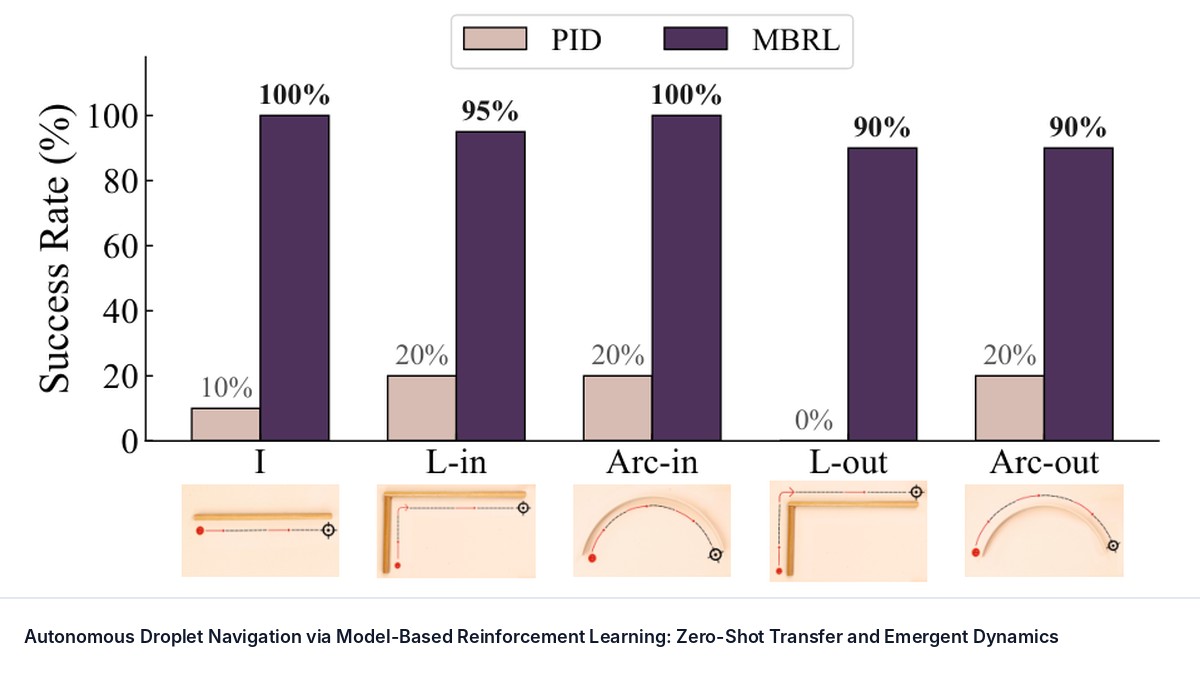
Autonomous Droplet Navigation via Model-Based Reinforcement Learning: Zero-Shot Transfer and Emergent Dynamics
Rajneesh Anand, Mayuresh V. Kothare
Self-driving laboratories (SDLs) are transforming chemical and materials discovery through closed-loop automation, yet automated infrastructure for physical manipulation of soft, deformable matter remains beyond current robotic platforms.
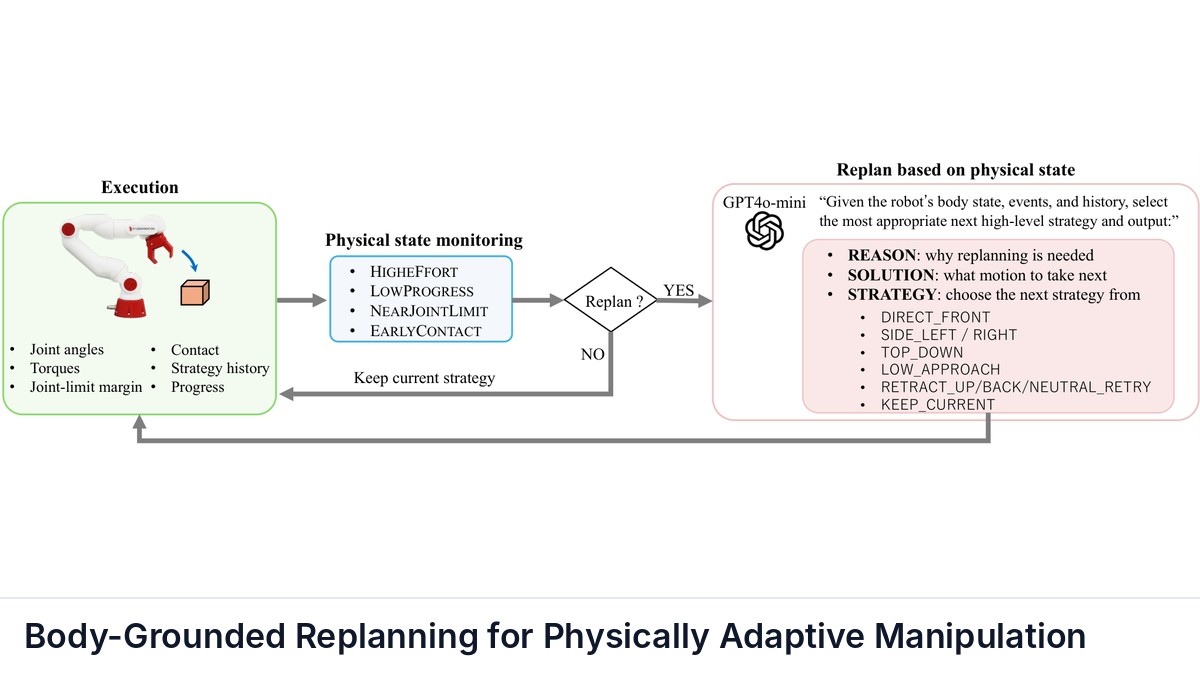
Body-Grounded Replanning for Physically Adaptive Manipulation
Namiko Saito, Hiroshi Kera
Manipulation requires not only reasoning about the external environment, but also about the robot's physical condition.