
Body-Grounded Replanning for Physically Adaptive Manipulation
Namiko Saito, Hiroshi Kera · N/A · 2026
Framework
N/A
License
N/A
Stars
N/A
Summary
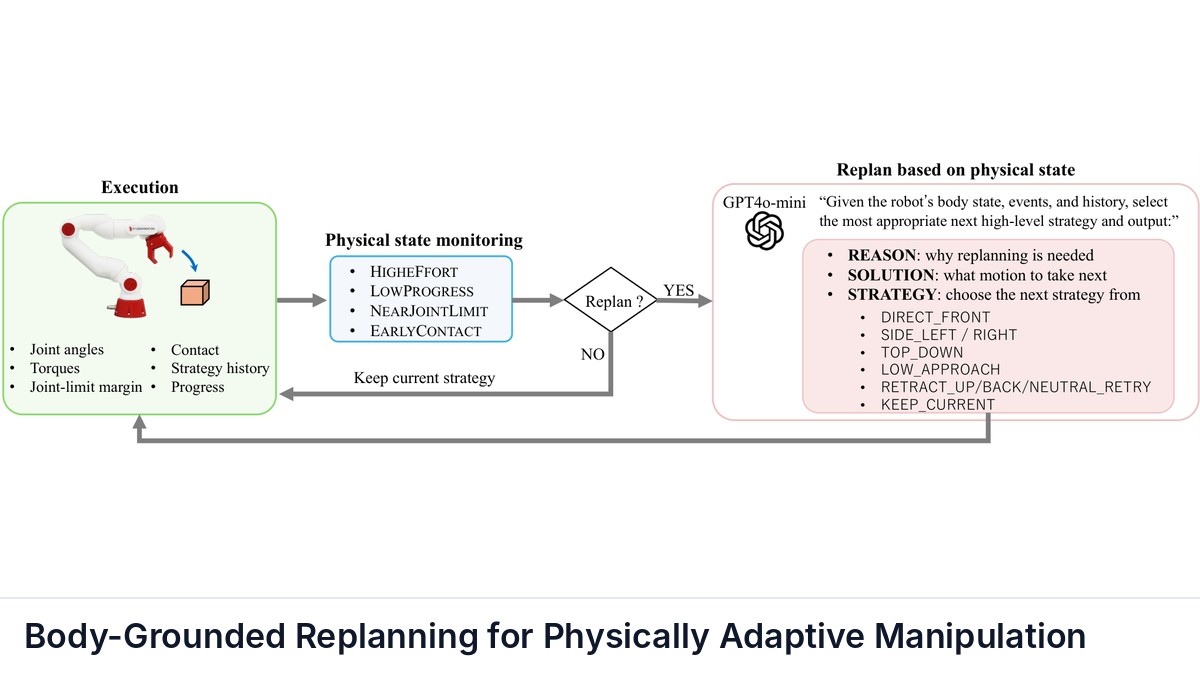
Manipulation requires not only reasoning about the external environment, but also about the robot's physical condition.
Abstract Summary
Key Points
- Manipulation requires not only reasoning about the external environment, but also about the robot's physical condition.
- A strategy may remain geometrically feasible while becoming physically unsuitable due to increased joint load or limited mobility, yet internal physical state is typically used only for low-level control.
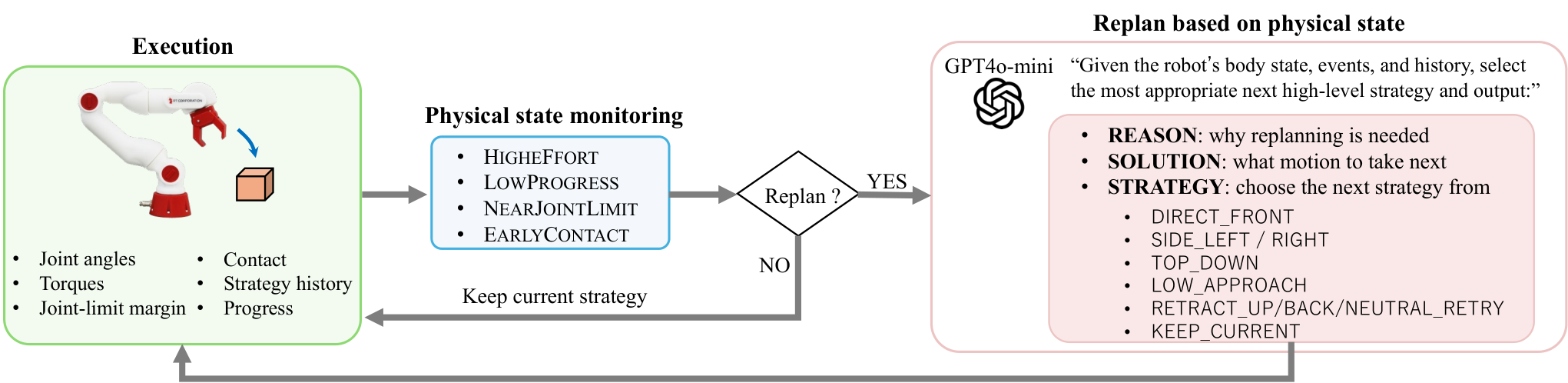
- We propose body-grounded high-level replanning, which uses internal physical state to adapt manipulation strategies during execution.
- Body-state events trigger strategy replanning, and an LLM interprets the underlying joint-level state, recent execution statistics, and execution history to select a context-dependent alternative, while leaving the task objective and low-level controller unchanged.
- We evaluate the framework on a reaching task under controlled load and asymmetric mobility constraints in simulation and on a real robot.
Section 3 Method
We consider a manipulation task in which a robot pursues a fixed task goal using one of multiple high-level strategies. Execution is indexed by discrete control step $t=0,1,\ldots$. An environment-centered planner selects an initial strategy $g_{0}\in\mathcal{G}$ based on the task goal and external environment, where $\mathcal{G}$ denotes the set of candidate strategies.
A fixed low-level controller then executes the selected strategy.
Section 4 Experimental Setup
We evaluate body-grounded replanning under controlled variations in the robot’s physical condition using reaching tasks in simulation and on hardware, followed by demonstrations on three additional manipulation tasks. Simulation experiments use a Franka Panda 7-DoF manipulator in robosuite [ 19 ] with MuJoCo [ 20 ] .
Hardware experiments use a CRANE-X7 7-DoF manipulator with Dynamixel actuators controlled through MoveIt [ 21 ] . Joint state and effort are recorded at $20$ Hz on both platforms.
Sources and Demonstrations
Figures are reproduced from Saito et al. See the full paper for experimental details and the project page, when the paper links one, for demonstrations and videos.
Related Papers
A Phenomenology of Neural Geometry in Vision-Language-Action Models
Mozes Jacobs, Aiden Swann, Mathilde Papillon et al.
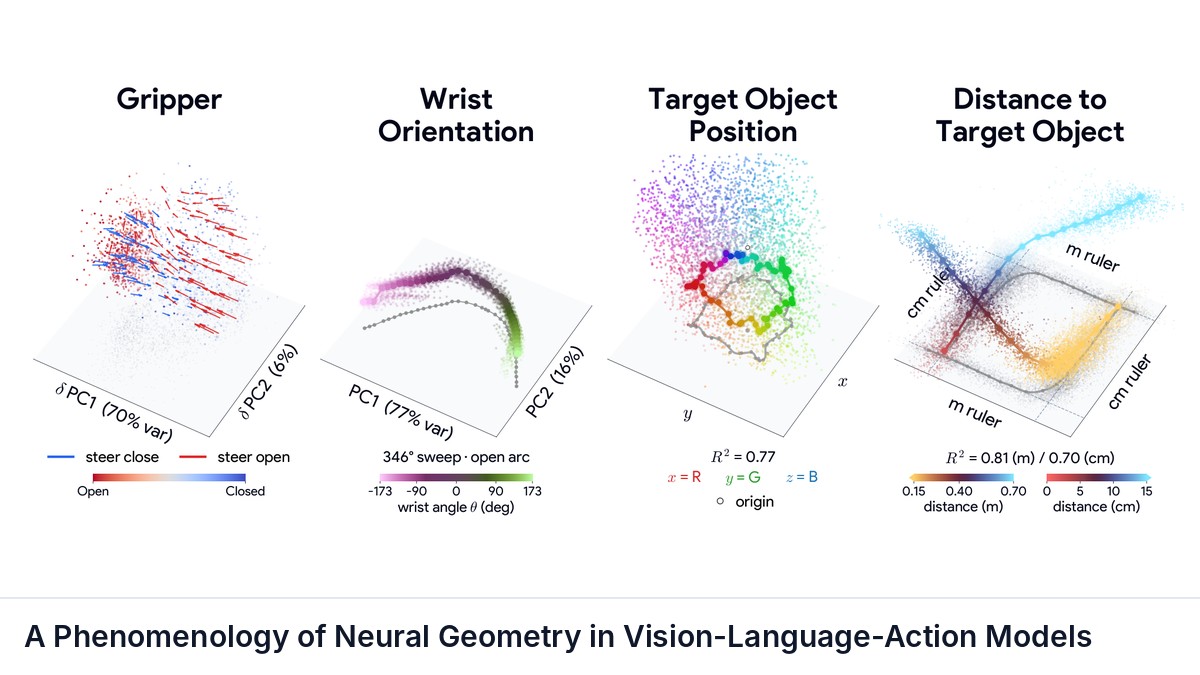
Robotic manipulation is inherently geometric, but what shape does the world take inside the policy that performs it?

A Sim-to-Real Integration Pipeline for Training and Deployment of Chunk-Based VLA Manipulation Policies
Mathilde Kappel, Clémence Grislain, Mohamed Chetouani et al.
Vision-Language-Action (VLA) models have become a prominent paradigm for mapping multimodal inputs, including semantic instructions, visual observations of the scene, and proprioceptive observations, to robot actions.
AD-WM: Action-Discriminative World Models for Counterfactual Model Predictive Control
Jiabin Qiu, Zixuan Chen, Hongye Cao et al.
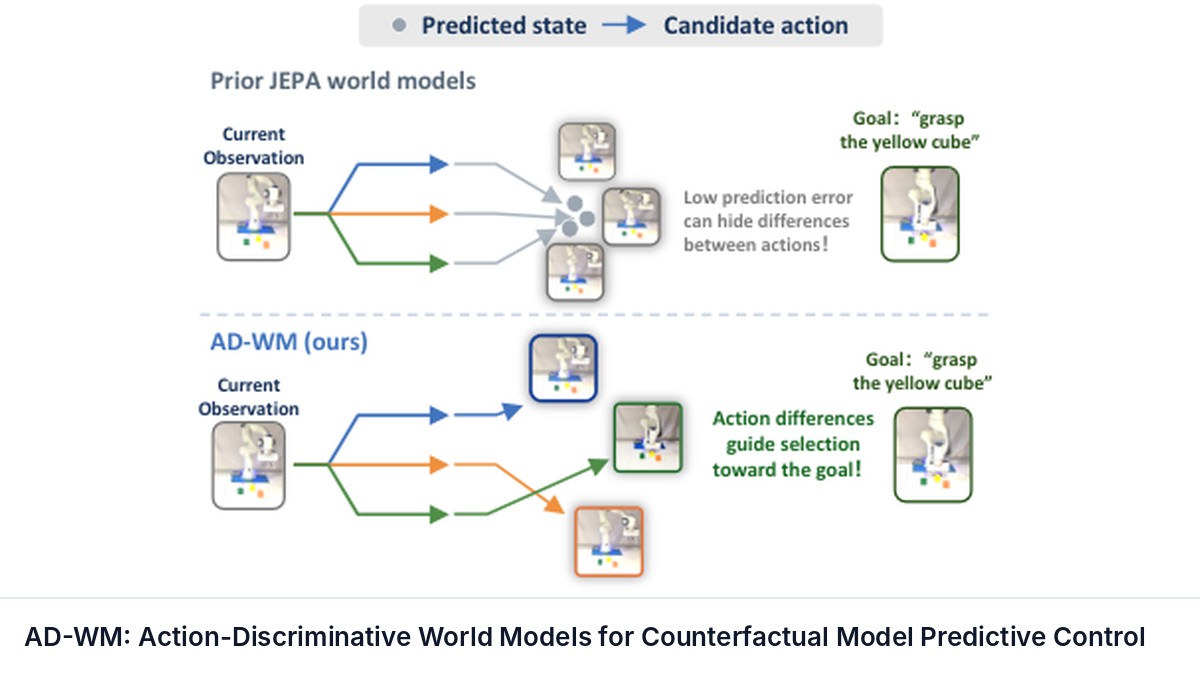
Latent world models are typically trained to predict factual transitions, whereas model predictive control (MPC) must compare alternative actions from the same state. A model can therefore achieve low factual prediction error yet poorly distinguish candidate actions.
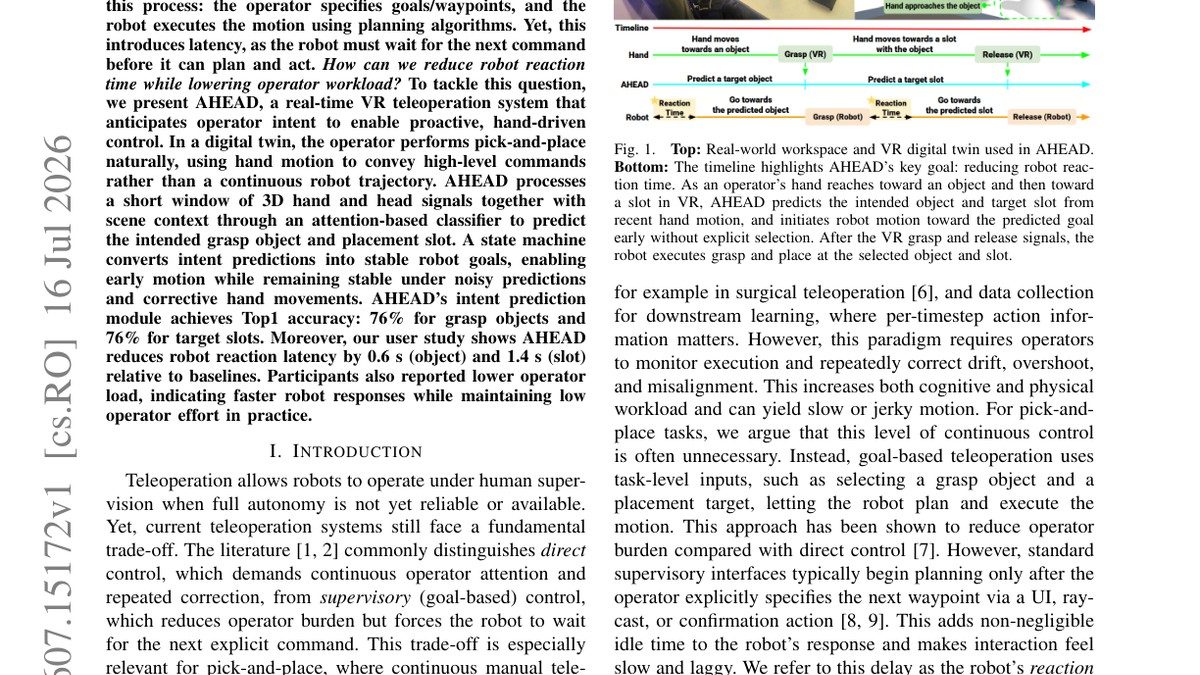
AHEAD: Anticipatory Hand-Driven Teleoperation via Human Intent Prediction
Seok Joon Kim, Junho Lee, Federica Spinola et al.
Direct hand-driven teleoperation maps an operator's hand motion to robot end-effector commands at every frame, enabling precise control, but it requires constant monitoring and correction during approach, grasp, and placement, which can be slow and fatiguing.