VLA

125 papers

Vision-Language-Action models for generalist robot control.

sim-to-real reinforcement-learning vision vla manipulation control learning-from-demonstration benchmark planning uav foundation-models imitation-learning dexterous offline-rl human-robot-interaction locomotion tactile perception representation-learning hand-tracking world-models benchmarking evaluation safety navigation vision-language il llm-robotics

Papers

Sorted by year (newest first)
A Sim-to-Real Integration Pipeline for Training and Deployment of Chunk-Based VLA Manipulation Policies
arXiv preprint

A Sim-to-Real Integration Pipeline for Training and Deployment of Chunk-Based VLA Manipulation Policies

Mathilde Kappel, Clémence Grislain, Mohamed Chetouani et al.

Vision-Language-Action (VLA) models have become a prominent paradigm for mapping multimodal inputs, including semantic instructions, visual observations of the scene, and proprioceptive observations, to robot actions.

manipulation vision vla reinforcement-learning sim-to-real control learning-from-demonstration benchmark
PDF Advanced
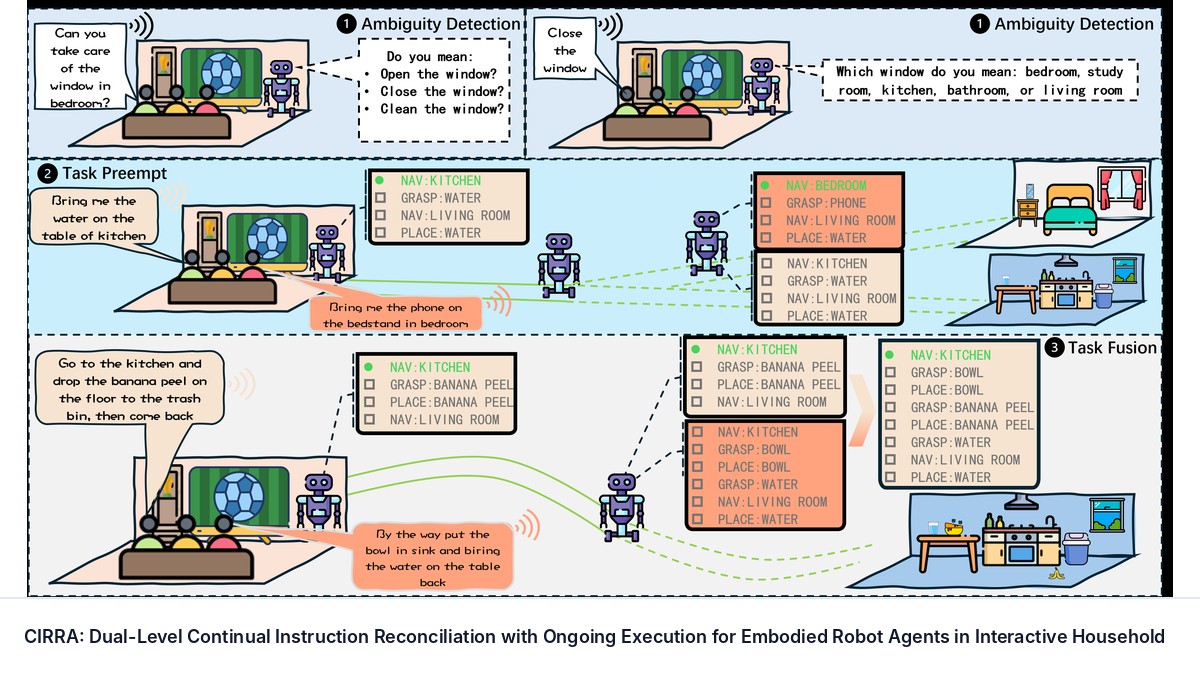
Actively Resolving Contextual Uncertainty for Underspecified Tasks in Natural Language
arXiv preprint

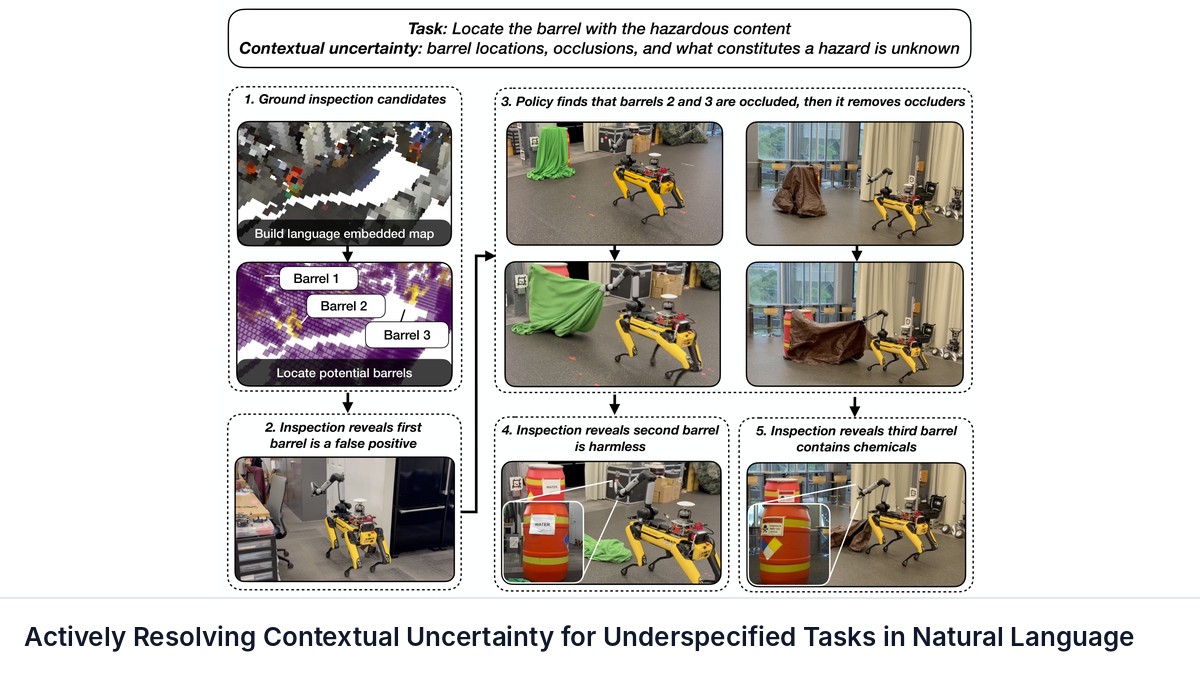
Actively Resolving Contextual Uncertainty for Underspecified Tasks in Natural Language

Zachary Ravichandran, Jonathan Diller, Fernando Cladera et al.

Foundation models provide robots with the ability to interpret natural language and reason about environmental context, yet most language-conditioned policies assume that goals are well-specified and that task-relevant information is provided upfront via a prior map.

vla reinforcement-learning planning
Code PDF Advanced
GitHub ★ —
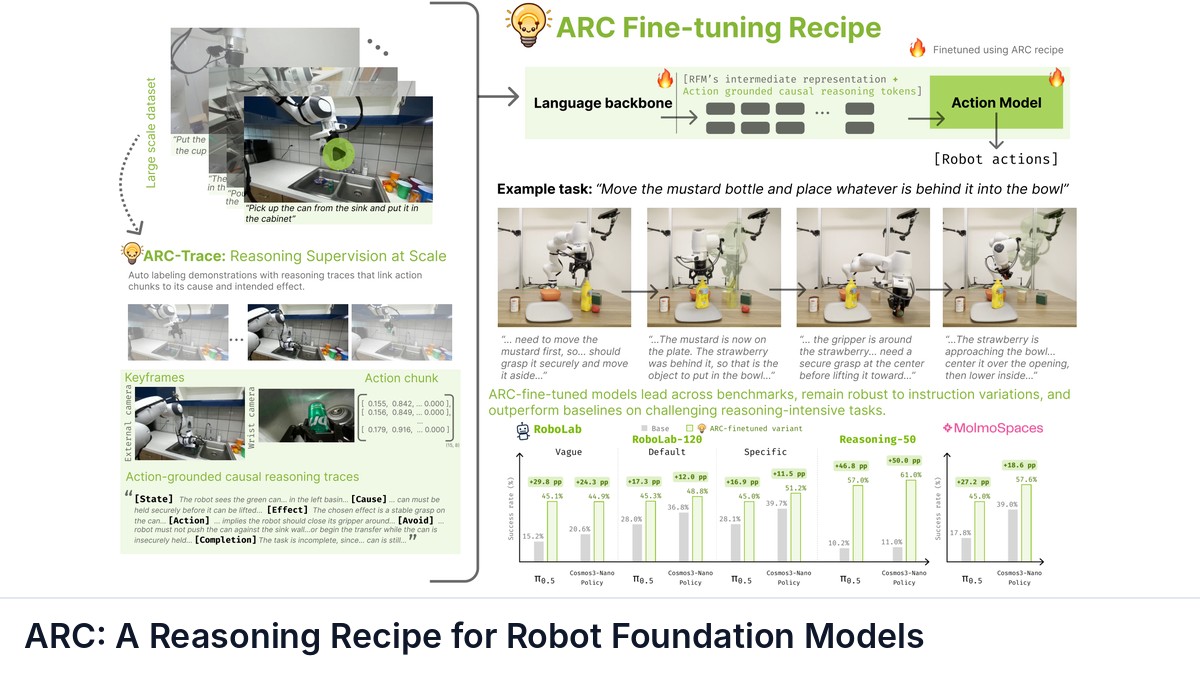
ARC: A Reasoning Recipe for Robot Foundation Models
arXiv preprint

ARC: A Reasoning Recipe for Robot Foundation Models

Gokul Puthumanaillam, Tao Sun, Elie Aljalbout et al.

The prevailing approach to improving robot foundation models (RFMs) relies on larger models, more robot demonstrations, and costly training at scale.

vla reinforcement-learning control learning-from-demonstration
PDF Advanced
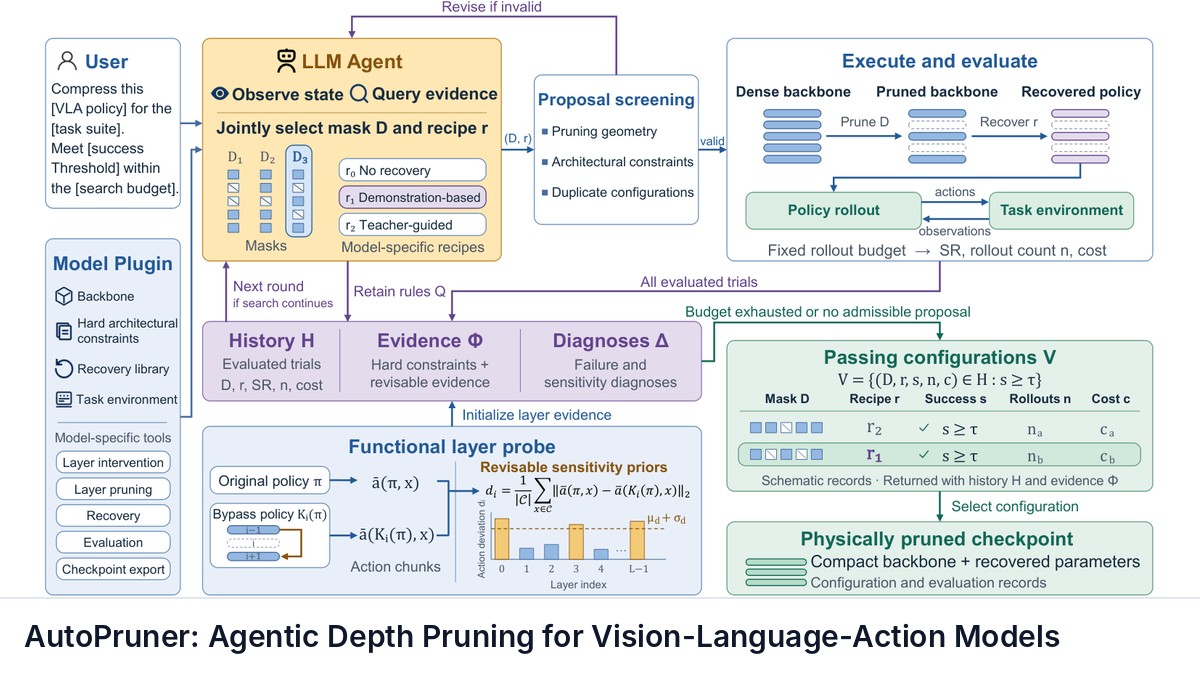
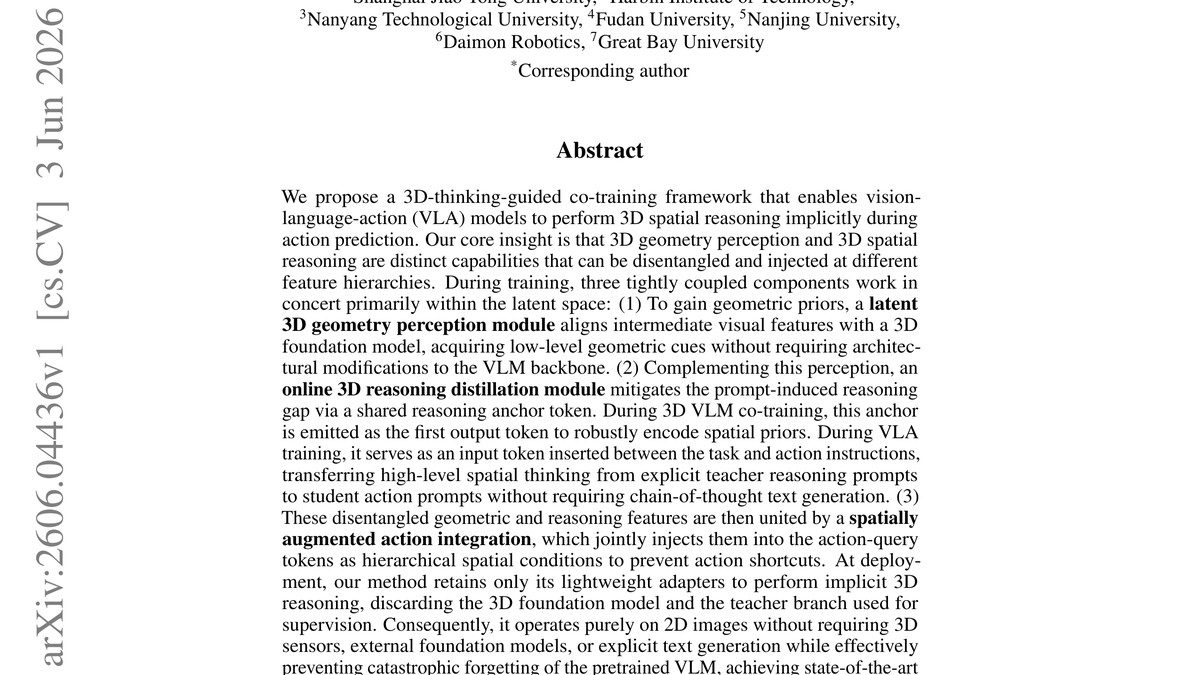
AutoPruner: Agentic Depth Pruning for Vision-Language-Action Models
arXiv preprint

AutoPruner: Agentic Depth Pruning for Vision-Language-Action Models

Tao Lin, Yikeng Chen, Qiwei Liang et al.

Layer pruning reduces the size and inference cost of vision-language-action (VLA) models, but selecting a deployable configuration requires deciding both which layers to remove and how to recover task performance.

vision vla benchmark
PDF Intermediate
AXIS: A Growable Community-Driven Data Engine for Scalable Robot Manipulation
arXiv preprint

AXIS: A Growable Community-Driven Data Engine for Scalable Robot Manipulation

Mengfei Zhao, Dihong Huang, Yikai Tang et al.

Learning effective robot manipulation policies requires diverse, high-quality demonstrations, yet existing data pipelines are often difficult to scale because they rely on specialized hardware, centralized operators, or fixed task suites.

manipulation vision vla learning-from-demonstration benchmark
PDF Advanced
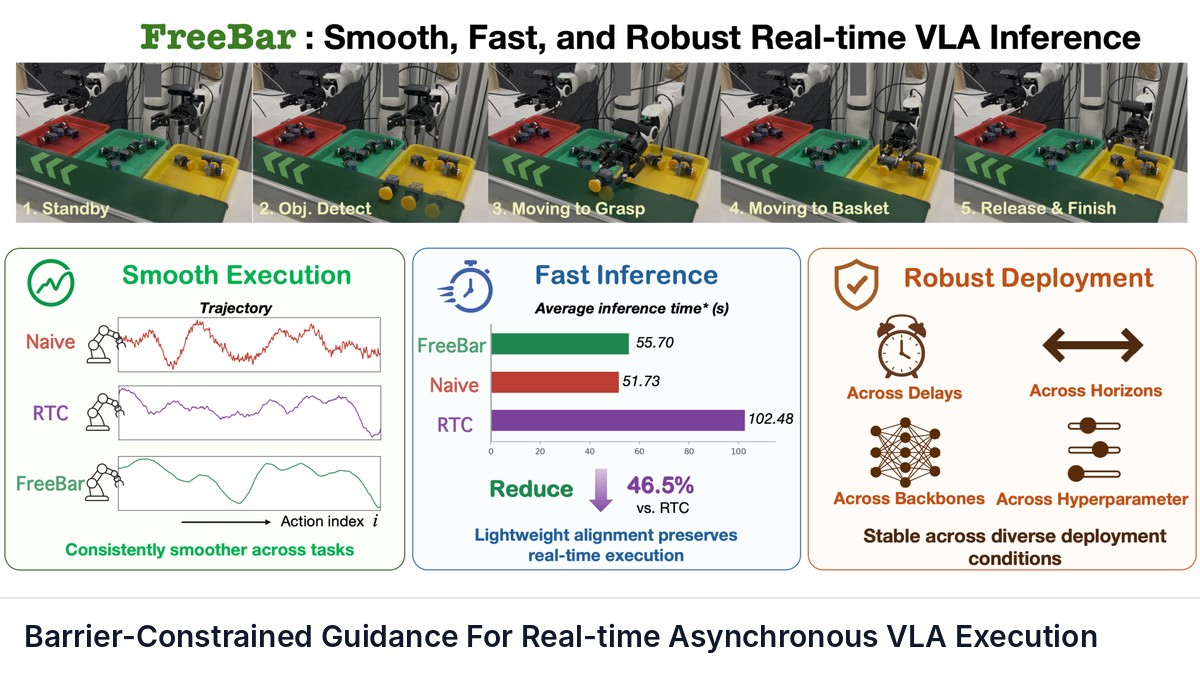
Barrier-Constrained Guidance For Real-time Asynchronous VLA Execution
arXiv preprint

Barrier-Constrained Guidance For Real-time Asynchronous VLA Execution

Wenbo Yu, Jifan Li, Wenke Xia et al.

While asynchronous execution enables VLA models to operate in real-time environments by predicting the next chunk during execution, it inevitably introduces boundary misalignment with the committed action stream.

vla reinforcement-learning control
Code PDF Intermediate
GitHub ★ —
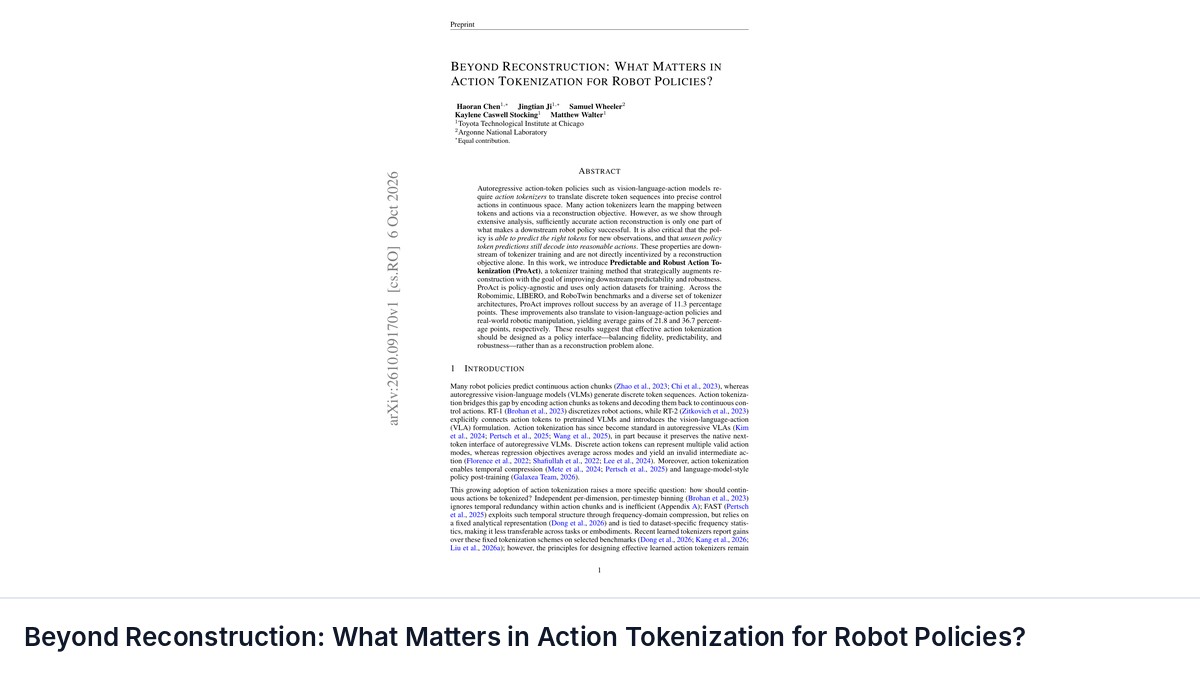
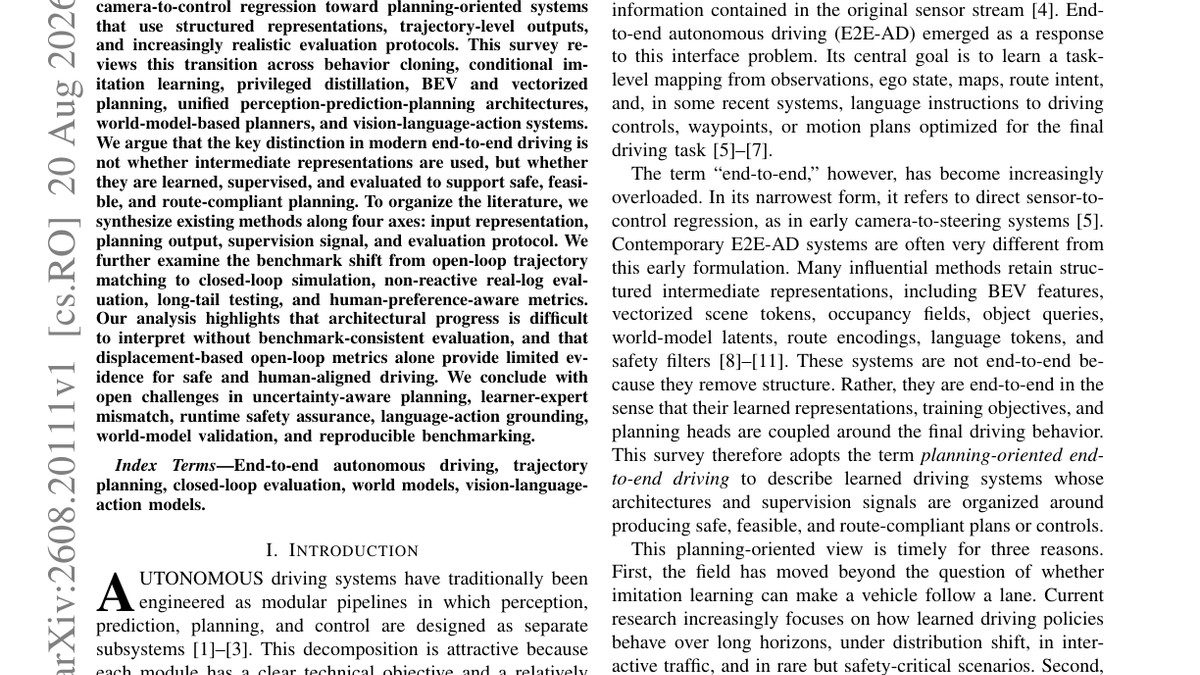
Beyond Reconstruction: What Matters in Action Tokenization for Robot Policies?
arXiv preprint

Beyond Reconstruction: What Matters in Action Tokenization for Robot Policies?

Haoran Chen, Jingtian Ji, Samuel Wheeler et al.

Autoregressive action-token policies such as vision-language-action models require action tokenizers to translate discrete token sequences into precise control actions in continuous space. Many action tokenizers learn the mapping between tokens and actions via a reconstruction objective.

manipulation vision vla reinforcement-learning control benchmark
PDF Intermediate
Capability-Aware Arbitration for Semantic Intent-Based Shared Control
arXiv preprint

Capability-Aware Arbitration for Semantic Intent-Based Shared Control

Zhaoda Du, Michael Bowman, Xiaoli Zhang

Shared control often allocates robot authority based on confidence in inferred human intent, assuming reliable autonomous execution. When this assumption fails, high intent confidence can cause over-helping.

manipulation vision vla reinforcement-learning control learning-from-demonstration benchmark
Code PDF Intermediate
GitHub ★ —
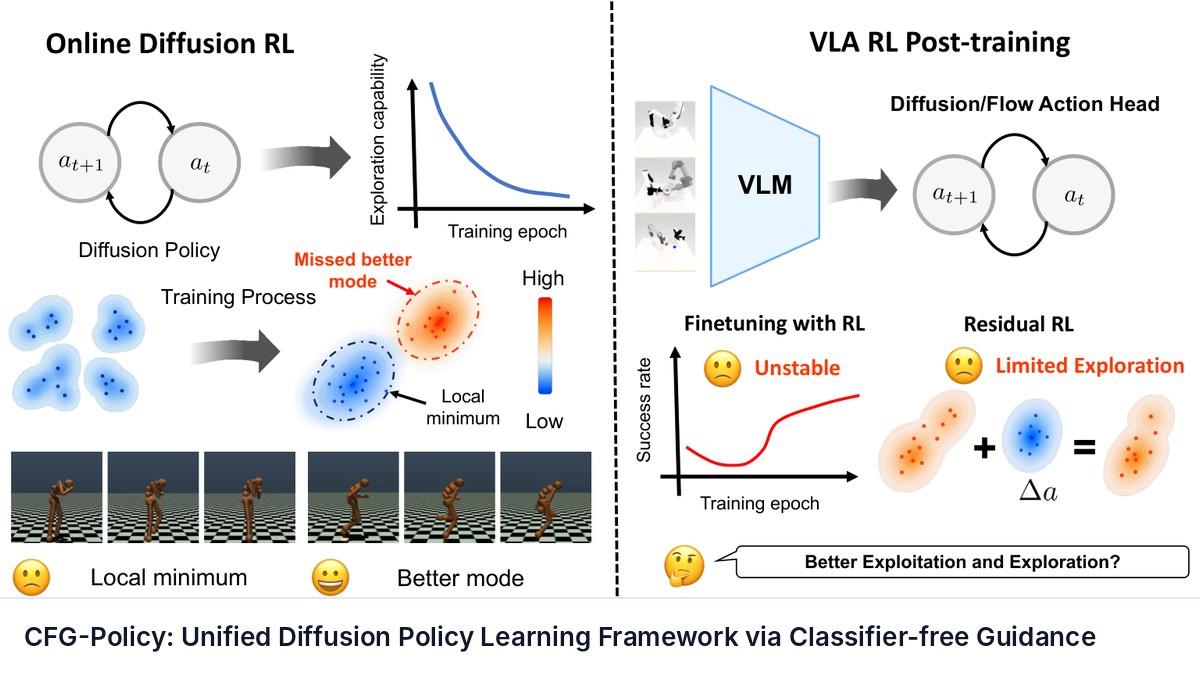
CFG-Policy: Unified Diffusion Policy Learning Framework via Classifier-free Guidance
arXiv preprint

CFG-Policy: Unified Diffusion Policy Learning Framework via Classifier-free Guidance

Shutong Ding, Zhaoyang Liu, Yimiao Zhou et al.

Diffusion policies are increasingly used in robotic control and manipulation, vision-language-action models, and world-model-based agents. Their ability to represent multimodal action distributions offers rich opportunities for exploration in reinforcement learning (RL).

manipulation vision vla reinforcement-learning control
Code PDF Advanced
GitHub ★ —
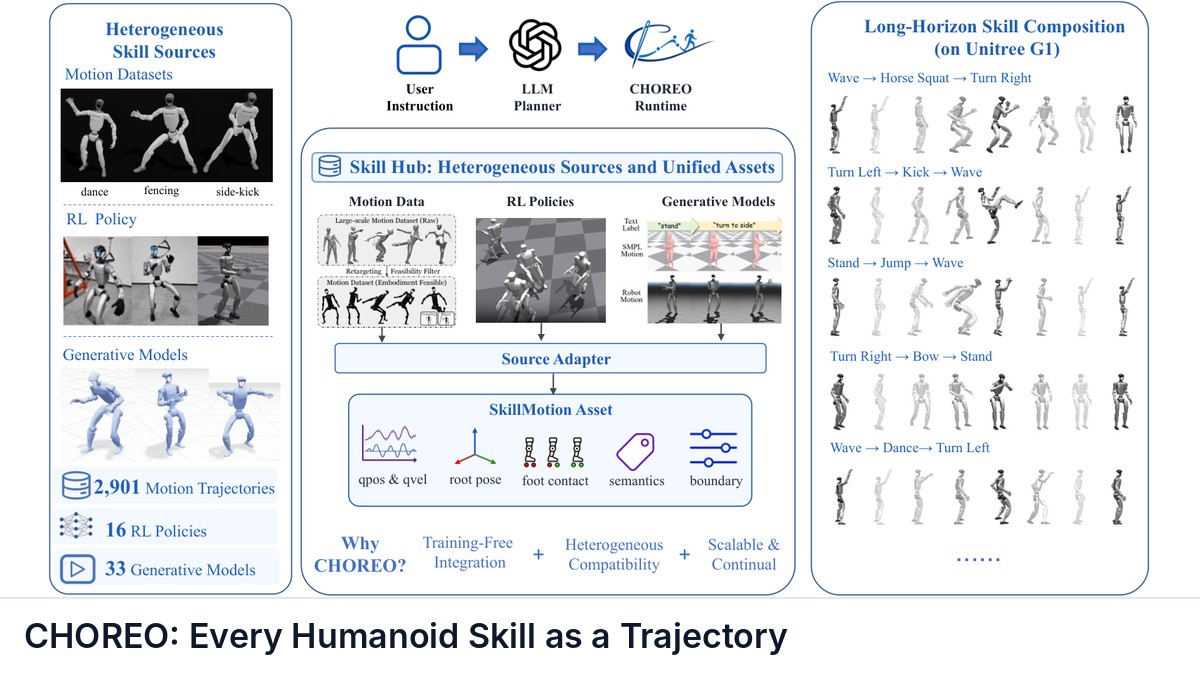
CHOREO: Every Humanoid Skill as a Trajectory
arXiv preprint

CHOREO: Every Humanoid Skill as a Trajectory

Ziyi Sun, Jingwen Chen, Yuxi Wang et al.

Recent advances in humanoid robotics have produced diverse skills through reinforcement learning, motion imitation, and generative modeling. Yet these capabilities remain siloed because they are built around incompatible representations, interfaces, and controllers.

vla reinforcement-learning control
PDF Intermediate
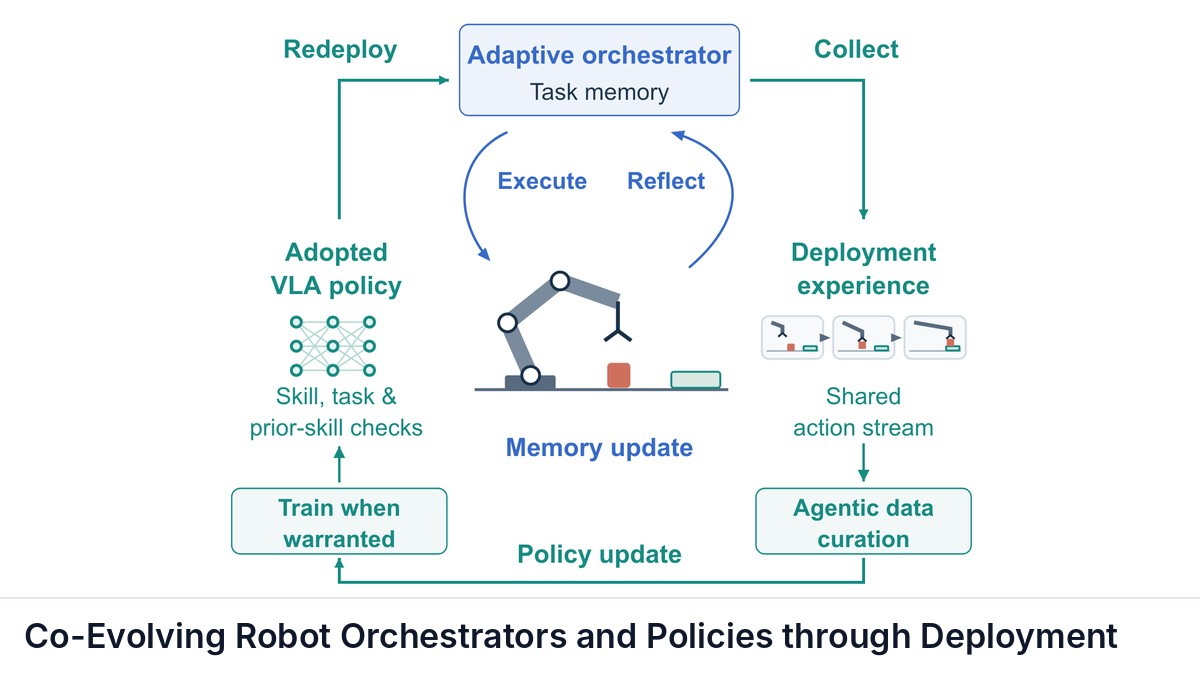
Co-Evolving Robot Orchestrators and Policies through Deployment
arXiv preprint

Co-Evolving Robot Orchestrators and Policies through Deployment

Xilun Zhang, Maggie Wang, Erik Bauer et al.

Vision-language-action (VLA) policies trained on large datasets are capable within their training domains, yet they still fail to generalize to the variety of situations a robot meets in real-world deployment.

vision vla reinforcement-learning learning-from-demonstration benchmark
PDF Intermediate
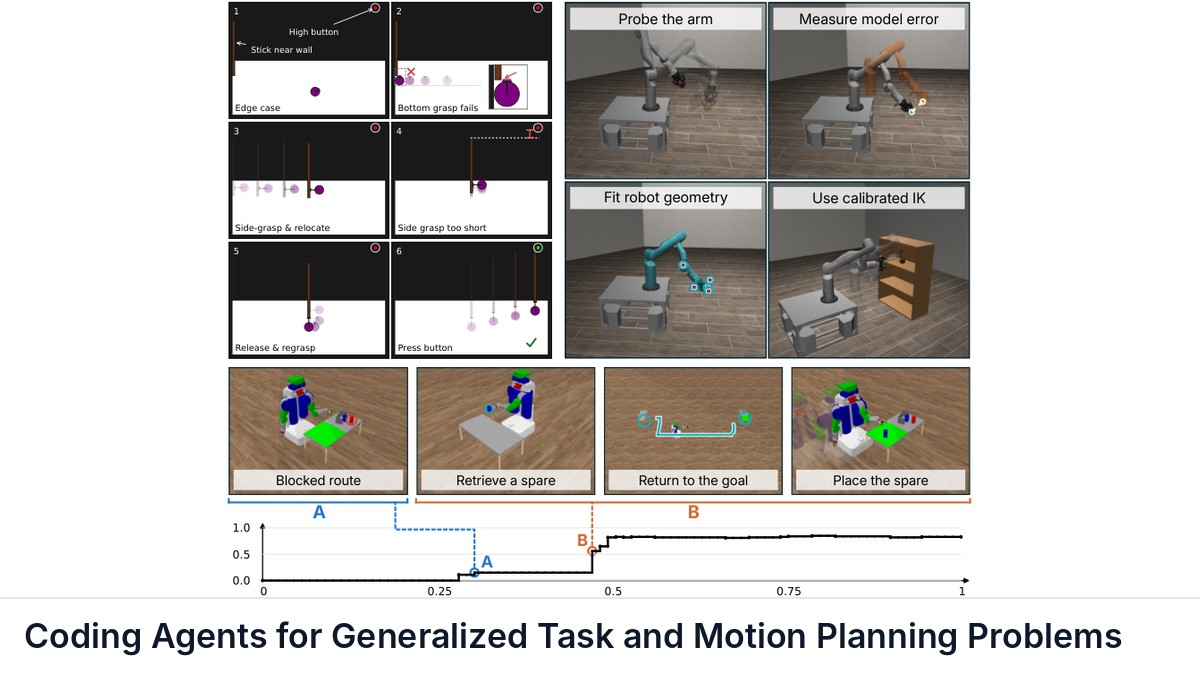
Coding Agents for Generalized Task and Motion Planning Problems
arXiv preprint

Coding Agents for Generalized Task and Motion Planning Problems

Matteo Merler, Bowen Li, Josh Roy et al.

Task and motion planning (TAMP) problems remain difficult even with full observability and object-centric states because discrete decisions are tightly coupled to geometric, kinematic, and dynamic constraints.

vla planning benchmark
PDF Intermediate
Decoding Task Progress from VLA Representations
arXiv preprint

Decoding Task Progress from VLA Representations

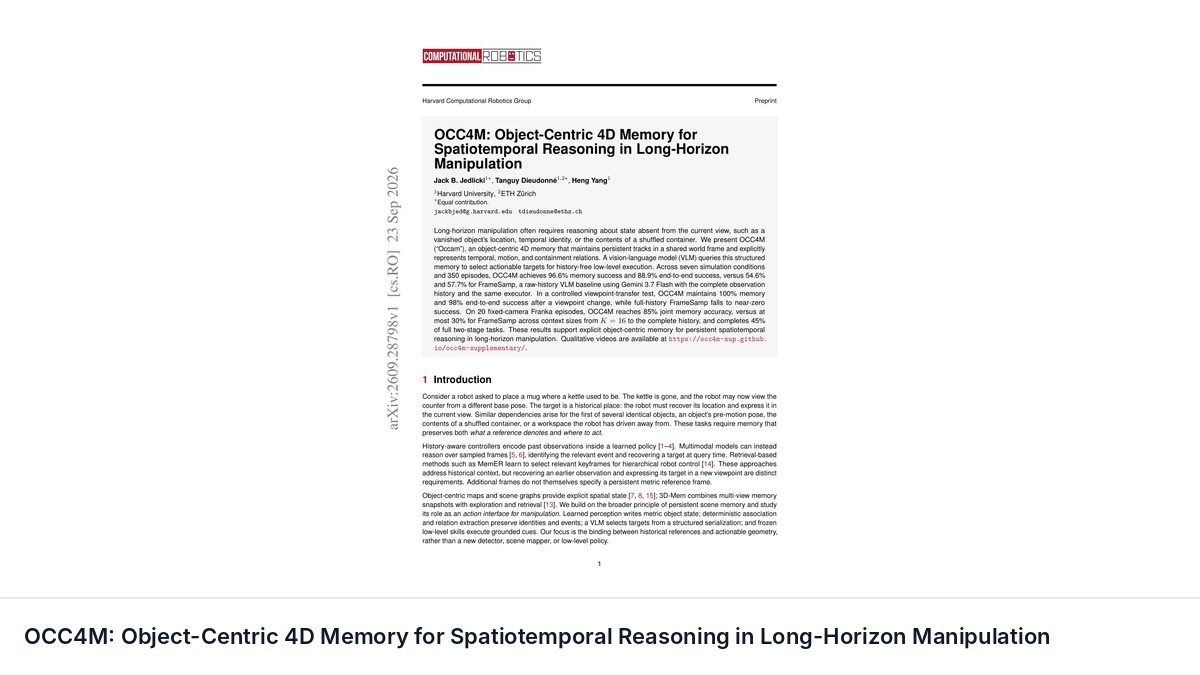
Atiksh Bhardwaj, Edward Weiyi Duan, Prithwish Dan et al.

Vision-language-action models (VLAs) are moving rapidly towards deployment as general-purpose manipulation policies, but we currently lack basic tools for understanding what these models represent internally or for monitoring them at runtime.

manipulation vision vla reinforcement-learning control
PDF Intermediate
Development of a Humanoid Robot Prototype for Multimodal Human-Robot Interaction
arXiv preprint

Development of a Humanoid Robot Prototype for Multimodal Human-Robot Interaction

Thang Tran Viet, Thanh Nguyen Canh, Huy Uong Gia et al.

Human-robot interaction (HRI) enables intuitive and intelligent collaboration between humans and robots in real-world environments. This paper introduces a humanoid robot prototype designed as a flexible testbed for developing and integrating artificial intelligence (AI) modules in HRI tasks.

manipulation vision vla reinforcement-learning control human-robot-interaction
Code PDF Intermediate
GitHub ★ —
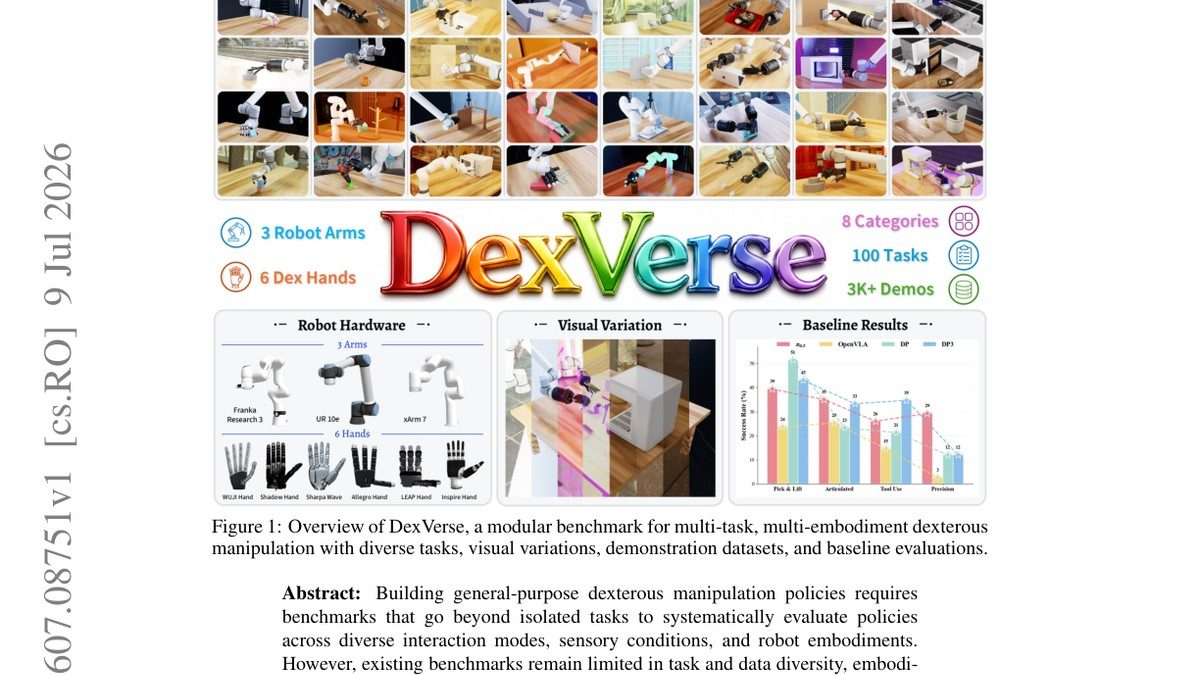
DexVerse: A Modular Benchmark for Multi-Task, Multi-Embodiment Dexterous Manipulation
arXiv preprint

DexVerse: A Modular Benchmark for Multi-Task, Multi-Embodiment Dexterous Manipulation

Yunchao Yao, Zhuxiu Xu, Tianqi Zhang et al.

Building general-purpose dexterous manipulation policies requires benchmarks that go beyond isolated tasks to systematically evaluate policies across diverse interaction modes, sensory conditions, and robot embodiments.

manipulation vision vla reinforcement-learning control learning-from-demonstration benchmark
PDF Advanced
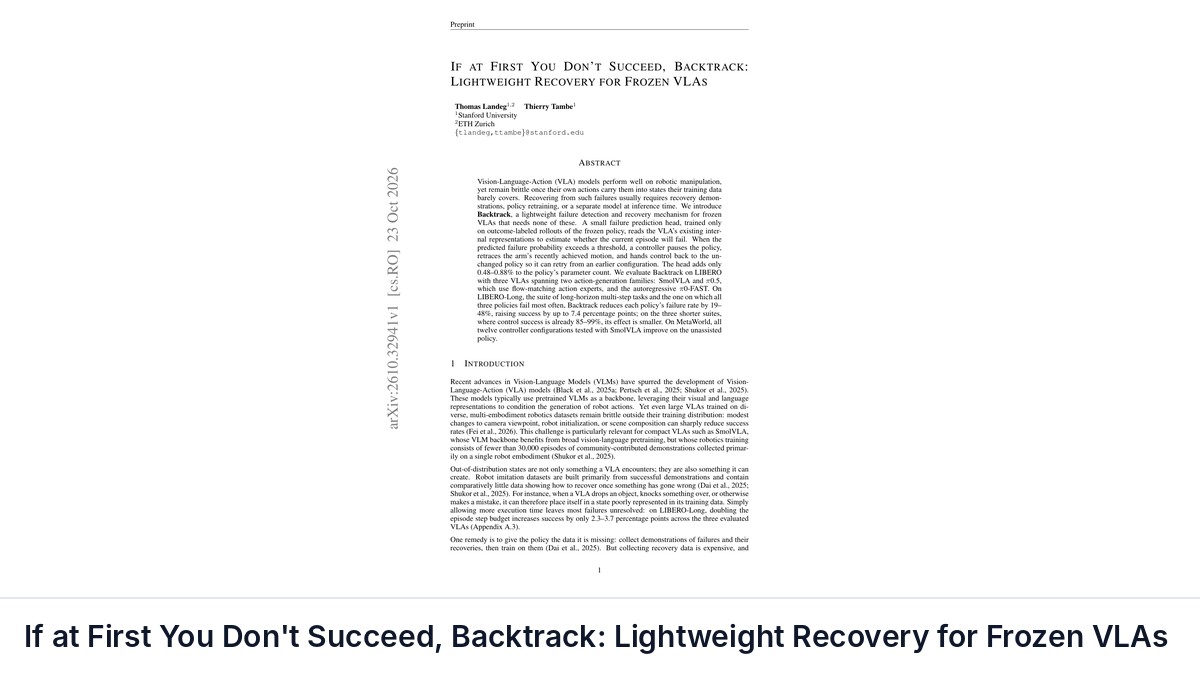
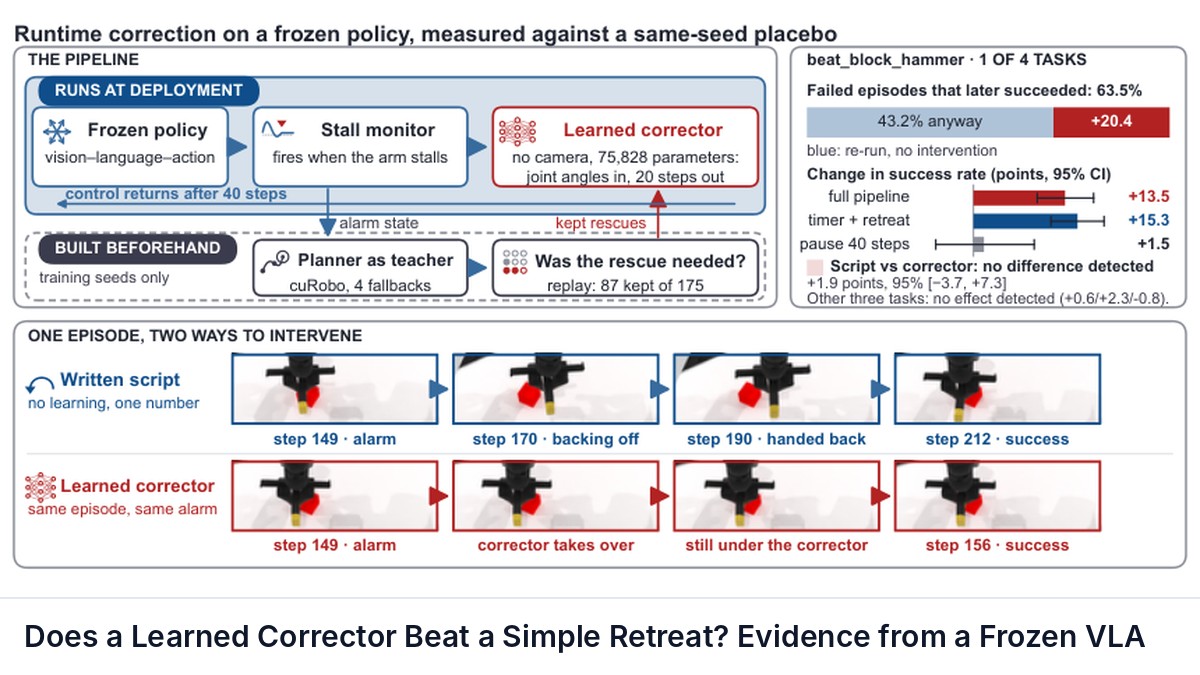
Does a Learned Corrector Beat a Simple Retreat? Evidence from a Frozen VLA
arXiv preprint

Does a Learned Corrector Beat a Simple Retreat? Evidence from a Frozen VLA

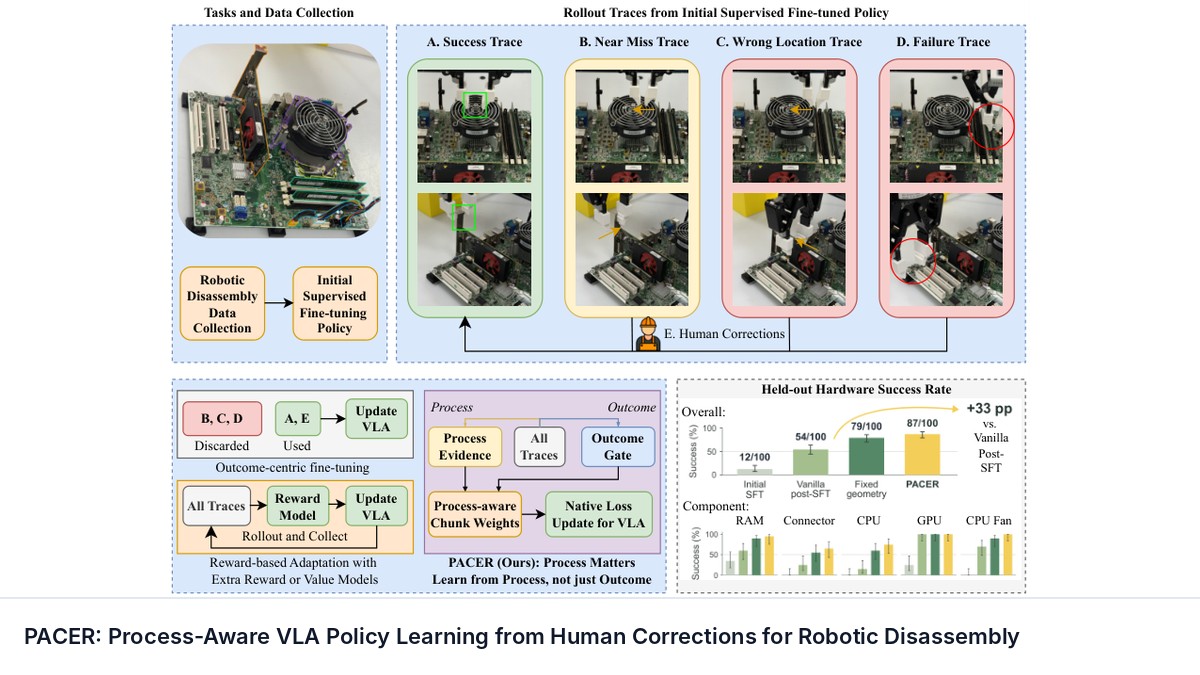
Chenchao Sheng, Zhuang Jiang, Liuhaichen Yang et al.

Before deploying runtime recovery for a frozen vision-language-action (VLA) policy, one must establish that an intervention improves success beyond ordinary run-to-run variation and that its complexity adds value over a simple action.

vision vla reinforcement-learning control benchmark
PDF Intermediate
Evidence-Gated Task and Motion Planning with Vision-Language Models
arXiv preprint

Evidence-Gated Task and Motion Planning with Vision-Language Models

Tsunehiko Tanaka, Matthew Stephenson, Alistair Macvicar et al.

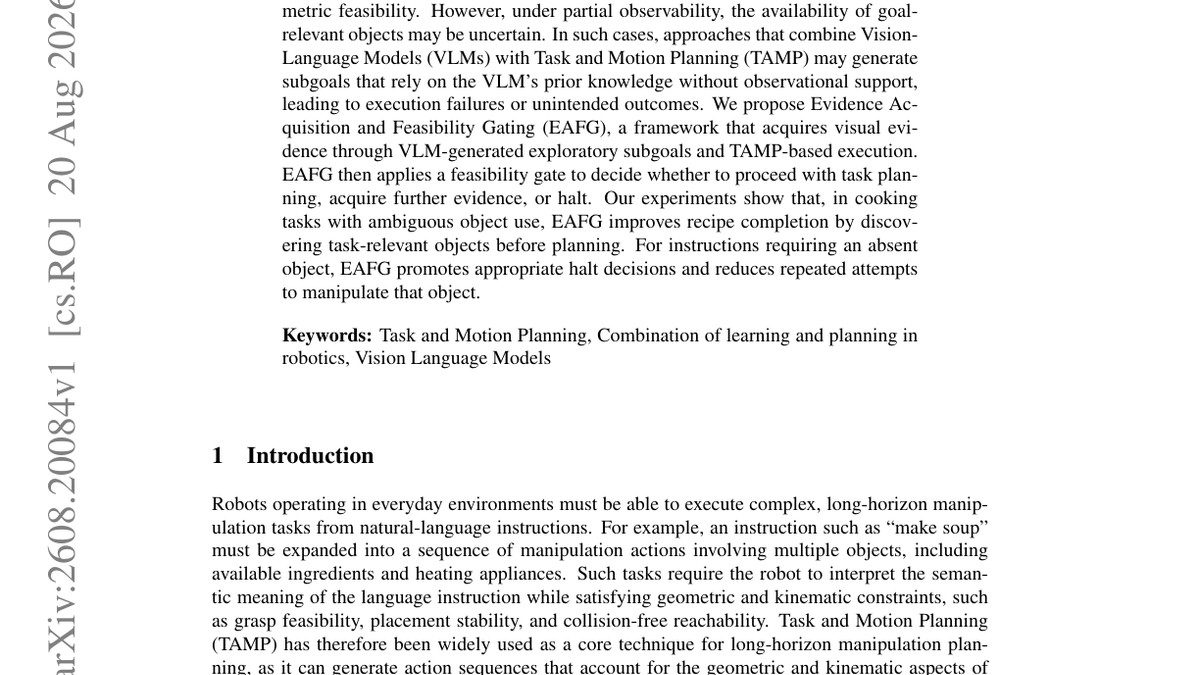
Robots executing long-horizon manipulation tasks from natural-language instructions must reason about both semantic task structure and geometric feasibility. However, under partial observability, the availability of goal-relevant objects may be uncertain.

manipulation vision vla reinforcement-learning planning
PDF Intermediate
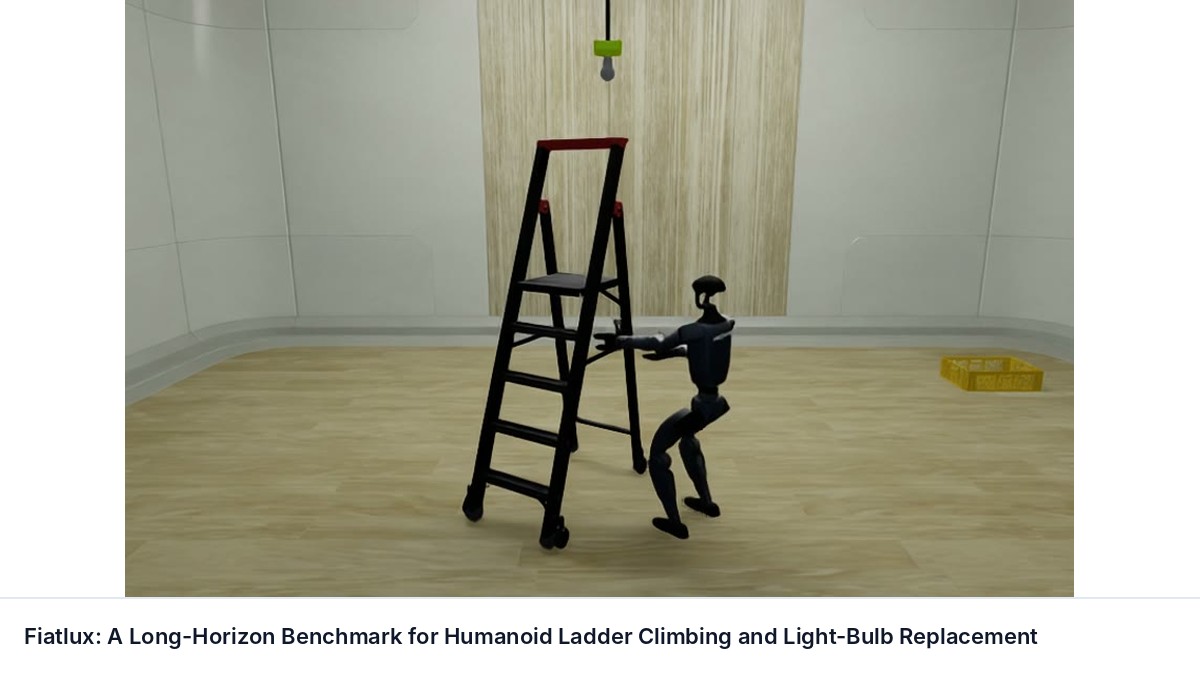
Fiatlux: A Long-Horizon Benchmark for Humanoid Ladder Climbing and Light-Bulb Replacement
arXiv preprint

Fiatlux: A Long-Horizon Benchmark for Humanoid Ladder Climbing and Light-Bulb Replacement

Pavel Bushuyeu, Yujin Chen, Anton Nikolaev et al.

Existing benchmarks evaluate tabletop manipulation, flat-floor household activity, or humanoid locomotion and manipulation as separate task groups; none scores vertical mobility and dexterous work on a fragile payload in one long-horizon episode.

manipulation locomotion vision vla reinforcement-learning control benchmark
PDF Intermediate
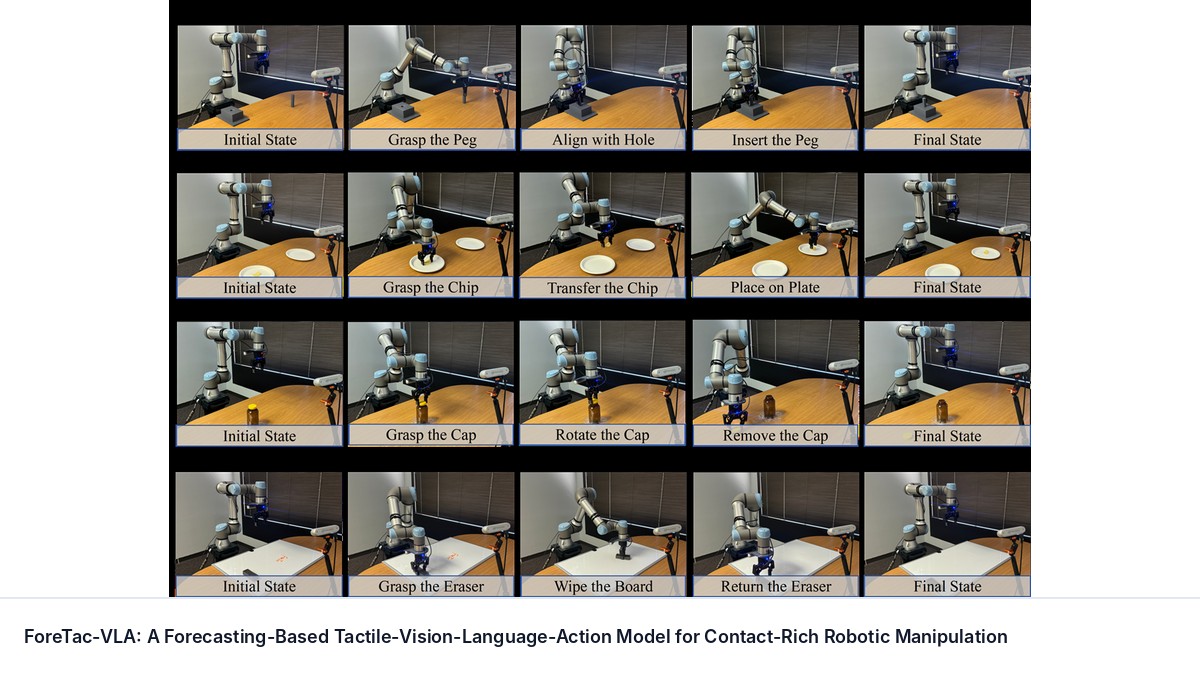
ForeTac-VLA: A Forecasting-Based Tactile-Vision-Language-Action Model for Contact-Rich Robotic Manipulation
arXiv preprint

ForeTac-VLA: A Forecasting-Based Tactile-Vision-Language-Action Model for Contact-Rich Robotic Manipulation

Zhengyu Tao, Xin Li, Xin Wang

Vision-language-action (VLA) models have demonstrated strong capabilities in robotic manipulation, yet their reliance on visual perception limits robustness in contact-rich environments, where critical physical interaction states may not be visually observable.

manipulation vision vla reinforcement-learning learning-from-demonstration tactile
PDF Intermediate
GesVLA: Gesture-Aware Vision-Language-Action Model
arXiv preprint

GesVLA: Gesture-Aware Vision-Language-Action Model

Wenxuan Guo, Ziyuan Li, Meng Zhang et al.

GesVLA augments standard VLA models with gesture awareness, enabling robots to interpret verbal instructions alongside human hand gestures for disambiguated manipulation.

vla manipulation hand-tracking
Code PDF Intermediate
GitHub ★ 18 Updated May 2026
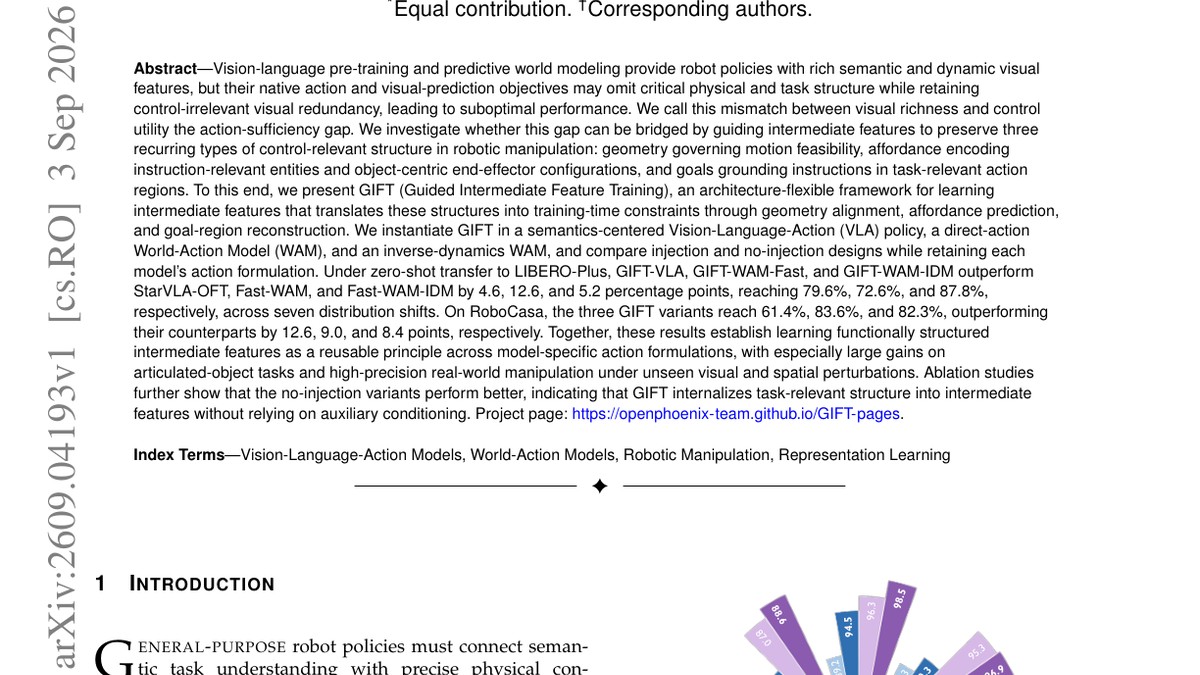
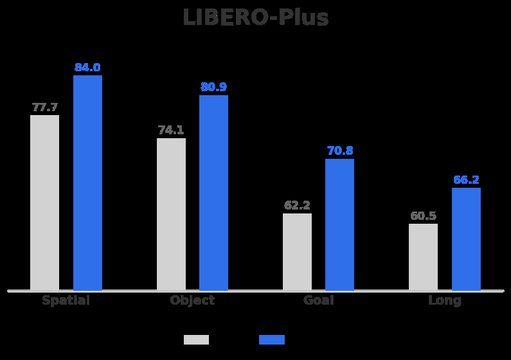
GIFT: Guided Intermediate Feature Training via Action-Oriented Structural Supervision for Robotic Manipulation
arXiv preprint

GIFT: Guided Intermediate Feature Training via Action-Oriented Structural Supervision for Robotic Manipulation

Yupeng Zheng, Xiang Li, Songen Gu et al.

Vision-language pre-training and predictive world modeling provide robot policies with rich semantic and dynamic visual features, but their native action and visual-prediction objectives may omit critical physical and task structure while retaining control-irrelevant visual redundancy.

manipulation vision vla reinforcement-learning control
PDF Intermediate
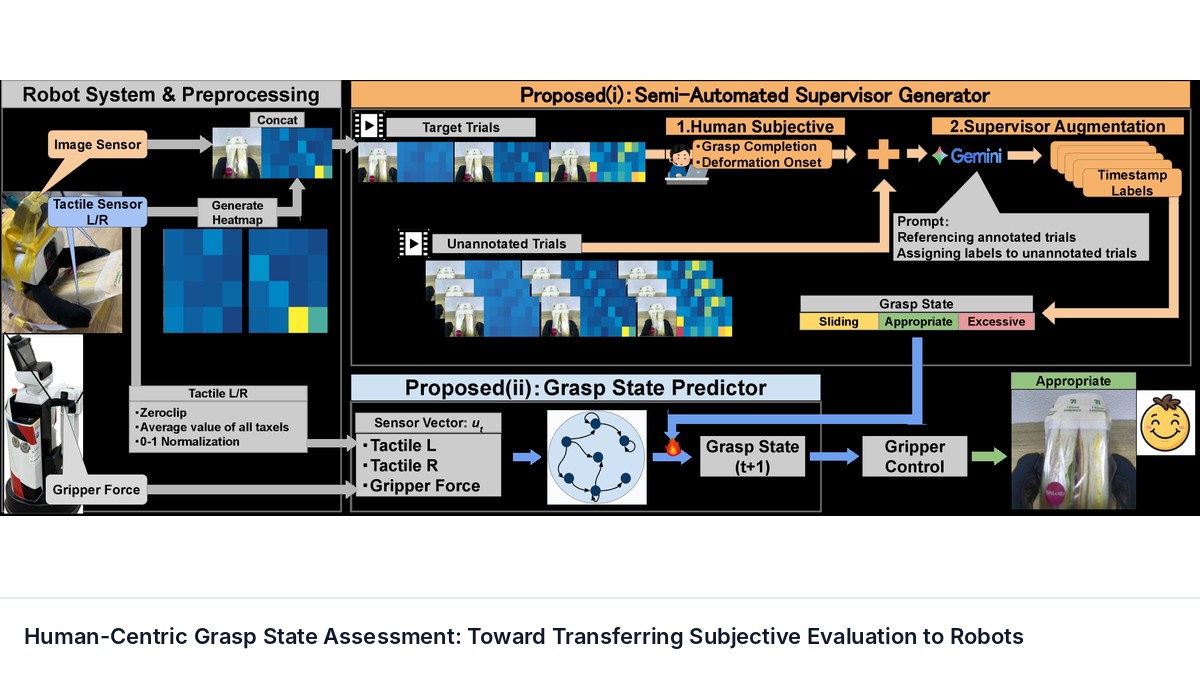
Human-Centric Grasp State Assessment: Toward Transferring Subjective Evaluation to Robots
arXiv preprint

Human-Centric Grasp State Assessment: Toward Transferring Subjective Evaluation to Robots

Ryohei Kobayashi, Kosei Isomoto, Yuga Yano et al.

We propose a framework that transfers tacit human subjective criteria to robotic systems for the appropriate grasping of deformable objects. Achieving such behavior is challenging because a semantic gap exists between qualitative human expectations and quantitative robotic measurements.

manipulation vision vla control tactile benchmark
PDF Intermediate
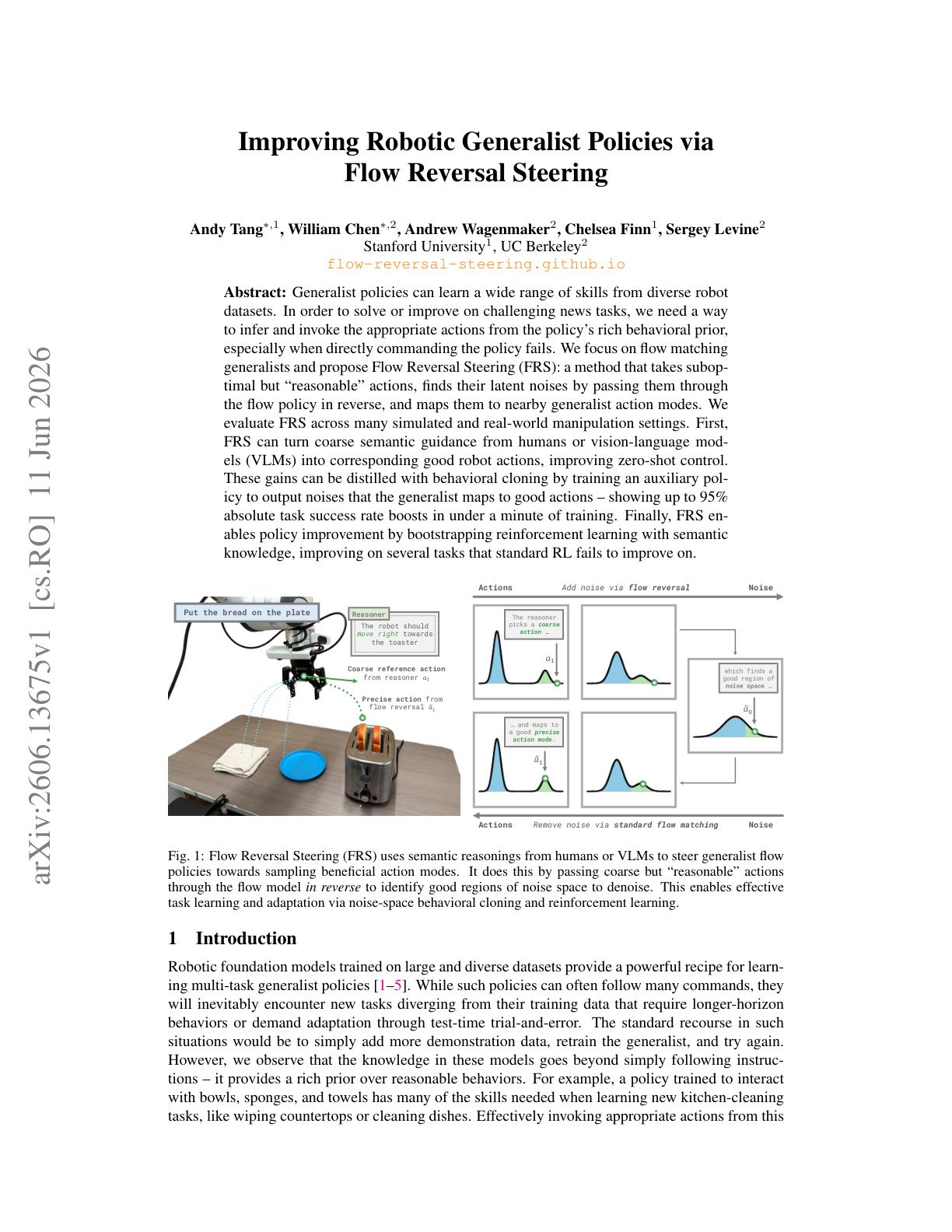
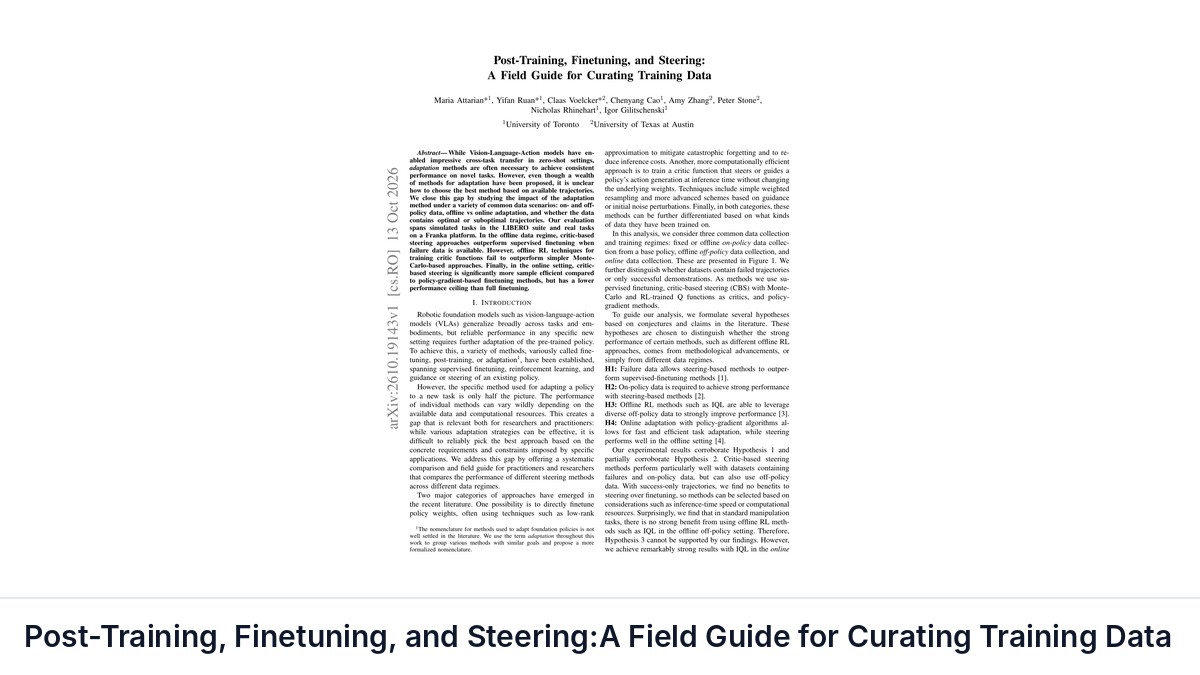
Improving Robotic Generalist Policies via Flow Reversal Steering
arXiv preprint

Improving Robotic Generalist Policies via Flow Reversal Steering

Andy Tang, William Chen, Andrew Wagenmaker et al.

Generalist policies can learn a wide range of skills from diverse robot datasets. In order to solve or improve on challenging news tasks, we need a way to infer and invoke the appropriate actions from the policy's rich behavioral prior, especially when directly commanding the policy fails.

manipulation vla world-models
PDF Advanced
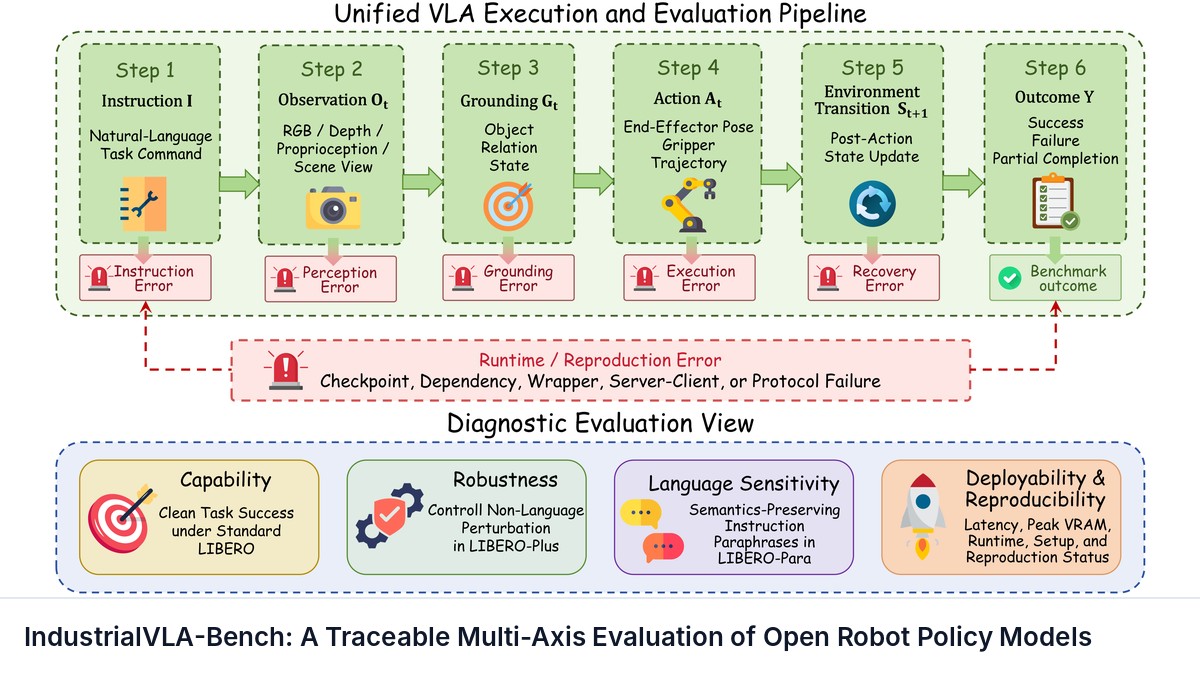
IndustrialVLA-Bench: A Traceable Multi-Axis Evaluation of Open Robot Policy Models
arXiv preprint

IndustrialVLA-Bench: A Traceable Multi-Axis Evaluation of Open Robot Policy Models

Yiqi Wang, Zhifeng Rao, Jiaqi Zhang et al.

Open robot policies increasingly follow two paradigms: vision-language-action models (VLAs) directly map observations and instructions to actions, whereas world-action models (WAMs) incorporate learned video or world dynamics into policy learning or action generation.

manipulation vision vla reinforcement-learning benchmark
Code PDF Intermediate
GitHub ★ —
Learning Options for Compositional Motor Control with Adapter Banks
arXiv preprint

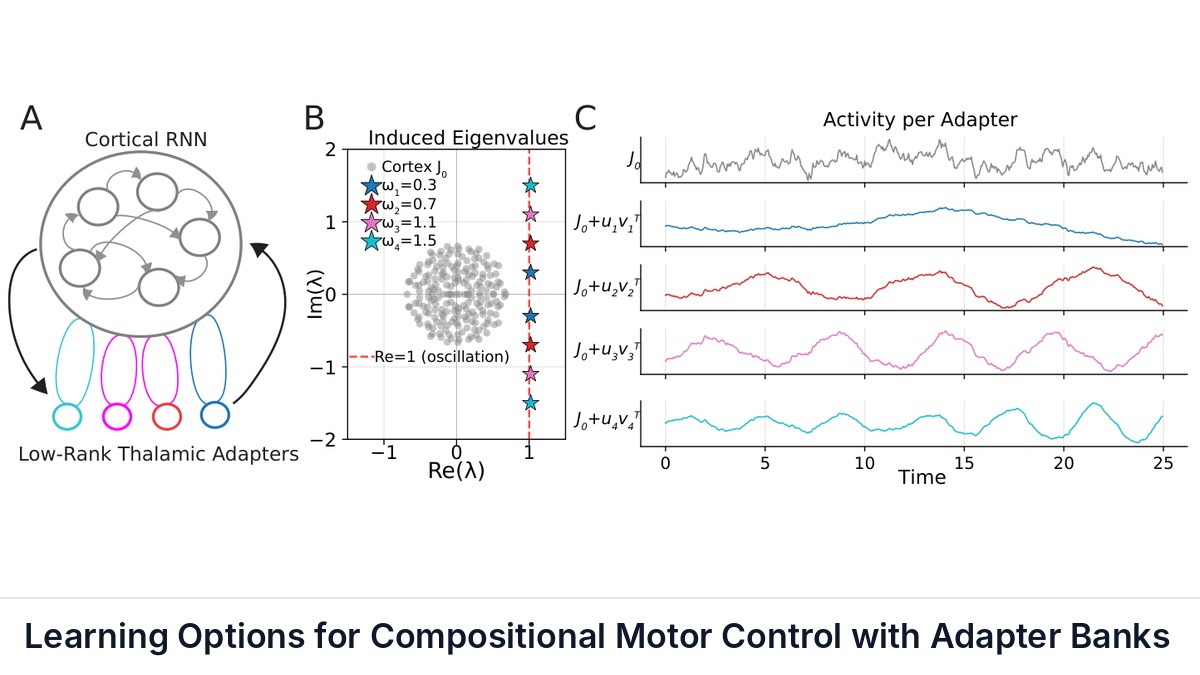
Learning Options for Compositional Motor Control with Adapter Banks

Sreejan Kumar, Marcelo Mattar, Lea Duncker

Learning flexible motor primitives is a hallmark of skilled motor control. Recent neuroscience theory proposes that motor primitives may be implemented as low-rank perturbations of a shared recurrent network, but leaves open how such a system is learned.

vla reinforcement-learning control
PDF Advanced
LIBERO-PeRM: Benchmarking Personalized Robotic Manipulation
arXiv preprint

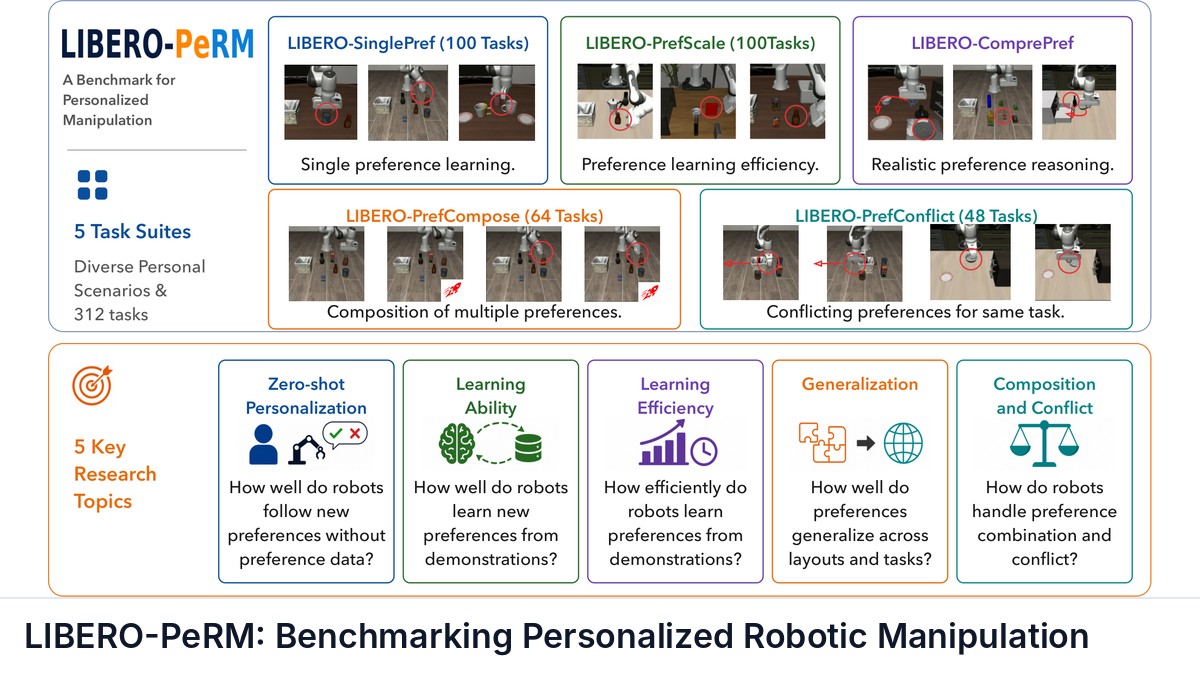
LIBERO-PeRM: Benchmarking Personalized Robotic Manipulation

Zhixu Li, Keqian Tang, Litian Gong et al.

Personalization is essential for general-purpose robots to transition into household environments and achieve true practicality.

manipulation vla control learning-from-demonstration benchmark
PDF Intermediate
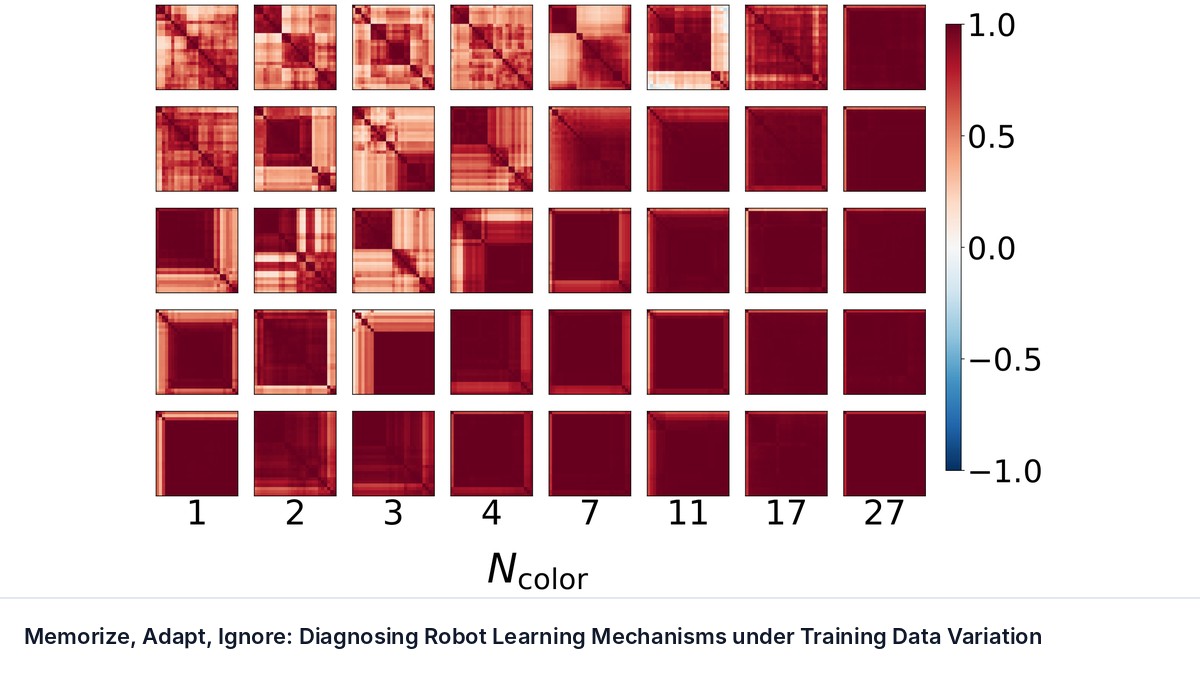
Memorize, Adapt, Ignore: Diagnosing Robot Learning Mechanisms under Training Data Variation
arXiv preprint

Memorize, Adapt, Ignore: Diagnosing Robot Learning Mechanisms under Training Data Variation

Ke Zhang, Danica J. Sutherland, Chao Liu

Training data variation, whether through designing a domain randomization (DR) scheme in simulation or curating demonstrations for imitation learning, is a primary lever for improving the robustness of robotic manipulation policies.

manipulation vision vla reinforcement-learning sim-to-real learning-from-demonstration
PDF Intermediate
Multi-Dimensional Featurizers Yield Fine-Grained Steering and Data Shaping in Robot Foundation Models
arXiv preprint

Multi-Dimensional Featurizers Yield Fine-Grained Steering and Data Shaping in Robot Foundation Models

Aiden Swann, Mozes Jacobs, Mathilde Papillon et al.

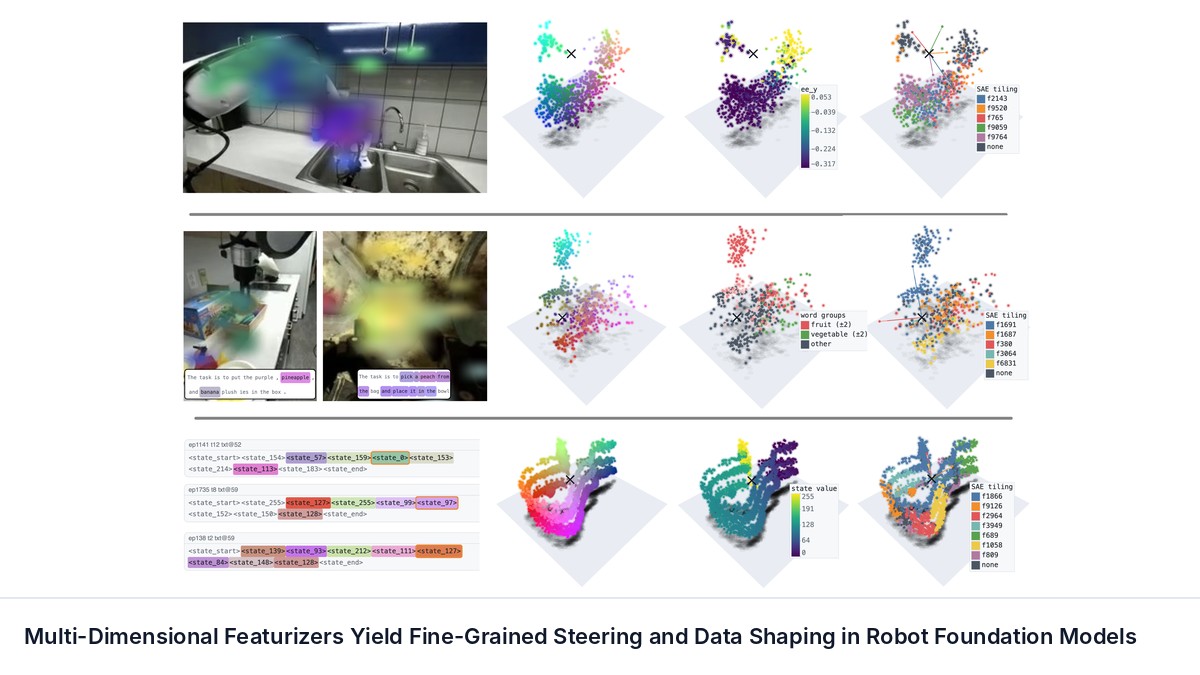
Can better feature discovery improve control over robot behavior through internal interventions and training data? Recent work in vision and language models reveals multidimensional features, motivating block-sparse featurizers (BSFs), which represent each feature in a low-dimensional subspace.

vision vla reinforcement-learning control benchmark
Code PDF Advanced
GitHub ★ —
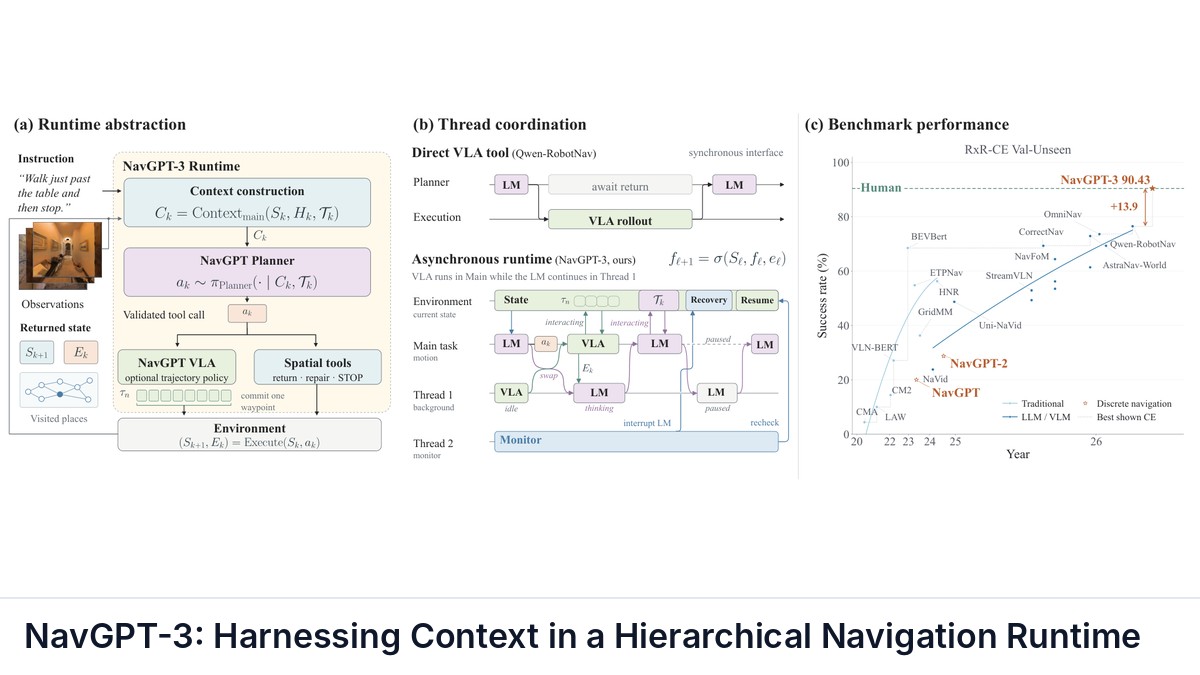
NavGPT-3: Harnessing Context in a Hierarchical Navigation Runtime
arXiv preprint

NavGPT-3: Harnessing Context in a Hierarchical Navigation Runtime

Gengze Zhou, Yicong Hong, Jiazhao Zhang et al.

Language models trained with long-horizon agentic reinforcement learning can generalize knowledge through reasoning, express precise actions, and pursue goals over many steps, raising the ceiling on what an embodied agent can understand and decide.

vision vla reinforcement-learning planning control benchmark
Code PDF Intermediate
GitHub ★ —
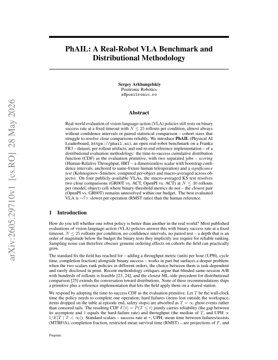
PhAIL: A Real-Robot VLA Benchmark and Distributional Methodology
arXiv preprint

PhAIL: A Real-Robot VLA Benchmark and Distributional Methodology

Sergey Arkhangelskiy

Real-world evaluation of vision-language-action (VLA) policies still rests on binary success rate at a fixed timeout with N <= 25 rollouts per condition, almost always without confidence intervals or

benchmarking vla manipulation evaluation
PDF Intermediate
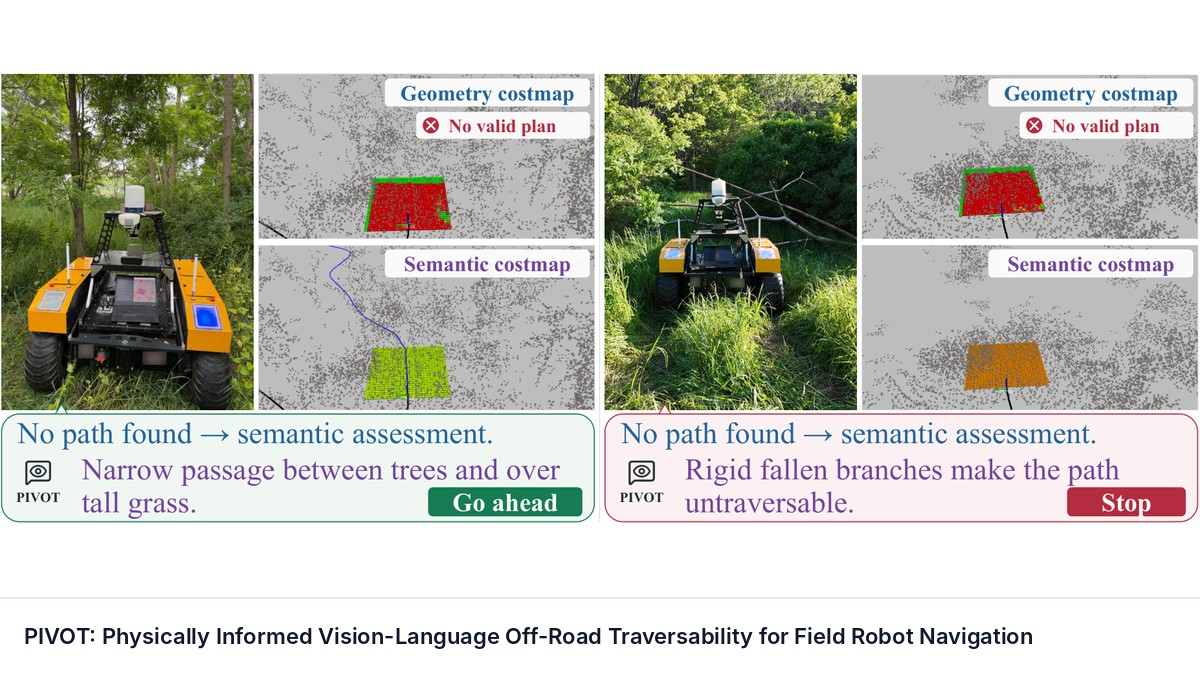
PIVOT: Physically Informed Vision-Language Off-Road Traversability for Field Robot Navigation
arXiv preprint

PIVOT: Physically Informed Vision-Language Off-Road Traversability for Field Robot Navigation

Aoran Jiao, Wenda Zhao, Hshmat Sahak et al.

Terrain assessment is a critical capability for off-road mobile robots, enabling safe and reliable navigation through unstructured and geometrically complex environments. Conventional geometry-based terrain assessment is fast to compute but often overly conservative in unstructured environments.

vision vla reinforcement-learning planning
PDF Intermediate
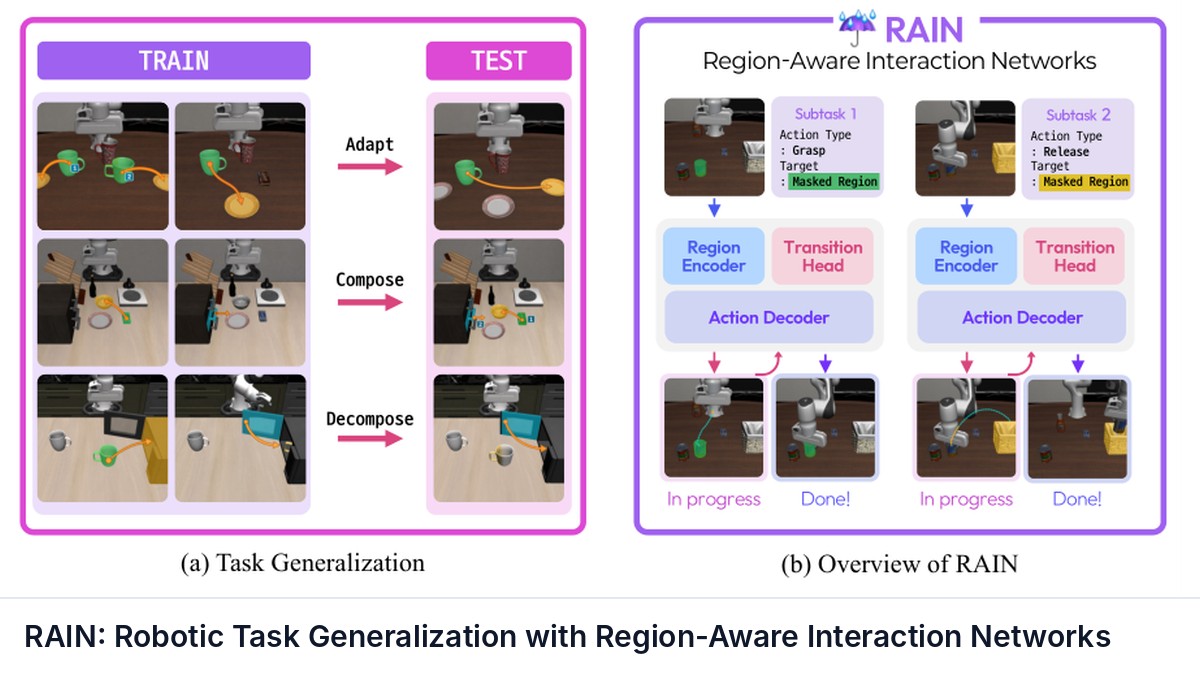
RAIN: Robotic Task Generalization with Region-Aware Interaction Networks
arXiv preprint

RAIN: Robotic Task Generalization with Region-Aware Interaction Networks

Seunghun Lee, Kyuhwan Shim, Yeogyeong Song et al.

Existing vision-language-action (VLA) models benefit from large-scale vision-language pretraining, but tend to memorize training trajectories, limiting their ability to adapt learned interactions to new task and scene configurations.

vision vla reinforcement-learning benchmark
Code PDF Advanced
GitHub ★ —
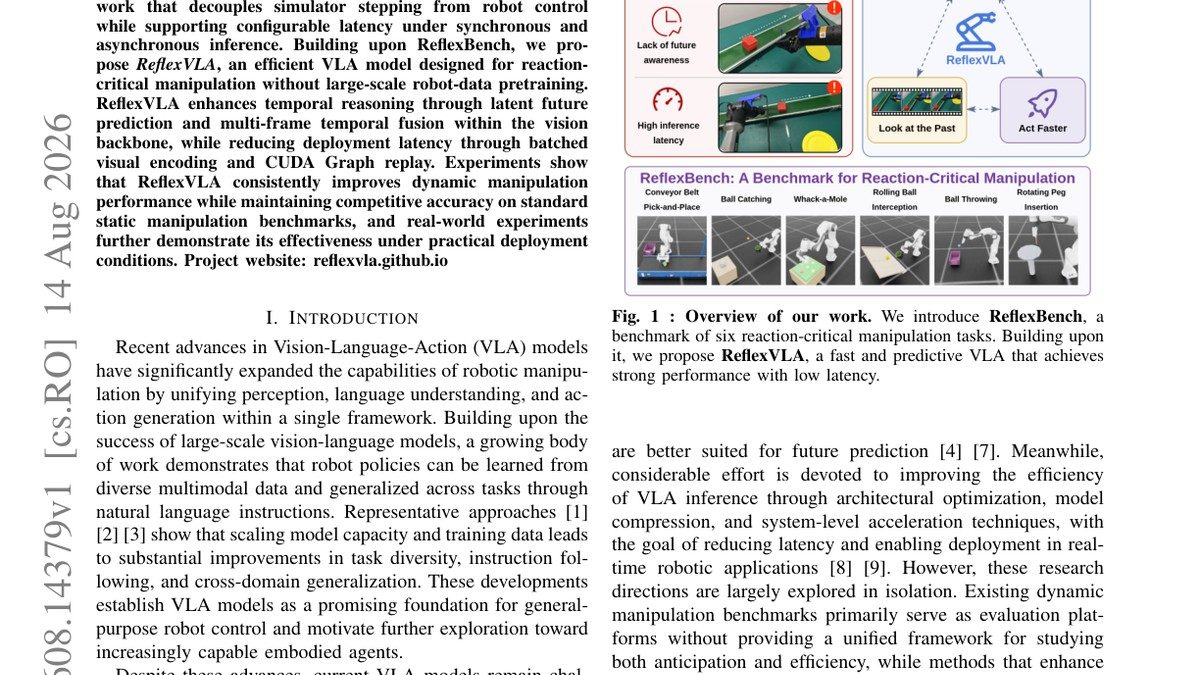
Reflex: Enabling Fast and Predictive Vision-Language-Action Models for Reaction-Critical Manipulation
arXiv preprint

Reflex: Enabling Fast and Predictive Vision-Language-Action Models for Reaction-Critical Manipulation

Yuxuan Chen, Wanruo Zhang, Xiao Li

Vision-Language-Action (VLA) models have recently achieved promising performance in robotic manipulation. However, existing benchmarks mainly evaluate generalization on static manipulation tasks and largely overlook dynamic interaction scenarios.

manipulation vision vla reinforcement-learning control benchmark
Code PDF Advanced
GitHub ★ —
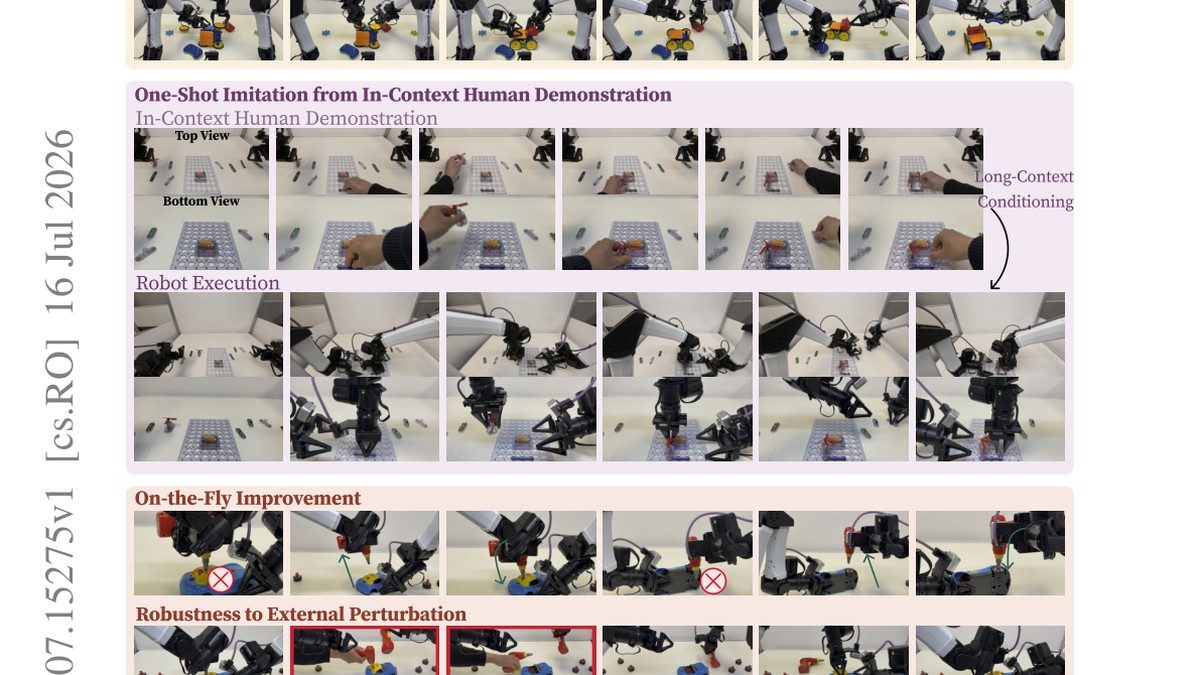
RoboTTT: Context Scaling for Robot Policies
arXiv preprint

RoboTTT: Context Scaling for Robot Policies

Yunfan Jiang, Yevgen Chebotar, Ruijie Zheng et al.

Recent robot foundation models operate with single-step or short-history visuomotor context.

manipulation vision vla reinforcement-learning learning-from-demonstration
Code PDF Advanced
GitHub ★ —
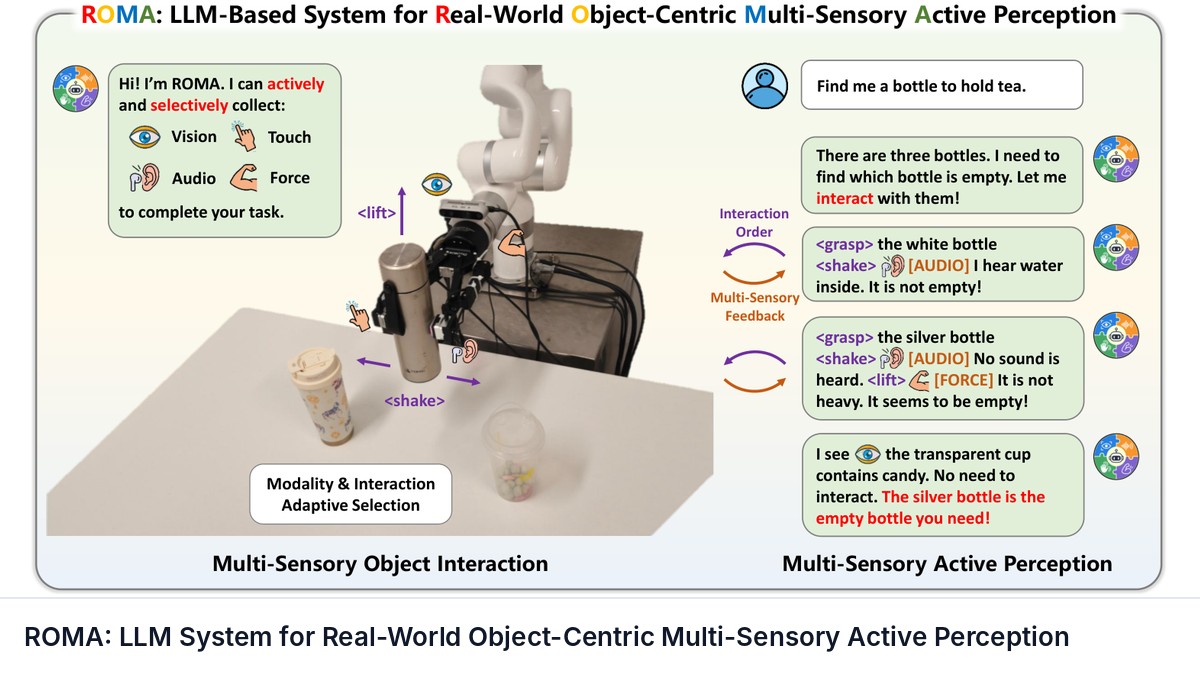
ROMA: LLM System for Real-World Object-Centric Multi-Sensory Active Perception
arXiv preprint

ROMA: LLM System for Real-World Object-Centric Multi-Sensory Active Perception

Ruoxuan Feng, Yutong Chen, Ruihua Song et al.

Humans inherently understand the physical world through an active process. When sensory evidence is insufficient to infer physical properties, we naturally interact with the environment by deciding what information is missing, how to acquire it, and when sufficient evidence has been obtained.

vision vla reinforcement-learning tactile benchmark
Code PDF Advanced
GitHub ★ —
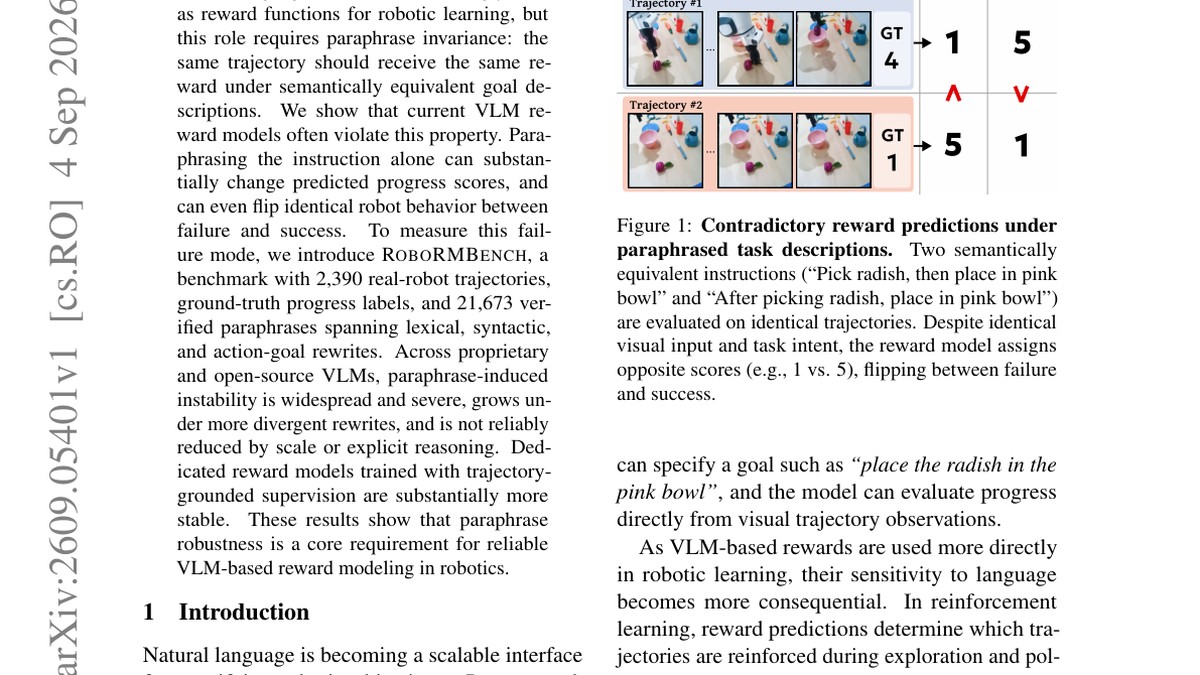
Same Trajectory, Contradictory Rewards (ROBORMBENCH): Paraphrase Fragility in Vision Language Reward Models
arXiv preprint

Same Trajectory, Contradictory Rewards (ROBORMBENCH): Paraphrase Fragility in Vision Language Reward Models

Wonje Jeung, Sangyeon Yoon, Hyesoo Hong et al.

Vision-language models are increasingly used as reward functions for robotic learning, but this role requires paraphrase invariance: the same trajectory should receive the same reward under semantically equivalent goal descriptions. We show that current VLM reward models often violate this property.

vision vla benchmark
PDF Intermediate
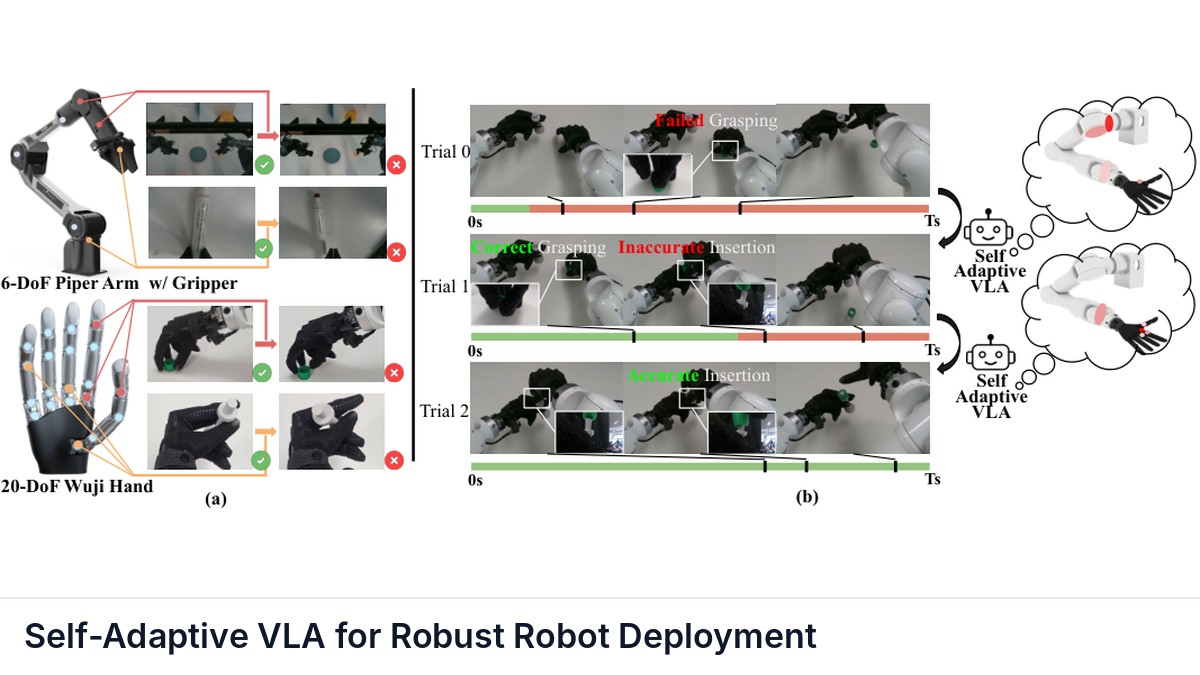
Self-Adaptive VLA for Robust Robot Deployment
arXiv preprint

Self-Adaptive VLA for Robust Robot Deployment

Hongxin Zhang, Chunru Lin, Tsun-Hsuan Wang et al.

While Vision-Language-Action (VLA) models demonstrate impressive capabilities in robotic manipulation, their memoryless nature renders them brittle to test-time environment shifts, particularly hardware shifts caused by wear or imperfect calibration.

manipulation vision vla reinforcement-learning learning-from-demonstration
Code PDF Advanced
GitHub ★ —
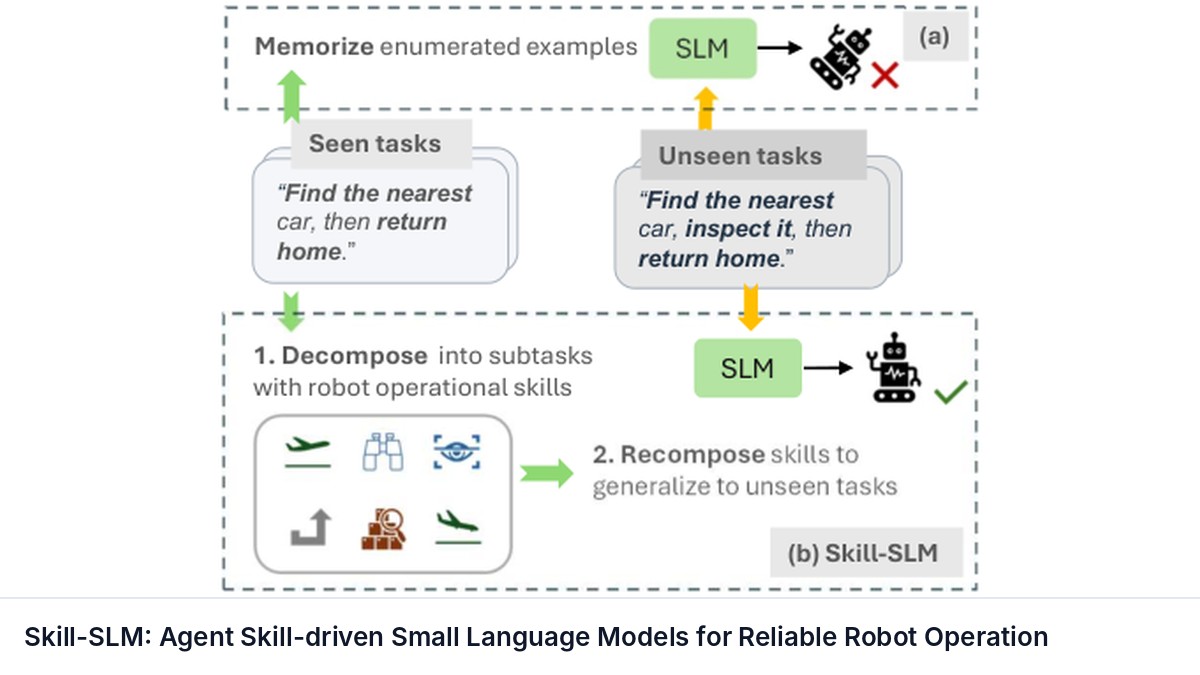
Skill-SLM: Agent Skill-driven Small Language Models for Reliable Robot Operation
arXiv preprint

Skill-SLM: Agent Skill-driven Small Language Models for Reliable Robot Operation

Wenhao Wang, Yanyan Li, Jiawei Yuan

Small language models (SLMs) have been increasingly adopted for onboard robot operation because they enable intelligent decision-making. However, existing approaches are mainly distillation-oriented and rely on enumerating representative task-solution pairs.

vla reinforcement-learning control benchmark
PDF Intermediate
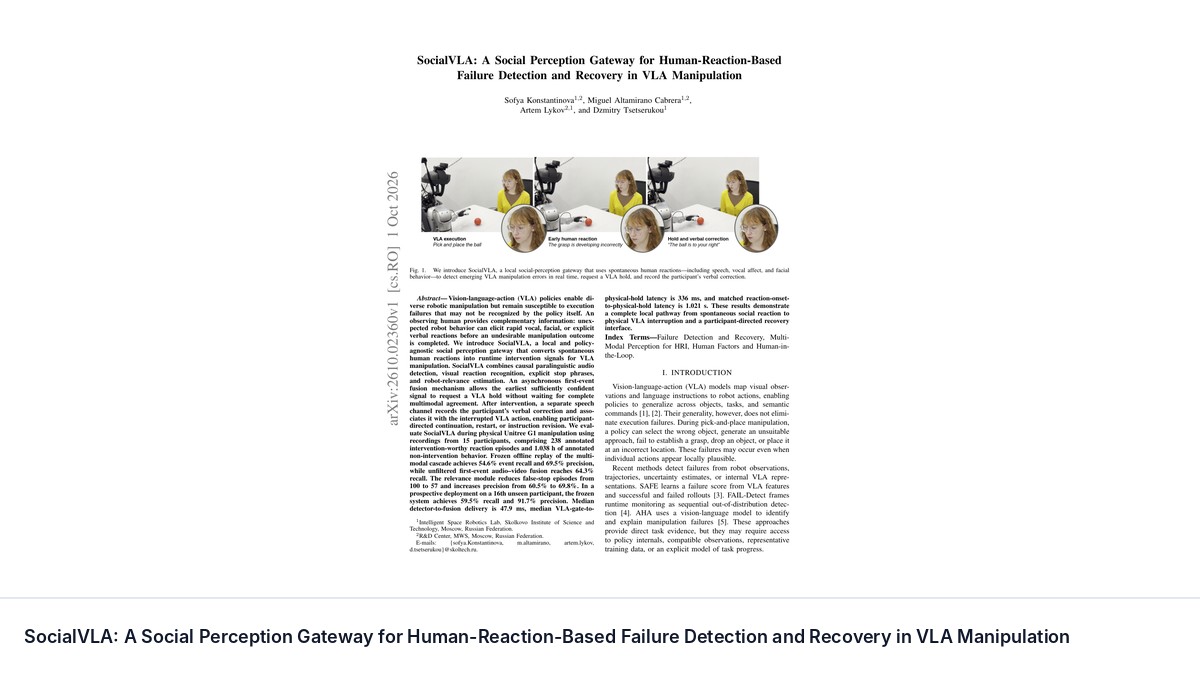
SocialVLA: A Social Perception Gateway for Human-Reaction-Based Failure Detection and Recovery in VLA Manipulation
arXiv preprint

SocialVLA: A Social Perception Gateway for Human-Reaction-Based Failure Detection and Recovery in VLA Manipulation

Sofya Konstantinova, Miguel Altamirano Cabrera, Artem Lykov et al.

Vision-language-action (VLA) policies enable diverse robotic manipulation but can fail during execution without recognizing their own errors. Human observers provide complementary signals, as unexpected robot behavior can trigger rapid vocal, facial, or verbal reactions before failure is completed.

manipulation vision vla reinforcement-learning control
Code PDF Intermediate
GitHub ★ —
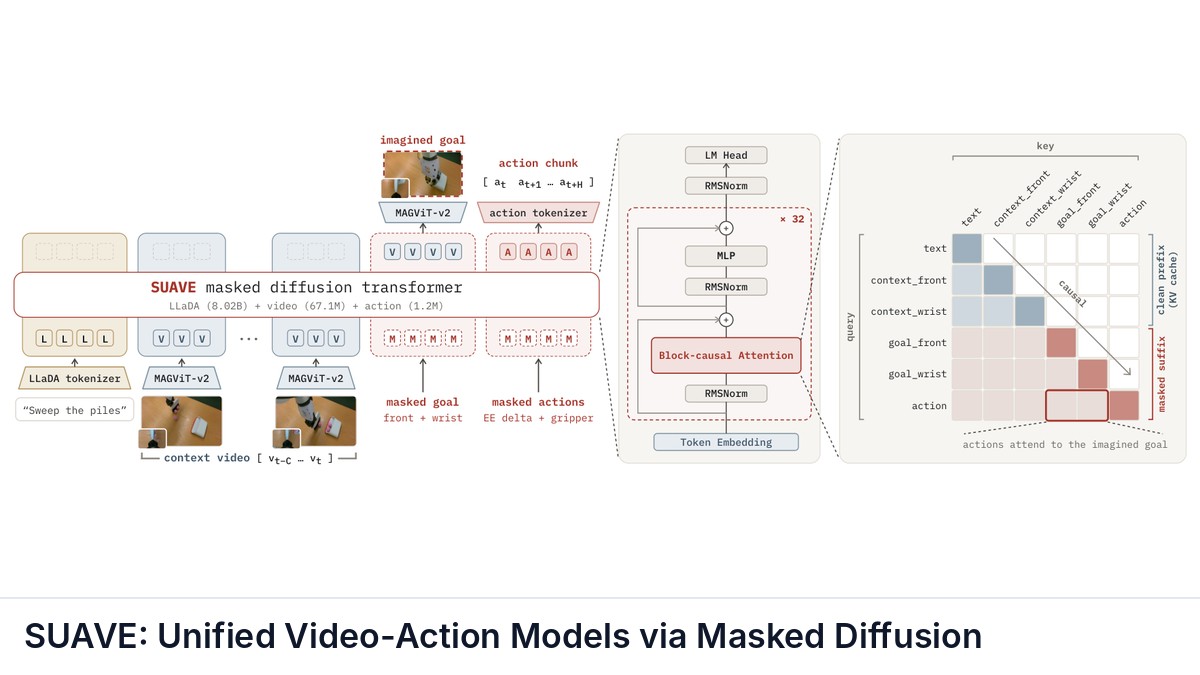
SUAVE: Unified Video-Action Models via Masked Diffusion
arXiv preprint

SUAVE: Unified Video-Action Models via Masked Diffusion

Rhythm Syed, Jean Mercat, Sedrick Keh et al.

Vision-language-action models (VLAs) inherit strong semantic grounding from pretrained vision-language backbones but are typically optimized for predicting actions rather than future observations. They can see and act, but they do not imagine the future before acting.

manipulation vision vla reinforcement-learning control
PDF Advanced
SWAP: Stepwise Action Policy Routing for Vision-Language-Action Models
arXiv preprint

SWAP: Stepwise Action Policy Routing for Vision-Language-Action Models

Mousumi Das, Aditeya Prajapati, Abrar Anwar et al.

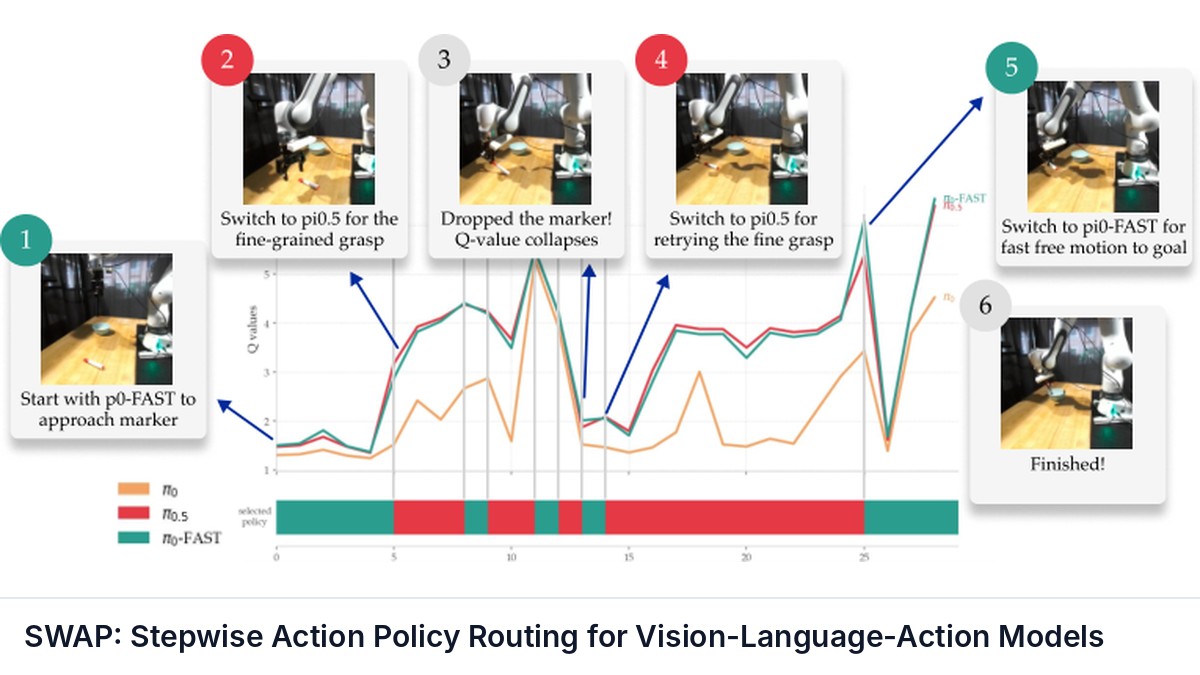
Robot manipulation systems using Vision-Language-Action (VLA) model backbones typically use just one VLA for task execution. However, individual VLAs do not perform well across different task states and environments.

manipulation vision vla reinforcement-learning
Code PDF Intermediate
GitHub ★ —
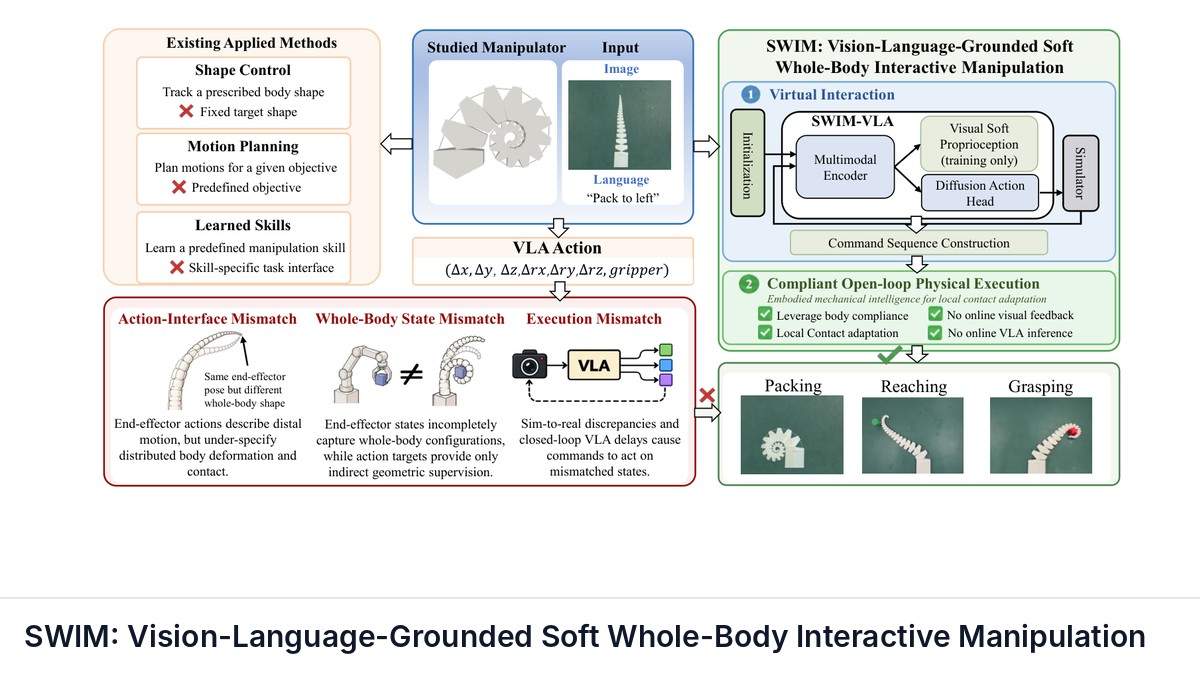
SWIM: Vision-Language-Grounded Soft Whole-Body Interactive Manipulation
arXiv preprint

SWIM: Vision-Language-Grounded Soft Whole-Body Interactive Manipulation

Tingcong Liu, Aye Phyu Phyu Aung, Junjie Xiong et al.

Soft and continuum robots enable manipulation through distributed body deformation and contact, yet translating language and visual context into executable whole-body actuation remains a fundamental challenge.

manipulation vision vla reinforcement-learning control learning-from-demonstration
PDF Advanced
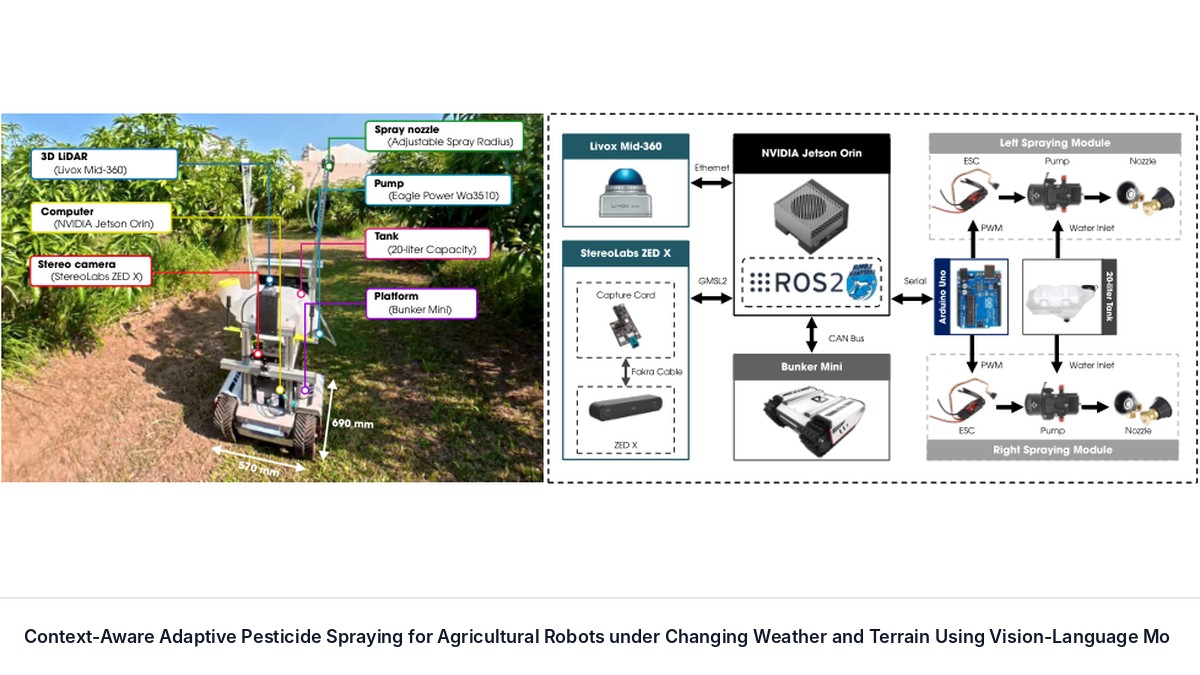
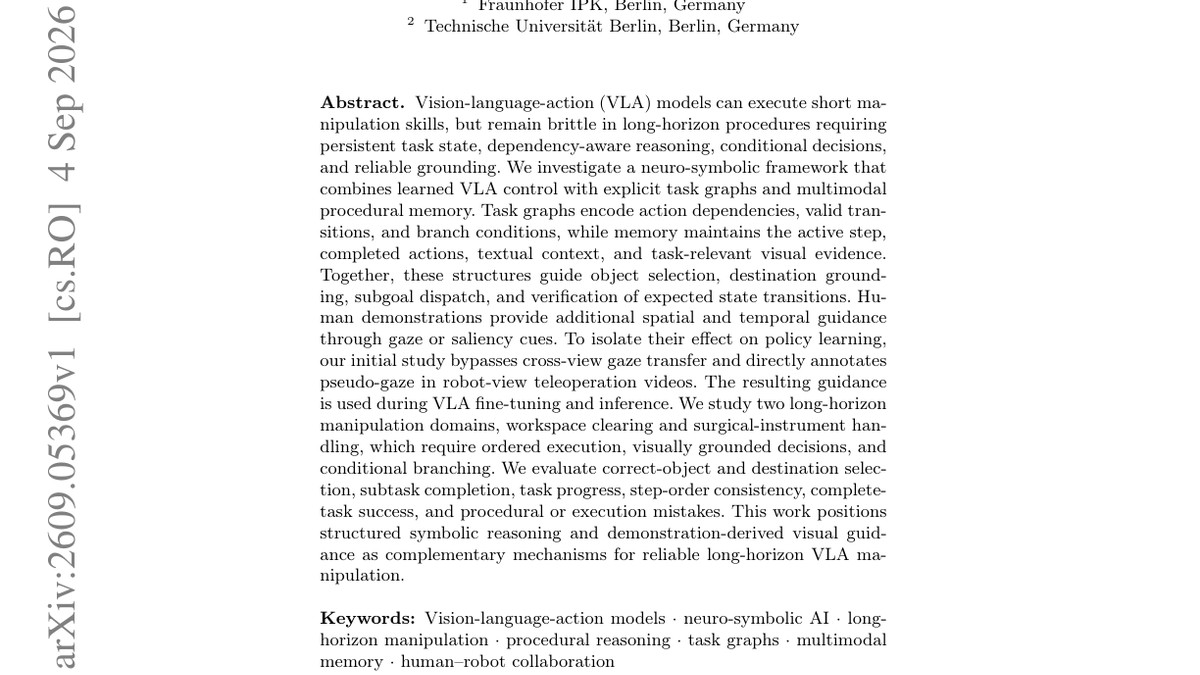
Towards Neuro-Symbolic Procedural Reasoning for Long-Horizon Vision-Language-Action Manipulation
arXiv preprint

Towards Neuro-Symbolic Procedural Reasoning for Long-Horizon Vision-Language-Action Manipulation

Vivek Chavan, Yahuan Shi, Oliver Heimann et al.

Vision-language-action (VLA) models can execute short manipulation skills, but remain brittle in long-horizon procedures requiring persistent task state, dependency-aware reasoning, conditional decisions, and reliable grounding.

manipulation vision vla reinforcement-learning control learning-from-demonstration
PDF Intermediate
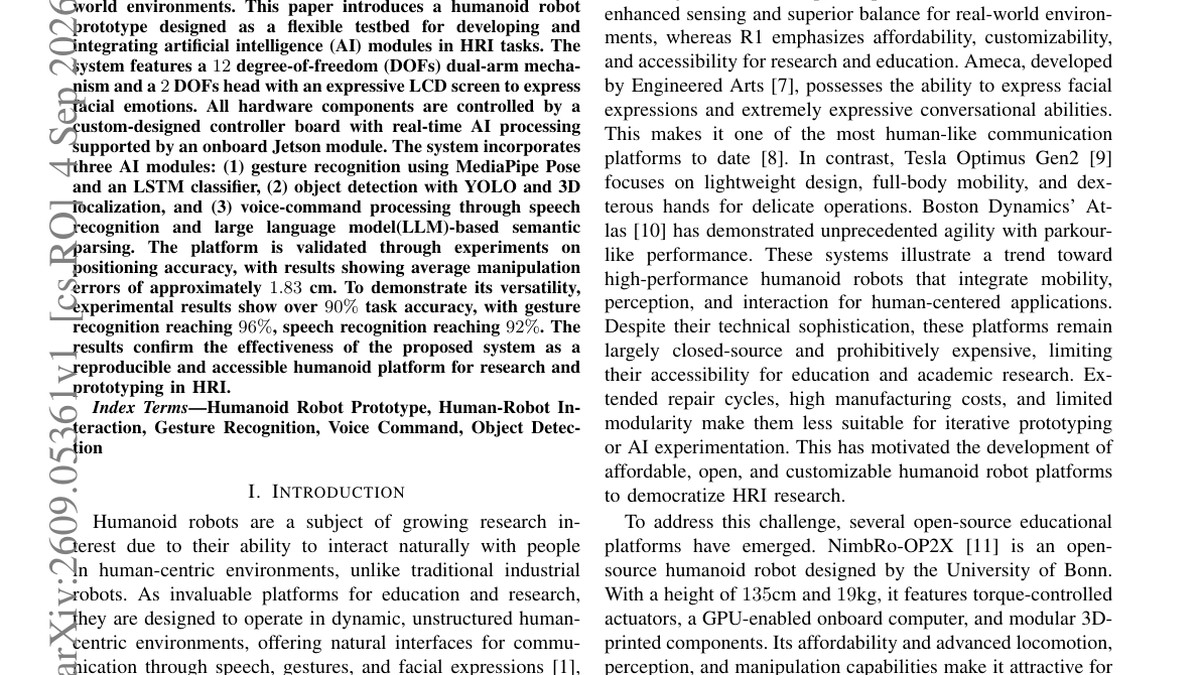
ULOHA: An Underwater Bimanual Robot System for Robot Learning
arXiv preprint

ULOHA: An Underwater Bimanual Robot System for Robot Learning

Masato Kobayashi, Takeru Tsunoori

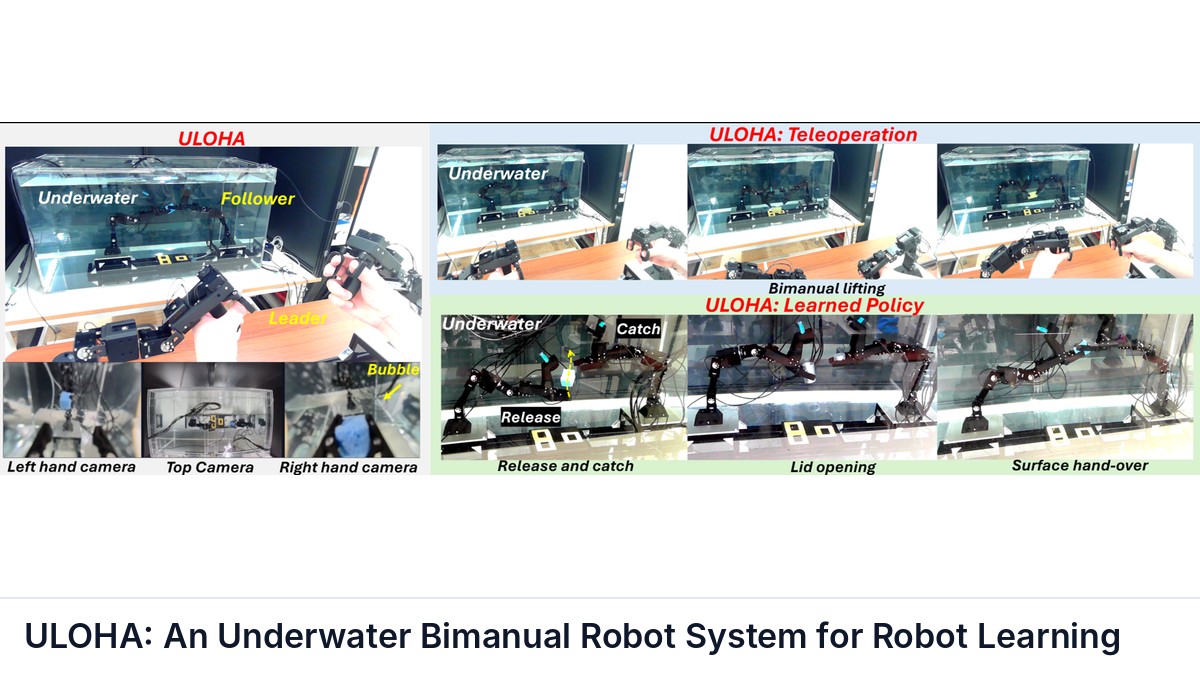
Underwater visuomotor policy learning has focused primarily on single manipulators, while bimanual imitation learning has been studied largely in air.

manipulation vision vla reinforcement-learning learning-from-demonstration
Code PDF Advanced
GitHub ★ —
Uncertainty Quantification for Flow-Based Vision-Language-Action Models
RSS 2026 — Best Paper Award

Uncertainty Quantification for Flow-Based Vision-Language-Action Models

Ralf Römer, Maximilian Seeliger, Saida Liu et al.

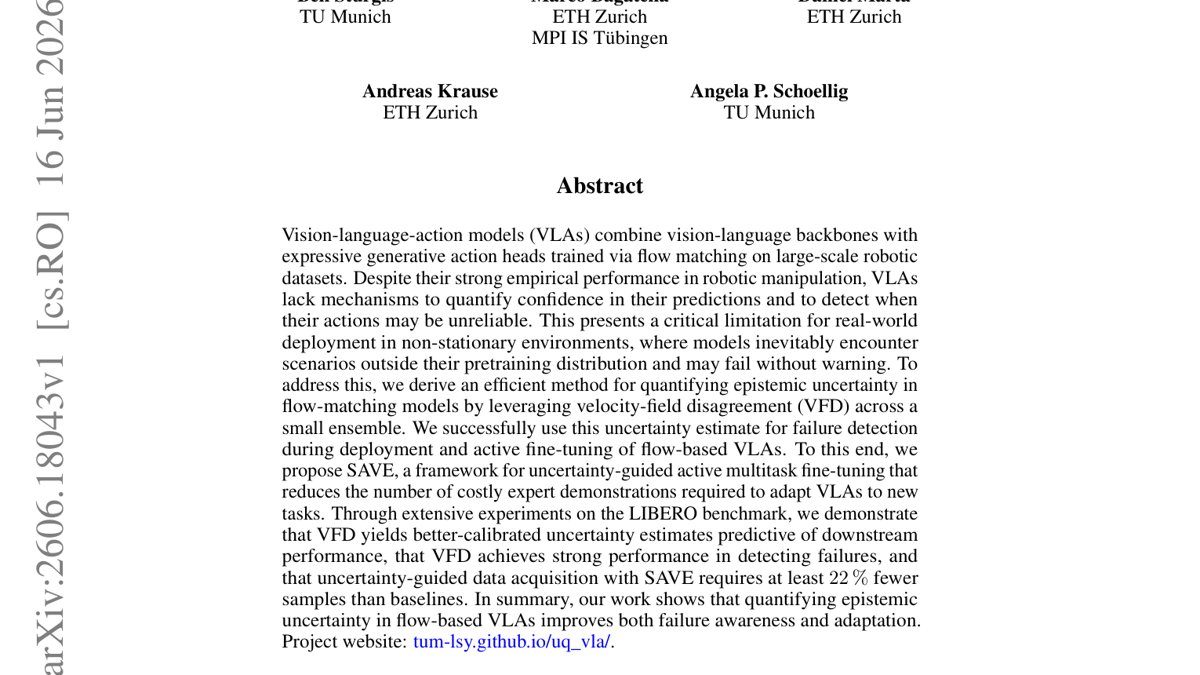
Quantifies epistemic uncertainty in flow-matching VLAs using velocity-field disagreement (VFD) across a small ensemble, enabling failure detection at deployment and sample-efficient active fine-tuning (SAVE).

vla foundation-models safety manipulation
Code PDF Advanced
GitHub ★ —
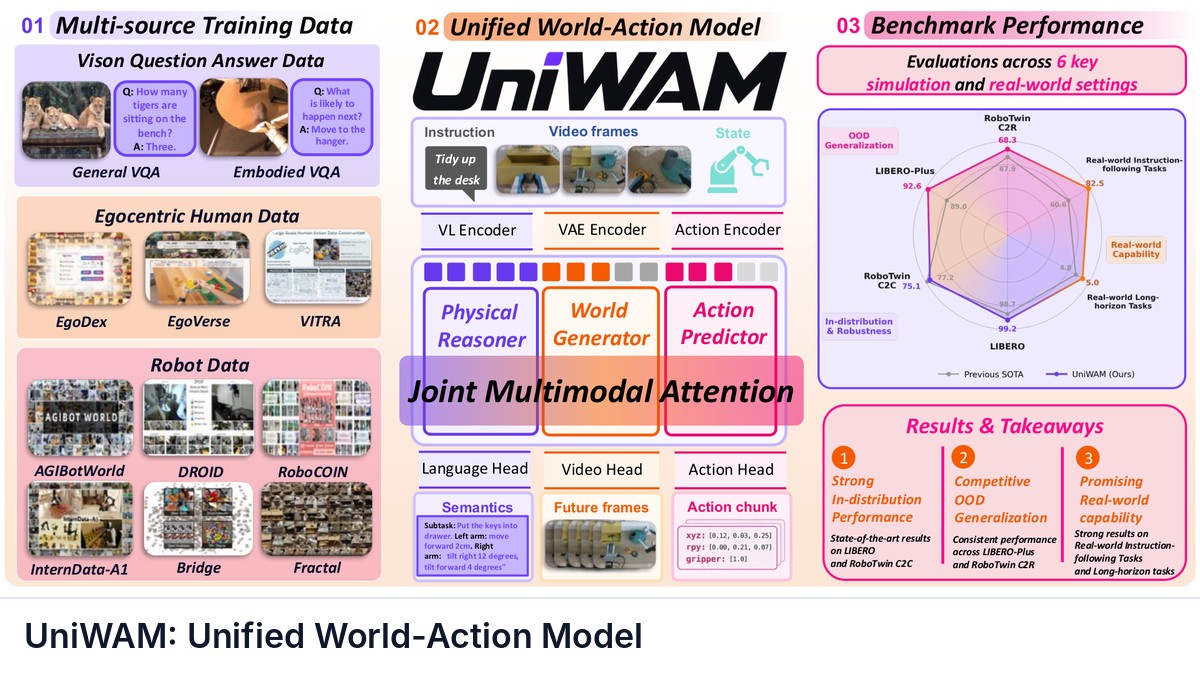
UniWAM: Unified World-Action Model
arXiv preprint

UniWAM: Unified World-Action Model

Jiayi Chen, Wenxuan Song, Jingbo Wang et al.

Vision-language-action models benefit from the understanding and reasoning capabilities of pretrained vision-language models, but action-only supervision provides limited grounding in world dynamics.

vision vla reinforcement-learning learning-from-demonstration benchmark
Code PDF Advanced
GitHub ★ —
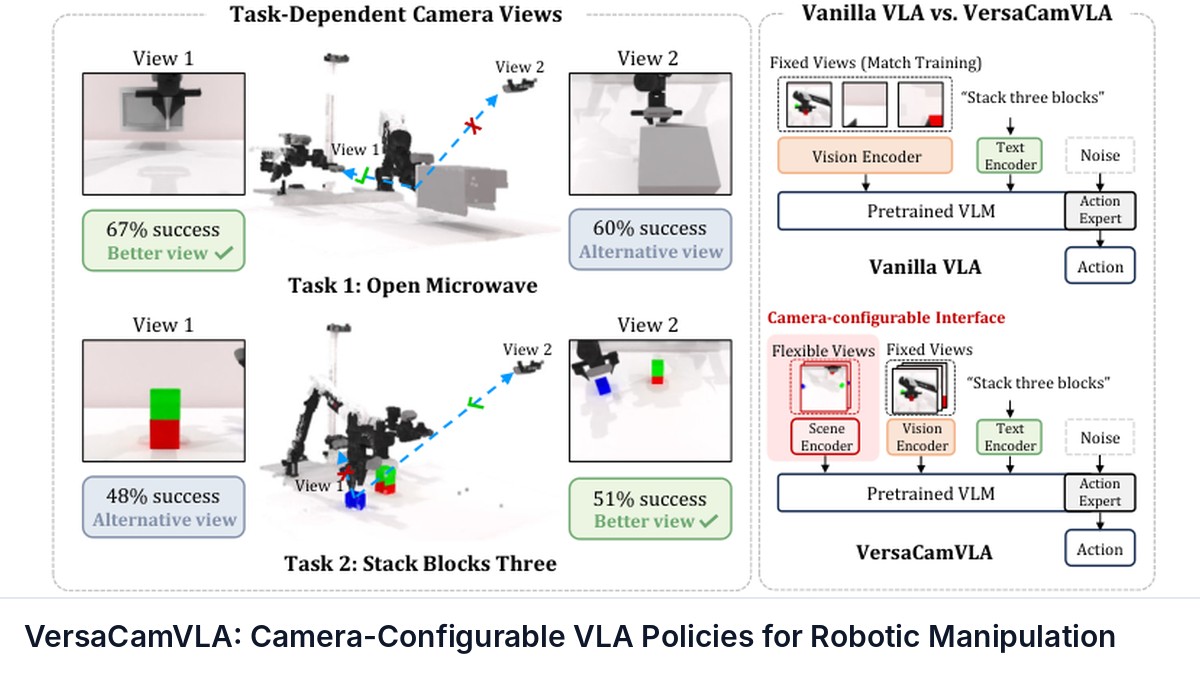
VersaCamVLA: Camera-Configurable VLA Policies for Robotic Manipulation
arXiv preprint

VersaCamVLA: Camera-Configurable VLA Policies for Robotic Manipulation

Boyao Han, Chen Shi, Jingjing Qian et al.

Vision-Language-Action (VLA) models have emerged as powerful foundations for robotic manipulation, but their reliance on fixed camera configurations during training makes them brittle to changes in camera count or pose during deployment.

manipulation vision vla reinforcement-learning
Code PDF Intermediate
GitHub ★ —
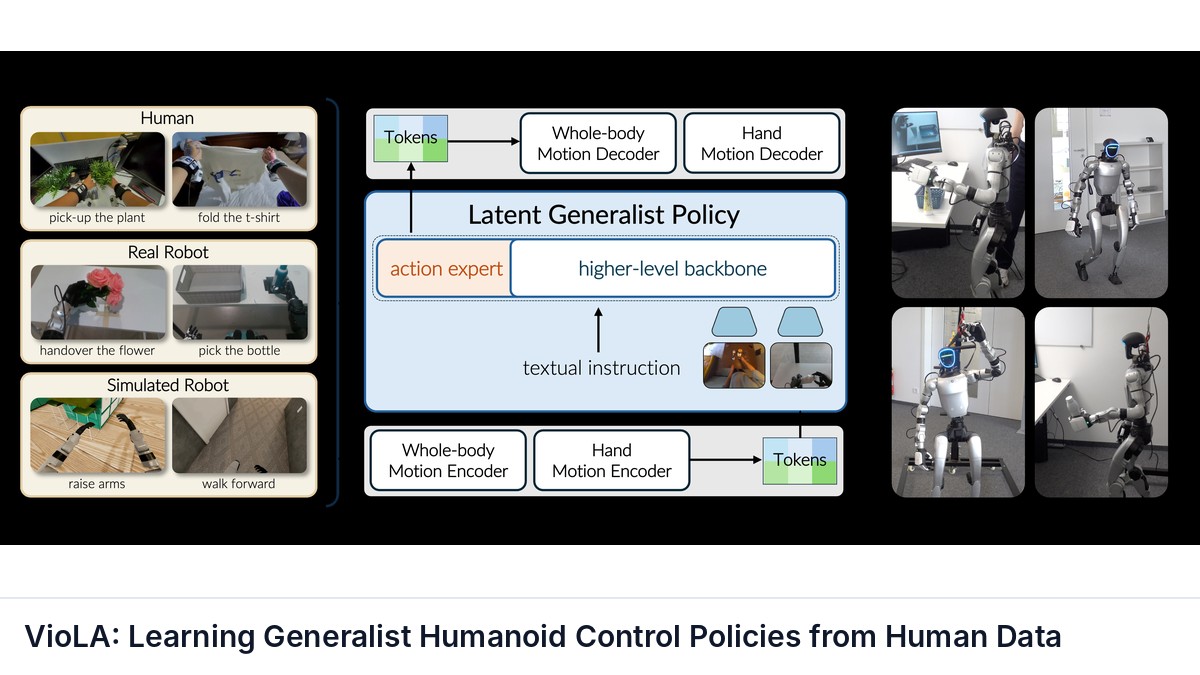
VioLA: Learning Generalist Humanoid Control Policies from Human Data
arXiv preprint

VioLA: Learning Generalist Humanoid Control Policies from Human Data

Mert Albaba, Jens Beißwenger, Anna Manasyan et al.

Teaching a humanoid to follow instructions with its whole body runs into two obstacles. Its action space is large and tightly coupled: legs, arms, and fingers must move together while the robot keeps its balance, which makes joint-level actions hard to learn.

manipulation locomotion vla reinforcement-learning control learning-from-demonstration
Code PDF Intermediate
GitHub ★ —
VLA-Corrector: Stage-Aware Observable State Understanding for Prompt-Based Closed-Loop Recovery of Vision-Language-Action Policies
arXiv preprint

VLA-Corrector: Stage-Aware Observable State Understanding for Prompt-Based Closed-Loop Recovery of Vision-Language-Action Policies

Chang Song, Bin Qian, Yan Feng et al.

Long-horizon robot manipulation with Vision-Language-Action (VLA) policies remains vulnerable to execution-time deviations, as final task success provides little information for diagnosing and correcting failures caused by action noise, object displacement, or goal misalignment.

manipulation vision vla reinforcement-learning benchmark
PDF Intermediate
When Listening Becomes Easier: Scrubbing Visual Cues for Shortcut-Free VLAs
arXiv preprint

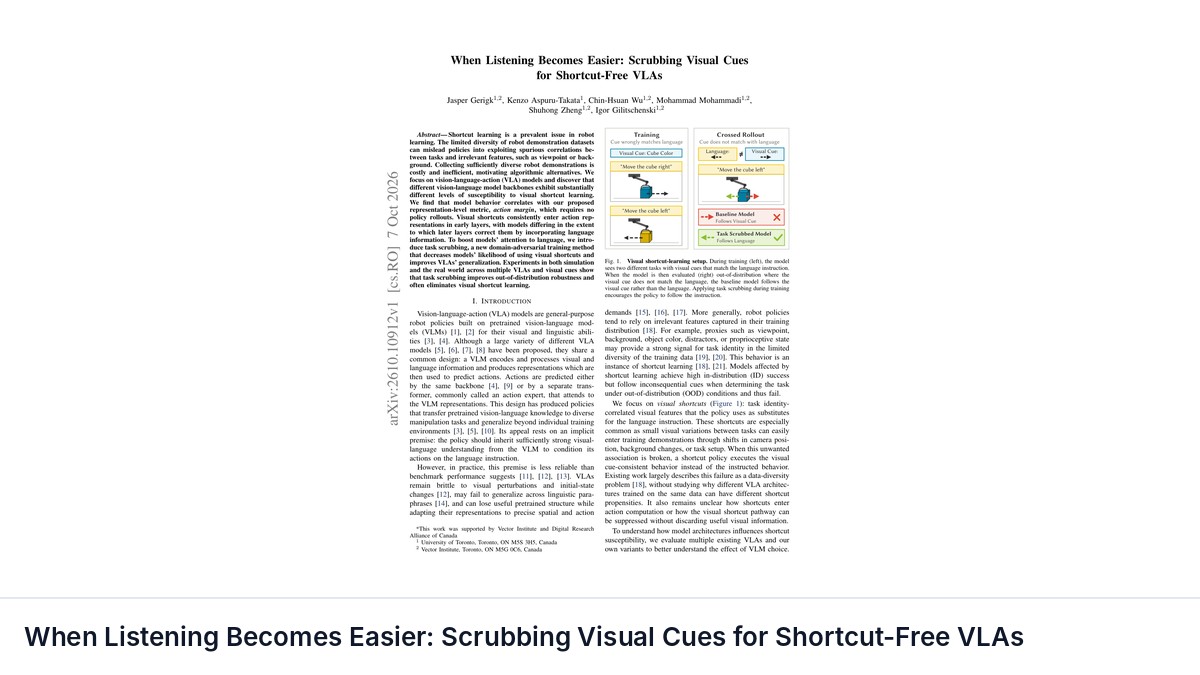
When Listening Becomes Easier: Scrubbing Visual Cues for Shortcut-Free VLAs

Jasper Gerigk, Kenzo Aspuru-Takata, Chin-Hsuan Wu et al.

Shortcut learning is a prevalent issue in robot learning. The limited diversity of robot demonstration datasets can mislead policies into exploiting spurious correlations between tasks and irrelevant features, such as viewpoint or background.

vision vla reinforcement-learning learning-from-demonstration benchmark
PDF Intermediate
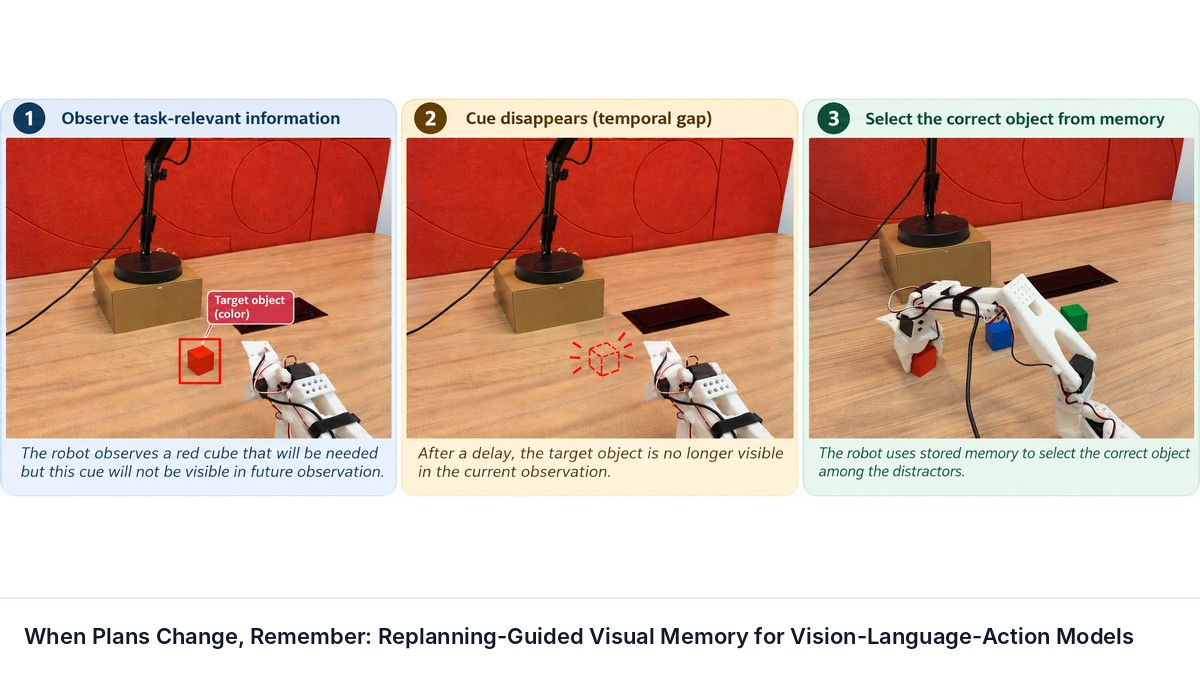
When Plans Change, Remember: Replanning-Guided Visual Memory for Vision-Language-Action Models
arXiv preprint

When Plans Change, Remember: Replanning-Guided Visual Memory for Vision-Language-Action Models

Victoria Smelova, Daniil Kazachkov, Georgiy Kazantsev et al.

Long-horizon, multi-stage Vision-Language-Action (VLA) policies often require visual information that is no longer present in the current observation. Retaining the complete observation history is computationally expensive and highly redundant, motivating selective visual memory.

vision vla reinforcement-learning planning control
PDF Intermediate
GR00T N1: An Open Foundation Model for Generalist Humanoid Robots
arXiv preprint

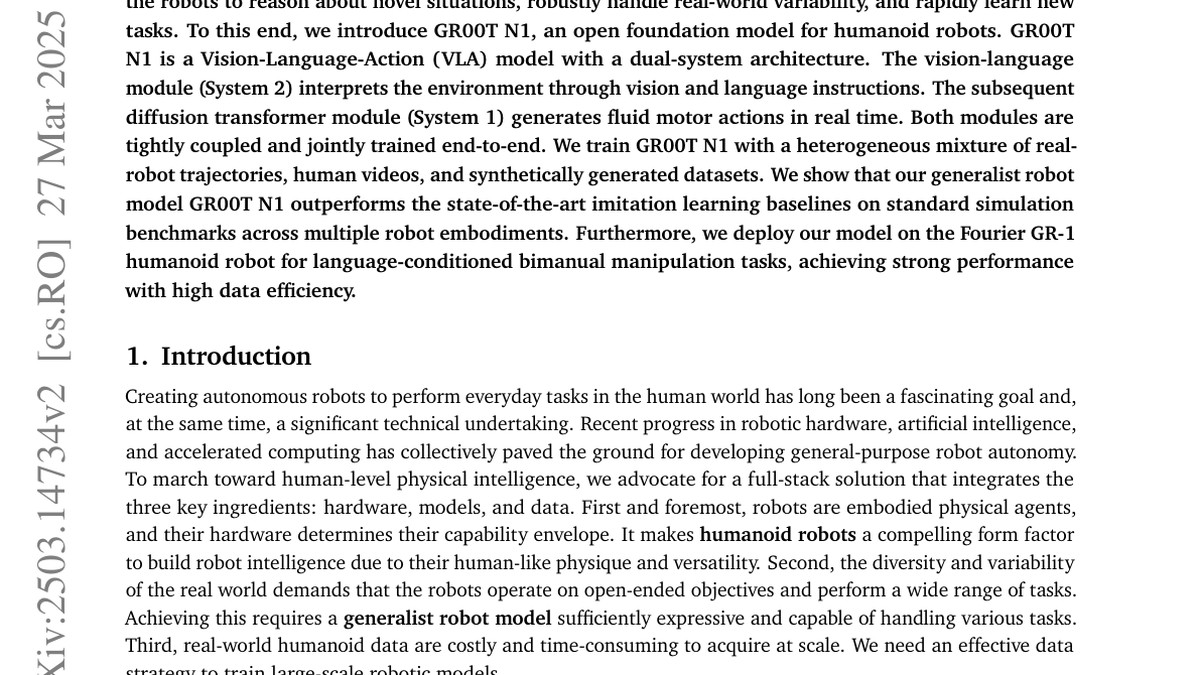
GR00T N1: An Open Foundation Model for Generalist Humanoid Robots

NVIDIA, :, Johan Bjorck et al.

General-purpose robots need a versatile body and an intelligent mind. Recent advancements in humanoid robots have shown great promise as a hardware platform for building generalist autonomy in the human world.

manipulation vision vla reinforcement-learning control learning-from-demonstration benchmark
Code PDF Advanced
GitHub ★ —
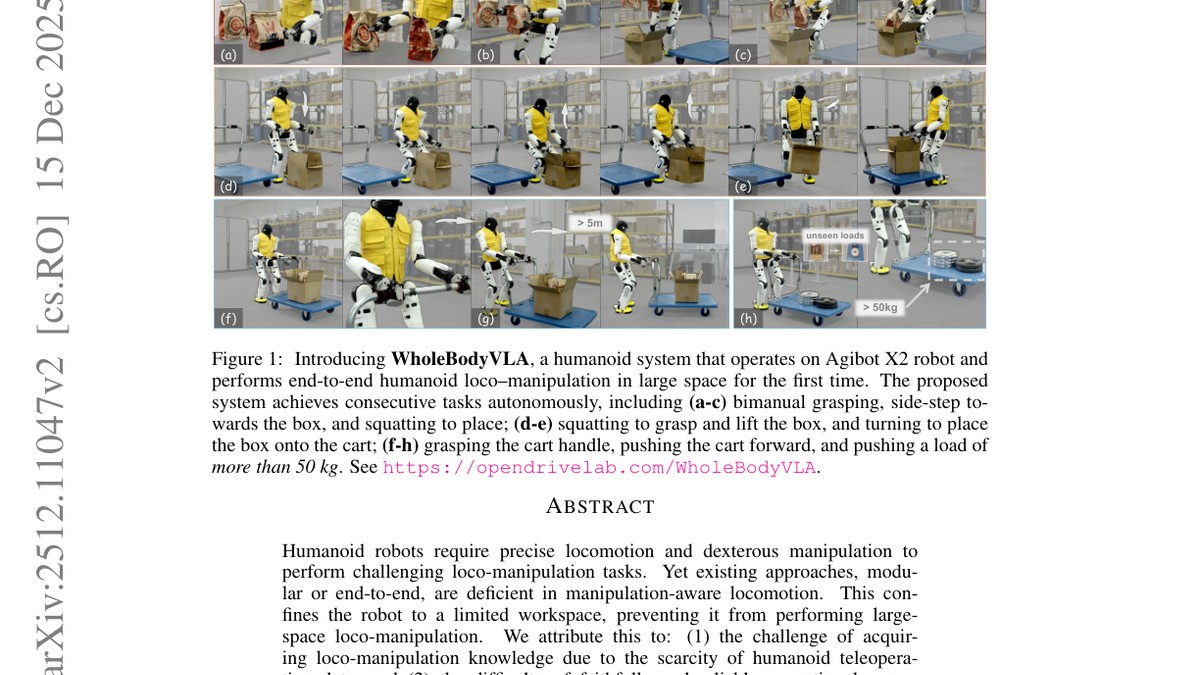
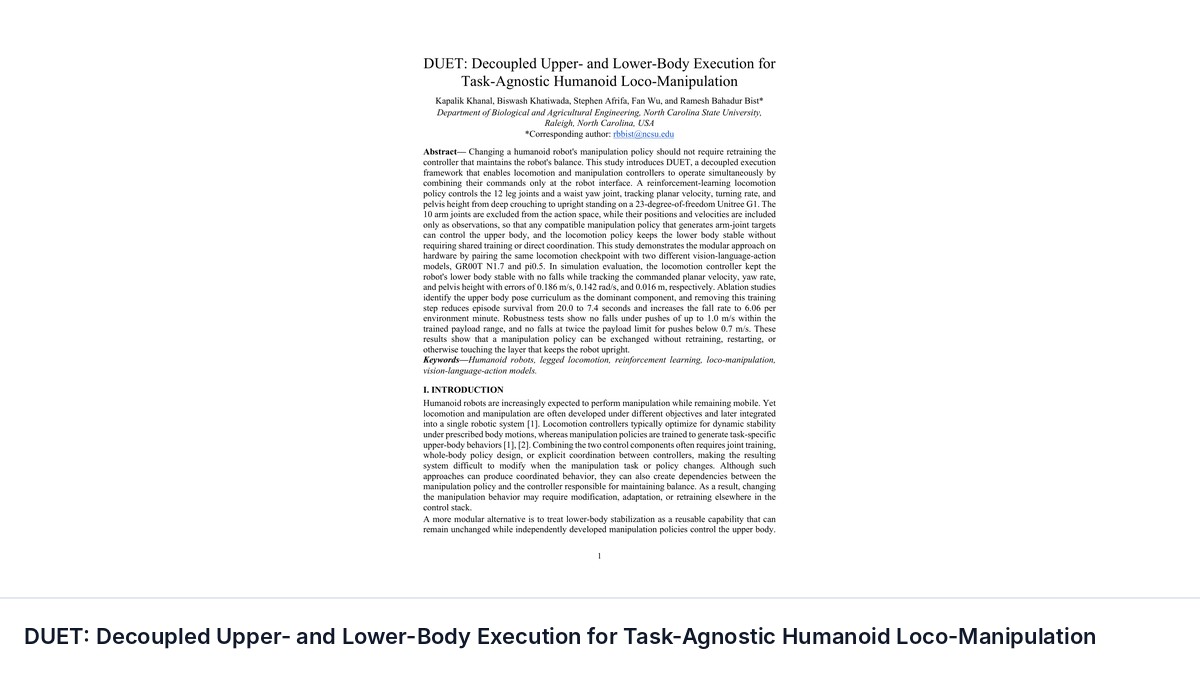
WholeBodyVLA: Towards Unified Latent VLA for Whole-Body Loco-Manipulation Control
arXiv preprint

WholeBodyVLA: Towards Unified Latent VLA for Whole-Body Loco-Manipulation Control

Haoran Jiang, Jin Chen, Qingwen Bu et al.

Humanoid robots require precise locomotion and dexterous manipulation to perform challenging loco-manipulation tasks. Yet existing approaches, modular or end-to-end, are deficient in manipulation-aware locomotion.

manipulation locomotion vision vla reinforcement-learning control learning-from-demonstration benchmark
Code PDF Advanced
GitHub ★ —
π0: A Vision-Language-Action Flow Model for General Robot Control
arXiv preprint

π0: A Vision-Language-Action Flow Model for General Robot Control

Karl Pertsch, Oliver Groth, Jonas Frey et al.

π0 is a 3.5B-parameter VLA flow model from Physical Intelligence that achieves state-of-the-art general robot manipulation by mixing online RL with high-quality human demonstrations, available as an open-source PyTorch implementation.

foundation-models vla manipulation il
Code PDF Advanced
GitHub ★ 11,990 Updated May 2026
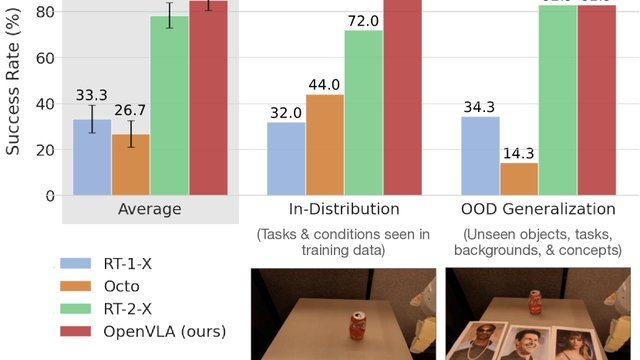
OpenVLA: An Open-Source Vision-Language-Action Model
arXiv

OpenVLA: An Open-Source Vision-Language-Action Model

Moo Jin Kim, Karl Pertsch, Siddharth Karamcheti et al.

A 7B-parameter open-source Vision-Language-Action model pre-trained on 970k real-world robot demonstrations, achieving strong generalization across robots and tasks.
vla llm-robotics foundation-models manipulation
Code PDF Intermediate
GitHub ★ 6,260 Updated May 2026
RT-1: Robotics Transformer for Real-World Control at Scale
RSS 2023

RT-1: Robotics Transformer for Real-World Control at Scale

Anthony Brohan, Yevgen Chebotar, Chelsea Finn et al.

RT-1 is a 35M-parameter transformer trained on 130K robot demonstrations that generalizes to new tasks, objects, and environments, forming the foundation for Google's RT-2 and RT-X line of VLA models.

foundation-models vla il manipulation
Code PDF Intermediate
GitHub ★ 1,723 Updated May 2026
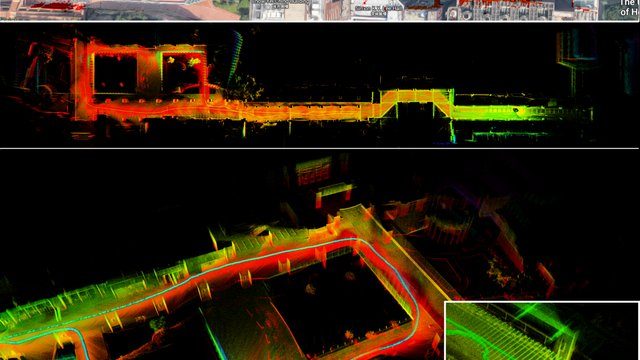
FAST-LIO2: Fast Direct LiDAR-Inertial Odometry
IEEE T-RO

FAST-LIO2: Fast Direct LiDAR-Inertial Odometry

Wei Xu, Yixi Cai, Dongjiao He et al.

A tightly-coupled LiDAR-inertial odometry system with incremental kd-tree mapping, enabling real-time state estimation for UAVs and mobile robots.

uav vla foundation-models
Code PDF Intermediate
GitHub ★ 4,707 Updated May 2026