
World-Calibrated Proposal-to-Action Flow for Vision-Language-Action Models
Jie He, Wei Li, Junwen Tong, Rui Shao, Wei-Shi Zheng, Liqiang Nie · N/A · 2026
Framework
N/A
License
N/A
Stars
N/A
Summary
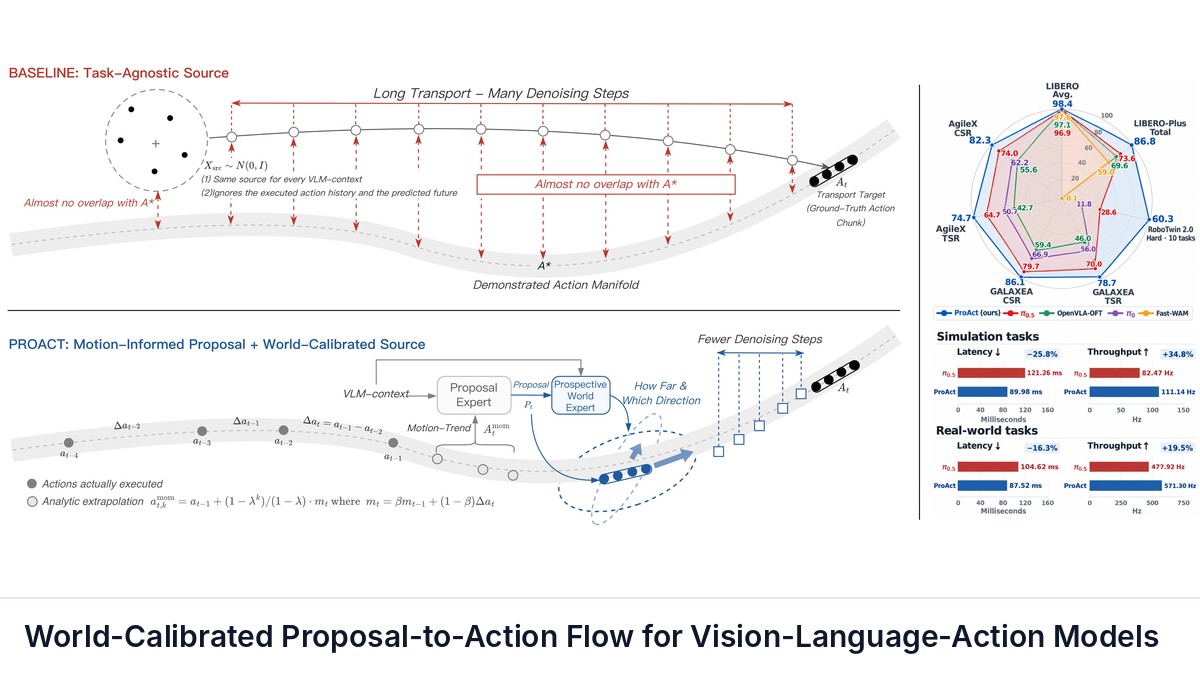
Flow-based Vision-Language-Action (VLA) policies generate action chunks by transporting samples from a task-agnostic isotropic Gaussian source.
Abstract Summary
Key Points
- Flow-based Vision-Language-Action (VLA) policies generate action chunks by transporting samples from a task-agnostic isotropic Gaussian source.
- As this source is conditioned on neither recent execution nor predicted future evolution, (i) it discards the local continuity established by recently executed motion.
- (ii) Even when predictive world representations are introduced, they often only condition the transport dynamics rather than determine where generation starts, how far it may deviate, or along which action directions it may expand.
- Building on this observation, we introduce ProAct, a world-calibrated proposal-to-action framework that makes the generative source itself predictable.
- (i) To preserve motion continuity, a lightweight Proposal Expert converts recent actions into a scene-aware hypothesis via one motion-anchored endpoint flow-matching step, initializing generation near the demonstrated action manifold.
ProAct
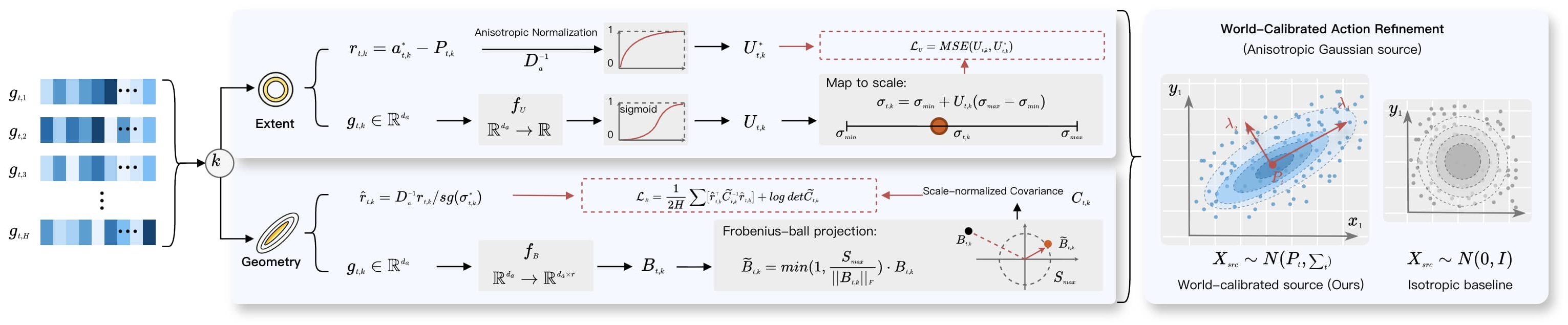
As shown in Fig. 2 , ProAct follows a propose–calibrate–refine pipeline. A Proposal Expert grounds recent motion into a scene-aware hypothesis, a prospective World Expert models latent future and proposal–future compatibility, and an Action Expert transports the calibrated source into executable actions.
This calibration determines where refinement starts, how far it may travel, and along which coupled directions it should proceed at each horizon step.
Experiments
We evaluate ProAct through four questions: (Q1) Does the world-calibrated, proposal-centered source outperform strong VLA baselines? (Q2) Are gains larger when long-horizon or perturbed conditions weaken motion continuity? (Q3) Which propose–calibrate–refine components drive the gains? (Q4) Does calibration improve proposal refinement and generation efficiency?
This section addresses Q1 and Q2 on three complementary benchmarks, testing whether a calibrated source improves strong VLA baselines under saturation, distribution shift, and long-horiz...

AI Use Disclosure
Generative AI tools were used solely to assist with English language polishing and to check formatting and presentation consistency in the manuscript. They were not used to develop research ideas, formulate hypotheses or mathematical claims, design the methodology or experiments, implement the proposed method, or analyze and interpret experimental results.
All AI-assisted edits were reviewed by the authors, who take full responsibility for the final content of the paper. The appendix is organized as follows: Sec. A : Implementation Details.
Sources and Demonstrations
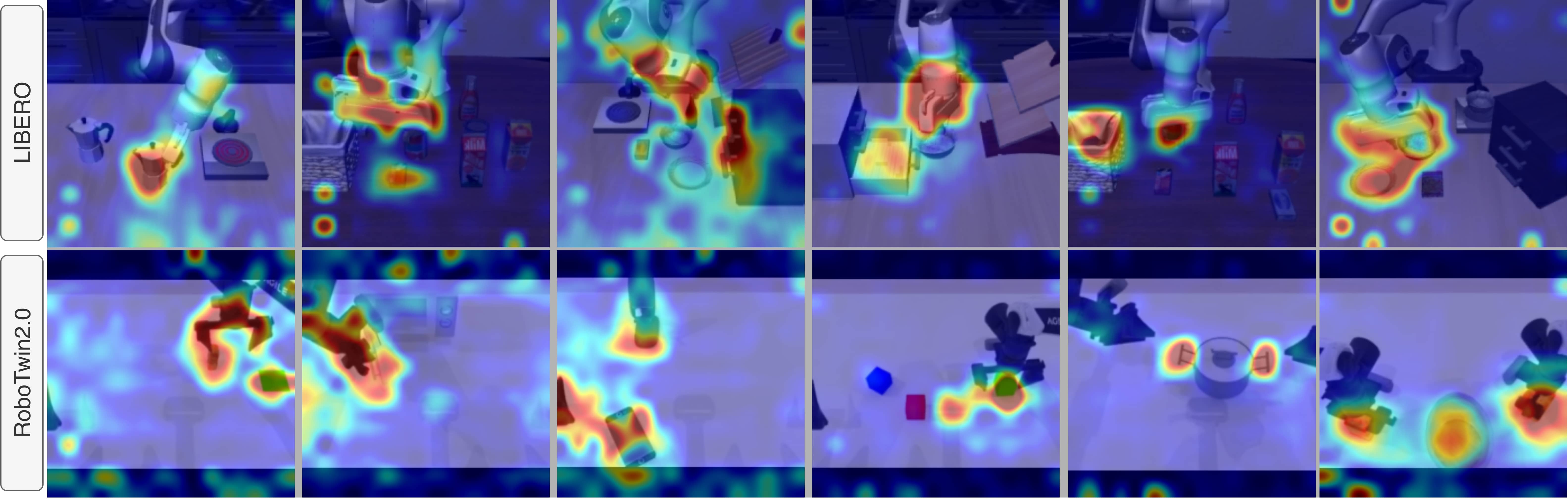
Figures are reproduced from He et al. See the full paper for experimental details and the project page, when the paper links one, for demonstrations and videos.
Related Papers
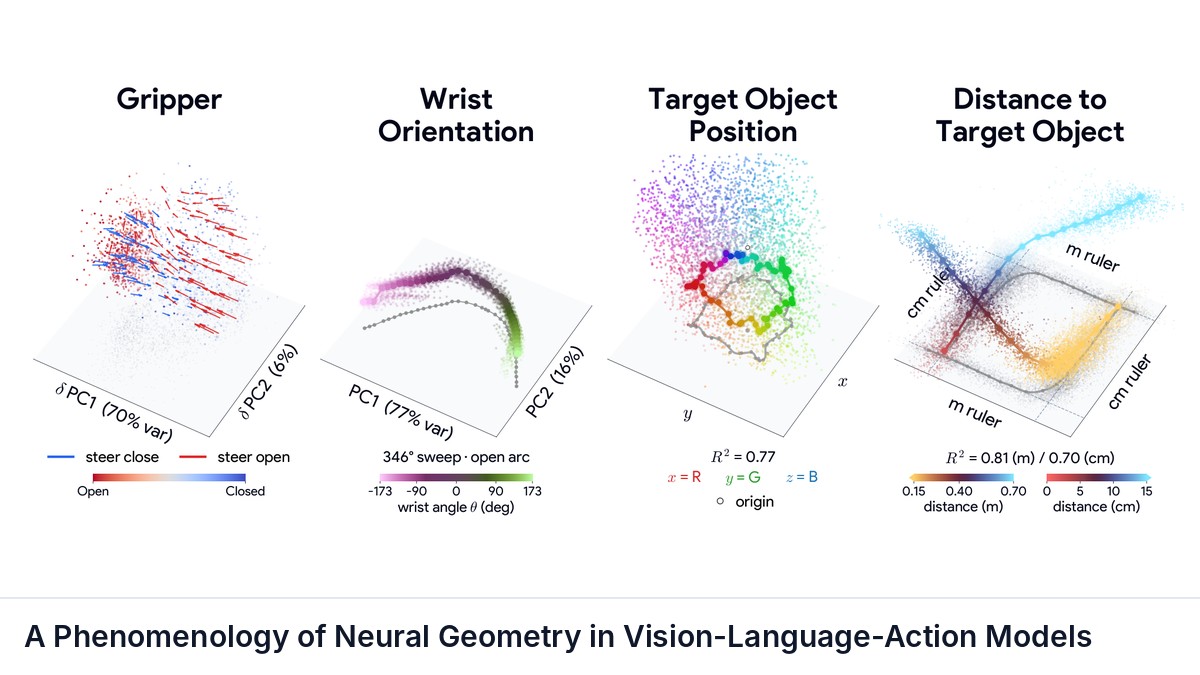
A Phenomenology of Neural Geometry in Vision-Language-Action Models
Mozes Jacobs, Aiden Swann, Mathilde Papillon et al.
Robotic manipulation is inherently geometric, but what shape does the world take inside the policy that performs it?

A Sim-to-Real Integration Pipeline for Training and Deployment of Chunk-Based VLA Manipulation Policies
Mathilde Kappel, Clémence Grislain, Mohamed Chetouani et al.
Vision-Language-Action (VLA) models have become a prominent paradigm for mapping multimodal inputs, including semantic instructions, visual observations of the scene, and proprioceptive observations, to robot actions.
Beyond Reconstruction: What Matters in Action Tokenization for Robot Policies?
Haoran Chen, Jingtian Ji, Samuel Wheeler et al.
Autoregressive action-token policies such as vision-language-action models require action tokenizers to translate discrete token sequences into precise control actions in continuous space. Many action tokenizers learn the mapping between tokens and actions via a reconstruction objective.

Capability-Aware Arbitration for Semantic Intent-Based Shared Control
Zhaoda Du, Michael Bowman, Xiaoli Zhang
Shared control often allocates robot authority based on confidence in inferred human intent, assuming reliable autonomous execution. When this assumption fails, high intent confidence can cause over-helping.