
PACER: Process-Aware VLA Policy Learning from Human Corrections for Robotic Disassembly
Chang Liu, Sibo Tian, Litian Gong, Zhiwen Fan, Jiachen Li, Xiao Liang, Minghui Zheng · N/A · 2026
Framework
N/A
License
N/A
Stars
N/A
Summary
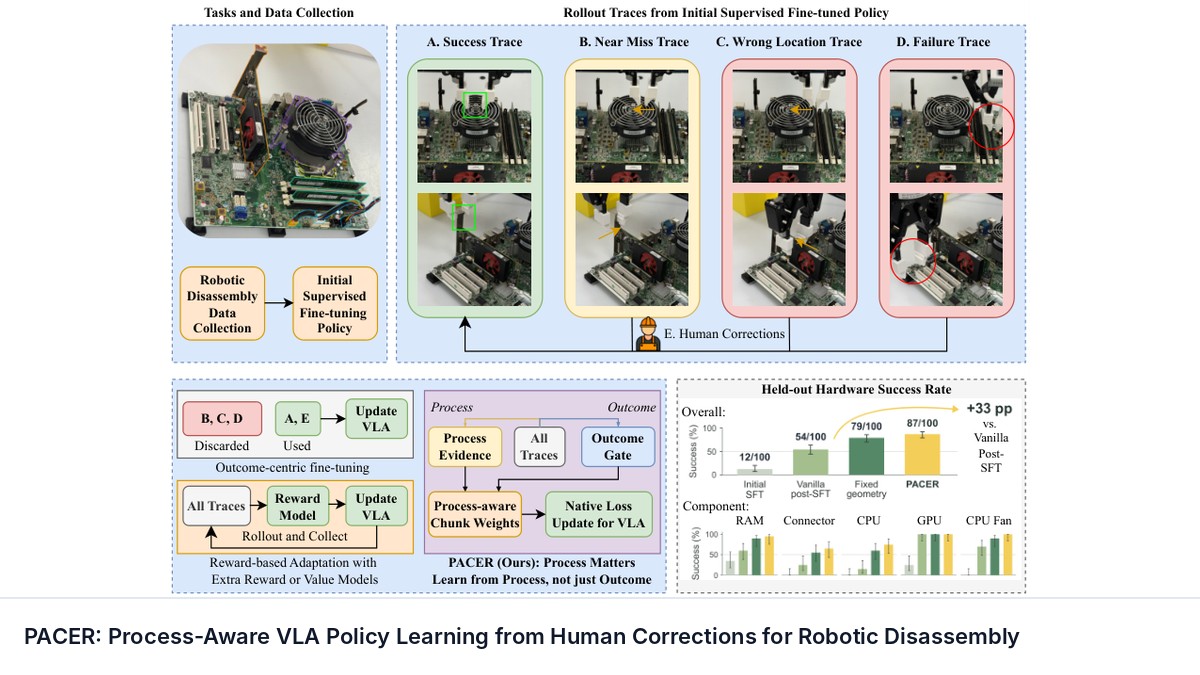
Robotic disassembly of end-of-life (EoL) products requires robots to accommodate product variation, follow prerequisite sequences, and approach components precisely for contact-rich manipulation.
Abstract Summary
Key Points
- Robotic disassembly of end-of-life (EoL) products requires robots to accommodate product variation, follow prerequisite sequences, and approach components precisely for contact-rich manipulation.
- Supervised fine-tuning (SFT) provides a practical path for adaptation, but limited and costly disassembly data cannot capture the distribution shifts arising from changing environments and product uncertainties.
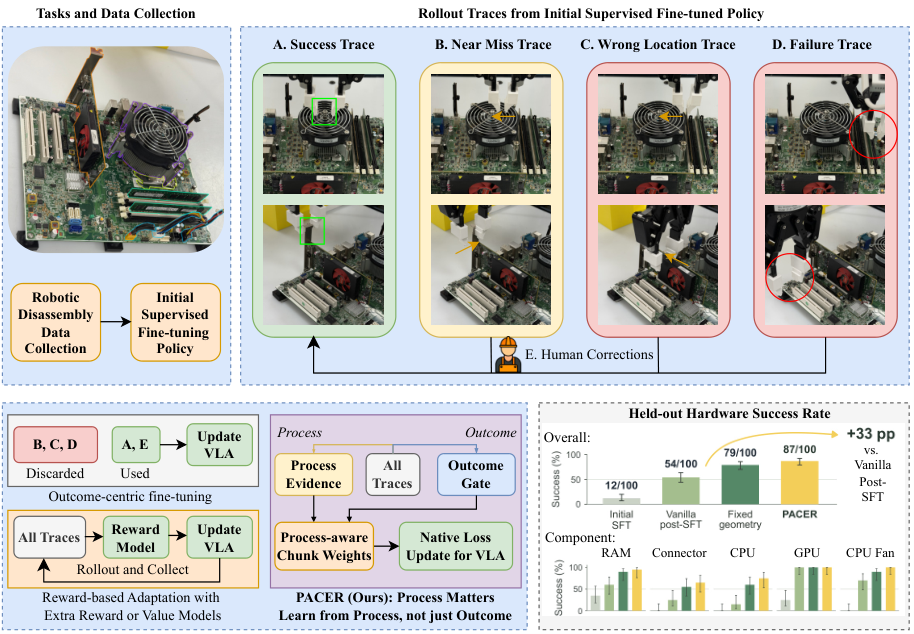
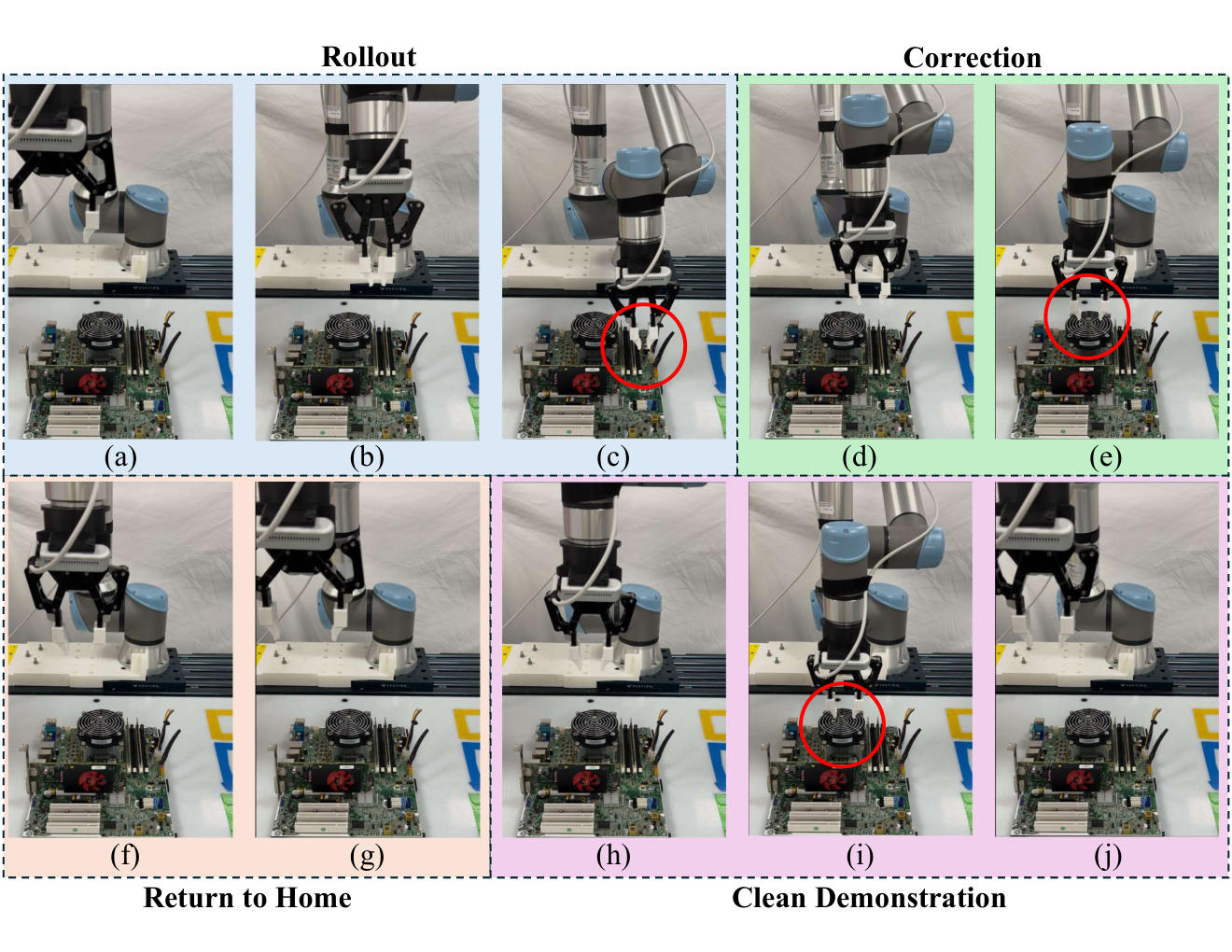
- The policy's own rollouts record its approach attempts, and human corrections demonstrate recovery from its errors, but turning these experiences into better policy performance remains challenging.
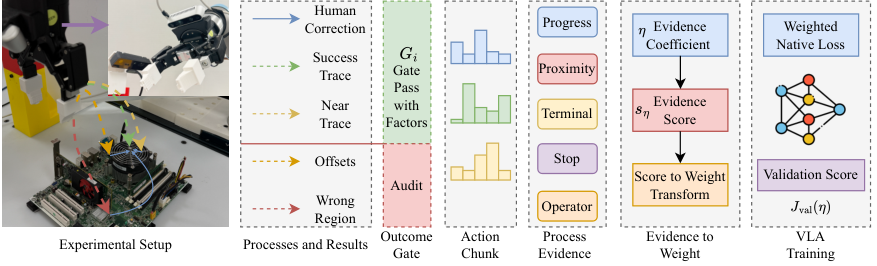
- We introduce PACER, a Process-Aware Correction and Evidence Reweighting framework that learns from these experiences through SFT, using progress toward the target and each trace's source and outcome to weight valid action chunks in the native supervised action loss.
- PACER trains one policy per weighting setting and selects one of the resulting policies through held-out validation.
PACER
We introduce PACER, a process-aware correction and evidence-reweighting framework for VLA post-training from heterogeneous disassembly traces, as shown in Figure 2 . PACER operates on the data side and preserves the action representation, the VLA backbone architecture, and the native per-sample action prediction objective, modifying only the sample-level contribution of each training row to that objective.
Experiments
Setup. We evaluate PACER on a UR5e motherboard-disassembly platform across five components: CPU, GPU, CPU fan, RAM, and the connector block. The supervised reference policy $\pi_{\theta_{0}}$ is obtained by supervised fine-tuning of $\pi_{0.5}$-DROID on an initial set $\mathcal{D}_{\mathrm{demo}}$ of 710 teleoperated trajectories.
RAM and connector-block demonstrations are split across multiple hardware configurations, yielding lower per-configuration coverage than the three single-configuration components.
Ablation Study
To validate the effectiveness of PACER, we assess the importance of supplementary clean demonstrations, human corrections, and autonomous rollouts for PACER post-training by removing each source in turn. We also compare selected PACER with four fixed weighting alternatives, as shown in Table 2 . Each of the eight policies in this comparison is trained from $\pi_{\theta_{0}}$ with the same nominal training budget.
Sources and Demonstrations
Figures are reproduced from Liu et al. See the full paper for experimental details and the project page, when the paper links one, for demonstrations and videos.
Related Papers

A Sim-to-Real Integration Pipeline for Training and Deployment of Chunk-Based VLA Manipulation Policies
Mathilde Kappel, Clémence Grislain, Mohamed Chetouani et al.
Vision-Language-Action (VLA) models have become a prominent paradigm for mapping multimodal inputs, including semantic instructions, visual observations of the scene, and proprioceptive observations, to robot actions.
Beyond Reconstruction: What Matters in Action Tokenization for Robot Policies?
Haoran Chen, Jingtian Ji, Samuel Wheeler et al.
Autoregressive action-token policies such as vision-language-action models require action tokenizers to translate discrete token sequences into precise control actions in continuous space. Many action tokenizers learn the mapping between tokens and actions via a reconstruction objective.
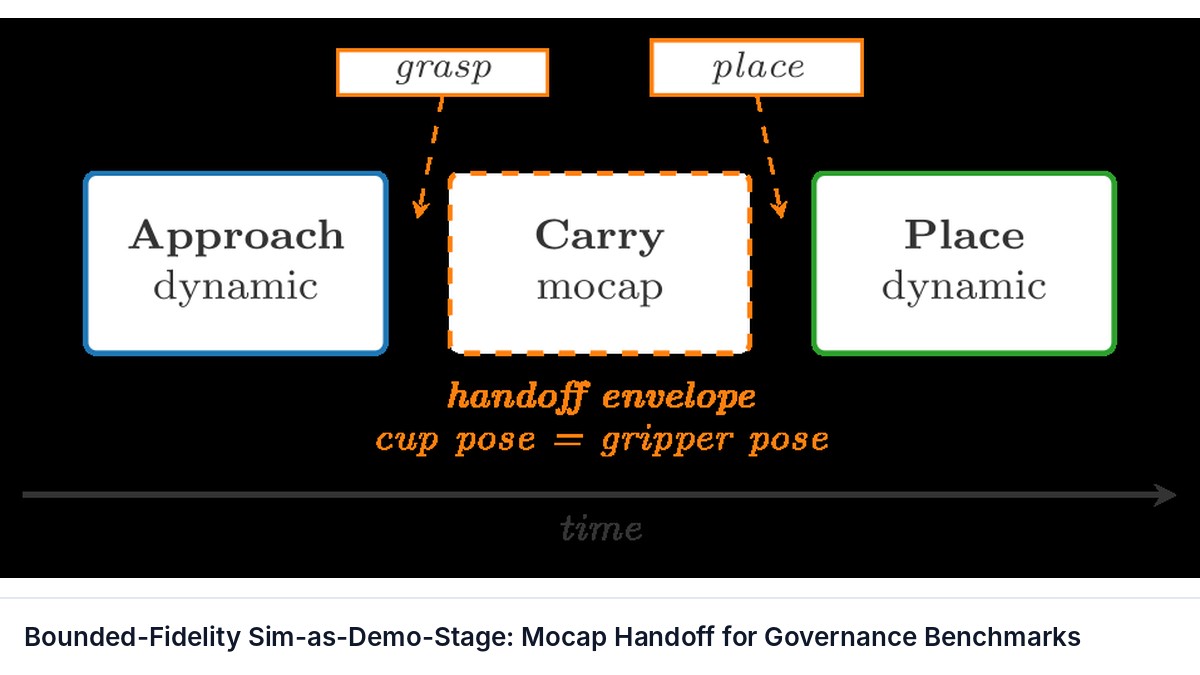
Bounded-Fidelity Sim-as-Demo-Stage: Mocap Handoff for Governance Benchmarks
Xue Qin, Simin Luan, Cong Yang et al.
Sim-to-real research pursues physics fidelity as a primary objective: simulators are judged by how closely they reproduce real-world contact dynamics.

Capability-Aware Arbitration for Semantic Intent-Based Shared Control
Zhaoda Du, Michael Bowman, Xiaoli Zhang
Shared control often allocates robot authority based on confidence in inferred human intent, assuming reliable autonomous execution. When this assumption fails, high intent confidence can cause over-helping.