
Bounded-Fidelity Sim-as-Demo-Stage: Mocap Handoff for Governance Benchmarks
Xue Qin, Simin Luan, Cong Yang, Zhijun Li · N/A · 2026
Framework
N/A
License
N/A
Stars
N/A
Summary
Sim-to-real research pursues physics fidelity as a primary objective: simulators are judged by how closely they reproduce real-world contact dynamics.
Abstract Summary
Key Points
- Sim-to-real research pursues physics fidelity as a primary objective: simulators are judged by how closely they reproduce real-world contact dynamics.
- For governance benchmarking of LLM-driven robots, where the simulator demonstrates that an admission/policy/contract/audit pipeline behaves correctly, contact fidelity at object handoffs (grasp, carry, place) becomes a liability: contact-force integration noise injects audit-chain divergence that is structurally unrelated to the governance property under test.
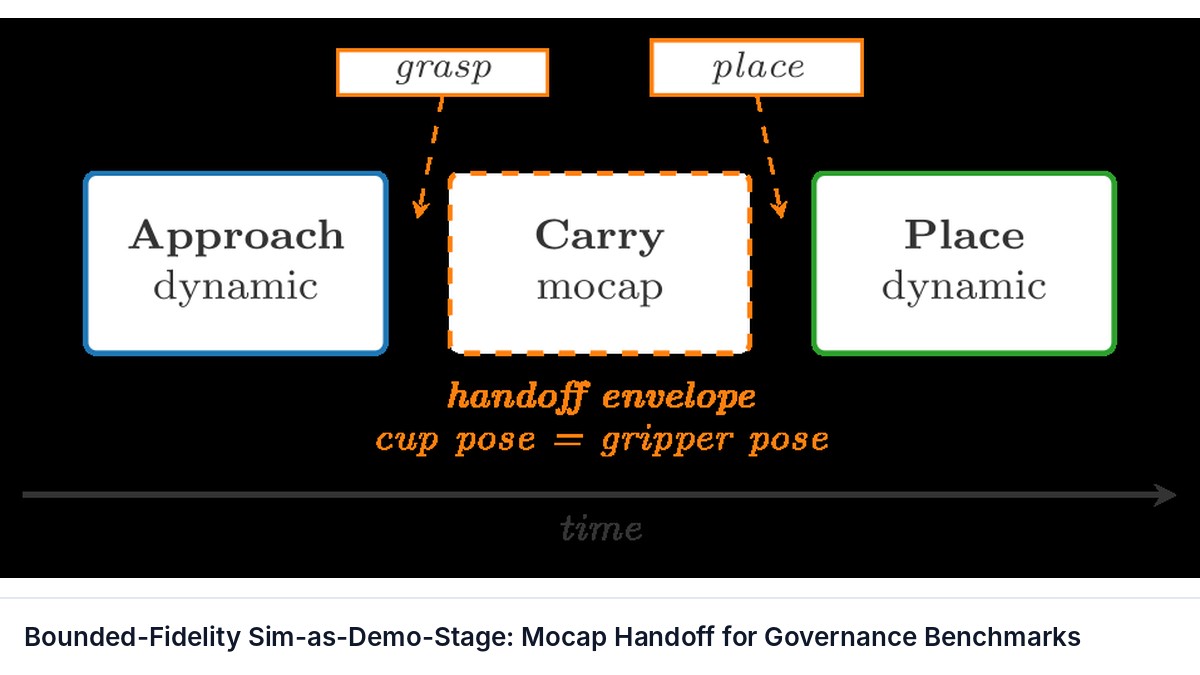
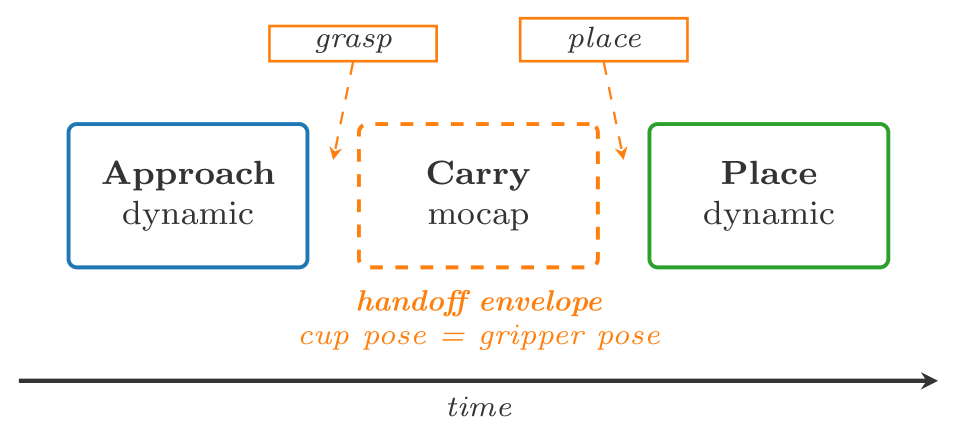
- We propose bounded-fidelity sim-as-demo-stage, a design pattern that suppresses contact physics within explicitly bracketed handoff envelopes while preserving full dynamics elsewhere.
- The construction uses MuJoCo's mocap-body primitive driven by a 220-line Python adapter that the governance bridge invokes via structured intents.
- We formalise audit-chain stability as byte-equality of the hashed event log across replays and identify two structural envelope properties that imply it.
The Bounded-Fidelity Pattern
MuJoCo’s mocap body is a body whose pose is driven externally via data.mocap_pos and data.mocap_quat , rather than by the contact-force integrator. Within a single simulation step, the mocap body is treated as a kinematic constraint: it does not respond to applied forces, and any contact with non-mocap geoms is resolved as if the mocap body’s pose were authoritative.
Experiments
The construction is implemented as a ${\sim}220$-LOC MocapAdapter module in the AEROS runtime, shipped as src/mocap_adapter.py in the artifact repository. The reference environment is Python $3.11.7$ with MuJoCo $3.1.4$ and mujoco $3.1.4$ Python bindings on macOS $14.5$; Section 4.7 reports a byte-equal reproduction on an independent Ubuntu host.
All replays in Section 4.3 –§ 4.6 use the fixed seed 12345 (the default for both reference harnesses, harness/envelope_precision.py and harness/multi_object.py ; override via --seed ).
Sources and Demonstrations
Figures are reproduced from Qin et al. See the full paper for experimental details and the project page, when the paper links one, for demonstrations and videos.
Related Papers

A Sim-to-Real Integration Pipeline for Training and Deployment of Chunk-Based VLA Manipulation Policies
Mathilde Kappel, Clémence Grislain, Mohamed Chetouani et al.
Vision-Language-Action (VLA) models have become a prominent paradigm for mapping multimodal inputs, including semantic instructions, visual observations of the scene, and proprioceptive observations, to robot actions.
SkillWeaver: Agentic Exploration over Neural Interaction Skills for Scalable Robot Data Generation
He Zhu, Lusen Zhao, Kwan Man Cheng et al.
Large-scale demonstrations have driven unprecedented progress in robot learning, yet collecting robot data through teleoperation is expensive and difficult to scale to diverse environments and long-horizon tasks.
3DThinkVLA: Endowing Vision-Language-Action Models with Latent 3D Priors via 3D-Thinking-Guided Co-training
Jiaxin Shi, Xidong Zhang, Fucai Zhu et al.
We propose a 3D-thinking-guided co-training framework that enables vision-language-action (VLA) models to perform 3D spatial reasoning implicitly during action prediction.
Beyond Reconstruction: What Matters in Action Tokenization for Robot Policies?
Haoran Chen, Jingtian Ji, Samuel Wheeler et al.
Autoregressive action-token policies such as vision-language-action models require action tokenizers to translate discrete token sequences into precise control actions in continuous space. Many action tokenizers learn the mapping between tokens and actions via a reconstruction objective.