
Embodiment-Classifier Guidance: Transferring Frozen VLAs Across Robot Dynamics without Demonstrations
Devin Han, Hershraj Niranjani · N/A · 2026
Framework
N/A
License
N/A
Stars
N/A
Summary
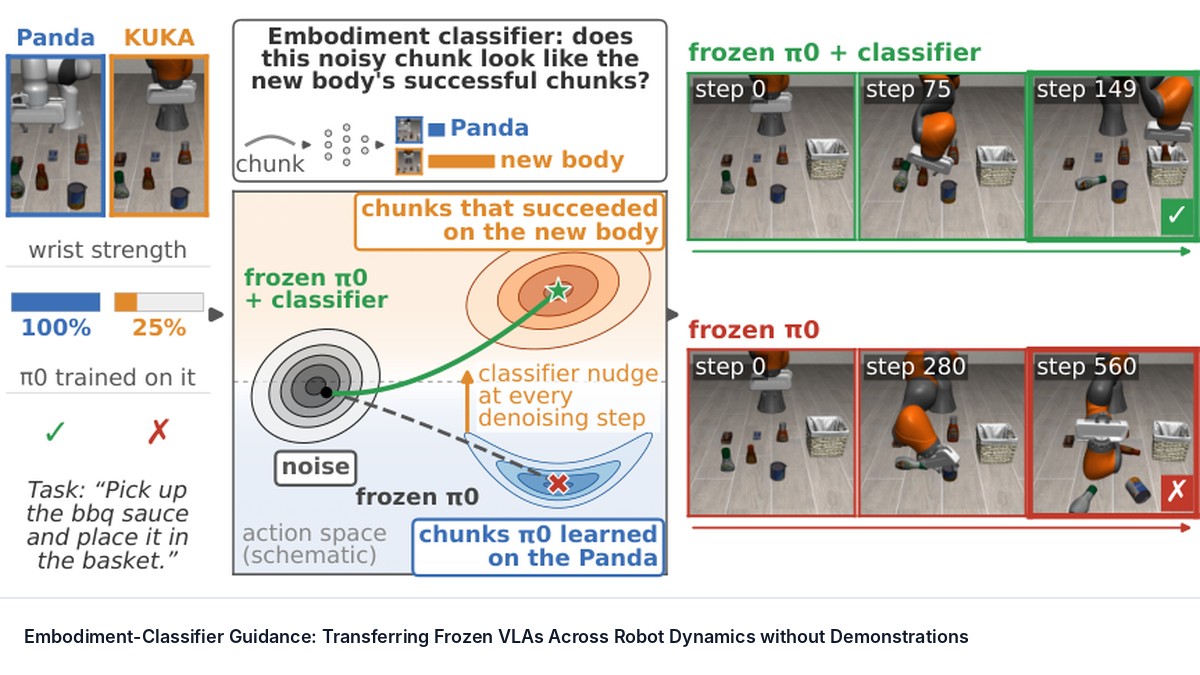
Flow-based policies such as $\pi_0$ are trained on a fixed set of embodiments, and transferring them to new ones is an open problem.
Abstract Summary
Key Points
- Flow-based policies such as $\pi_0$ are trained on a fixed set of embodiments, and transferring them to new ones is an open problem.
- To adapt a frozen $\pi_0$ to a new embodiment without additional demonstrations or parameter updates, we train a lightweight embodiment classifier to distinguish successful action chunks on the source body from those on the target body, using a few calibration tasks.
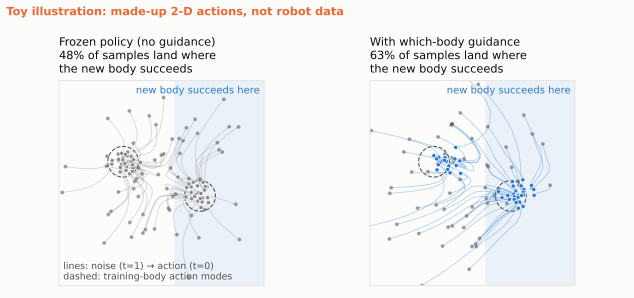
- On transfer tasks that $\pi_0$ saw on its source body but the classifier was never trained on, we nudge each denoising step of $\pi_0$ with the classifier's gradient, which estimates the direction from the distribution of successful actions on the source body toward that on the target body.
- On the LIBERO simulation benchmark with four modified controllers, embodiment-classifier guidance raises $\pi_0$'s average success on the target bodies from 72% to 80% across 12 suite-controller pairs, with a 31% relative reduction in failures (11 of 12 gain; 5 significant after Holm correction).
- In simulation, guidance is data-efficient, needing few target-body rollouts per task, which makes it promising for sim-to-real transfer, where rollouts are costly.
Embodiment-Classifier Guidance
Setting. $\pi_{0}$ maps an observation $o$ (two camera images, robot state, instruction) to an action chunk $a\in\mathbb{R}^{50\times 7}$.
It is a flow-matching model [ 17 ] : with the noised chunk $x_{t}=t\,\varepsilon+(1-t)\,a$ and flow time $t\in[0,1]$, a network $v(x_{t},t,o)$ predicts the velocity $\varepsilon-a$, and sampling takes 10 Euler steps from $x_{1}=\varepsilon$, after which the robot executes 5 actions and $\pi_{0}$ plans again.
Experimental Setup
Policy and tasks. We use the frozen public $\pi_{0}$ LIBERO checkpoint [ 2 ] in LIBERO [ 18 ] (robosuite [ 28 ] ), a simulated benchmark of tabletop manipulation tasks in four suites that vary the objects (Object), spatial layouts (Spatial) and goals (Goal), plus long-horizon tasks (LIBERO-10). Each suite has four calibration and four transfer tasks (App. A ), all of which $\pi_{0}$ saw on its source body.
Results
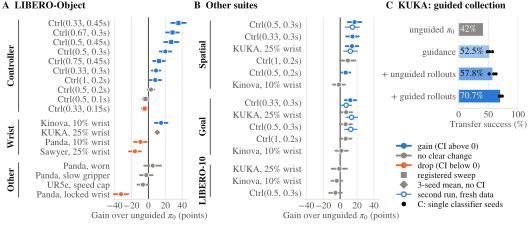
Across the four suites, guidance improves 11 of the 12 suite–body pairs with a changed controller, 7 with a CI above zero (Fig. 2 A, B); 5 remain significant after a Holm correction over the 12 pairs. Pooled over the 12 pairs, success rises from 72% to 80% (1,718 to 1,931 of 2,400 episodes), a 31% relative reduction in failures.
On LIBERO-Object, Ctrl(0.5, 0.3 s) rises from 73% to 93% (+20 points [+13.5, +27]); two more classifier seeds give 93.5% and 91%. The exception is LIBERO-10, where Ctrl(0.5, 0.3 s) drops by 5.5 points [$-13$, +2].
Sources and Demonstrations
Figures are reproduced from Han et al. See the full paper for experimental details and the project page, when the paper links one, for demonstrations and videos.
Related Papers

A Sim-to-Real Integration Pipeline for Training and Deployment of Chunk-Based VLA Manipulation Policies
Mathilde Kappel, Clémence Grislain, Mohamed Chetouani et al.
Vision-Language-Action (VLA) models have become a prominent paradigm for mapping multimodal inputs, including semantic instructions, visual observations of the scene, and proprioceptive observations, to robot actions.
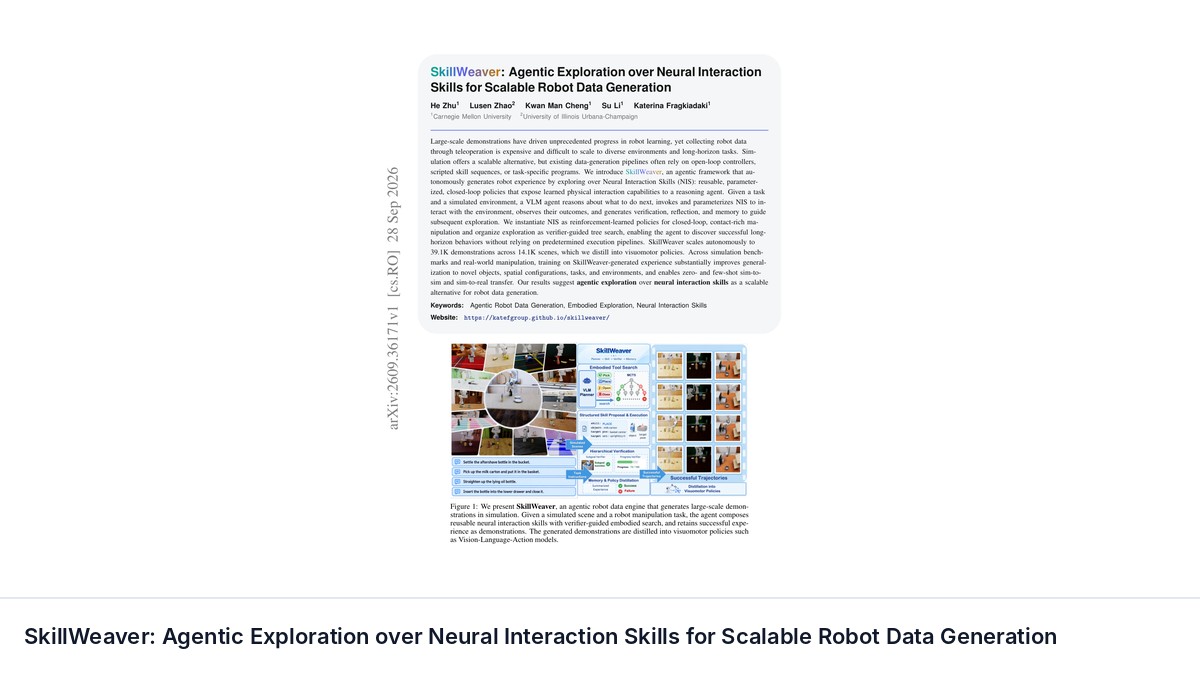
SkillWeaver: Agentic Exploration over Neural Interaction Skills for Scalable Robot Data Generation
He Zhu, Lusen Zhao, Kwan Man Cheng et al.
Large-scale demonstrations have driven unprecedented progress in robot learning, yet collecting robot data through teleoperation is expensive and difficult to scale to diverse environments and long-horizon tasks.

Capability-Aware Arbitration for Semantic Intent-Based Shared Control
Zhaoda Du, Michael Bowman, Xiaoli Zhang
Shared control often allocates robot authority based on confidence in inferred human intent, assuming reliable autonomous execution. When this assumption fails, high intent confidence can cause over-helping.
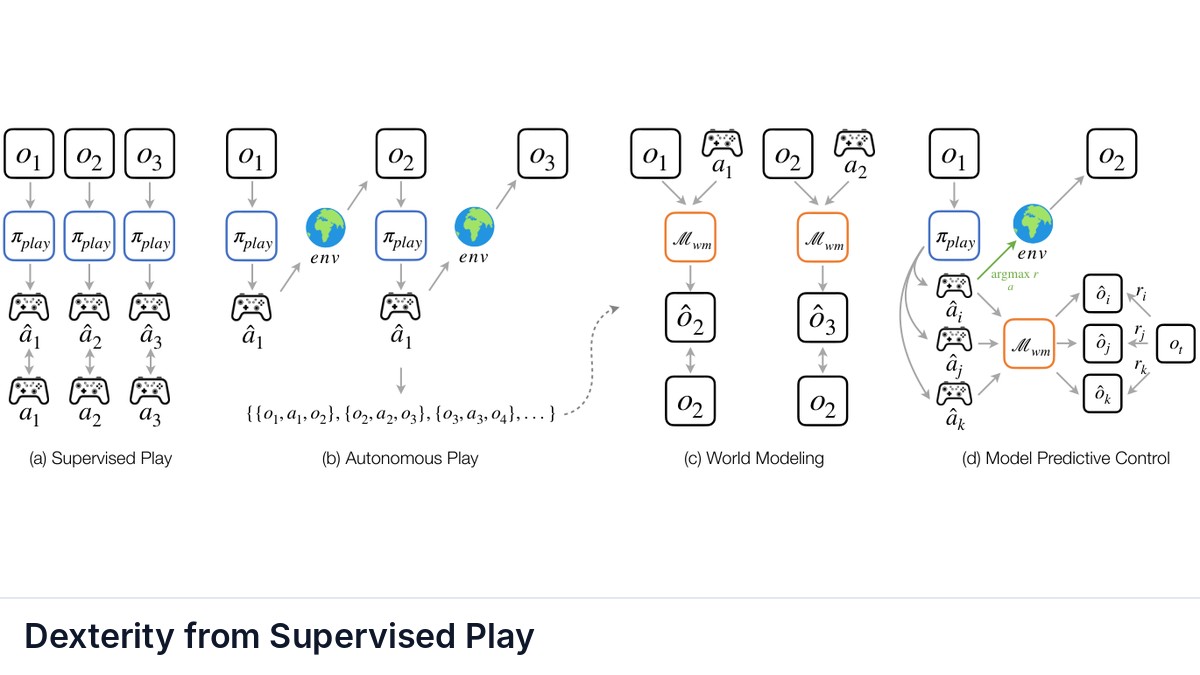
Dexterity from Supervised Play
Botao He, Yiming Dou, Yiannis Aloimonos et al.
How can robots autonomously collect the contact-rich experience needed to learn dexterous manipulation?