
Dexterity from Supervised Play
Botao He, Yiming Dou, Yiannis Aloimonos, Jitendra Malik, Akash Sharma, Ruoshi Liu · N/A · 2026
Framework
N/A
License
N/A
Stars
N/A
Summary
How can robots autonomously collect the contact-rich experience needed to learn dexterous manipulation?
Abstract Summary
Key Points
- How can robots autonomously collect the contact-rich experience needed to learn dexterous manipulation?
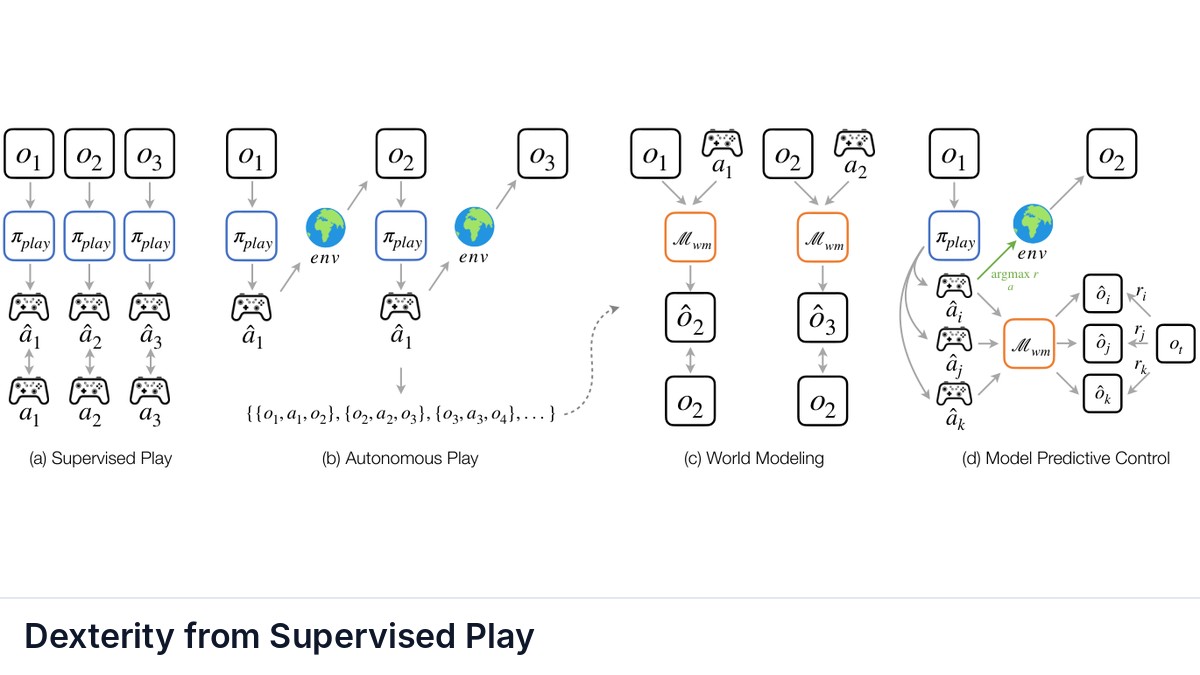
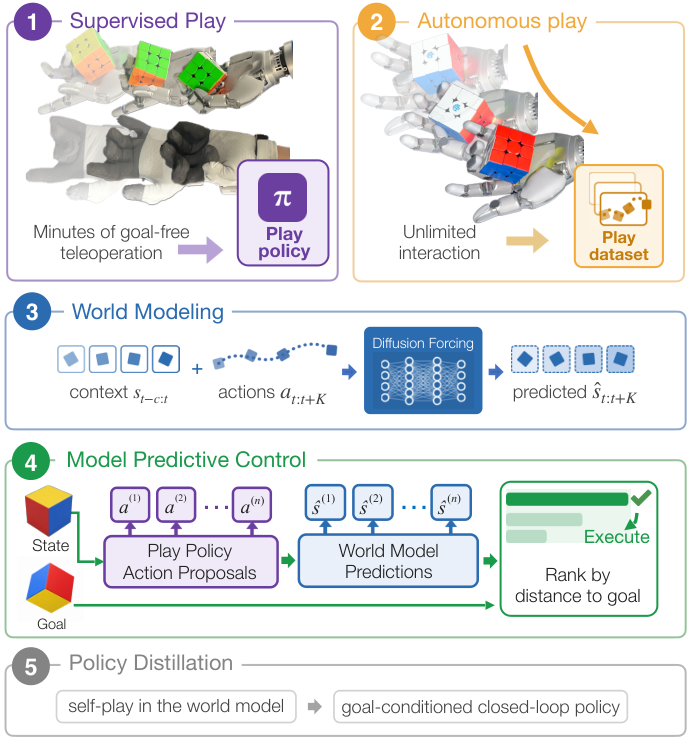
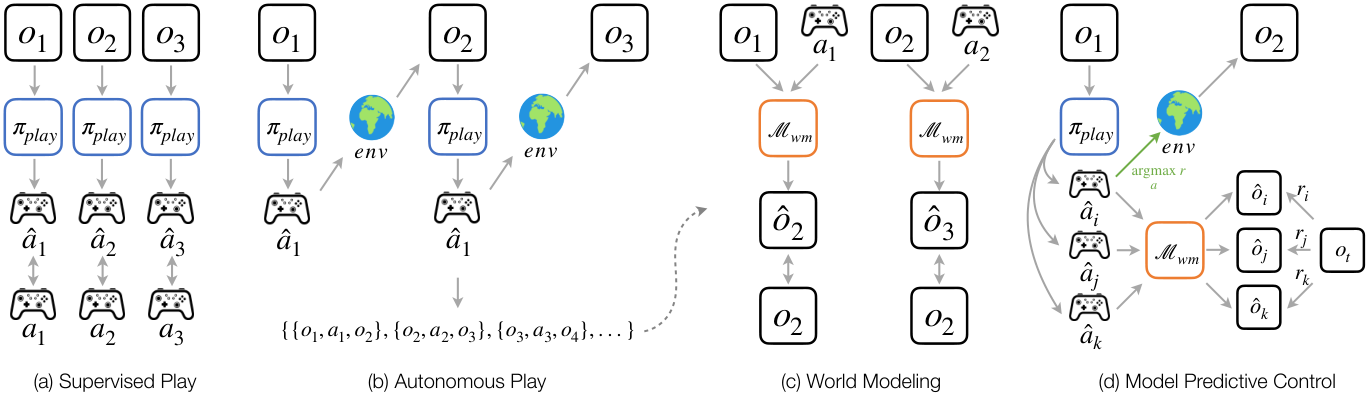
- We present DSP: Dexterity from supervised play, a framework in which a robot learns a play policy from minutes of human play through behavior cloning, then deploys it autonomously to collect hours of interaction data to train a world model.
- During inference, the same play policy then guides model-predictive control (MPC) by proposing candidate action sequences for evaluation under the learned world model.
- To accelerate inference, we also introduce a method for distilling a closed-loop, goal-conditioned policy through self-play within the learned world model.
- We evaluate this framework on underactuated pushing and any-to-any in-hand pose reorientation with a multifingered hand, in simulation and real world.
Method
Given a dexterous manipulation task, our pipeline \dspfont DSP achieves it in 4 stages described in Fig. 2 . We first collect data through teleoperation to train a play policy (see Sec. III-B ). We then rollout this policy on the robot autonomously to collect a play dataset that contains observation–action transitions (see Sec. III-C ).
This play dataset is used to train an action-conditioned world model to model the dynamics of the interaction (see Sec. III-D ).
Experiments
Our experiments evaluate whether \dspfont DSP can turn goal-free play into goal-directed manipulation across tasks and on real hardware, whether play-guided MPC is more interaction-efficient than direct policy learning and task-specific RL, and how play-policy design, autonomous-play scale, and world-model design affect prediction and control. We organize the evaluation around three tasks.
Task A: Push-T tests state-based planar pushing to target poses under a fixed tight 10k-frame teleoperation budget, measuring success and best mask overlap.
Sources and Demonstrations
Figures are reproduced from He et al. See the full paper for experimental details and the project page, when the paper links one, for demonstrations and videos.
Related Papers

A Sim-to-Real Integration Pipeline for Training and Deployment of Chunk-Based VLA Manipulation Policies
Mathilde Kappel, Clémence Grislain, Mohamed Chetouani et al.
Vision-Language-Action (VLA) models have become a prominent paradigm for mapping multimodal inputs, including semantic instructions, visual observations of the scene, and proprioceptive observations, to robot actions.
Collective Learning for Unified Robotic Manipulation via Predictive Dynamics Adaptation
Shaocheng Liu, Yuan Meng, Zhenshan Bing et al.
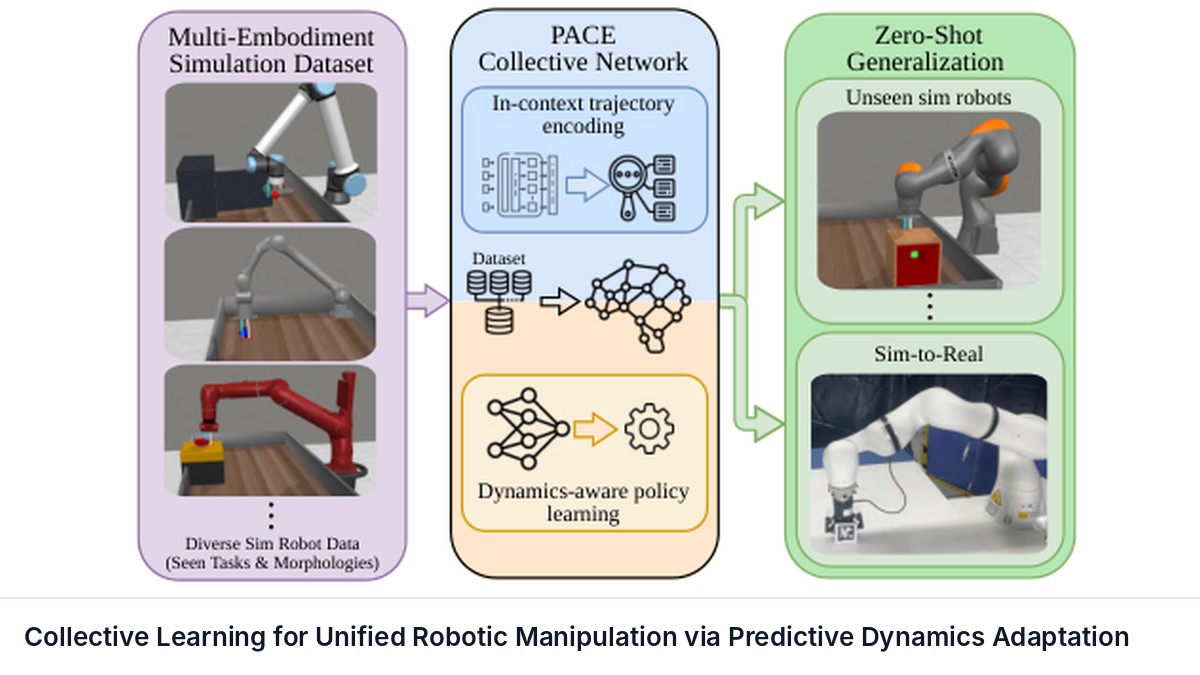
Learning a collective policy for state-based Cartesian manipulation across diverse robotic embodiments presents a fundamental challenge due to embodiment-dependent transition dynamics.
Has GPT-6-Astra Achieved Embodied Intelligence?
SenseNova, Joint Research Team, : et al.
GPT-6-Astra demonstrates a level of competence in robotic manipulation and navigation that challenges the conventional paradigm of building specialized models for individual tasks and embodiments.
In-Context Learning for Robots: Methods and Applications
Haojian Huang, Zexi Li, Junhao Guo et al.
General-purpose robots must infer what a new task requires and translate that understanding into appropriate physical action.