
In-Context Learning for Robots: Methods and Applications
Haojian Huang, Zexi Li, Junhao Guo, Yehang Zhang, Wenxuan Peng, Bohan Zhou, Weilin Ruan, Leyi Wu, Chenxu Wang, Jianchong Su, Binghui Xie, Wosong Chen, Yingjie Xu, Tianhao Zhou, Suzeyu Chen, Pukun Zhao, Jiaqi He, Xinyi Li, Runze Li, Peiran Dong, Shaoxiang Dang, Jing Huang, Yingbing Chen, Yifan Chang, Tianyi Zhang, Shiyuan Deng, Haozhi Wang, Yangkai Wei, Wenqian Li, Han Yang, Kaiwen Zhou, Huaping Liu, James Cheng, Rui Shao, Donglin Wang, Yaochu Jin, Jianye Hao, Ying-Cong Chen, Yinchuan Li · N/A · 2026
Framework
N/A
License
N/A
Stars
N/A
Summary
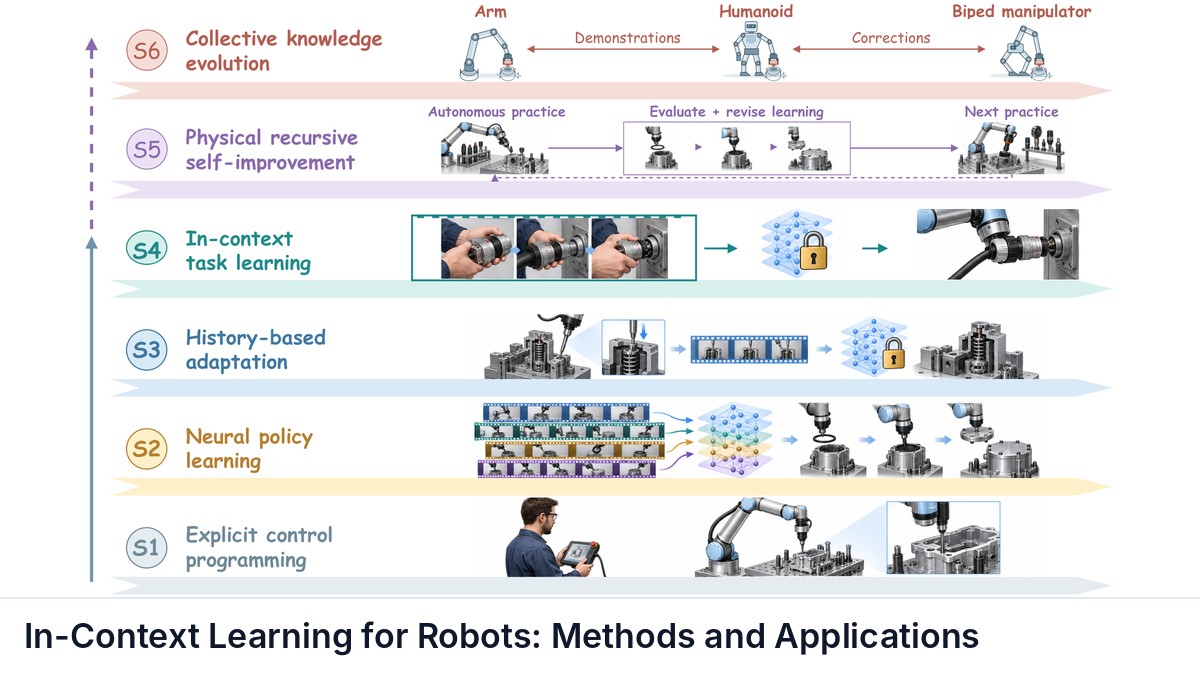
General-purpose robots must infer what a new task requires and translate that understanding into appropriate physical action.
Abstract Summary
Key Points
- General-purpose robots must infer what a new task requires and translate that understanding into appropriate physical action.
- In-context learning (ICL) for robots supports this process by using demonstrations and interaction to direct existing competence with neural parameters held fixed during deployment.
- We organize this literature review around the interfaces connecting contextual evidence to execution, distinguishing four families: context-conditioned policies, geometric demonstration transfer, world-model-based control, and skill- and agent-based execution.
- Comparing these interfaces clarifies their transfer assumptions and the roles of training, correspondence, and memory in making context useful.
- Across manipulation and navigation, we examine how these mechanisms preserve taught requirements as objects, environments, and execution conditions change.
Foundations: Why Do Robots Need Context?
A packing robot may already grasp every part yet need a demonstration to establish their order, history to identify completed placements, and contact evidence to accommodate a tighter fit. The same visible scene can therefore require different actions. Useful context resolves this decision-relevant ambiguity through actions the robot can already execute.
This distinction motivates the learning horizons, adaptation regimes, and four control interfaces below.
Sources and Demonstrations
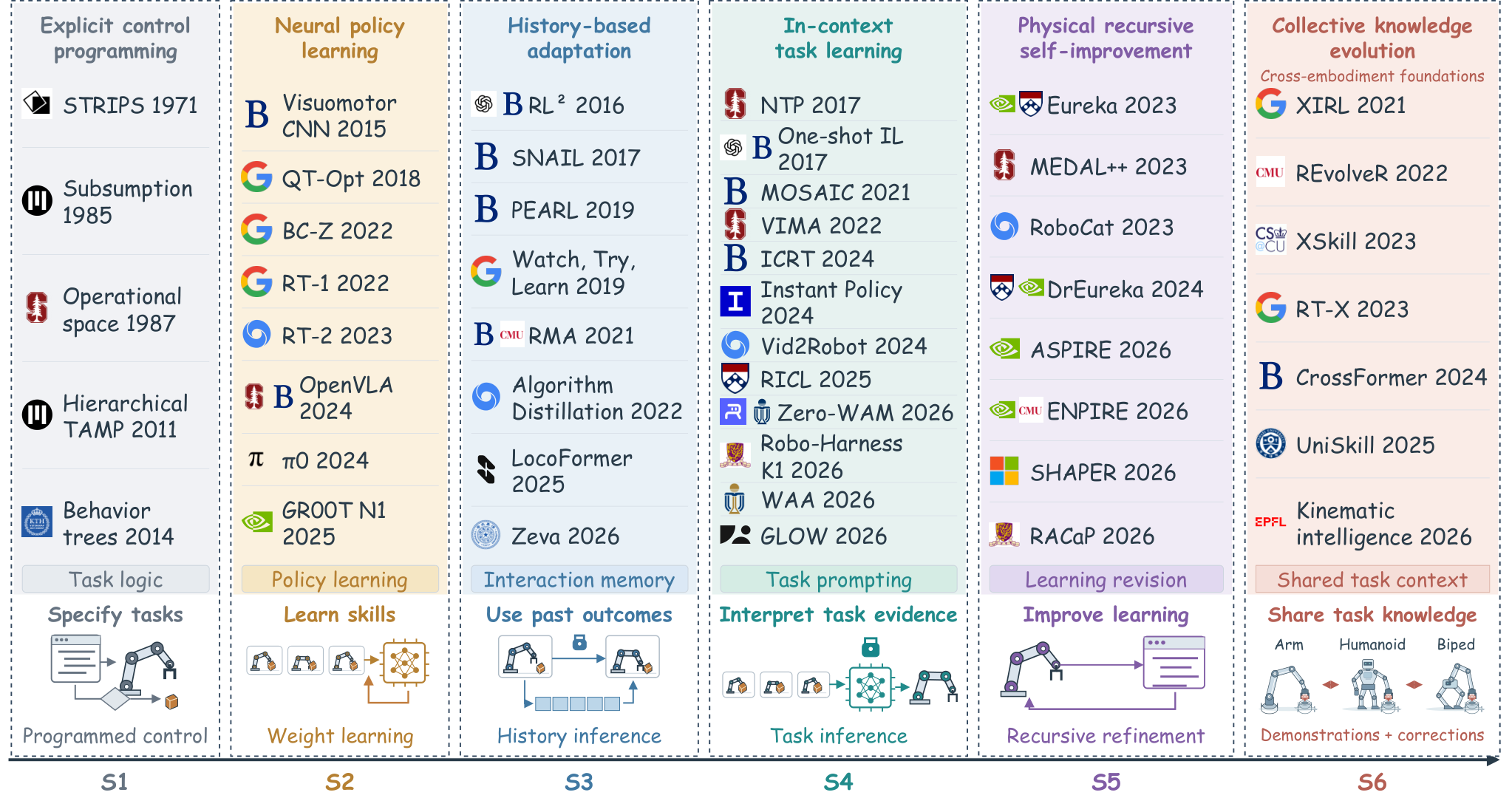
Figures are reproduced from Huang et al. See the full paper for experimental details and the project page, when the paper links one, for demonstrations and videos.
Related Papers
Dexterity from Supervised Play
Botao He, Yiming Dou, Yiannis Aloimonos et al.
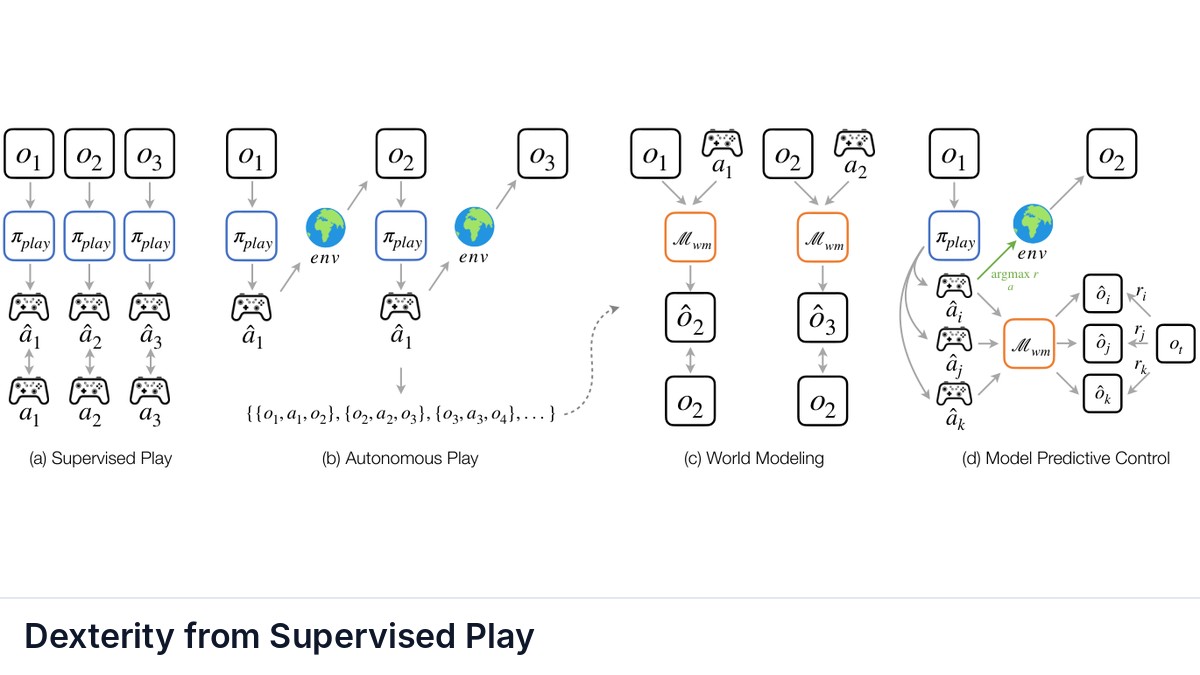
How can robots autonomously collect the contact-rich experience needed to learn dexterous manipulation?
Has GPT-6-Astra Achieved Embodied Intelligence?
SenseNova, Joint Research Team, : et al.
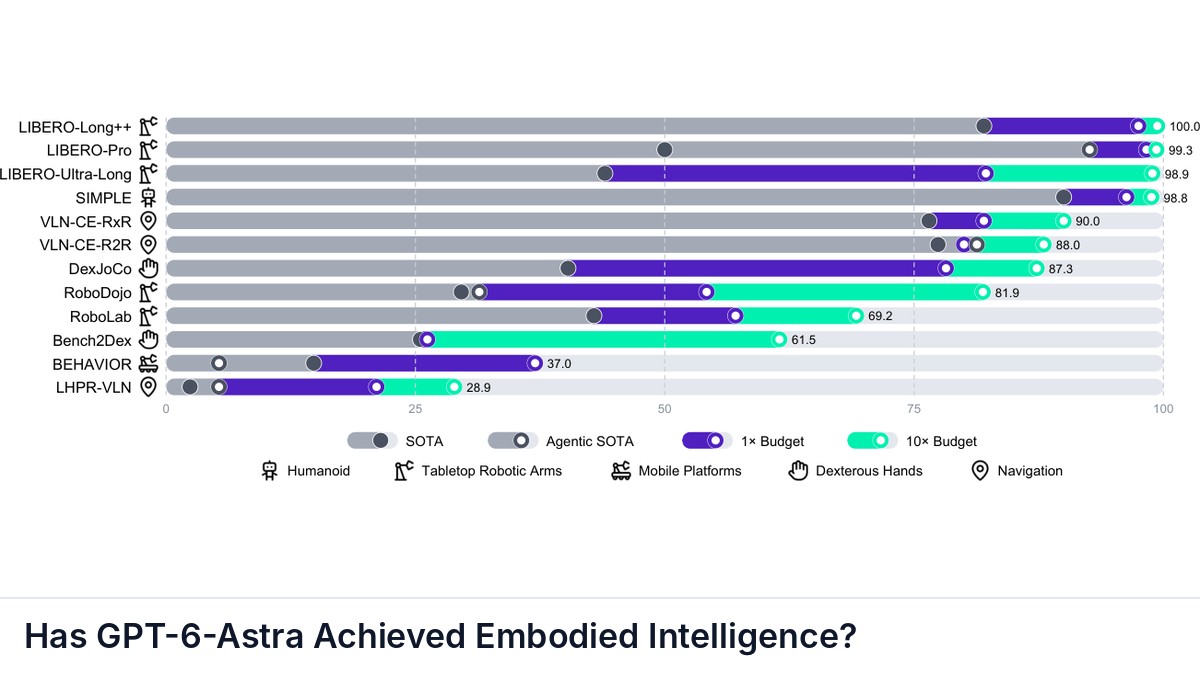
GPT-6-Astra demonstrates a level of competence in robotic manipulation and navigation that challenges the conventional paradigm of building specialized models for individual tasks and embodiments.
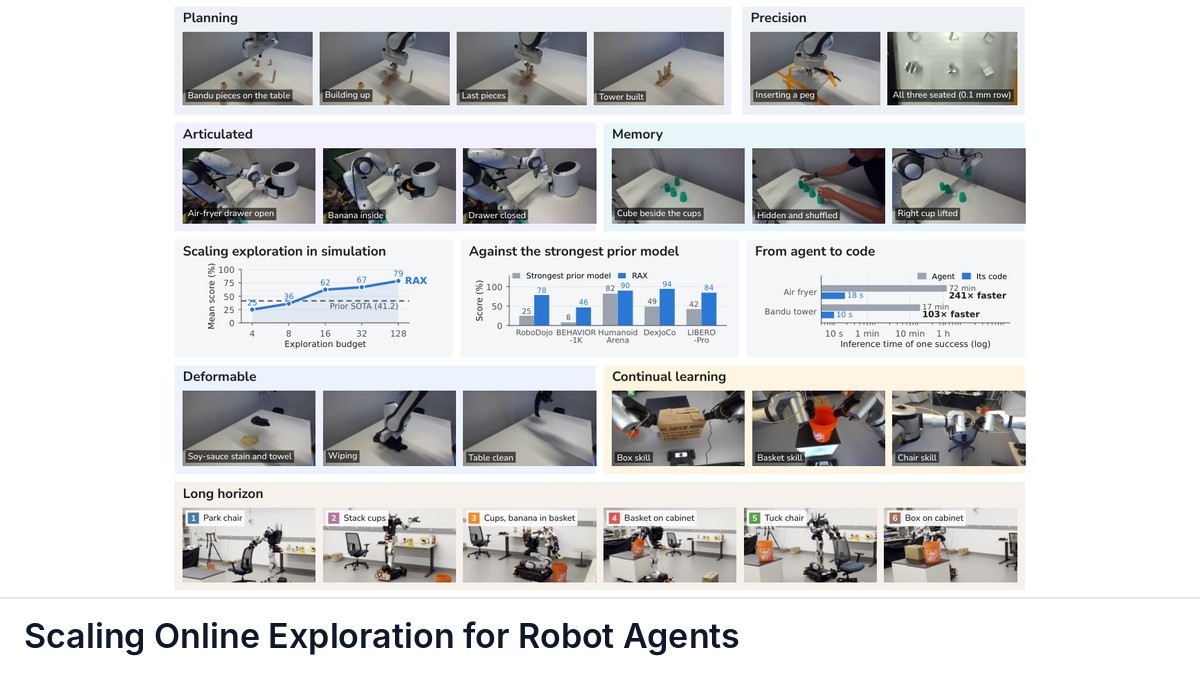
Scaling Online Exploration for Robot Agents
Runhan Huang, Xiangcheng Zhang, Haoyu Chen et al.
Robot learning has advanced by scaling demonstration datasets and model capacity; however, deploying a new robot embodiment or task typically necessitates a dedicated teleoperation corpus.

A Sim-to-Real Integration Pipeline for Training and Deployment of Chunk-Based VLA Manipulation Policies
Mathilde Kappel, Clémence Grislain, Mohamed Chetouani et al.
Vision-Language-Action (VLA) models have become a prominent paradigm for mapping multimodal inputs, including semantic instructions, visual observations of the scene, and proprioceptive observations, to robot actions.