
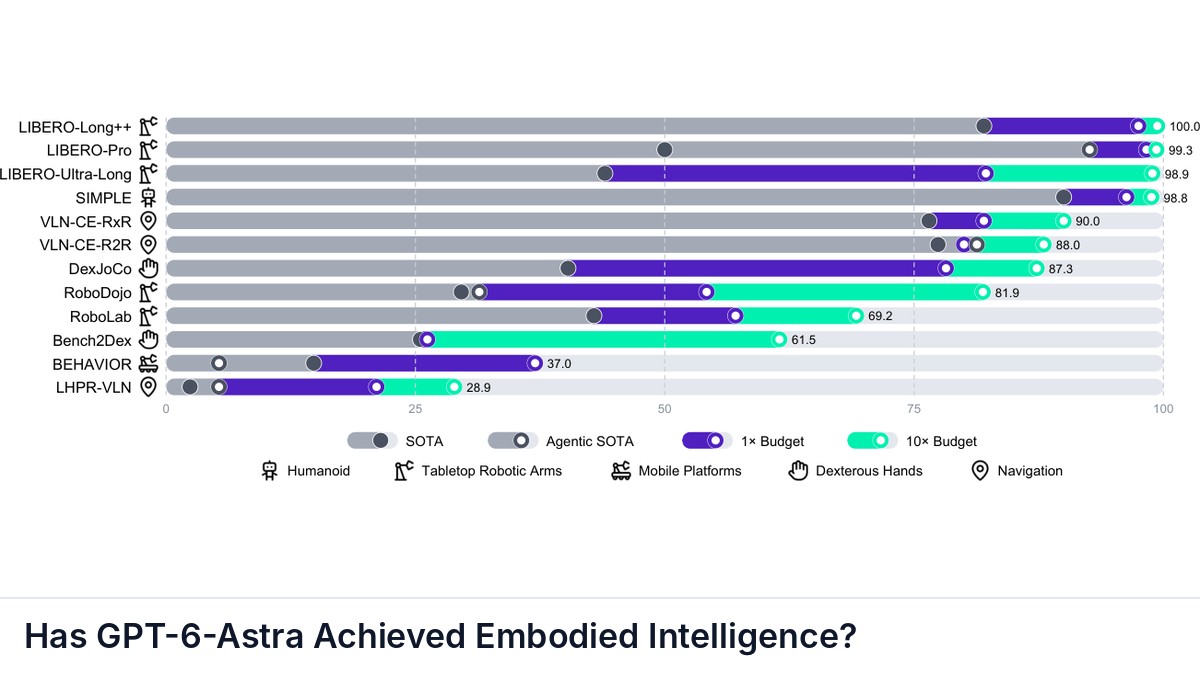
Has GPT-6-Astra Achieved Embodied Intelligence?
SenseNova, Joint Research Team, :, Zhongang Cai, Ziang Cao, Tailai Chen, Han Chong Chua, Linjun Dai, Hanming Deng, Hokin Deng, Haiwen Diao, Chenjing Ding, Weichen Fan, Xiao Fu, Zerui Gong, Chenyang Gu, Zexin He, Zhi Hou, Bo Li, Qinyue Li, Quanzhou Li, Xiaowan Li, Zhichao Liao, Dahua Lin, Zilong Lin, Bo Liu, Chunxiao Liu, Pengfei Liu, Tianqi Liu, Ziwei Liu, Chen Change Loy, Lewei Lu, Jiapeng Luo, Yuexiao Ma, Liang Pan, Xingang Pan, Oscar Qian, Ziyi Shang, Yuyao Shao, Dawei Su, Dacheng Tao, Qingyi Tao, Quan Wang, Ruisi Wang, Xiaogang Wang, Ziyi Wang, Beichen Wen, Donghao Wu, Jiaxu Wu, Silei Wu, Xiaoming Wu, Zhonghua Wu, Hongcan Xiao, Weiye Xu, Atsushi Yamashita, Lei Yang, Zhe Yang, Baiqiao Yin, Wanqi Yin, Hanfei Zhao, Tianbo Zhong, Long Zhuo, Jing Zuo · N/A · 2026
Framework
N/A
License
N/A
Stars
N/A
Summary
GPT-6-Astra demonstrates a level of competence in robotic manipulation and navigation that challenges the conventional paradigm of building specialized models for individual tasks and embodiments.
Abstract Summary
Key Points
- GPT-6-Astra demonstrates a level of competence in robotic manipulation and navigation that challenges the conventional paradigm of building specialized models for individual tasks and embodiments.
- In this report, we ask not only how capable GPT-6-Astra is, but what its capabilities imply for the field.
- First, we probe the limits of standalone GPT-6-Astra
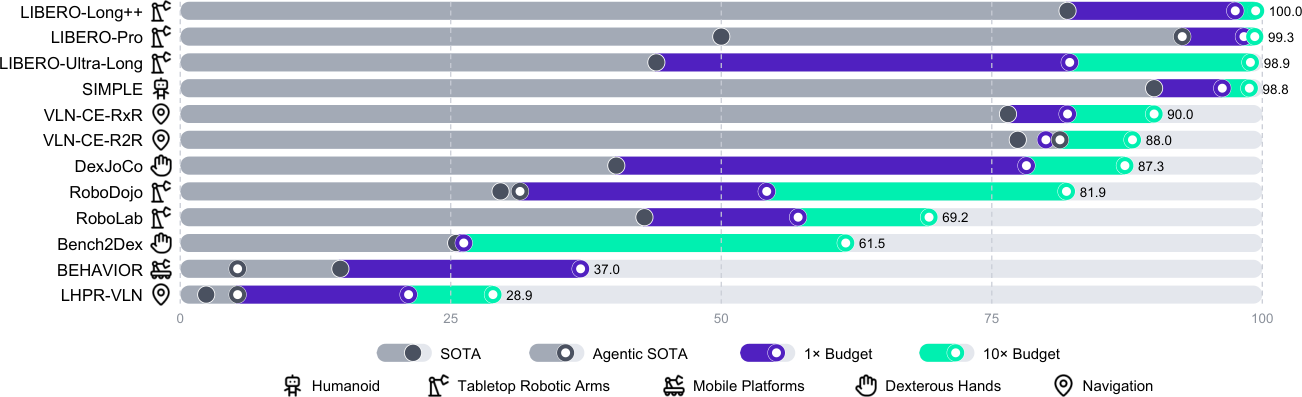
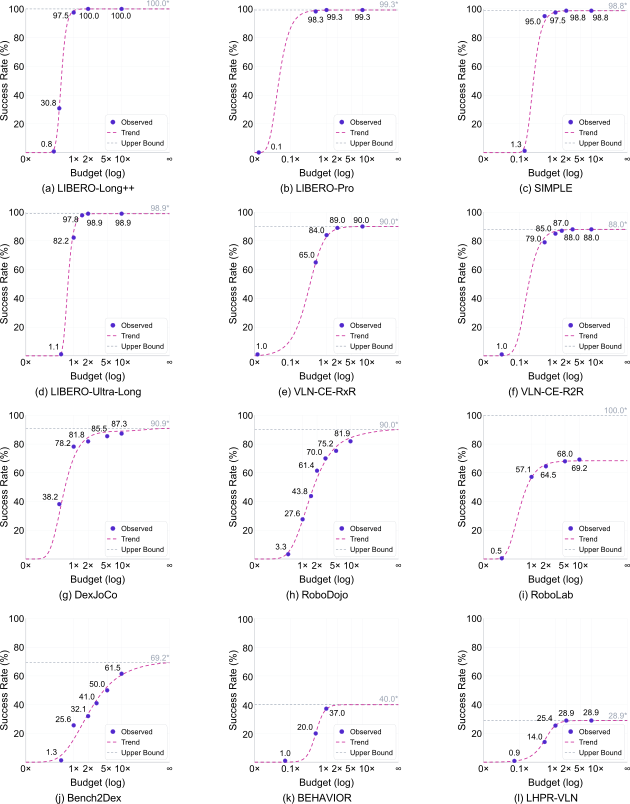
- We conduct a large-scale evaluation across 12 representative benchmarks spanning tabletop manipulation, humanoids, mobile platforms, and dexterous hands.
- Under a unified protocol that allows in-context learning (ICL) from training-set demonstrations and substantially increases the number of execution steps, GPT-6-Astra achieves unprecedented performance (Fig.
Large-Scale Study under A Unified Protocol
We study GPT-6-Astra across twelve embodied settings, spanning manipulation, humanoid loco-manipulation, household activities, and navigation, under a single protocol in which its model weights remain fixed.
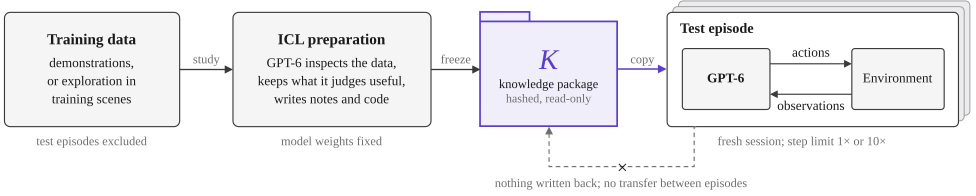
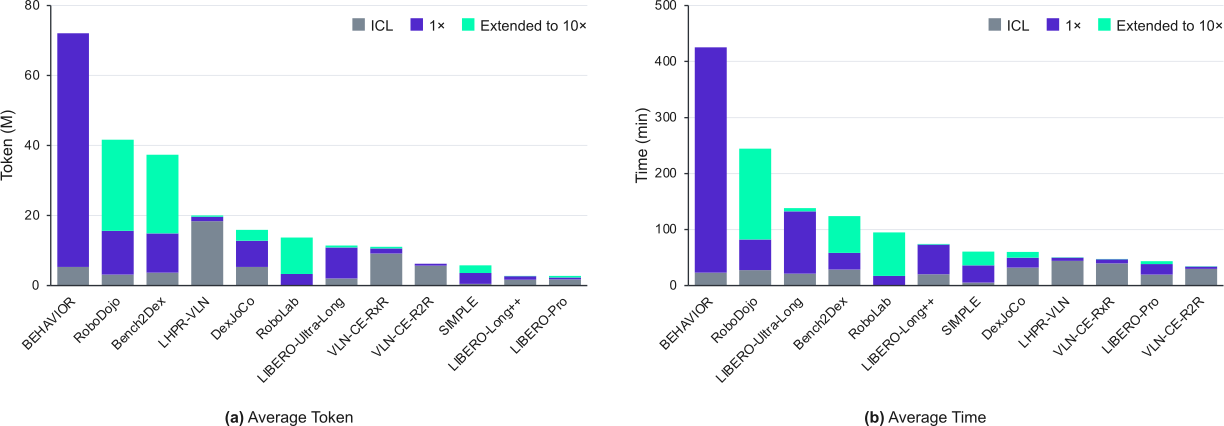
Two conditions shape the study: in-context learning (ICL), which gives GPT-6-Astra access to the same training demonstrations from which conventional policies are learned, and an extended interaction budget, which gives it more opportunity to correct mistakes within an episode.
Harness Ablation
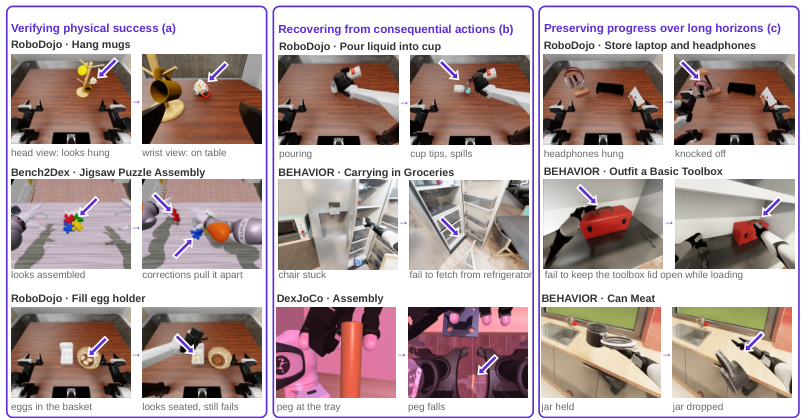
Section 2.2 shows that additional interaction can substantially improve task completion, but its benefits depend on how effectively the agent uses that interaction. Longer execution incurs substantial inference costs and does not reliably resolve failures in physical verification, recovery, or preservation of subtask progress.
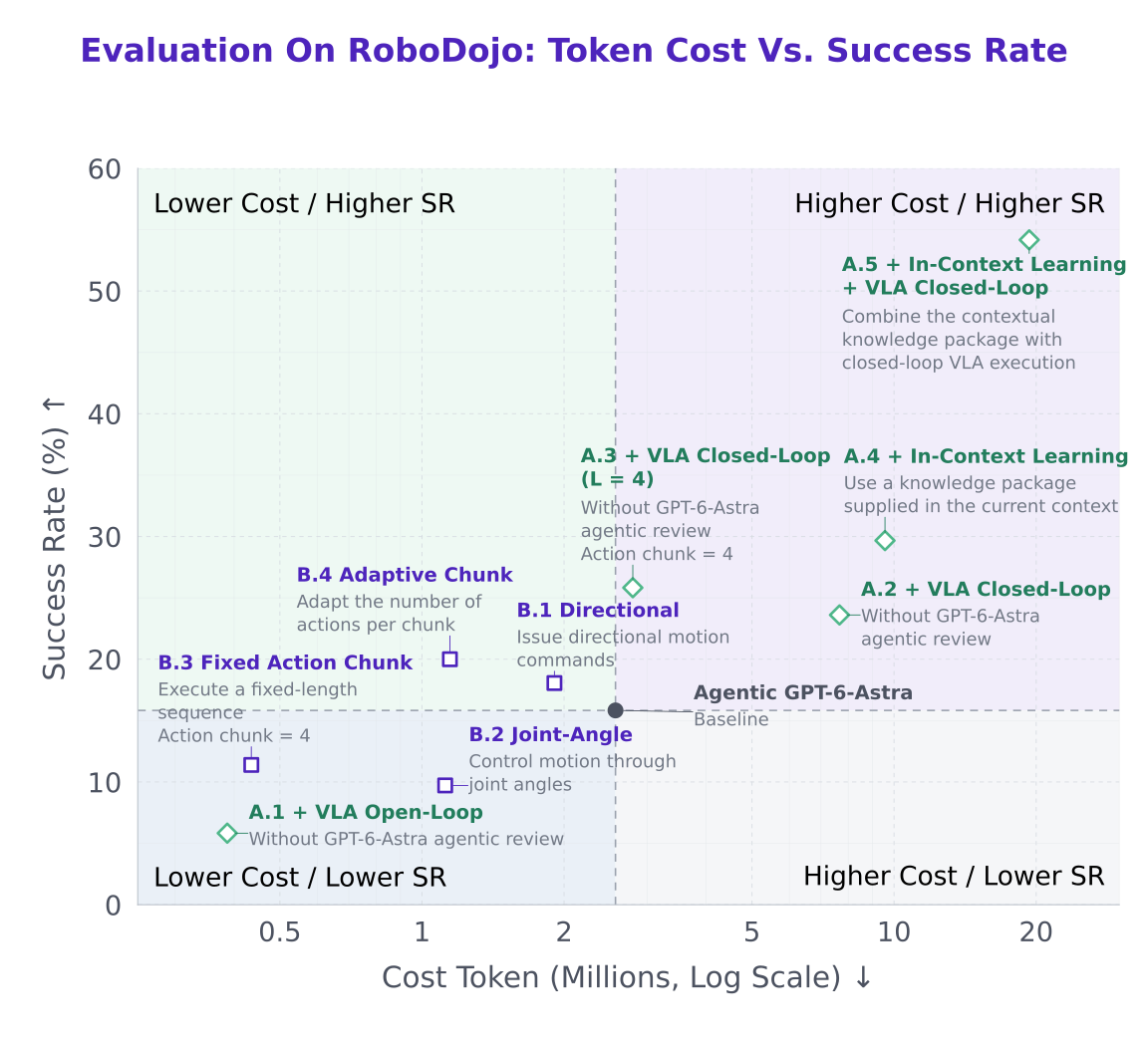
These findings motivate examining the harness that connects GPT-6-Astra’s reasoning to observations, actions, and feedback.
Real-World Validation
Since the simulation protocol of Sec. 2.1 rests on two assumptions that do not hold on physical robots, namely that successful demonstrations of the test task are available and that additional execution steps are free, we further study a real-world variant of the protocol that revises both.
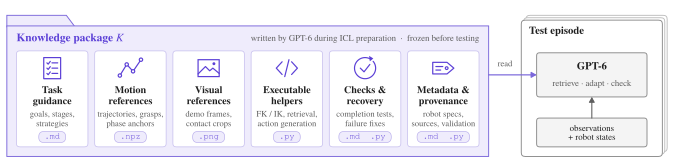
First, the context changes: since new tasks often come without demonstrations in real-world deployment, GPT-6-Astra operates in a zero-shot setting and receives only structured information provided by a human as context.
Towards a Next-Generation Embodied Benchmark
The preceding sections show that GPT-6-Astra’s results on established embodied benchmarks depend heavily on conditions that the benchmarks grant. Its success rises with in-context access to the benchmark’s demonstrations and with an extended step budget in which failures cost nothing (Sec. 2 ), and depends on how a general agent is adapted to an action interface built for a learned policy (Sec. 3 ).
Contributors
Zhongang Cai*, Zhonghua Wu*, Qingyi Tao*. Simulation Benchmarks: Quanzhou Li*, Han Chong Chua*, Ruisi Wang*, Xiaoming Wu*, Tianqi Liu*, Bo Liu*, Pengfei Liu*, Jing Zuo*, Hongcan Xiao*, Qinyue Li. Harness Framework: Weiye Xu*, Yuyao Shao*, Silei Wu*, Jiapeng Luo*, Hanming Deng*, Tailai Chen*, Linjun Dai*, Ziyi Shang*, Xiaowan Li, Donghao Wu, Tianbo Zhong, Chenjing Ding.
Full Simulation Results
Tasks and demonstrations. LIBERO-PRO [ 183 ] applies task-preserving perturbations to the four LIBERO suites and separates each suite into Task and Swap variants. We evaluate the complete official benchmark: eight suites, ten tasks per suite, and ten fixed initial states per task, for 800 episodes in total.
Before evaluation, we freeze a package selected by the exact base task, combining matching Task/Swap task-family notes with global strategy, perception, verification, and recovery notes distilled from a separate public exploration phase.
Harness Ablation Study
Configuration Average Generalization Precision Long-Horizon Memory Open Tokens (M) $\downarrow$ Baseline 22.78 / 15.56 27.08 / 22.22 9.79 / 0.00 23.13 / 4.17 22.22 / 22.22 31.67 / 29.17 2.56 A.
Agent Components w/ planning subagent 26.03 / 19.44 37.08 / 33.33 11.88 / 4.17 21.46 / 4.17 40.56 / 38.89 19.17 / 16.67 2.96 w/ execution subagent 21.56 / 15.28 36.39 / 33.33 14.79 / 4.17 10.63 / 0.00 25.56 / 22.22 20.42 / 16.67 2.55 w/ feedback subagent 30.00 / 24.72 30.83 / 27.78 16.88 / 12.50 24.38 / 8.33 33.33 / 33.33 44.58 / 41.67 2.74 w/ history co...
Full Real Robot Results
This appendix documents the real-world experiments of Sec. 4 . App. 11.1 summarizes all platforms, and App. 11.2 – 11.9 document each platform, from the simplest to the most complex embodiment, in the same five parts: setting, context provided, tasks and results, findings, and visualization. Table 14 summarizes the cameras, action interfaces, supplied context, and task outcomes across all eight platforms.
Figure 13 provides task visualizations grouped by outcome, while the following subsections detail each platform’s protocols and results.
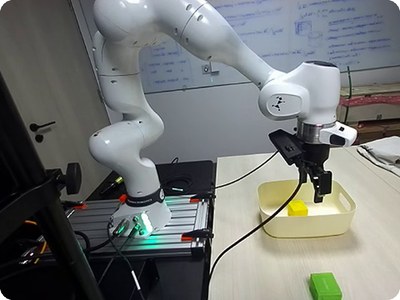
Sources and Demonstrations
Figures are reproduced from SenseNova et al. See the full paper for experimental details and the project page, when the paper links one, for demonstrations and videos.
Related Papers
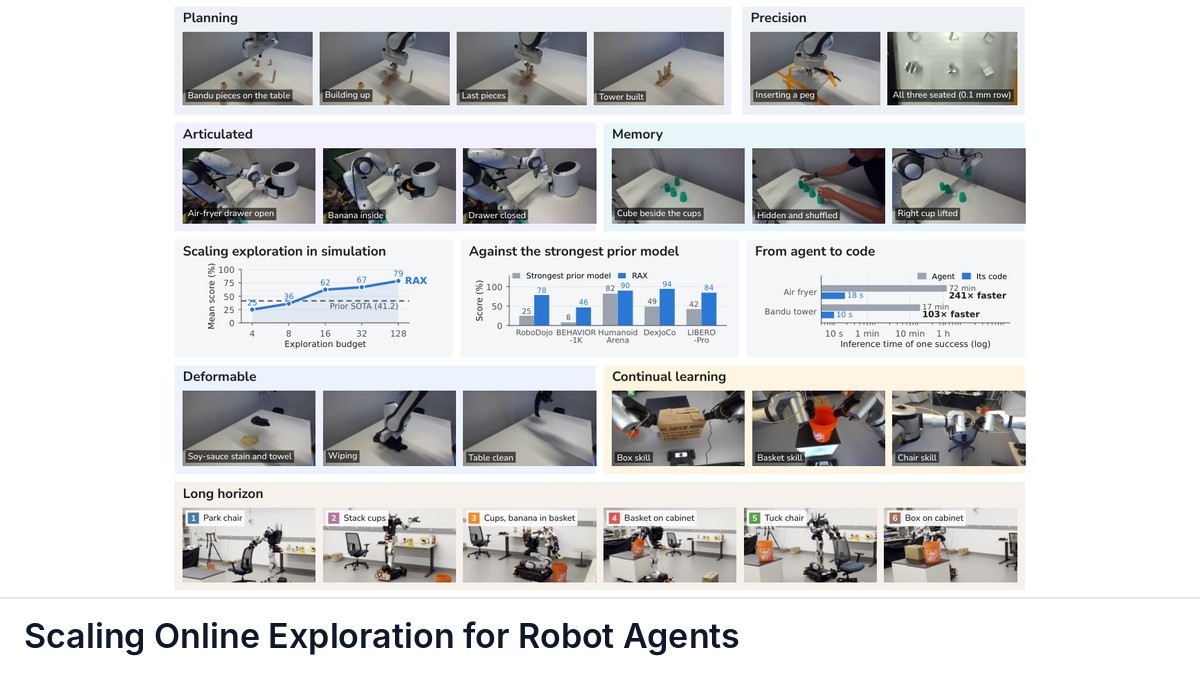
Scaling Online Exploration for Robot Agents
Runhan Huang, Xiangcheng Zhang, Haoyu Chen et al.
Robot learning has advanced by scaling demonstration datasets and model capacity; however, deploying a new robot embodiment or task typically necessitates a dedicated teleoperation corpus.
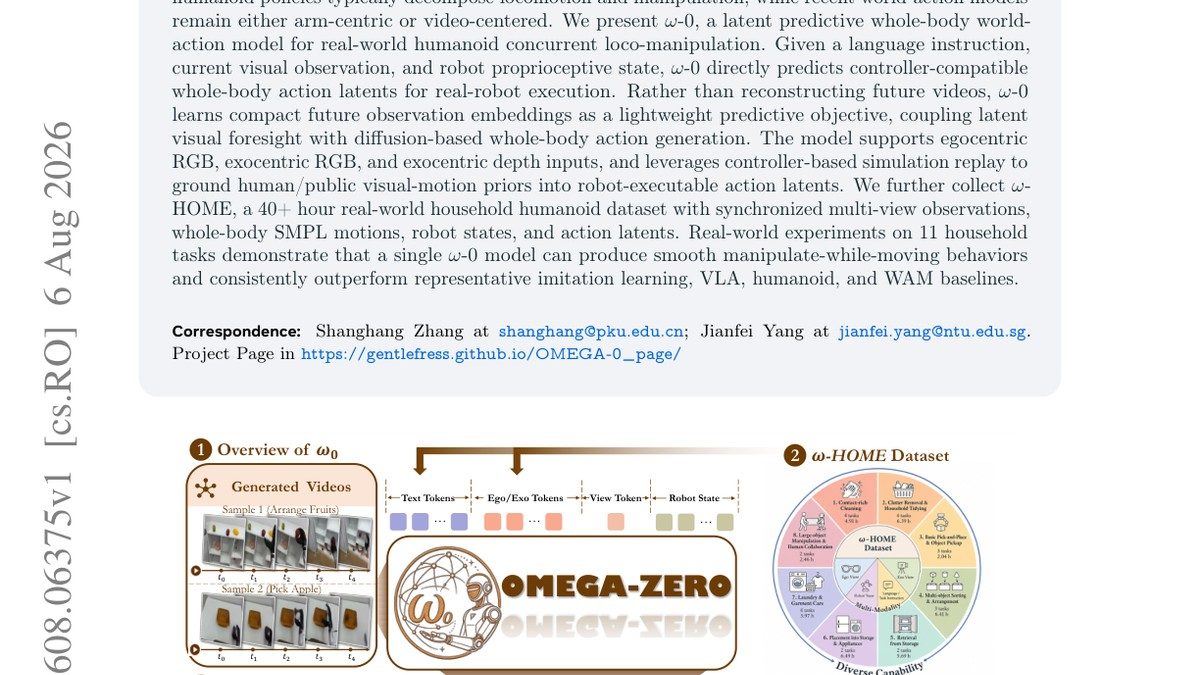
$ω$-0: A Latent Predictive World Action Model for Concurrent Humanoid Loco-Manipulation
Zhe Li, Zhenzhe Zhang, Yangyang Wei et al.
Humanoid household tasks often require concurrent loco-manipulation, where the robot must move, adjust posture, maintain balance, and manipulate objects as a single coordinated behavior.
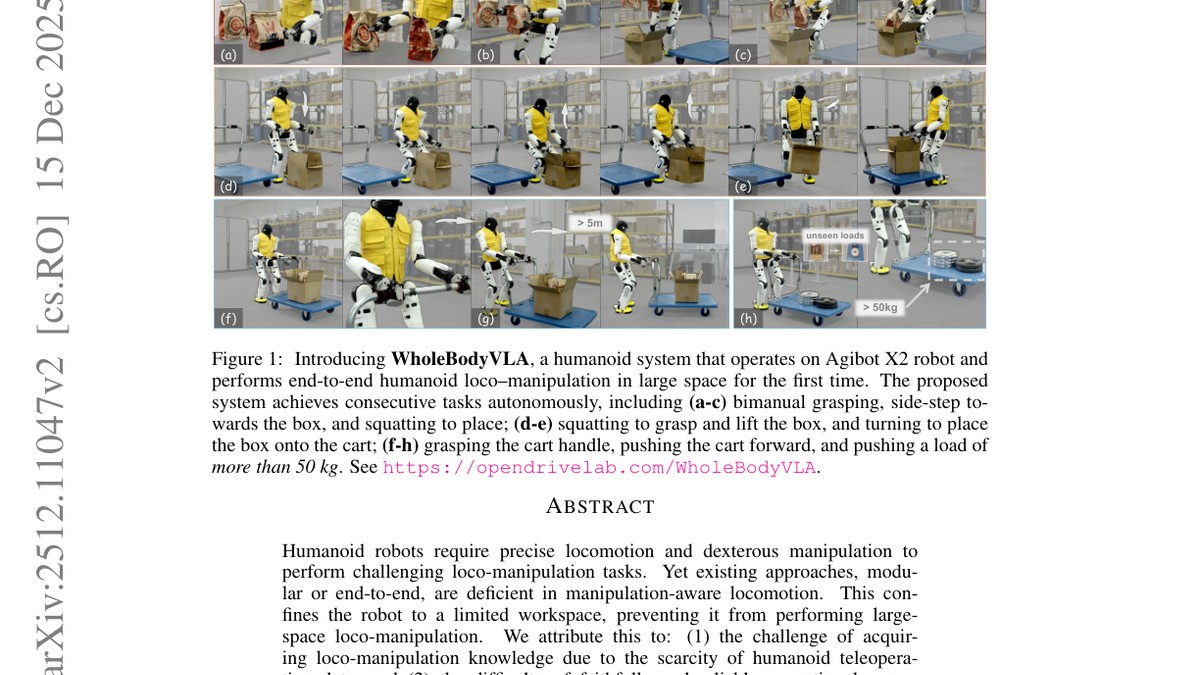
WholeBodyVLA: Towards Unified Latent VLA for Whole-Body Loco-Manipulation Control
Haoran Jiang, Jin Chen, Qingwen Bu et al.
Humanoid robots require precise locomotion and dexterous manipulation to perform challenging loco-manipulation tasks. Yet existing approaches, modular or end-to-end, are deficient in manipulation-aware locomotion.

A Sim-to-Real Integration Pipeline for Training and Deployment of Chunk-Based VLA Manipulation Policies
Mathilde Kappel, Clémence Grislain, Mohamed Chetouani et al.
Vision-Language-Action (VLA) models have become a prominent paradigm for mapping multimodal inputs, including semantic instructions, visual observations of the scene, and proprioceptive observations, to robot actions.