
Collective Learning for Unified Robotic Manipulation via Predictive Dynamics Adaptation
Shaocheng Liu, Yuan Meng, Zhenshan Bing, Alois Knoll · N/A · 2026
Framework
N/A
License
N/A
Stars
N/A
Summary
Learning a collective policy for state-based Cartesian manipulation across diverse robotic embodiments presents a fundamental challenge due to embodiment-dependent transition dynamics.
Abstract Summary
Key Points
- Learning a collective policy for state-based Cartesian manipulation across diverse robotic embodiments presents a fundamental challenge due to embodiment-dependent transition dynamics.
- Collective learning aggregates multi-robot experience to discover shared task structure, yet naive aggregation can average incompatible action modes when different embodiments realize the same Cartesian command through different transition behavior.
- This leads to strategy ambiguity and performance collapse on dynamically outlying embodiments
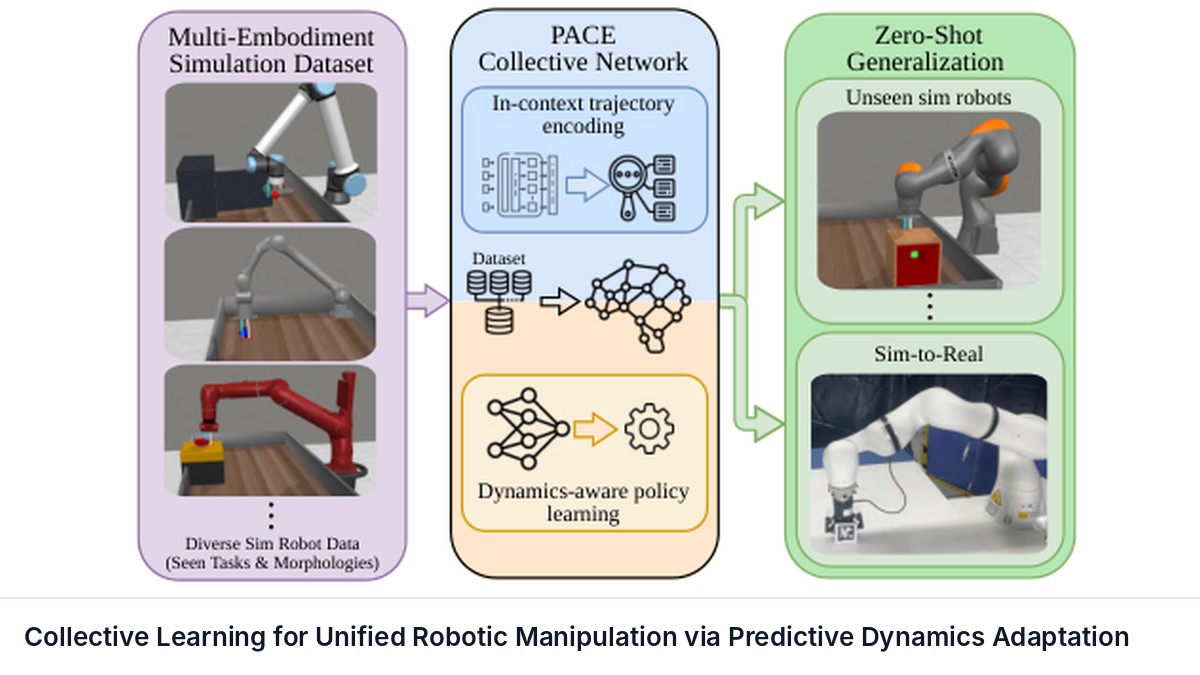
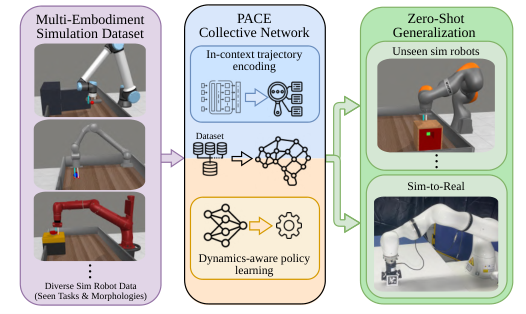
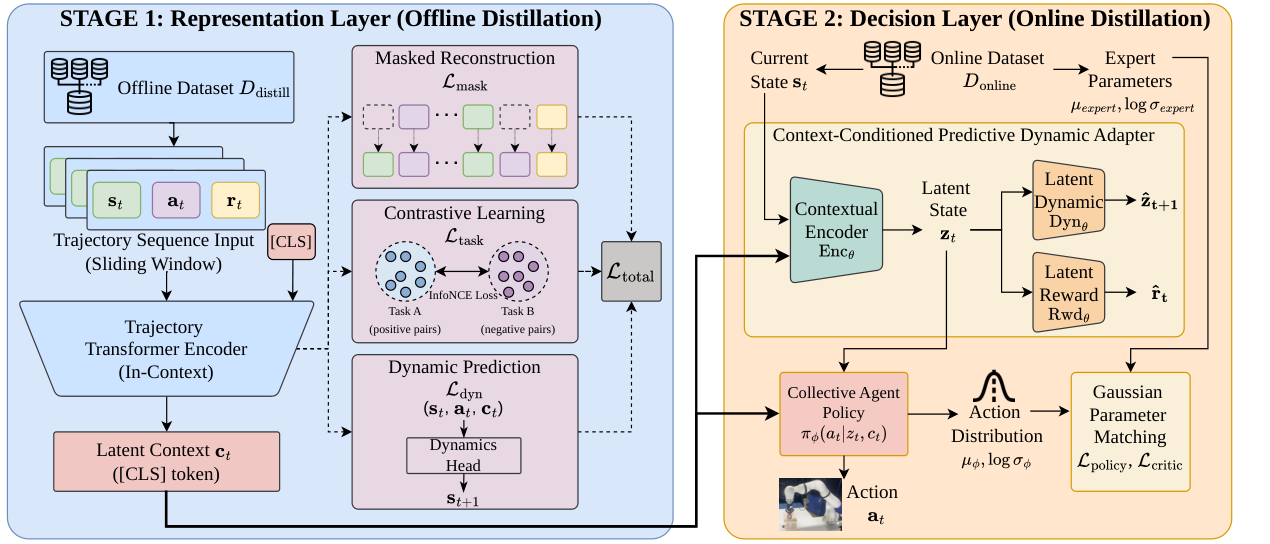
- To address this, we propose PACE, a two-stage collective learning framework that separates shared task-space intent from embodiment-dependent transition dynamics.
- The first stage employs a representation layer pre-trained on offline trajectories to extract task-level context from collective data.
Methodology
We formulate collective multi-task imitation learning as a family of Markov Decision Processes (MDPs), $\mathcal{M}=\{M_{rob,task}\mid rob\in\mathcal{R},\tau\in\mathcal{T}\}$, where $\mathcal{R}$ represents distinct robot embodiments and $\mathcal{T}$ represents manipulation tasks. Unified state and action spaces. We use a unified Cartesian space to facilitate transfer.
Experiments
This section evaluates whether PACE improves collective manipulation learning across robot embodiments with different transition behavior. We use a shared low-dimensional state representation and Cartesian action interface for all methods, so the comparison focuses on embodiment-dependent differences in how commanded actions are realized.
Preliminary observations highlight a critical limitation in standard Behavior Cloning baselines.
Sources and Demonstrations
Figures are reproduced from Liu et al. See the full paper for experimental details and the project page, when the paper links one, for demonstrations and videos.
Related Papers
Dexterity from Supervised Play
Botao He, Yiming Dou, Yiannis Aloimonos et al.
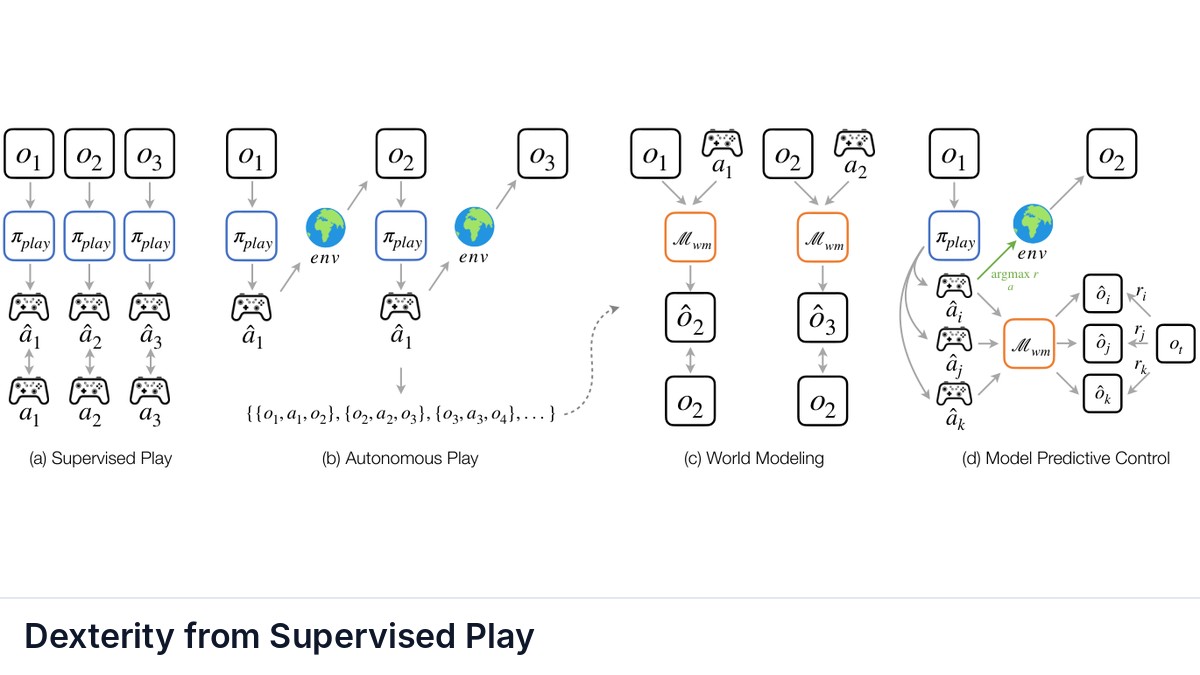
How can robots autonomously collect the contact-rich experience needed to learn dexterous manipulation?

A Sim-to-Real Integration Pipeline for Training and Deployment of Chunk-Based VLA Manipulation Policies
Mathilde Kappel, Clémence Grislain, Mohamed Chetouani et al.
Vision-Language-Action (VLA) models have become a prominent paradigm for mapping multimodal inputs, including semantic instructions, visual observations of the scene, and proprioceptive observations, to robot actions.
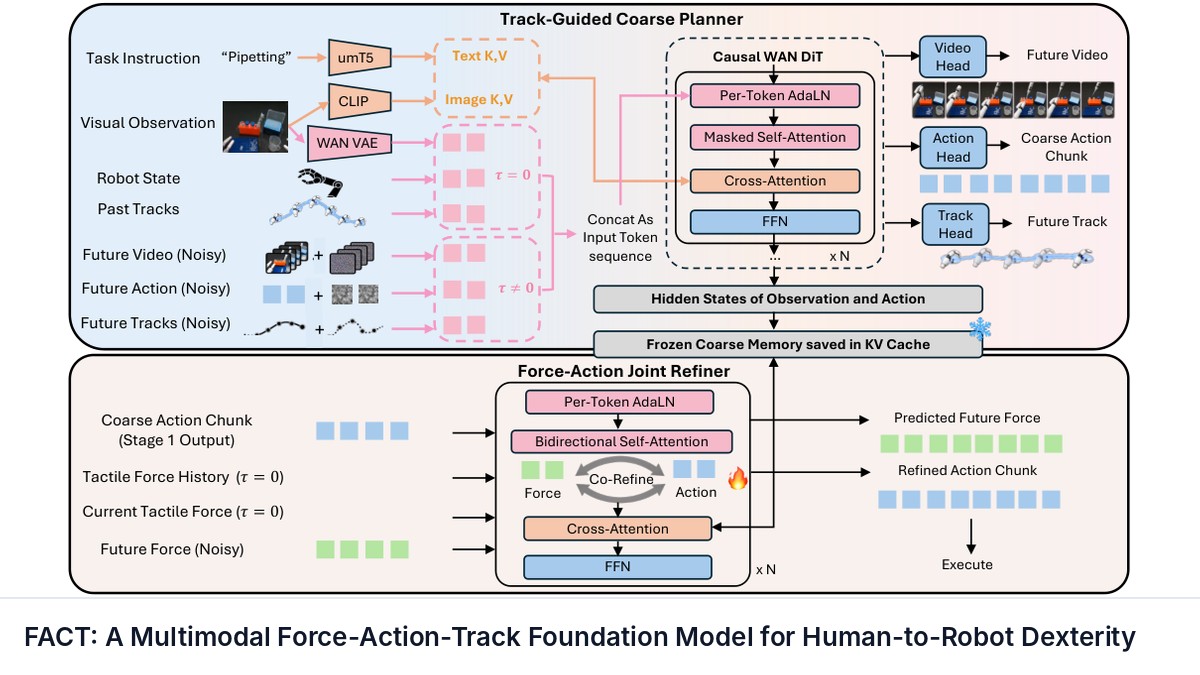
FACT: A Multimodal Force-Action-Track Foundation Model for Human-to-Robot Dexterity
Zhi Cao, Yining Hong, Jiaolong Yang et al.
Human demonstrations offer a scalable alternative to costly robot data collection for dexterous manipulation, but most human datasets lack force measurements.
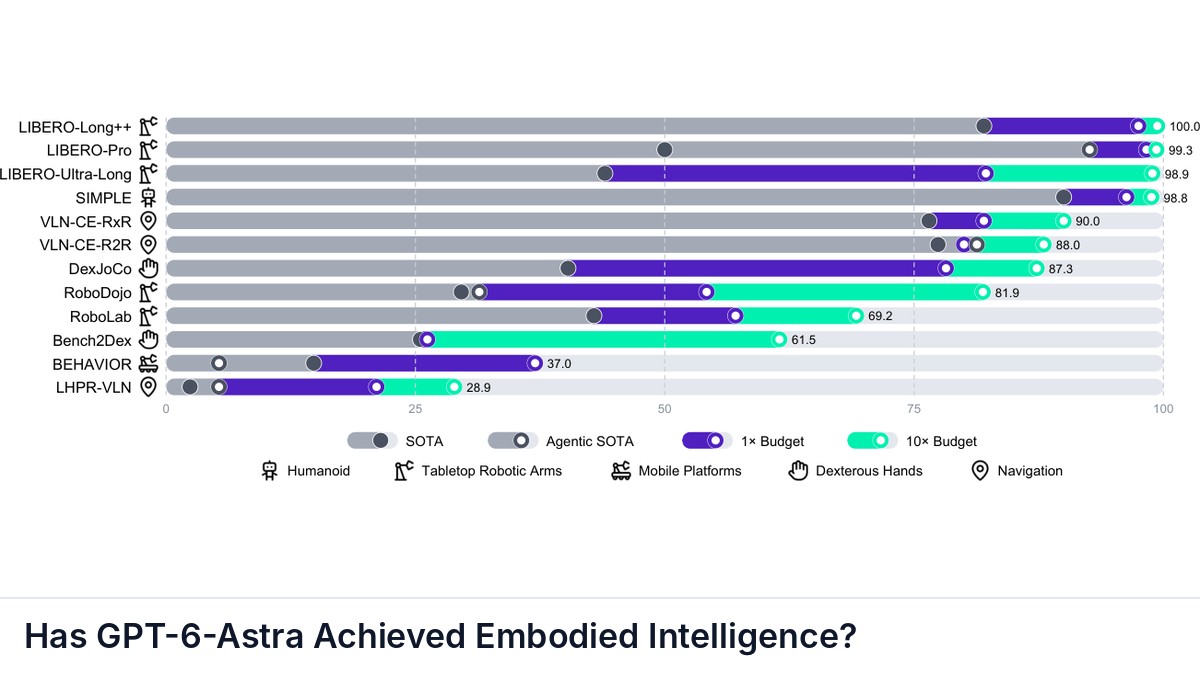
Has GPT-6-Astra Achieved Embodied Intelligence?
SenseNova, Joint Research Team, : et al.
GPT-6-Astra demonstrates a level of competence in robotic manipulation and navigation that challenges the conventional paradigm of building specialized models for individual tasks and embodiments.