
FACT: A Multimodal Force-Action-Track Foundation Model for Human-to-Robot Dexterity
Zhi Cao, Yining Hong, Jiaolong Yang, Yejin Choi, Li Fei-Fei, Jiajun Wu, Huang Huang · N/A · 2026
Framework
N/A
License
N/A
Stars
N/A
Summary
Human demonstrations offer a scalable alternative to costly robot data collection for dexterous manipulation, but most human datasets lack force measurements.
Abstract Summary
Key Points
- Human demonstrations offer a scalable alternative to costly robot data collection for dexterous manipulation, but most human datasets lack force measurements.
- Dexterous manipulation requires not only visual and proprioceptive understanding but also the ability to anticipate and regulate interaction forces.
- To scale force-aware human-robot co-training, we introduce EgoForce, a large-scale human tactile dataset capturing force-rich manipulation experience, and combine it with robot demonstrations for pretraining.
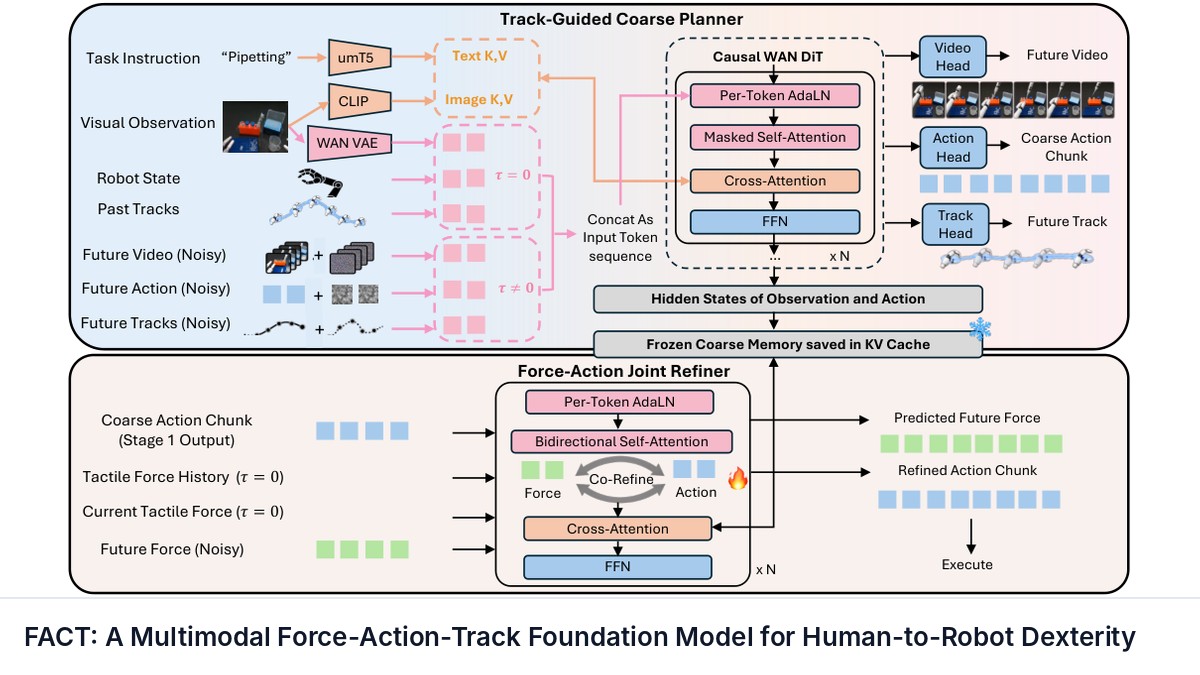
- We present FACT, a robot foundation model that cascades from prospective visual planning to force-aware refinement for dexterous manipulation.
- FACT comprises two jointly trained components
The EgoForce Dataset
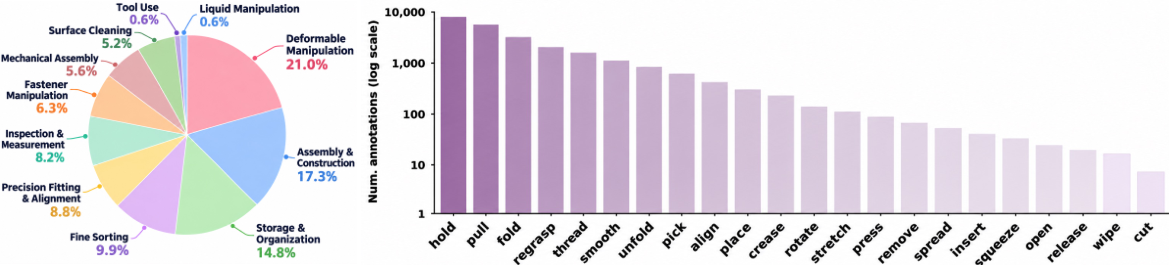
Human demonstrations provide a scalable source of dexterous manipulation experience, but existing human data captures vision without the forces involved in interaction, while collecting force-supervised data at comparable scale on robots is expensive and difficult.
We therefore develop EgoForce , a large-scale human tactile dataset paired with a collection platform that captures synchronized vision, hand motion, and calibrated tactile force for FACT pretraining.
The FACT Framework
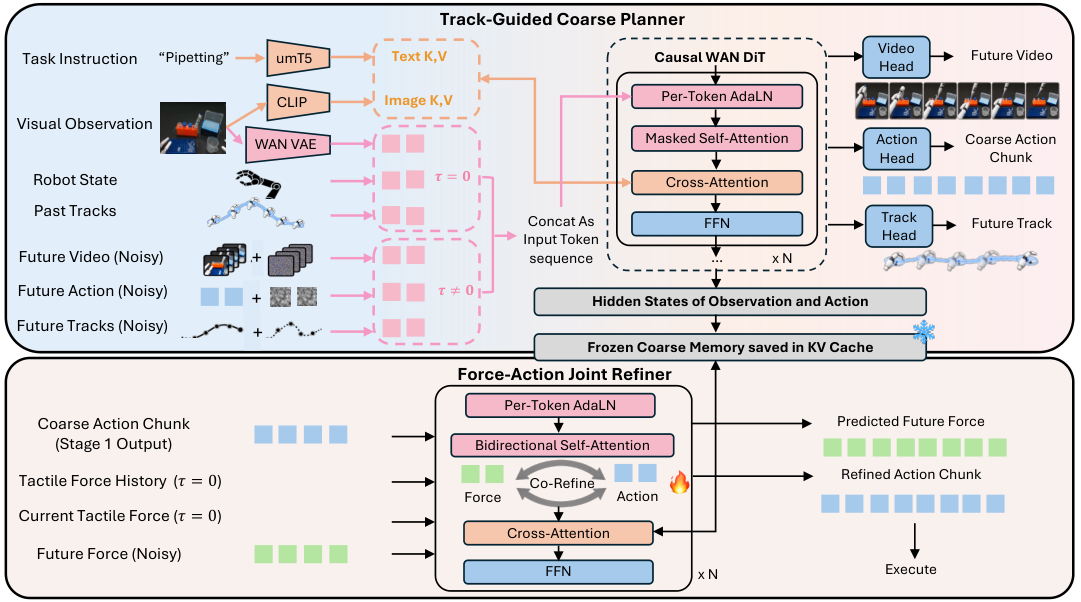
FACT is a flow-matching model for transferring dexterous manipulation from large-scale human experience to robot execution. FACT cascades from prospective visual planning to force-aware refinement ( Figure 3 ) through two jointly trained components. The Track-Guided Coarse Planner jointly predicts future video, visual tracks, and actions.
Future video and tracks provide a shared representation of task progress across human and robot embodiments, allowing human experience to shape coarse robot motion.
Experiments
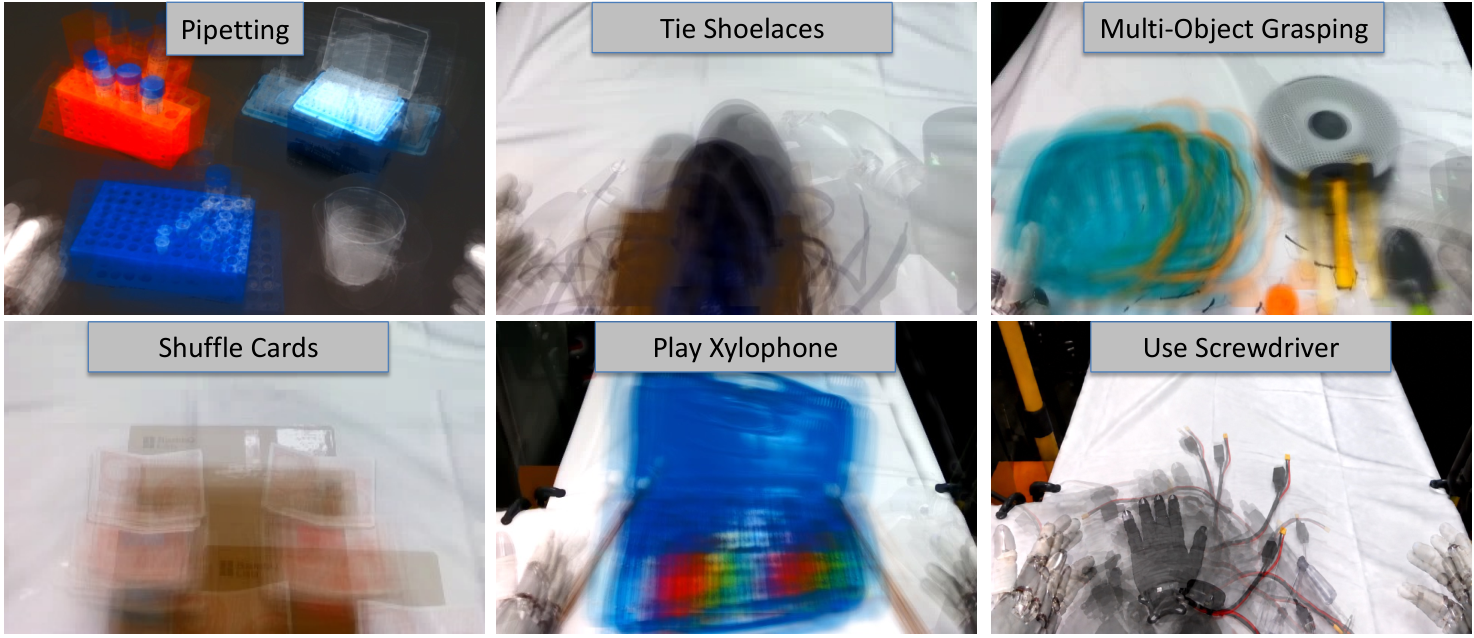
We evaluate FACT on a ten-task real-robot suite. All policies are evaluated on a bimanual YAM station with two Sharpa Wave hands (22 joints, five-fingertip 6-axis force sensing), equipped with a RealSense D435 ego-view camera and two ZED Mini wrist cameras.
For each evaluation task we collect 10 robot teleoperation trajectories using a Manus-glove and wrist-tracker interface and 90 human demonstrations collected with a Wuji tactile glove and wrist-tracker interface, resulting in a 100-trajectory mixture dataset per task.
Sources and Demonstrations
Figures are reproduced from Cao et al. See the full paper for experimental details and the project page, when the paper links one, for demonstrations and videos.
Related Papers
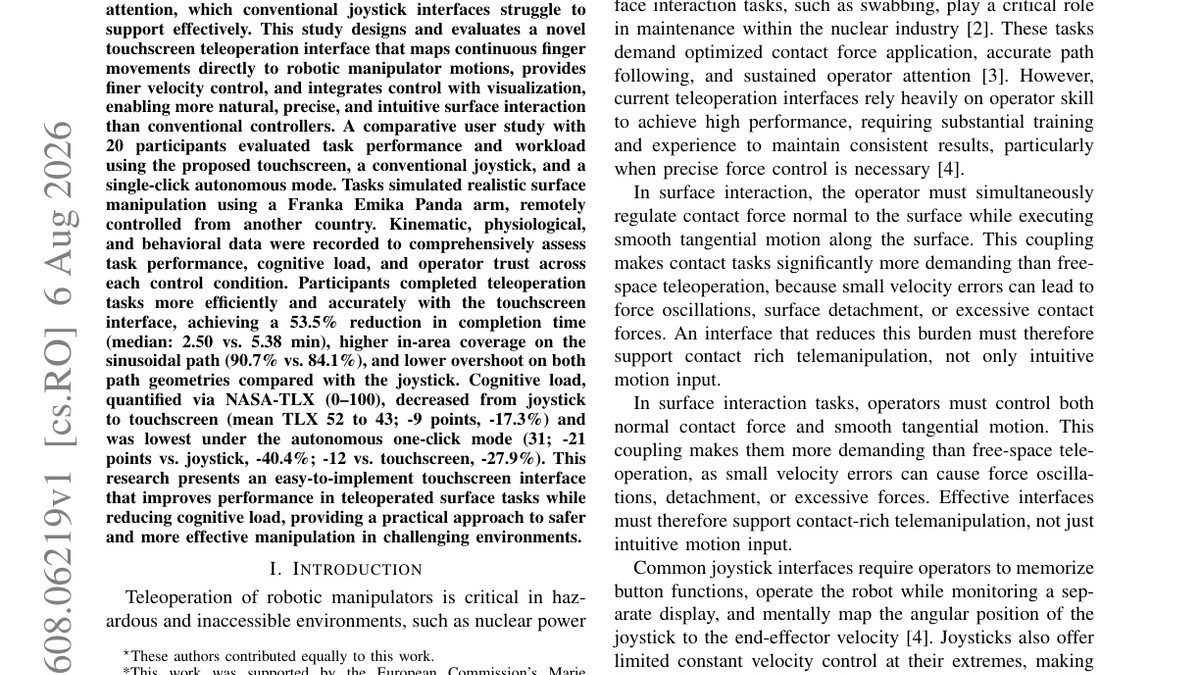
Design and Evaluation of a Touchscreen-Based Teleoperation Interface for Robotic Manipulators
Juan José García Cárdenas, Alperen Kenan, Hamidreza Raei et al.
Intuitive teleoperation interfaces are crucial for the safe and effective operation of robotic manipulators in challenging environments.
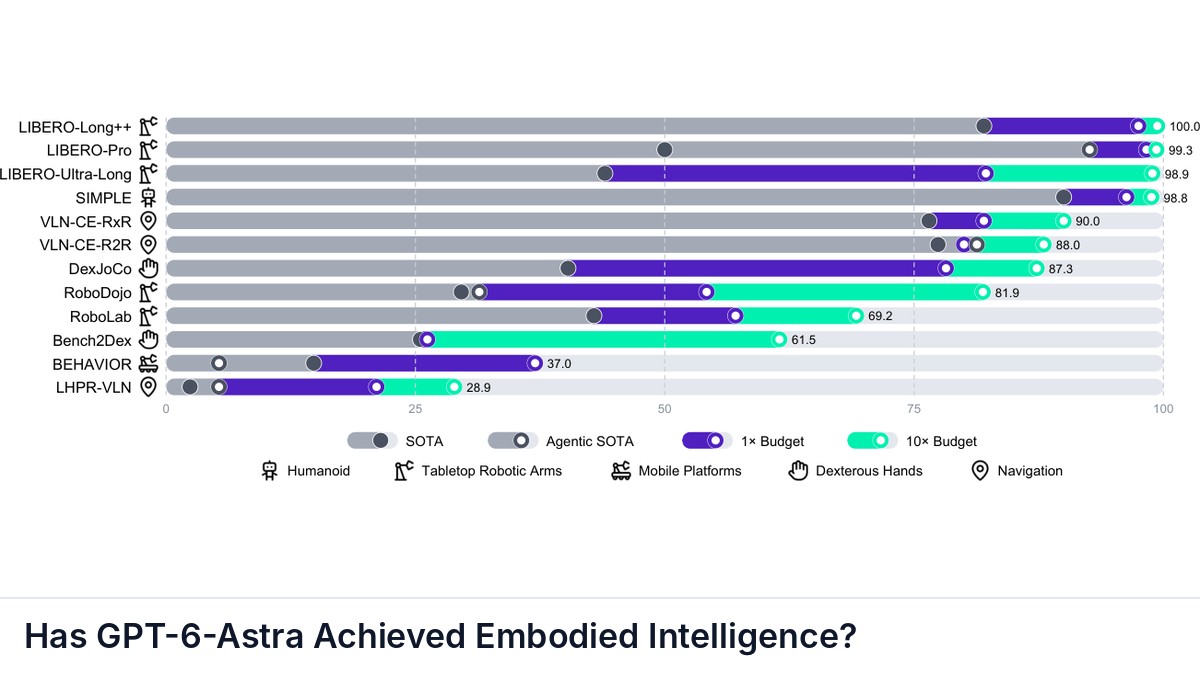
Has GPT-6-Astra Achieved Embodied Intelligence?
SenseNova, Joint Research Team, : et al.
GPT-6-Astra demonstrates a level of competence in robotic manipulation and navigation that challenges the conventional paradigm of building specialized models for individual tasks and embodiments.
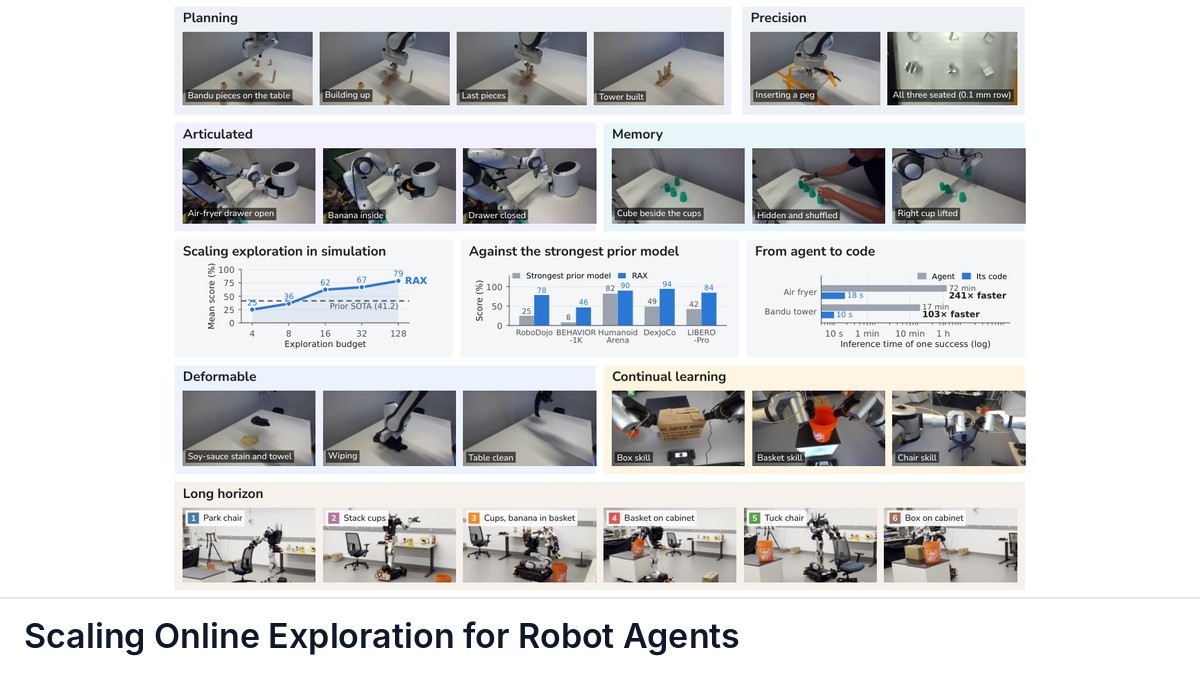
Scaling Online Exploration for Robot Agents
Runhan Huang, Xiangcheng Zhang, Haoyu Chen et al.
Robot learning has advanced by scaling demonstration datasets and model capacity; however, deploying a new robot embodiment or task typically necessitates a dedicated teleoperation corpus.
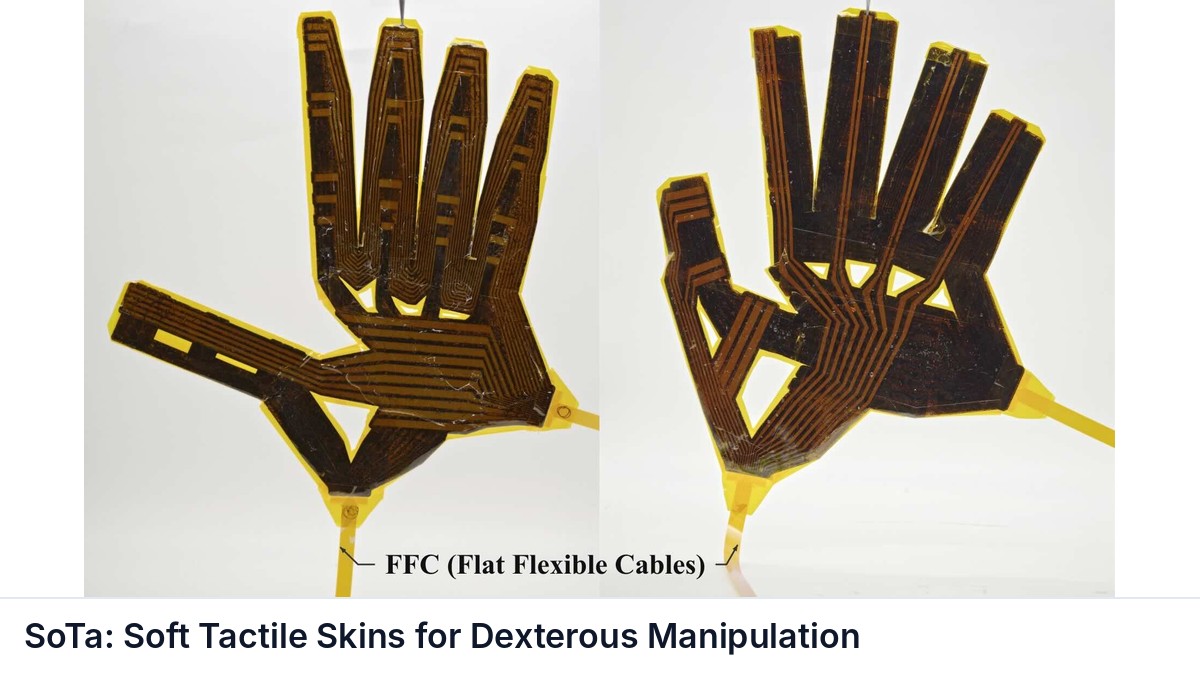
SoTa: Soft Tactile Skins for Dexterous Manipulation
Jingyun Yang, Baiyu Shi, Timothy Yu et al.
A growing body of work suggests that tactile sensing gives robot policies contact information that complements vision in dexterous manipulation. However, visuo-tactile robot data remains scarce: dexterous demonstrations require teleoperating robots, which limits dataset scale.