
SoTa: Soft Tactile Skins for Dexterous Manipulation
Jingyun Yang, Baiyu Shi, Timothy Yu, Haitian Liu, Alberta Longhini, Weichen Wang, Rika Antonova, Zhenan Bao, Jeannette Bohg · N/A · 2026
Framework
N/A
License
N/A
Stars
N/A
Summary
A growing body of work suggests that tactile sensing gives robot policies contact information that complements vision in dexterous manipulation. However, visuo-tactile robot data remains scarce: dexterous demonstrations require teleoperating robots, which limits dataset scale.
Abstract Summary
Key Points
- A growing body of work suggests that tactile sensing gives robot policies contact information that complements vision in dexterous manipulation.
- However, visuo-tactile robot data remains scarce: dexterous demonstrations require teleoperating robots, which limits dataset scale.
- Human demonstrations are far cheaper to collect and offer a path to scale this data, but only if human and robot hands carry tactile sensors with corresponding signals.
- This requires sensors that conform to different hand geometries, cover the full hand, and share a common layout across embodiments.
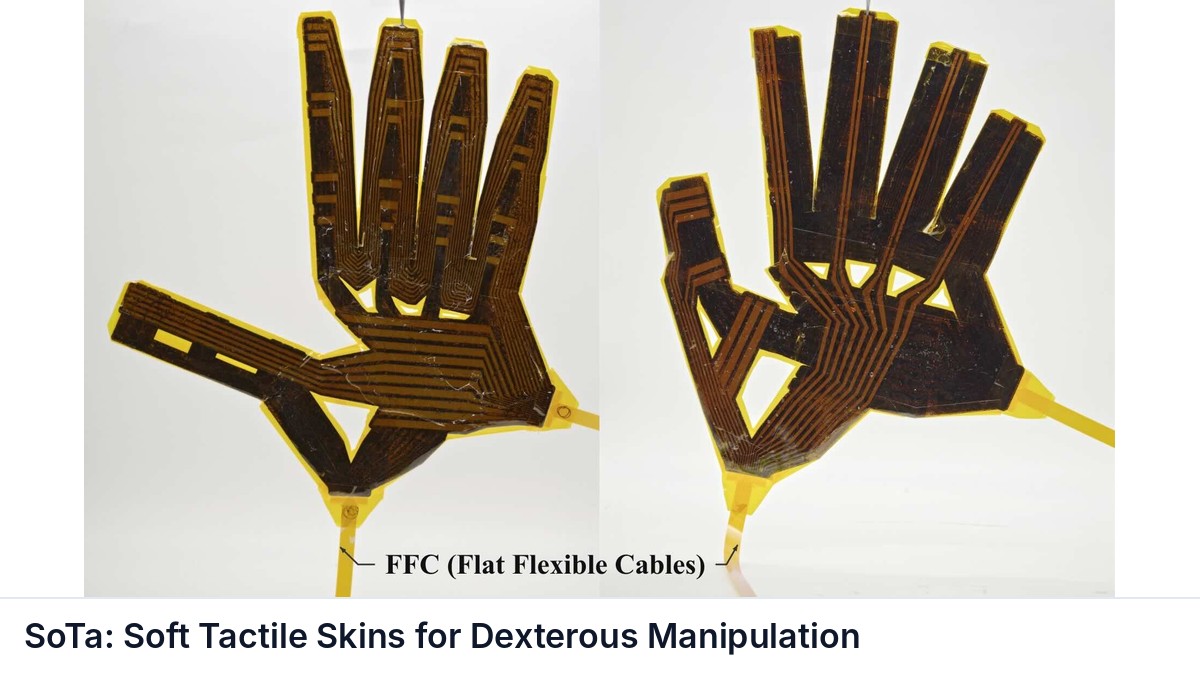
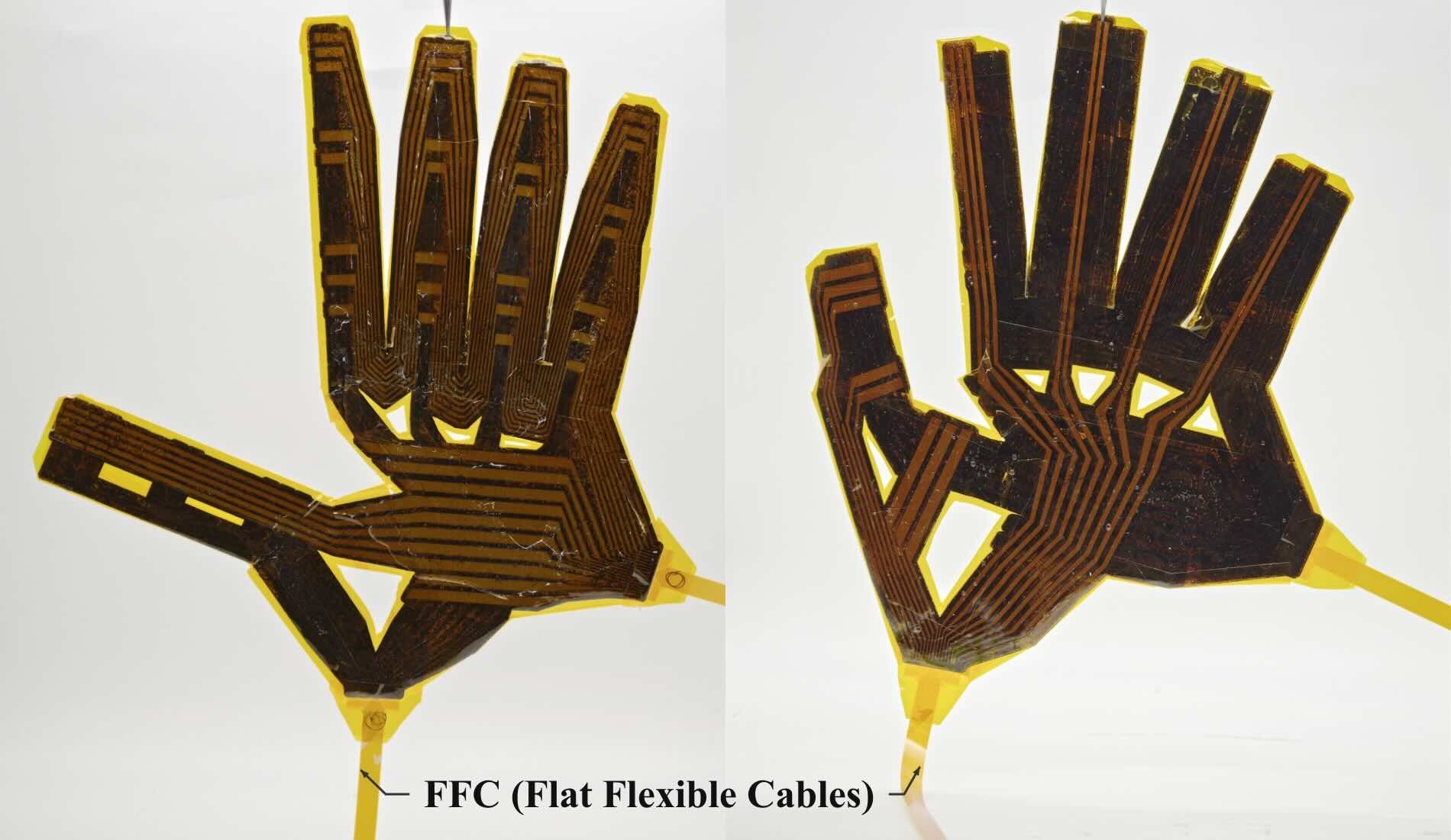
- We present SoTa, a low-cost capacitive tactile skin that provides full-hand coverage on humans and robots while preserving a shared layout of 202 taxels across corresponding finger and palm regions.
The SoTa Sensor
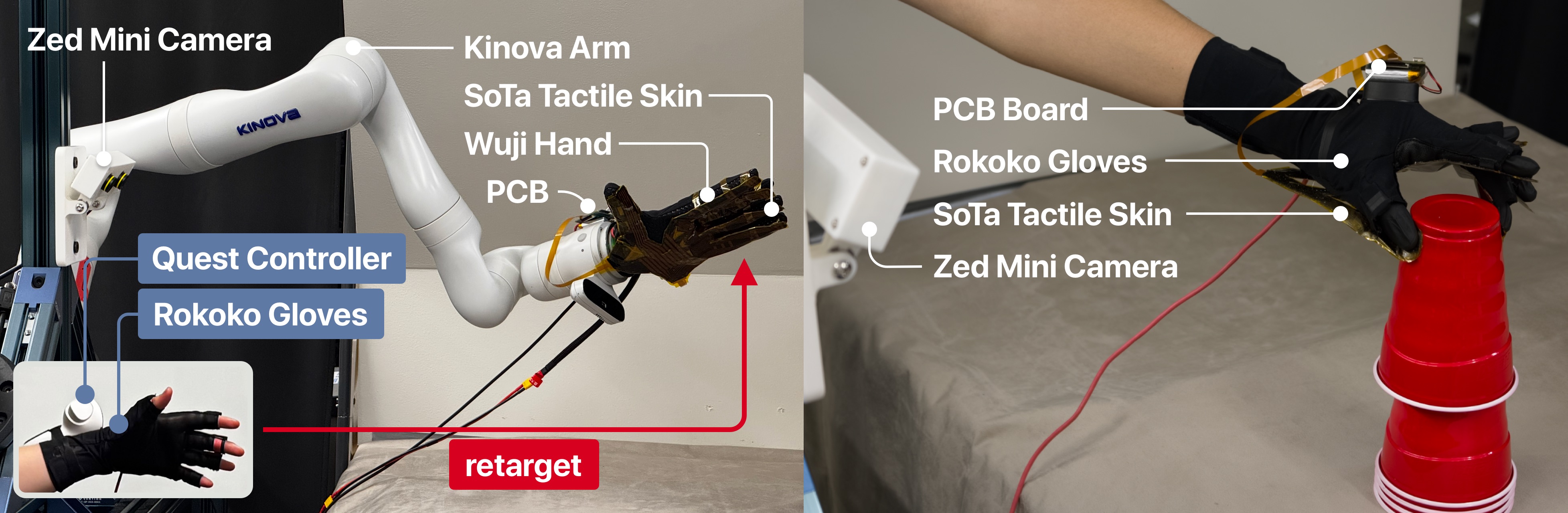
We describe our SoTa sensor design (Section III-A ), our visuo-tactile dexterous manipulation data collection setup, which supports human and robot demonstration collection (Section III-B ), and our policy learning architecture, with a shared tactile encoder across embodiments (Section III-C ). (a) (b) (c) (d) We build tactile skins for both the human demonstrator and the robot hand.
The devices are mechanically customized to each embodiment but share the same capacitive sensing principle, taxel size, and taxel count.
Experimental Evaluation
We evaluate three aspects of SoTa. First, we test whether tactile observations improve contact-rich manipulation relative to vision-only policies. Second, we examine the effects of auxiliary language supervision and human-robot co-training under a fixed robot data budget. Finally, we characterize sensor durability and motion-induced artifacts. Tasks.
Sources and Demonstrations
Figures are reproduced from Yang et al. See the full paper for experimental details and the project page, when the paper links one, for demonstrations and videos.
Related Papers
Design and Evaluation of a Touchscreen-Based Teleoperation Interface for Robotic Manipulators
Juan José García Cárdenas, Alperen Kenan, Hamidreza Raei et al.
Intuitive teleoperation interfaces are crucial for the safe and effective operation of robotic manipulators in challenging environments.
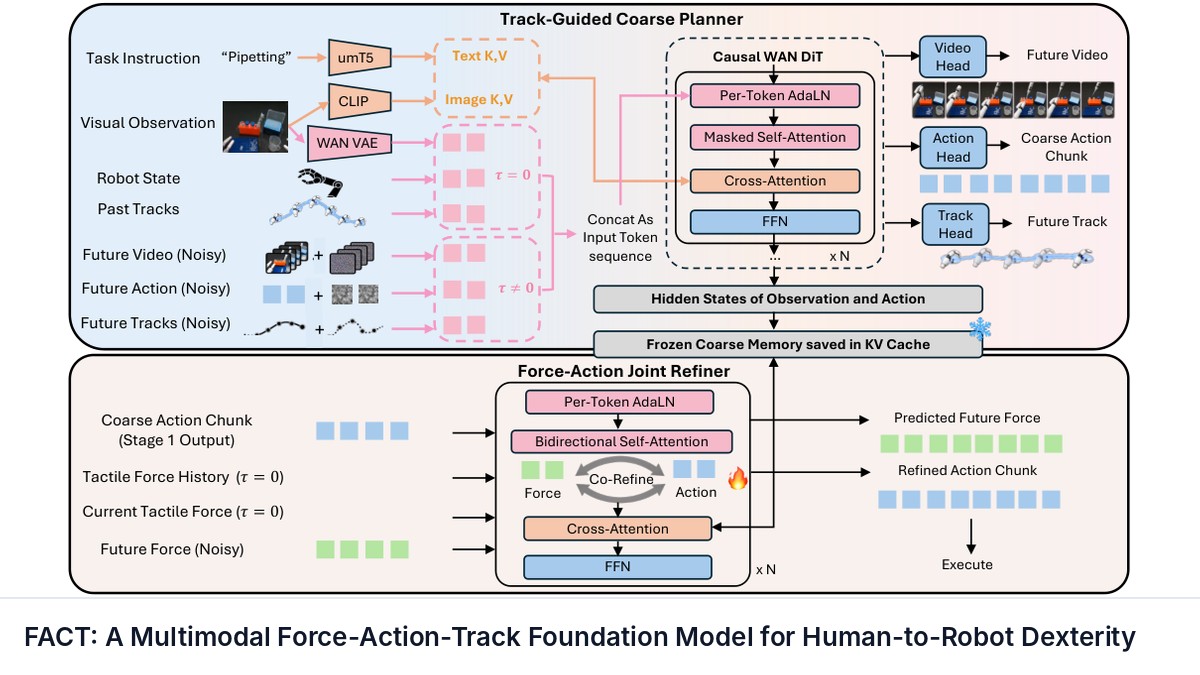
FACT: A Multimodal Force-Action-Track Foundation Model for Human-to-Robot Dexterity
Zhi Cao, Yining Hong, Jiaolong Yang et al.
Human demonstrations offer a scalable alternative to costly robot data collection for dexterous manipulation, but most human datasets lack force measurements.

A Sim-to-Real Integration Pipeline for Training and Deployment of Chunk-Based VLA Manipulation Policies
Mathilde Kappel, Clémence Grislain, Mohamed Chetouani et al.
Vision-Language-Action (VLA) models have become a prominent paradigm for mapping multimodal inputs, including semantic instructions, visual observations of the scene, and proprioceptive observations, to robot actions.
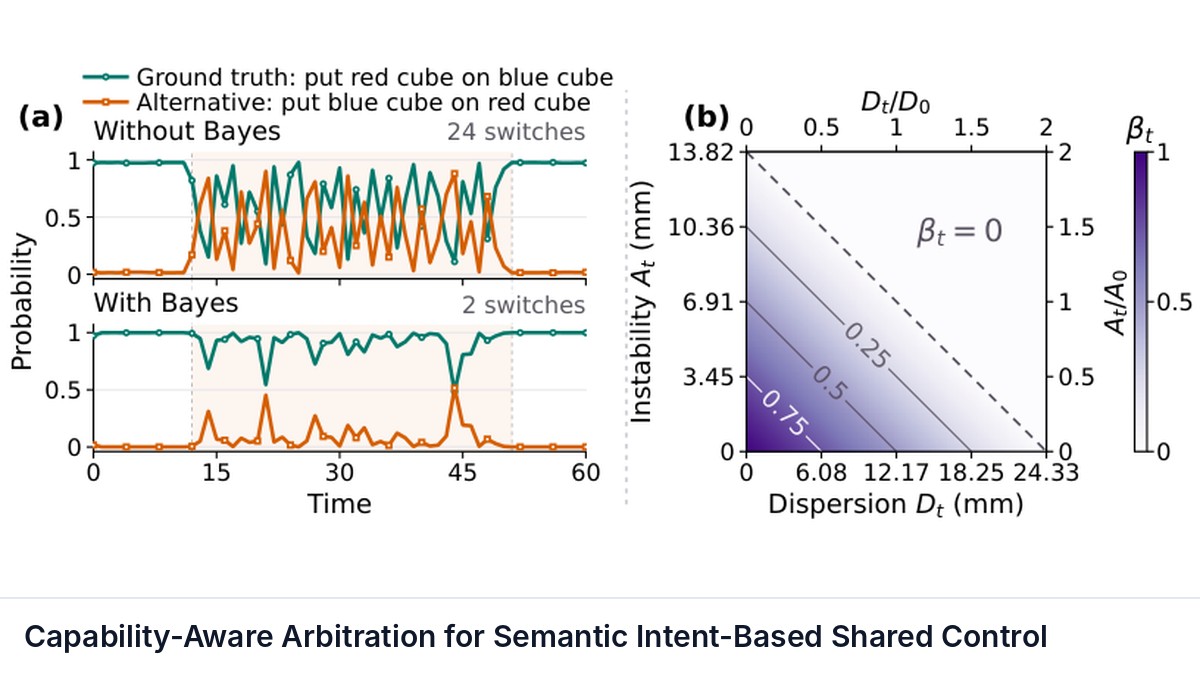
Capability-Aware Arbitration for Semantic Intent-Based Shared Control
Zhaoda Du, Michael Bowman, Xiaoli Zhang
Shared control often allocates robot authority based on confidence in inferred human intent, assuming reliable autonomous execution. When this assumption fails, high intent confidence can cause over-helping.