
PhAIL: A Real-Robot VLA Benchmark and Distributional Methodology
Sergey Arkhangelskiy · · 2026
Framework
N/A
License
N/A
Stars
0
Summary
Real-world evaluation of vision-language-action (VLA) policies still rests on binary success rate at a fixed timeout with N <= 25 rollouts per condition, almost always without confidence intervals or
Abstract Summary
Key Points
- Open real-robot benchmark on Franka FR3 for distributional evaluation of VLAs.
- Proposes time-to-success CDF and Human-Relative Throughput (HRT) metric.
- Bootstrap confidence intervals and per-object KS significance testing.
- Resolves close VLA comparisons that binary success rates miss.
- Dataset and analysis pipeline open-sourced at https://phail.ai.
Time-to-Success CDF as Evaluation Primitive
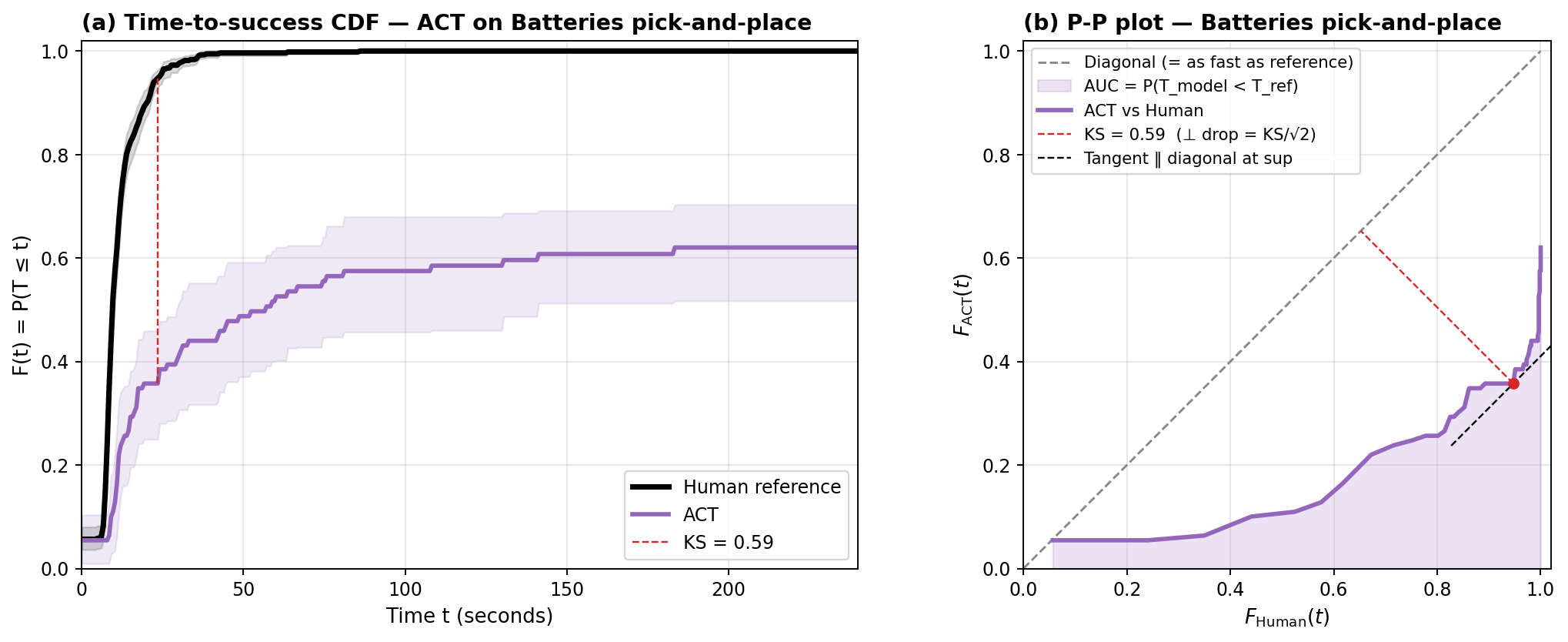
The methodology has three components: the random variable and its CDF (§ 3.1 ), the scoring layer (scalars and visualizations derived from the CDF, § 3.2 ), and the significance layer (distributional tests on the CDF, § 3.3 ). The strict separation between scoring (which ranks via a scalar’s CI) and significance (which tests whether two policies’ CDFs differ at all) is the methodological core.
PhAIL: Design, Protocol, and Power Budget
The evaluation station uses a DROID-style configuration [ 11 ] : a Franka Research 3 with a Robotiq 2F-85 parallel-jaw gripper, plus over-the-shoulder external and wrist-mounted RGB cameras.
The task is bin-to-bin order picking across four object types spanning a useful slice of physical regimes – wooden spoons (rigid, elongated, multi-grasp), towels (deformable), scissors (articulated, metallic), and batteries (small, rigid). Each rollout contains many independent placement operations, which we exploit for sample size.
Results
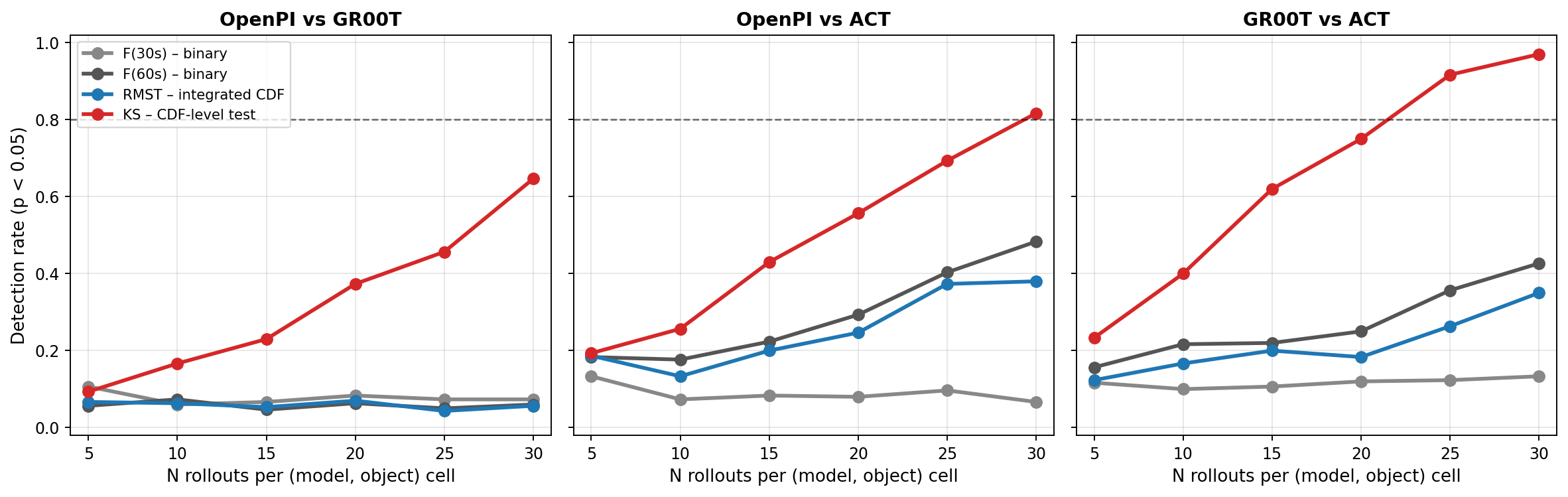
All numbers below use $\tau=240$ s for RMST, $n_{\text{boot}}=1000$ for episode-clustered bootstrap CIs, seed $0$. Per-(model, object) cell sizes are 32–46 episodes for OpenPI, GR00T, and ACT; 26–34 for SmolVLA. OpenPI and GR00T are within 0.5 percentage points of HRT, their 95% CIs overlap almost entirely ($[12.2,15.7]$ vs.
$[12.0,15.2]$), and they swap order between HRT (per-cell macro mean) and global RMST – two principled aggregations of the same primitive on this benchmark.
Sources and Demonstrations
Figures are reproduced from Arkhangelskiy See the full paper for experimental details and the project page, when the paper links one, for demonstrations and videos.
Related Papers
3DThinkVLA: Endowing Vision-Language-Action Models with Latent 3D Priors via 3D-Thinking-Guided Co-training
Jiaxin Shi, Xidong Zhang, Fucai Zhu et al.
We propose a 3D-thinking-guided co-training framework that enables vision-language-action (VLA) models to perform 3D spatial reasoning implicitly during action prediction.
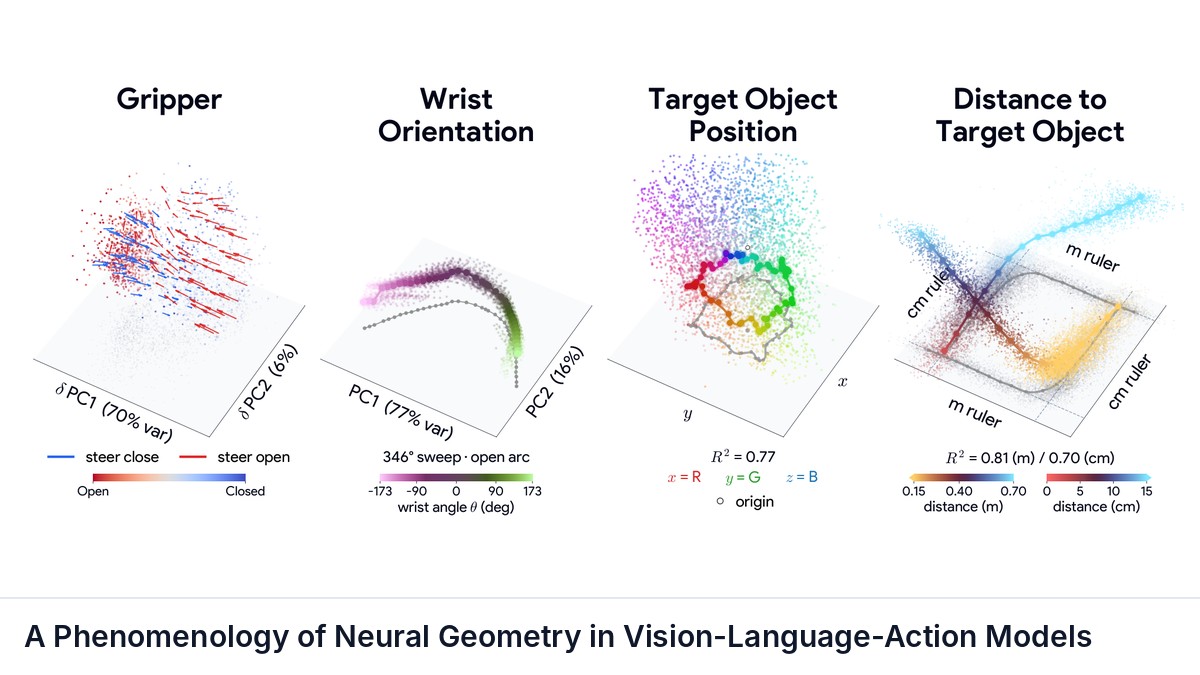
A Phenomenology of Neural Geometry in Vision-Language-Action Models
Mozes Jacobs, Aiden Swann, Mathilde Papillon et al.
Robotic manipulation is inherently geometric, but what shape does the world take inside the policy that performs it?

A Sim-to-Real Integration Pipeline for Training and Deployment of Chunk-Based VLA Manipulation Policies
Mathilde Kappel, Clémence Grislain, Mohamed Chetouani et al.
Vision-Language-Action (VLA) models have become a prominent paradigm for mapping multimodal inputs, including semantic instructions, visual observations of the scene, and proprioceptive observations, to robot actions.
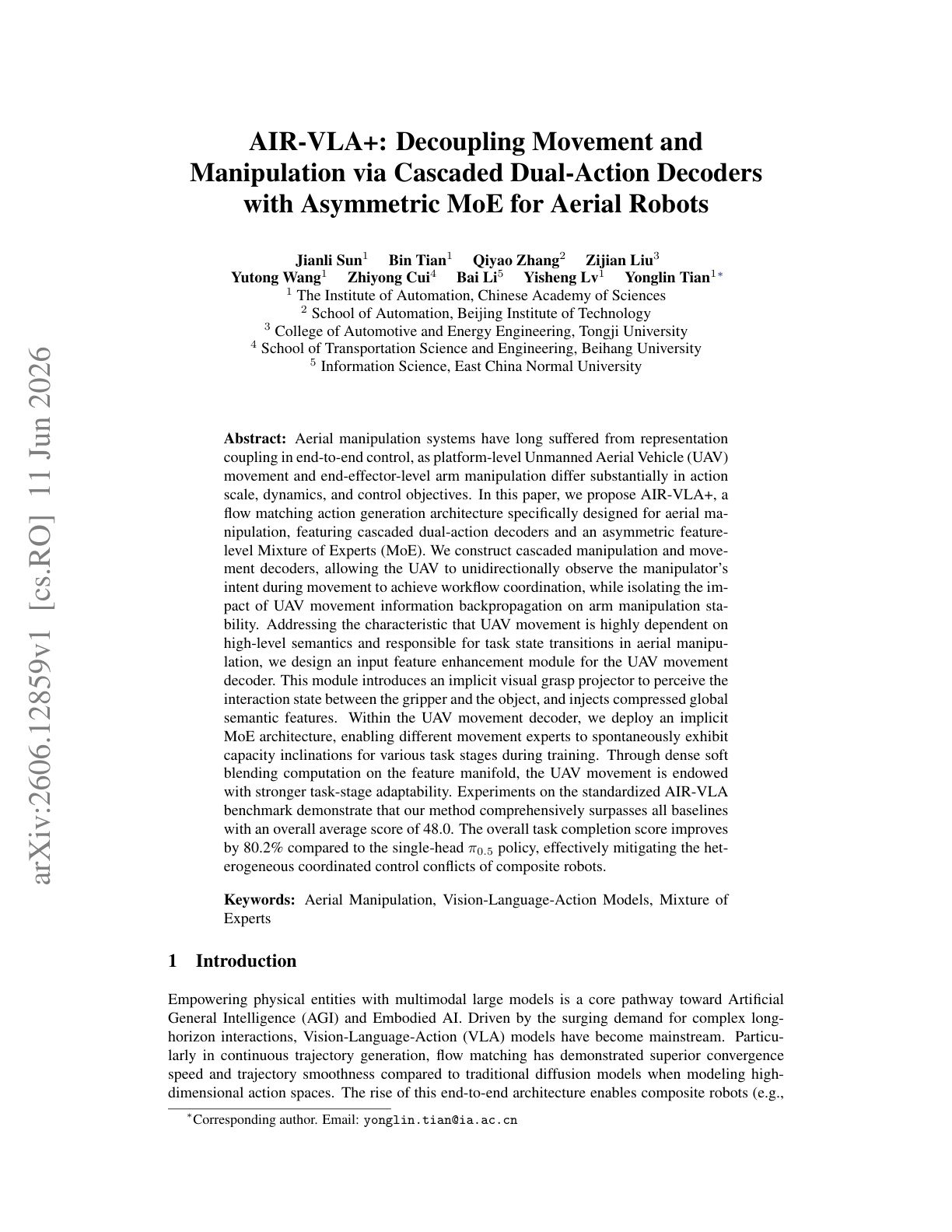
AIR-VLA+: Decoupling Movement and Manipulation via Cascaded Dual-Action Decoders with Asymmetric MoE for Aerial Robots
Jianli Sun, Bin Tian, Qiyao Zhang et al.
Aerial manipulation systems have long suffered from representation coupling in end-to-end control, as platform-level Unmanned Aerial Vehicle (UAV) movement and end-effector-level arm manipulation differ substantially in action scale, dynamics, and control objectives.