
Learning Options for Compositional Motor Control with Adapter Banks
Sreejan Kumar, Marcelo Mattar, Lea Duncker · N/A · 2026
Framework
N/A
License
N/A
Stars
N/A
Summary
Learning flexible motor primitives is a hallmark of skilled motor control. Recent neuroscience theory proposes that motor primitives may be implemented as low-rank perturbations of a shared recurrent network, but leaves open how such a system is learned.
Abstract Summary
Key Points
- Learning flexible motor primitives is a hallmark of skilled motor control
- Recent neuroscience theory proposes that motor primitives may be implemented as low-rank perturbations of a shared recurrent network, but leaves open how such a system is learned.
- We translate this principle into a novel architecture for learning motor skills end-to-end: a shared recurrent core modulated by a bank of residual adapters, each selected by a discrete latent code.
- Trained on closed-loop biomechanical control, the adapters develop emergent low-rank perturbations of the recurrent dynamics despite no architectural rank constraint, placing task representations in disparate subspaces of the shared core network.
- A simple high-level policy over the learned options, optimized while the whole network is frozen, sequences the low-rank adapters to produce novel out-of-distribution movements.
Low-rank Adapters via Thalamocortical Architectures in Neuroscience
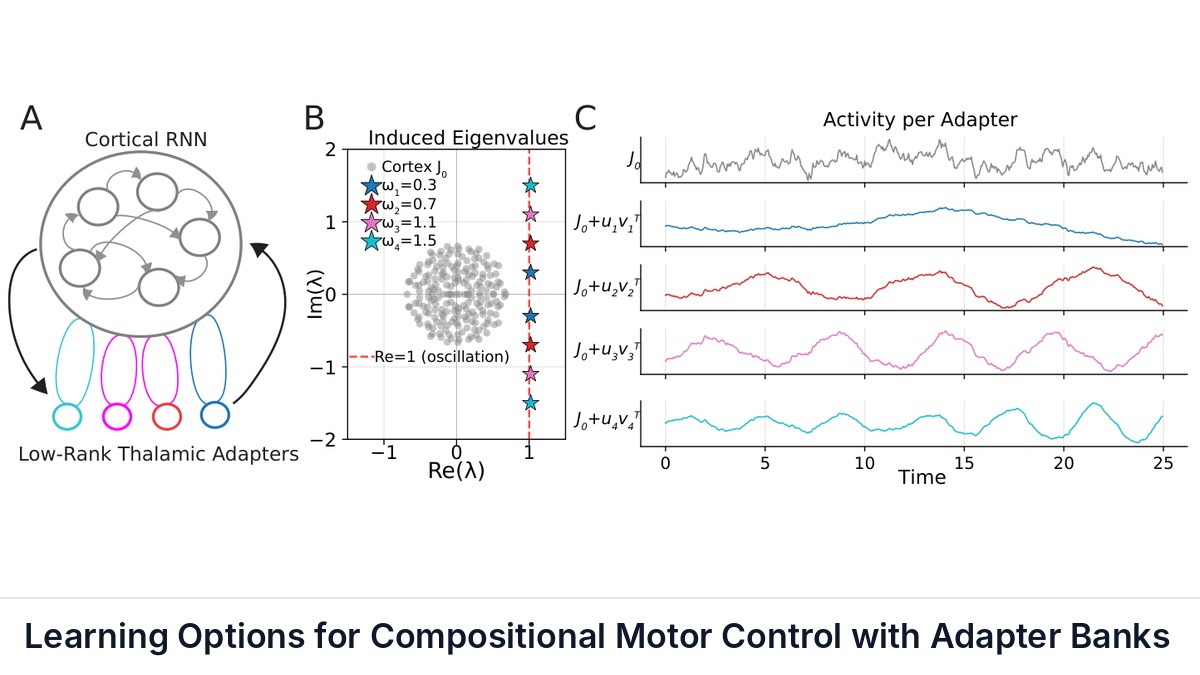
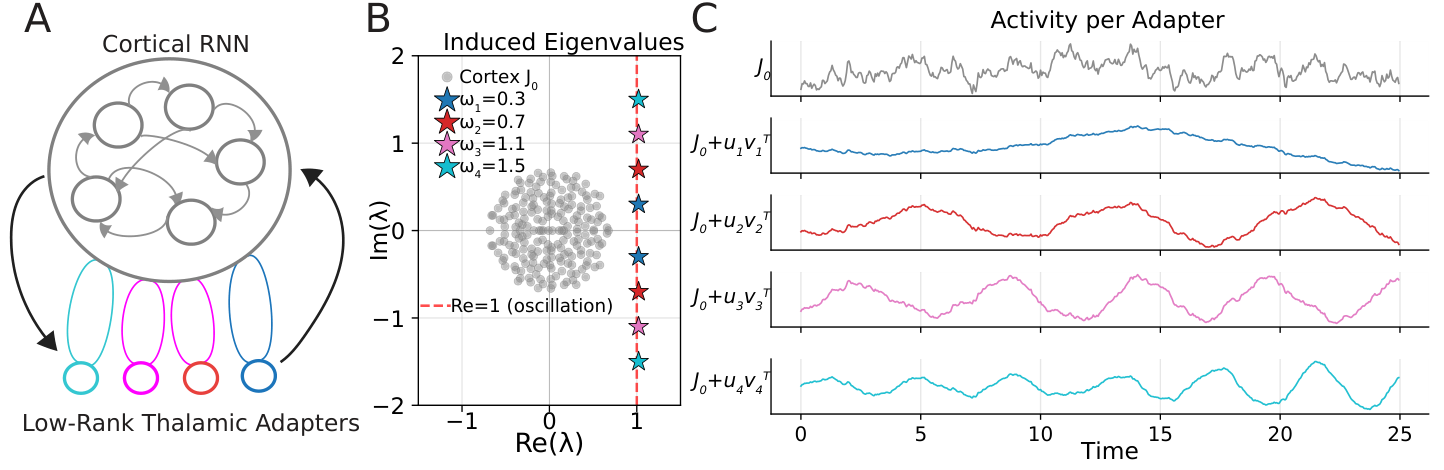
Theoretical work has proposed an architecture for composing motor primitives into flexible sequences, inspired by the connectivity between motor cortex, thalamus and basal ganglia in the brain [ 12 ] . Here, motor primitives are implemented through an interplay of the recurrence in motor cortex, and cortex-thalamus-cortex projections (thalamocortical loops, Figure 1 A).
Learning Adapters for Flexible Motor Control
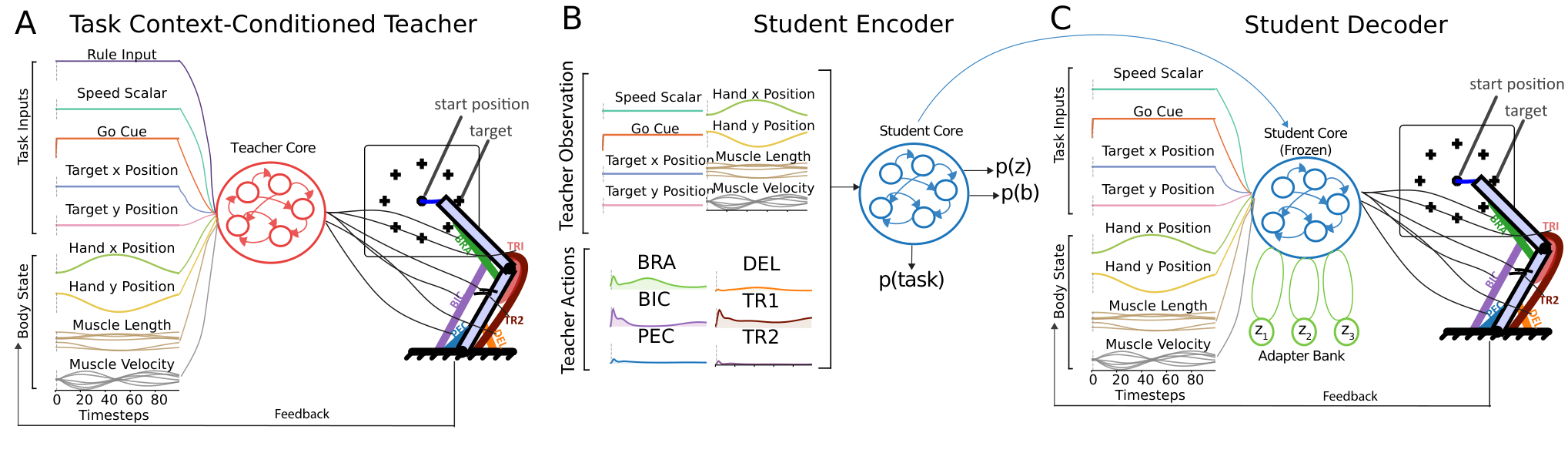
To understand how learning system can discover reusable building blocks of behavior that flexibly recombine to solve new problems, we turn to the domain of closed-loop biomechanical motor control. We adopt a closed-loop biomechanical control task from Lazzari and Saxena [18] .
In this task, an RNN is required to control a two-link biomechanical arm with six muscles to generate a variety of movement types: straight reaches, clockwise and counterclockwise circular arcs, and sinusoidal trajectories.
Results
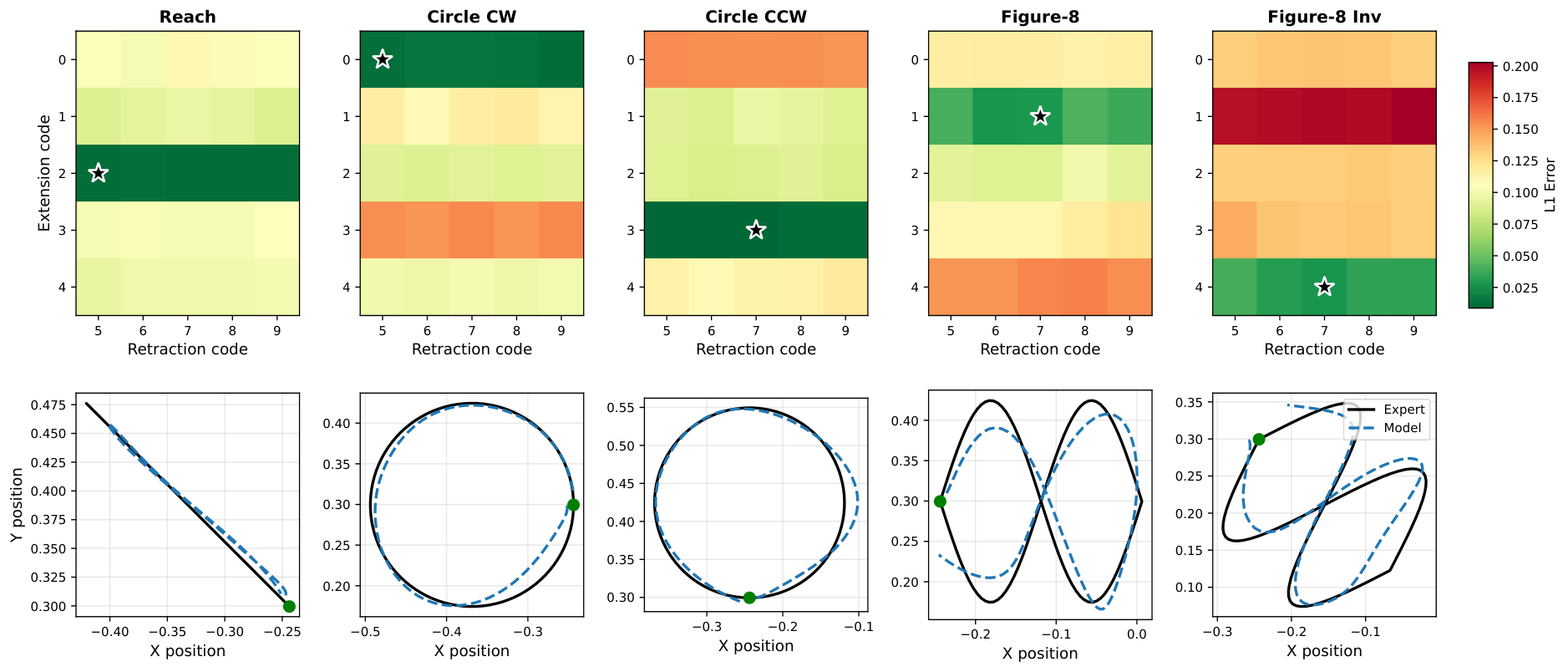
We first verify that the student successfully reproduces the teacher’s compound movements (Figure 3 , bottom row). Trained only on compound trajectories and without ever being supplied the rule as input, the student traces the expert circles, figure-eights, and reaches with end-to-end hand L1 of approximately order $10^{-2}$ m on all five tasks.
The reach is essentially exact; the figure-eights show closed-loop wobble deviations, but recover the general shape. The more revealing analysis is the forced-code sweep (Figure 3 , top row).
Sources and Demonstrations
Figures are reproduced from Kumar et al. See the full paper for experimental details and the project page, when the paper links one, for demonstrations and videos.
Related Papers
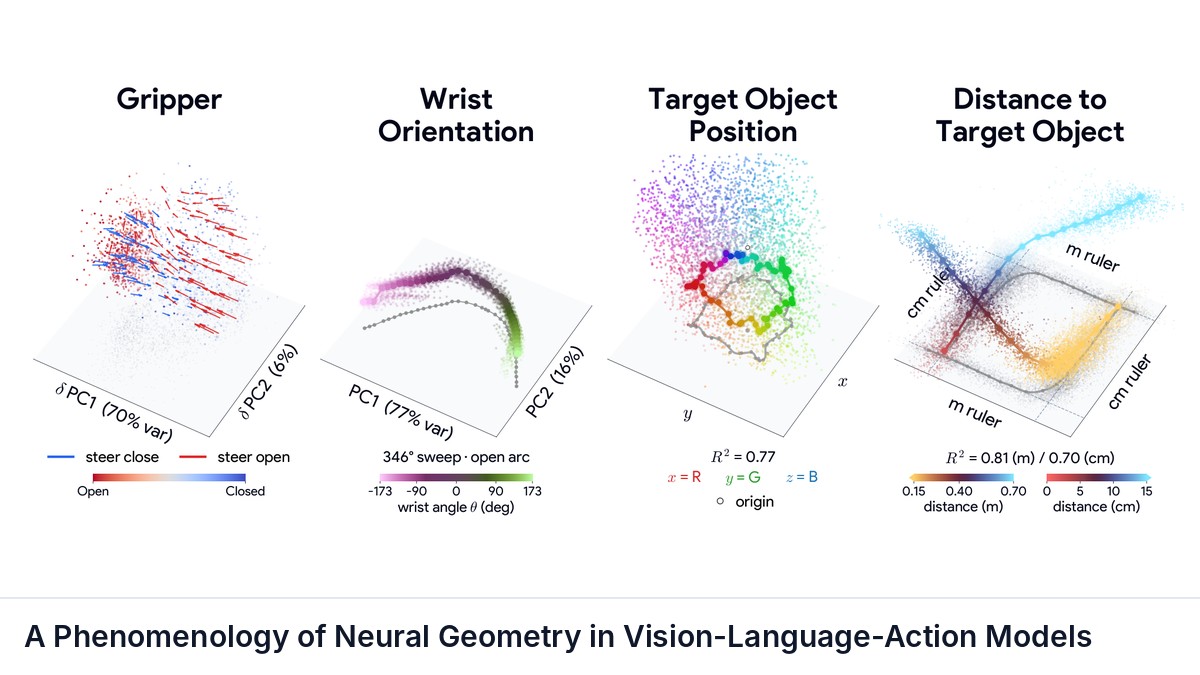
A Phenomenology of Neural Geometry in Vision-Language-Action Models
Mozes Jacobs, Aiden Swann, Mathilde Papillon et al.
Robotic manipulation is inherently geometric, but what shape does the world take inside the policy that performs it?

A Sim-to-Real Integration Pipeline for Training and Deployment of Chunk-Based VLA Manipulation Policies
Mathilde Kappel, Clémence Grislain, Mohamed Chetouani et al.
Vision-Language-Action (VLA) models have become a prominent paradigm for mapping multimodal inputs, including semantic instructions, visual observations of the scene, and proprioceptive observations, to robot actions.
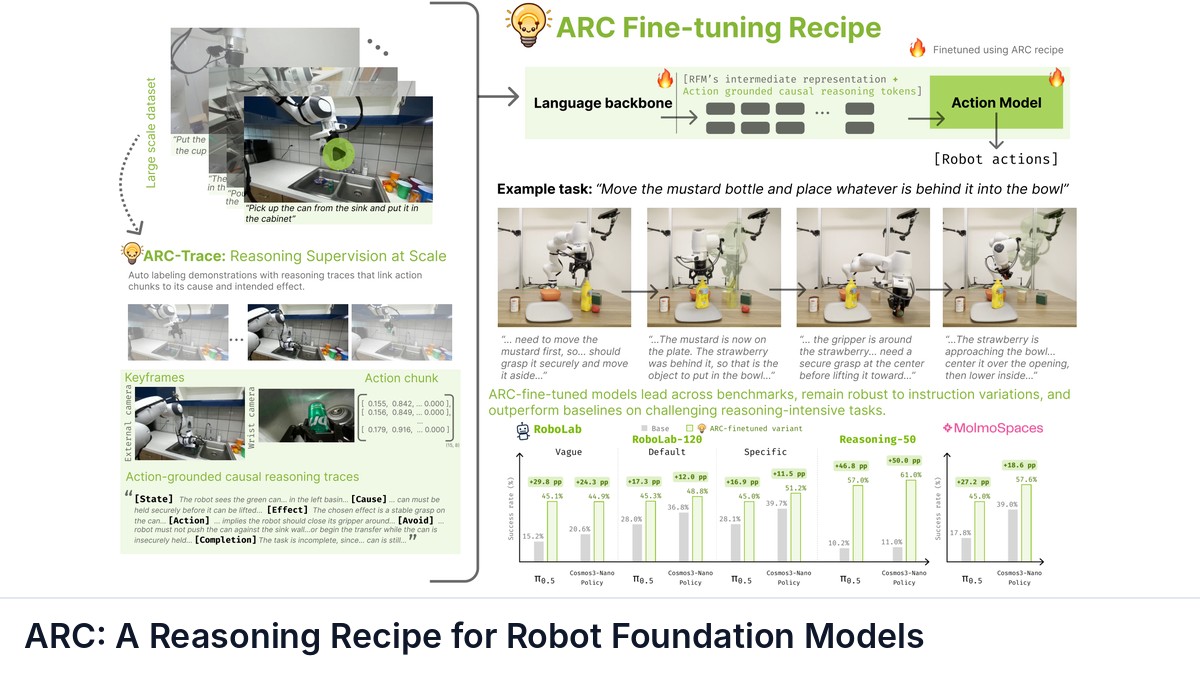
ARC: A Reasoning Recipe for Robot Foundation Models
Gokul Puthumanaillam, Tao Sun, Elie Aljalbout et al.
The prevailing approach to improving robot foundation models (RFMs) relies on larger models, more robot demonstrations, and costly training at scale.
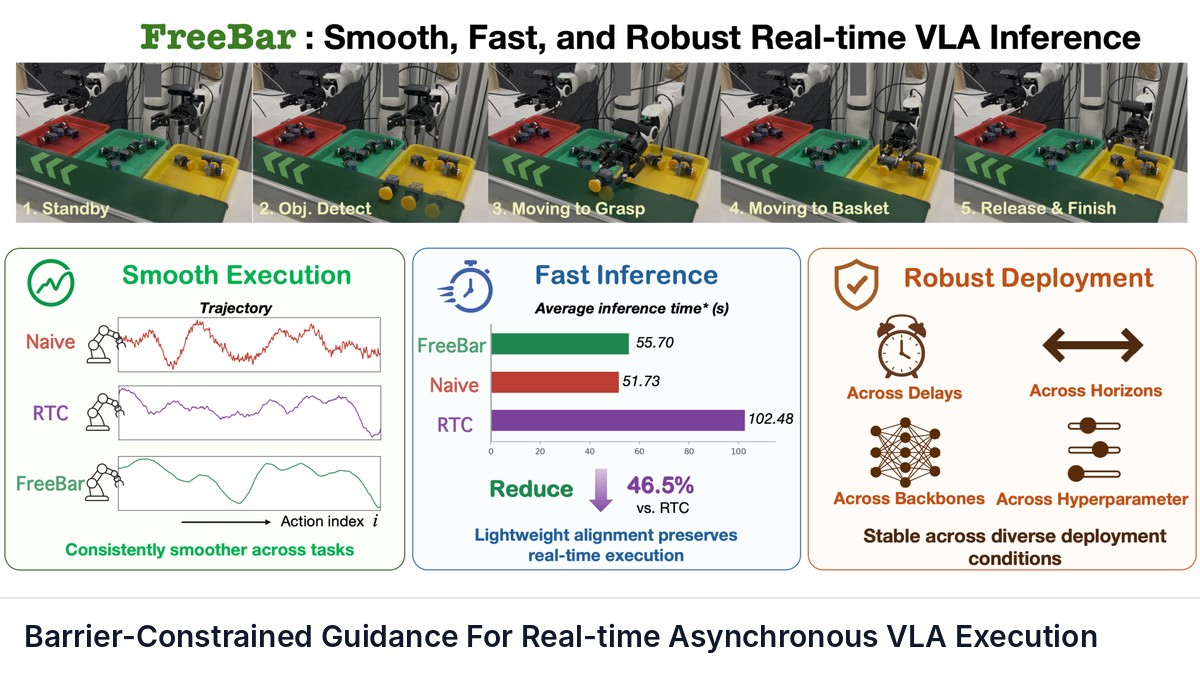
Barrier-Constrained Guidance For Real-time Asynchronous VLA Execution
Wenbo Yu, Jifan Li, Wenke Xia et al.
While asynchronous execution enables VLA models to operate in real-time environments by predicting the next chunk during execution, it inevitably introduces boundary misalignment with the committed action stream.