
Barrier-Constrained Guidance For Real-time Asynchronous VLA Execution
Wenbo Yu, Jifan Li, Wenke Xia, Yuchen Li, Yizhuo Zhang, Pei Ren, Zhengping Che, Di hu · N/A · 2026
Framework
N/A
License
N/A
Stars
N/A
Summary
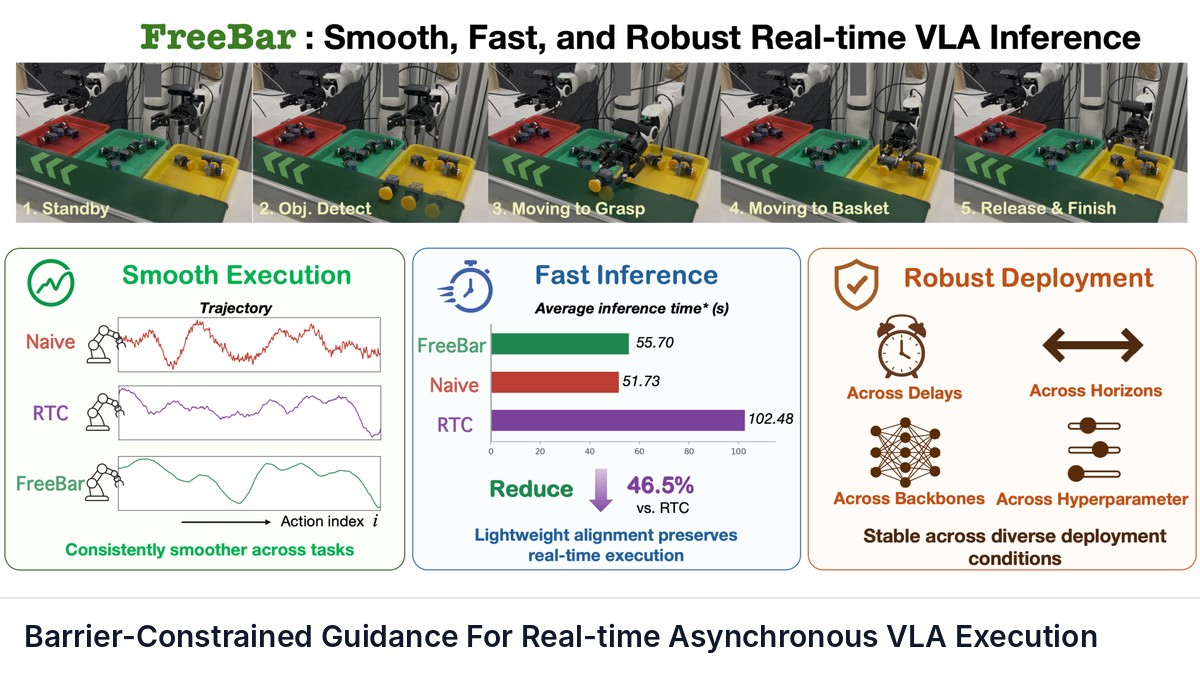
While asynchronous execution enables VLA models to operate in real-time environments by predicting the next chunk during execution, it inevitably introduces boundary misalignment with the committed action stream.
Abstract Summary
Key Points
- While asynchronous execution enables VLA models to operate in real-time environments by predicting the next chunk during execution, it inevitably introduces boundary misalignment with the committed action stream.
- Existing delay-aware solutions address this at the prohibitive cost of extensive retraining, architectural modifications, or fixed-prefix inpainting that inflates computation when low latency is vital.
- To address these problems, we propose FreeBar, a training-free real-time inference plugin that enables robust asynchronous execution with only marginal additional inference cost by casting chunk alignment in flow-based VLAs as barrier-guided action-space constraint.
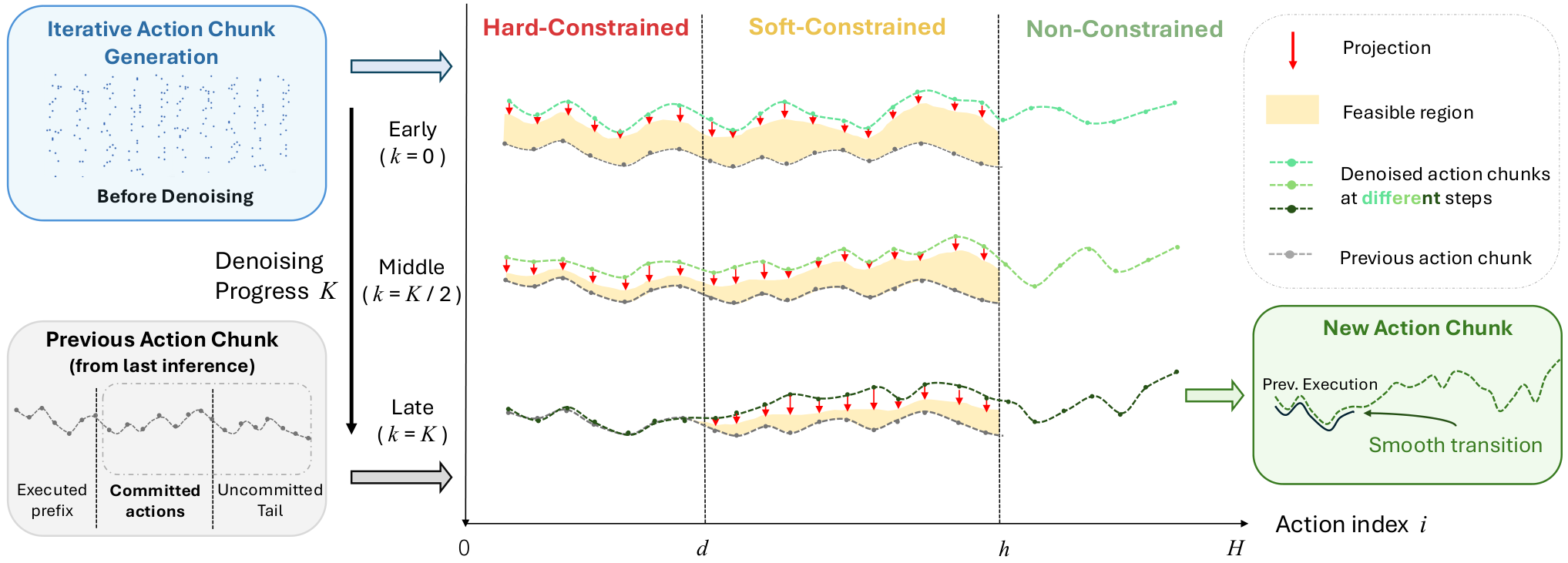
- Specifically, FreeBar introduces a lightweight Control Barrier Function (CBF)-inspired consistency constraint between consecutive action chunks and solves the resulting correction in closed form, avoiding costly backpropagation through the VLA action head.
- By progressively tightening the consistency bound during generation, FreeBar aligns generated chunks with the committed execution stream while preserving early-stage generative and within-chunk future action flexibility,.
Method
We propose FreeBar, a training-free inference plugin for real-time asynchronous VLA execution. Instead of using VJP-based gradient guidance, FreeBar applies a closed-form action-space projection that aligns the generated chunk with the ongoing execution stream.
The projection imposes a feasible correction set that contracts over denoising time and across the prediction horizon, preserving short-term continuity while ensuring the generation fidelity of the entire action chunk.
Experiments
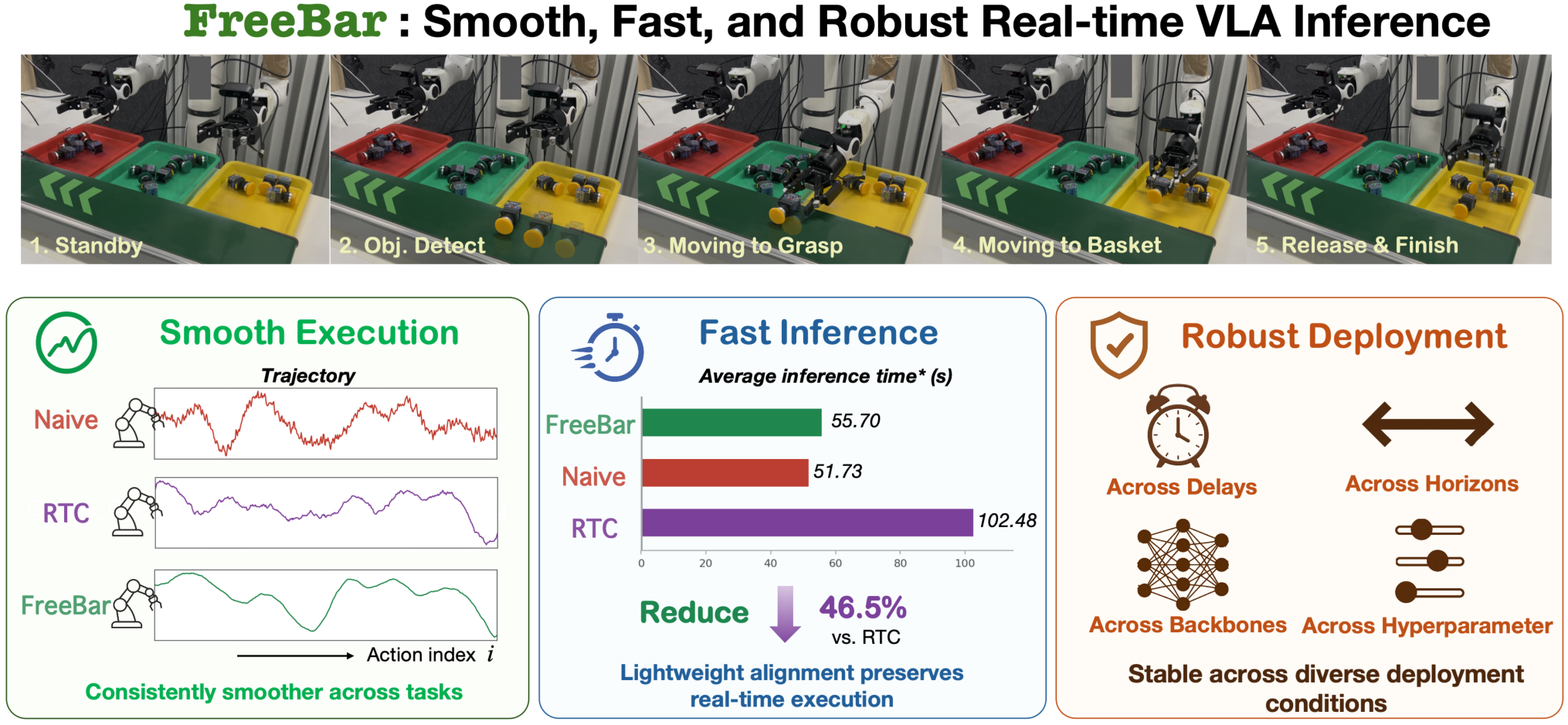
To comprehensively evaluate our method, we design our experiments to investigate four key aspects: (1) the improvement of task success rates and execution stability under asynchronous inference in both simulated and real-world environments; (2) the reduction in inference overhead compared to VJP-based baselines like RTC; (3) the necessity of core components, specifically the horizon-wise graded constraints; and (4) the method’s robustness across diverse delay conditions, execution horizons, hyperparameters, and base VLA policies.
Sources and Demonstrations
Figures are reproduced from Yu et al. See the full paper for experimental details and the project page, when the paper links one, for demonstrations and videos.
Related Papers
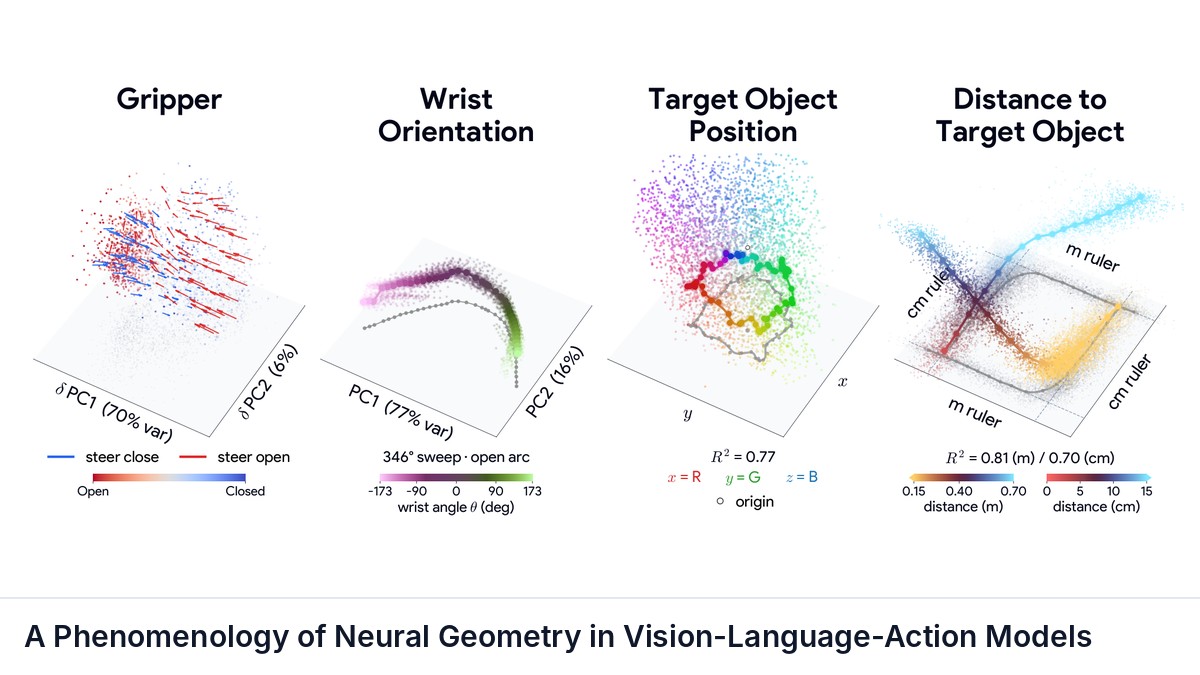
A Phenomenology of Neural Geometry in Vision-Language-Action Models
Mozes Jacobs, Aiden Swann, Mathilde Papillon et al.
Robotic manipulation is inherently geometric, but what shape does the world take inside the policy that performs it?

A Sim-to-Real Integration Pipeline for Training and Deployment of Chunk-Based VLA Manipulation Policies
Mathilde Kappel, Clémence Grislain, Mohamed Chetouani et al.
Vision-Language-Action (VLA) models have become a prominent paradigm for mapping multimodal inputs, including semantic instructions, visual observations of the scene, and proprioceptive observations, to robot actions.
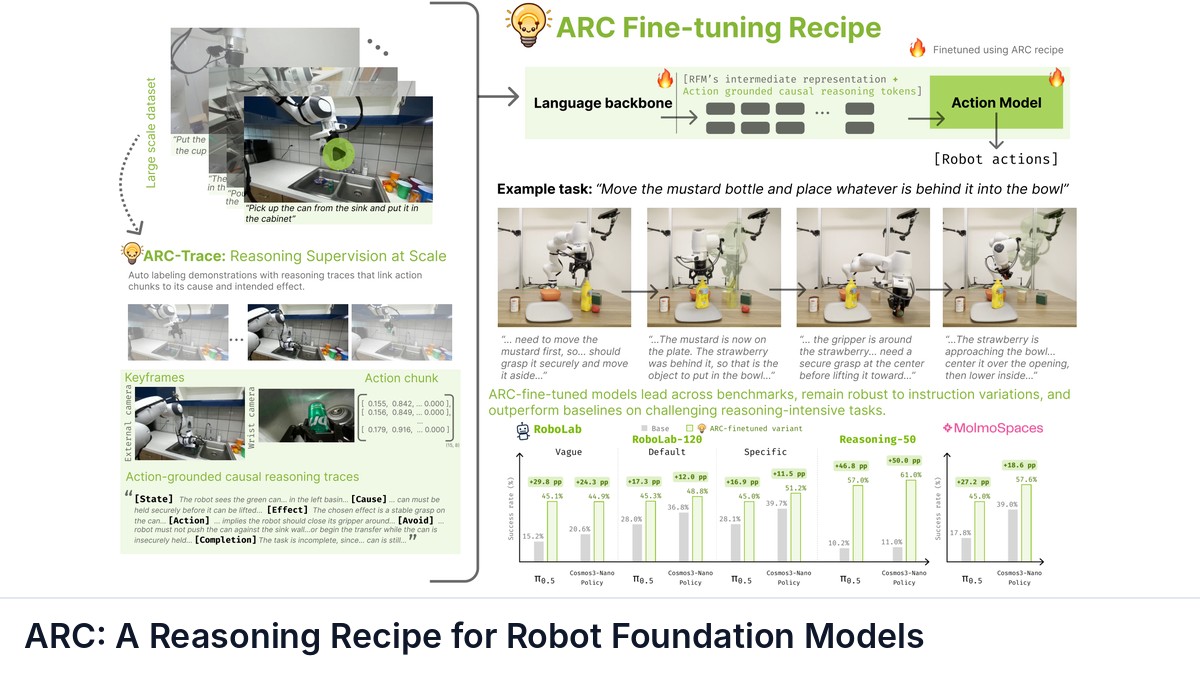
ARC: A Reasoning Recipe for Robot Foundation Models
Gokul Puthumanaillam, Tao Sun, Elie Aljalbout et al.
The prevailing approach to improving robot foundation models (RFMs) relies on larger models, more robot demonstrations, and costly training at scale.
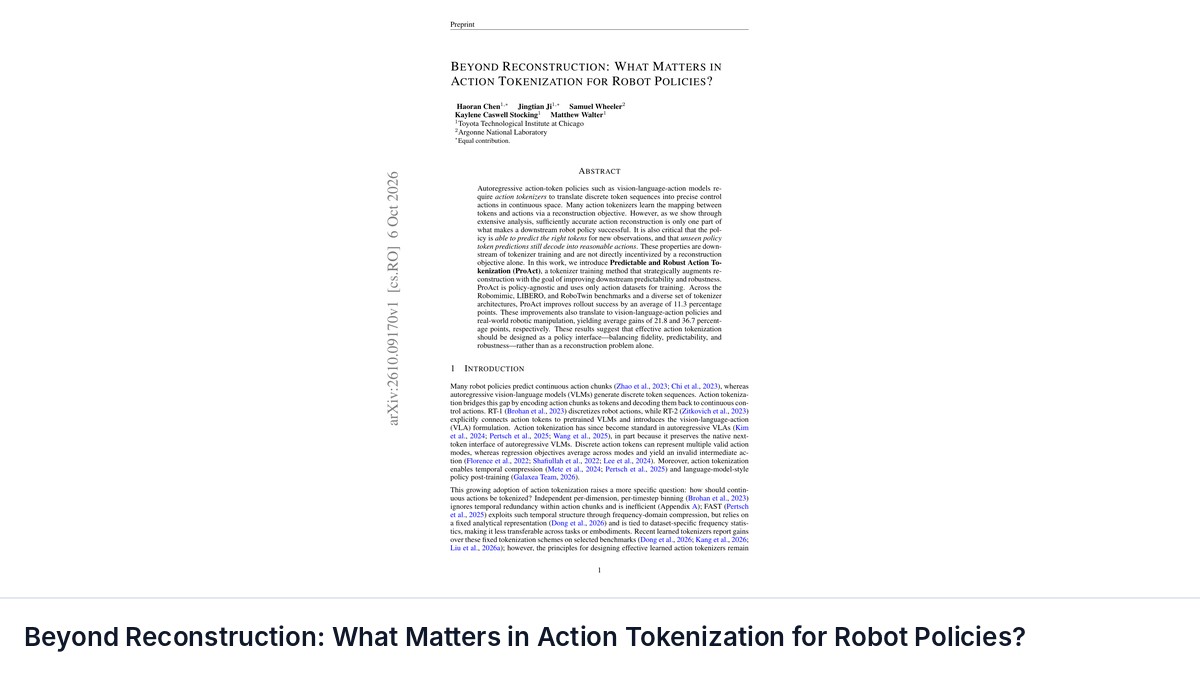
Beyond Reconstruction: What Matters in Action Tokenization for Robot Policies?
Haoran Chen, Jingtian Ji, Samuel Wheeler et al.
Autoregressive action-token policies such as vision-language-action models require action tokenizers to translate discrete token sequences into precise control actions in continuous space. Many action tokenizers learn the mapping between tokens and actions via a reconstruction objective.