
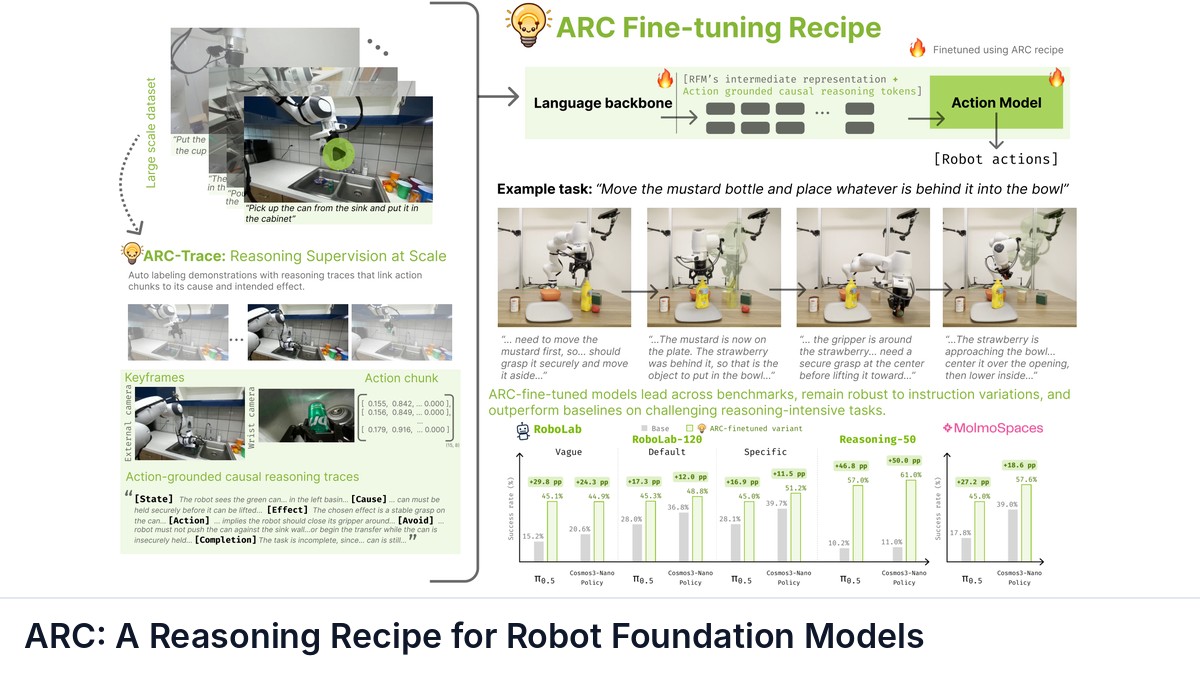
ARC: A Reasoning Recipe for Robot Foundation Models
Gokul Puthumanaillam, Tao Sun, Elie Aljalbout, Moritz Reuss, Zhaoshuo Li, Fabio Ramos, Ankit Goyal, Jenai Xuning Yang · N/A · 2026
Framework
N/A
License
N/A
Stars
N/A
Summary
The prevailing approach to improving robot foundation models (RFMs) relies on larger models, more robot demonstrations, and costly training at scale.
Abstract Summary
Key Points
- The prevailing approach to improving robot foundation models (RFMs) relies on larger models, more robot demonstrations, and costly training at scale.
- We show that there exists an effective and efficient complementary approach: the right reasoning recipe can substantially improve the zero-shot task performance of existing state-of-the-art RFMs.
- We refer to this recipe as ARC
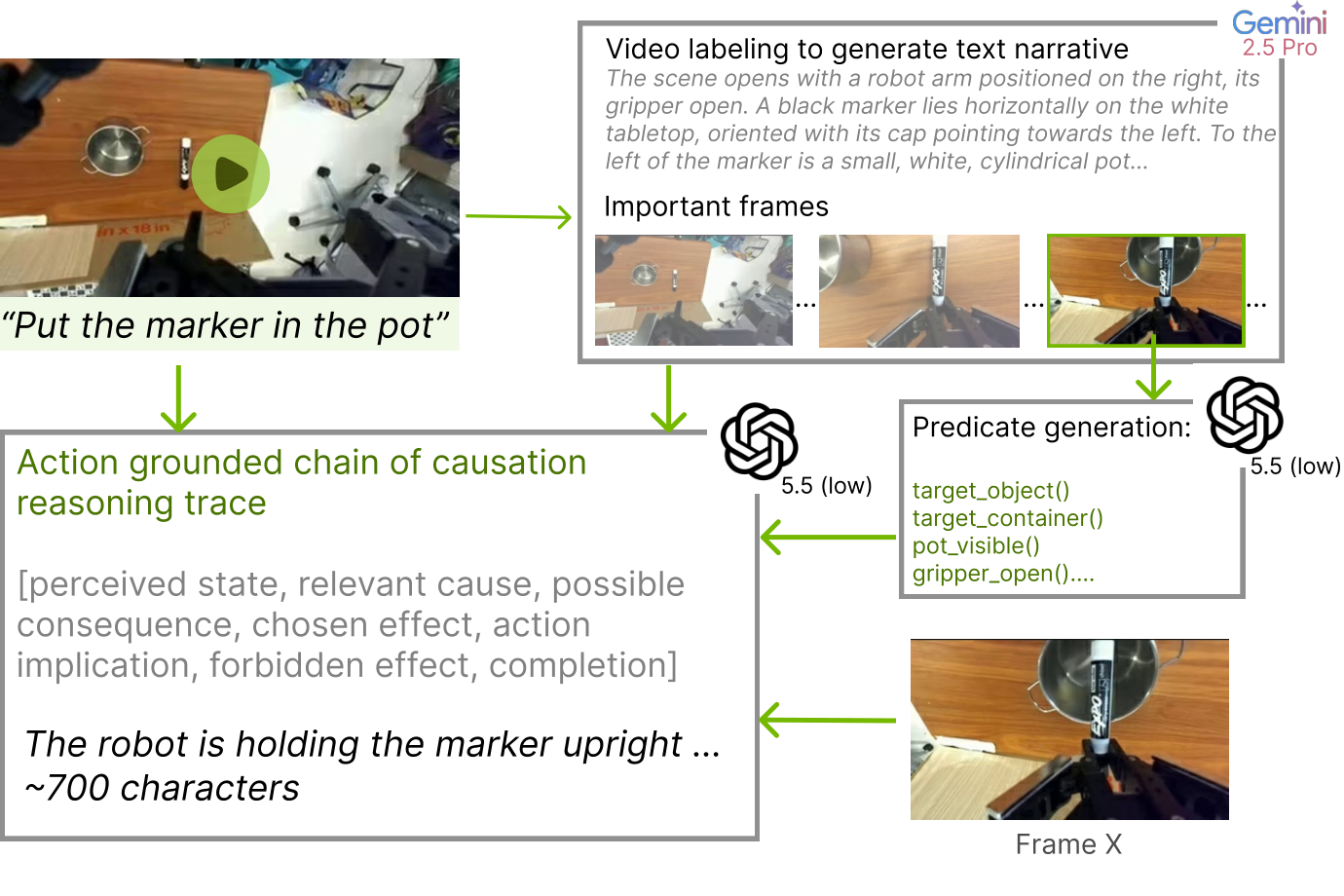
- It consists of three key ingredients: a reasoning trace, a scalable automatic labeling pipeline, and a strategy for adapting pretrained RFMs to use these traces for control.
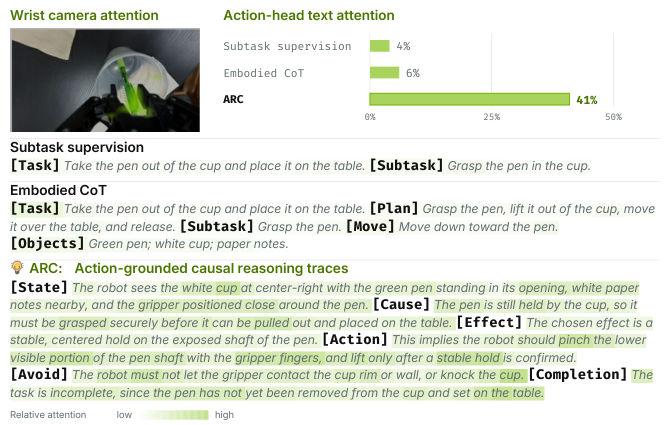
- First, we find that effective reasoning traces should be grounded in the robot's next action and explain its causal structure: why the action is appropriate and what effect it should produce.
Preliminaries and Problem Statement
Robot task setting. We consider a robot operating in a partially observed environment. A task is specified by an instruction $g\in\mathcal{G}$. At time $t$, the robot receives an observation $o_{t}\in\mathcal{O}$ and executes an action $a_{t}$ $\in\mathcal{A}$.
We denote the interaction history by $h_{t}=(o_{0},a_{0},\ldots,a_{t-1},o_{t}).$ To cover models that predict several actions at once, we write $\mathbf{a}_{t}=(a_{t},\ldots,a_{t+H-1})$ for an action chunk of horizon $H$.
The Arc Framework
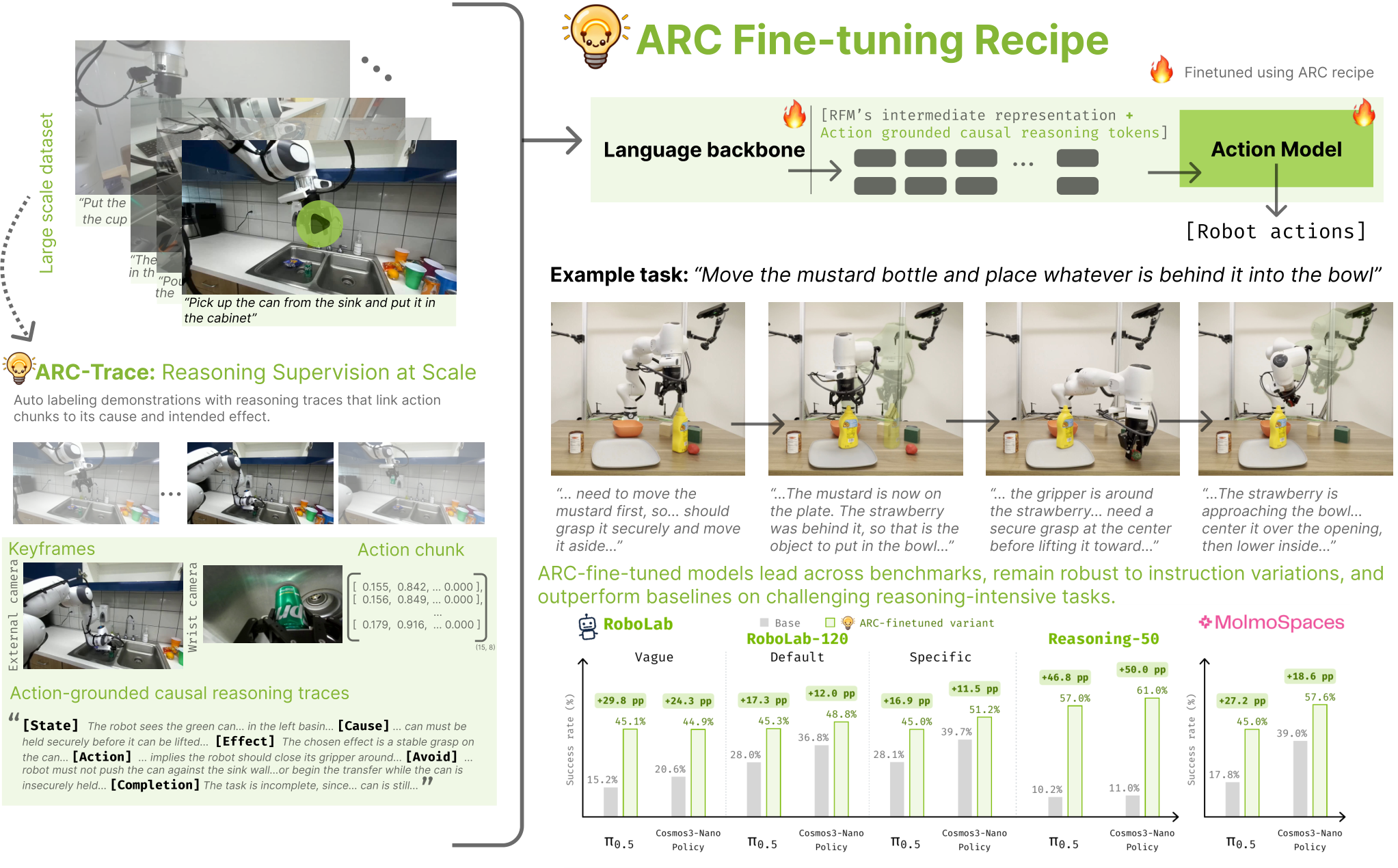
We now describe the components of Arc : the reasoning representation (Sec. 4.1 ), the Arc -Trace relabeling pipeline (Sec. 4.2 ), and the fine-tuning recipe that connects reasoning to control (Sec. 4.3 ). We represent $r_{t}$ in natural language, reusing the model’s pretrained language conditioning.
We examine ECoT-style reasoning and semantic subtask supervision, adapting both formats to the same $\pi_{0.5}$ backbone and fine-tuning it with each ( Zawalski et al., 2024 ; Black et al., 2025a ) .
Experiments
We evaluate $\pi_{0.5}$+ Arc (VLA) and Cosmos3-Nano+ Arc (WAM) (both finetuned on Arc -Trace-DROID) zero-shot on RoboLab-120 ( Yang et al., 2026 ) , MolmoSpaces ( Kim et al., 2026 ) , and RoboLab-Reasoning-50. We additionally evaluate Arc -$\pi_{0.5}$ on paired real-world tasks without further fine-tuning. All simulation and hardware experiments use the DROID embodiment.
We use Qwen3.6-35B-A3B as the default external VLM (ablated in section 5.2 ). General task performance.
AI Use Statement
We used vision-language models to automatically generate action-grounded causal annotations for ARC-Trace and, during evaluation, to generate reasoning traces from task instructions and camera observations. The models and prompting procedures are described in the methodology and appendix. Large language models also assisted with manuscript drafting and editing.
The authors take responsibility for the final manuscript, reported results, and all AI-assisted content.

Reproducibility statement
We describe ARC’s reasoning representation and training objectives in Sections 4.1 and 4.3 . Appendix A.1 details the ARC-Trace construction pipeline and labeling prompts. Model-specific training configurations and hyperparameters are provided in Appendices B.1 and B.2 , while inference prompts and deployment procedures are documented in Appendices B.3 and B.3.1 .
The evaluation protocols, benchmark construction, baseline implementations, and hardware setup are described in Appendices C.1.3 , C.3 , and C.2 .

Sources and Demonstrations
Figures are reproduced from Puthumanaillam et al. See the full paper for experimental details and the project page, when the paper links one, for demonstrations and videos.
Related Papers

A Sim-to-Real Integration Pipeline for Training and Deployment of Chunk-Based VLA Manipulation Policies
Mathilde Kappel, Clémence Grislain, Mohamed Chetouani et al.
Vision-Language-Action (VLA) models have become a prominent paradigm for mapping multimodal inputs, including semantic instructions, visual observations of the scene, and proprioceptive observations, to robot actions.

Capability-Aware Arbitration for Semantic Intent-Based Shared Control
Zhaoda Du, Michael Bowman, Xiaoli Zhang
Shared control often allocates robot authority based on confidence in inferred human intent, assuming reliable autonomous execution. When this assumption fails, high intent confidence can cause over-helping.
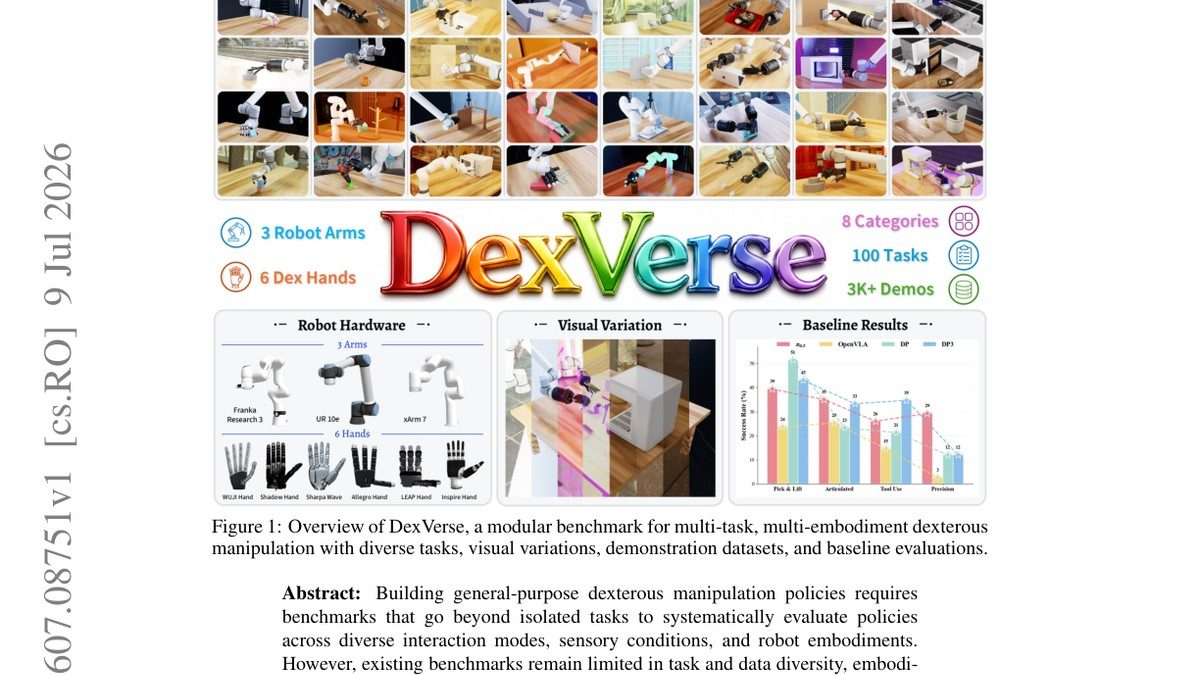
DexVerse: A Modular Benchmark for Multi-Task, Multi-Embodiment Dexterous Manipulation
Yunchao Yao, Zhuxiu Xu, Tianqi Zhang et al.
Building general-purpose dexterous manipulation policies requires benchmarks that go beyond isolated tasks to systematically evaluate policies across diverse interaction modes, sensory conditions, and robot embodiments.
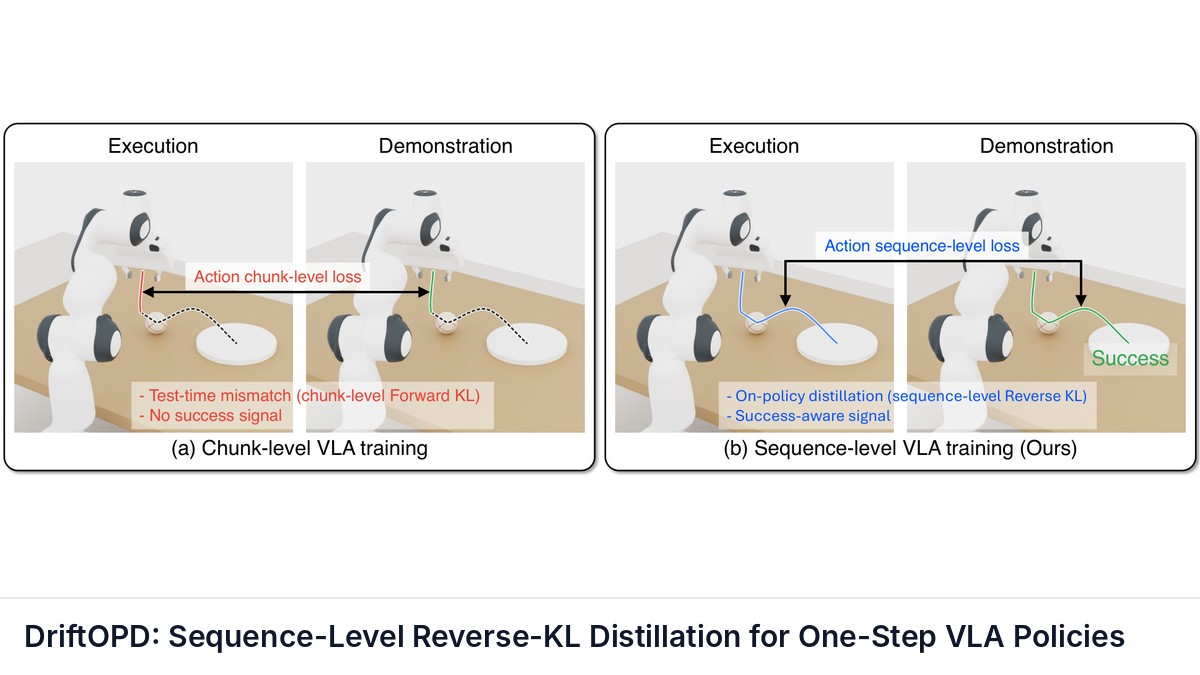
DriftOPD: Sequence-Level Reverse-KL Distillation for One-Step VLA Policies
Youngjun Jun, Kyumin Choi, Youngmin Kim et al.
Vision-Language-Action (VLA) models increasingly rely on action experts that generate short action chunks under receding-horizon control.