
DriftOPD: Sequence-Level Reverse-KL Distillation for One-Step VLA Policies
Youngjun Jun, Kyumin Choi, Youngmin Kim, Seonghyun Jin, Sunwoo Park, Jangho Park, Jong Chul Ye · N/A · 2026
Framework
N/A
License
N/A
Stars
N/A
Summary
Vision-Language-Action (VLA) models increasingly rely on action experts that generate short action chunks under receding-horizon control.
Abstract Summary
Key Points
- Vision-Language-Action (VLA) models increasingly rely on action experts that generate short action chunks under receding-horizon control.
- While chunk-level training is convenient across robot embodiments, it optimizes local action likelihood without explicitly accounting for long-horizon task success.
- Sequence-level reinforcement learning can address this limitation, but typically requires policy rollouts and closed-loop interaction, which are costly for real-robot manipulation.
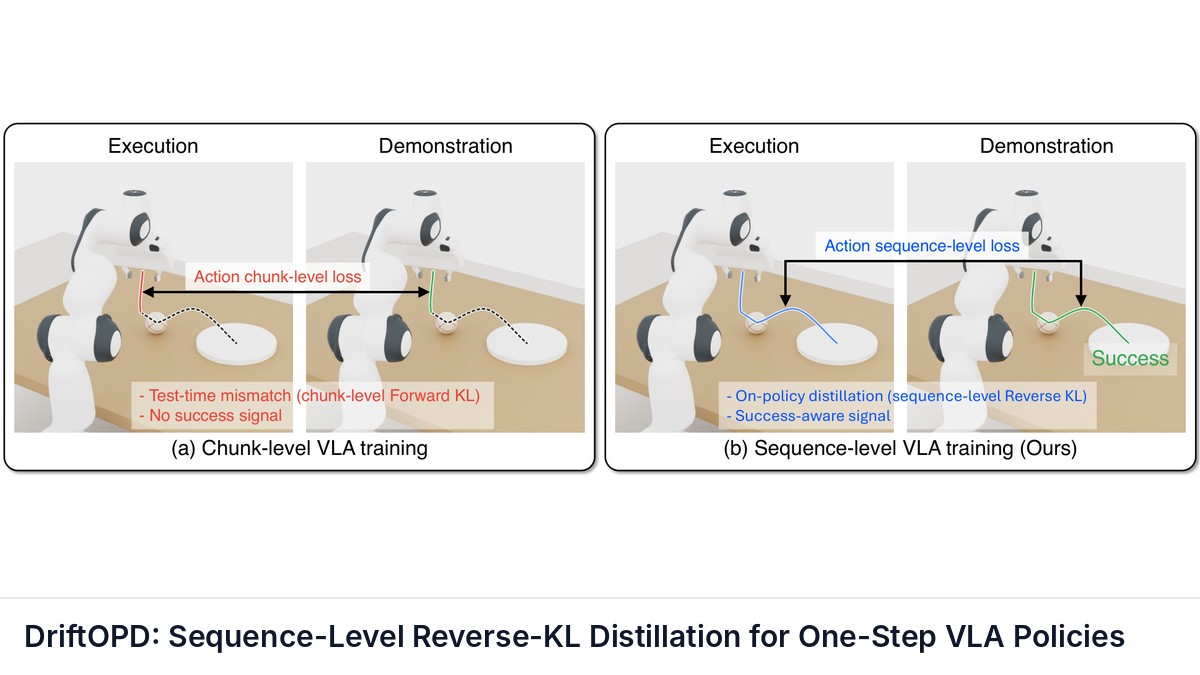
- We introduce DriftOPD, a teacher-free, rollout-free framework for sequence-level on-policy distillation of continuous VLA action experts.
- We show that the sequence-level reverse Kullback-Leibler (KL) divergence decomposes into a chunk-level reverse-KL term and a future-potential term that captures the long-horizon effect of the current action.
Preliminary
On-policy distillation (OPD) minimizes the reverse Kullback-Leibler divergence (KLD) between a model distribution $q_{\theta}$ and a target distribution $p$ over model-generated sequences ( Gu et al., 2024 ) : where $c$ is the conditioning context and $\bm{x}=(x_{1},\ldots,x_{T})$ is an autoregressively generated sequence.
Method
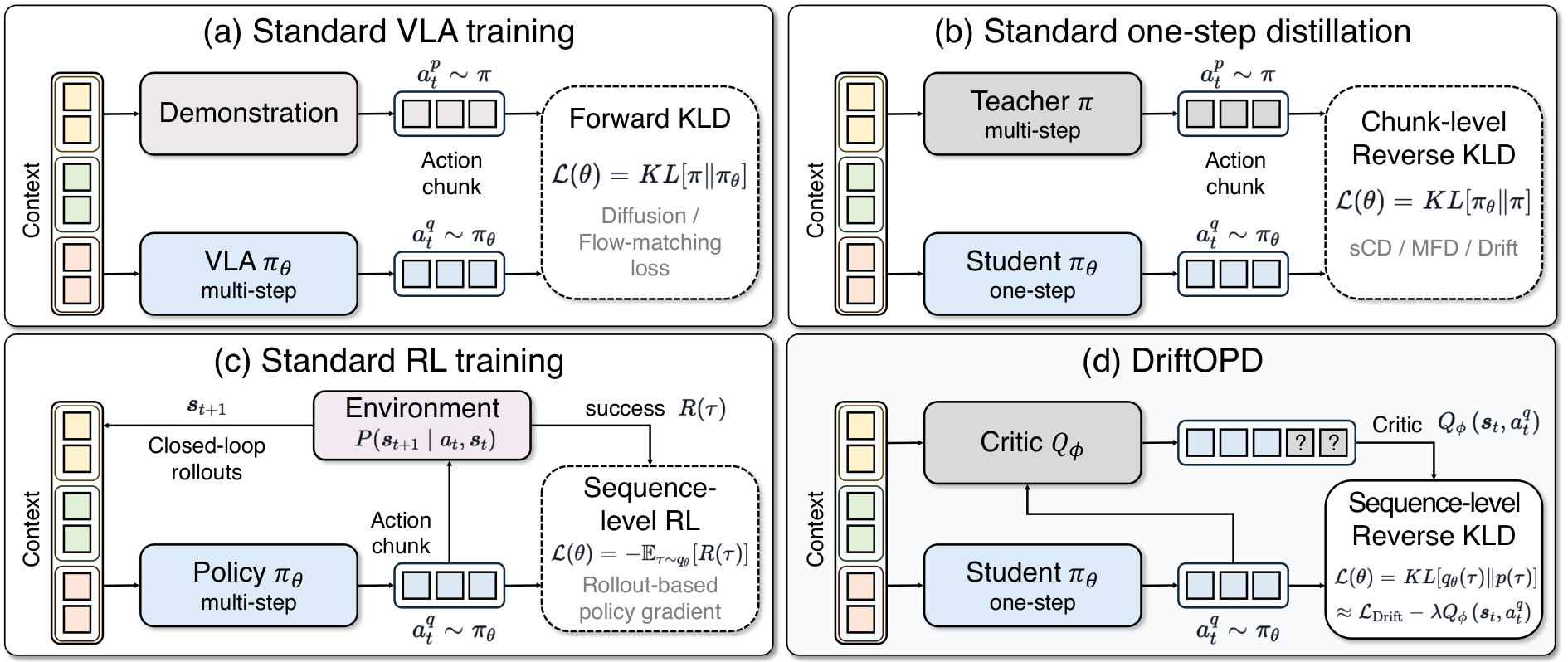
We formulate VLA learning through the reverse KLD between the distributions over action sequences induced by the model and target policies. This sequence-level perspective is illustrated in Figure 2 . Let $t$ index the action-chunk sequence, with $\bm{s}_{t}$ denoting the current VLA context (e.g., observation, instruction, and action state) and $a_{t}$ the corresponding action chunk.
Experiment
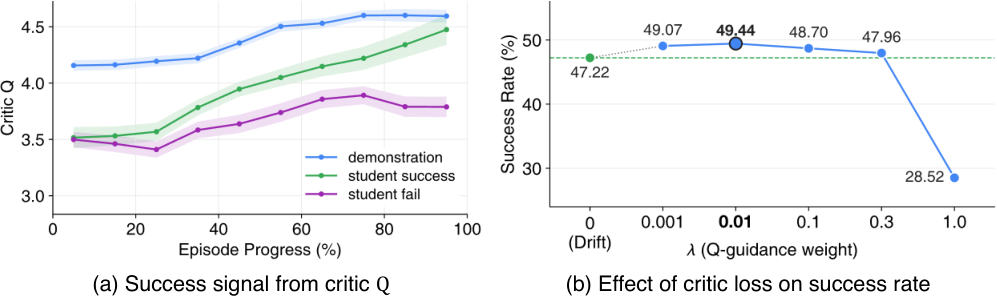
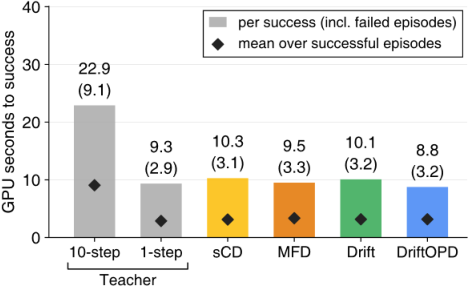
We experimentally evaluate and analyze the effectiveness of DriftOPD on robot manipulation tasks.
We use the $\pi_{0.5}$ ( Black et al., 2025a ) , GR00T N1.5/N1.6 ( Bjorck et al., 2025 ) , and ABot-M0 ( Yang et al., 2026a ) vision language action models, covering fully finetuned models, LoRA ( Hu et al., 2022 ) finetuned models, models finetuned on selected VLM layers, and a JiT ( Li and He, 2026 ) -style model that directly predicts clean actions.
Sources and Demonstrations
Figures are reproduced from Jun et al. See the full paper for experimental details and the project page, when the paper links one, for demonstrations and videos.
Related Papers

A Sim-to-Real Integration Pipeline for Training and Deployment of Chunk-Based VLA Manipulation Policies
Mathilde Kappel, Clémence Grislain, Mohamed Chetouani et al.
Vision-Language-Action (VLA) models have become a prominent paradigm for mapping multimodal inputs, including semantic instructions, visual observations of the scene, and proprioceptive observations, to robot actions.
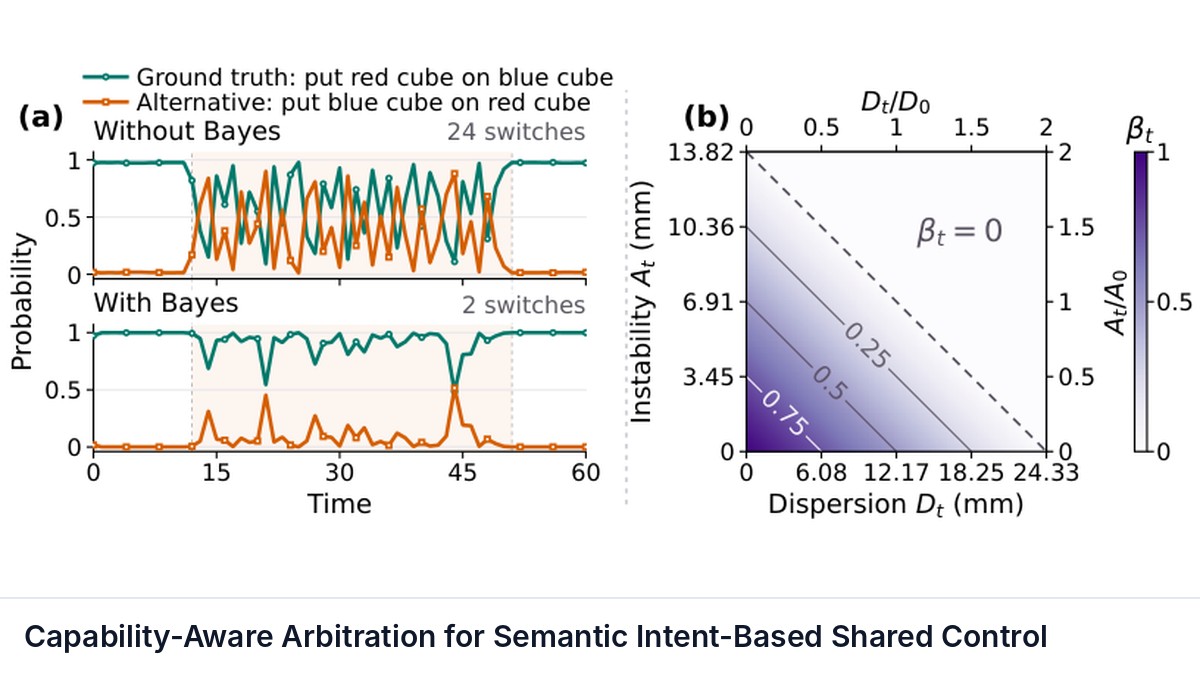
Capability-Aware Arbitration for Semantic Intent-Based Shared Control
Zhaoda Du, Michael Bowman, Xiaoli Zhang
Shared control often allocates robot authority based on confidence in inferred human intent, assuming reliable autonomous execution. When this assumption fails, high intent confidence can cause over-helping.
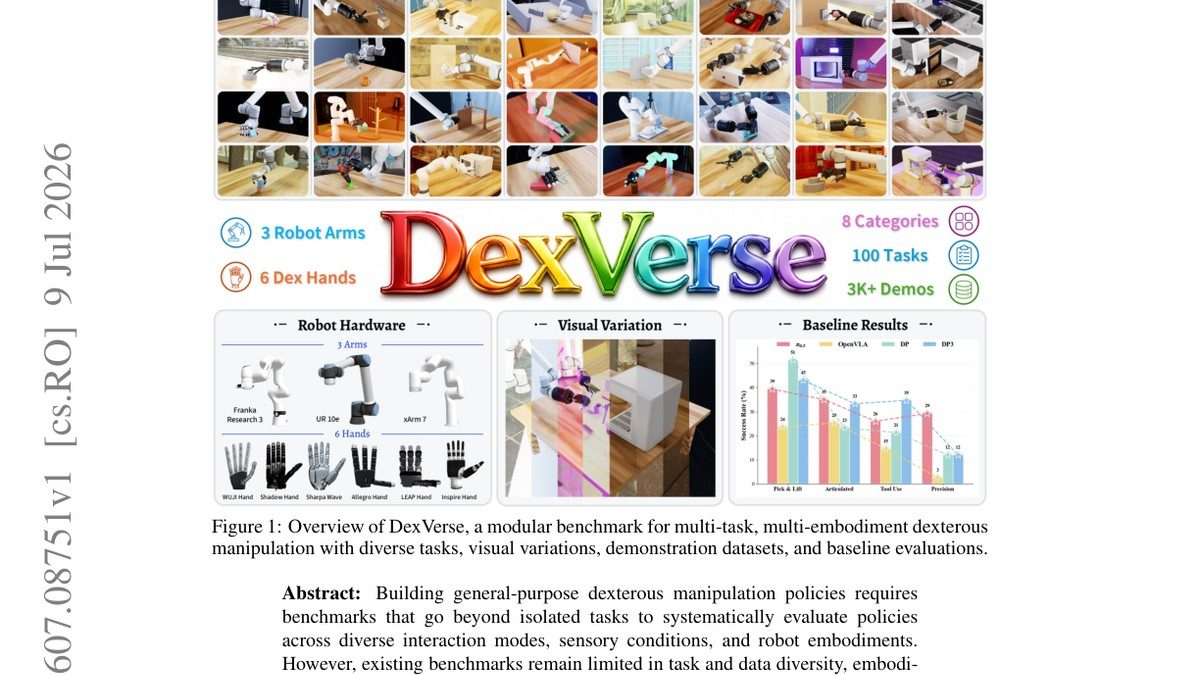
DexVerse: A Modular Benchmark for Multi-Task, Multi-Embodiment Dexterous Manipulation
Yunchao Yao, Zhuxiu Xu, Tianqi Zhang et al.
Building general-purpose dexterous manipulation policies requires benchmarks that go beyond isolated tasks to systematically evaluate policies across diverse interaction modes, sensory conditions, and robot embodiments.
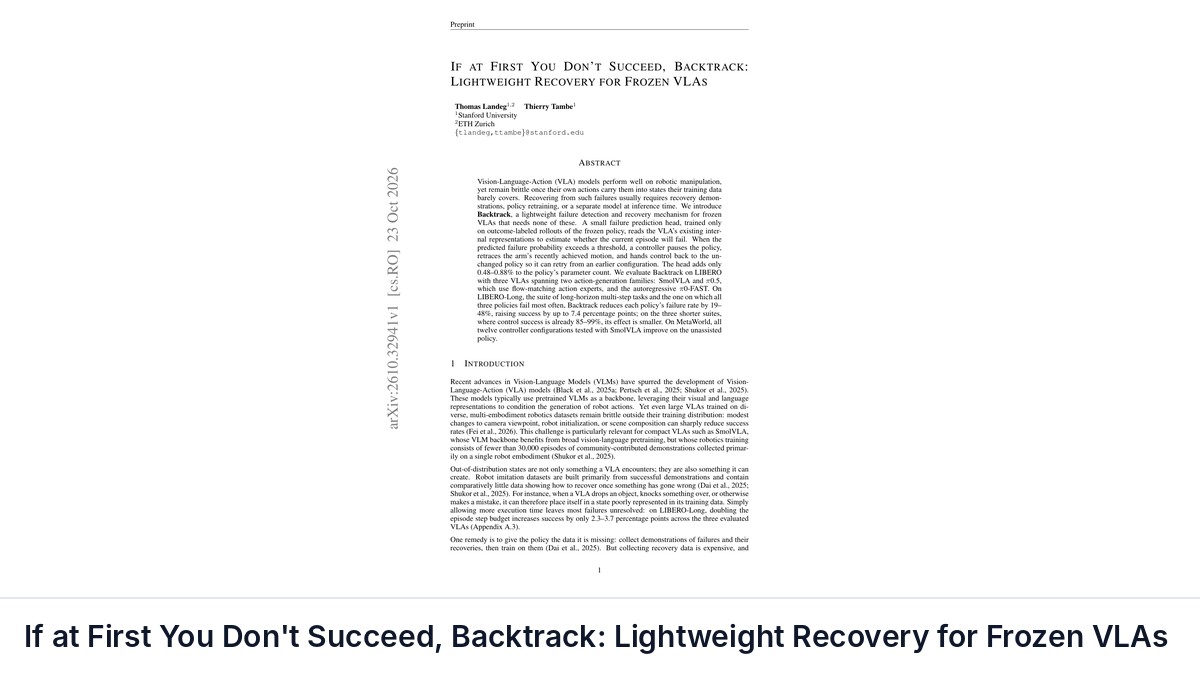
If at First You Don't Succeed, Backtrack: Lightweight Recovery for Frozen VLAs
Thomas Landeg, Thierry Tambe
Vision-Language-Action (VLA) models perform well on robotic manipulation, yet remain brittle once their own actions carry them into states their training data barely covers.