
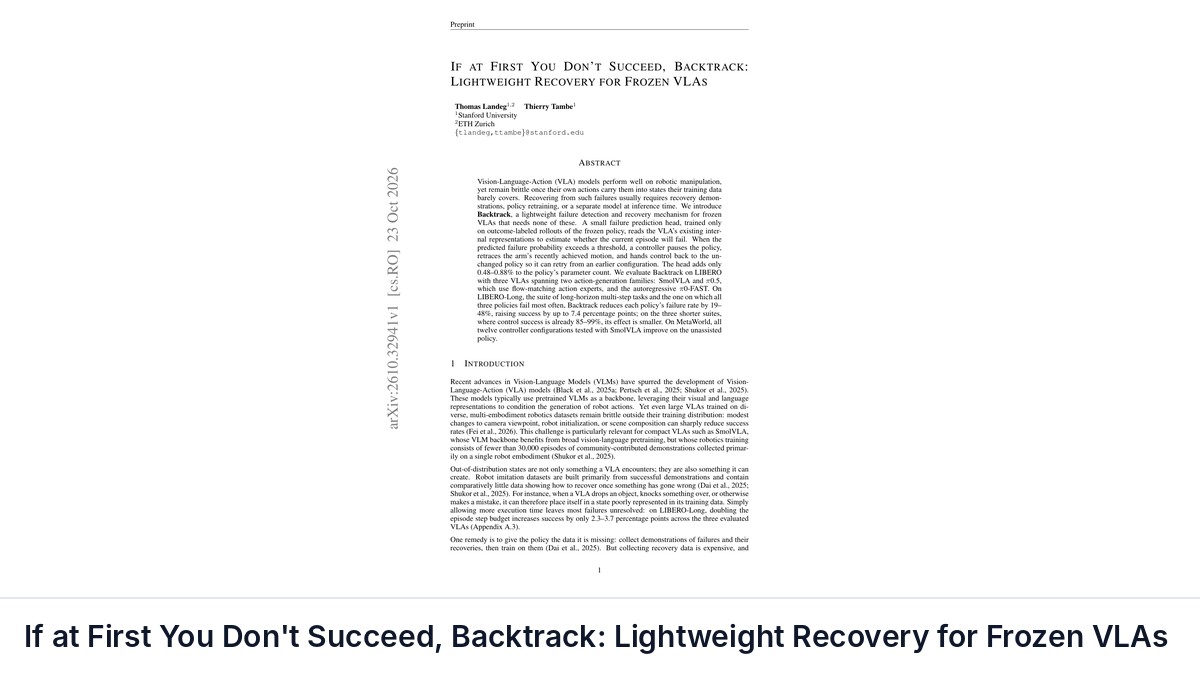
If at First You Don't Succeed, Backtrack: Lightweight Recovery for Frozen VLAs
Thomas Landeg, Thierry Tambe · N/A · 2026
Framework
N/A
License
N/A
Stars
N/A
Summary
Vision-Language-Action (VLA) models perform well on robotic manipulation, yet remain brittle once their own actions carry them into states their training data barely covers.
Abstract Summary
Key Points
- Vision-Language-Action (VLA) models perform well on robotic manipulation, yet remain brittle once their own actions carry them into states their training data barely covers.
- Recovering from such failures usually requires recovery demonstrations, policy retraining, or a separate model at inference time.
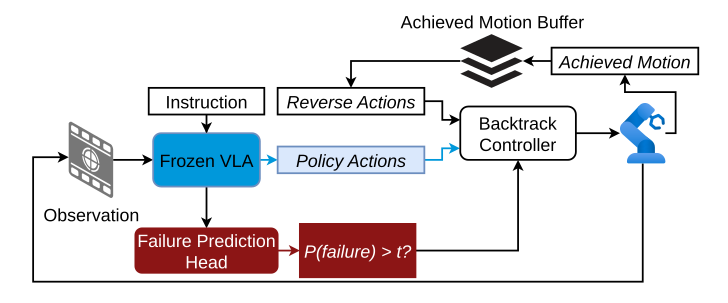
- We introduce Backtrack, a lightweight failure detection and recovery mechanism for frozen VLAs that needs none of these.
- A small failure prediction head, trained only on outcome-labeled rollouts of the frozen policy, reads the VLA's existing internal representations to estimate whether the current episode will fail.
- When the predicted failure probability exceeds a threshold, a controller pauses the policy, retraces the arm's recently achieved motion, and hands control back to the unchanged policy so it can retry from an earlier configuration.
Method
We attach a Failure Prediction Head (FPH) to the frozen policy. The FPH is a multi-head attention pooling (MAP) layer over the policy’s own token features, followed by a three-layer feed-forward network (FFN) that outputs a single scalar: the predicted probability that the current episode will end in failure.
The FPH consumes activations the policy already computes during normal action generation, so it requires no additional forward pass through the backbone.
Experimental Setup
We evaluate primarily on LIBERO ( Liu et al., 2023a ) , using its four ten-task suites: LIBERO-Spatial, LIBERO-Object, LIBERO-Goal, and LIBERO-Long. To check that the method is not specific to one benchmark we additionally evaluate on MetaWorld ( Yu et al., 2020 ) , a separate manipulation benchmark with a different simulator, task set, and embodiment. The MetaWorld experiments use SmolVLA with the pre feature tap.
Results
Table 3 reports the main result. On LIBERO-Long, Backtrack reduces the failure rates of SmolVLA, $\pi$0.5 and $\pi$0-FAST by 19.0%, 30.3% and 48.2%, respectively. Every 95% confidence interval excludes zero. Aggregated over all four LIBERO suites, the three policies sit much closer together, at 20.3%, 26.2% and 19.6%, again with every interval excluding zero.
Sources and Demonstrations
Figures are reproduced from Landeg et al. See the full paper for experimental details and the project page, when the paper links one, for demonstrations and videos.
Related Papers

A Sim-to-Real Integration Pipeline for Training and Deployment of Chunk-Based VLA Manipulation Policies
Mathilde Kappel, Clémence Grislain, Mohamed Chetouani et al.
Vision-Language-Action (VLA) models have become a prominent paradigm for mapping multimodal inputs, including semantic instructions, visual observations of the scene, and proprioceptive observations, to robot actions.

Capability-Aware Arbitration for Semantic Intent-Based Shared Control
Zhaoda Du, Michael Bowman, Xiaoli Zhang
Shared control often allocates robot authority based on confidence in inferred human intent, assuming reliable autonomous execution. When this assumption fails, high intent confidence can cause over-helping.
DexVerse: A Modular Benchmark for Multi-Task, Multi-Embodiment Dexterous Manipulation
Yunchao Yao, Zhuxiu Xu, Tianqi Zhang et al.
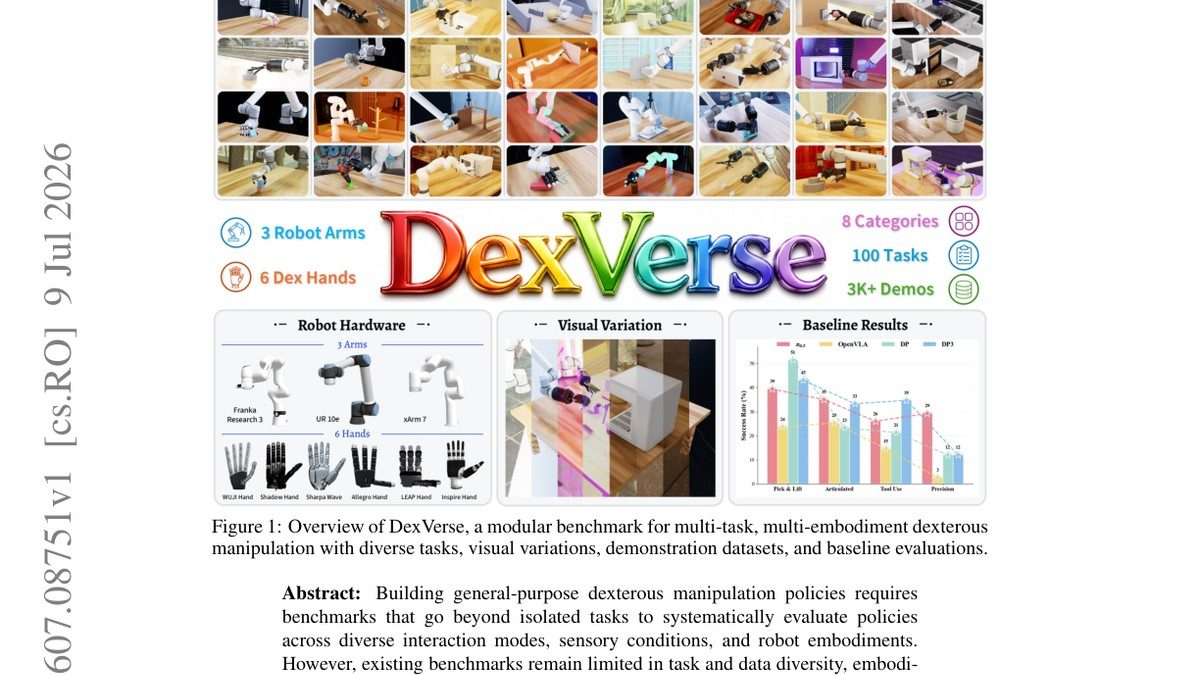
Building general-purpose dexterous manipulation policies requires benchmarks that go beyond isolated tasks to systematically evaluate policies across diverse interaction modes, sensory conditions, and robot embodiments.
DriftOPD: Sequence-Level Reverse-KL Distillation for One-Step VLA Policies
Youngjun Jun, Kyumin Choi, Youngmin Kim et al.
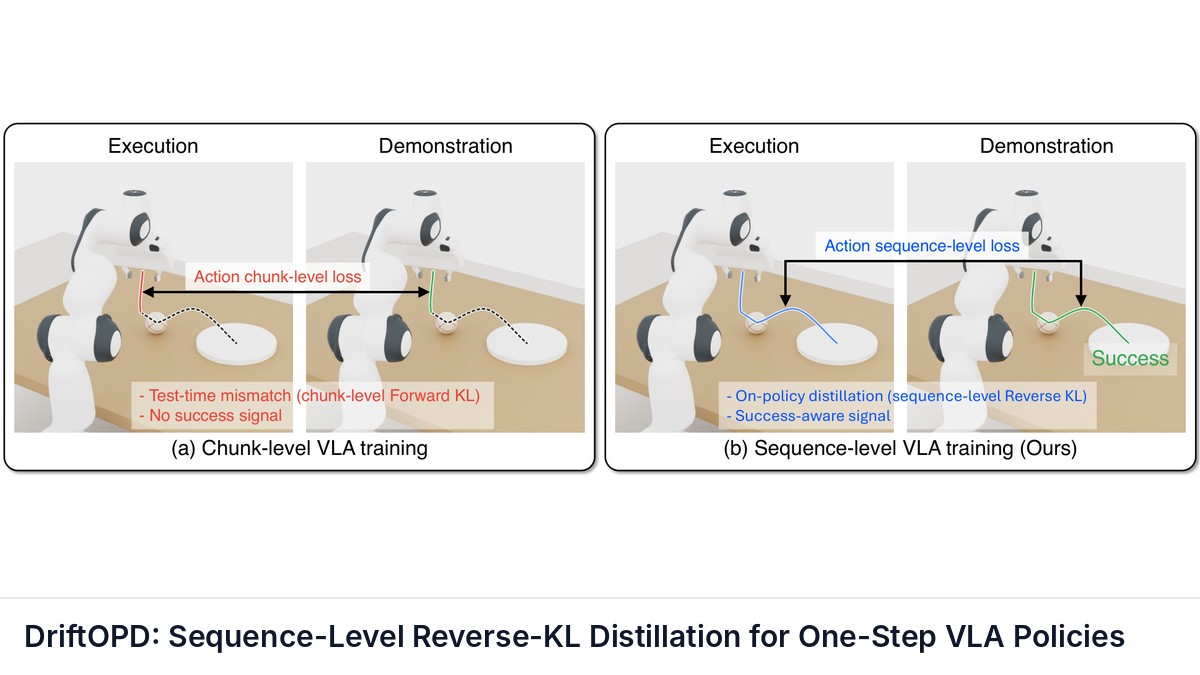
Vision-Language-Action (VLA) models increasingly rely on action experts that generate short action chunks under receding-horizon control.