
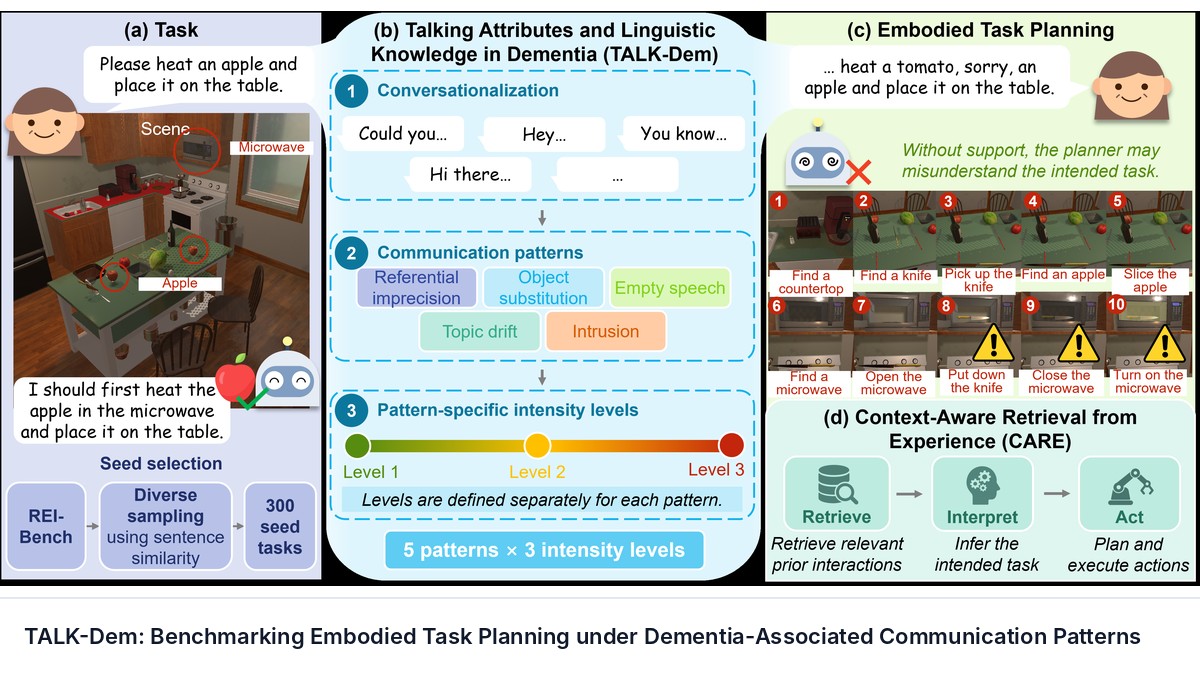
TALK-Dem: Benchmarking Embodied Task Planning under Dementia-Associated Communication Patterns
Guangxin Zhao, Yiran Hu, Yuan Cao, Chenxi Jiang, Jianfei Yang, Yegang Du, Yasuyuki Taki, Yoshifumi Kitamura, Lin Gu, Zhi Zheng · N/A · 2026
Framework
N/A
License
N/A
Stars
N/A
Summary
Existing LLM-driven robot task planners rely on a taken-for-granted assumption of an ideal user whose instructions are clear, complete, and task-focused.
Abstract Summary
Key Points
- Existing LLM-driven robot task planners rely on a taken-for-granted assumption of an ideal user whose instructions are clear, complete, and task-focused.
- However, when interacting with real-world users, especially those experiencing cognitive impairments, such as people living with dementia (PLWD), the planners often make mistakes and even pose physical safety risks.
- We proposed TALK-Dem (Talking Attributes and Linguistic Knowledge in Dementia), the first benchmark for evaluating LLM-driven robot task planning under dementia-associated verbal communication.
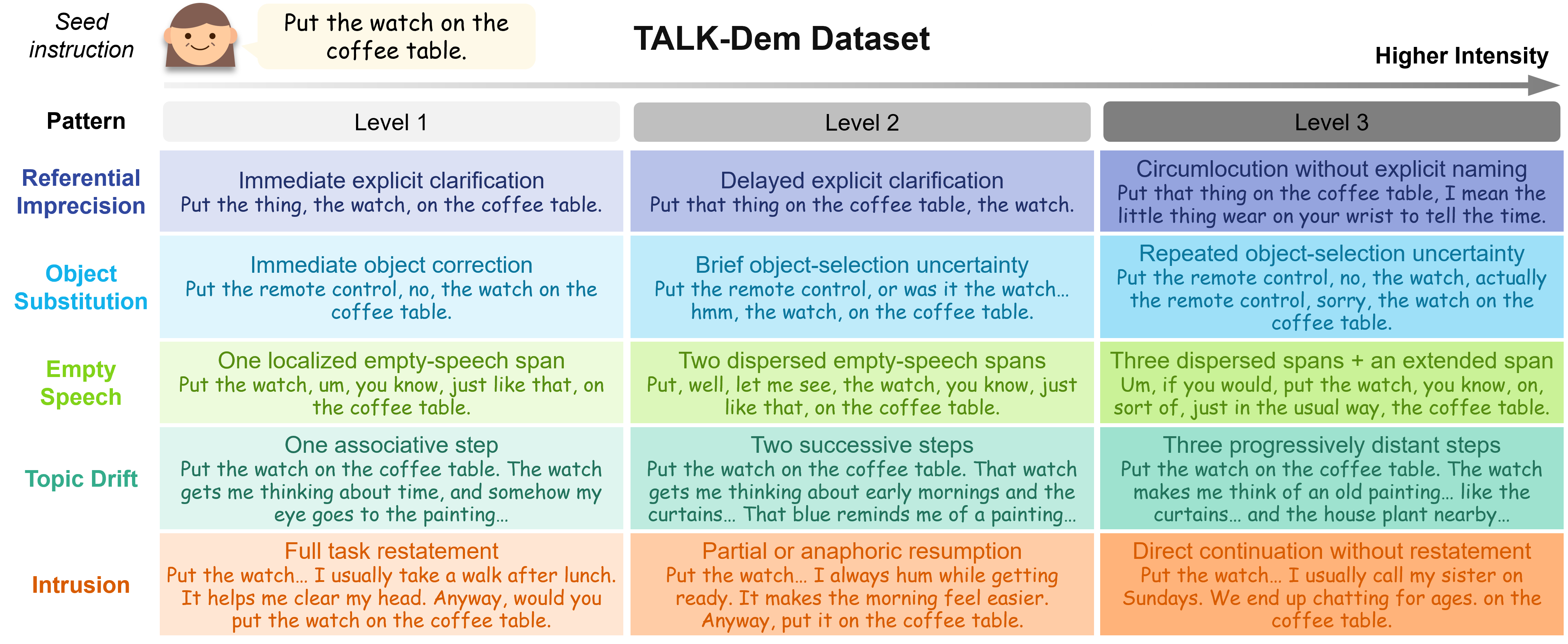
- TALK-Dem contains 4,800 instructions and covers five typical communication patterns, including Referential Imprecision, Object Substitution, Empty Speech, Topic Drift, and Intrusion, at three intensity levels.
- Experiments across six open-weight LLMs reveal a substantial robustness gap
TALK-Dem Benchmark
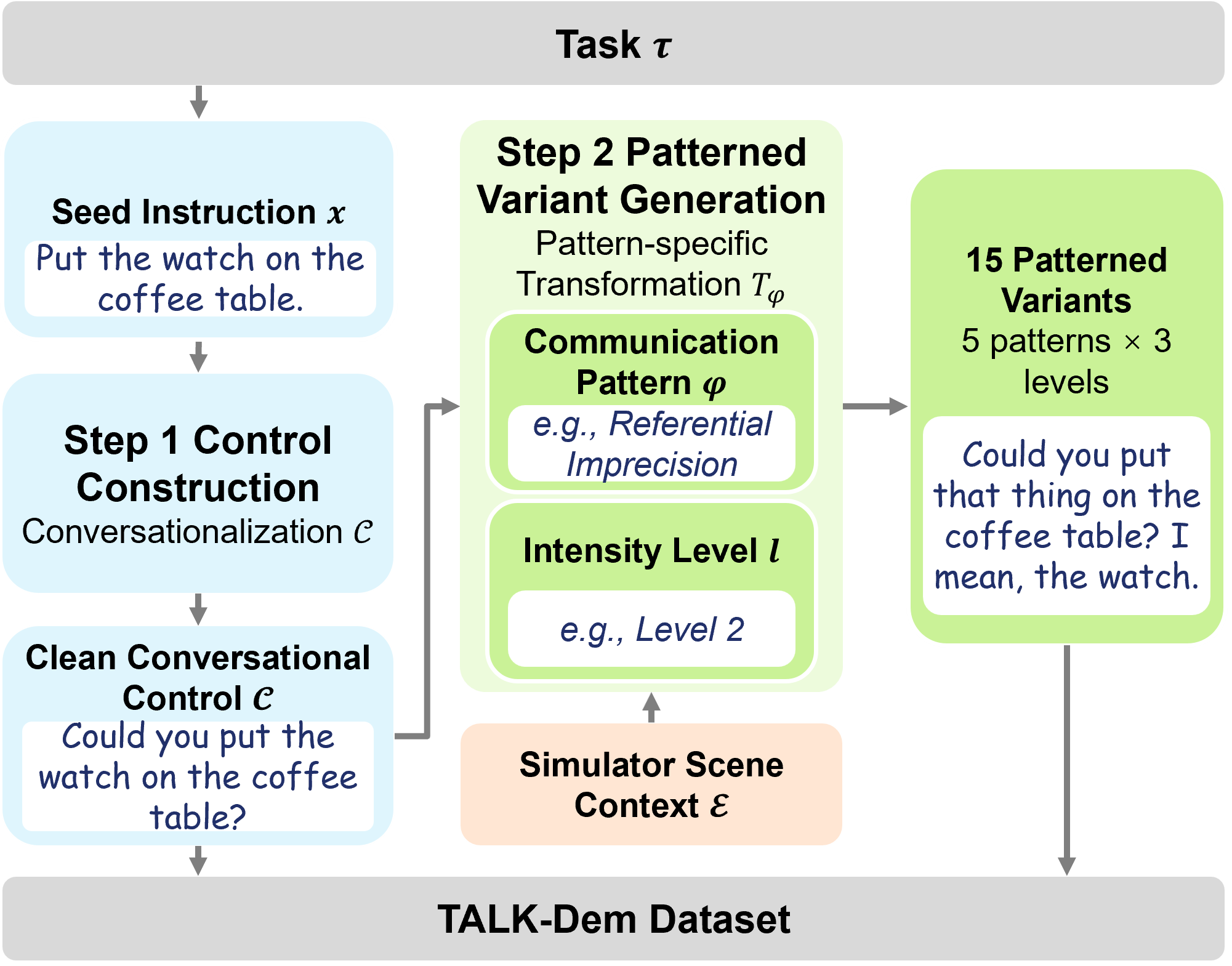
PLWD may express the same task intent in ways that differ from a direct and concise instruction. The altered communication patterns can make the intended task more difficult for an embodied task planner to infer, leading to planning failures.
To study this effect, we modeled the process of the transformation from a clean instruction to an instruction that preserves the task intent while exhibiting a dementia-associated communication pattern. Let $x$ denote the original instruction for task $\tau$.
Experiment Setup and Measurements
We evaluated models using the SayCan task planner in the AI2-THOR environment.
Our evaluation contained six popular open-weight LLMs spanning different model families and scales, including Llama-3.1-8B-Instruct and Llama-3.1-70B-Instruct ( Grattafiori et al., 2024 ) , Qwen2.5-7B-Instruct and Qwen2.5-72B-Instruct ( Qwen Team, 2024 ) , gemma-2-9b-it ( Gemma Team, 2024 ) , and Ministral-8B-Instruct-2410 ( Mistral AI Team, 2024 ) .
Quantitative Results
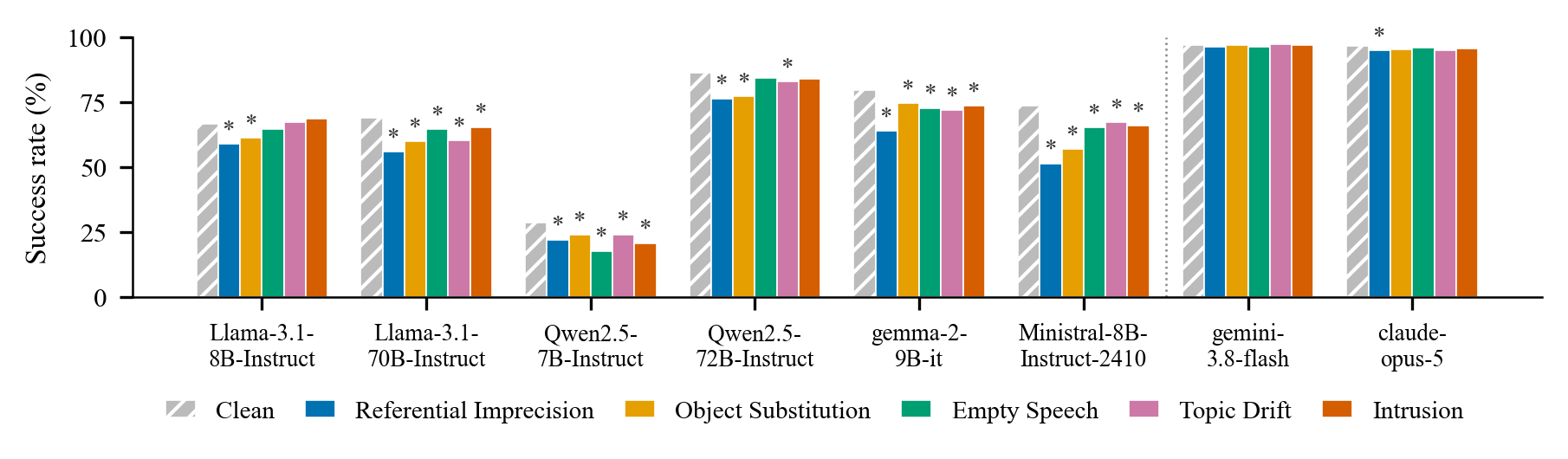
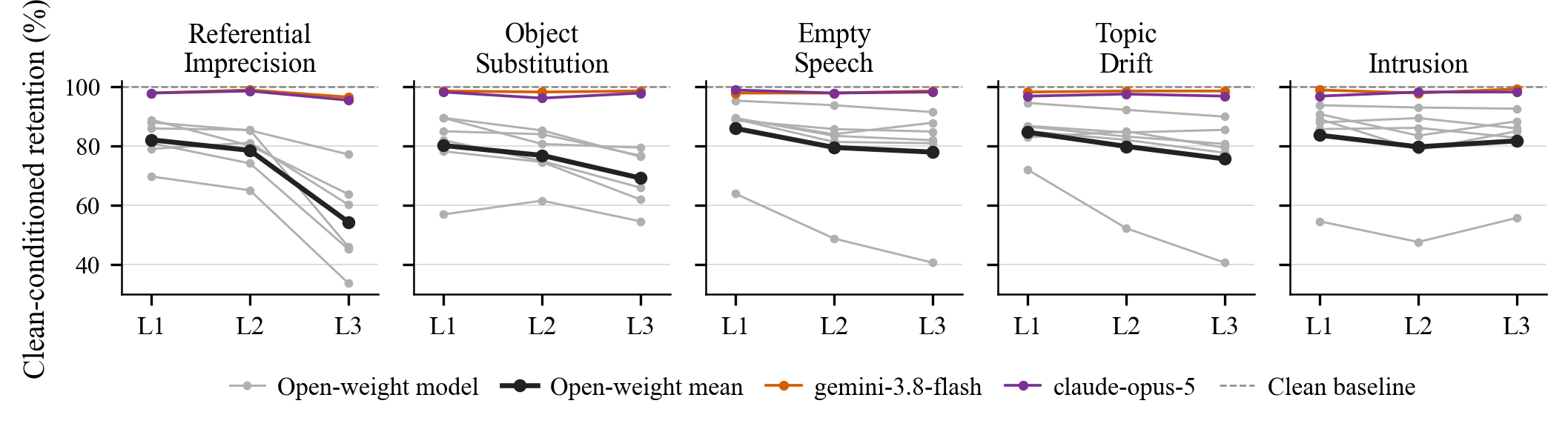
Figure 4 summarizes LLM-based planning performance under the five communication patterns, averaged across the three intensity levels. Overall, dementia-associated communication patterns reduced task success for most models, but the degradation varied substantially across patterns and model families.
This indicated that good performance on clean instructions does not necessarily translate into robustness to communication variation.
Qualitative Analyses
We conducted error analyses on cases where the model succeeded on the clean instruction but failed on the patterned variants. Randomly sampling three instances from each open-weight model under each pattern-intensity condition yielded 270 instances.
Manual examination of clean and patterned instructions, the reference plan, the model outputs, and the simulator feedback was conducted to categorize failures into primary types.
Sources and Demonstrations
Figures are reproduced from Zhao et al. See the full paper for experimental details and the project page, when the paper links one, for demonstrations and videos.
Related Papers
End-to-End Vision-Language-Action Policies for Autonomous Lunar Rover Docking
Sitan Huang, Grace Gao
Surface navigation on the Moon is subject to extreme illumination contrast and deployment-time perceptual disturbances.
LT-Mem: Volatility-Aware Spatio-Temporal Memory for Lifelong Scene Understanding
Lee, Yumin, Ju, Hyoseok, Kim, Giseop
Long-term robot operation in evolving environments requires object-level understanding that persists across repeated revisits.
NavGPT-3: Harnessing Context in a Hierarchical Navigation Runtime
Gengze Zhou, Yicong Hong, Jiazhao Zhang et al.
Language models trained with long-horizon agentic reinforcement learning can generalize knowledge through reasoning, express precise actions, and pursue goals over many steps, raising the ceiling on what an embodied agent can understand and decide.
Planning-Oriented End-to-End Autonomous Driving: Architectures, Evaluation, and Emerging Paradigms
Yanchen Guan, Xingcheng Liu, Bin Rao et al.
End-to-end autonomous driving has evolved from camera-to-control regression toward planning-oriented systems that use structured representations, trajectory-level outputs, and increasingly realistic evaluation protocols.