
NavGPT-3: Harnessing Context in a Hierarchical Navigation Runtime
Gengze Zhou, Yicong Hong, Jiazhao Zhang, Xunyi Zhao, Jian Zhou, Zixing Lei, Zun Wang, Chongyang Zhao, Xionghui Chen, Stephen Gould, Anton van den Hengel, Qi Wu · N/A · 2026
Framework
N/A
License
N/A
Stars
N/A
Summary
Language models trained with long-horizon agentic reinforcement learning can generalize knowledge through reasoning, express precise actions, and pursue goals over many steps, raising the ceiling on what an embodied agent can understand and decide.
Abstract Summary
Key Points
- Language models trained with long-horizon agentic reinforcement learning can generalize knowledge through reasoning, express precise actions, and pursue goals over many steps, raising the ceiling on what an embodied agent can understand and decide.
- Physical interaction, however, remains the domain of action policies, which provide dense, low-latency control.
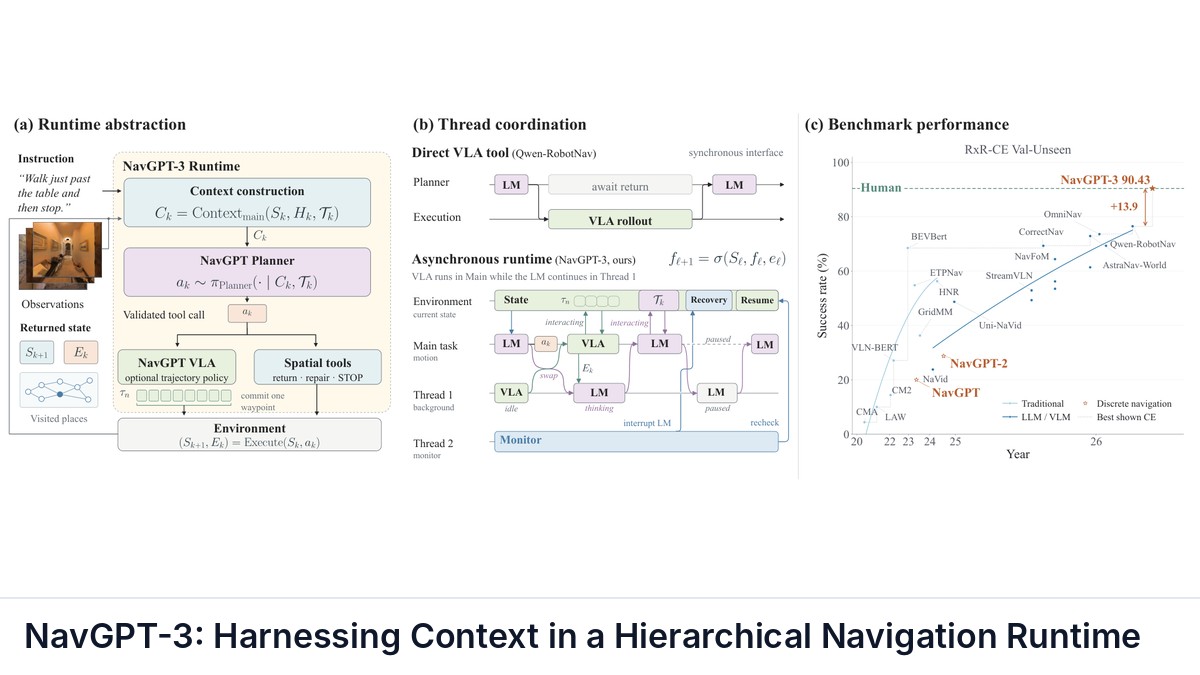
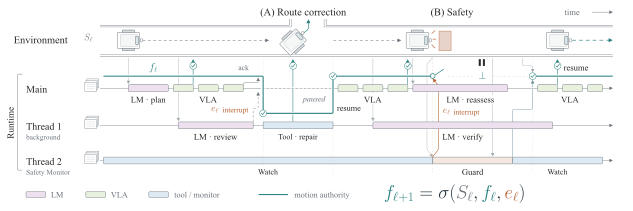
- We present NavGPT-3, a harness that connects the two models, with an OS-like runtime built above it: reasoning, acting, and monitoring run as threads with their own context, tools, and permissions, while the runtime schedules them and decides which thread controls the robot's motion, so that the robot can react to sudden real-world events through interruption and thread switching.
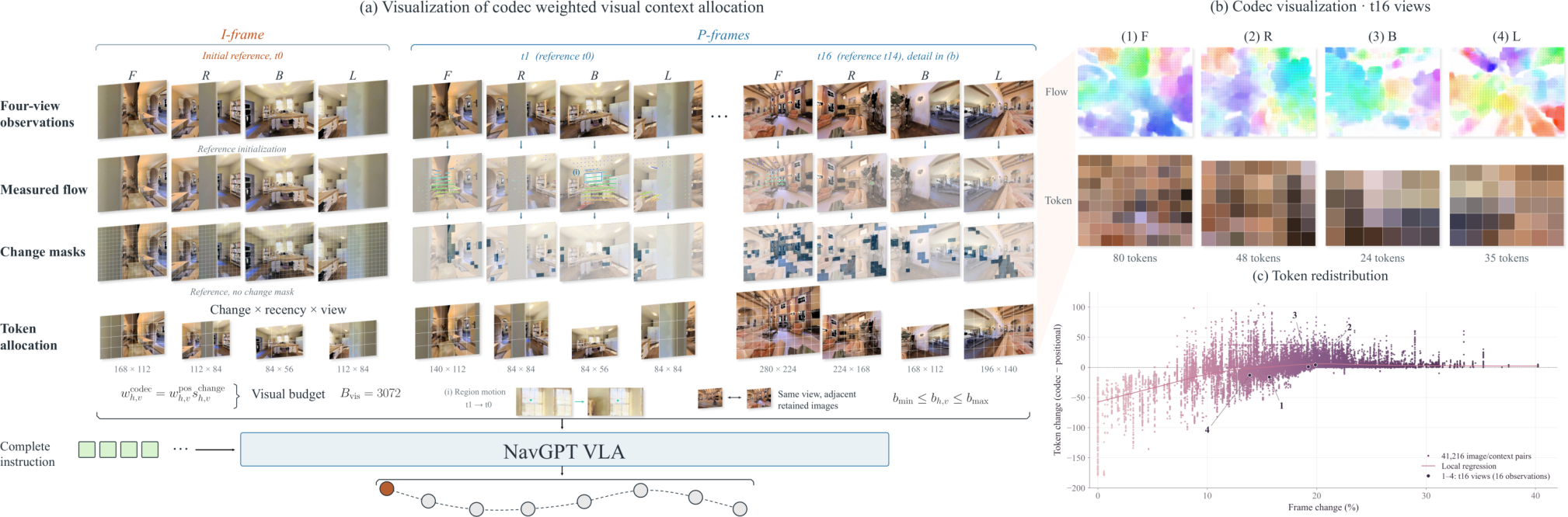
- Beneath it, our action policy NavGPT VLA, trained on 19.28M examples, allocates visual tokens using codec allocation, in proportion to scene change; its 8B model alone reaches 74.51 SR on R2R-CE and leads RxR-CE with 78.19 SR.
- With the complete harness, NavGPT-3 sets the state of the art on R2R-CE (81.51 SR) and, for the first time, brings an autonomous agent to human level: on RxR-CE it matches human followers in success (90.43 vs.
Method: Harness, Runtime, and VLA Co-Design
NavGPT-3 co-designs a complete harness between a reasoning model and a navigation policy: context and state management, spatial tools, validated execution, structured returns, route repair, and an explicit decision to end the task. A runtime built above the harness controls its threads. Part I describes these two layers; Part II describes the VLA beneath them.
The harness shapes model behavior through the context, state, and tool interfaces that connect the Planner, the VLA, and the environment (simulator or robot).
Experiments
This section evaluates the NavGPT-3 harness, the collaboration with the VLA, and the complete system. In Section 4.1 , we first show the development process of the harness tools and of the visual context shown to the model by automated recursive self-improvement on a subset of training episodes.
In Section 4.2 , we evaluate the resulting tools: we add the VLA, Map, and Backtrack tool groups to the basic tools for two Planners and measure accuracy, cost, and reaction time.
Sources and Demonstrations
Figures are reproduced from Zhou et al. See the full paper for experimental details and the project page, when the paper links one, for demonstrations and videos.
Related Papers
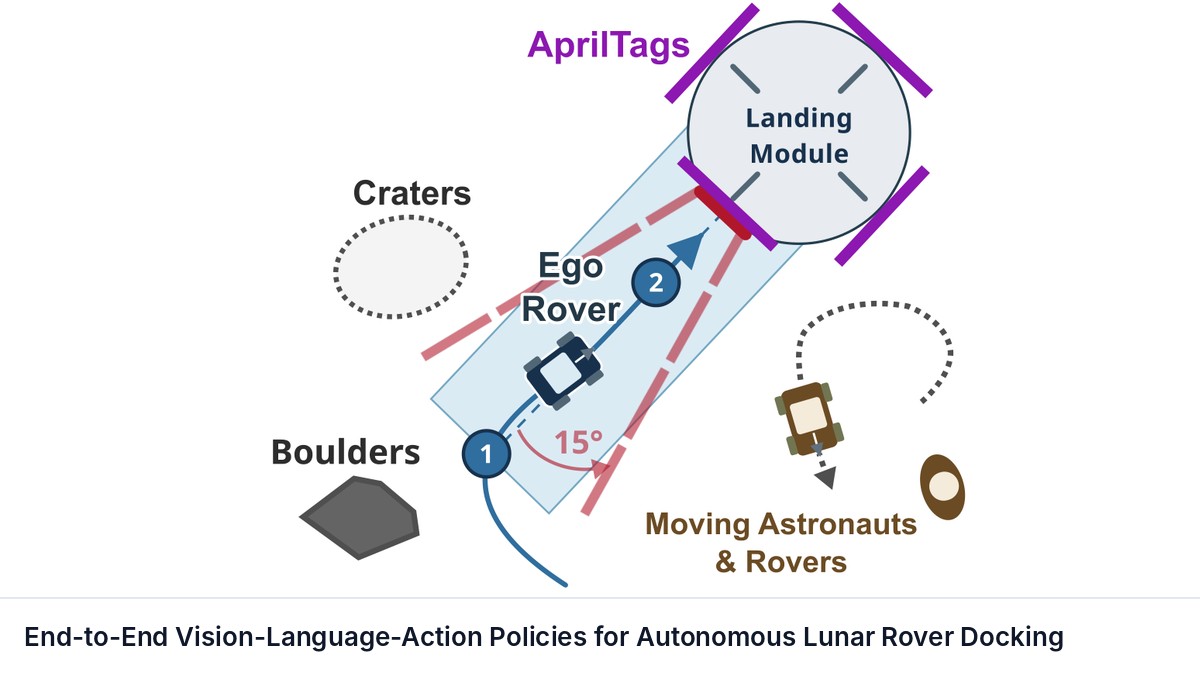
End-to-End Vision-Language-Action Policies for Autonomous Lunar Rover Docking
Sitan Huang, Grace Gao
Surface navigation on the Moon is subject to extreme illumination contrast and deployment-time perceptual disturbances.
Planning-Oriented End-to-End Autonomous Driving: Architectures, Evaluation, and Emerging Paradigms
Yanchen Guan, Xingcheng Liu, Bin Rao et al.
End-to-end autonomous driving has evolved from camera-to-control regression toward planning-oriented systems that use structured representations, trajectory-level outputs, and increasingly realistic evaluation protocols.

A Sim-to-Real Integration Pipeline for Training and Deployment of Chunk-Based VLA Manipulation Policies
Mathilde Kappel, Clémence Grislain, Mohamed Chetouani et al.
Vision-Language-Action (VLA) models have become a prominent paradigm for mapping multimodal inputs, including semantic instructions, visual observations of the scene, and proprioceptive observations, to robot actions.
Aim Short to Reach Far: Your Frozen World Model Can Plan Better Than You Think
Xvyuan Liu, Jianjie Fang, Chen Gao et al.
Planners built on visual world models commonly score each predicted outcome by its distance to the encoded goal image. We show that this target can limit control even with exact dynamics and globally optimal short-horizon search: reaching a goal may require actions that initially move away from it.