
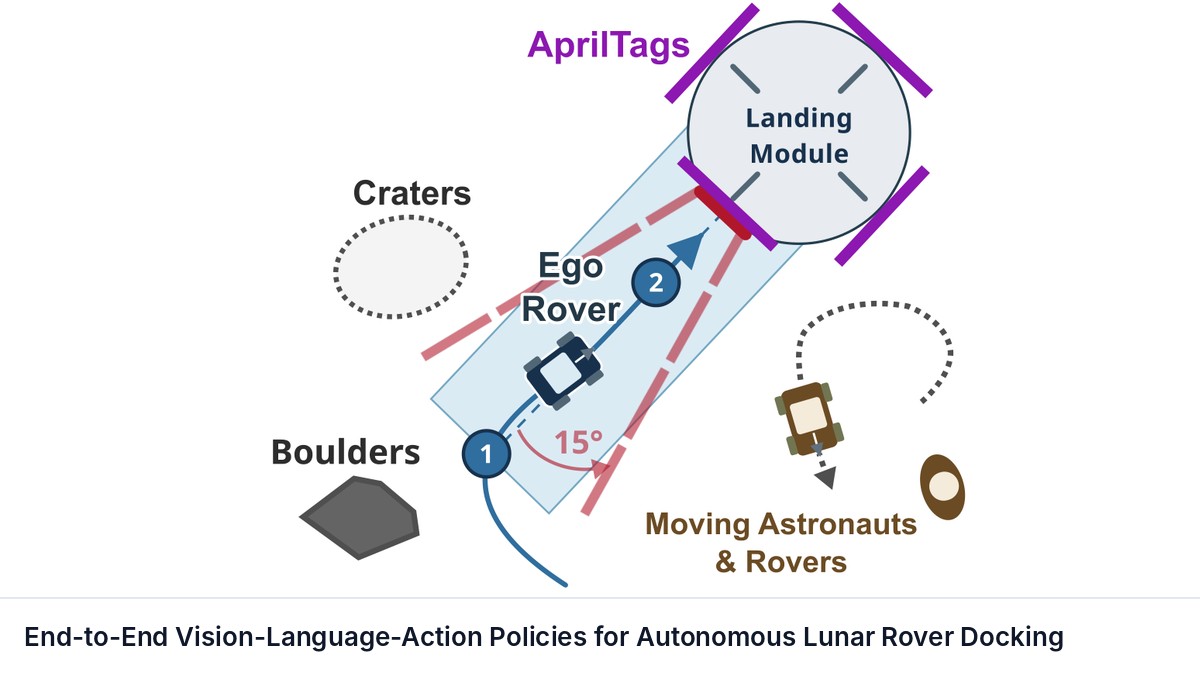
End-to-End Vision-Language-Action Policies for Autonomous Lunar Rover Docking
Sitan Huang, Grace Gao · N/A · 2026
Framework
N/A
License
N/A
Stars
N/A
Summary
Surface navigation on the Moon is subject to extreme illumination contrast and deployment-time perceptual disturbances.
Abstract Summary
Key Points
- Surface navigation on the Moon is subject to extreme illumination contrast and deployment-time perceptual disturbances.
- While modular navigation pipelines have long supported planetary rover navigation, robustness is compromised by measurement errors that propagate through hand-engineered components.
- End-to-end learned policies are an alternative approach to navigation, which maps observations directly to control actions without intermediate components.
- Vision-language-action models, in particular, have driven significant breakthroughs in robotics and autonomous vehicle research.
- By leveraging internet-scale vision-language pretraining, these models can be exploited for their commonsense reasoning and visual understanding to provide robust generalization with limited task-specific data.
Methodology
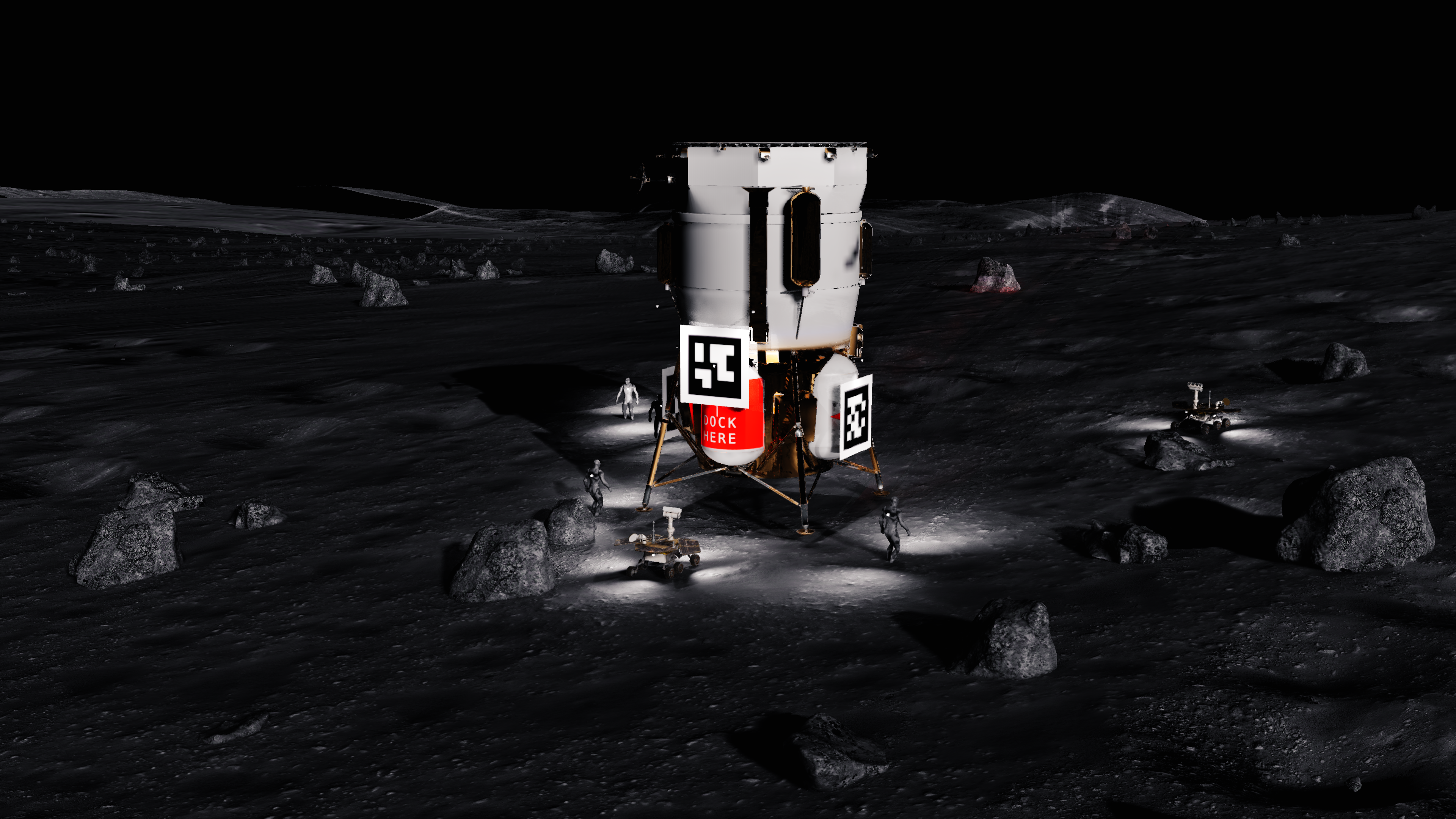
The lunar surface simulator LuPNT [ 3 ] , built on Unreal Engine, is used to generate photorealistic imagery and simulate closed-loop vehicle dynamics (Fig. 1(b) ).
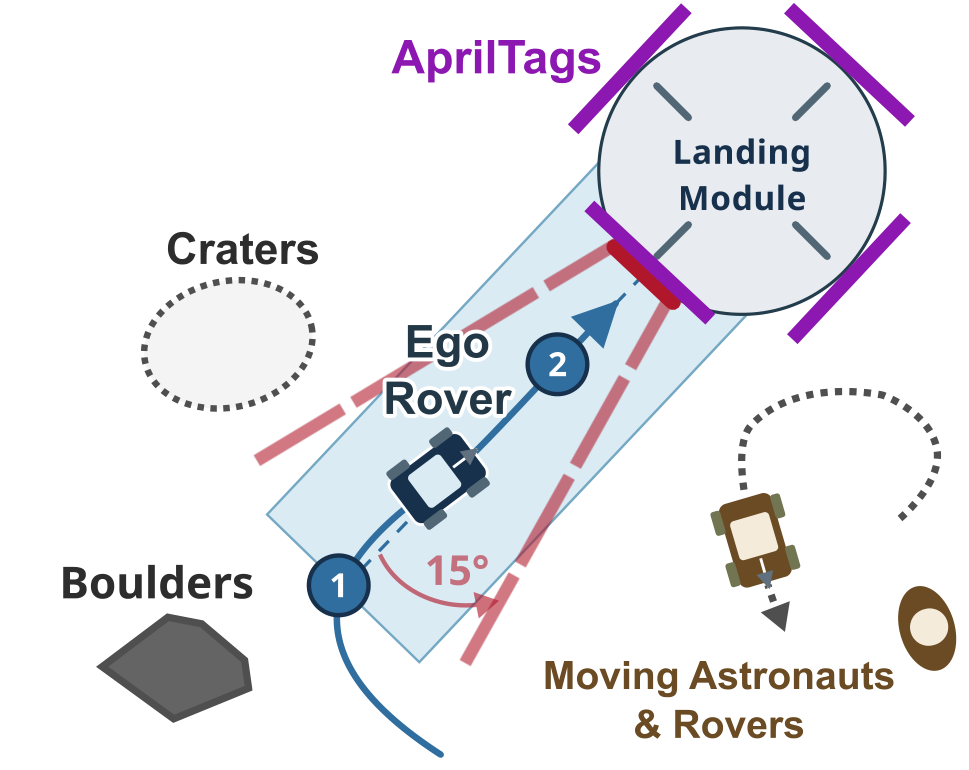
Docking scenarios are 50 $\times$ 50 m regions sampled from a 5 m/px resolution digital elevation model, each containing 6.3 $\pm$ 4.1 (mean $\pm$ SD) boulders (diameter: 2.4 $\pm$ 0.8 m) and 5.0 $\pm$ 3.6 craters (diameter: 4.0 m; depth: 0.8 $\pm$ 0.1 m) on average. The sun elevation is sampled from 20 ∘ to 90 ∘ .
Evaluation
Unless otherwise specified, evaluations are conducted in $N=100$ procedurally generated scenarios using seeds unseen during training-data synthesis, with initial rover-to-landing-module separations of 30–50 m. The VLA policy uses a trajectory sampling temperature of 0.26 and adaptive-horizon execution unless otherwise noted.
The VLA policy and modular autonomy stack are evaluated under the following nominal and sensor-disturbance conditions (Fig. 4 ).
Sources and Demonstrations
Figures are reproduced from Huang et al. See the full paper for experimental details and the project page, when the paper links one, for demonstrations and videos.
Related Papers
Planning-Oriented End-to-End Autonomous Driving: Architectures, Evaluation, and Emerging Paradigms
Yanchen Guan, Xingcheng Liu, Bin Rao et al.
End-to-end autonomous driving has evolved from camera-to-control regression toward planning-oriented systems that use structured representations, trajectory-level outputs, and increasingly realistic evaluation protocols.

A Sim-to-Real Integration Pipeline for Training and Deployment of Chunk-Based VLA Manipulation Policies
Mathilde Kappel, Clémence Grislain, Mohamed Chetouani et al.
Vision-Language-Action (VLA) models have become a prominent paradigm for mapping multimodal inputs, including semantic instructions, visual observations of the scene, and proprioceptive observations, to robot actions.

Capability-Aware Arbitration for Semantic Intent-Based Shared Control
Zhaoda Du, Michael Bowman, Xiaoli Zhang
Shared control often allocates robot authority based on confidence in inferred human intent, assuming reliable autonomous execution. When this assumption fails, high intent confidence can cause over-helping.
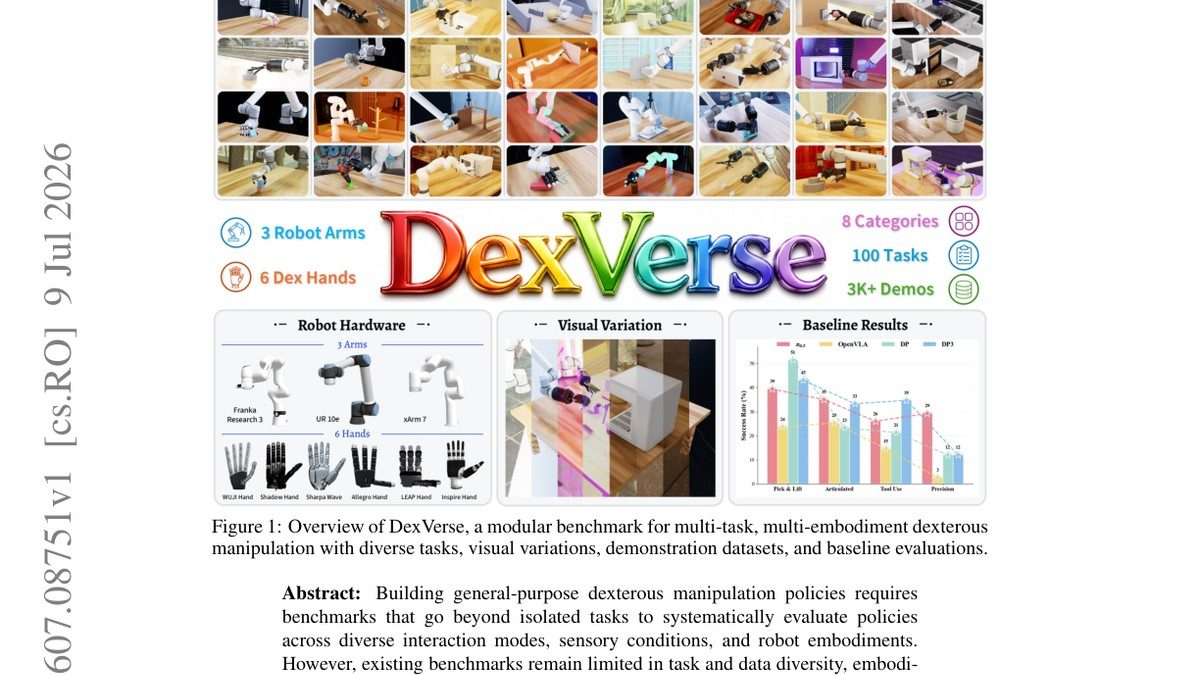
DexVerse: A Modular Benchmark for Multi-Task, Multi-Embodiment Dexterous Manipulation
Yunchao Yao, Zhuxiu Xu, Tianqi Zhang et al.
Building general-purpose dexterous manipulation policies requires benchmarks that go beyond isolated tasks to systematically evaluate policies across diverse interaction modes, sensory conditions, and robot embodiments.