
LT-Mem: Volatility-Aware Spatio-Temporal Memory for Lifelong Scene Understanding
Lee, Yumin, Ju, Hyoseok, Kim, Giseop · N/A · 2026
Framework
N/A
License
N/A
Stars
N/A
Summary
Long-term robot operation in evolving environments requires object-level understanding that persists across repeated revisits.
Abstract Summary
Key Points
- Long-term robot operation in evolving environments requires object-level understanding that persists across repeated revisits.
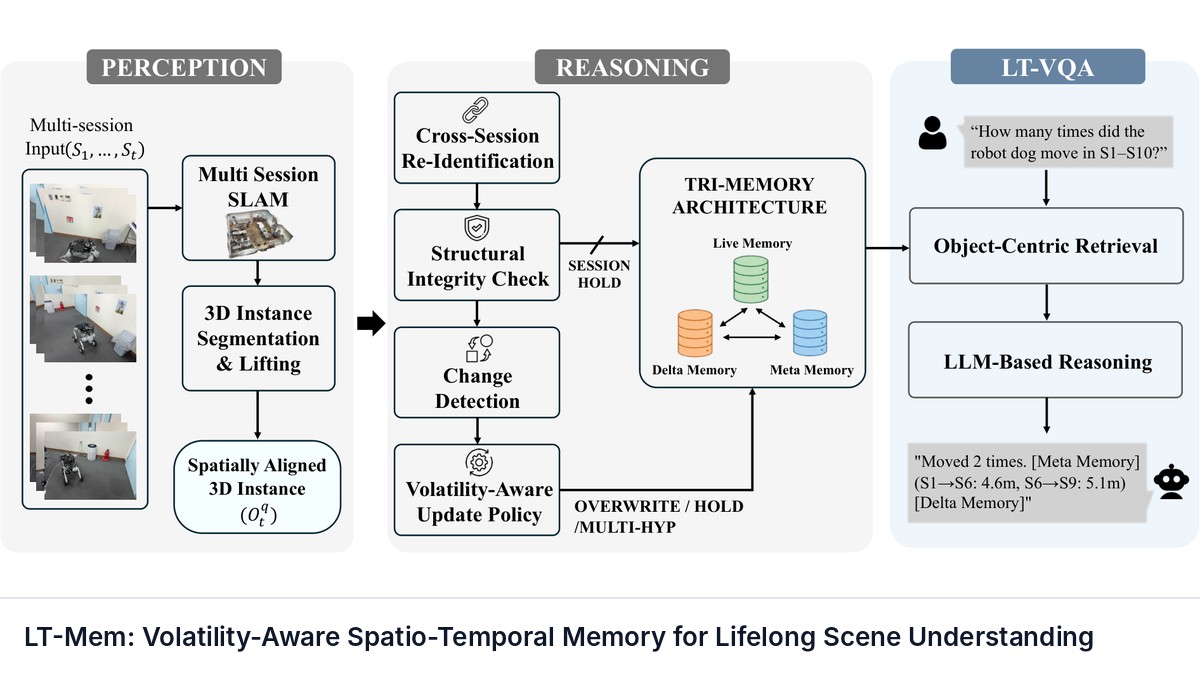
- Existing systems either overwrite history to maintain an up-to-date map or store semantic snapshots without consistent cross-session object identity, resulting in temporal amnesia: the systematic loss of object history that prevents answering queries such as "Where has the green chair been across all sessions?" We propose LT-Mem, a volatility-aware memory evolution framework that unifies spatially aligned instance-level 3D perception with volatility-conditioned temporal reasoning.
- First, a multi-session SLAM backbone provides spatially aligned per-object observations across sessions.
- Second, a reasoning layer governs how object memory evolves: deterministic evidence scoring preserves cross-session identity, and a volatility-aware policy selects among overwrite, hold, and multi-hypothesis actions based on each object's dynamics.
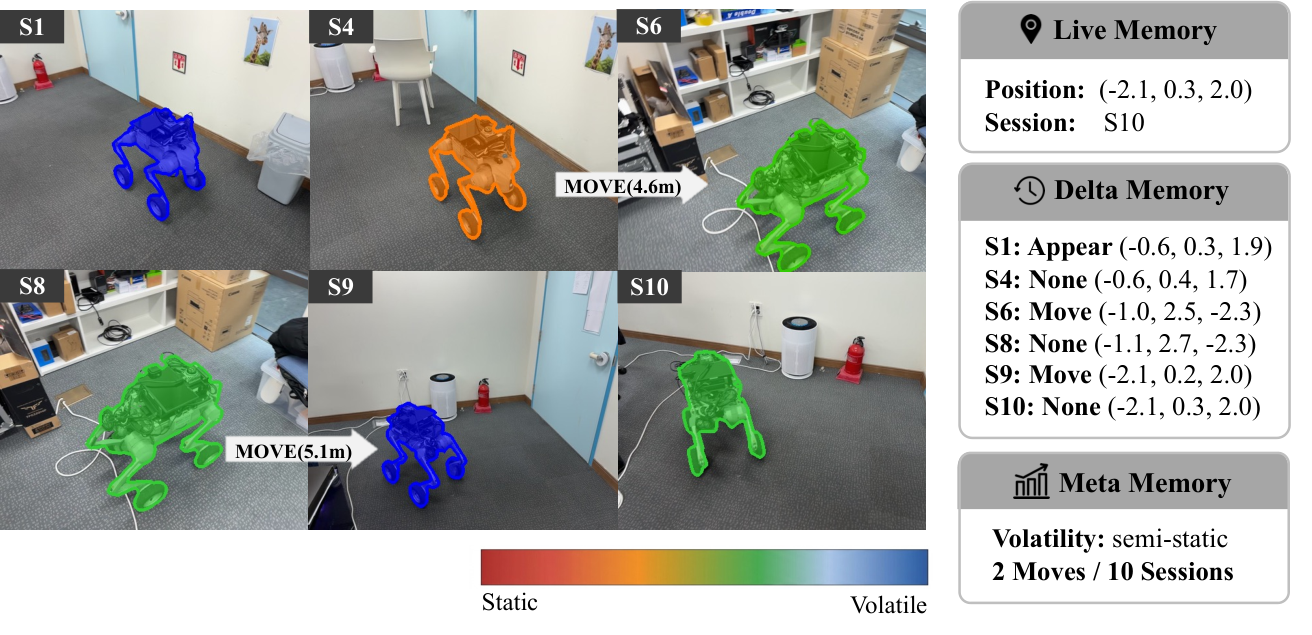
- Third, the resulting Tri-Memory structure (Live, Delta, Meta) preserves both current states and event histories, enabling longitudinal object-centric reasoning.
Method
We consider an environment observed across $T$ sessions (i.e., independent mapping runs conducted at different times) $S_{1},\ldots,S_{T}$, where objects may move, appear, disappear, or be temporarily occluded.
For each object $q$ in session $S_{t}$, the perception layer produces a 3D observation where $\mathbf{c}_{t}^{q}\in\mathbb{R}^{3}$ is the centroid, $v_{t}^{q}$ denotes volume, and $\mathbf{f}_{t}^{q}$ is a visual embedding extracted from the segmented region.
Experiments
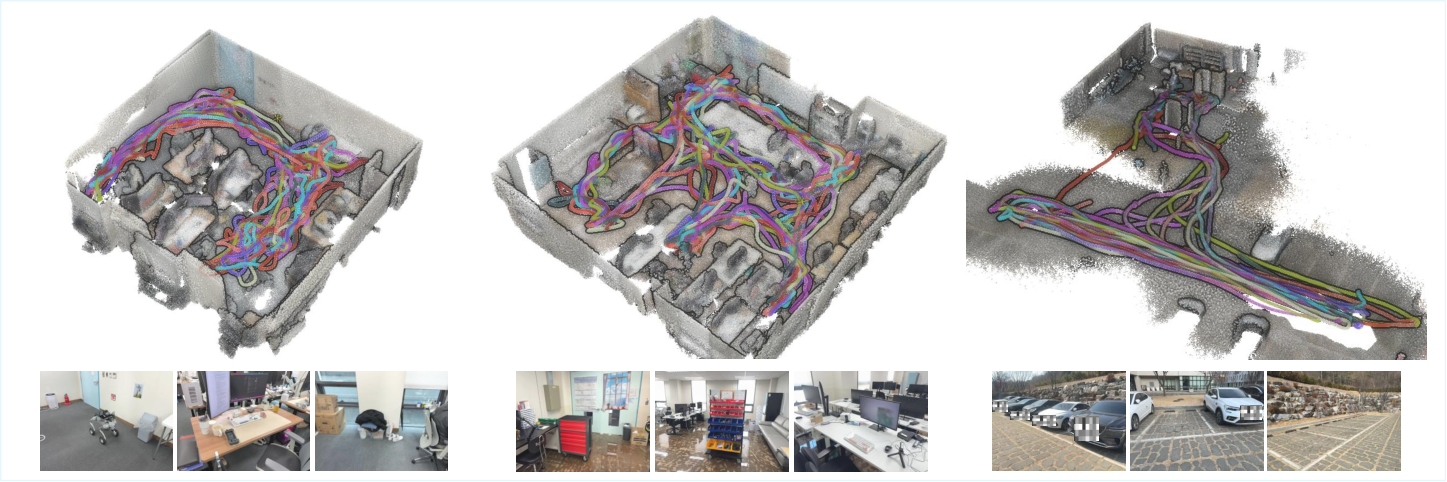
We construct LT-VQA, a controlled multi-session dataset for evaluating long-term object-centric scene understanding. It jointly provides globally aligned multi-session geometry, persistent object-instance identity, event-level state transition annotations, and session-indexed temporal QA pairs.
While 3RScan [ 20 ] provides instance-level correspondence across rescans, it lacks event-level annotations and temporal QA supervision.
Sources and Demonstrations
Figures are reproduced from Lee et al. See the full paper for experimental details and the project page, when the paper links one, for demonstrations and videos.
Related Papers
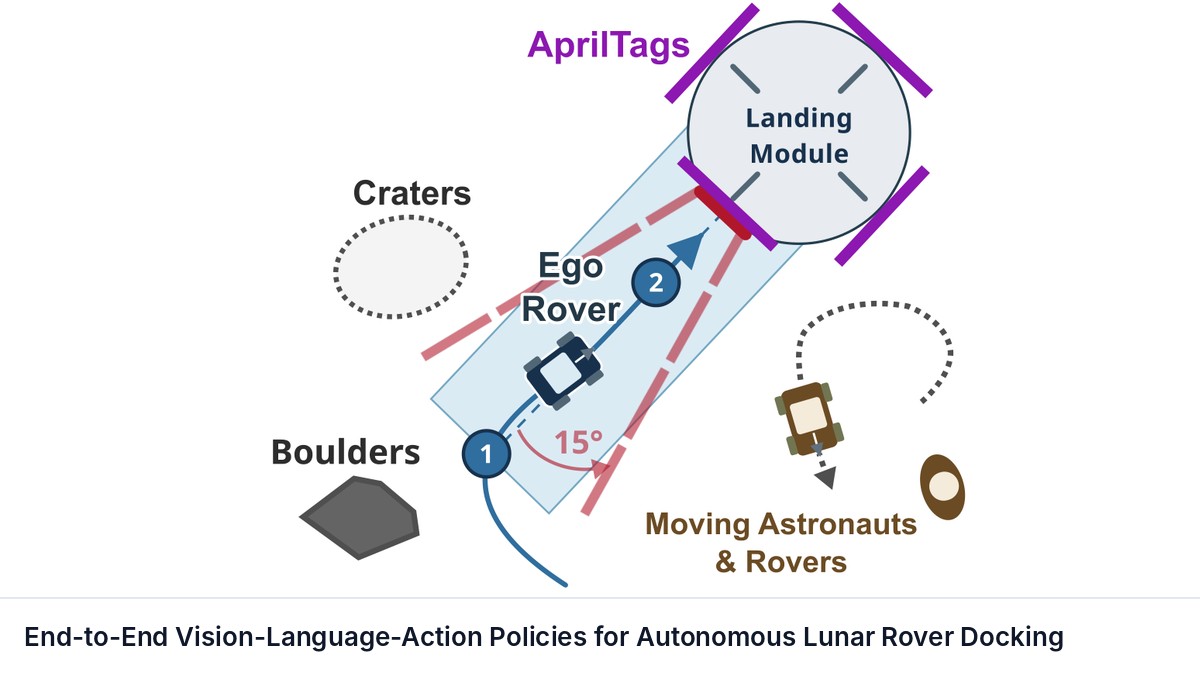
End-to-End Vision-Language-Action Policies for Autonomous Lunar Rover Docking
Sitan Huang, Grace Gao
Surface navigation on the Moon is subject to extreme illumination contrast and deployment-time perceptual disturbances.
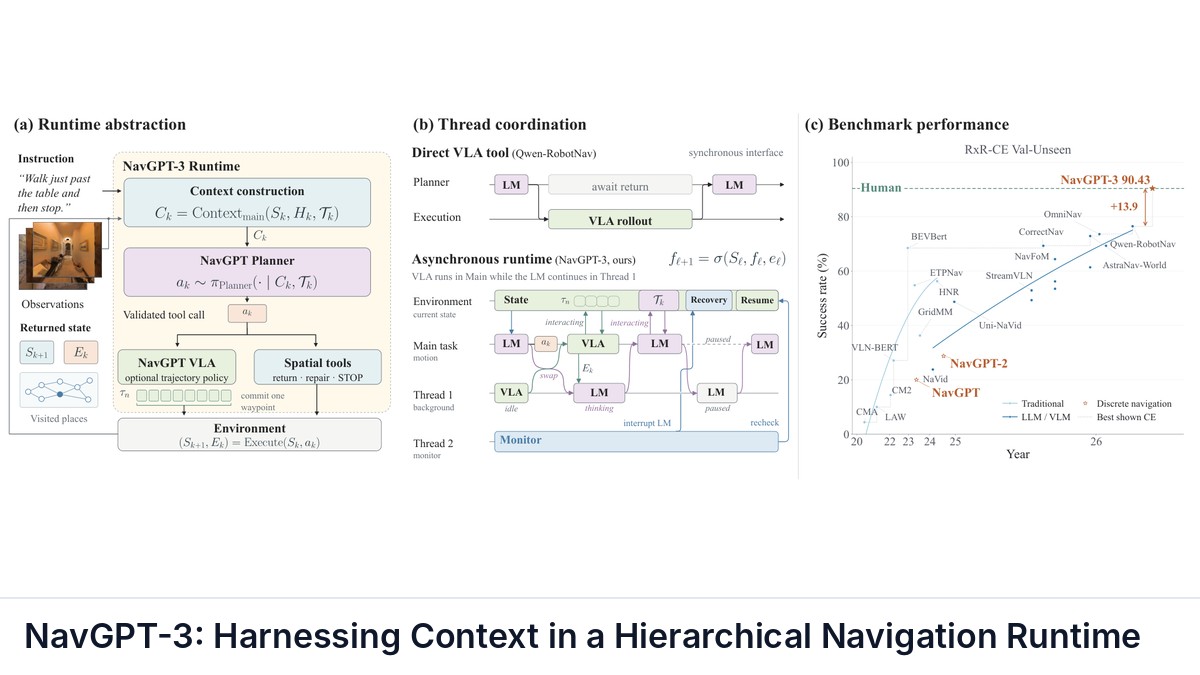
NavGPT-3: Harnessing Context in a Hierarchical Navigation Runtime
Gengze Zhou, Yicong Hong, Jiazhao Zhang et al.
Language models trained with long-horizon agentic reinforcement learning can generalize knowledge through reasoning, express precise actions, and pursue goals over many steps, raising the ceiling on what an embodied agent can understand and decide.
Planning-Oriented End-to-End Autonomous Driving: Architectures, Evaluation, and Emerging Paradigms
Yanchen Guan, Xingcheng Liu, Bin Rao et al.
End-to-end autonomous driving has evolved from camera-to-control regression toward planning-oriented systems that use structured representations, trajectory-level outputs, and increasingly realistic evaluation protocols.
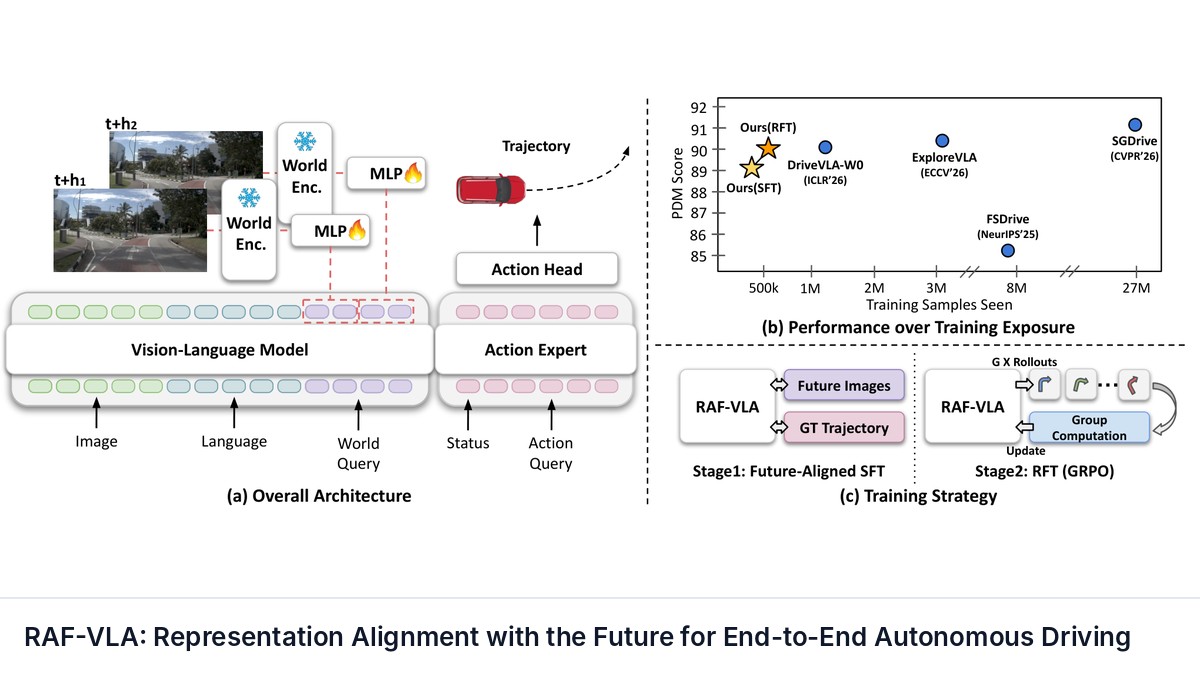
RAF-VLA: Representation Alignment with the Future for End-to-End Autonomous Driving
Dogun Kim, Yongjae Lee, Joonhee Lim et al.
Recent Vision-Language-Action (VLA) models for autonomous driving have incorporated world modeling by predicting future driving scenes alongside driving actions, demonstrating strong planning performance.