
RAF-VLA: Representation Alignment with the Future for End-to-End Autonomous Driving
Dogun Kim, Yongjae Lee, Joonhee Lim, Yeina Lee, Junhyeok Park, Moogeun Park, Dongsuk Kum · N/A · 2026
Framework
N/A
License
N/A
Stars
N/A
Summary
Recent Vision-Language-Action (VLA) models for autonomous driving have incorporated world modeling by predicting future driving scenes alongside driving actions, demonstrating strong planning performance. Future driving scenes are utilized as dense supervision, encouraging the policy to learn ric...
Abstract Summary
Key Points
- Recent Vision-Language-Action (VLA) models for autonomous driving have incorporated world modelin...
- Future driving scenes are utilized as dense supervision, encouraging the policy to learn rich int...
- However, these World-Modeling VLAs rely on explicit future generation to learn such representatio...
- To address these limitations, we propose RAF-VLA (Representation Alignment with the Future), a VL...
- RAF-VLA employs Future-Aligned Supervised Fine-Tuning, in which a straightforward regularization ...
RAF-VLA: Representation Alignment with the Future for End-to-End Autonomous Driving
|Authors: Dogun Kim, Yongjae Lee, Joonhee Lim, Yeina Lee, Junhyeok Park, Moogeun Park, Dongsuk Kum
|Venue: arXiv preprint | Year: 2026
|arXiv: 2609.17728
Abstract
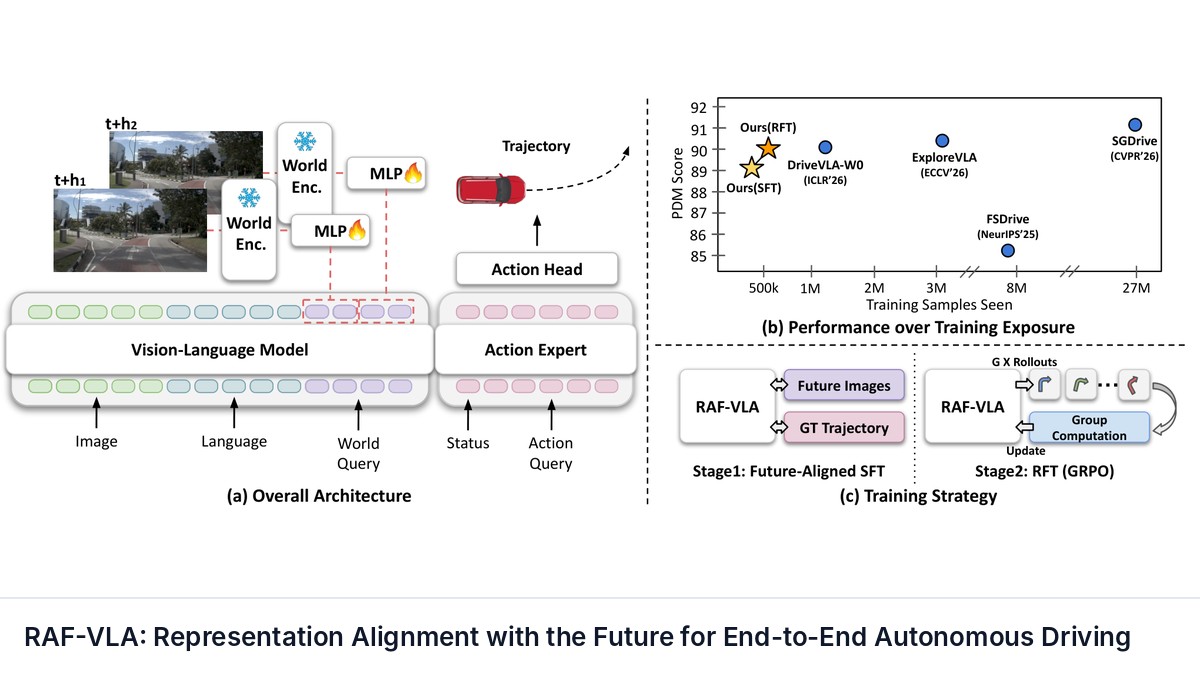
Recent Vision-Language-Action (VLA) models for autonomous driving have incorporated world modeling by predicting future driving scenes alongside driving actions, demonstrating strong planning performance. Future driving scenes are utilized as dense supervision, encouraging the policy to learn rich internal representations useful for planning. However, these World-Modeling VLAs rely on explicit future generation to learn such representations, thereby introducing two key limitations: additional training burden and inference latency. To address these limitations, we propose RAF-VLA (Representation Alignment with the Future), a VLA-based autonomous driving framework that shapes planning-relevant internal representations through direct guidance from future-frame representations. RAF-VLA employs Future-Aligned Supervised Fine-Tuning, in which a straightforward regularization aligns the policy’s hidden states with future-frame representations obtained from a pretrained world encoder while learning driving actions. This simple alignment allows RAF-VLA to avoid the training burden and inference latency associated with future generation. Extensive experiments on the NAVSIM benchmark show that RAF-VLA achieves competitive planning performance against state-of-the-art VLA planners with substantially fewer training samples seen. Moreover, RAF-VLA incurs only 3.8% training overhead and a negligible 1 ms inference overhead.
Key Contributions
- Recent Vision-Language-Action (VLA) models for autonomous driving have incorporated world modelin…
- Future driving scenes are utilized as dense supervision, encouraging the policy to learn rich int…
- However, these World-Modeling VLAs rely on explicit future generation to learn such representatio…
- To address these limitations, we propose RAF-VLA (Representation Alignment with the Future), a VL…
- RAF-VLA employs Future-Aligned Supervised Fine-Tuning, in which a straightforward regularization …
Topics
- vision
- vla
- reinforcement-learning
- planning
- benchmark
Code & Data
- GitHub repository: https://github.com/OpenDriveLab/OpenScene
BibTeX
@article{Kim2026_260917728,
  title     = {RAF-VLA: Representation Alignment with the Future for End-to-End Autonomous Driving},
  author    = {Dogun Kim and Yongjae Lee and Joonhee Lim and Yeina Lee and Junhyeok Park and Moogeun Park and Dongsuk Kum},
  year      = {2026},
  eprint    = {2609.17728},
  archivePrefix = {arXiv},
  primaryClass  = {cs.RO},
  url       = {https://arxiv.org/abs/2609.17728}
}
Related Papers
Planning-Oriented End-to-End Autonomous Driving: Architectures, Evaluation, and Emerging Paradigms
Yanchen Guan, Xingcheng Liu, Bin Rao et al. · arXiv preprint · Aug 2026
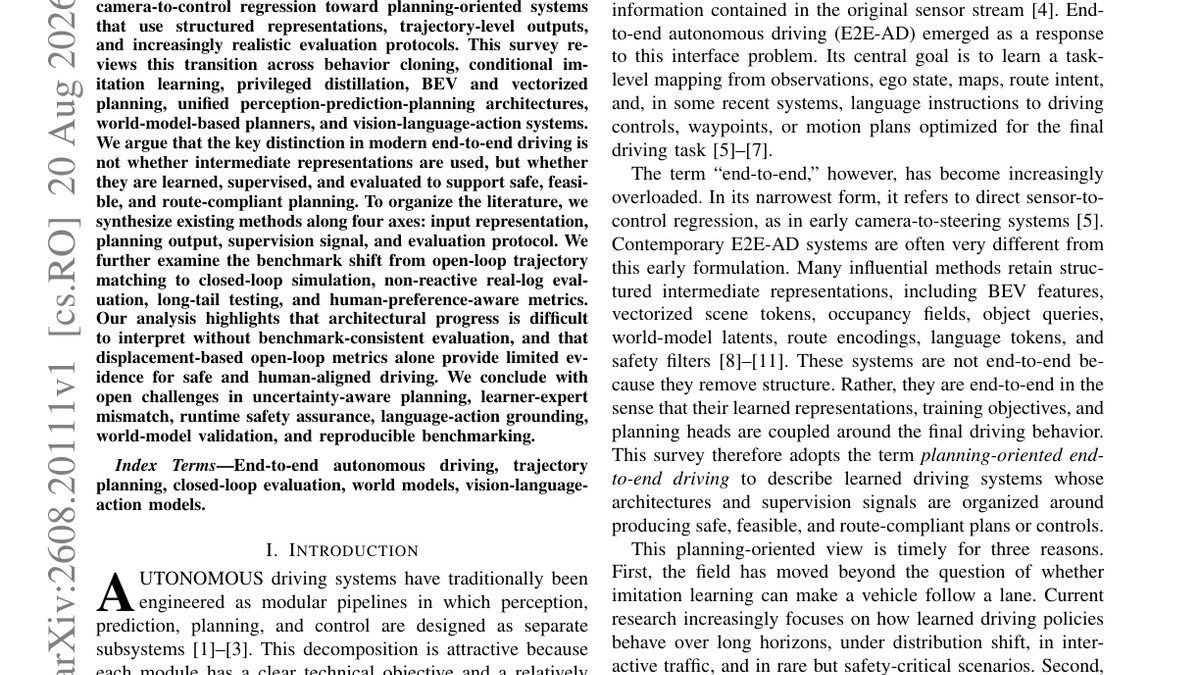
End-to-end autonomous driving has evolved from camera-to-control regression toward planning-oriented systems that use structured representations, trajectory-level outputs, and increasingly realistic evaluation protocols. This survey reviews this transition across behavior cloning, conditional imi...
Beyond Episodic Evaluation: Memory Architectural Bottlenecks in Sequential Embodied Question Answering
Zikui Cai, Kaushal Janga, Tan Dat Dao et al. · arXiv preprint · Jul 2026
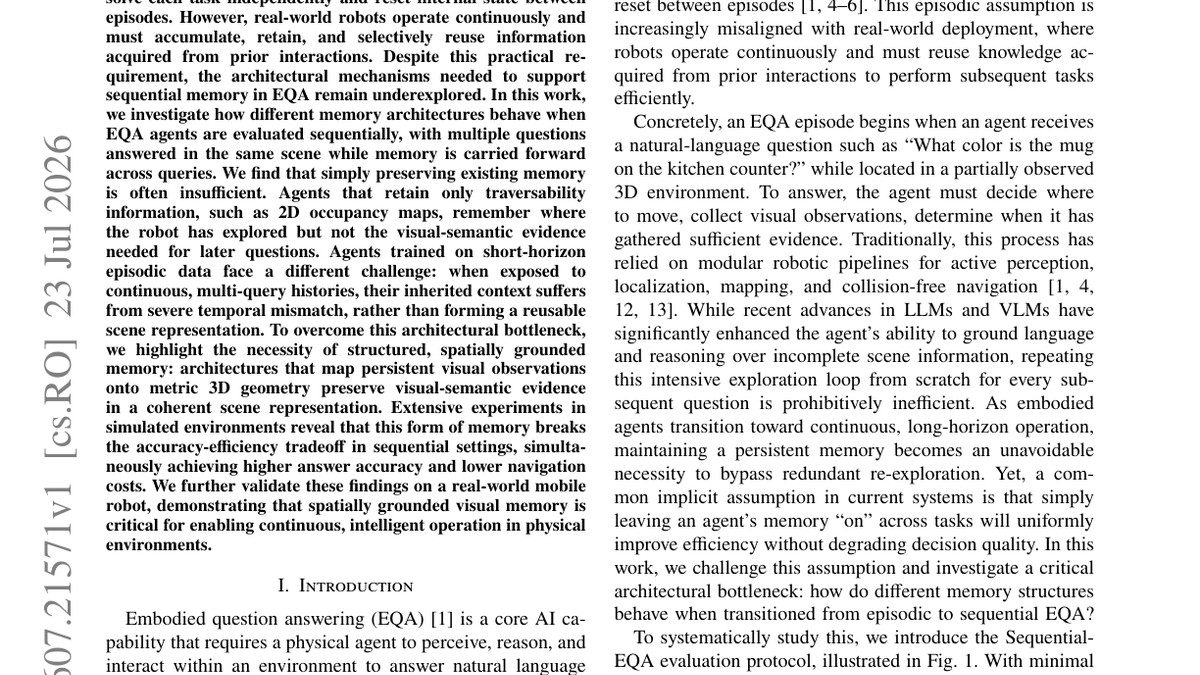
Embodied question answering (EQA) is traditionally evaluated under an episodic formulation, where agents solve each task independently and reset internal state between episodes. However, real-world robots operate continuously and must accumulate, retain, and selectively reuse information acquired...
Continuous Actions from Discrete Minds: Latent-Aligned Planning for End-to-End Autonomous Driving
Ruoyu Yao, Yusen Xie, Qingzhao Liu et al. · arXiv preprint · Sep 2026
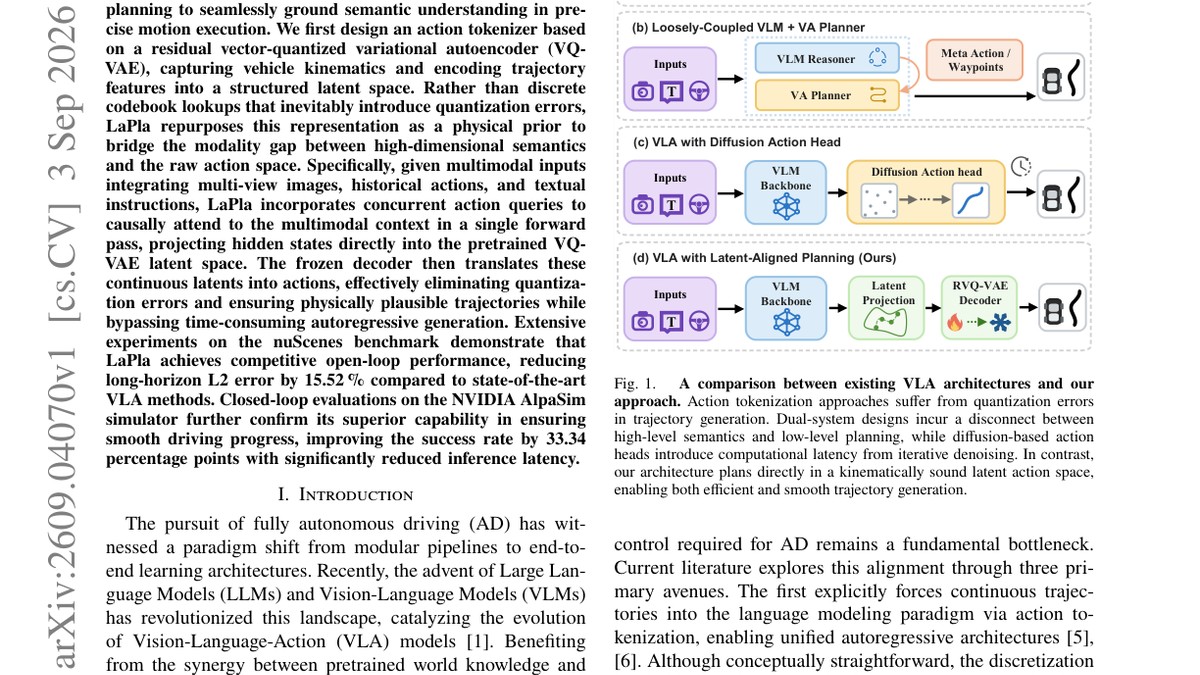
Bridging the gap between the discrete reasoning of Vision-Language Models and the continuous, physics-constrained nature of autonomous driving remains a significant challenge. In this work, we introduce LaPla, a unified Vision-Language-Action (VLA) framework featuring latent-aligned planning to s...
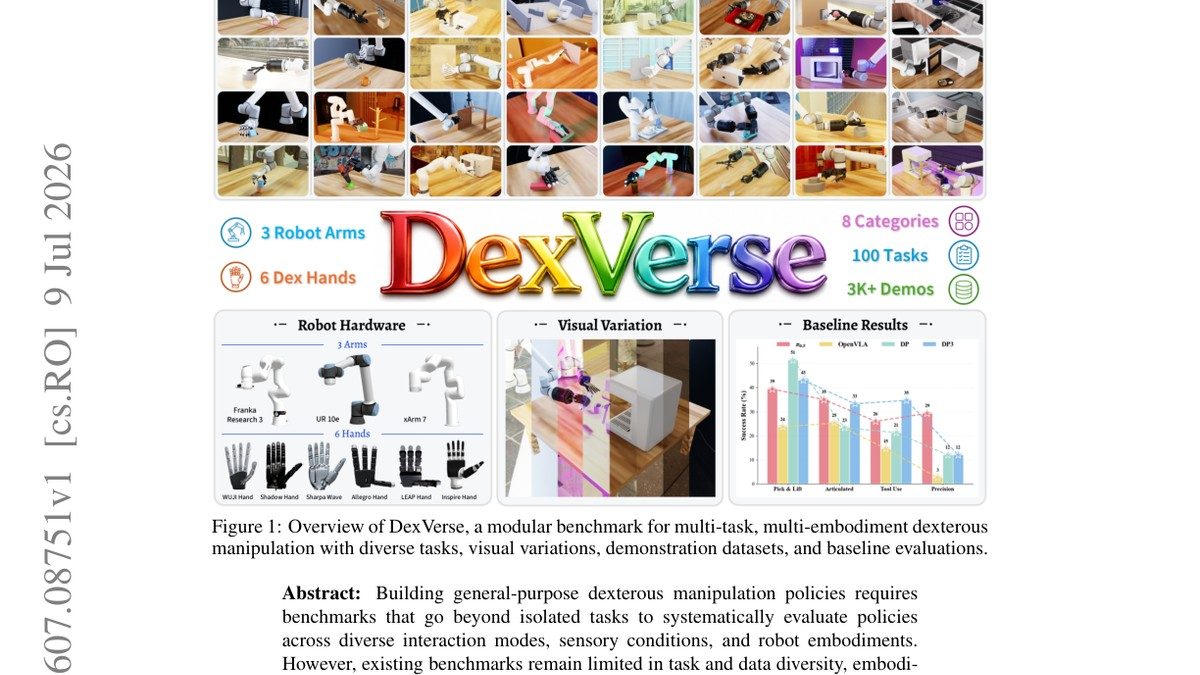
DexVerse: A Modular Benchmark for Multi-Task, Multi-Embodiment Dexterous Manipulation
Yunchao Yao, Zhuxiu Xu, Tianqi Zhang et al. · arXiv preprint · Jul 2026
Building general-purpose dexterous manipulation policies requires benchmarks that go beyond isolated tasks to systematically evaluate policies across diverse interaction modes, sensory conditions, and robot embodiments. However, existing benchmarks remain limited in task and data diversity, embod...