
Beyond Episodic Evaluation: Memory Architectural Bottlenecks in Sequential Embodied Question Answering
Zikui Cai, Kaushal Janga, Tan Dat Dao, Seungjae Lee, Shivin Dass, Mingyo Seo, Kaiyu Yue, Mintong Kang, Nandhu Pillai, Monte Hoover, Aadi Palnitkar, Ruchit Rawal, Ruijie Zheng, Bo Li, Yuke Zhu, Roberto Martín-Martín, Tom Goldstein, Furong Huang · N/A · 2026
Framework
N/A
License
N/A
Stars
N/A
Summary
Embodied question answering (EQA) is traditionally evaluated under an episodic formulation, where agents solve each task independently and reset internal state between episodes. However, real-world robots operate continuously and must accumulate, retain, and selectively reuse information acquired...
Abstract Summary
Key Points
- Embodied question answering (EQA) is traditionally evaluated under an episodic formulation, where...
- However, real-world robots operate continuously and must accumulate, retain, and selectively reus...
- Despite this practical requirement, the architectural mechanisms needed to support sequential mem...
- In this work, we investigate how different memory architectures behave when EQA agents are evalua...
- We find that simply preserving existing memory is often insufficient
Beyond Episodic Evaluation: Memory Architectural Bottlenecks in Sequential Embodied Question Answering
|Authors: Zikui Cai, Kaushal Janga, Tan Dat Dao, Seungjae Lee, Shivin Dass, Mingyo Seo, Kaiyu Yue, Mintong Kang, Nandhu Pillai, Monte Hoover, Aadi Palnitkar, Ruchit Rawal, Ruijie Zheng, Bo Li, Yuke Zhu, Roberto Martín-Martín, Tom Goldstein, Furong Huang
|Venue: arXiv preprint | Year: 2026
|arXiv: 2607.21571v1
Abstract
Embodied question answering (EQA) is traditionally evaluated under an episodic formulation, where agents solve each task independently and reset internal state between episodes. However, real-world robots operate continuously and must accumulate, retain, and selectively reuse information acquired from prior interactions. Despite this practical requirement, the architectural mechanisms needed to support sequential memory in EQA remain underexplored. In this work, we investigate how different memory architectures behave when EQA agents are evaluated sequentially, with multiple questions answered in the same scene while memory is carried forward across queries. We find that simply preserving existing memory is often insufficient. Agents that retain only traversability information, such as 2D occupancy maps, remember where the robot has explored but not the visual-semantic evidence needed for later questions. Agents trained on short-horizon episodic data face a different challenge: when exposed to continuous, multi-query histories, their inherited context suffers from severe temporal mismatch, rather than forming a reusable scene representation. To overcome this architectural bottleneck, we highlight the necessity of structured, spatially grounded memory: architectures that map persistent visual observations onto metric 3D geometry preserve visual-semantic evidence in a coherent scene representation. Extensive experiments in simulated environments reveal that this form of memory breaks the accuracy-efficiency tradeoff in sequential settings, simultaneously achieving higher answer accuracy and lower navigation costs. We further validate these findings on a real-world mobile robot, demonstrating that spatially grounded visual memory is critical for enabling continuous, intelligent operation in physical environments.
Key Contributions
- Embodied question answering (EQA) is traditionally evaluated under an episodic formulation, where…
- However, real-world robots operate continuously and must accumulate, retain, and selectively reus…
- Despite this practical requirement, the architectural mechanisms needed to support sequential mem…
- In this work, we investigate how different memory architectures behave when EQA agents are evalua…
- We find that simply preserving existing memory is often insufficient
Topics
- vision
- reinforcement-learning
- planning
- benchmark
Code & Data
No code repository linked in paper metadata.
BibTeX
@article{Cai2026_260721571v1,
  title     = {Beyond Episodic Evaluation: Memory Architectural Bottlenecks in Sequential Embodied Question Answering},
  author    = {Zikui Cai and Kaushal Janga and Tan Dat Dao and Seungjae Lee and Shivin Dass and Mingyo Seo and Kaiyu Yue and Mintong Kang and Nandhu Pillai and Monte Hoover and Aadi Palnitkar and Ruchit Rawal and Ruijie Zheng and Bo Li and Yuke Zhu and Roberto Martín-Martín and Tom Goldstein and Furong Huang},
  year      = {2026},
  eprint    = {2607.21571v1},
  archivePrefix = {arXiv},
  primaryClass  = {cs.RO},
  url       = {https://arxiv.org/abs/2607.21571v1}
}
Related Papers
Embodied Scene Rearrangement Planning
Canzhi Chen, Zan Wang, Siqi Zhu et al. · arXiv preprint · Aug 2026
This paper introduces Embodied Scene Rearrangement Planning (ESRP), a novel task requiring embodied agents to rearrange furniture in 3D scenes to match a target configuration using only egocentric observations and a top-down target layout. Unlike prior rearrangement tasks, ESRP precludes global s...
Planning-Oriented End-to-End Autonomous Driving: Architectures, Evaluation, and Emerging Paradigms
Yanchen Guan, Xingcheng Liu, Bin Rao et al. · arXiv preprint · Aug 2026
End-to-end autonomous driving has evolved from camera-to-control regression toward planning-oriented systems that use structured representations, trajectory-level outputs, and increasingly realistic evaluation protocols. This survey reviews this transition across behavior cloning, conditional imi...
Towards Surgical World-Action Modeling: A Preliminary Joint Visual-Trajectory Forecasting for Surgical Motion Planning
Weiliang Huang, Huanrong Liu, Bob Zhang et al. · arXiv preprint · Aug 2026
Reliable surgical planning requires models to anticipate not only how instruments will move, but also how the operative visual state will evolve together with such motion. Existing approaches typically treat future scene generation and instrument trajectory prediction as two separate tasks. Scene...
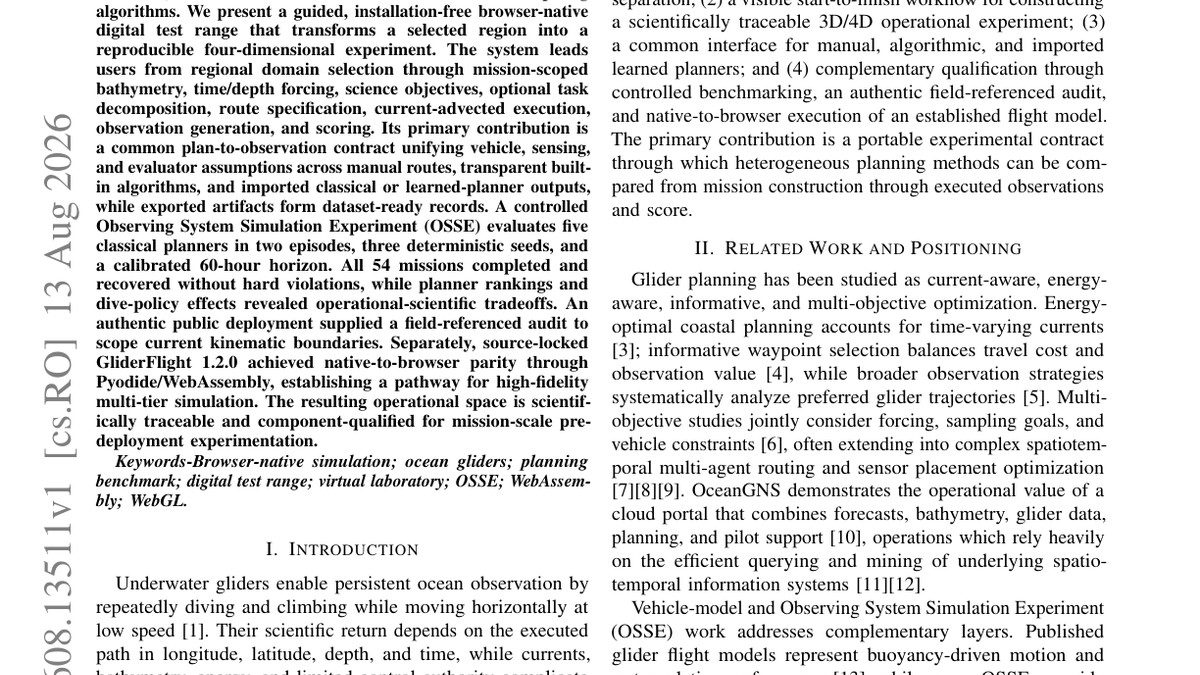
A Browser-Native Digital Test Range for Benchmarking 4D Ocean-Glider Planning Algorithms
Edward Holmberg, Elias Ioup, Mahdi Abdelguerfi · arXiv preprint · Aug 2026
Repeated in-situ evaluation of ocean-glider planners requires scarce vehicles, operators, deployment and recovery resources, and ocean conditions that cannot be reset for competing algorithms. We present a guided, installation-free browser-native digital test range that transforms a selected regi...