
A Browser-Native Digital Test Range for Benchmarking 4D Ocean-Glider Planning Algorithms
Edward Holmberg, Elias Ioup, Mahdi Abdelguerfi · N/A · 2026
Framework
N/A
License
N/A
Stars
N/A
Summary
Repeated in-situ evaluation of ocean-glider planners requires scarce vehicles, operators, deployment and recovery resources, and ocean conditions that cannot be reset for competing algorithms. We present a guided, installation-free browser-native digital test range that transforms a selected regi...
Abstract Summary
Key Points
- Repeated in-situ evaluation of ocean-glider planners requires scarce vehicles, operators, deploym...
- We present a guided, installation-free browser-native digital test range that transforms a select...
- The system leads users from regional domain selection through mission-scoped bathymetry, time/dep...
- Its primary contribution is a common plan-to-observation contract unifying vehicle, sensing, and ...
- A controlled Observing System Simulation Experiment (OSSE) evaluates five classical planners in t...
A Browser-Native Digital Test Range for Benchmarking 4D Ocean-Glider Planning Algorithms
|Authors: Edward Holmberg, Elias Ioup, Mahdi Abdelguerfi
|Venue: arXiv preprint | Year: 2026
|arXiv: 2608.13511v1
Abstract
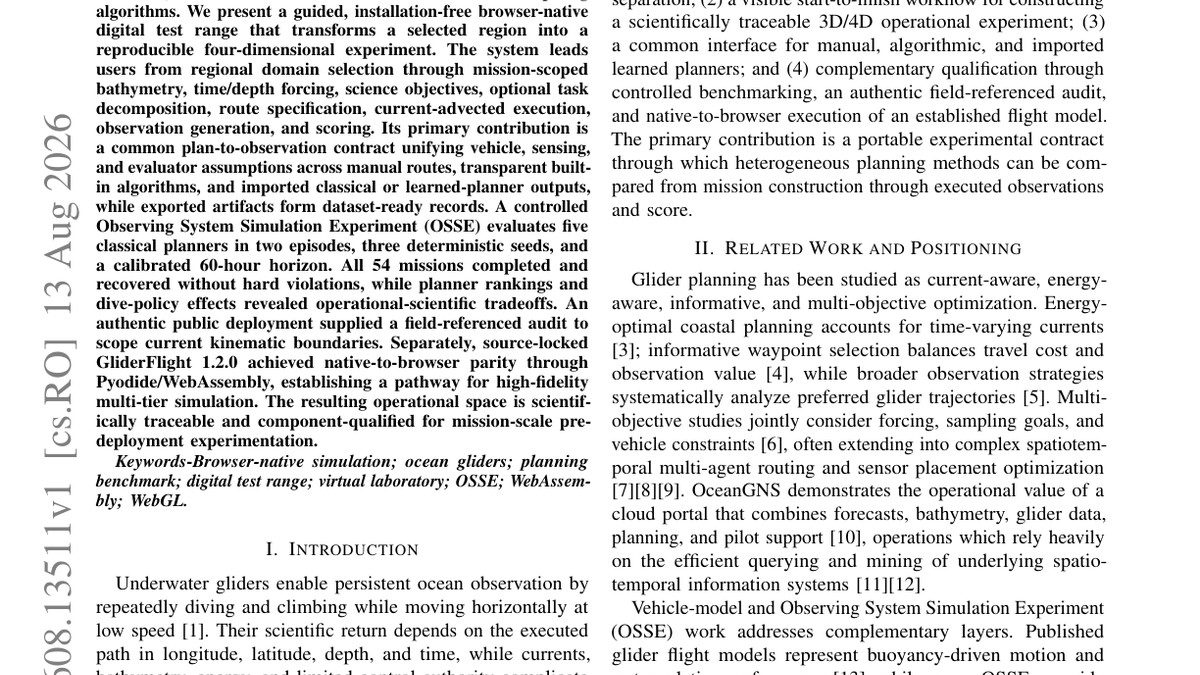
Repeated in-situ evaluation of ocean-glider planners requires scarce vehicles, operators, deployment and recovery resources, and ocean conditions that cannot be reset for competing algorithms. We present a guided, installation-free browser-native digital test range that transforms a selected region into a reproducible four-dimensional experiment. The system leads users from regional domain selection through mission-scoped bathymetry, time/depth forcing, science objectives, optional task decomposition, route specification, current-advected execution, observation generation, and scoring. Its primary contribution is a common plan-to-observation contract unifying vehicle, sensing, and evaluator assumptions across manual routes, transparent built-in algorithms, and imported classical or learned-planner outputs, while exported artifacts form dataset-ready records. A controlled Observing System Simulation Experiment (OSSE) evaluates five classical planners in two episodes, three deterministic seeds, and a calibrated 60-hour horizon. All 54 missions completed and recovered without hard violations, while planner rankings and dive-policy effects revealed operational-scientific tradeoffs. An authentic public deployment supplied a field-referenced audit to scope current kinematic boundaries. Separately, source-locked GliderFlight 1.2.0 achieved native-to-browser parity through Pyodide/WebAssembly, establishing a pathway for high-fidelity multi-tier simulation. The resulting operational space is scientifically traceable and component-qualified for mission-scale pre-deployment experimentation.
Key Contributions
- Repeated in-situ evaluation of ocean-glider planners requires scarce vehicles, operators, deploym…
- We present a guided, installation-free browser-native digital test range that transforms a select…
- The system leads users from regional domain selection through mission-scoped bathymetry, time/dep…
- Its primary contribution is a common plan-to-observation contract unifying vehicle, sensing, and …
- A controlled Observing System Simulation Experiment (OSSE) evaluates five classical planners in t…
Topics
- reinforcement-learning
- planning
- control
- benchmark
Code & Data
No code repository linked in paper metadata.
BibTeX
@article{Holmberg2026_260813511v1,
  title     = {A Browser-Native Digital Test Range for Benchmarking 4D Ocean-Glider Planning Algorithms},
  author    = {Edward Holmberg and Elias Ioup and Mahdi Abdelguerfi},
  year      = {2026},
  eprint    = {2608.13511v1},
  archivePrefix = {arXiv},
  primaryClass  = {cs.RO},
  url       = {https://arxiv.org/abs/2608.13511v1}
}
Related Papers
Compact Latent Coordination for Autonomous Vehicles at Unsignalized Intersections
Gil Lifshits, Igal Bilik, Gilad Katz · arXiv preprint · Jul 2026
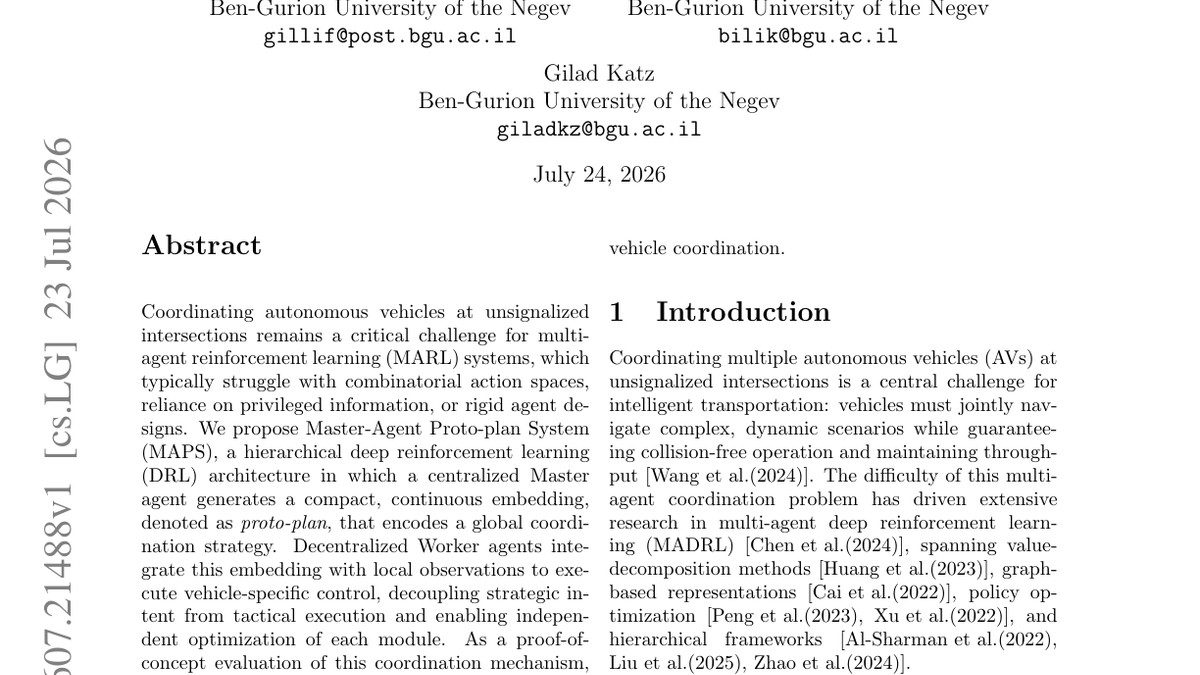
Coordinating autonomous vehicles at unsignalized intersections remains a critical challenge for multi-agent reinforcement learning (MARL) systems, which typically struggle with combinatorial action spaces, reliance on privileged information, or rigid agent designs. We propose Master-Agent Proto-p...
Planning-Oriented End-to-End Autonomous Driving: Architectures, Evaluation, and Emerging Paradigms
Yanchen Guan, Xingcheng Liu, Bin Rao et al. · arXiv preprint · Aug 2026
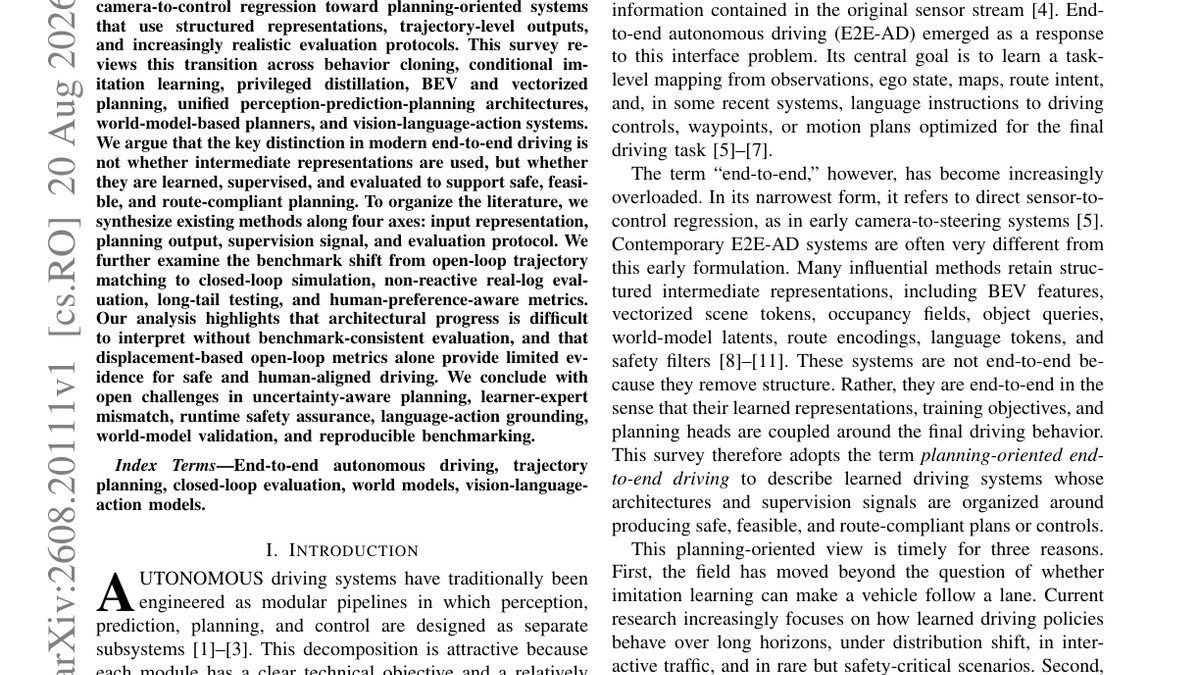
End-to-end autonomous driving has evolved from camera-to-control regression toward planning-oriented systems that use structured representations, trajectory-level outputs, and increasingly realistic evaluation protocols. This survey reviews this transition across behavior cloning, conditional imi...
A Low-Cost, Open Platform for End-to-End Autonomous Driving on a Miniature Ackermann Vehicle
Gustavo Claudio Karl Couto, Eric Aislan Antonelo, Gabriel George Zipperer · arXiv preprint · Sep 2026
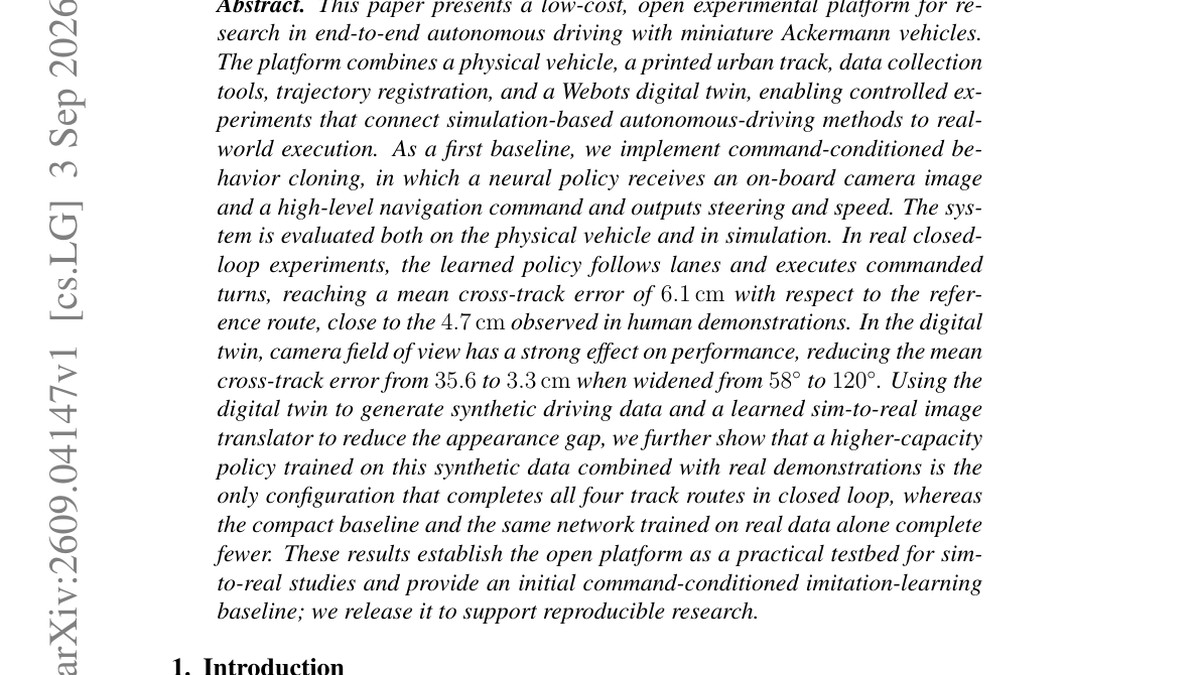
This paper presents a low-cost, open experimental platform for research in end-to-end autonomous driving with miniature Ackermann vehicles. The platform combines a physical vehicle, a printed urban track, data collection tools, trajectory registration, and a Webots digital twin, enabling controll...
AHEAD: Anticipatory Hand-Driven Teleoperation via Human Intent Prediction
Seok Joon Kim, Junho Lee, Federica Spinola et al. · arXiv preprint · Jul 2026
Direct hand-driven teleoperation maps an operator's hand motion to robot end-effector commands at every frame, enabling precise control, but it requires constant monitoring and correction during approach, grasp, and placement, which can be slow and fatiguing. For repetitive pick-and-place tasks, ...