
A Low-Cost, Open Platform for End-to-End Autonomous Driving on a Miniature Ackermann Vehicle
Gustavo Claudio Karl Couto, Eric Aislan Antonelo, Gabriel George Zipperer · N/A · 2026
Framework
N/A
License
N/A
Stars
N/A
Summary
This paper presents a low-cost, open experimental platform for research in end-to-end autonomous driving with miniature Ackermann vehicles. The platform combines a physical vehicle, a printed urban track, data collection tools, trajectory registration, and a Webots digital twin, enabling controll...
Abstract Summary
Key Points
- This paper presents a low-cost, open experimental platform for research in end-to-end autonomous ...
- The platform combines a physical vehicle, a printed urban track, data collection tools, trajector...
- As a first baseline, we implement command-conditioned behavior cloning, in which a neural policy ...
- The system is evaluated both on the physical vehicle and in simulation
- In real closed-loop experiments, the learned policy follows lanes and executes commanded turns, r...
A Low-Cost, Open Platform for End-to-End Autonomous Driving on a Miniature Ackermann Vehicle
|Authors: Gustavo Claudio Karl Couto, Eric Aislan Antonelo, Gabriel George Zipperer
|Venue: arXiv preprint | Year: 2026
|arXiv: 2609.04147v1
Abstract
This paper presents a low-cost, open experimental platform for research in end-to-end autonomous driving with miniature Ackermann vehicles. The platform combines a physical vehicle, a printed urban track, data collection tools, trajectory registration, and a Webots digital twin, enabling controlled experiments that connect simulation-based autonomous-driving methods to real-world execution. As a first baseline, we implement command-conditioned behavior cloning, in which a neural policy receives an on-board camera image and a high-level navigation command and outputs steering and speed. The system is evaluated both on the physical vehicle and in simulation. In real closed-loop experiments, the learned policy follows lanes and executes commanded turns, reaching a mean cross-track error of 6.1 cm with respect to the reference route, close to the 4.7 cm observed in human demonstrations. In the digital twin, camera field of view has a strong effect on performance, reducing the mean cross-track error from 35.6 to 3.3 cm when widened from 58 to 120 degrees. Using the digital twin to generate synthetic driving data and a learned sim-to-real image translator to reduce the appearance gap, we further show that a higher-capacity policy trained on this synthetic data combined with real demonstrations is the only configuration that completes all four track routes in closed loop, whereas the compact baseline and the same network trained on real data alone complete fewer. These results establish the open platform as a practical testbed for sim-to-real studies and provide an initial command-conditioned imitation-learning baseline; we release it to support reproducible research.
Key Contributions
- This paper presents a low-cost, open experimental platform for research in end-to-end autonomous …
- The platform combines a physical vehicle, a printed urban track, data collection tools, trajector…
- As a first baseline, we implement command-conditioned behavior cloning, in which a neural policy …
- The system is evaluated both on the physical vehicle and in simulation
- In real closed-loop experiments, the learned policy follows lanes and executes commanded turns, r…
Topics
- vision
- reinforcement-learning
- sim-to-real
- planning
- control
- learning-from-demonstration
Code & Data
No code repository linked in paper metadata.
BibTeX
@article{Couto2026_260904147v1,
  title     = {A Low-Cost, Open Platform for End-to-End Autonomous Driving on a Miniature Ackermann Vehicle},
  author    = {Gustavo Claudio Karl Couto and Eric Aislan Antonelo and Gabriel George Zipperer},
  year      = {2026},
  eprint    = {2609.04147v1},
  archivePrefix = {arXiv},
  primaryClass  = {cs.LG},
  url       = {https://arxiv.org/abs/2609.04147v1}
}
Related Papers
Planning-Oriented End-to-End Autonomous Driving: Architectures, Evaluation, and Emerging Paradigms
Yanchen Guan, Xingcheng Liu, Bin Rao et al. · arXiv preprint · Aug 2026
End-to-end autonomous driving has evolved from camera-to-control regression toward planning-oriented systems that use structured representations, trajectory-level outputs, and increasingly realistic evaluation protocols. This survey reviews this transition across behavior cloning, conditional imi...
Video2DoorTraversal: Push Door Traversal via Simulated Door Twins
Xincheng Tang, Yiji Chen, Youhan Xie et al. · arXiv preprint · Aug 2026
Door opening and traversal is a long-horizon loco-manipulation task that requires precise handle interaction and coordinated base-arm control. We present Video2DoorTraversal, a single-video real-to-sim-to-real framework for wheel-legged mobile manipulators. Given one RGB video of a real door, Doo...
AHEAD: Anticipatory Hand-Driven Teleoperation via Human Intent Prediction
Seok Joon Kim, Junho Lee, Federica Spinola et al. · arXiv preprint · Jul 2026
Direct hand-driven teleoperation maps an operator's hand motion to robot end-effector commands at every frame, enabling precise control, but it requires constant monitoring and correction during approach, grasp, and placement, which can be slow and fatiguing. For repetitive pick-and-place tasks, ...
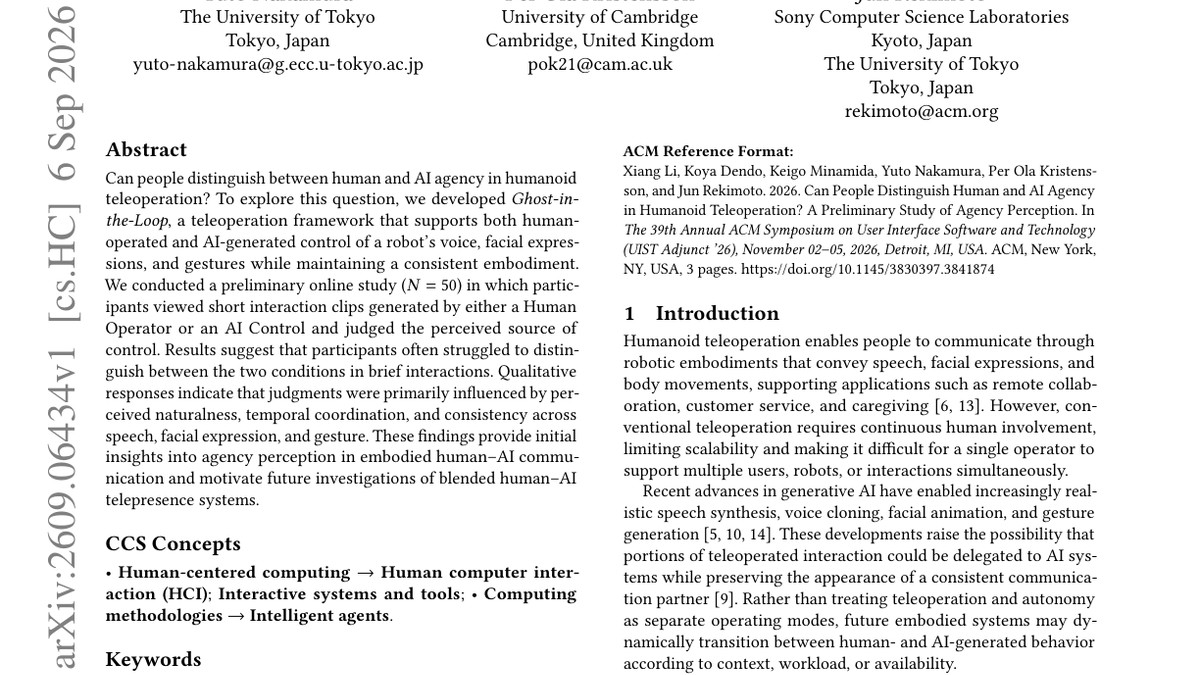
Can People Distinguish Human and AI Agency in Humanoid Teleoperation? A Preliminary Study of Agency Perception
Xiang Li, Koya Dendo, Keigo Minamida et al. · arXiv preprint · Sep 2026
Can people distinguish between human and AI agency in humanoid teleoperation? To explore this question, we developed \textit{Ghost-in-the-Loop}, a teleoperation framework that supports both human-operated and AI-generated control of a robot's voice, facial expressions, and gestures while maintain...