
Can People Distinguish Human and AI Agency in Humanoid Teleoperation? A Preliminary Study of Agency Perception
Xiang Li, Koya Dendo, Keigo Minamida, Yuto Nakamura, Per Ola Kristensson, Jun Rekimoto · N/A · 2026
Framework
N/A
License
N/A
Stars
N/A
Summary
Can people distinguish between human and AI agency in humanoid teleoperation? To explore this question, we developed \textit{Ghost-in-the-Loop}, a teleoperation framework that supports both human-operated and AI-generated control of a robot's voice, facial expressions, and gestures while maintain...
Abstract Summary
Key Points
- Can people distinguish between human and AI agency in humanoid teleoperation?
- To explore this question, we developed \textit{Ghost-in-the-Loop}, a teleoperation framework that...
- We conducted a preliminary online study ($N=50$) in which participants viewed short interaction c...
- Results suggest that participants often struggled to distinguish between the two conditions in br...
- Qualitative responses indicate that judgments were primarily influenced by perceived naturalness,...
Can People Distinguish Human and AI Agency in Humanoid Teleoperation? A Preliminary Study of Agency Perception
|Authors: Xiang Li, Koya Dendo, Keigo Minamida, Yuto Nakamura, Per Ola Kristensson, Jun Rekimoto
|Venue: arXiv preprint | Year: 2026
|arXiv: 2609.06434v1
Abstract
Can people distinguish between human and AI agency in humanoid teleoperation? To explore this question, we developed \textit{Ghost-in-the-Loop}, a teleoperation framework that supports both human-operated and AI-generated control of a robot’s voice, facial expressions, and gestures while maintaining a consistent embodiment. We conducted a preliminary online study ($N=50$) in which participants viewed short interaction clips generated by either a Human Operator or an AI Control and judged the perceived source of control. Results suggest that participants often struggled to distinguish between the two conditions in brief interactions. Qualitative responses indicate that judgments were primarily influenced by perceived naturalness, temporal coordination, and consistency across speech, facial expression, and gesture. These findings provide initial insights into agency perception in embodied human—AI communication and motivate future investigations of blended human—AI telepresence systems.
Key Contributions
- Can people distinguish between human and AI agency in humanoid teleoperation?
- To explore this question, we developed \textit{Ghost-in-the-Loop}, a teleoperation framework that…
- We conducted a preliminary online study ($N=50$) in which participants viewed short interaction c…
- Results suggest that participants often struggled to distinguish between the two conditions in br…
- Qualitative responses indicate that judgments were primarily influenced by perceived naturalness,…
Topics
- vision
- reinforcement-learning
- control
- learning-from-demonstration
Code & Data
No code repository linked in paper metadata.
BibTeX
@article{Li2026_260906434v1,
  title     = {Can People Distinguish Human and AI Agency in Humanoid Teleoperation? A Preliminary Study of Agency Perception},
  author    = {Xiang Li and Koya Dendo and Keigo Minamida and Yuto Nakamura and Per Ola Kristensson and Jun Rekimoto},
  year      = {2026},
  eprint    = {2609.06434v1},
  archivePrefix = {arXiv},
  primaryClass  = {cs.HC},
  url       = {https://arxiv.org/abs/2609.06434v1}
}
Related Papers
A Low-Cost, Open Platform for End-to-End Autonomous Driving on a Miniature Ackermann Vehicle
Gustavo Claudio Karl Couto, Eric Aislan Antonelo, Gabriel George Zipperer · arXiv preprint · Sep 2026
This paper presents a low-cost, open experimental platform for research in end-to-end autonomous driving with miniature Ackermann vehicles. The platform combines a physical vehicle, a printed urban track, data collection tools, trajectory registration, and a Webots digital twin, enabling controll...
Design and Evaluation of a Touchscreen-Based Teleoperation Interface for Robotic Manipulators
Juan José García Cárdenas, Alperen Kenan, Hamidreza Raei et al. · arXiv preprint · Aug 2026
Intuitive teleoperation interfaces are crucial for the safe and effective operation of robotic manipulators in challenging environments. In the nuclear industry, surface contact tasks such as swab sampling require precise path and force tracking, obstacle avoidance, and sustained operator attenti...
DexVerse: A Modular Benchmark for Multi-Task, Multi-Embodiment Dexterous Manipulation
Yunchao Yao, Zhuxiu Xu, Tianqi Zhang et al. · arXiv preprint · Jul 2026
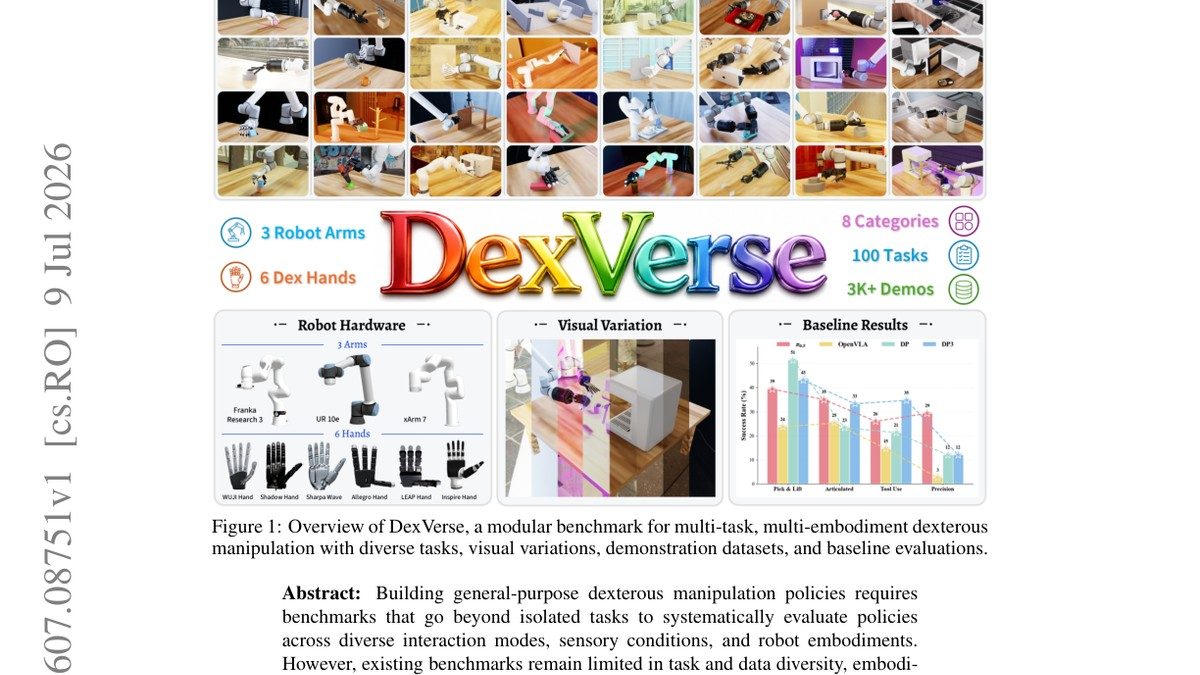
Building general-purpose dexterous manipulation policies requires benchmarks that go beyond isolated tasks to systematically evaluate policies across diverse interaction modes, sensory conditions, and robot embodiments. However, existing benchmarks remain limited in task and data diversity, embod...
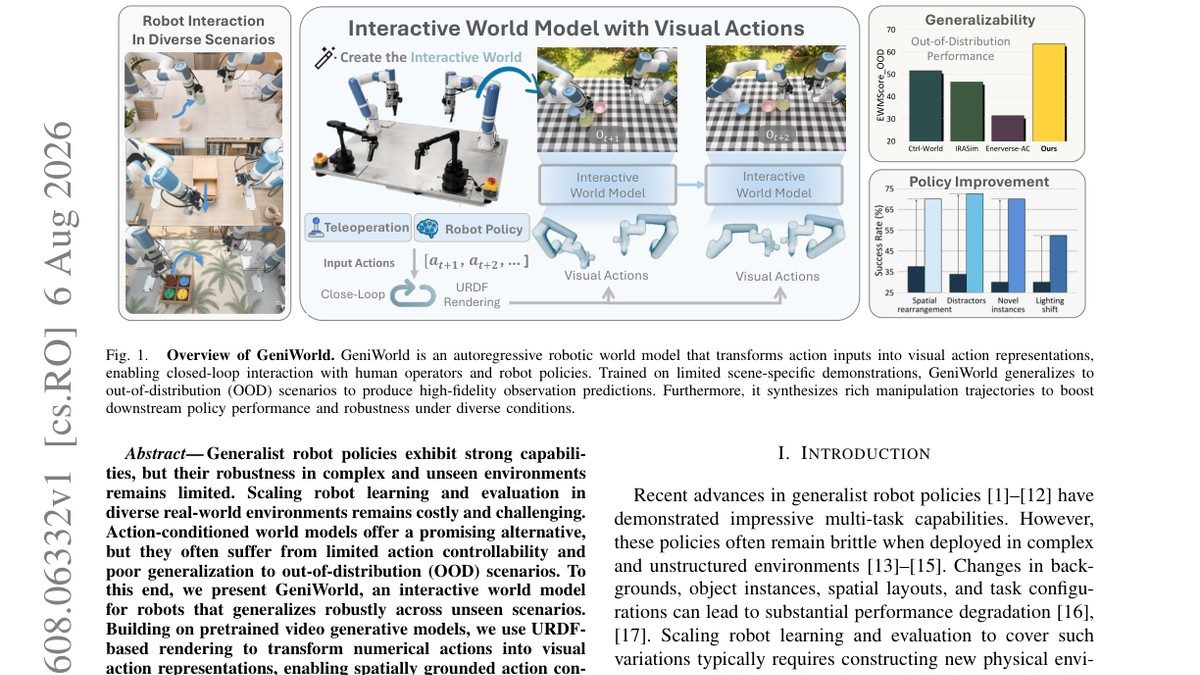
GeniWorld: A Generalizable Interactive World Model for Robotic Manipulation via Visual Actions
Chenghao Gu, Hanyang Yu, Jingbo Zhang et al. · arXiv preprint · Aug 2026
Generalist robot policies exhibit strong capabilities, but their robustness in complex and unseen environments remains limited. Scaling robot learning and evaluation in diverse real-world environments remains costly and challenging. Action-conditioned world models offer a promising alternative, b...