
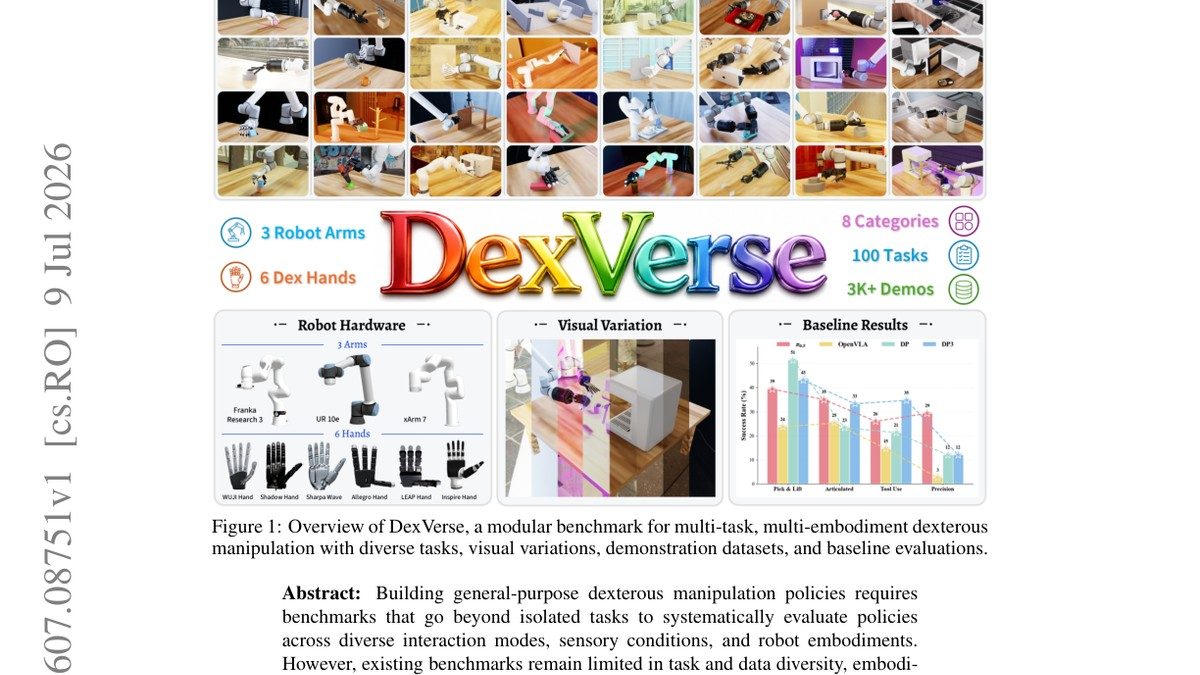
DexVerse: A Modular Benchmark for Multi-Task, Multi-Embodiment Dexterous Manipulation
Yunchao Yao, Zhuxiu Xu, Tianqi Zhang, Zixian Liu, Sikai Li, Zhenyu Wei, Feng Chen, Dihong Huang, Kechang Wan, Chenyang Ma, Shuqi Zhao, Shenghua Gao, Masayoshi Tomizuka, Yi Ma, Mingyu Ding · N/A · 2026
Framework
N/A
License
N/A
Stars
N/A
Summary
Building general-purpose dexterous manipulation policies requires benchmarks that go beyond isolated tasks to systematically evaluate policies across diverse interaction modes, sensory conditions, and robot embodiments. However, existing benchmarks remain limited in task and data diversity, embod...
Abstract Summary
Key Points
- Building general-purpose dexterous manipulation policies requires benchmarks that go beyond isola...
- However, existing benchmarks remain limited in task and data diversity, embodiment coverage, or c...
- We present DexVerse, a large-scale and modular benchmark for dexterous manipulation
- DexVerse includes 100 tasks spanning a broad range of manipulation skills, including object grasp...
- It supports 3 robot arms and 6 dexterous hands, and is extensible to new tasks, assets, and embod...
DexVerse: A Modular Benchmark for Multi-Task, Multi-Embodiment Dexterous Manipulation
|Authors: Yunchao Yao, Zhuxiu Xu, Tianqi Zhang, Zixian Liu, Sikai Li, Zhenyu Wei, Feng Chen, Dihong Huang, Kechang Wan, Chenyang Ma, Shuqi Zhao, Shenghua Gao, Masayoshi Tomizuka, Yi Ma, Mingyu Ding
|Venue: arXiv preprint | Year: 2026
|arXiv: 2607.08751v1
Abstract
Building general-purpose dexterous manipulation policies requires benchmarks that go beyond isolated tasks to systematically evaluate policies across diverse interaction modes, sensory conditions, and robot embodiments. However, existing benchmarks remain limited in task and data diversity, embodiment coverage, or controllable visual variation, hindering studies of cross-task and cross-embodiment generalization. We present DexVerse, a large-scale and modular benchmark for dexterous manipulation. DexVerse includes 100 tasks spanning a broad range of manipulation skills, including object grasping and relocation, articulated-object interaction, functional tool use, bimanual coordination, non-prehensile control, contact-rich behaviors, multi-goal execution, and long-horizon multi-stage task completion. It supports 3 robot arms and 6 dexterous hands, and is extensible to new tasks, assets, and embodiments. To evaluate visuomotor generalization, DexVerse provides configurable visual variations in textures, background, lighting, and camera viewpoints. We further provide a VR-based teleoperation interface and 3,180 demonstrations with synchronized proprioceptive, RGB, depth, point-cloud, and state observations. We benchmark representative methods, including Diffusion Policy, DP3, OpenVLA, and $π_{0.5}$, across 19 tasks. Results reveal substantial challenges in task generalization and visuomotor robustness, establishing DexVerse as a promising testbed for general-purpose dexterous manipulation. Project page: https://ycyao216.github.io/DexVerse.site
Key Contributions
- Building general-purpose dexterous manipulation policies requires benchmarks that go beyond isola…
- However, existing benchmarks remain limited in task and data diversity, embodiment coverage, or c…
- We present DexVerse, a large-scale and modular benchmark for dexterous manipulation
- DexVerse includes 100 tasks spanning a broad range of manipulation skills, including object grasp…
- It supports 3 robot arms and 6 dexterous hands, and is extensible to new tasks, assets, and embod…
Topics
- manipulation
- vision
- vla
- reinforcement-learning
- control
- learning-from-demonstration
- benchmark
Code & Data
No code repository linked in paper metadata.
BibTeX
@article{Yao2026_260708751v1,
  title     = {DexVerse: A Modular Benchmark for Multi-Task, Multi-Embodiment Dexterous Manipulation},
  author    = {Yunchao Yao and Zhuxiu Xu and Tianqi Zhang and Zixian Liu and Sikai Li and Zhenyu Wei and Feng Chen and Dihong Huang and Kechang Wan and Chenyang Ma and Shuqi Zhao and Shenghua Gao and Masayoshi Tomizuka and Yi Ma and Mingyu Ding},
  year      = {2026},
  eprint    = {2607.08751v1},
  archivePrefix = {arXiv},
  primaryClass  = {cs.RO},
  url       = {https://arxiv.org/abs/2607.08751v1}
}
Related Papers
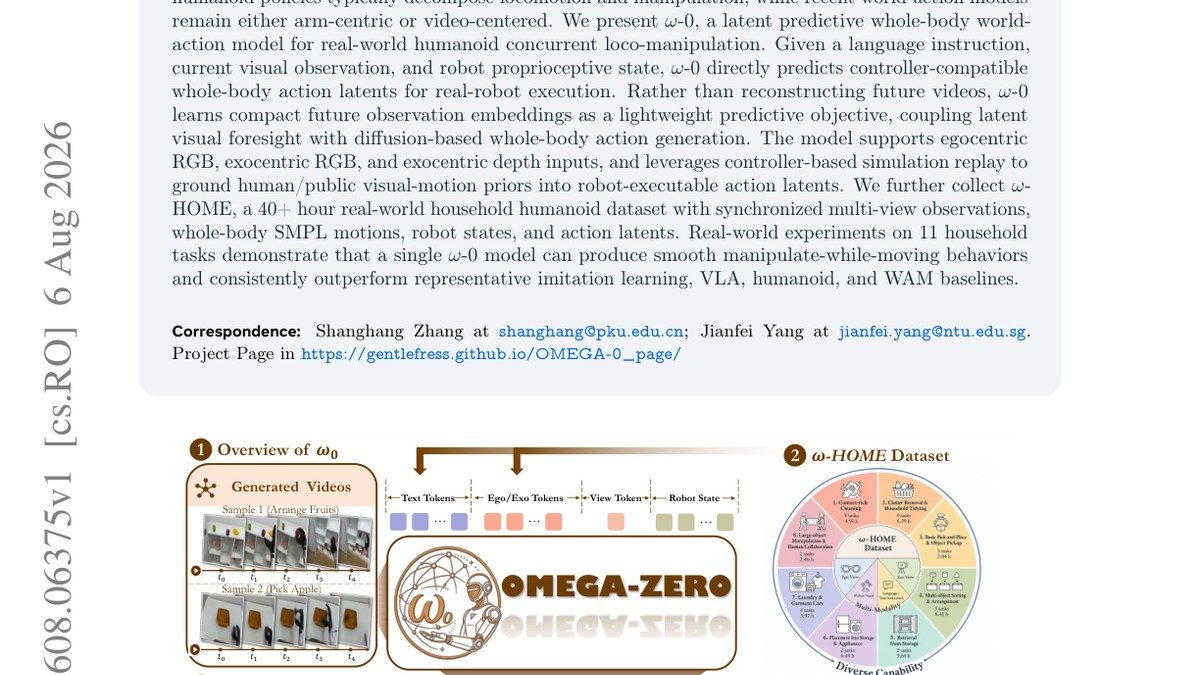
$ω$-0: A Latent Predictive World Action Model for Concurrent Humanoid Loco-Manipulation
Zhe Li, Zhenzhe Zhang, Yangyang Wei et al. · arXiv preprint · Aug 2026
Humanoid household tasks often require concurrent loco-manipulation, where the robot must move, adjust posture, maintain balance, and manipulate objects as a single coordinated behavior. Yet existing humanoid policies typically decompose locomotion and manipulation, while recent world-action mode...
GR00T N1: An Open Foundation Model for Generalist Humanoid Robots
NVIDIA, :, Johan Bjorck et al. · arXiv preprint · Mar 2025
General-purpose robots need a versatile body and an intelligent mind. Recent advancements in humanoid robots have shown great promise as a hardware platform for building generalist autonomy in the human world. A robot foundation model, trained on massive and diverse data sources, is essential for...
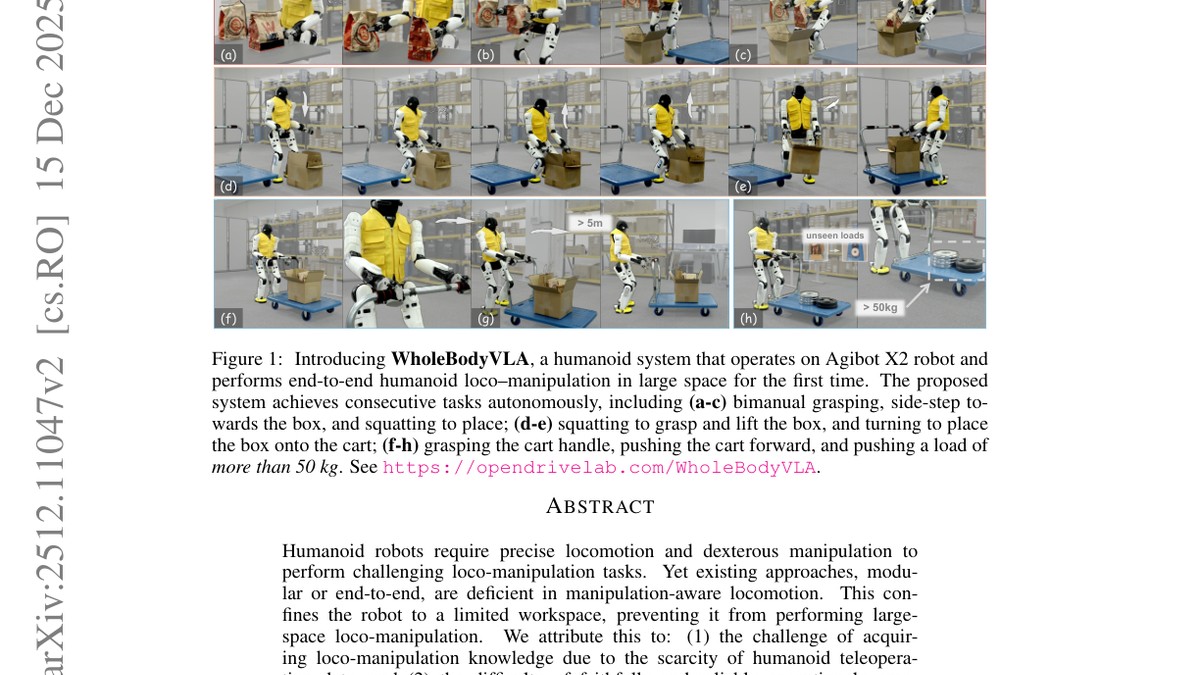
WholeBodyVLA: Towards Unified Latent VLA for Whole-Body Loco-Manipulation Control
Haoran Jiang, Jin Chen, Qingwen Bu et al. · arXiv preprint · Dec 2025
Humanoid robots require precise locomotion and dexterous manipulation to perform challenging loco-manipulation tasks. Yet existing approaches, modular or end-to-end, are deficient in manipulation-aware locomotion. This confines the robot to a limited workspace, preventing it from performing large...
Design and Evaluation of a Touchscreen-Based Teleoperation Interface for Robotic Manipulators
Juan José García Cárdenas, Alperen Kenan, Hamidreza Raei et al. · arXiv preprint · Aug 2026
Intuitive teleoperation interfaces are crucial for the safe and effective operation of robotic manipulators in challenging environments. In the nuclear industry, surface contact tasks such as swab sampling require precise path and force tracking, obstacle avoidance, and sustained operator attenti...