
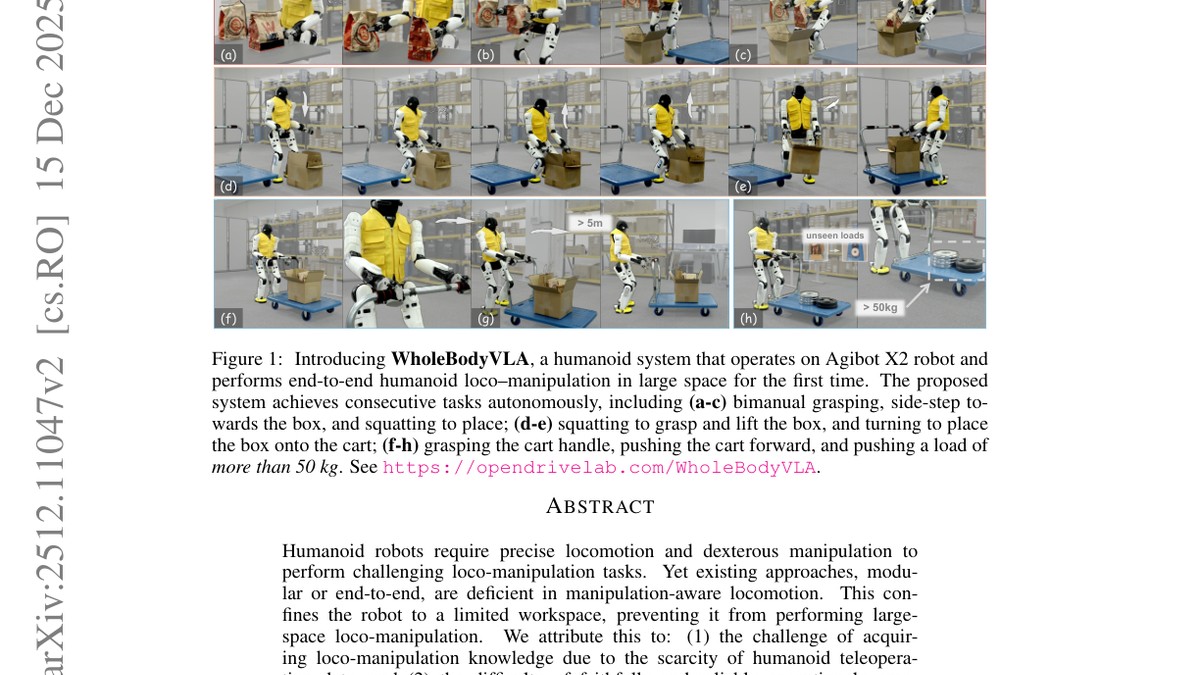
WholeBodyVLA: Towards Unified Latent VLA for Whole-Body Loco-Manipulation Control
Haoran Jiang, Jin Chen, Qingwen Bu, Li Chen, Modi Shi, Yanjie Zhang, Delong Li, Chuanzhe Suo, Chuang Wang, Zhihui Peng, Hongyang Li · N/A · 2025
Framework
N/A
License
N/A
Stars
N/A
Summary
Humanoid robots require precise locomotion and dexterous manipulation to perform challenging loco-manipulation tasks. Yet existing approaches, modular or end-to-end, are deficient in manipulation-aware locomotion. This confines the robot to a limited workspace, preventing it from performing large...
Abstract Summary
Key Points
- Humanoid robots require precise locomotion and dexterous manipulation to perform challenging loco...
- Yet existing approaches, modular or end-to-end, are deficient in manipulation-aware locomotion
- This confines the robot to a limited workspace, preventing it from performing large-space loco-ma...
- We attribute this to: (1) the challenge of acquiring loco-manipulation knowledge due to the scarc...
- To acquire richer loco-manipulation knowledge, we propose a unified latent learning framework tha...
WholeBodyVLA: Towards Unified Latent VLA for Whole-Body Loco-Manipulation Control
|Authors: Haoran Jiang, Jin Chen, Qingwen Bu, Li Chen, Modi Shi, Yanjie Zhang, Delong Li, Chuanzhe Suo, Chuang Wang, Zhihui Peng, Hongyang Li
|Venue: arXiv preprint | Year: 2025
|arXiv: 2512.11047v2
Abstract
Humanoid robots require precise locomotion and dexterous manipulation to perform challenging loco-manipulation tasks. Yet existing approaches, modular or end-to-end, are deficient in manipulation-aware locomotion. This confines the robot to a limited workspace, preventing it from performing large-space loco-manipulation. We attribute this to: (1) the challenge of acquiring loco-manipulation knowledge due to the scarcity of humanoid teleoperation data, and (2) the difficulty of faithfully and reliably executing locomotion commands, stemming from the limited precision and stability of existing RL controllers. To acquire richer loco-manipulation knowledge, we propose a unified latent learning framework that enables Vision-Language-Action (VLA) system to learn from low-cost action-free egocentric videos. Moreover, an efficient human data collection pipeline is devised to augment the dataset and scale the benefits. To execute the desired locomotion commands more precisely, we present a loco-manipulation-oriented (LMO) RL policy specifically tailored for accurate and stable core loco-manipulation movements, such as advancing, turning, and squatting. Building on these components, we introduce WholeBodyVLA, a unified framework for humanoid loco-manipulation. To the best of our knowledge, WholeBodyVLA is one of its kind enabling large-space humanoid loco-manipulation. It is verified via comprehensive experiments on the AgiBot X2 humanoid, outperforming prior baseline by 21.3%. It also demonstrates strong generalization and high extensibility across a broad range of tasks.
Key Contributions
- Humanoid robots require precise locomotion and dexterous manipulation to perform challenging loco…
- Yet existing approaches, modular or end-to-end, are deficient in manipulation-aware locomotion
- This confines the robot to a limited workspace, preventing it from performing large-space loco-ma…
- We attribute this to: (1) the challenge of acquiring loco-manipulation knowledge due to the scarc…
- To acquire richer loco-manipulation knowledge, we propose a unified latent learning framework tha…
Topics
- manipulation
- locomotion
- vision
- vla
- reinforcement-learning
- control
- learning-from-demonstration
- benchmark
Code & Data
- GitHub repository: https://github.com/OpenDriveLab/WholebodyVLA
BibTeX
@article{Jiang2025_251211047v2,
  title     = {WholeBodyVLA: Towards Unified Latent VLA for Whole-Body Loco-Manipulation Control},
  author    = {Haoran Jiang and Jin Chen and Qingwen Bu and Li Chen and Modi Shi and Yanjie Zhang and Delong Li and Chuanzhe Suo and Chuang Wang and Zhihui Peng and Hongyang Li},
  year      = {2025},
  eprint    = {2512.11047v2},
  archivePrefix = {arXiv},
  primaryClass  = {cs.RO},
  url       = {https://arxiv.org/abs/2512.11047v2}
}
Related Papers
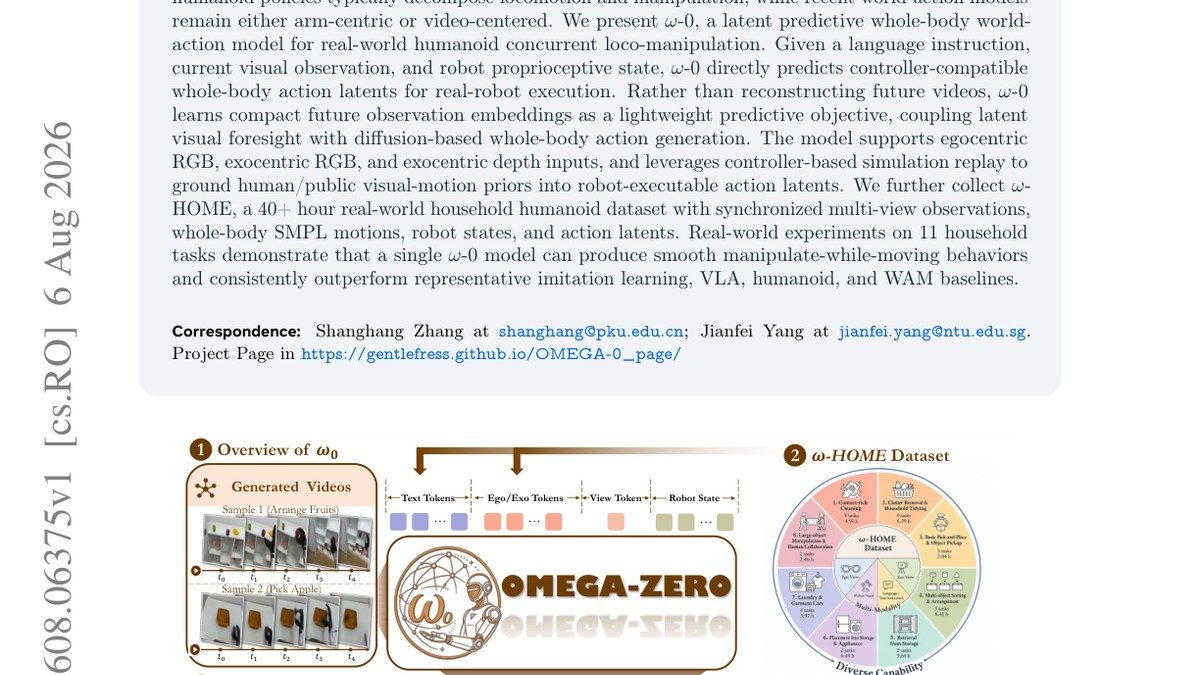
$ω$-0: A Latent Predictive World Action Model for Concurrent Humanoid Loco-Manipulation
Zhe Li, Zhenzhe Zhang, Yangyang Wei et al. · arXiv preprint · Aug 2026
Humanoid household tasks often require concurrent loco-manipulation, where the robot must move, adjust posture, maintain balance, and manipulate objects as a single coordinated behavior. Yet existing humanoid policies typically decompose locomotion and manipulation, while recent world-action mode...
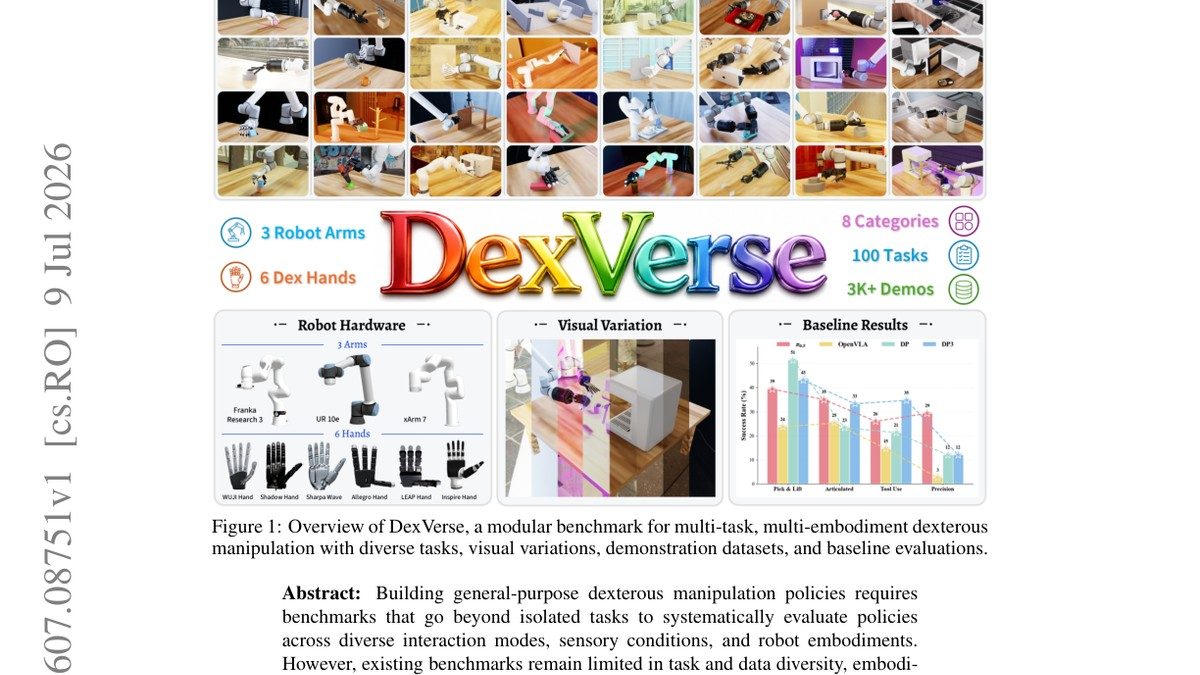
DexVerse: A Modular Benchmark for Multi-Task, Multi-Embodiment Dexterous Manipulation
Yunchao Yao, Zhuxiu Xu, Tianqi Zhang et al. · arXiv preprint · Jul 2026
Building general-purpose dexterous manipulation policies requires benchmarks that go beyond isolated tasks to systematically evaluate policies across diverse interaction modes, sensory conditions, and robot embodiments. However, existing benchmarks remain limited in task and data diversity, embod...
GR00T N1: An Open Foundation Model for Generalist Humanoid Robots
NVIDIA, :, Johan Bjorck et al. · arXiv preprint · Mar 2025
General-purpose robots need a versatile body and an intelligent mind. Recent advancements in humanoid robots have shown great promise as a hardware platform for building generalist autonomy in the human world. A robot foundation model, trained on massive and diverse data sources, is essential for...
DECOWAM: Decoupled Whole-Body World-Action Model for Legged Mobile Manipulation
Siyuan Ma, Boshi Zhang, Yutian Zhang et al. · arXiv preprint · Aug 2026
Mobile manipulation requires a robot to predict how locomotion and arm motion jointly alter future observations and control. Existing world-action models, developed largely for fixed-base platforms, do not explicitly distinguish camera ego-motion from base and arm actions. Here we introduce DECOW...