
DECOWAM: Decoupled Whole-Body World-Action Model for Legged Mobile Manipulation
Siyuan Ma, Boshi Zhang, Yutian Zhang, Qinglian Wu, Jiaqi Zhai, Dong Wei, Qiaojun Yu · N/A · 2026
Framework
N/A
License
N/A
Stars
N/A
Summary
Mobile manipulation requires a robot to predict how locomotion and arm motion jointly alter future observations and control. Existing world-action models, developed largely for fixed-base platforms, do not explicitly distinguish camera ego-motion from base and arm actions. Here we introduce DECOW...
Abstract Summary
Key Points
- Mobile manipulation requires a robot to predict how locomotion and arm motion jointly alter futur...
- Existing world-action models, developed largely for fixed-base platforms, do not explicitly disti...
- Here we introduce DECOWAM, a whole-body world-action model that separates these factors through d...
- DECOWAM freezes an adapted FastWAM backbone and trains residual adapters, an action-equivalent fu...
- We further introduce ARMDOG, a real-robot dataset that synchronizes video, whole-body state and a...
DECOWAM: Decoupled Whole-Body World-Action Model for Legged Mobile Manipulation
|Authors: Siyuan Ma, Boshi Zhang, Yutian Zhang, Qinglian Wu, Jiaqi Zhai, Dong Wei, Qiaojun Yu
|Venue: arXiv preprint | Year: 2026
|arXiv: 2608.20114v1
Abstract
Mobile manipulation requires a robot to predict how locomotion and arm motion jointly alter future observations and control. Existing world-action models, developed largely for fixed-base platforms, do not explicitly distinguish camera ego-motion from base and arm actions. Here we introduce DECOWAM, a whole-body world-action model that separates these factors through dedicated conditional interfaces. DECOWAM freezes an adapted FastWAM backbone and trains residual adapters, an action-equivalent future bottleneck distilled from privileged observations, adversarially separated base and arm latents, and base-velocity conditioning for video prediction. We further introduce ARMDOG, a real-robot dataset that synchronizes video, whole-body state and action, and language. On a fixed replay protocol, DECOWAM improved both future-video and action prediction over FastWAM, reducing action MSE by 21.7% with 25.95M trainable adaptation parameters. Across 79 closed-loop trials per method, it achieved the highest observed whole-body coordination and base-displacement robustness among the compared systems, while task completion remained comparable to the strongest baseline. These results show that embodiment-aware factorization can support parameter-efficient joint visual prediction and whole-body control under moving viewpoints.
Key Contributions
- Mobile manipulation requires a robot to predict how locomotion and arm motion jointly alter futur…
- Existing world-action models, developed largely for fixed-base platforms, do not explicitly disti…
- Here we introduce DECOWAM, a whole-body world-action model that separates these factors through d…
- DECOWAM freezes an adapted FastWAM backbone and trains residual adapters, an action-equivalent fu…
- We further introduce ARMDOG, a real-robot dataset that synchronizes video, whole-body state and a…
Topics
- manipulation
- locomotion
- vision
- reinforcement-learning
- control
- benchmark
Code & Data
No code repository linked in paper metadata.
BibTeX
@article{Ma2026_260820114v1,
  title     = {DECOWAM: Decoupled Whole-Body World-Action Model for Legged Mobile Manipulation},
  author    = {Siyuan Ma and Boshi Zhang and Yutian Zhang and Qinglian Wu and Jiaqi Zhai and Dong Wei and Qiaojun Yu},
  year      = {2026},
  eprint    = {2608.20114v1},
  archivePrefix = {arXiv},
  primaryClass  = {cs.AI},
  url       = {https://arxiv.org/abs/2608.20114v1}
}
Related Papers
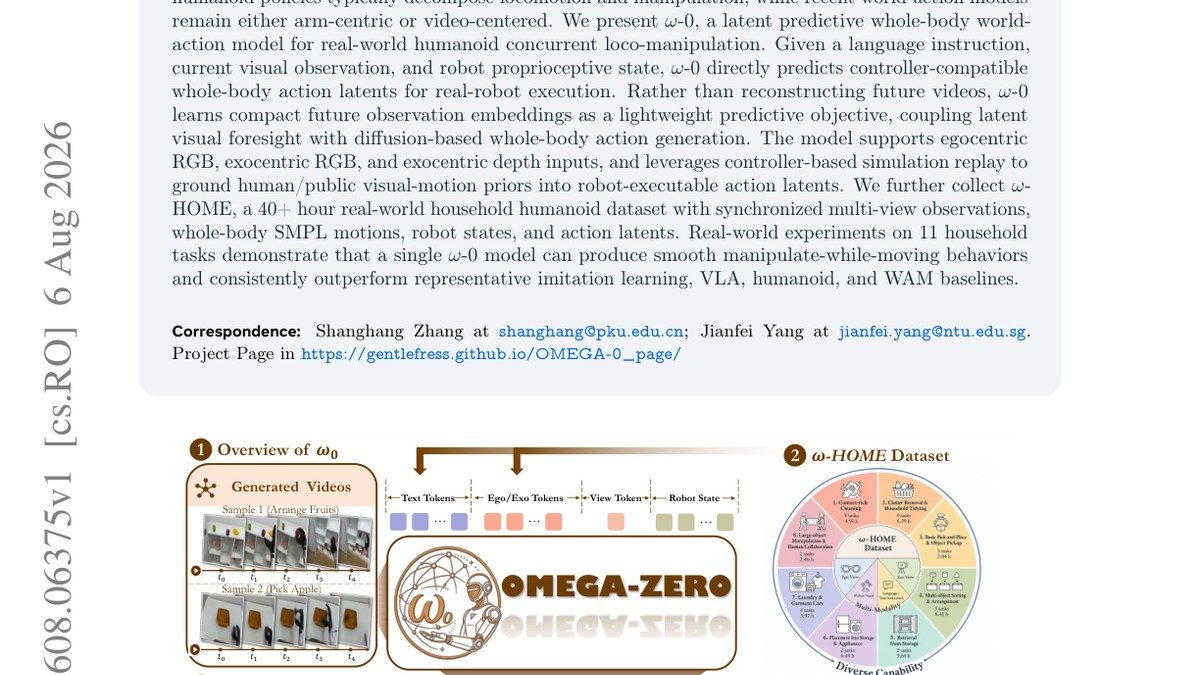
$ω$-0: A Latent Predictive World Action Model for Concurrent Humanoid Loco-Manipulation
Zhe Li, Zhenzhe Zhang, Yangyang Wei et al. · arXiv preprint · Aug 2026
Humanoid household tasks often require concurrent loco-manipulation, where the robot must move, adjust posture, maintain balance, and manipulate objects as a single coordinated behavior. Yet existing humanoid policies typically decompose locomotion and manipulation, while recent world-action mode...
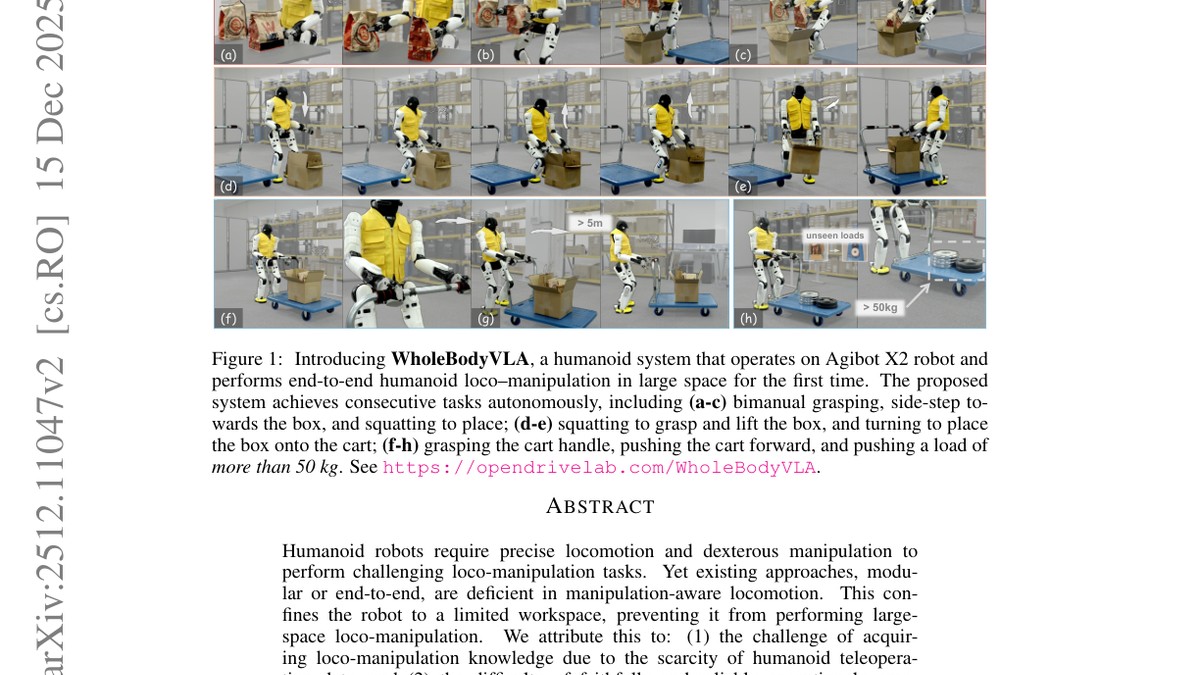
WholeBodyVLA: Towards Unified Latent VLA for Whole-Body Loco-Manipulation Control
Haoran Jiang, Jin Chen, Qingwen Bu et al. · arXiv preprint · Dec 2025
Humanoid robots require precise locomotion and dexterous manipulation to perform challenging loco-manipulation tasks. Yet existing approaches, modular or end-to-end, are deficient in manipulation-aware locomotion. This confines the robot to a limited workspace, preventing it from performing large...
Design and Evaluation of a Touchscreen-Based Teleoperation Interface for Robotic Manipulators
Juan José García Cárdenas, Alperen Kenan, Hamidreza Raei et al. · arXiv preprint · Aug 2026
Intuitive teleoperation interfaces are crucial for the safe and effective operation of robotic manipulators in challenging environments. In the nuclear industry, surface contact tasks such as swab sampling require precise path and force tracking, obstacle avoidance, and sustained operator attenti...
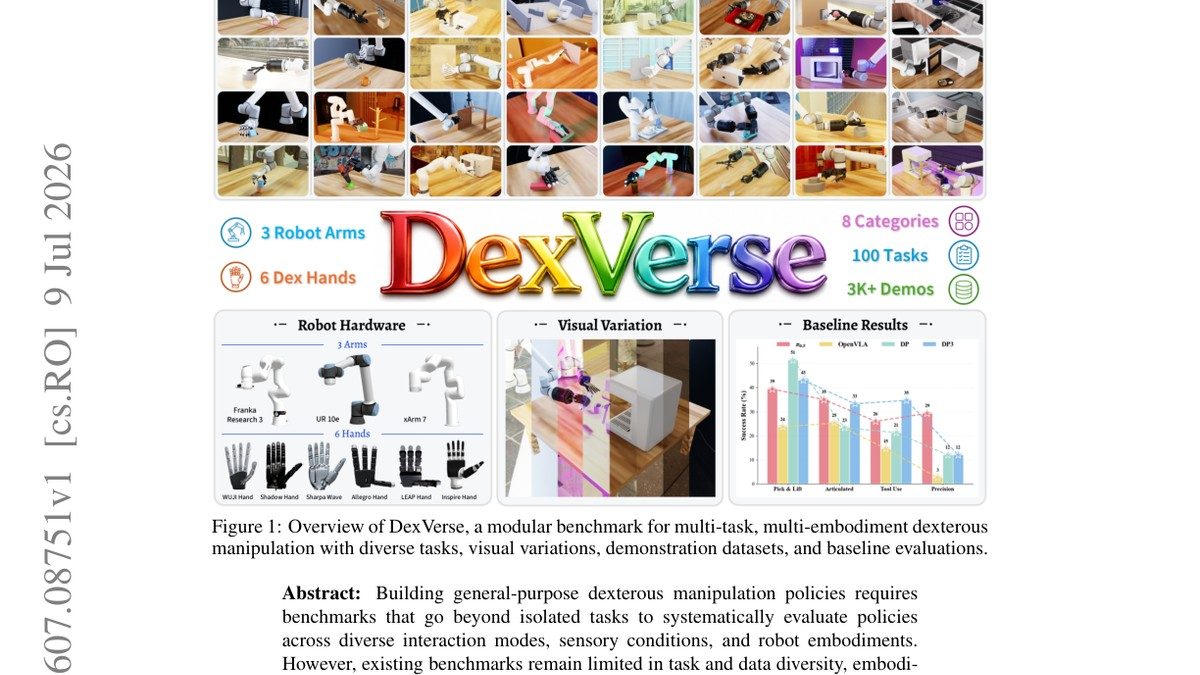
DexVerse: A Modular Benchmark for Multi-Task, Multi-Embodiment Dexterous Manipulation
Yunchao Yao, Zhuxiu Xu, Tianqi Zhang et al. · arXiv preprint · Jul 2026
Building general-purpose dexterous manipulation policies requires benchmarks that go beyond isolated tasks to systematically evaluate policies across diverse interaction modes, sensory conditions, and robot embodiments. However, existing benchmarks remain limited in task and data diversity, embod...