
AHEAD: Anticipatory Hand-Driven Teleoperation via Human Intent Prediction
Seok Joon Kim, Junho Lee, Federica Spinola, Taein Kwon, Mohsen Moghaddam · N/A · 2026
Framework
N/A
License
N/A
Stars
N/A
Summary
Direct hand-driven teleoperation maps an operator's hand motion to robot end-effector commands at every frame, enabling precise control, but it requires constant monitoring and correction during approach, grasp, and placement, which can be slow and fatiguing. For repetitive pick-and-place tasks, ...
Abstract Summary
Key Points
- Direct hand-driven teleoperation maps an operator's hand motion to robot end-effector commands at...
- For repetitive pick-and-place tasks, supervisory (goal-based) teleoperation simplifies this proce...
- Yet, this introduces latency, as the robot must wait for the next command before it can plan and act
- "How can we reduce robot reaction time while lowering operator workload?" To tackle this question...
- In a digital twin, the operator performs pick-and-place naturally, using hand motion to convey hi...
AHEAD: Anticipatory Hand-Driven Teleoperation via Human Intent Prediction
|Authors: Seok Joon Kim, Junho Lee, Federica Spinola, Taein Kwon, Mohsen Moghaddam
|Venue: arXiv preprint | Year: 2026
|arXiv: 2607.15172v1
Abstract
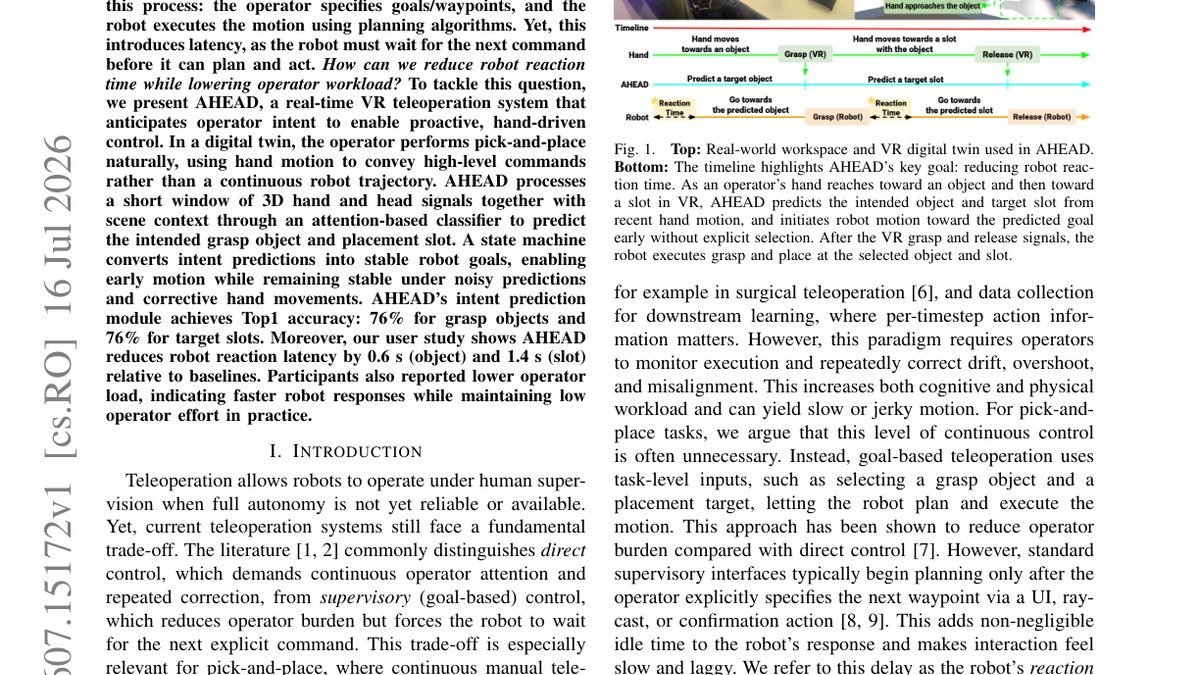
Direct hand-driven teleoperation maps an operator’s hand motion to robot end-effector commands at every frame, enabling precise control, but it requires constant monitoring and correction during approach, grasp, and placement, which can be slow and fatiguing. For repetitive pick-and-place tasks, supervisory (goal-based) teleoperation simplifies this process: the operator specifies goals/waypoints, and the robot executes the motion using planning algorithms. Yet, this introduces latency, as the robot must wait for the next command before it can plan and act. “How can we reduce robot reaction time while lowering operator workload?” To tackle this question, we present AHEAD, a real-time VR teleoperation system that anticipates operator intent to enable proactive, hand-driven control. In a digital twin, the operator performs pick-and-place naturally, using hand motion to convey high-level commands rather than a continuous robot trajectory. AHEAD processes a short window of 3D hand and head signals together with scene context through an attention-based classifier to predict the intended grasp object and placement slot. A state machine converts intent predictions into stable robot goals, enabling early motion while remaining stable under noisy predictions and corrective hand movements. AHEAD’s intent prediction module achieves Top1 accuracy: 76% for grasp objects and 76% for target slots. Moreover, our user study shows AHEAD reduces robot reaction latency by 0.6 s (object) and 1.4 s (slot) relative to baselines. Participants also reported lower operator load, indicating faster robot responses while maintaining low operator effort in practice.
Key Contributions
- Direct hand-driven teleoperation maps an operator’s hand motion to robot end-effector commands at…
- For repetitive pick-and-place tasks, supervisory (goal-based) teleoperation simplifies this proce…
- Yet, this introduces latency, as the robot must wait for the next command before it can plan and act
- “How can we reduce robot reaction time while lowering operator workload?” To tackle this question…
- In a digital twin, the operator performs pick-and-place naturally, using hand motion to convey hi…
Topics
- manipulation
- reinforcement-learning
- planning
- control
- learning-from-demonstration
Code & Data
No code repository linked in paper metadata.
BibTeX
@article{Kim2026_260715172v1,
  title     = {AHEAD: Anticipatory Hand-Driven Teleoperation via Human Intent Prediction},
  author    = {Seok Joon Kim and Junho Lee and Federica Spinola and Taein Kwon and Mohsen Moghaddam},
  year      = {2026},
  eprint    = {2607.15172v1},
  archivePrefix = {arXiv},
  primaryClass  = {cs.RO},
  url       = {https://arxiv.org/abs/2607.15172v1}
}
Related Papers
A Low-Cost, Open Platform for End-to-End Autonomous Driving on a Miniature Ackermann Vehicle
Gustavo Claudio Karl Couto, Eric Aislan Antonelo, Gabriel George Zipperer · arXiv preprint · Sep 2026
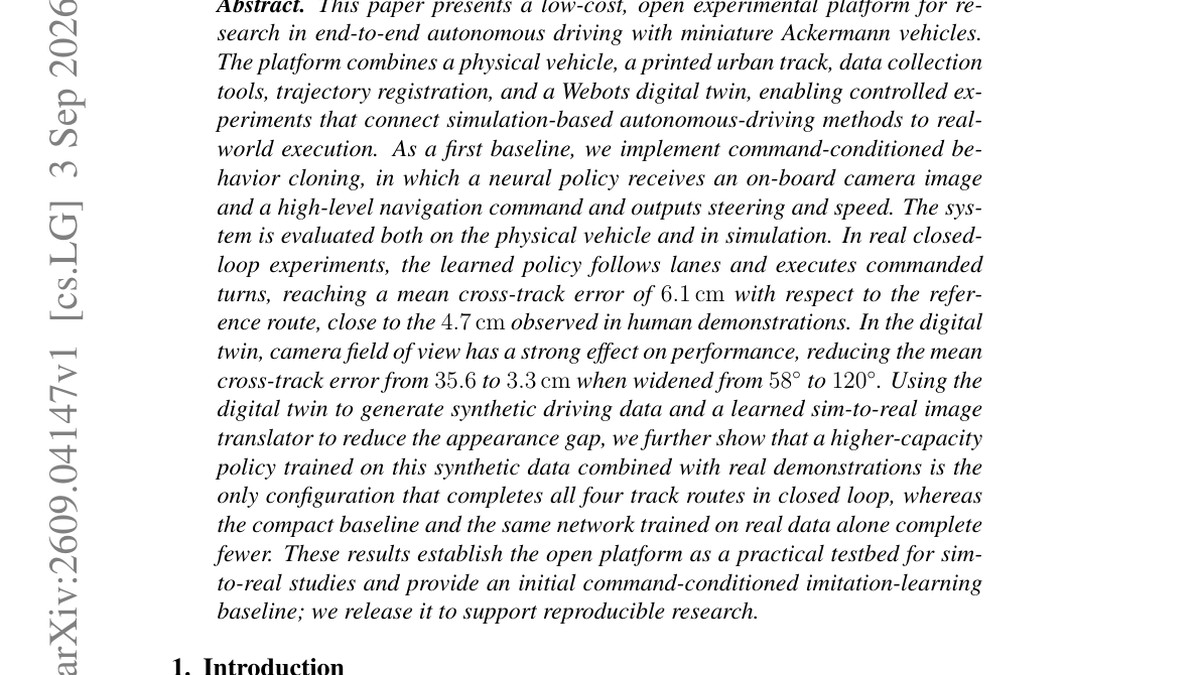
This paper presents a low-cost, open experimental platform for research in end-to-end autonomous driving with miniature Ackermann vehicles. The platform combines a physical vehicle, a printed urban track, data collection tools, trajectory registration, and a Webots digital twin, enabling controll...
Design and Evaluation of a Touchscreen-Based Teleoperation Interface for Robotic Manipulators
Juan José García Cárdenas, Alperen Kenan, Hamidreza Raei et al. · arXiv preprint · Aug 2026
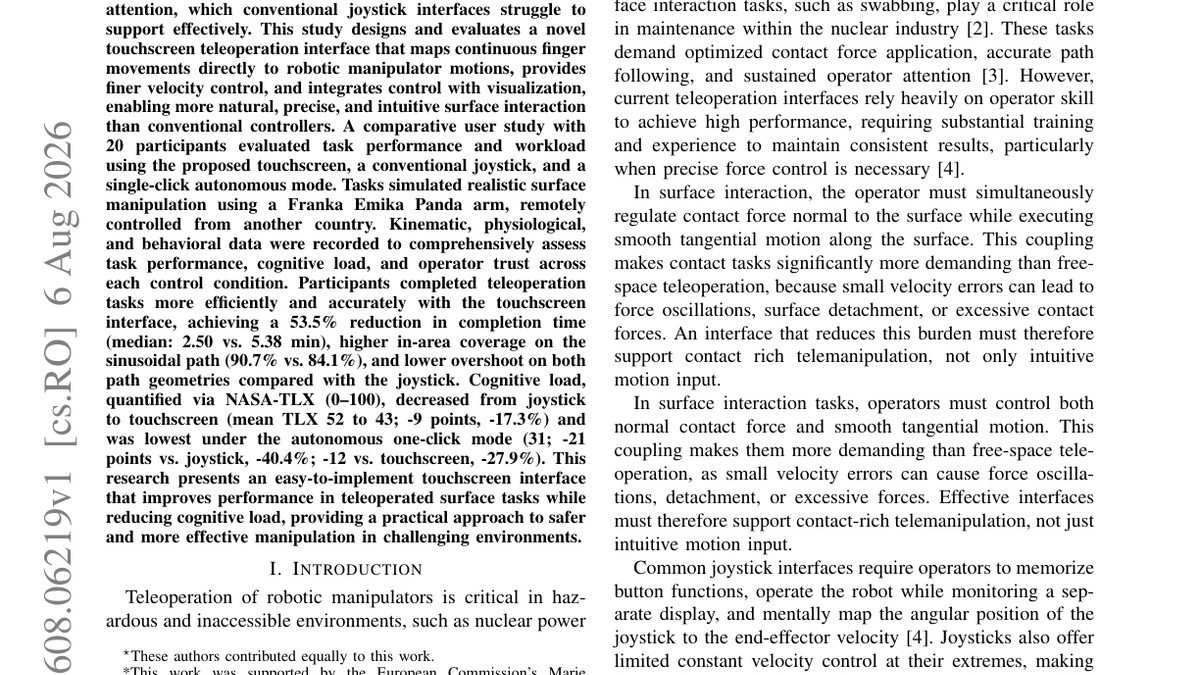
Intuitive teleoperation interfaces are crucial for the safe and effective operation of robotic manipulators in challenging environments. In the nuclear industry, surface contact tasks such as swab sampling require precise path and force tracking, obstacle avoidance, and sustained operator attenti...
DexVerse: A Modular Benchmark for Multi-Task, Multi-Embodiment Dexterous Manipulation
Yunchao Yao, Zhuxiu Xu, Tianqi Zhang et al. · arXiv preprint · Jul 2026
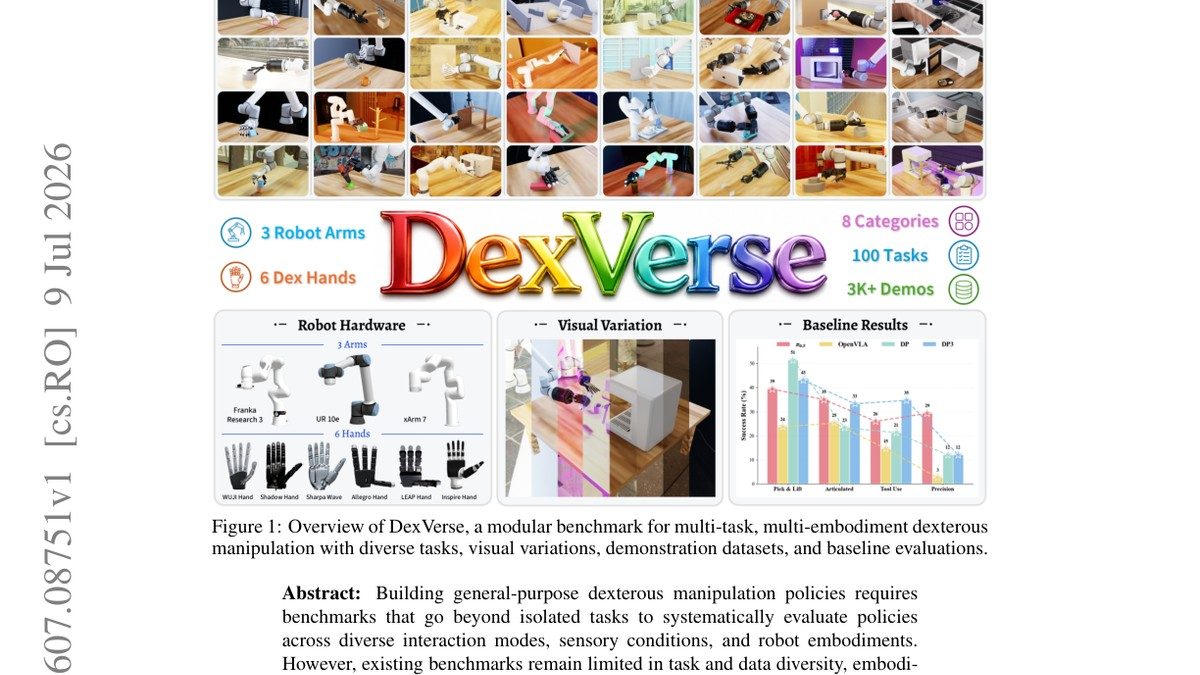
Building general-purpose dexterous manipulation policies requires benchmarks that go beyond isolated tasks to systematically evaluate policies across diverse interaction modes, sensory conditions, and robot embodiments. However, existing benchmarks remain limited in task and data diversity, embod...
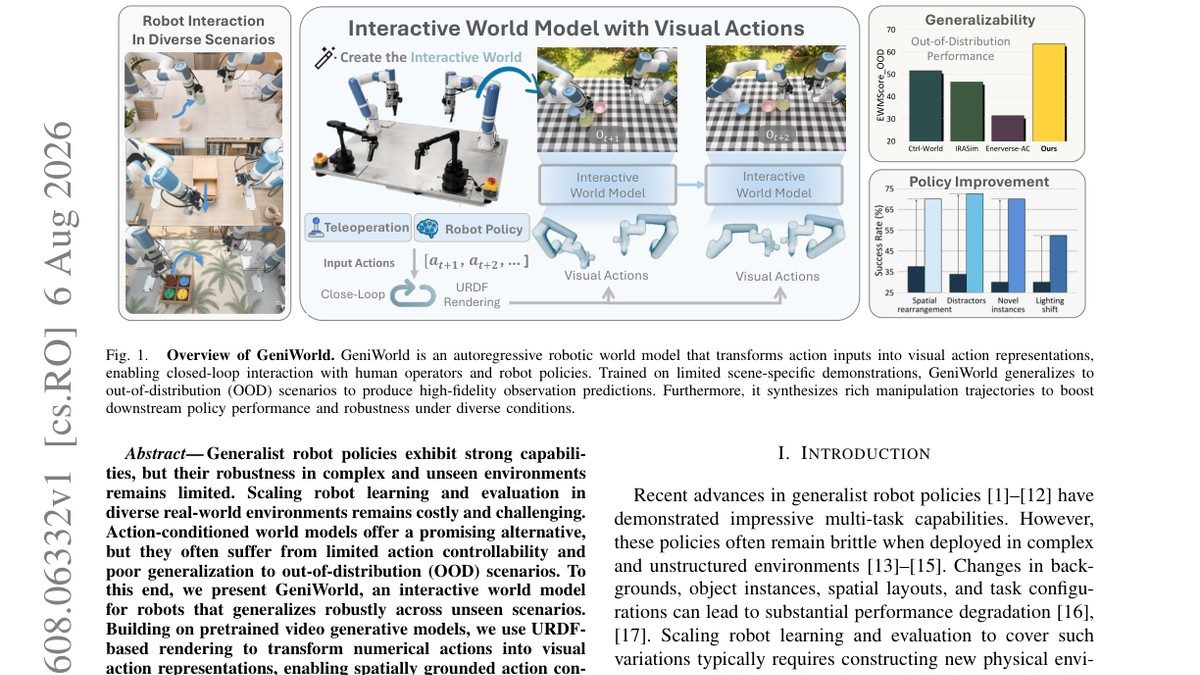
GeniWorld: A Generalizable Interactive World Model for Robotic Manipulation via Visual Actions
Chenghao Gu, Hanyang Yu, Jingbo Zhang et al. · arXiv preprint · Aug 2026
Generalist robot policies exhibit strong capabilities, but their robustness in complex and unseen environments remains limited. Scaling robot learning and evaluation in diverse real-world environments remains costly and challenging. Action-conditioned world models offer a promising alternative, b...