
Video2DoorTraversal: Push Door Traversal via Simulated Door Twins
Xincheng Tang, Yiji Chen, Youhan Xie, Wanyu Li, Zhengjie Shu, Lai Jiang, Wenkang Hu, Yitong Li, Jinchuang Zhang, Xibin Song, Ruigang Yang · N/A · 2026
Framework
N/A
License
N/A
Stars
N/A
Summary
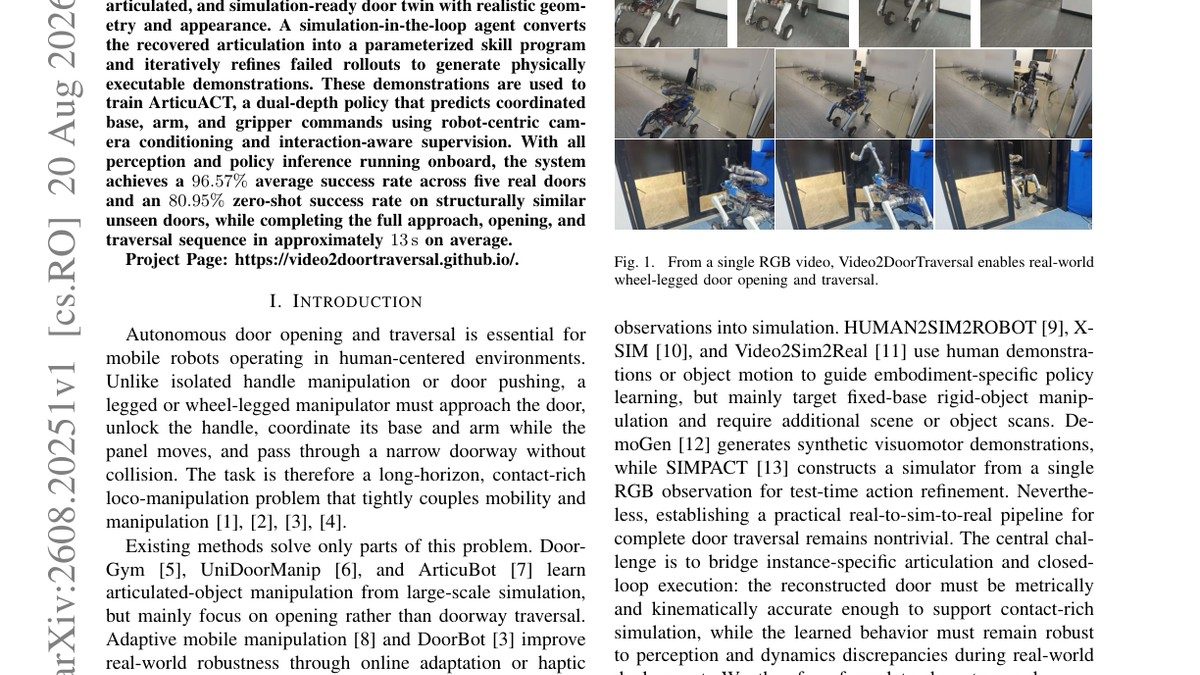
Door opening and traversal is a long-horizon loco-manipulation task that requires precise handle interaction and coordinated base-arm control. We present Video2DoorTraversal, a single-video real-to-sim-to-real framework for wheel-legged mobile manipulators. Given one RGB video of a real door, Doo...
Abstract Summary
Key Points
- Door opening and traversal is a long-horizon loco-manipulation task that requires precise handle ...
- We present Video2DoorTraversal, a single-video real-to-sim-to-real framework for wheel-legged mob...
- Given one RGB video of a real door, DoorTwin reconstructs an instance-aligned, articulated, and s...
- A simulation-in-the-loop agent converts the recovered articulation into a parameterized skill pro...
- These demonstrations are used to train ArticuACT, a dual-depth policy that predicts coordinated b...
Video2DoorTraversal: Push Door Traversal via Simulated Door Twins
|Authors: Xincheng Tang, Yiji Chen, Youhan Xie, Wanyu Li, Zhengjie Shu, Lai Jiang, Wenkang Hu, Yitong Li, Jinchuang Zhang, Xibin Song, Ruigang Yang
|Venue: arXiv preprint | Year: 2026
|arXiv: 2608.20251v1
Abstract
Door opening and traversal is a long-horizon loco-manipulation task that requires precise handle interaction and coordinated base-arm control. We present Video2DoorTraversal, a single-video real-to-sim-to-real framework for wheel-legged mobile manipulators. Given one RGB video of a real door, DoorTwin reconstructs an instance-aligned, articulated, and simulation-ready door twin with realistic geometry and appearance. A simulation-in-the-loop agent converts the recovered articulation into a parameterized skill program and iteratively refines failed rollouts to generate physically executable demonstrations. These demonstrations are used to train ArticuACT, a dual-depth policy that predicts coordinated base, arm, and gripper commands using robot-centric camera conditioning and interaction-aware supervision. With all perception and policy inference running onboard, the system achieves a 96.57% average success rate across five real doors and an 80.95% zero-shot success rate on structurally similar unseen doors, while completing the full approach, opening, and traversal sequence in approximately 13s on average. Project Page: https://video2doortraversal.github.io/.
Key Contributions
- Door opening and traversal is a long-horizon loco-manipulation task that requires precise handle …
- We present Video2DoorTraversal, a single-video real-to-sim-to-real framework for wheel-legged mob…
- Given one RGB video of a real door, DoorTwin reconstructs an instance-aligned, articulated, and s…
- A simulation-in-the-loop agent converts the recovered articulation into a parameterized skill pro…
- These demonstrations are used to train ArticuACT, a dual-depth policy that predicts coordinated b…
Topics
- manipulation
- locomotion
- vision
- reinforcement-learning
- sim-to-real
- control
- learning-from-demonstration
Code & Data
No code repository linked in paper metadata.
BibTeX
@article{Tang2026_260820251v1,
  title     = {Video2DoorTraversal: Push Door Traversal via Simulated Door Twins},
  author    = {Xincheng Tang and Yiji Chen and Youhan Xie and Wanyu Li and Zhengjie Shu and Lai Jiang and Wenkang Hu and Yitong Li and Jinchuang Zhang and Xibin Song and Ruigang Yang},
  year      = {2026},
  eprint    = {2608.20251v1},
  archivePrefix = {arXiv},
  primaryClass  = {cs.RO},
  url       = {https://arxiv.org/abs/2608.20251v1}
}
Related Papers
$ω$-0: A Latent Predictive World Action Model for Concurrent Humanoid Loco-Manipulation
Zhe Li, Zhenzhe Zhang, Yangyang Wei et al. · arXiv preprint · Aug 2026
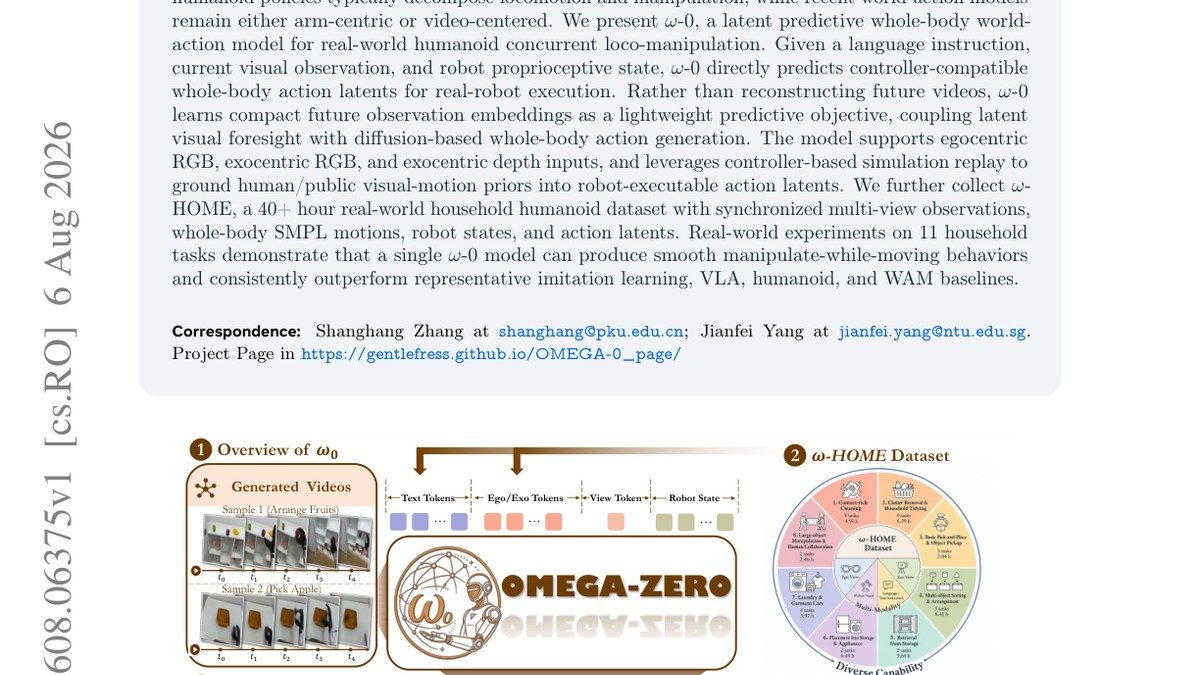
Humanoid household tasks often require concurrent loco-manipulation, where the robot must move, adjust posture, maintain balance, and manipulate objects as a single coordinated behavior. Yet existing humanoid policies typically decompose locomotion and manipulation, while recent world-action mode...
WholeBodyVLA: Towards Unified Latent VLA for Whole-Body Loco-Manipulation Control
Haoran Jiang, Jin Chen, Qingwen Bu et al. · arXiv preprint · Dec 2025
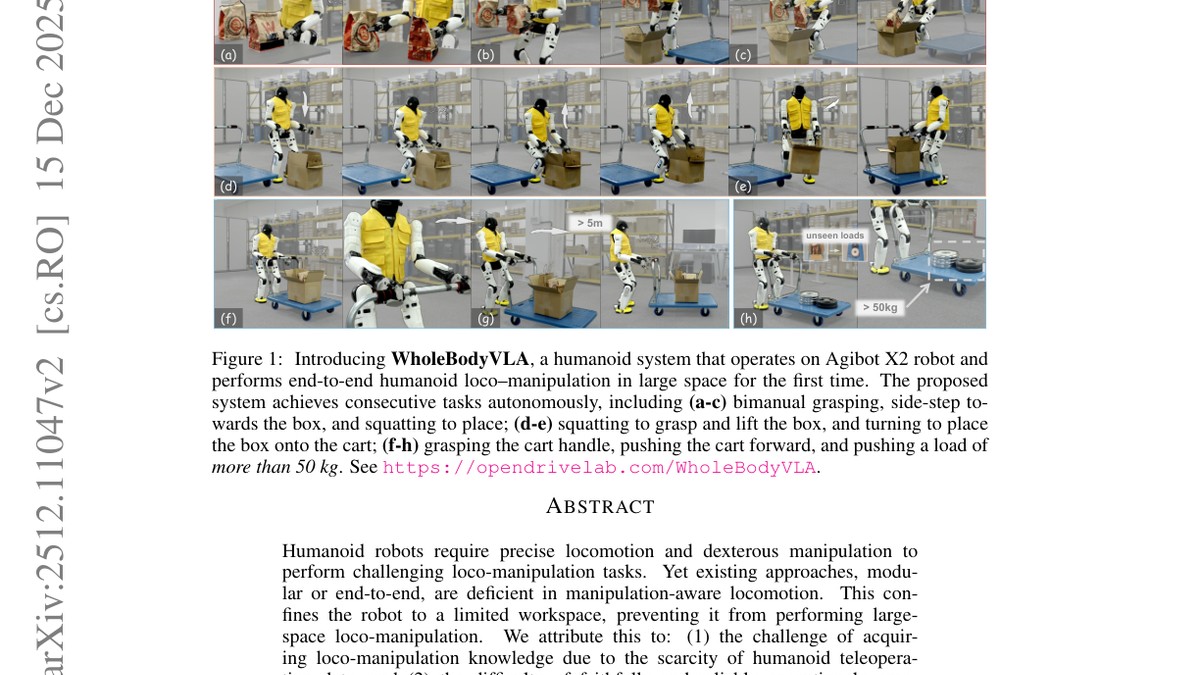
Humanoid robots require precise locomotion and dexterous manipulation to perform challenging loco-manipulation tasks. Yet existing approaches, modular or end-to-end, are deficient in manipulation-aware locomotion. This confines the robot to a limited workspace, preventing it from performing large...
A Low-Cost, Open Platform for End-to-End Autonomous Driving on a Miniature Ackermann Vehicle
Gustavo Claudio Karl Couto, Eric Aislan Antonelo, Gabriel George Zipperer · arXiv preprint · Sep 2026
This paper presents a low-cost, open experimental platform for research in end-to-end autonomous driving with miniature Ackermann vehicles. The platform combines a physical vehicle, a printed urban track, data collection tools, trajectory registration, and a Webots digital twin, enabling controll...
DECOWAM: Decoupled Whole-Body World-Action Model for Legged Mobile Manipulation
Siyuan Ma, Boshi Zhang, Yutian Zhang et al. · arXiv preprint · Aug 2026
Mobile manipulation requires a robot to predict how locomotion and arm motion jointly alter future observations and control. Existing world-action models, developed largely for fixed-base platforms, do not explicitly distinguish camera ego-motion from base and arm actions. Here we introduce DECOW...