
Embodied Scene Rearrangement Planning
Canzhi Chen, Zan Wang, Siqi Zhu, Qi Wu, Yixuan Li, Wei Liang · N/A · 2026
Framework
N/A
License
N/A
Stars
N/A
Summary
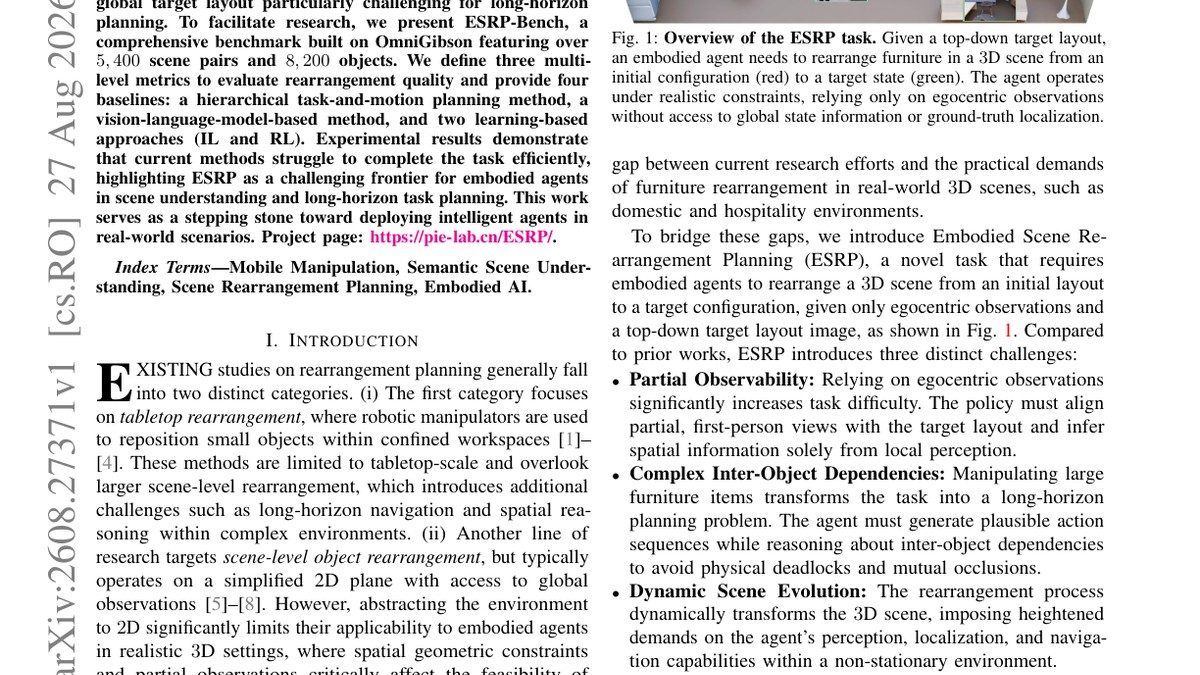
This paper introduces Embodied Scene Rearrangement Planning (ESRP), a novel task requiring embodied agents to rearrange furniture in 3D scenes to match a target configuration using only egocentric observations and a top-down target layout. Unlike prior rearrangement tasks, ESRP precludes global s...
Abstract Summary
Key Points
- This paper introduces Embodied Scene Rearrangement Planning (ESRP), a novel task requiring embodi...
- Unlike prior rearrangement tasks, ESRP precludes global state access and introduces mutual object...
- These factors make aligning partial egocentric observations with the global target layout particu...
- To facilitate research, we present ESRP-Bench, a comprehensive benchmark built on OmniGibson feat...
- We define three multi-level metrics to evaluate rearrangement quality and provide four baselines:...
Embodied Scene Rearrangement Planning
|Authors: Canzhi Chen, Zan Wang, Siqi Zhu, Qi Wu, Yixuan Li, Wei Liang
|Venue: arXiv preprint | Year: 2026
|arXiv: 2608.27371v1
Abstract
This paper introduces Embodied Scene Rearrangement Planning (ESRP), a novel task requiring embodied agents to rearrange furniture in 3D scenes to match a target configuration using only egocentric observations and a top-down target layout. Unlike prior rearrangement tasks, ESRP precludes global state access and introduces mutual object occlusions, reflecting the practical constraints of real-world robotic deployment. These factors make aligning partial egocentric observations with the global target layout particularly challenging for long-horizon planning. To facilitate research, we present ESRP-Bench, a comprehensive benchmark built on OmniGibson featuring over 5,400 scene pairs and 8,200 objects. We define three multi-level metrics to evaluate rearrangement quality and provide four baselines: a hierarchical task-and-motion planning method, a vision-language-model-based method, and two learning-based approaches (IL and RL). Experimental results demonstrate that current methods struggle to complete the task efficiently, highlighting ESRP as a challenging frontier for embodied agents in scene understanding and long-horizon task planning. This work serves as a stepping stone toward deploying intelligent agents in real-world scenarios. Project page: https://pie-lab.cn/ESRP/.
Key Contributions
- This paper introduces Embodied Scene Rearrangement Planning (ESRP), a novel task requiring embodi…
- Unlike prior rearrangement tasks, ESRP precludes global state access and introduces mutual object…
- These factors make aligning partial egocentric observations with the global target layout particu…
- To facilitate research, we present ESRP-Bench, a comprehensive benchmark built on OmniGibson feat…
- We define three multi-level metrics to evaluate rearrangement quality and provide four baselines:…
Topics
- vision
- reinforcement-learning
- planning
- benchmark
Code & Data
- GitHub repository: https://github.com/QwenLM/Qwen3-VL
BibTeX
@article{Chen2026_260827371v1,
  title     = {Embodied Scene Rearrangement Planning},
  author    = {Canzhi Chen and Zan Wang and Siqi Zhu and Qi Wu and Yixuan Li and Wei Liang},
  year      = {2026},
  eprint    = {2608.27371v1},
  archivePrefix = {arXiv},
  primaryClass  = {cs.RO},
  url       = {https://arxiv.org/abs/2608.27371v1}
}
Related Papers
Beyond Episodic Evaluation: Memory Architectural Bottlenecks in Sequential Embodied Question Answering
Zikui Cai, Kaushal Janga, Tan Dat Dao et al. · arXiv preprint · Jul 2026
Embodied question answering (EQA) is traditionally evaluated under an episodic formulation, where agents solve each task independently and reset internal state between episodes. However, real-world robots operate continuously and must accumulate, retain, and selectively reuse information acquired...
Planning-Oriented End-to-End Autonomous Driving: Architectures, Evaluation, and Emerging Paradigms
Yanchen Guan, Xingcheng Liu, Bin Rao et al. · arXiv preprint · Aug 2026
End-to-end autonomous driving has evolved from camera-to-control regression toward planning-oriented systems that use structured representations, trajectory-level outputs, and increasingly realistic evaluation protocols. This survey reviews this transition across behavior cloning, conditional imi...
Towards Surgical World-Action Modeling: A Preliminary Joint Visual-Trajectory Forecasting for Surgical Motion Planning
Weiliang Huang, Huanrong Liu, Bob Zhang et al. · arXiv preprint · Aug 2026
Reliable surgical planning requires models to anticipate not only how instruments will move, but also how the operative visual state will evolve together with such motion. Existing approaches typically treat future scene generation and instrument trajectory prediction as two separate tasks. Scene...
A Browser-Native Digital Test Range for Benchmarking 4D Ocean-Glider Planning Algorithms
Edward Holmberg, Elias Ioup, Mahdi Abdelguerfi · arXiv preprint · Aug 2026
Repeated in-situ evaluation of ocean-glider planners requires scarce vehicles, operators, deployment and recovery resources, and ocean conditions that cannot be reset for competing algorithms. We present a guided, installation-free browser-native digital test range that transforms a selected regi...