
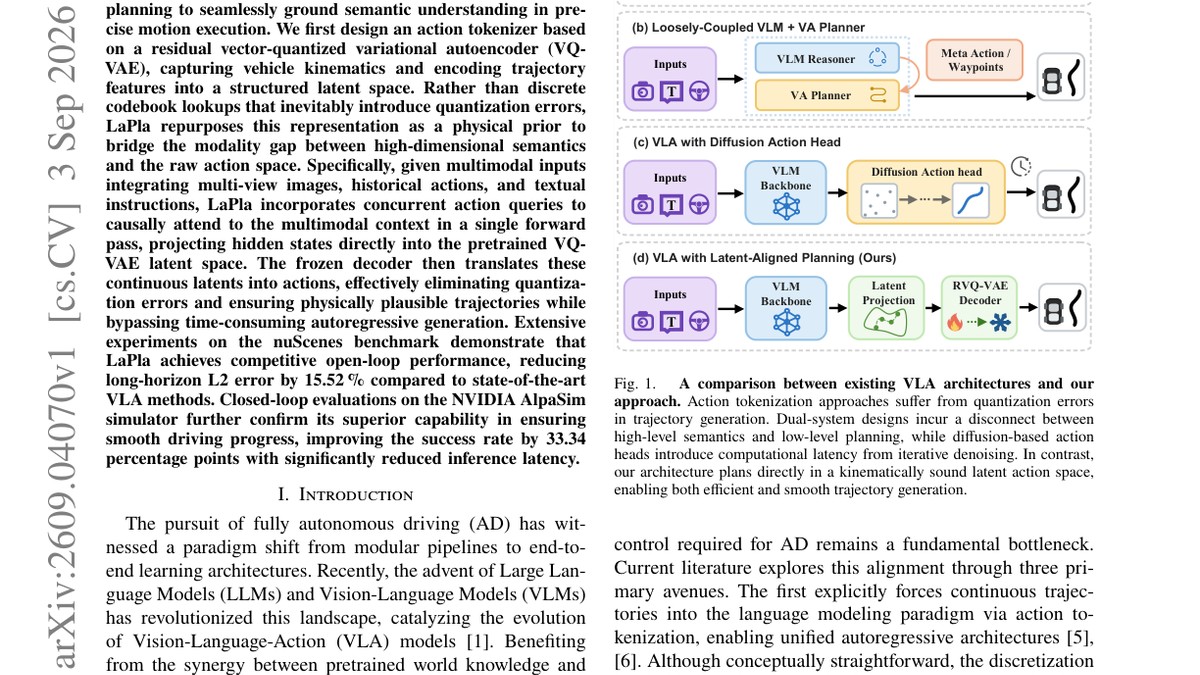
Continuous Actions from Discrete Minds: Latent-Aligned Planning for End-to-End Autonomous Driving
Ruoyu Yao, Yusen Xie, Qingzhao Liu, Pei Liu, Zewei Yang, Yipeng Zhu, Xiaolong Wang, Jun Ma · N/A · 2026
Framework
N/A
License
N/A
Stars
N/A
Summary
Bridging the gap between the discrete reasoning of Vision-Language Models and the continuous, physics-constrained nature of autonomous driving remains a significant challenge. In this work, we introduce LaPla, a unified Vision-Language-Action (VLA) framework featuring latent-aligned planning to s...
Abstract Summary
Key Points
- Bridging the gap between the discrete reasoning of Vision-Language Models and the continuous, phy...
- In this work, we introduce LaPla, a unified Vision-Language-Action (VLA) framework featuring late...
- We first design an action tokenizer based on a residual vector-quantized variational autoencoder ...
- Rather than discrete codebook lookups that inevitably introduce quantization errors, LaPla repurp...
- Specifically, given multimodal inputs integrating multi-view images, historical actions, and text...
Continuous Actions from Discrete Minds: Latent-Aligned Planning for End-to-End Autonomous Driving
|Authors: Ruoyu Yao, Yusen Xie, Qingzhao Liu, Pei Liu, Zewei Yang, Yipeng Zhu, Xiaolong Wang, Jun Ma
|Venue: arXiv preprint | Year: 2026
|arXiv: 2609.04070v1
Abstract
Bridging the gap between the discrete reasoning of Vision-Language Models and the continuous, physics-constrained nature of autonomous driving remains a significant challenge. In this work, we introduce LaPla, a unified Vision-Language-Action (VLA) framework featuring latent-aligned planning to seamlessly ground semantic understanding in precise motion execution. We first design an action tokenizer based on a residual vector-quantized variational autoencoder (VQ-VAE), capturing vehicle kinematics and encoding trajectory features into a structured latent space. Rather than discrete codebook lookups that inevitably introduce quantization errors, LaPla repurposes this representation as a physical prior to bridge the modality gap between high-dimensional semantics and the raw action space. Specifically, given multimodal inputs integrating multi-view images, historical actions, and textual instructions, LaPla incorporates concurrent action queries to causally attend to the multimodal context in a single forward pass, projecting hidden states directly into the pretrained VQ-VAE latent space. The frozen decoder then translates these continuous latents into actions, effectively eliminating quantization errors and ensuring physically plausible trajectories while bypassing time-consuming autoregressive generation. Extensive experiments on the nuScenes benchmark demonstrate that LaPla achieves competitive open-loop performance, reducing long-horizon L2 error by 15.52% compared to state-of-the-art VLA methods. Closed-loop evaluations on the NVIDIA AlpaSim simulator further confirm its superior capability in ensuring smooth driving progress, improving the success rate by 33.34 percentage points with significantly reduced inference latency.
Key Contributions
- Bridging the gap between the discrete reasoning of Vision-Language Models and the continuous, phy…
- In this work, we introduce LaPla, a unified Vision-Language-Action (VLA) framework featuring late…
- We first design an action tokenizer based on a residual vector-quantized variational autoencoder …
- Rather than discrete codebook lookups that inevitably introduce quantization errors, LaPla repurp…
- Specifically, given multimodal inputs integrating multi-view images, historical actions, and text…
Topics
- vision
- vla
- planning
- benchmark
Code & Data
No code repository linked in paper metadata.
BibTeX
@article{Yao2026_260904070v1,
  title     = {Continuous Actions from Discrete Minds: Latent-Aligned Planning for End-to-End Autonomous Driving},
  author    = {Ruoyu Yao and Yusen Xie and Qingzhao Liu and Pei Liu and Zewei Yang and Yipeng Zhu and Xiaolong Wang and Jun Ma},
  year      = {2026},
  eprint    = {2609.04070v1},
  archivePrefix = {arXiv},
  primaryClass  = {cs.CV},
  url       = {https://arxiv.org/abs/2609.04070v1}
}
Related Papers
Planning-Oriented End-to-End Autonomous Driving: Architectures, Evaluation, and Emerging Paradigms
Yanchen Guan, Xingcheng Liu, Bin Rao et al. · arXiv preprint · Aug 2026
End-to-end autonomous driving has evolved from camera-to-control regression toward planning-oriented systems that use structured representations, trajectory-level outputs, and increasingly realistic evaluation protocols. This survey reviews this transition across behavior cloning, conditional imi...
RoboSPA: Can VLA Models Go Beyond Simple Scenes and Short-Horizon Tasks?
Zhenxuan Fan, Bo Zhang, Yutong Lin et al. · arXiv preprint · Sep 2026
Vision-Language-Action (VLA) models have shown promising progress in language-conditioned robotic manipulation. However, existing datasets and benchmarks mainly evaluate task completion under predefined settings, offering limited insight into model reasoning under increasing spatial and procedura...
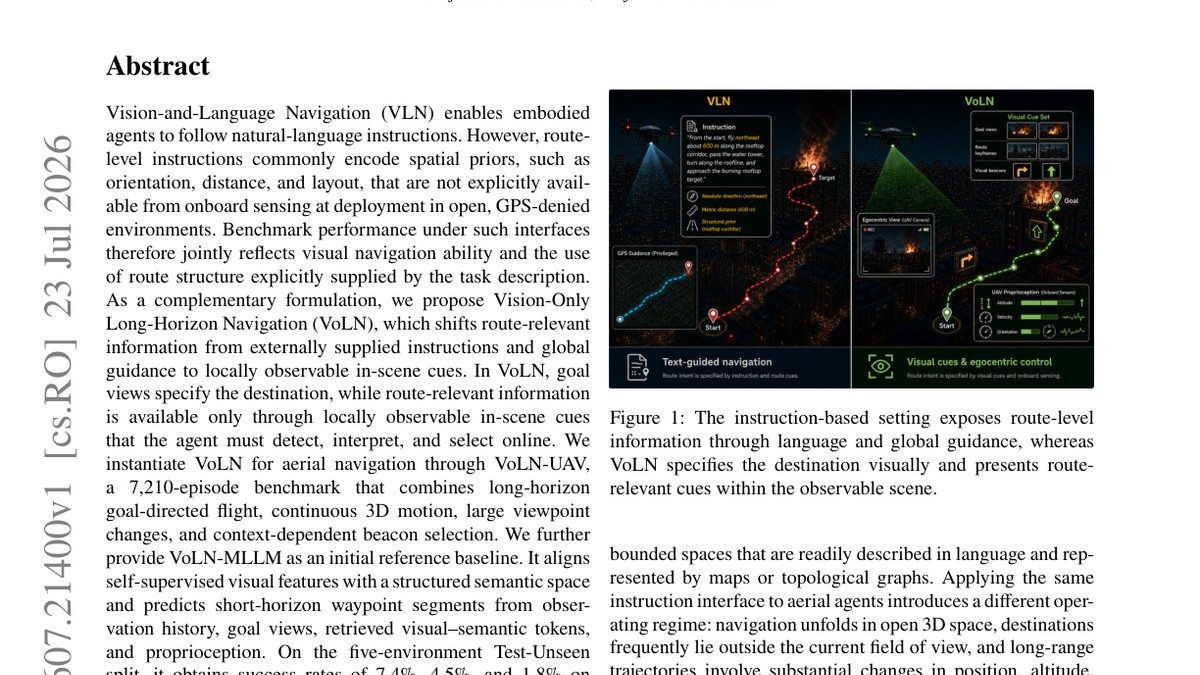
VoLN: Vision-Only Long-Horizon Navigation---Paradigm, Benchmark, and Method
Jiabin Lou, Haopeng Wang, Yuanshuai Wang et al. · arXiv preprint · Jul 2026
Vision-and-Language Navigation (VLN) enables embodied agents to follow natural-language instructions. However, route-level instructions commonly encode spatial priors, such as orientation, distance, and layout, that are not explicitly available from onboard sensing at deployment in open, GPS-deni...

AXIS: A Growable Community-Driven Data Engine for Scalable Robot Manipulation
Mengfei Zhao, Dihong Huang, Yikai Tang et al. · arXiv preprint · Jul 2026
Learning effective robot manipulation policies requires diverse, high-quality demonstrations, yet existing data pipelines are often difficult to scale because they rely on specialized hardware, centralized operators, or fixed task suites. We present AXIS, a growable community-driven data engine a...