
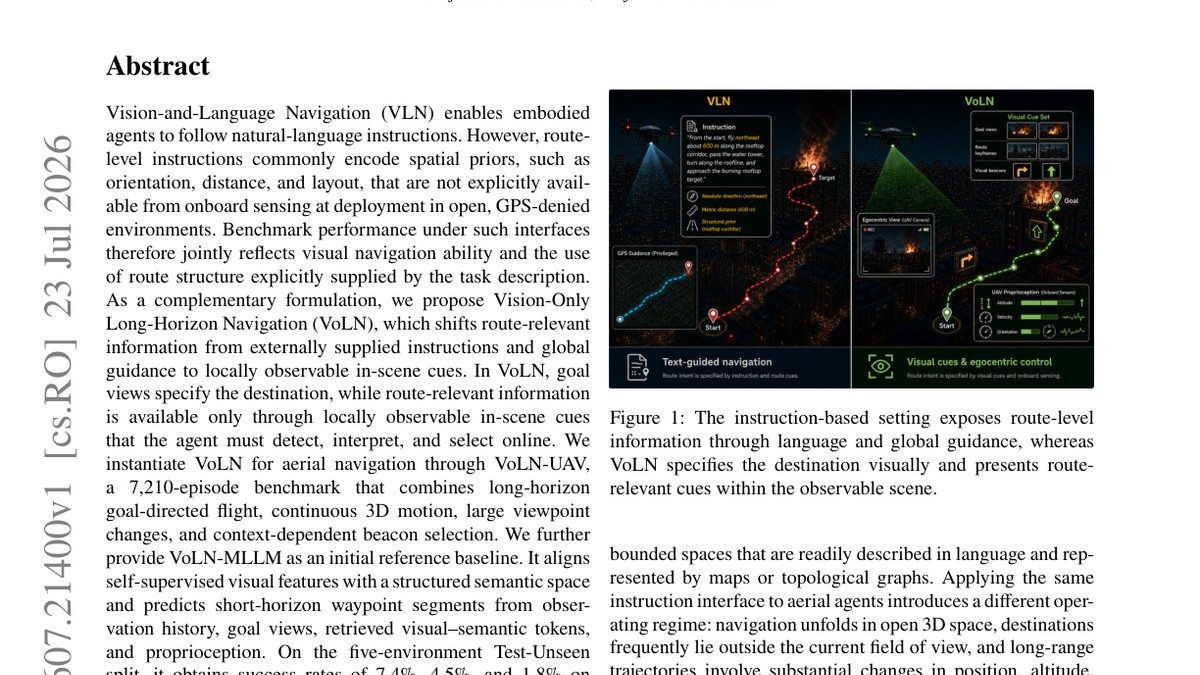
VoLN: Vision-Only Long-Horizon Navigation---Paradigm, Benchmark, and Method
Jiabin Lou, Haopeng Wang, Yuanshuai Wang, Xinyu Liu, Xuxin Lv, Yuxin Guo, Lei Huang, Rongye Shi, Wenjun Wu · N/A · 2026
Framework
N/A
License
N/A
Stars
N/A
Summary
Vision-and-Language Navigation (VLN) enables embodied agents to follow natural-language instructions. However, route-level instructions commonly encode spatial priors, such as orientation, distance, and layout, that are not explicitly available from onboard sensing at deployment in open, GPS-deni...
Abstract Summary
Key Points
- Vision-and-Language Navigation (VLN) enables embodied agents to follow natural-language instructions
- However, route-level instructions commonly encode spatial priors, such as orientation, distance, ...
- Benchmark performance under such interfaces therefore jointly reflects visual navigation ability ...
- As a complementary formulation, we propose Vision-Only Long-Horizon Navigation (VoLN), which shif...
- In VoLN, goal views specify the destination, while route-relevant information is available only t...
VoLN: Vision-Only Long-Horizon Navigation---Paradigm, Benchmark, and Method
|Authors: Jiabin Lou, Haopeng Wang, Yuanshuai Wang, Xinyu Liu, Xuxin Lv, Yuxin Guo, Lei Huang, Rongye Shi, Wenjun Wu
|Venue: arXiv preprint | Year: 2026
|arXiv: 2607.21400v1
Abstract
Vision-and-Language Navigation (VLN) enables embodied agents to follow natural-language instructions. However, route-level instructions commonly encode spatial priors, such as orientation, distance, and layout, that are not explicitly available from onboard sensing at deployment in open, GPS-denied environments. Benchmark performance under such interfaces therefore jointly reflects visual navigation ability and the use of route structure explicitly supplied by the task description. As a complementary formulation, we propose Vision-Only Long-Horizon Navigation (VoLN), which shifts route-relevant information from externally supplied instructions and global guidance to locally observable in-scene cues. In VoLN, goal views specify the destination, while route-relevant information is available only through locally observable in-scene cues that the agent must detect, interpret, and select online. We instantiate VoLN for aerial navigation through VoLN-UAV, a 7,210-episode benchmark that combines long-horizon goal-directed flight, continuous 3D motion, large viewpoint changes, and context-dependent beacon selection. We further provide VoLN-MLLM as an initial reference baseline. It aligns self-supervised visual features with a structured semantic space and predicts short-horizon waypoint segments from observation history, goal views, retrieved visual—semantic tokens, and proprioception. On the five-environment Test-Unseen split, it obtains success rates of 7.4%, 4.5%, and 1.8% on Easy, Normal, and Hard episodes, respectively. These results provide an initial evaluation of VoLN and reveal substantial remaining challenges in long-horizon evidence integration, cross-view goal matching, and closed-loop stability. Project page: https://admire-ljb.github.io/VoLN-UAV/
Key Contributions
- Vision-and-Language Navigation (VLN) enables embodied agents to follow natural-language instructions
- However, route-level instructions commonly encode spatial priors, such as orientation, distance, …
- Benchmark performance under such interfaces therefore jointly reflects visual navigation ability …
- As a complementary formulation, we propose Vision-Only Long-Horizon Navigation (VoLN), which shif…
- In VoLN, goal views specify the destination, while route-relevant information is available only t…
Topics
- vision
- vla
- planning
- benchmark
Code & Data
- GitHub repository: https://github.com/Admire-ljb/VoLN-UAV
BibTeX
@article{Lou2026_260721400v1,
  title     = {VoLN: Vision-Only Long-Horizon Navigation---Paradigm, Benchmark, and Method},
  author    = {Jiabin Lou and Haopeng Wang and Yuanshuai Wang and Xinyu Liu and Xuxin Lv and Yuxin Guo and Lei Huang and Rongye Shi and Wenjun Wu},
  year      = {2026},
  eprint    = {2607.21400v1},
  archivePrefix = {arXiv},
  primaryClass  = {cs.RO},
  url       = {https://arxiv.org/abs/2607.21400v1}
}
Related Papers
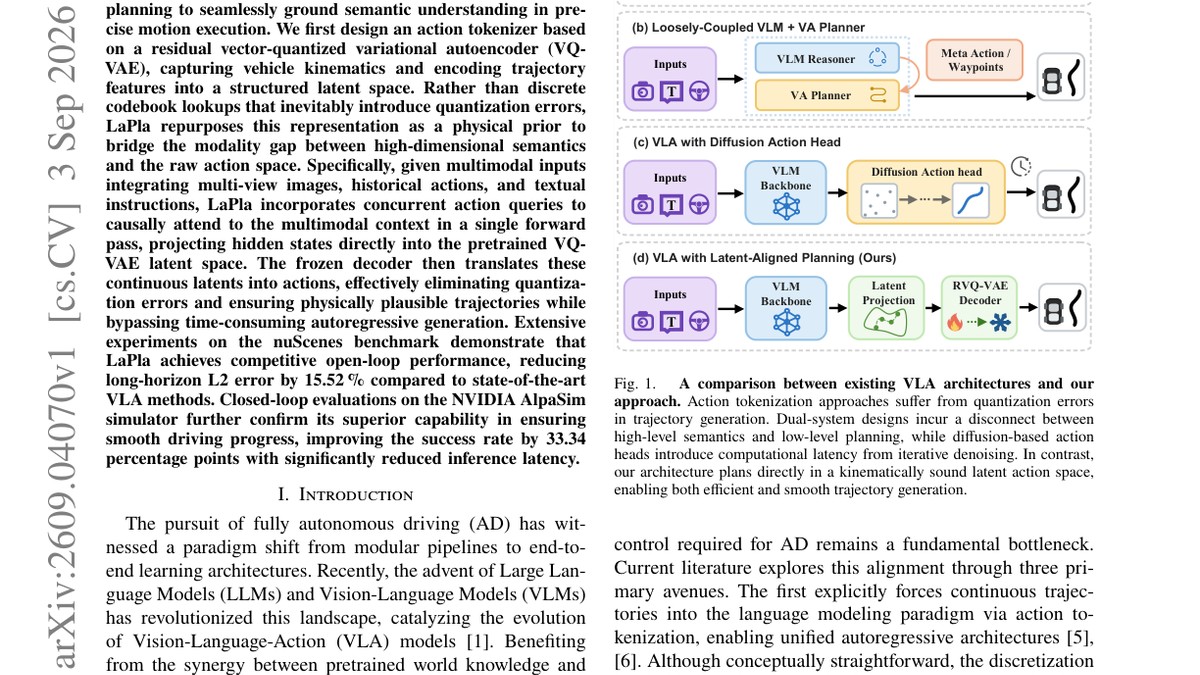
Continuous Actions from Discrete Minds: Latent-Aligned Planning for End-to-End Autonomous Driving
Ruoyu Yao, Yusen Xie, Qingzhao Liu et al. · arXiv preprint · Sep 2026
Bridging the gap between the discrete reasoning of Vision-Language Models and the continuous, physics-constrained nature of autonomous driving remains a significant challenge. In this work, we introduce LaPla, a unified Vision-Language-Action (VLA) framework featuring latent-aligned planning to s...
Planning-Oriented End-to-End Autonomous Driving: Architectures, Evaluation, and Emerging Paradigms
Yanchen Guan, Xingcheng Liu, Bin Rao et al. · arXiv preprint · Aug 2026
End-to-end autonomous driving has evolved from camera-to-control regression toward planning-oriented systems that use structured representations, trajectory-level outputs, and increasingly realistic evaluation protocols. This survey reviews this transition across behavior cloning, conditional imi...
RoboSPA: Can VLA Models Go Beyond Simple Scenes and Short-Horizon Tasks?
Zhenxuan Fan, Bo Zhang, Yutong Lin et al. · arXiv preprint · Sep 2026
Vision-Language-Action (VLA) models have shown promising progress in language-conditioned robotic manipulation. However, existing datasets and benchmarks mainly evaluate task completion under predefined settings, offering limited insight into model reasoning under increasing spatial and procedura...

AXIS: A Growable Community-Driven Data Engine for Scalable Robot Manipulation
Mengfei Zhao, Dihong Huang, Yikai Tang et al. · arXiv preprint · Jul 2026
Learning effective robot manipulation policies requires diverse, high-quality demonstrations, yet existing data pipelines are often difficult to scale because they rely on specialized hardware, centralized operators, or fixed task suites. We present AXIS, a growable community-driven data engine a...