
RoboSPA: Can VLA Models Go Beyond Simple Scenes and Short-Horizon Tasks?
Zhenxuan Fan, Bo Zhang, Yutong Lin, Yuqian Yuan, Juekai Lin, Liang Liang, Zhuoyi Huang, Wenqiao Zhang, Juncheng Li, Siliang Tang, Jun Xiao, Yueting Zhuang · N/A · 2026
Framework
N/A
License
N/A
Stars
N/A
Summary
Vision-Language-Action (VLA) models have shown promising progress in language-conditioned robotic manipulation. However, existing datasets and benchmarks mainly evaluate task completion under predefined settings, offering limited insight into model reasoning under increasing spatial and procedura...
Abstract Summary
Key Points
- Vision-Language-Action (VLA) models have shown promising progress in language-conditioned robotic...
- However, existing datasets and benchmarks mainly evaluate task completion under predefined settin...
- We introduce \textbf{RoboSPA} (\textbf{Robo}t \textbf{S}patial-\textbf{P}rocedural \textbf{A}sses...
- \texttt{RoboSPA} focuses on two core dimensions, Fine-Grained Spatial Reasoning and Long-Horizon ...
- Each task is instantiated across five difficulty levels, yielding 280 variants with increasing sp...
RoboSPA: Can VLA Models Go Beyond Simple Scenes and Short-Horizon Tasks?
|Authors: Zhenxuan Fan, Bo Zhang, Yutong Lin, Yuqian Yuan, Juekai Lin, Liang Liang, Zhuoyi Huang, Wenqiao Zhang, Juncheng Li, Siliang Tang, Jun Xiao, Yueting Zhuang
|Venue: arXiv preprint | Year: 2026
|arXiv: 2609.05324v1
Abstract
Vision-Language-Action (VLA) models have shown promising progress in language-conditioned robotic manipulation. However, existing datasets and benchmarks mainly evaluate task completion under predefined settings, offering limited insight into model reasoning under increasing spatial and procedural complexity. We introduce \textbf{RoboSPA} (\textbf{Robo}t \textbf{S}patial-\textbf{P}rocedural \textbf{A}ssessment), a large-scale robotic manipulation dataset and benchmark for diagnosing embodied reasoning in VLA models. \texttt{RoboSPA} focuses on two core dimensions, Fine-Grained Spatial Reasoning and Long-Horizon Procedural Planning, covering 10 task categories and 56 base tasks. Each task is instantiated across five difficulty levels, yielding 280 variants with increasing spatial ambiguity and procedural complexity. We collect 527K trajectories across multiple embodiments and diverse scenes. Beyond binary success rate, \texttt{RoboSPA} introduces diagnostic metrics for more detailed evaluation. Experiments on representative VLA models show that current systems still struggle with complex spatial relations, precise low-level execution, and memory-intensive planning. These results establish \texttt{RoboSPA} as a challenging diagnostic benchmark for developing more capable, reliable, and generalizable embodied agents. Our data and code are available at https://github.com/fanzhenxuan/RoboSPA.
Key Contributions
- Vision-Language-Action (VLA) models have shown promising progress in language-conditioned robotic…
- However, existing datasets and benchmarks mainly evaluate task completion under predefined settin…
- We introduce \textbf{RoboSPA} (\textbf{Robo}t \textbf{S}patial-\textbf{P}rocedural \textbf{A}sses…
- \texttt{RoboSPA} focuses on two core dimensions, Fine-Grained Spatial Reasoning and Long-Horizon …
- Each task is instantiated across five difficulty levels, yielding 280 variants with increasing sp…
Topics
- manipulation
- vision
- vla
- planning
- benchmark
Code & Data
- GitHub repository: https://github.com/fanzhenxuan/RoboSPA
BibTeX
@article{Fan2026_260905324v1,
  title     = {RoboSPA: Can VLA Models Go Beyond Simple Scenes and Short-Horizon Tasks?},
  author    = {Zhenxuan Fan and Bo Zhang and Yutong Lin and Yuqian Yuan and Juekai Lin and Liang Liang and Zhuoyi Huang and Wenqiao Zhang and Juncheng Li and Siliang Tang and Jun Xiao and Yueting Zhuang},
  year      = {2026},
  eprint    = {2609.05324v1},
  archivePrefix = {arXiv},
  primaryClass  = {cs.RO},
  url       = {https://arxiv.org/abs/2609.05324v1}
}
Related Papers

AXIS: A Growable Community-Driven Data Engine for Scalable Robot Manipulation
Mengfei Zhao, Dihong Huang, Yikai Tang et al. · arXiv preprint · Jul 2026
Learning effective robot manipulation policies requires diverse, high-quality demonstrations, yet existing data pipelines are often difficult to scale because they rely on specialized hardware, centralized operators, or fixed task suites. We present AXIS, a growable community-driven data engine a...
Continuous Actions from Discrete Minds: Latent-Aligned Planning for End-to-End Autonomous Driving
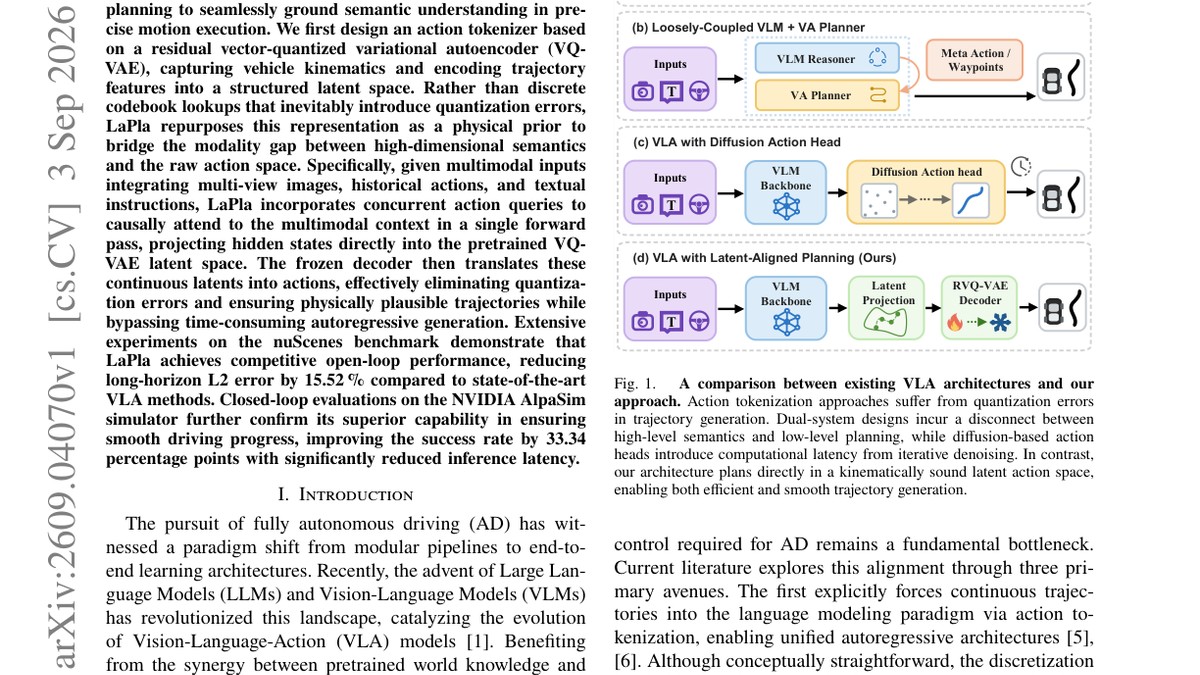
Ruoyu Yao, Yusen Xie, Qingzhao Liu et al. · arXiv preprint · Sep 2026
Bridging the gap between the discrete reasoning of Vision-Language Models and the continuous, physics-constrained nature of autonomous driving remains a significant challenge. In this work, we introduce LaPla, a unified Vision-Language-Action (VLA) framework featuring latent-aligned planning to s...
DexVerse: A Modular Benchmark for Multi-Task, Multi-Embodiment Dexterous Manipulation
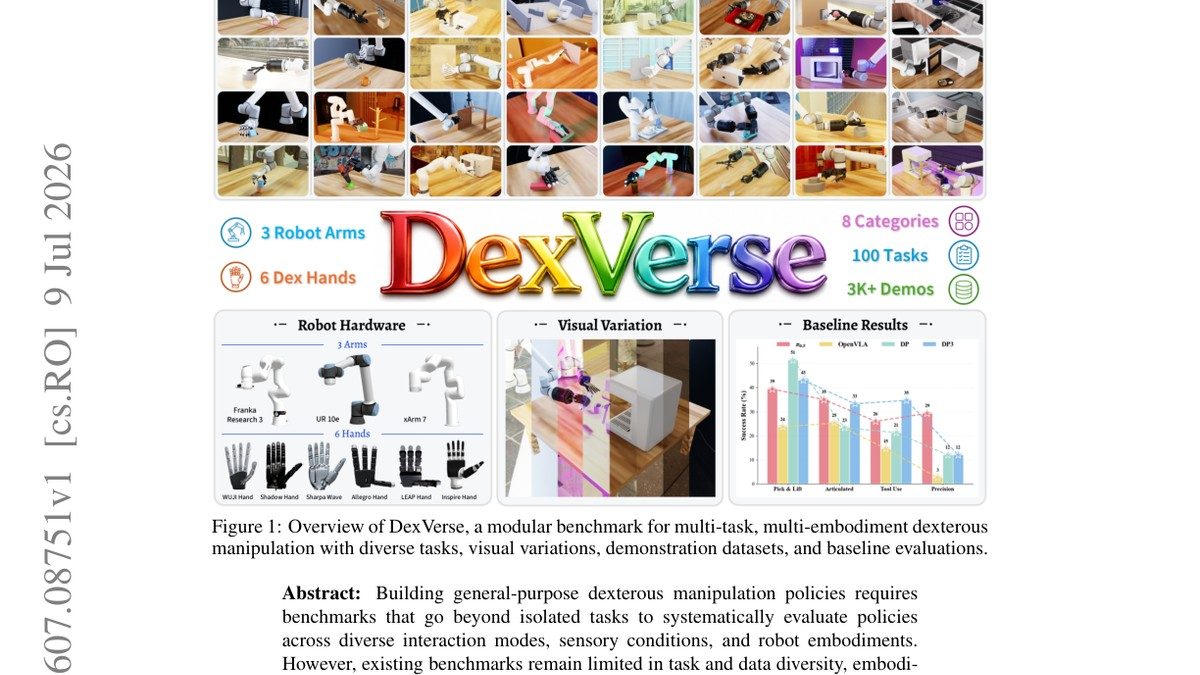
Yunchao Yao, Zhuxiu Xu, Tianqi Zhang et al. · arXiv preprint · Jul 2026
Building general-purpose dexterous manipulation policies requires benchmarks that go beyond isolated tasks to systematically evaluate policies across diverse interaction modes, sensory conditions, and robot embodiments. However, existing benchmarks remain limited in task and data diversity, embod...
DyPES-VLA: Learning Shared Dynamics Priors and Embodiment-Specific Control for Cross-Embodiment Manipulation
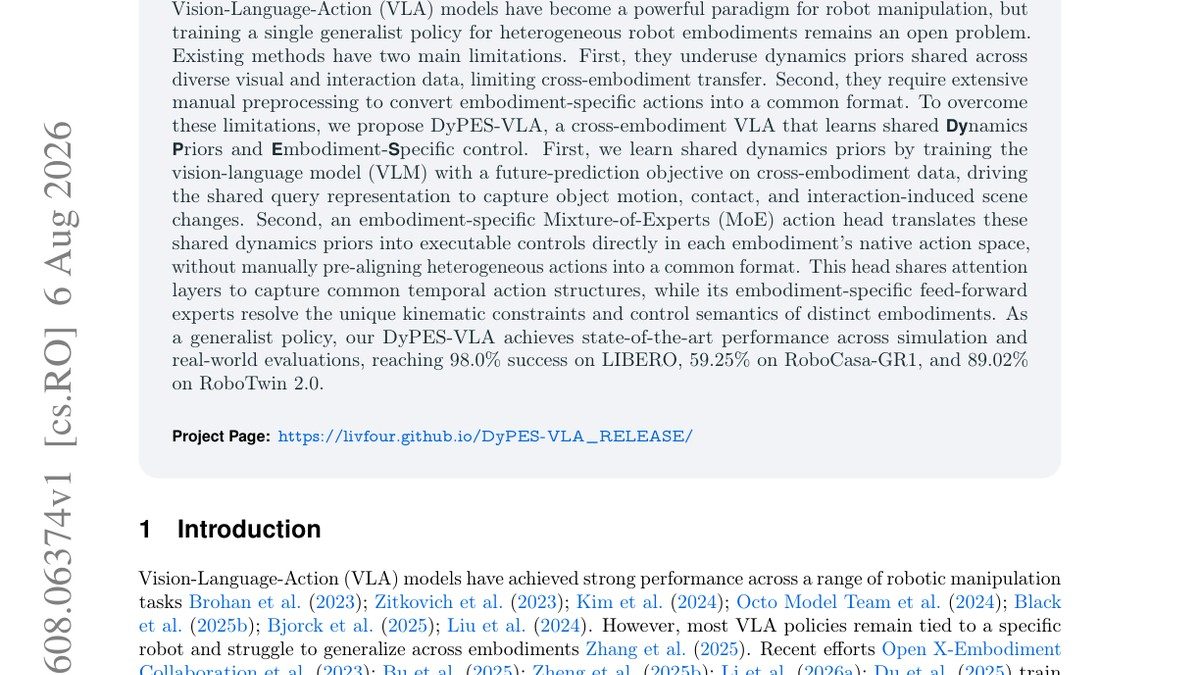
Junfeng Li, Junjie He, Zhide Zhong et al. · arXiv preprint · Aug 2026
Vision-Language-Action (VLA) models have become a powerful paradigm for robot manipulation, but training a single generalist policy for heterogeneous robot embodiments remains an open problem. Existing methods have two main limitations. First, they underuse dynamics priors shared across diverse v...