
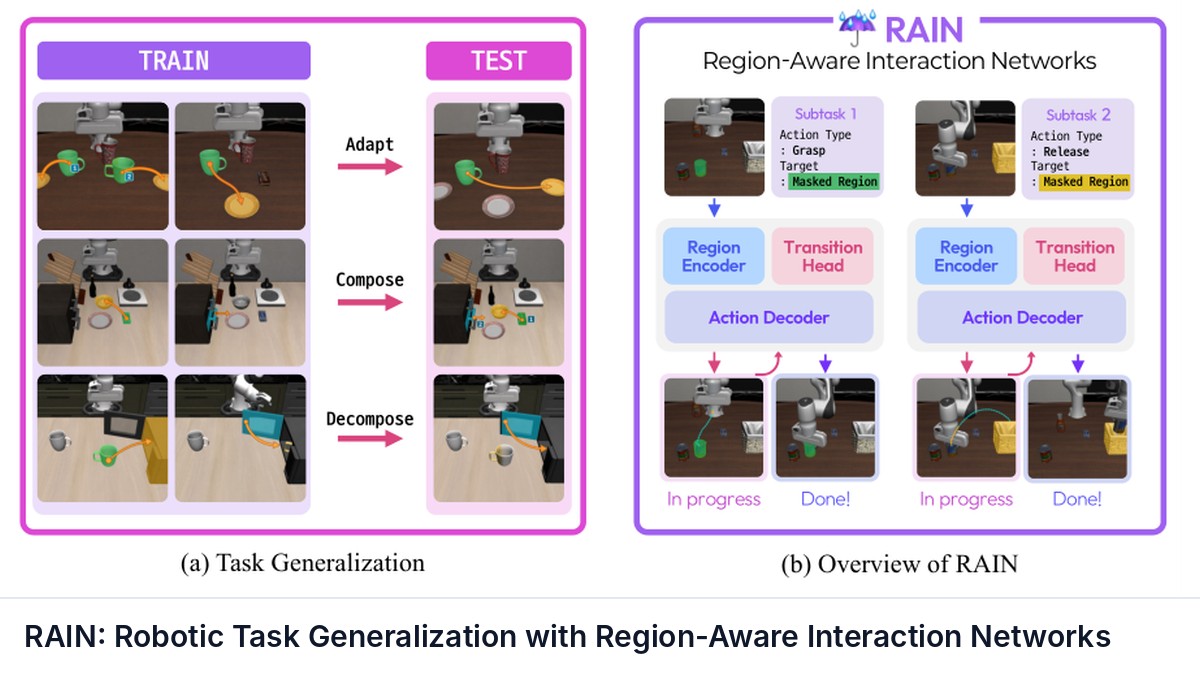
RAIN: Robotic Task Generalization with Region-Aware Interaction Networks
Seunghun Lee, Kyuhwan Shim, Yeogyeong Song, Seung Hwan Kim, Sihaeng Lee, Byoung-Tak Zhang, Sunghoon Im, Gunhee Lee · N/A · 2026
Framework
N/A
License
N/A
Stars
N/A
Summary
Existing vision-language-action (VLA) models benefit from large-scale vision-language pretraining, but tend to memorize training trajectories, limiting their ability to adapt learned interactions to new task and scene configurations.
Abstract Summary
Key Points
- Existing vision-language-action (VLA) models benefit from large-scale vision-language pretraining, but tend to memorize training trajectories, limiting their ability to adapt learned interactions to new task and scene configurations.
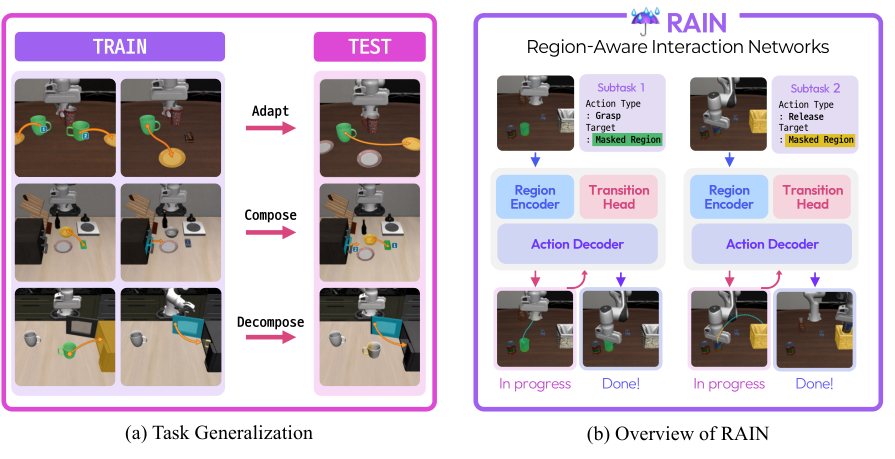
- To address this problem, we propose \textbf{Region-Aware Interaction Networks (RAIN)}, which formulates a task as a sequence of goal-conditioned subtasks, each specified by an action type and a target-region mask.
- This formulation allows learned skills to be reused across different objects and scene layouts and composed into task sequences not seen during training.
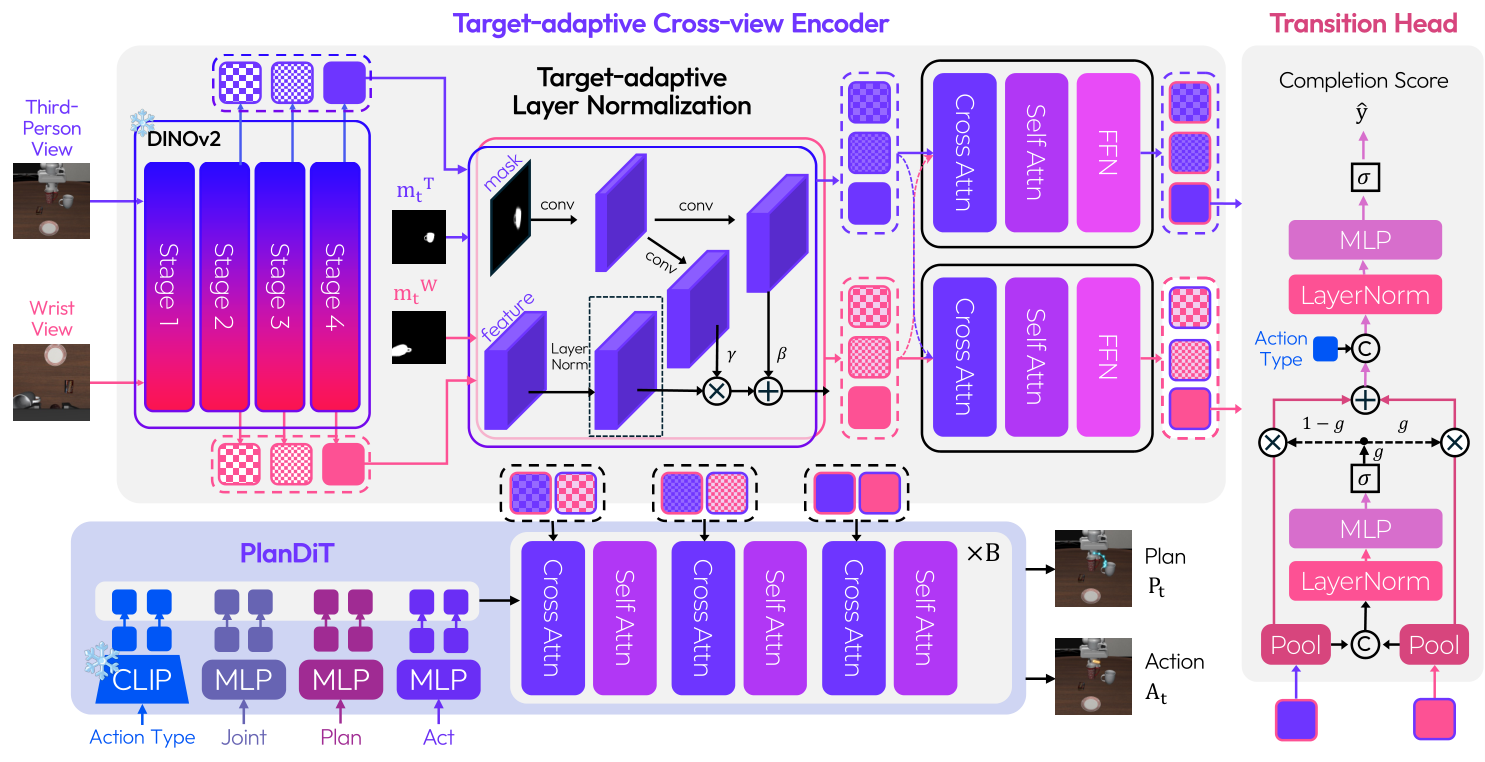
- Its Target-adaptive Cross-View Encoder (TCE) conditions multi-view features on target masks and exchanges information across views, while PlanDiT predicts target-directed trajectories and actions.
- A Transition Head estimates subtask completion to enable automatic transitions
Method
Qwen [ 42 ] decomposes each task into target-centered subtasks, forming an ordered sequence of (action type, target) pairs. We determine subtask intervals from recorded gripper trajectories: finger closing, opening, and stabilization identify grasp and release phases, while changes or stops in translation and rotation delimit other interactions.
The detected completion event defines the interval endpoint, and this final frame receives a completion label.
Experiments
General. We use frozen DINOv2-L/14 [ 43 ] for visual encoding with feature dimension $d=1024$ and frozen CLIP ViT-L/14 [ 1 ] for action-type encoding. PlanDiT uses $B=2$ stage cycles, giving six cross-attention and six self-attention layers, with action horizon $H=16$ and $N=8$ plan waypoints. The consistency loss uses $K=4$ frames, with $\lambda_{\mathrm{fm}}=1$ and $\lambda_{\mathrm{cons}}=0.1$.
Inference uses four flow-matching steps and replans every eight actions.
Sources and Demonstrations
Figures are reproduced from Lee et al. See the full paper for experimental details and the project page, when the paper links one, for demonstrations and videos.
Related Papers

A Sim-to-Real Integration Pipeline for Training and Deployment of Chunk-Based VLA Manipulation Policies
Mathilde Kappel, Clémence Grislain, Mohamed Chetouani et al.
Vision-Language-Action (VLA) models have become a prominent paradigm for mapping multimodal inputs, including semantic instructions, visual observations of the scene, and proprioceptive observations, to robot actions.
Beyond Reconstruction: What Matters in Action Tokenization for Robot Policies?
Haoran Chen, Jingtian Ji, Samuel Wheeler et al.
Autoregressive action-token policies such as vision-language-action models require action tokenizers to translate discrete token sequences into precise control actions in continuous space. Many action tokenizers learn the mapping between tokens and actions via a reconstruction objective.

Capability-Aware Arbitration for Semantic Intent-Based Shared Control
Zhaoda Du, Michael Bowman, Xiaoli Zhang
Shared control often allocates robot authority based on confidence in inferred human intent, assuming reliable autonomous execution. When this assumption fails, high intent confidence can cause over-helping.
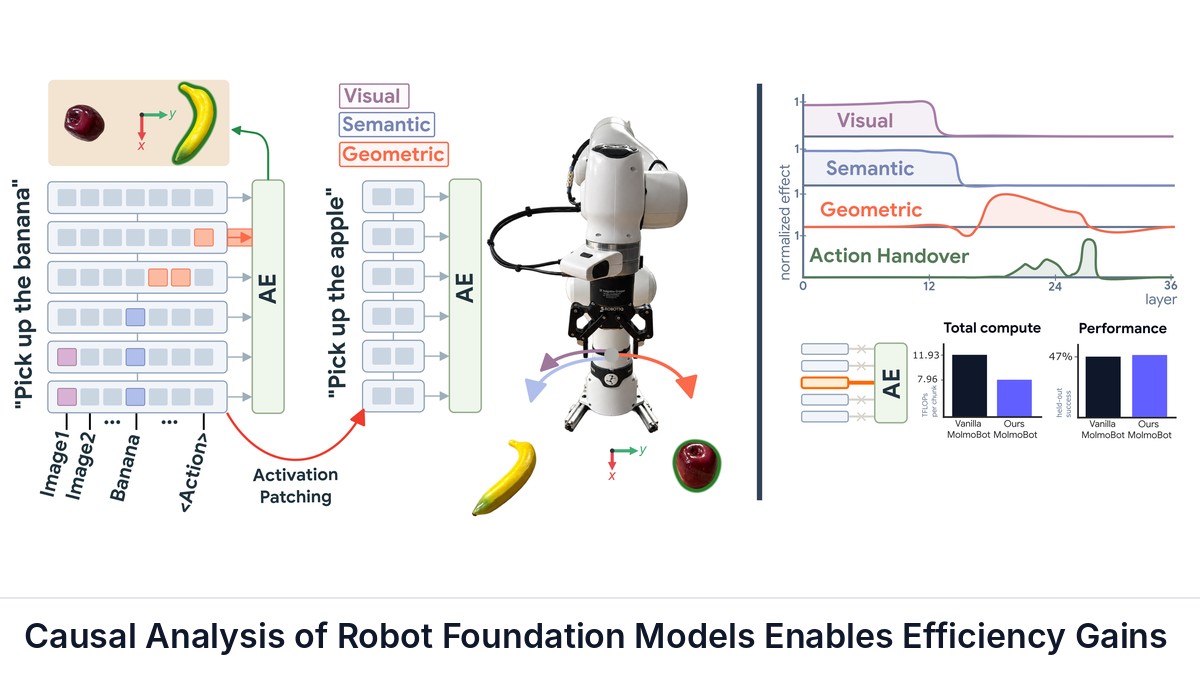
Causal Analysis of Robot Foundation Models Enables Efficiency Gains
Aiden Swann, Mathilde Papillon, Mozes Jacobs et al.
Vision-language-action (VLA) models are a promising approach to general purpose robot manipulation.