
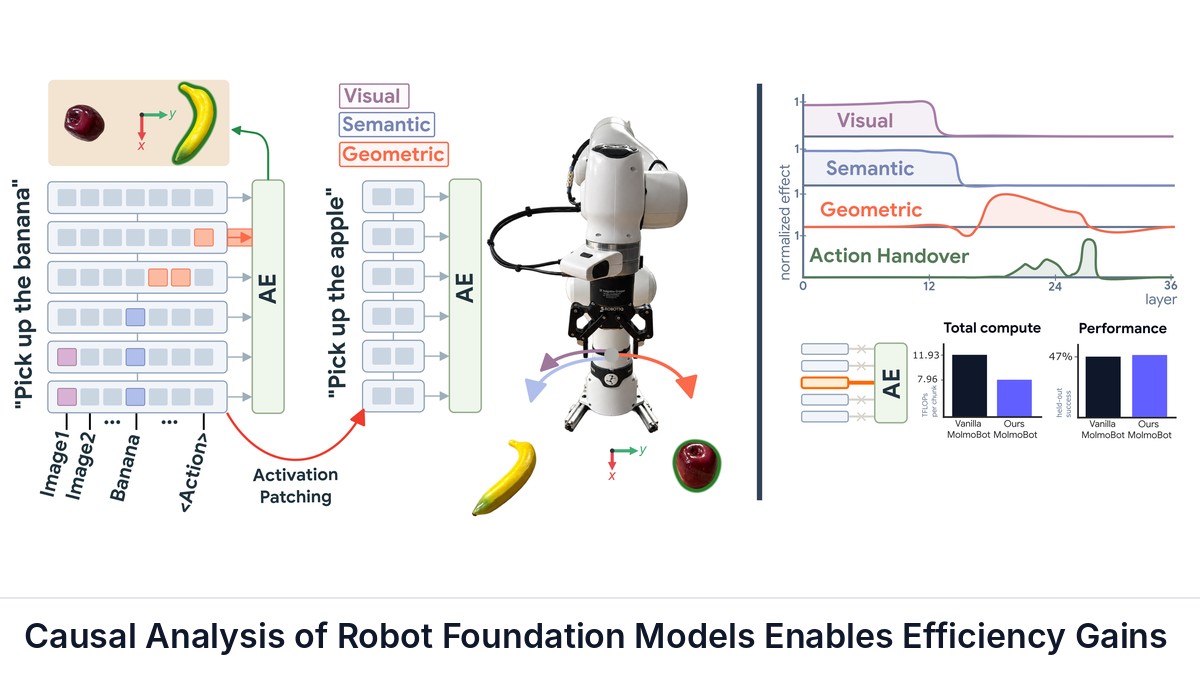
Causal Analysis of Robot Foundation Models Enables Efficiency Gains
Aiden Swann, Mathilde Papillon, Mozes Jacobs, Siddharth Boppana, Tal Haklay, Eric Bigelow, Andrew Lee, Conor Watts, Thomas Icard, Mac Schwager, Owen Lewis, Jack Merullo, Ekdeep Singh Lubana, Atticus Geiger, Thomas Fel, Matthew Kowal · N/A · 2026
Framework
N/A
License
N/A
Stars
N/A
Summary
Vision-language-action (VLA) models are a promising approach to general purpose robot manipulation.
Abstract Summary
Key Points
- Vision-language-action (VLA) models are a promising approach to general purpose robot manipulation
- While the internal computation of vision-language models, which compose the backbone of VLAs, has been studied extensively, less is known about how their perceptual and semantic representations are transformed into action in VLA models.
- We study this question mechanistically in three frontier VLA models ($\pi_{0.5}$, MolmoAct2, and MolmoBot) by analyzing the causal pathways through which the input image and the instruction shape actions.
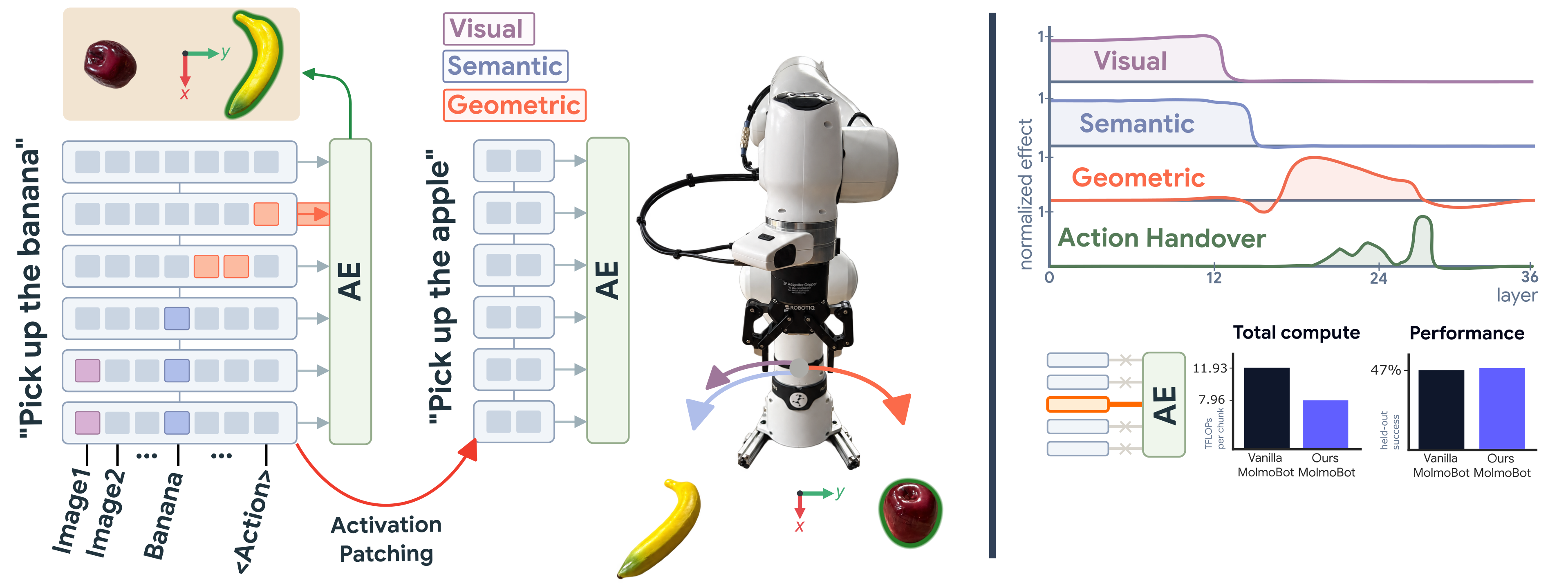
- Across the three models, activation patching shows that causally relevant information influences the action expert (AE) through a narrow band of mid-to-late cross-attention layers, which we term the action-conditioning interface.
- The content of this information changes with token and layer within the model
Discovering the Action-Conditioning Interface
Our goal is to study how task-relevant information within the vision-language backbone is passed to the action expert. We then use the identified causal interface to create policies that improve efficiency without costing performance. We study MolmoBot, $\pi_{0.5}$, and MolmoAct2 ( Deshpande et al., 2026 ; Physical Intelligence et al., 2025 ; Fang et al., 2026 ) .
Each model conditions its continuous action expert on representations from all backbone layers using different attention implementations.
Efficiency Improvements in Real Policies
Our mechanistic findings suggest a direct opportunity to improve the efficiency of VLA architectures: the narrow VLM–action-expert interface identified in Figure 2 . Thus, we restrict action expert conditioning to the identified layers by removing completely the cross attention layers outside of the action-conditioning interface , and evaluate whether these simplified policies retain their capabilities.
Explaining the Action Conditioning Interface
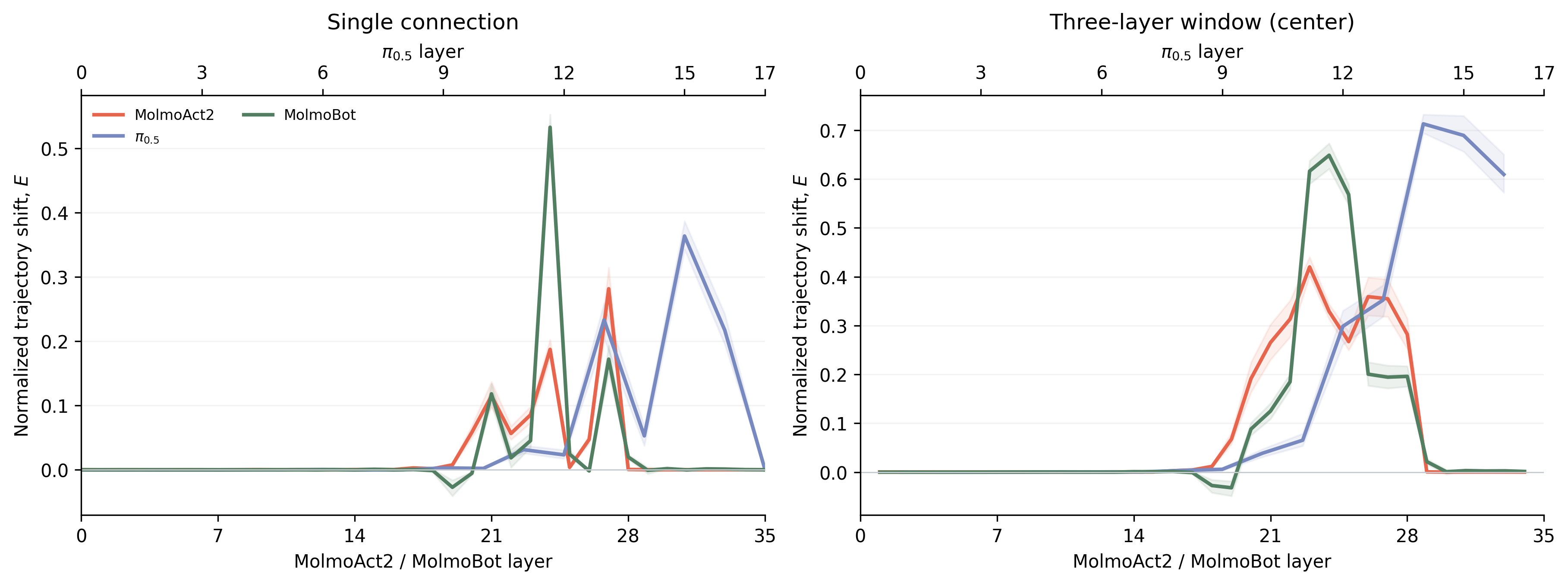
In a VLA, information flows from perception, through the vision-language backbone, to the action expert that produces motor commands. The interface discovery in Section 2 raises a question about what information the backbone supplies to the expert. Our goal is to distinguish representations that determine which object the model selects from those that determine where it reaches.
We test hypotheses about this information by comparing the effects of interchange interventions with predictions from a high-level causal model.
Sources and Demonstrations
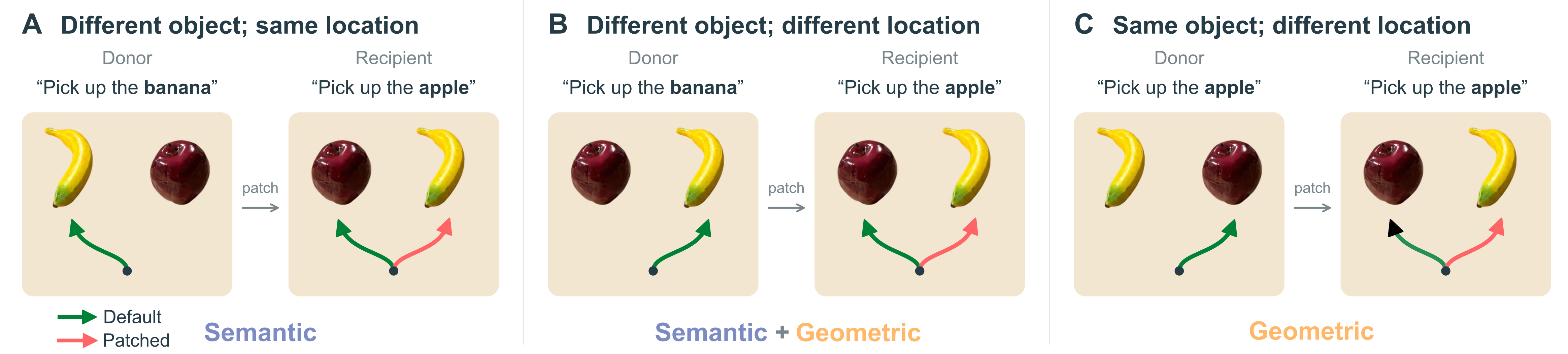
Figures are reproduced from Swann et al. See the full paper for experimental details and the project page, when the paper links one, for demonstrations and videos.
Related Papers

A Sim-to-Real Integration Pipeline for Training and Deployment of Chunk-Based VLA Manipulation Policies
Mathilde Kappel, Clémence Grislain, Mohamed Chetouani et al.
Vision-Language-Action (VLA) models have become a prominent paradigm for mapping multimodal inputs, including semantic instructions, visual observations of the scene, and proprioceptive observations, to robot actions.
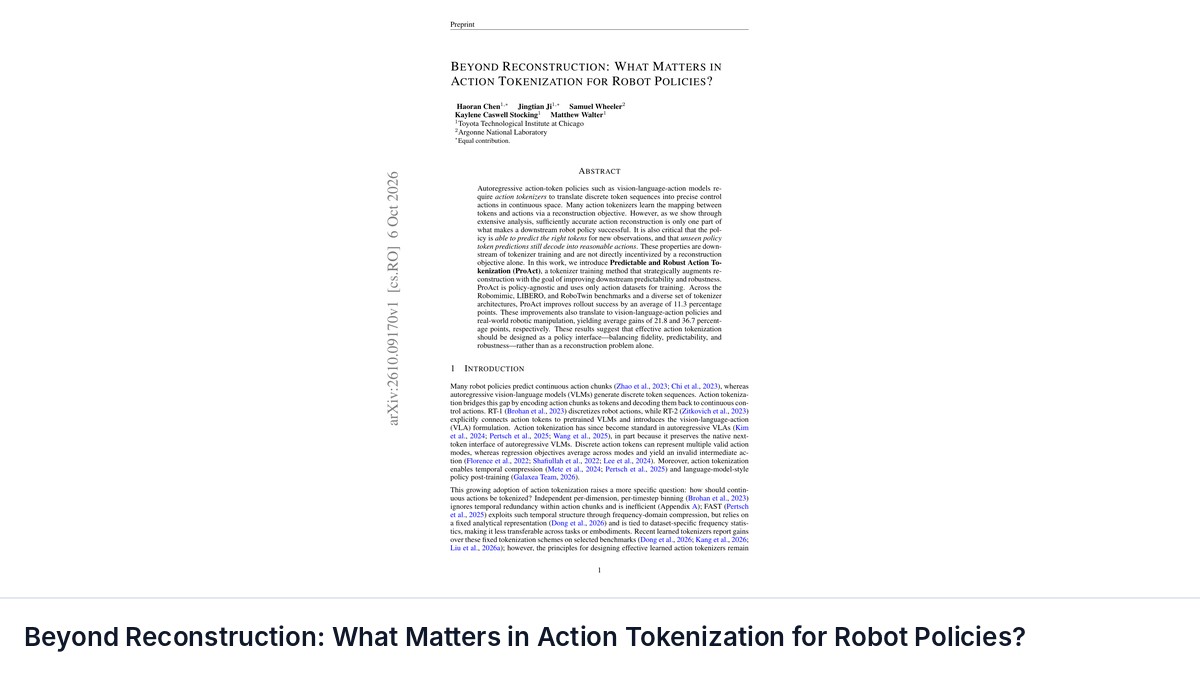
Beyond Reconstruction: What Matters in Action Tokenization for Robot Policies?
Haoran Chen, Jingtian Ji, Samuel Wheeler et al.
Autoregressive action-token policies such as vision-language-action models require action tokenizers to translate discrete token sequences into precise control actions in continuous space. Many action tokenizers learn the mapping between tokens and actions via a reconstruction objective.

Capability-Aware Arbitration for Semantic Intent-Based Shared Control
Zhaoda Du, Michael Bowman, Xiaoli Zhang
Shared control often allocates robot authority based on confidence in inferred human intent, assuming reliable autonomous execution. When this assumption fails, high intent confidence can cause over-helping.
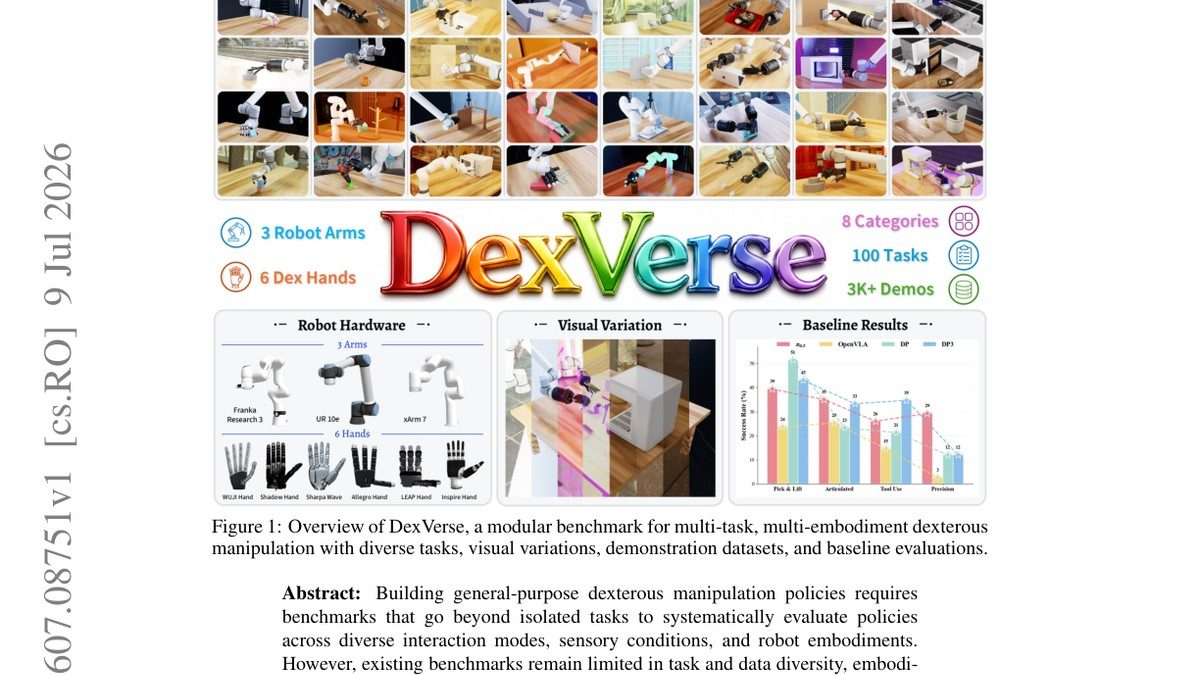
DexVerse: A Modular Benchmark for Multi-Task, Multi-Embodiment Dexterous Manipulation
Yunchao Yao, Zhuxiu Xu, Tianqi Zhang et al.
Building general-purpose dexterous manipulation policies requires benchmarks that go beyond isolated tasks to systematically evaluate policies across diverse interaction modes, sensory conditions, and robot embodiments.