
Improving Robotic Generalist Policies via Flow Reversal Steering
Andy Tang, William Chen, Andrew Wagenmaker, Chelsea Finn, Sergey Levine · N/A · 2026
Framework
N/A
License
N/A
Stars
N/A
Summary
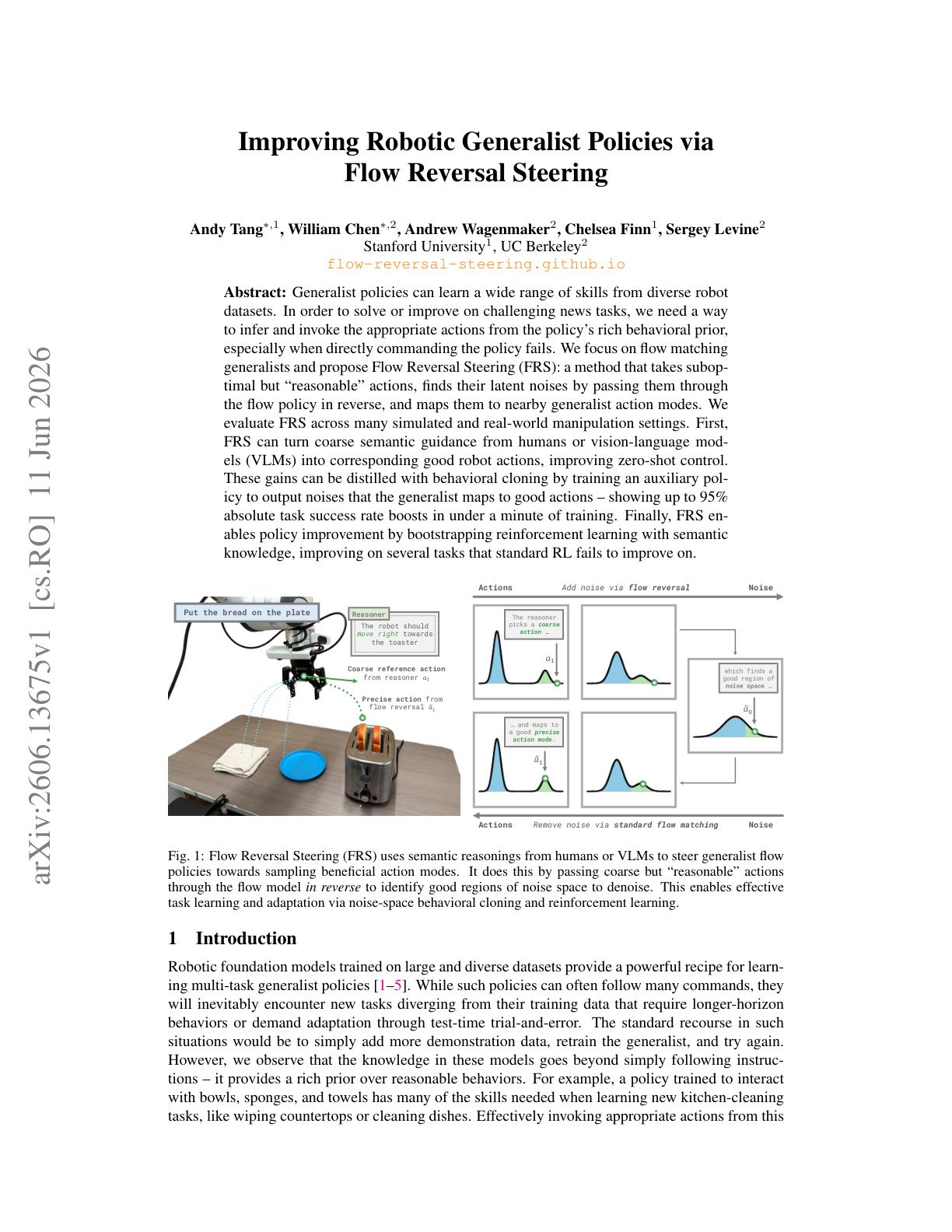
Generalist policies can learn a wide range of skills from diverse robot datasets. In order to solve or improve on challenging news tasks, we need a way to infer and invoke the appropriate actions from the policy's rich behavioral prior, especially when directly commanding the policy fails.
Abstract Summary
Key Points
- Proposes Flow Reversal Steering (FRS) to navigate flow-matching generalist policy latent spaces.
- Converts suboptimal actions into latent noises and maps them to better generalist action modes.
- Enables zero-shot control from semantic guidance and achieves up to 95% success rate boosts with minimal distillation.
- Bootstraps RL with semantic knowledge for policy improvement on tasks where standard RL fails.
Preliminaries
Flow matching VLAs. Generalist policies take a pretrained backbone and fine-tunes it with behavioral cloning (BC) to match the action distribution of experts.
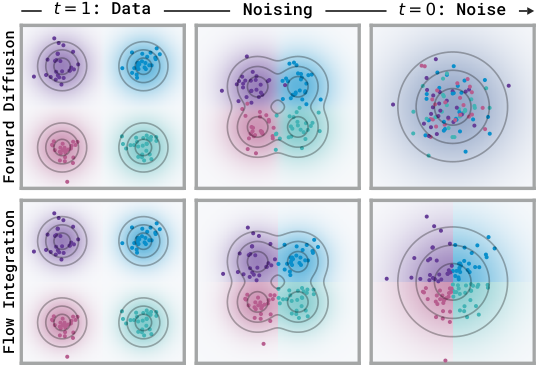
Given BC data $(o,a_{1})$ and sampled times $t\in[0,1]$, these policies fit a velocity field $v_{\theta}(a_{t},t\mid o)$ that maps noise $a_{0}\sim\mathcal{N}(0,I)$ to actions $a_{1}$ by denoising partially-noised actions produced by forward diffusion $a_{t}=t\cdot a_{1}+(1-t)\cdot a_{0}$.

Flow Reversal Steering (FRS)
Our method, Flow Reversal Steering (FRS), takes “coarse” actions and refines them using a generalist policy into similar, higher-quality actions. In Sec. 4.1 , we show how flow reversal can identify noises that bias the flow matching policy into sampling actions of the same mode as the coarse one. Then, in Sec.
4.2 , we consider how humans or VLMs can provide such coarse guidance to the robot, based on their semantic knowledge. Flow reversal converts these rough sketches of robot behaviors into in-distribution actions. Finally, in Sec.
Experiments
We now evaluate Flow Reversal Steering by answering: (1) Can FRS improve performance without any training by having VLMs guide generalists towards semantically-reasonable behaviors? (2) Can we use the improved trajectories from FRS to rapidly learn new tasks? (3) Can FRS help generalists more efficiently improve from experience? See App. E and App. F for more experimental details. Simulation.

Sources and Demonstrations
Figures are reproduced from Tang et al. See the full paper for experimental details and the project page, when the paper links one, for demonstrations and videos.
Related Papers
3DThinkVLA: Endowing Vision-Language-Action Models with Latent 3D Priors via 3D-Thinking-Guided Co-training
Jiaxin Shi, Xidong Zhang, Fucai Zhu et al.
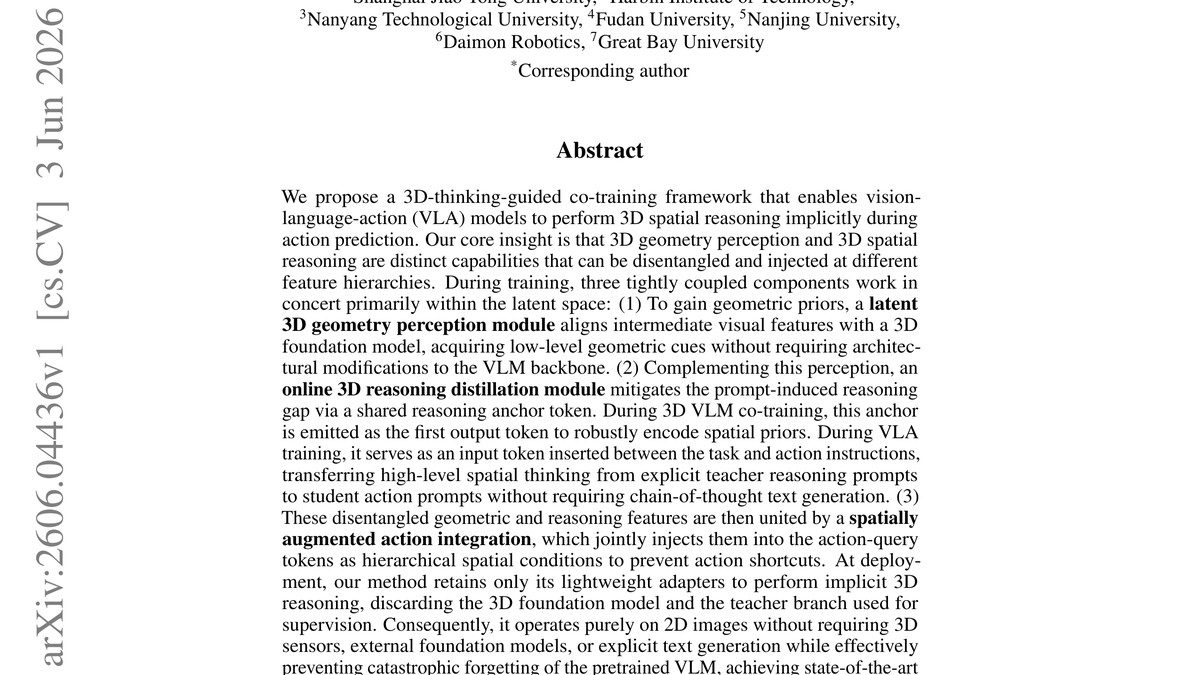
We propose a 3D-thinking-guided co-training framework that enables vision-language-action (VLA) models to perform 3D spatial reasoning implicitly during action prediction.
A Phenomenology of Neural Geometry in Vision-Language-Action Models
Mozes Jacobs, Aiden Swann, Mathilde Papillon et al.
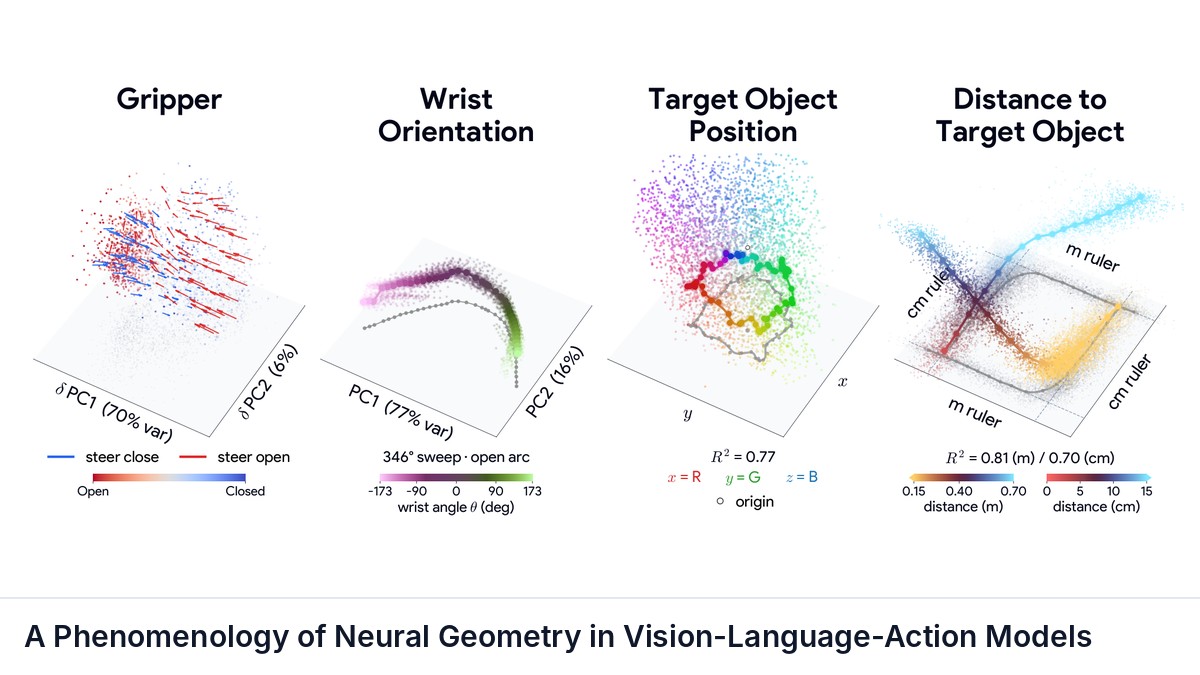
Robotic manipulation is inherently geometric, but what shape does the world take inside the policy that performs it?

A Sim-to-Real Integration Pipeline for Training and Deployment of Chunk-Based VLA Manipulation Policies
Mathilde Kappel, Clémence Grislain, Mohamed Chetouani et al.
Vision-Language-Action (VLA) models have become a prominent paradigm for mapping multimodal inputs, including semantic instructions, visual observations of the scene, and proprioceptive observations, to robot actions.
AIR-VLA+: Decoupling Movement and Manipulation via Cascaded Dual-Action Decoders with Asymmetric MoE for Aerial Robots
Jianli Sun, Bin Tian, Qiyao Zhang et al.
Aerial manipulation systems have long suffered from representation coupling in end-to-end control, as platform-level Unmanned Aerial Vehicle (UAV) movement and end-effector-level arm manipulation differ substantially in action scale, dynamics, and control objectives.