
Reflex: Enabling Fast and Predictive Vision-Language-Action Models for Reaction-Critical Manipulation
Yuxuan Chen, Wanruo Zhang, Xiao Li · N/A · 2026
Framework
N/A
License
N/A
Stars
N/A
Summary
Vision-Language-Action (VLA) models have recently achieved promising performance in robotic manipulation. However, existing benchmarks mainly evaluate generalization on static manipulation tasks and largely overlook dynamic interaction scenarios.
Abstract Summary
Key Points
- Vision-Language-Action (VLA) models have recently achieved promising performance in robotic manipulation.
- However, existing benchmarks mainly evaluate generalization on static manipulation tasks and largely overlook dynamic interaction scenarios.
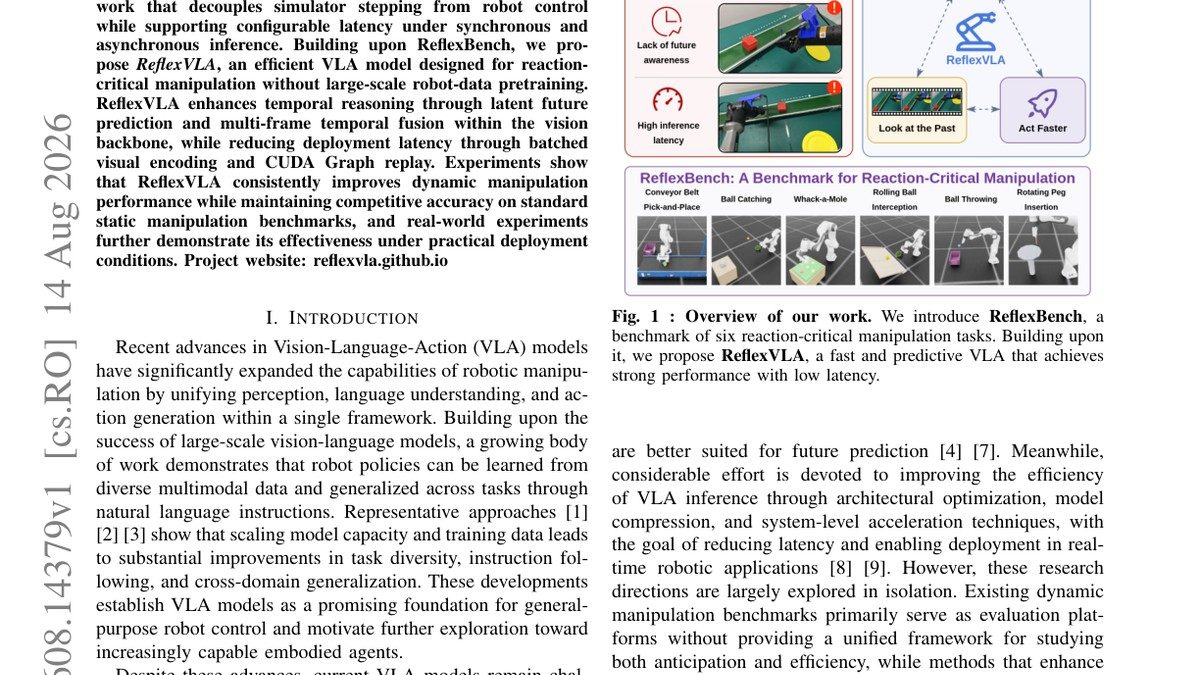
- To address this gap, we present ReflexBench, a benchmark for reaction-critical manipulation
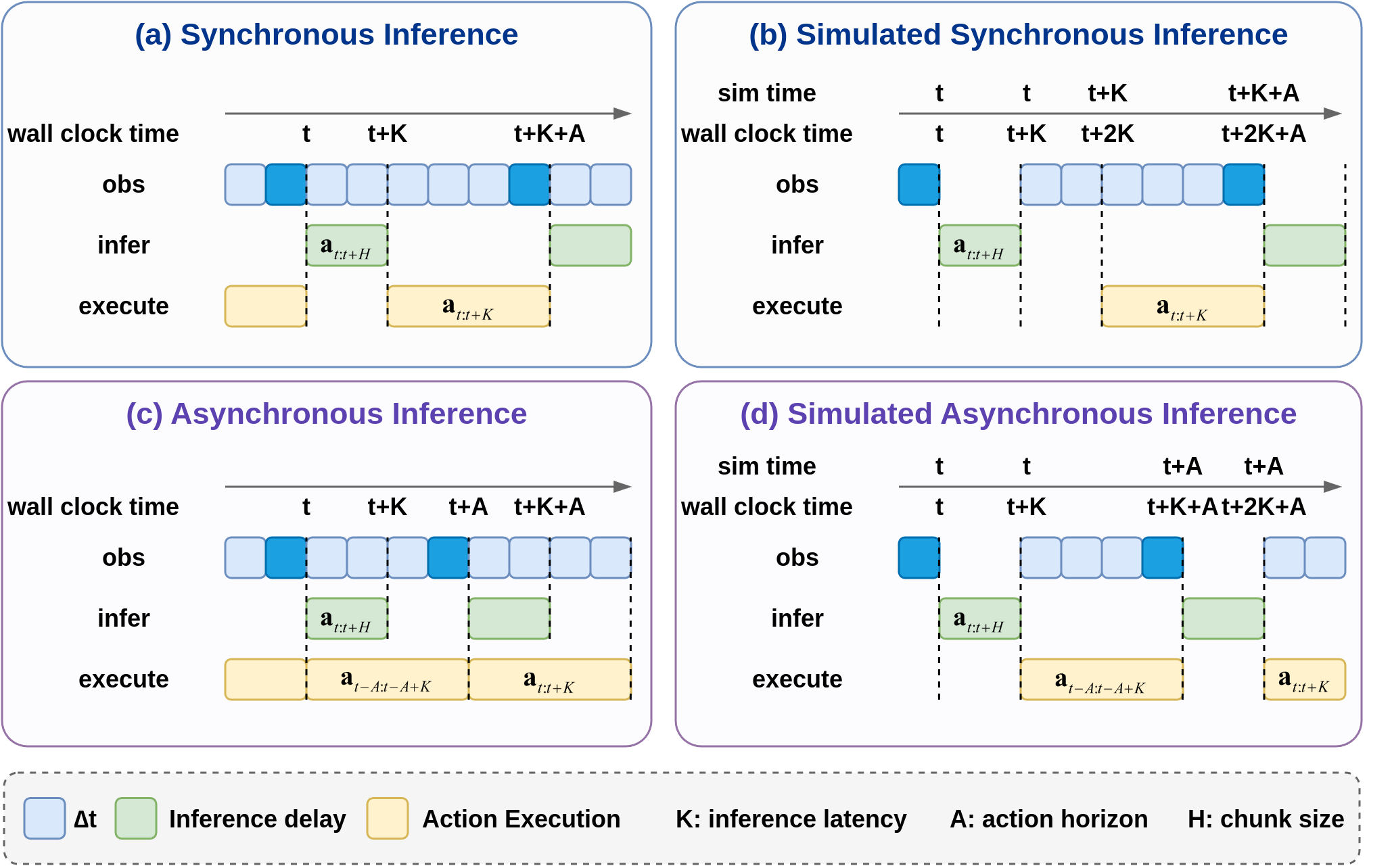
- ReflexBench contains six dynamic tasks and introduces an evaluation framework that decouples simulator stepping from robot control while supporting configurable latency under synchronous and asynchronous inference.
- Building upon ReflexBench, we propose ReflexVLA, an efficient VLA model designed for reaction-critical manipulation without large-scale robot-data pretraining.
ReflexBench
Recent robotic manipulation benchmarks evaluate VLA models across diverse tasks and environments [ 12 ] [ 13 ] [ 14 ] [ 15 ] , but largely overlook reaction-critical scenarios. Furthermore, most simulation benchmarks pause the environment during policy inference, ignoring inference latency and the resulting perception-execution delays.
Consequently, they fail to accurately assess VLA performance in dynamic real-world settings.
ReflexVLA
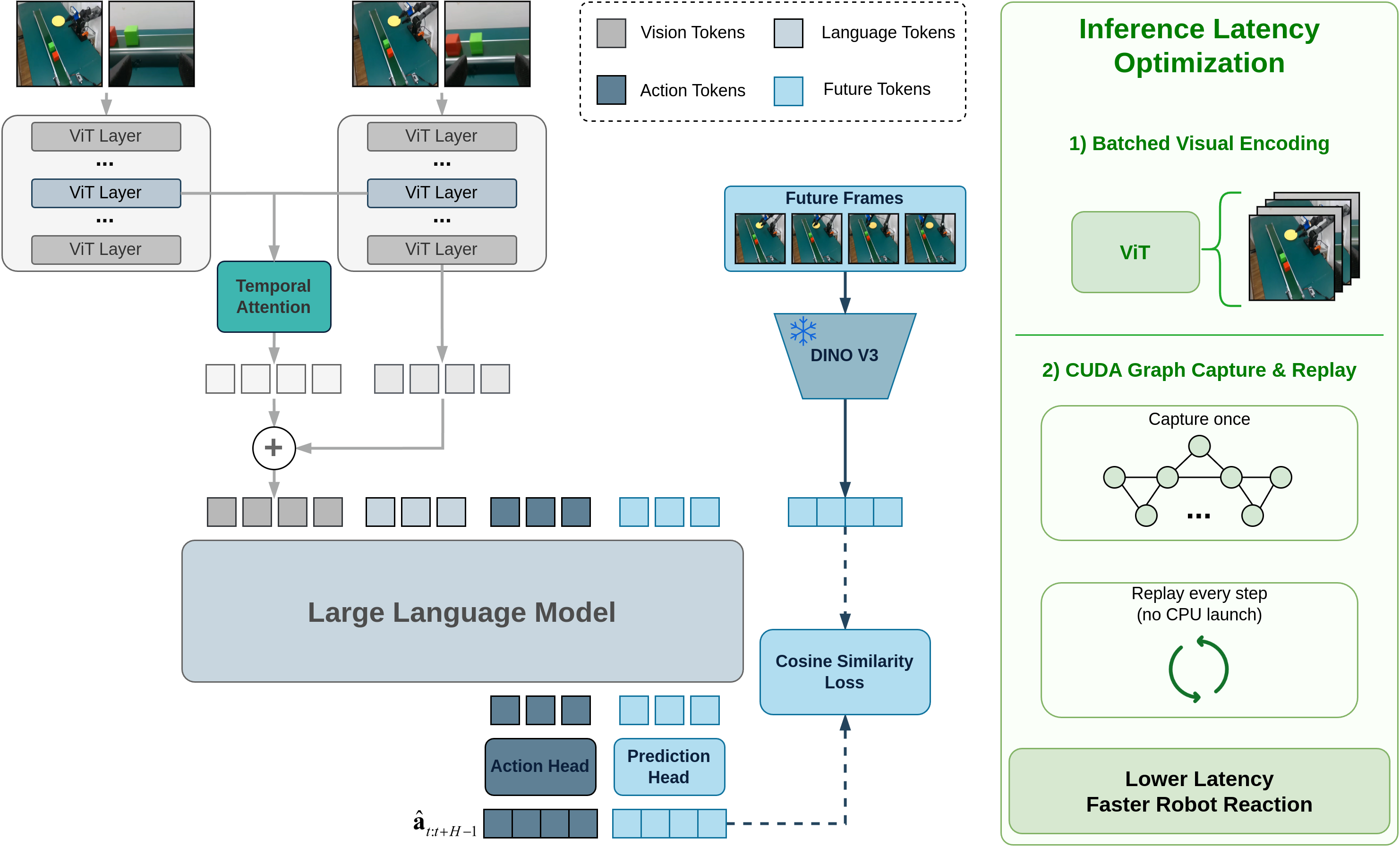
ReflexVLA is built on top of a compact vision-language-action architecture [ 10 ] . The visual encoder is a fused ViT backbone composed of DINOv2 [ 16 ] and SigLIP [ 17 ] at $224\times 224$ resolution. The language backbone is a Qwen2.5-0.5B [ 18 ] causal transformer.
Given a language instruction and multi-view RGB observations, the model inserts projected visual tokens after the beginning-of-sequence token and uses learnable action queries to produce an action chunk through a continuous regression head. As shown in Fig.
Experiments
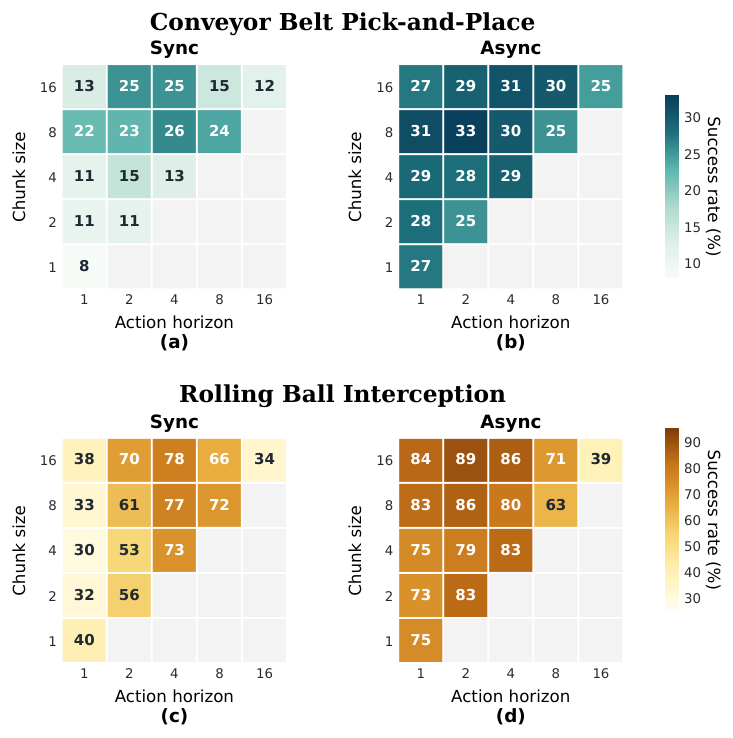
How do different factors influence the success rate of reaction-critical manipulation tasks? Q2: Does ReflexVLA achieve better performance on ReflexBench than existing VLA baselines? Q3: Does ReflexVLA still achieve competitive performance on standard static manipulation tasks? Q4: What is the contribution of each design component to the overall performance of ReflexVLA?
Q5: How well does ReflexVLA perform in real-world manipulation tasks? Baselines. We compare ReflexVLA with a diverse set of representative VLA models.
Sources and Demonstrations
Figures are reproduced from Chen et al. See the full paper for experimental details and the project page, when the paper links one, for demonstrations and videos.
Related Papers

A Sim-to-Real Integration Pipeline for Training and Deployment of Chunk-Based VLA Manipulation Policies
Mathilde Kappel, Clémence Grislain, Mohamed Chetouani et al.
Vision-Language-Action (VLA) models have become a prominent paradigm for mapping multimodal inputs, including semantic instructions, visual observations of the scene, and proprioceptive observations, to robot actions.
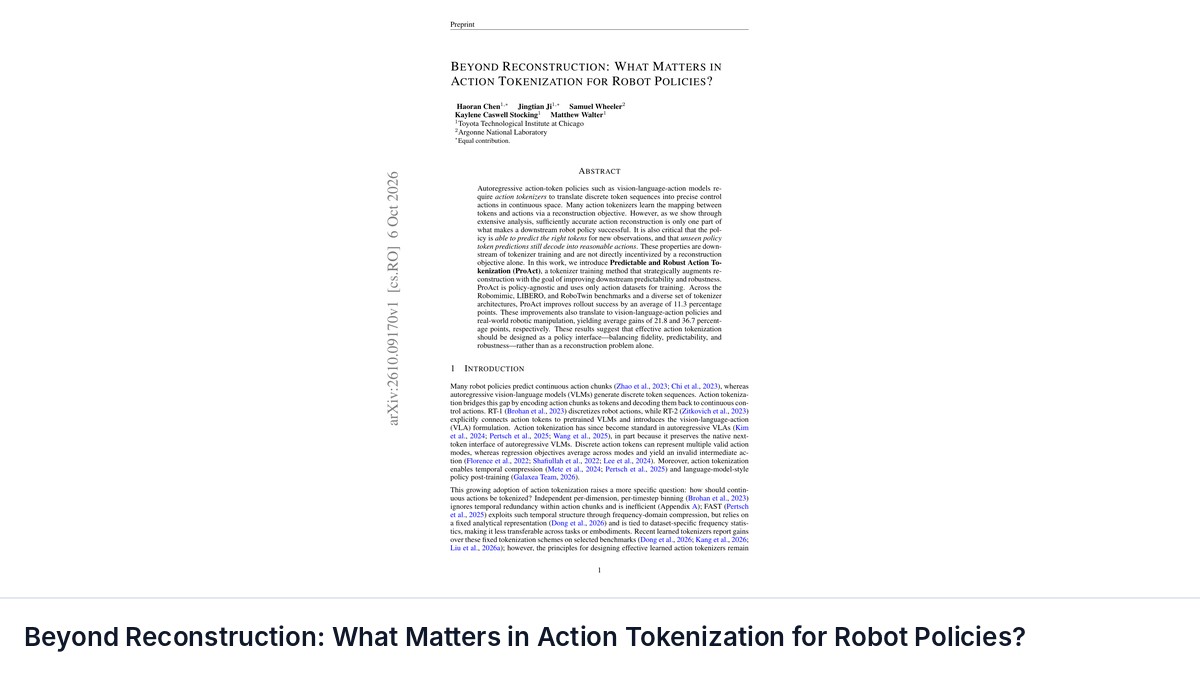
Beyond Reconstruction: What Matters in Action Tokenization for Robot Policies?
Haoran Chen, Jingtian Ji, Samuel Wheeler et al.
Autoregressive action-token policies such as vision-language-action models require action tokenizers to translate discrete token sequences into precise control actions in continuous space. Many action tokenizers learn the mapping between tokens and actions via a reconstruction objective.
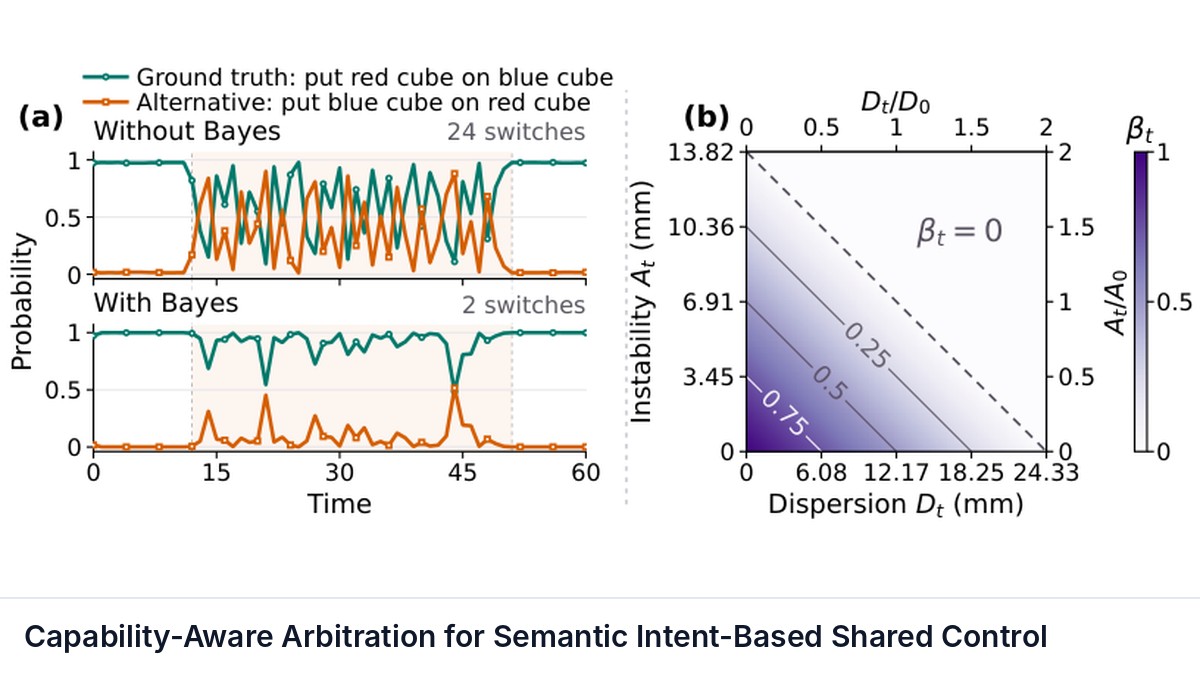
Capability-Aware Arbitration for Semantic Intent-Based Shared Control
Zhaoda Du, Michael Bowman, Xiaoli Zhang
Shared control often allocates robot authority based on confidence in inferred human intent, assuming reliable autonomous execution. When this assumption fails, high intent confidence can cause over-helping.
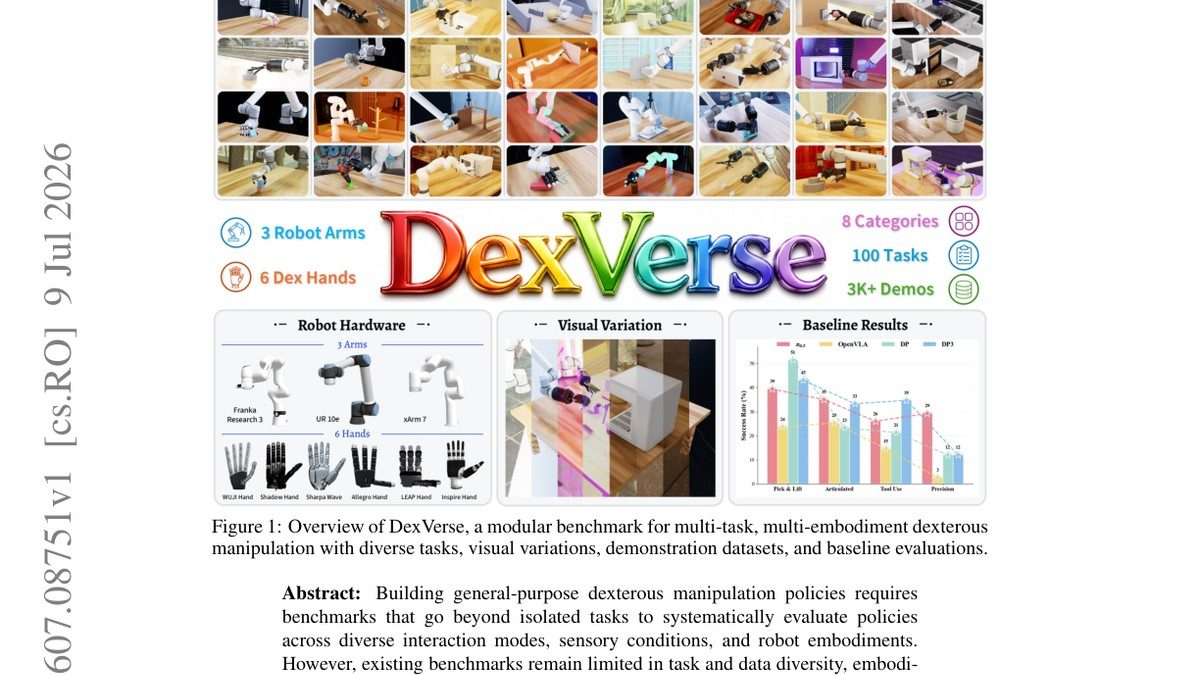
DexVerse: A Modular Benchmark for Multi-Task, Multi-Embodiment Dexterous Manipulation
Yunchao Yao, Zhuxiu Xu, Tianqi Zhang et al.
Building general-purpose dexterous manipulation policies requires benchmarks that go beyond isolated tasks to systematically evaluate policies across diverse interaction modes, sensory conditions, and robot embodiments.