
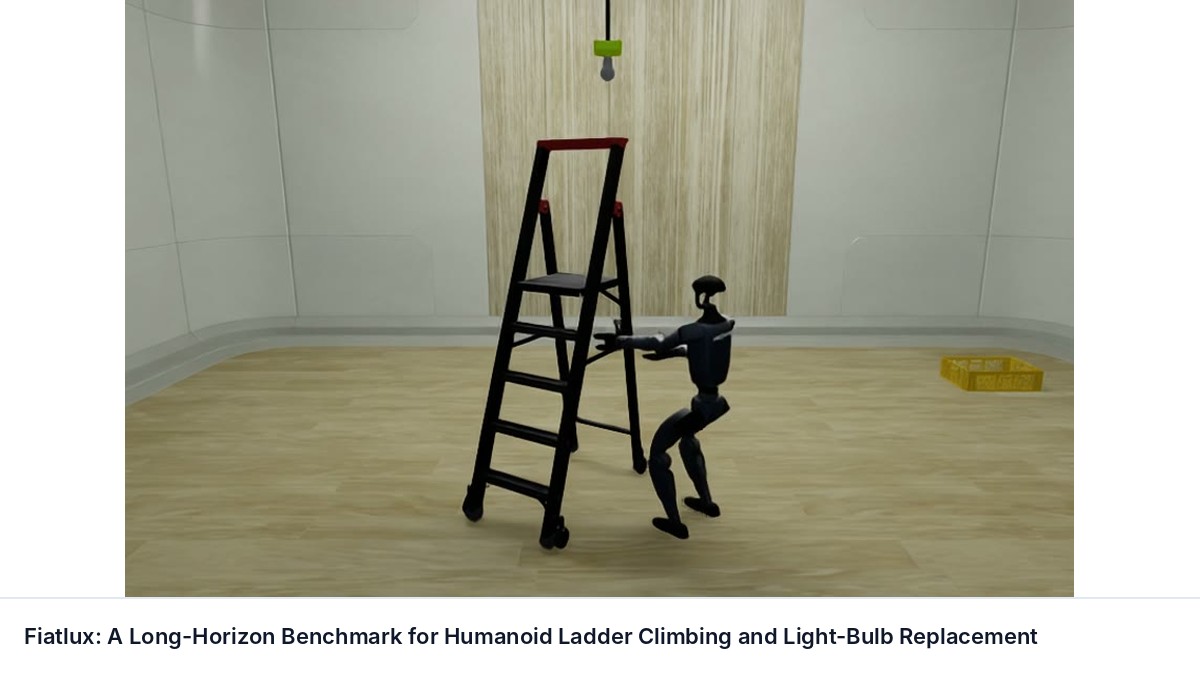
Fiatlux: A Long-Horizon Benchmark for Humanoid Ladder Climbing and Light-Bulb Replacement
Pavel Bushuyeu, Yujin Chen, Anton Nikolaev, Brian Shu, Igor Molybog · N/A · 2026
Framework
N/A
License
N/A
Stars
N/A
Summary
Existing benchmarks evaluate tabletop manipulation, flat-floor household activity, or humanoid locomotion and manipulation as separate task groups; none scores vertical mobility and dexterous work on a fragile payload in one long-horizon episode. We present Fiatlux, a light-bulb replacement bench...
Abstract Summary
Key Points
- Existing benchmarks evaluate tabletop manipulation, flat-floor household activity, or humanoid lo...
- We present Fiatlux, a light-bulb replacement benchmark built on NVIDIA Isaac Lab
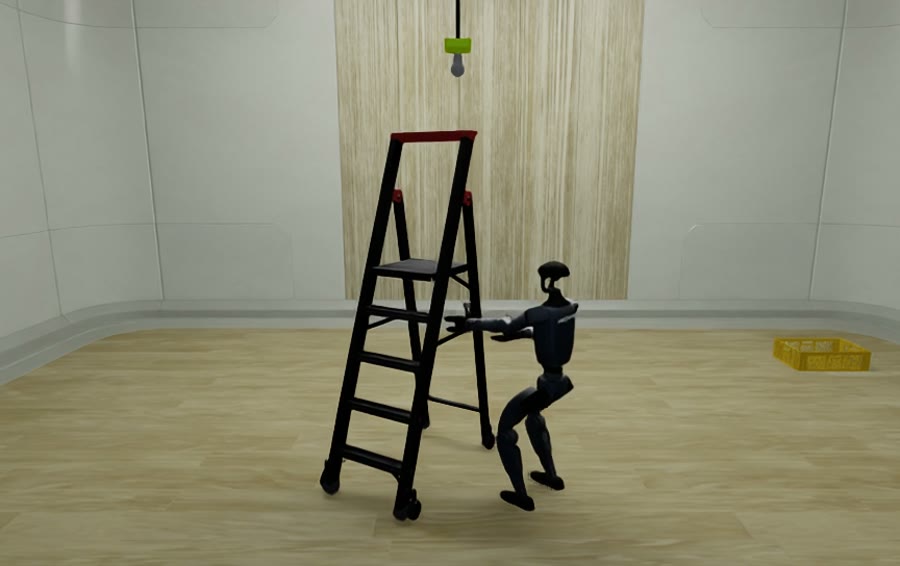
- In one episode, a Unitree G1 humanoid positions a step ladder under a ceiling or wall fixture, cl...
- We decompose the episode into twelve subtask environments scored on difficulty-weighted gates
- The goal is a successful replacement, with the fresh bulb seated, the spent one disposed of, neit...
Methodology and Implementation
Fiatlux structures the long-horizon light-bulb replacement task into a single scene built in NVIDIA Isaac Lab on the PhysX solver. The complete benchmark task evaluates the multi-stage pipeline as one flat episode ($T=72{,}000$ steps at 50 Hz, a $1{,}440\text{ s}$ horizon).
To establish clear, non-overlapping operational boundaries for stage-wise policy evaluation, Fiatlux registers 12 atomic subtasks as separate environments (Table I ).
Validation and Baselines
Evaluations use the benchmark CLI tools. Each policy runs one episode per subtask at each of four layout seeds, reported as mean and standard deviation over the seeds. Rollout trajectories are recorded as bags and scored offline, so the same recording can be re-scored under different rules without re-running the simulator.
The offline scorer reports the success rate, the clean success rate of Section III , the mean per-episode score, and the broken and dropped rates.
Sources and Demonstrations
Figures are reproduced from Bushuyeu et al. See the full paper for experimental details and the project page, when the paper links one, for demonstrations and videos.
Related Papers
DUET: Decoupled Upper- and Lower-Body Execution for Task-Agnostic Humanoid Loco-Manipulation
Kapalik Khanal, Biswash Khatiwada, Stephen Afrifa et al.
Changing a humanoid robot's manipulation policy should not require retraining the controller that maintains the robot's balance. This study introduces DUET, a decoupled execution framework that enables locomotion and manipulation controllers to operate simultaneously by combining their commands o...
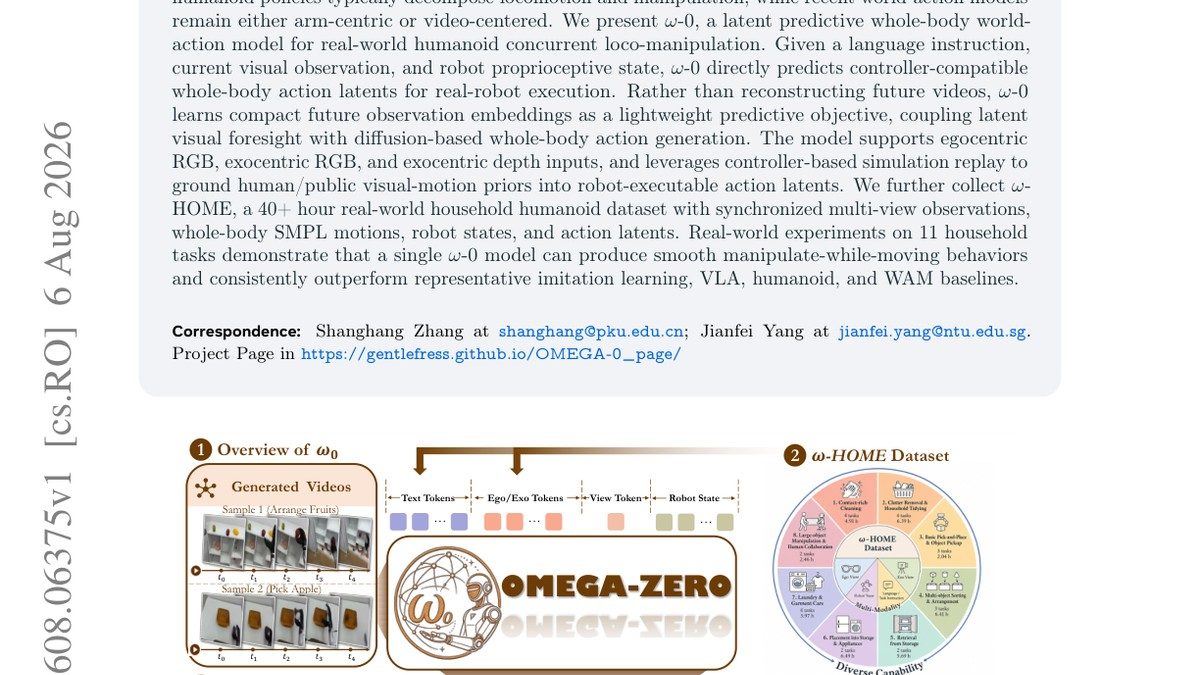
$ω$-0: A Latent Predictive World Action Model for Concurrent Humanoid Loco-Manipulation
Zhe Li, Zhenzhe Zhang, Yangyang Wei et al.
Humanoid household tasks often require concurrent loco-manipulation, where the robot must move, adjust posture, maintain balance, and manipulate objects as a single coordinated behavior. Yet existing humanoid policies typically decompose locomotion and manipulation, while recent world-action mode...
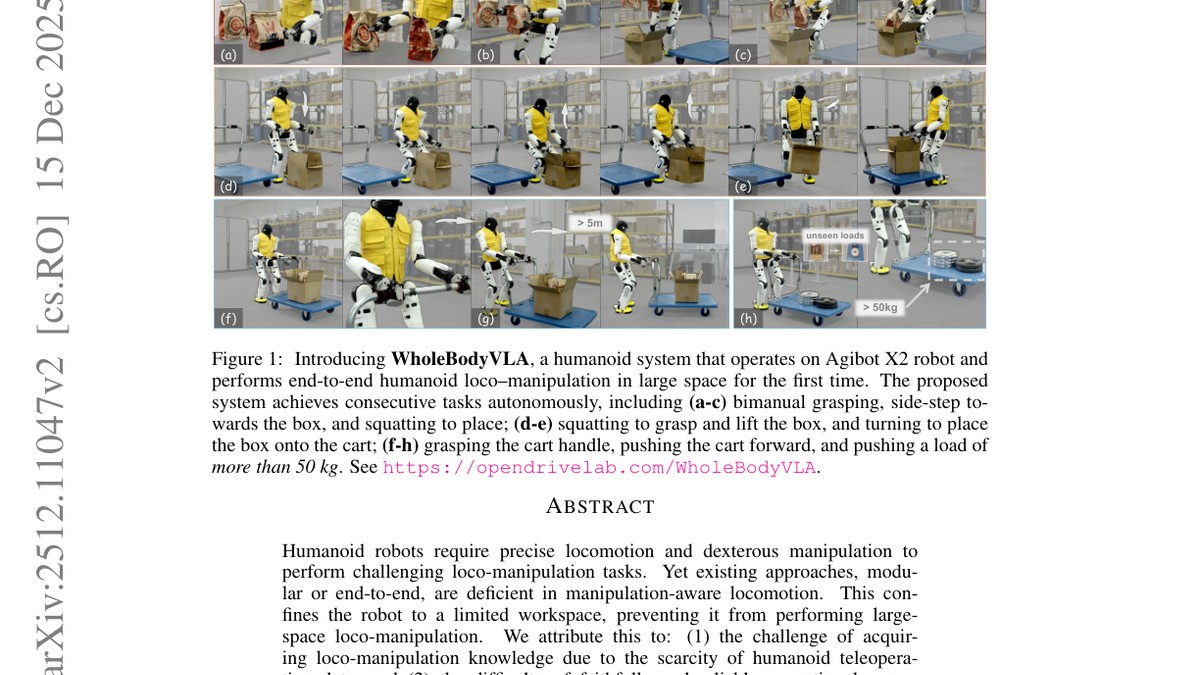
WholeBodyVLA: Towards Unified Latent VLA for Whole-Body Loco-Manipulation Control
Haoran Jiang, Jin Chen, Qingwen Bu et al.
Humanoid robots require precise locomotion and dexterous manipulation to perform challenging loco-manipulation tasks. Yet existing approaches, modular or end-to-end, are deficient in manipulation-aware locomotion. This confines the robot to a limited workspace, preventing it from performing large...

A Sim-to-Real Integration Pipeline for Training and Deployment of Chunk-Based VLA Manipulation Policies
Mathilde Kappel, Clémence Grislain, Mohamed Chetouani et al.
Vision-Language-Action (VLA) models have become a prominent paradigm for mapping multimodal inputs, including semantic instructions, visual observations of the scene, and proprioceptive observations, to robot actions. Most state-of-the-art models predict actions in the end-effector pose space as ...