
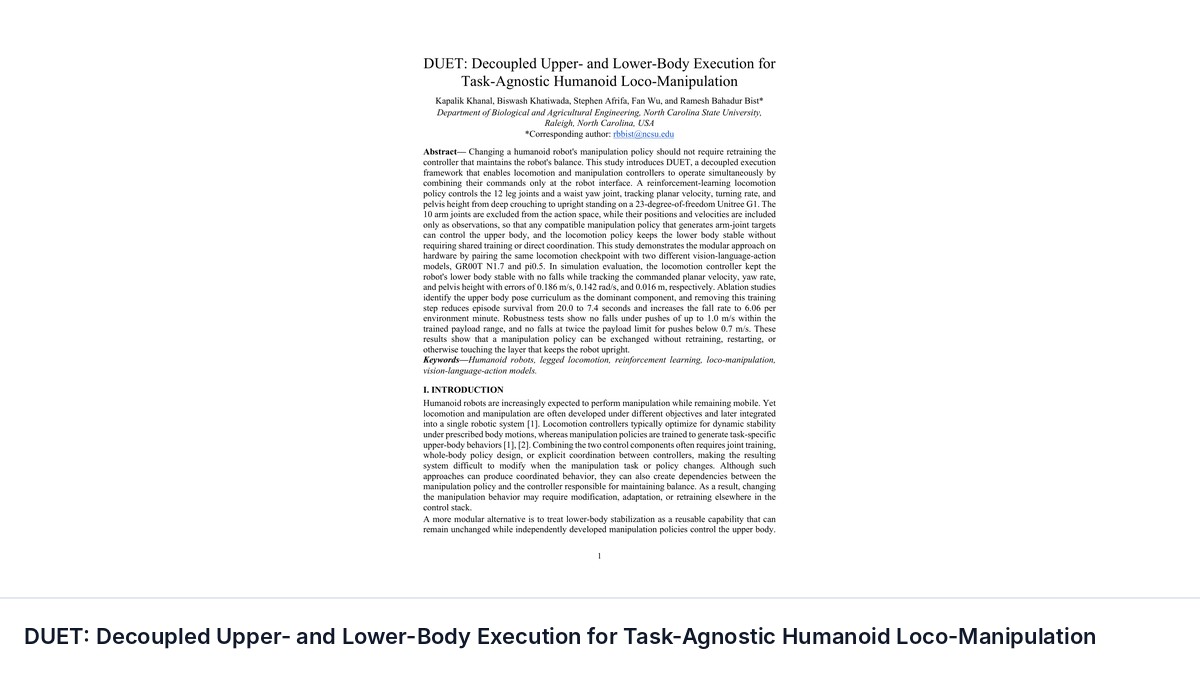
DUET: Decoupled Upper- and Lower-Body Execution for Task-Agnostic Humanoid Loco-Manipulation
Kapalik Khanal, Biswash Khatiwada, Stephen Afrifa, Fan Wu, Ramesh Bahadur Bist · N/A · 2026
Framework
N/A
License
N/A
Stars
N/A
Summary
Changing a humanoid robot's manipulation policy should not require retraining the controller that maintains the robot's balance. This study introduces DUET, a decoupled execution framework that enables locomotion and manipulation controllers to operate simultaneously by combining their commands o...
Abstract Summary
Key Points
- Changing a humanoid robot's manipulation policy should not require retraining the controller that...
- This study introduces DUET, a decoupled execution framework that enables locomotion and manipulat...
- A reinforcement-learning locomotion policy controls the 12 leg joints and a waist yaw joint, trac...
- The 10 arm joints are excluded from the action space, while their positions and velocities are in...
- This study demonstrates the modular approach on hardware by pairing the same locomotion checkpoin...
DUET: Decoupled Upper- and Lower-Body Execution for Task-Agnostic Humanoid Loco-Manipulation
|Authors: Kapalik Khanal, Biswash Khatiwada, Stephen Afrifa, Fan Wu, Ramesh Bahadur Bist
|Venue: arXiv preprint | Year: 2026
|arXiv: 2610.23872
Abstract
Changing a humanoid robot’s manipulation policy should not require retraining the controller that maintains the robot’s balance. This study introduces DUET, a decoupled execution framework that enables locomotion and manipulation controllers to operate simultaneously by combining their commands only at the robot interface. A reinforcement-learning locomotion policy controls the 12 leg joints and a waist yaw joint, tracking planar velocity, turning rate, and pelvis height from deep crouching to upright standing on a 23-degree-of-freedom Unitree G1. The 10 arm joints are excluded from the action space, while their positions and velocities are included only as observations, so that any compatible manipulation policy that generates arm-joint targets can control the upper body, and the locomotion policy keeps the lower body stable without requiring shared training or direct coordination. This study demonstrates the modular approach on hardware by pairing the same locomotion checkpoint with two different vision-language-action models, GR00T N1.7 and pi0.5. In simulation evaluation, the locomotion controller kept the robot’s lower body stable with no falls while tracking the commanded planar velocity, yaw rate, and pelvis height with errors of 0.186 m/s, 0.142 rad/s, and 0.016 m, respectively. Ablation studies identify the upper-body pose curriculum as the dominant component, and removing this training step reduces episode survival from 20.0 to 7.4 seconds and increases the fall rate to 6.06 per environment minute. Robustness tests show no falls under pushes of up to 1.0 m/s within the trained payload range, and no falls at twice the payload limit for pushes below 0.7 m/s. These results show that a manipulation policy can be exchanged without retraining, restarting, or otherwise touching the layer that keeps the robot upright.
Key Contributions
- Changing a humanoid robot’s manipulation policy should not require retraining the controller that…
- This study introduces DUET, a decoupled execution framework that enables locomotion and manipulat…
- A reinforcement-learning locomotion policy controls the 12 leg joints and a waist yaw joint, trac…
- The 10 arm joints are excluded from the action space, while their positions and velocities are in…
- This study demonstrates the modular approach on hardware by pairing the same locomotion checkpoin…
Topics
- manipulation
- locomotion
- vision
- vla
- reinforcement-learning
- control
- tactile
- benchmark
Code & Data
- GitHub repository: https://github.com/NVIDIA/Isaac-GR00T
BibTeX
@article{Khanal2026_261023872,
  title     = {DUET: Decoupled Upper- and Lower-Body Execution for Task-Agnostic Humanoid Loco-Manipulation},
  author    = {Kapalik Khanal and Biswash Khatiwada and Stephen Afrifa and Fan Wu and Ramesh Bahadur Bist},
  year      = {2026},
  eprint    = {2610.23872},
  archivePrefix = {arXiv},
  primaryClass  = {cs.RO},
  url       = {https://arxiv.org/abs/2610.23872}
}
Related Papers
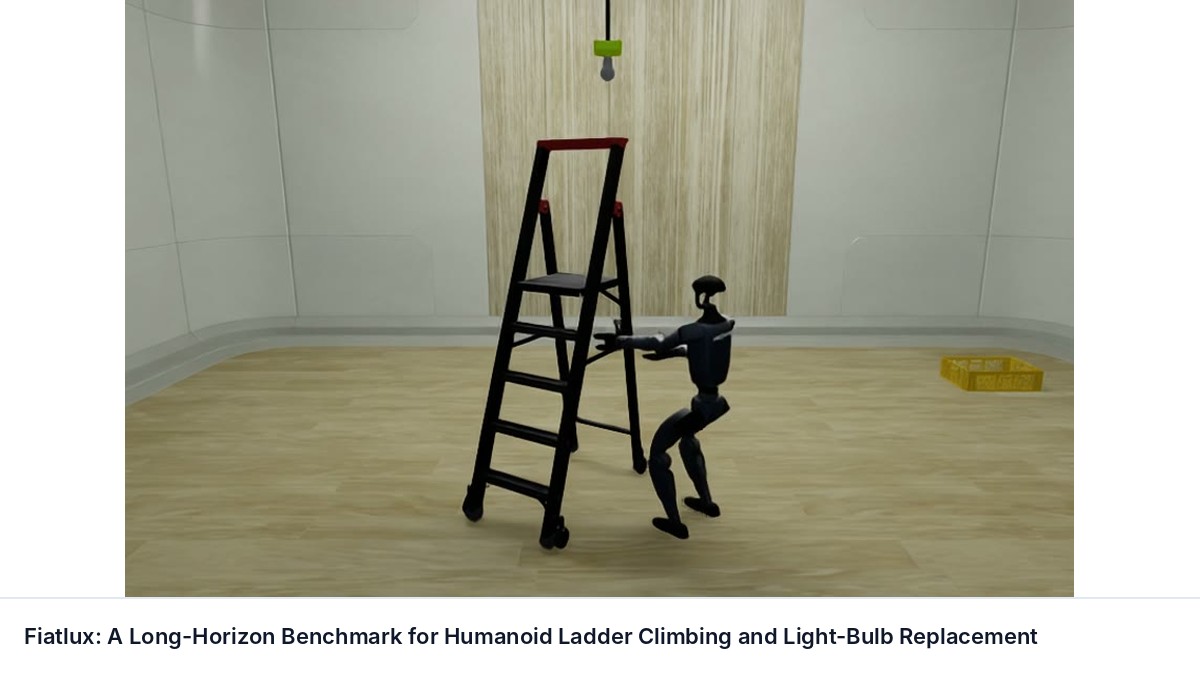
Fiatlux: A Long-Horizon Benchmark for Humanoid Ladder Climbing and Light-Bulb Replacement
Pavel Bushuyeu, Yujin Chen, Anton Nikolaev et al.
Existing benchmarks evaluate tabletop manipulation, flat-floor household activity, or humanoid locomotion and manipulation as separate task groups; none scores vertical mobility and dexterous work on a fragile payload in one long-horizon episode. We present Fiatlux, a light-bulb replacement bench...
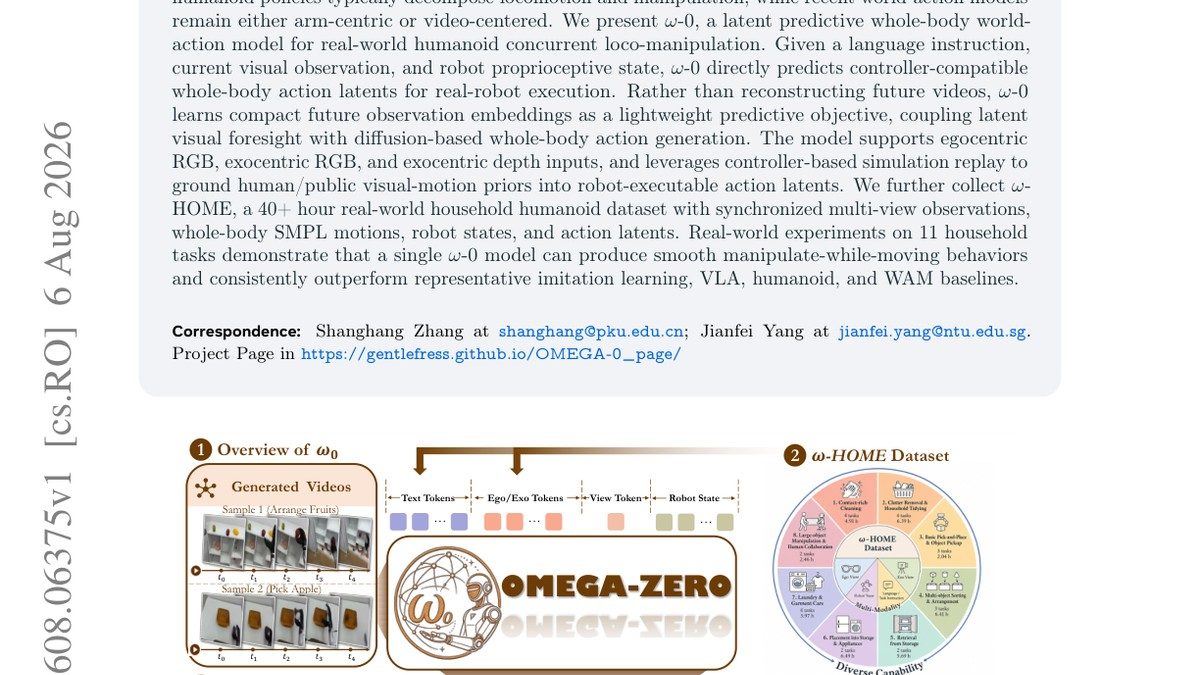
$ω$-0: A Latent Predictive World Action Model for Concurrent Humanoid Loco-Manipulation
Zhe Li, Zhenzhe Zhang, Yangyang Wei et al.
Humanoid household tasks often require concurrent loco-manipulation, where the robot must move, adjust posture, maintain balance, and manipulate objects as a single coordinated behavior. Yet existing humanoid policies typically decompose locomotion and manipulation, while recent world-action mode...
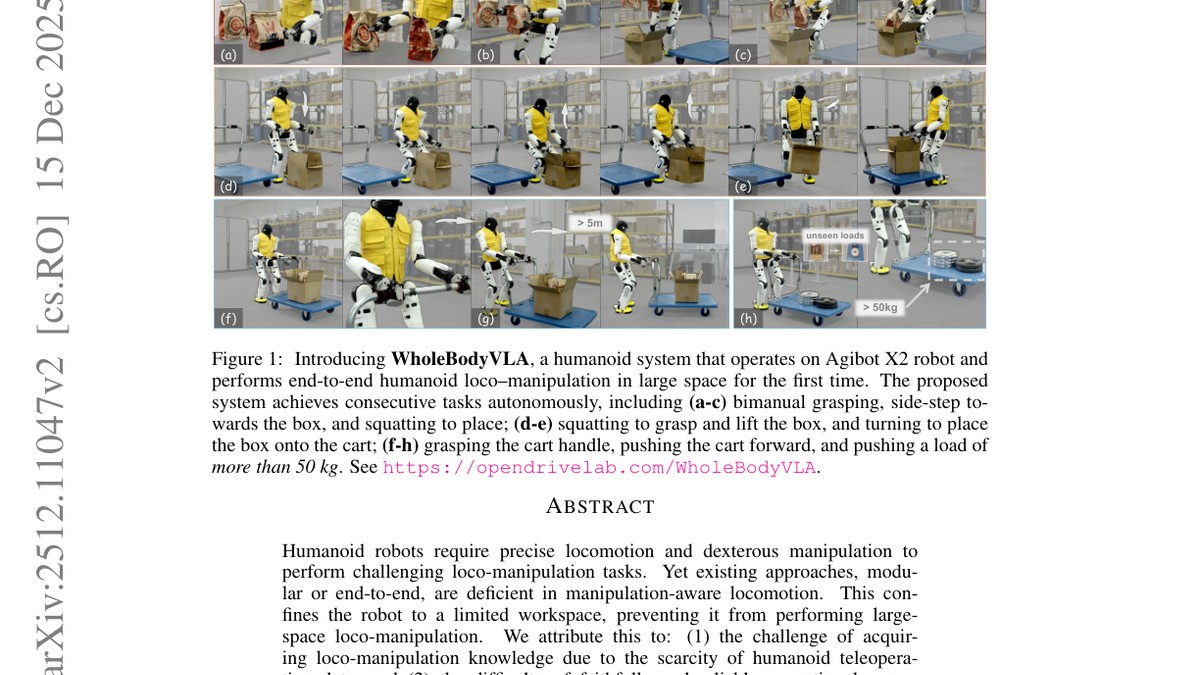
WholeBodyVLA: Towards Unified Latent VLA for Whole-Body Loco-Manipulation Control
Haoran Jiang, Jin Chen, Qingwen Bu et al.
Humanoid robots require precise locomotion and dexterous manipulation to perform challenging loco-manipulation tasks. Yet existing approaches, modular or end-to-end, are deficient in manipulation-aware locomotion. This confines the robot to a limited workspace, preventing it from performing large...

A Sim-to-Real Integration Pipeline for Training and Deployment of Chunk-Based VLA Manipulation Policies
Mathilde Kappel, Clémence Grislain, Mohamed Chetouani et al.
Vision-Language-Action (VLA) models have become a prominent paradigm for mapping multimodal inputs, including semantic instructions, visual observations of the scene, and proprioceptive observations, to robot actions. Most state-of-the-art models predict actions in the end-effector pose space as ...