
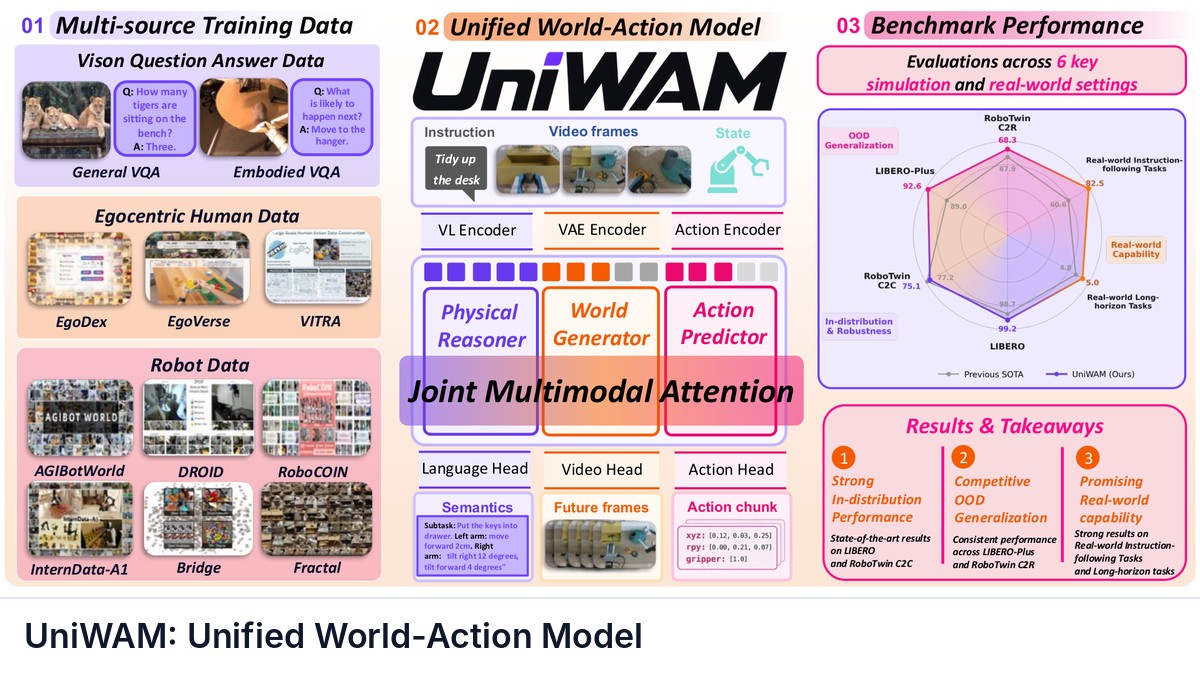
UniWAM: Unified World-Action Model
Jiayi Chen, Wenxuan Song, Jingbo Wang, Shuai Zhou, Xicheng Gong, Zehua Fan, Ziyang Zhou, Junwu E, Haodong Yan, Fuhao Li, Qize Yu, Xu Huang, Pengwei Wang, Wen Chen, Shunbo Zhou, Haoang Li · N/A · 2026
Framework
N/A
License
N/A
Stars
N/A
Summary
Vision-language-action models benefit from the understanding and reasoning capabilities of pretrained vision-language models, but action-only supervision provides limited grounding in world dynamics.
Abstract Summary
Key Points
- Vision-language-action models benefit from the understanding and reasoning capabilities of pretrained vision-language models, but action-only supervision provides limited grounding in world dynamics.
- Conversely, world-action models inherit spatiotemporal priors from video generation models, yet remain limited in semantic understanding and reasoning under distribution shifts.
- We introduce UniWAM, a unified architecture that integrates a physical reasoner, a world generator, and an action predictor to jointly learn semantic understanding of the physical world, visual generation, and action prediction.
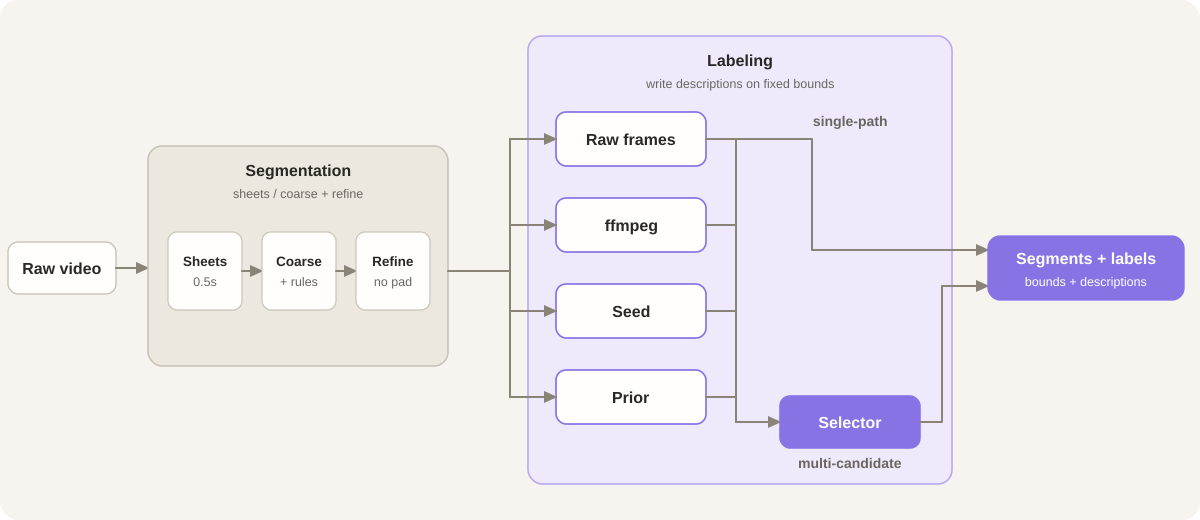
- To ensure the quality of the training data, we developed a rigorous data cleaning and annotation pipeline for both human egocentric data and robot data.
- To adapt the vision-language component to embodied tasks while preserving its inherited language capabilities, we represent low-level actions in natural language and introduce a pre-training recipe that assigns complementary supervision from visual question answering (VQA) data, human egocentric data, and robot demonstrations to the appropriate model components.
Data
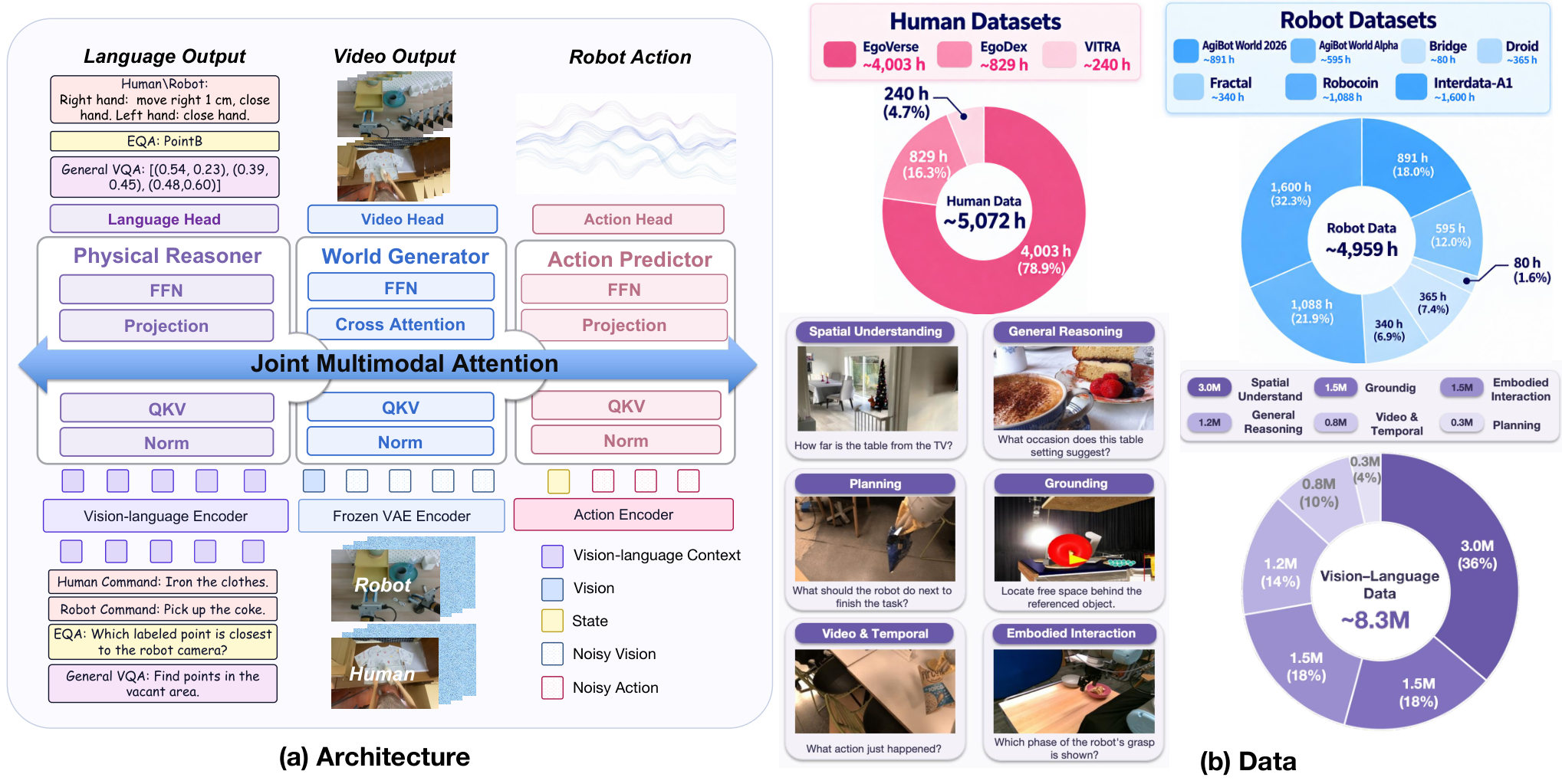
Our robot pretraining data combine AgiBotWorld2026 ( AgiBot World Team, 2026 ) , Bridge ( Walke et al., 2023 ) , Droid ( Khazatsky et al., 2024 ) , Fractal ( Brohan et al., 2023 ) , Robocoin ( Wu et al., 2025 ) , and Interdata-a1 ( Tian et al., 2025 ) , covering single-arm and dual-arm embodiments. The selected data total approximately 4,363 hours, with a per-source breakdown in Table 1 .
We also apply language-action supervision to these robot data, using descriptions of local manipulation behavior.
Method
As shown in Figure 3 , UniWAM unifies semantic understanding, language modeling, visual generation, and action prediction in a Mixture-of-Transformers (MoT) architecture ( Liang et al., 2025 ) , i.e., physical reasoner, world generator, and action predictor. They exchange information through joint attention.
Experiments
We design our experiments to answer the following questions: (Q1) Can our UniWAM successfully perform manipulation tasks under in-domain conditions, complex perturbations, and OOD conditions, respectively? ( Section 5.1 ) (Q2) Does the unified design of UniWAM improve instruction following and long-horizon manipulation in the real world? ( ) (Q3) Does our unified model scale effectively with data?
( Section 5.3 ) (Q4) How does our physical language shape the learned representations and enable strong generalization? ( Section 5.3 ) (Q5) How impo...
Sources and Demonstrations
Figures are reproduced from Chen et al. See the full paper for experimental details and the project page, when the paper links one, for demonstrations and videos.
Related Papers

A Sim-to-Real Integration Pipeline for Training and Deployment of Chunk-Based VLA Manipulation Policies
Mathilde Kappel, Clémence Grislain, Mohamed Chetouani et al.
Vision-Language-Action (VLA) models have become a prominent paradigm for mapping multimodal inputs, including semantic instructions, visual observations of the scene, and proprioceptive observations, to robot actions.
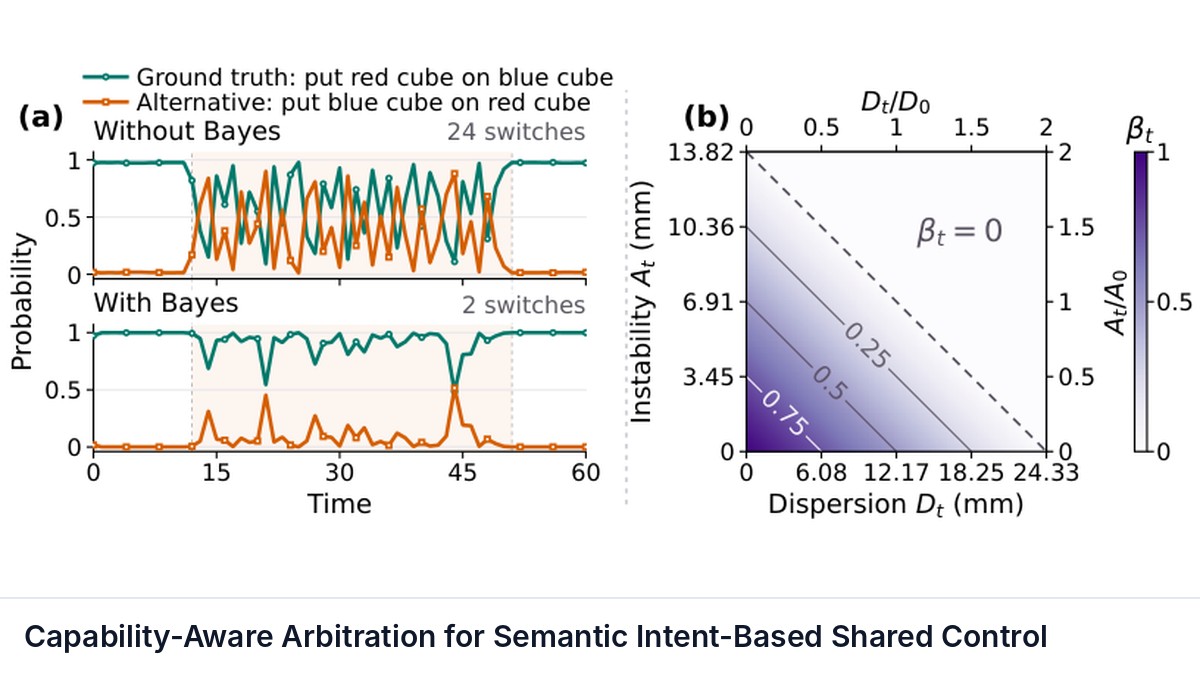
Capability-Aware Arbitration for Semantic Intent-Based Shared Control
Zhaoda Du, Michael Bowman, Xiaoli Zhang
Shared control often allocates robot authority based on confidence in inferred human intent, assuming reliable autonomous execution. When this assumption fails, high intent confidence can cause over-helping.
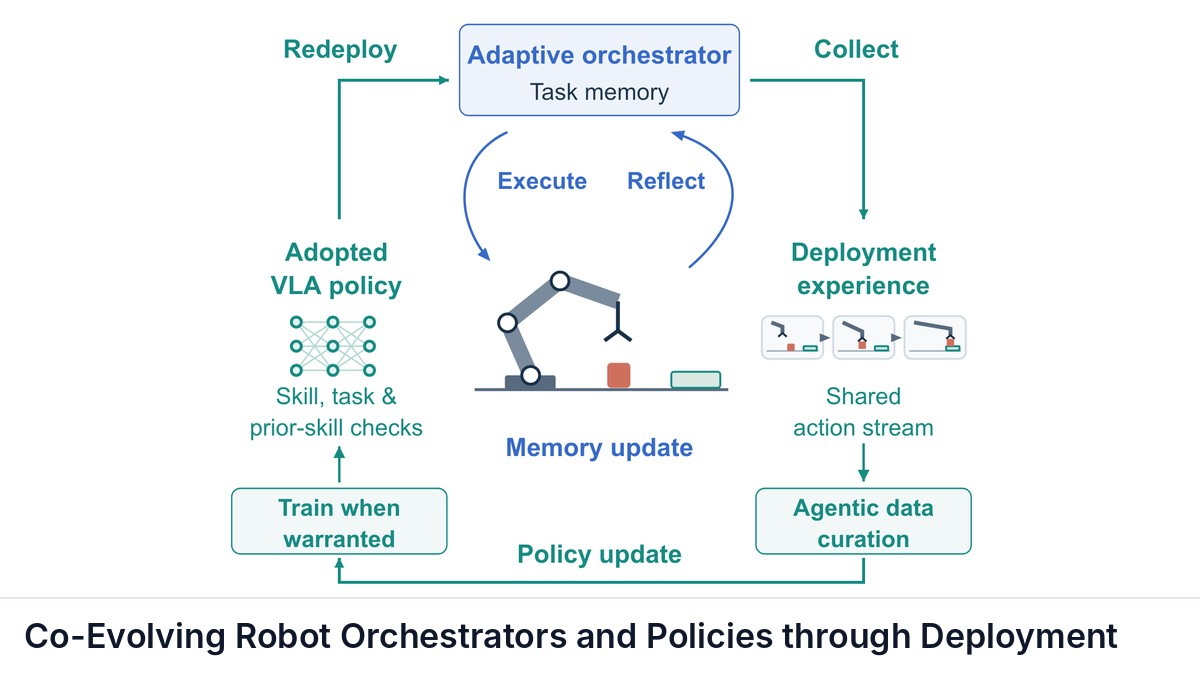
Co-Evolving Robot Orchestrators and Policies through Deployment
Xilun Zhang, Maggie Wang, Erik Bauer et al.
Vision-language-action (VLA) policies trained on large datasets are capable within their training domains, yet they still fail to generalize to the variety of situations a robot meets in real-world deployment.
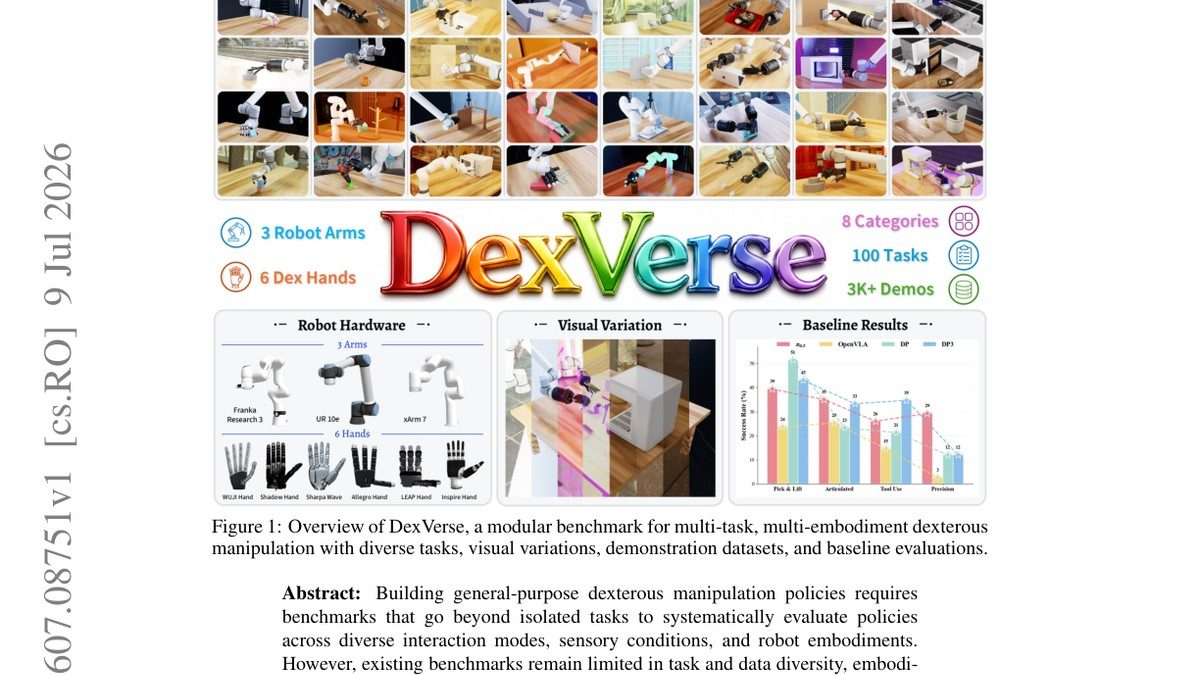
DexVerse: A Modular Benchmark for Multi-Task, Multi-Embodiment Dexterous Manipulation
Yunchao Yao, Zhuxiu Xu, Tianqi Zhang et al.
Building general-purpose dexterous manipulation policies requires benchmarks that go beyond isolated tasks to systematically evaluate policies across diverse interaction modes, sensory conditions, and robot embodiments.