
HaWMPO: Hallucination-Aware World Model-based Policy Optimization for Generalist Robot Policy
Zengjue Chen, Peidong Liu, Jiawei Li, Qi Wang · N/A · 2026
Framework
N/A
License
N/A
Stars
N/A
Summary
Generalist robot policies have demonstrated strong generalization across robotic manipulation tasks, yet their success rates remain limited in com- plex long-horizon scenarios.
Abstract Summary
Key Points
- Generalist robot policies have demonstrated strong generalization across robotic manipulation tasks, yet their success rates remain limited in com- plex long-horizon scenarios.
- Recent methods improve Visual-Language-Action (VLA) policies through online reinforcement learning on real robots, but such training relies on costly physical interactions, suffers from low sample efficiency, and may introduce hardware and safety risks.
- World models offer a promising alternative by enabling policy optimization with imagined rollouts
- However, long-horizon rollouts generated by world models often suffer from prediction hal- lucinations, producing biased state transitions that can mislead policy learning.
- To address this issue, we propose Hallucination-aware World Model-based Pol- icy Optimization (HaWMPO), a closed-loop reinforcement learning pipeline for VLA policy post-training with world models.
Methodology
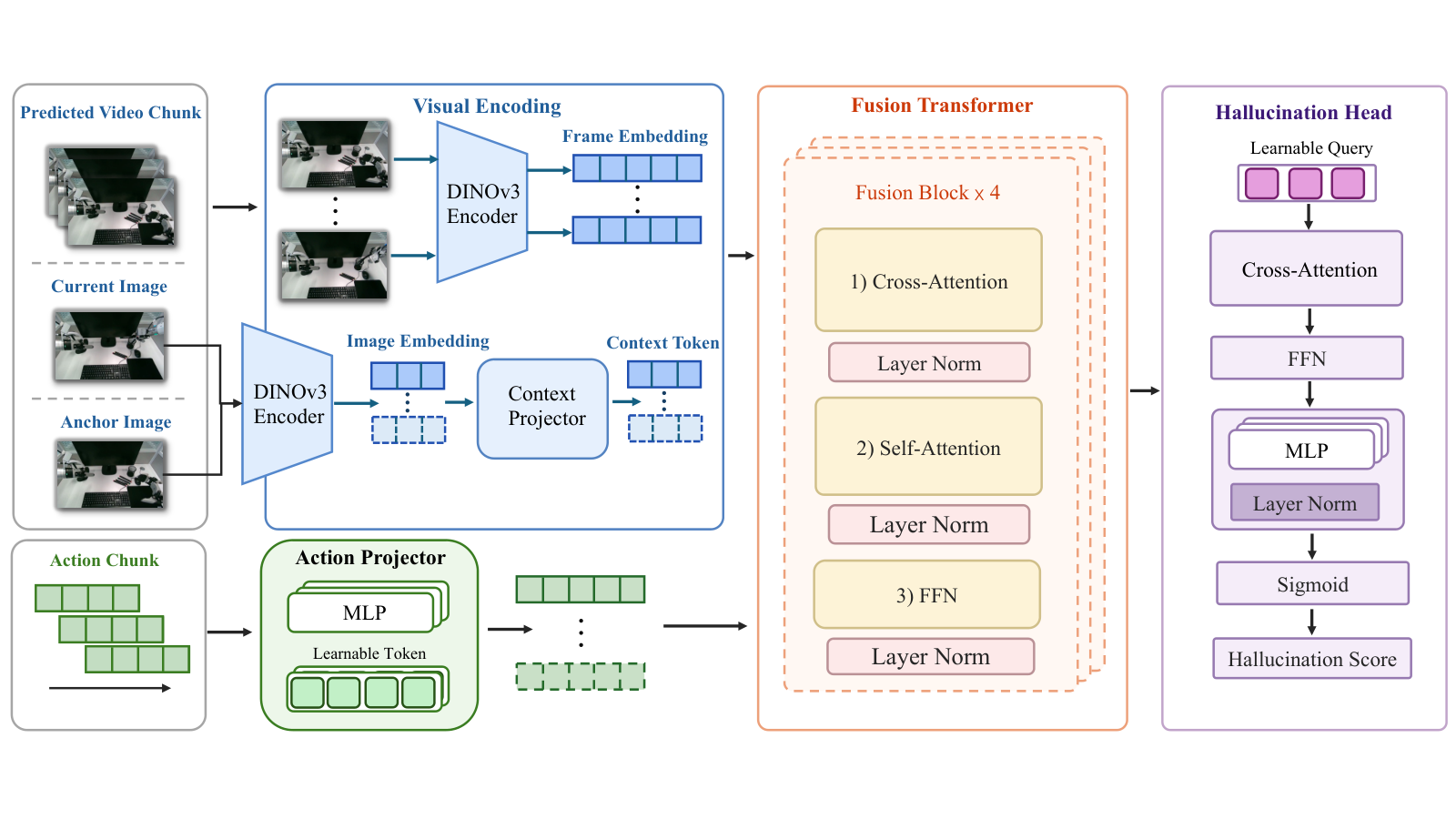
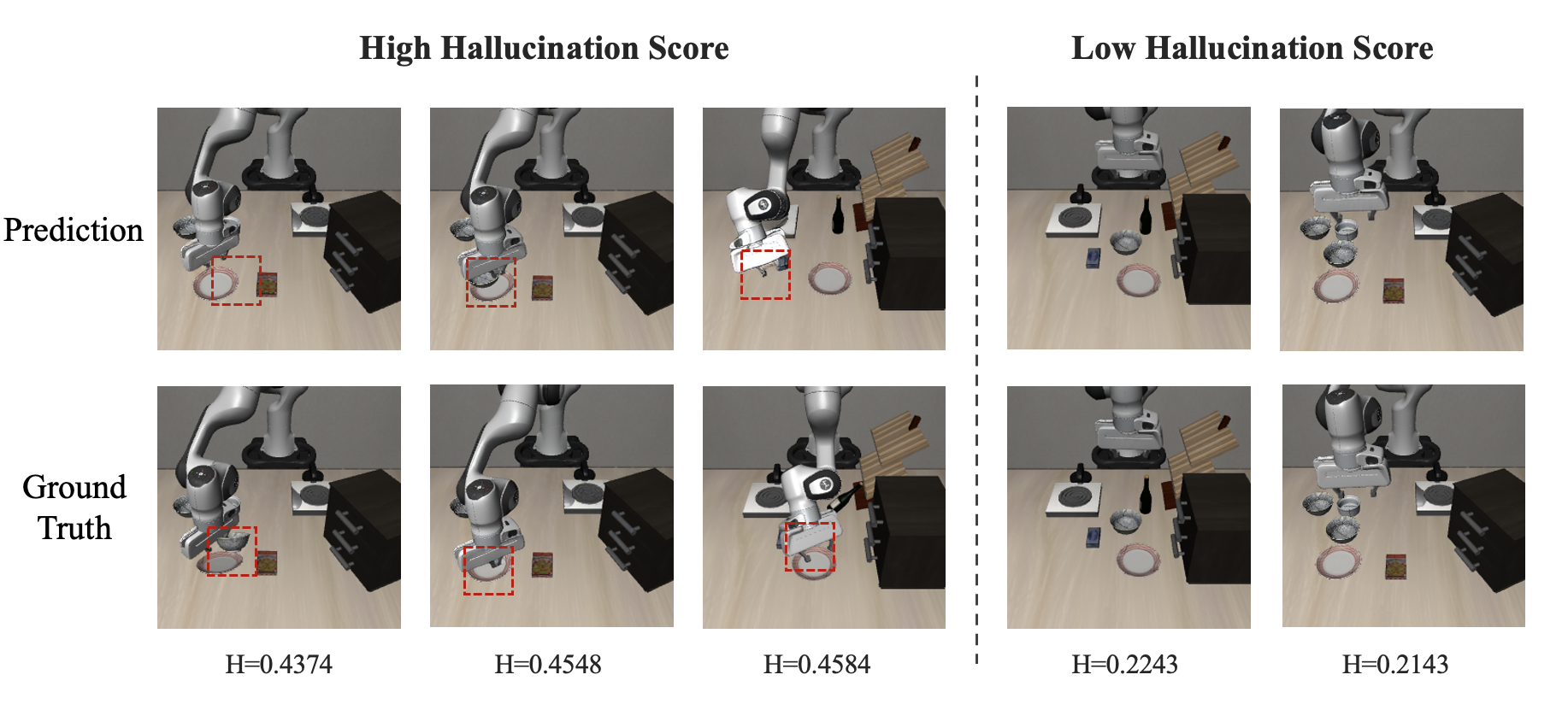
World-model prediction errors can accumulate during imagined rollouts and introduce misleading signals into VLA policy optimization. We introduce an action-conditioned Hallucination-Aware Model (HAM) to estimate the reliability of each generated video chunk.
HAM takes an eight-frame predicted chunk $\hat{\mathbf{V}}_{c}$, its conditioning actions $\mathbf{a}_{c}$, the current observation $I_{c}$, and an anchor image $I_{0}$ as inputs. Here, $I_{0}$ is the initial observation of the rollout, providing a fixed visual reference.
Experiments
In this experiment, we follow the experimental setup of prior work and adopt OpenVLA-OFT as the base model. Before reinforcement learning, the base model is first supervised fine-tuned using a one-shot SFT setting, where only one expert trajectory is used for each task to obtain an initial policy.
To ensure a fair comparison with existing methods, we continue to use the LIBERO simulation benchmark as the primary evaluation environment.
Sources and Demonstrations
Figures are reproduced from Chen et al. See the full paper for experimental details and the project page, when the paper links one, for demonstrations and videos.
Related Papers

A Sim-to-Real Integration Pipeline for Training and Deployment of Chunk-Based VLA Manipulation Policies
Mathilde Kappel, Clémence Grislain, Mohamed Chetouani et al.
Vision-Language-Action (VLA) models have become a prominent paradigm for mapping multimodal inputs, including semantic instructions, visual observations of the scene, and proprioceptive observations, to robot actions.
Beyond Reconstruction: What Matters in Action Tokenization for Robot Policies?
Haoran Chen, Jingtian Ji, Samuel Wheeler et al.
Autoregressive action-token policies such as vision-language-action models require action tokenizers to translate discrete token sequences into precise control actions in continuous space. Many action tokenizers learn the mapping between tokens and actions via a reconstruction objective.
Capability-Aware Arbitration for Semantic Intent-Based Shared Control
Zhaoda Du, Michael Bowman, Xiaoli Zhang
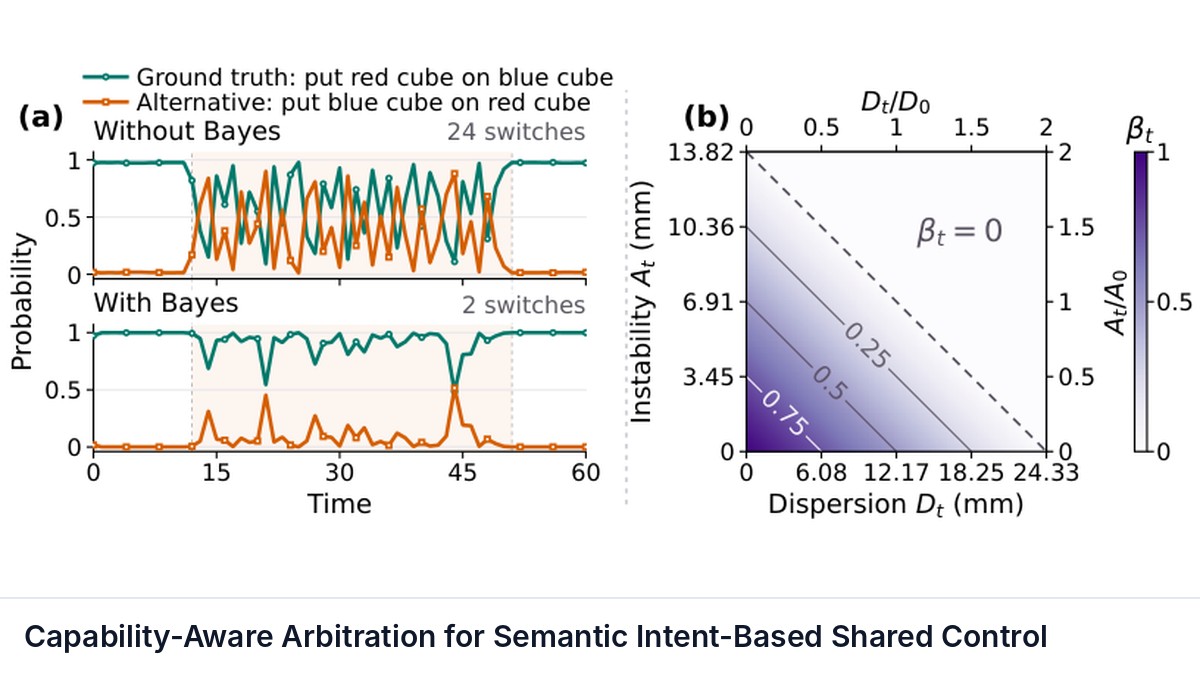
Shared control often allocates robot authority based on confidence in inferred human intent, assuming reliable autonomous execution. When this assumption fails, high intent confidence can cause over-helping.
Causal Analysis of Robot Foundation Models Enables Efficiency Gains
Aiden Swann, Mathilde Papillon, Mozes Jacobs et al.
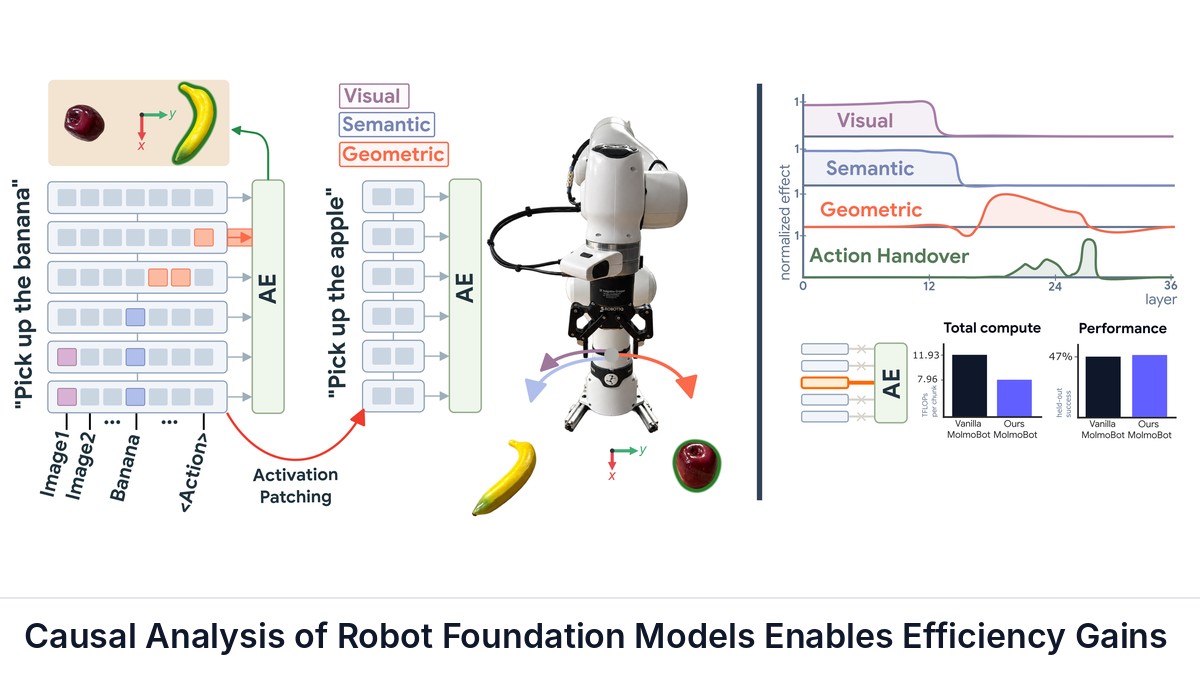
Vision-language-action (VLA) models are a promising approach to general purpose robot manipulation.