
When Listening Becomes Easier: Scrubbing Visual Cues for Shortcut-Free VLAs
Jasper Gerigk, Kenzo Aspuru-Takata, Chin-Hsuan Wu, Mohammad Mohammadi, Shuhong Zheng, Igor Gilitschenski · N/A · 2026
Framework
N/A
License
N/A
Stars
N/A
Summary
Shortcut learning is a prevalent issue in robot learning. The limited diversity of robot demonstration datasets can mislead policies into exploiting spurious correlations between tasks and irrelevant features, such as viewpoint or background.
Abstract Summary
Key Points
- Shortcut learning is a prevalent issue in robot learning
- The limited diversity of robot demonstration datasets can mislead policies into exploiting spurious correlations between tasks and irrelevant features, such as viewpoint or background.
- Collecting sufficiently diverse robot demonstrations is costly and inefficient, motivating algorithmic alternatives.
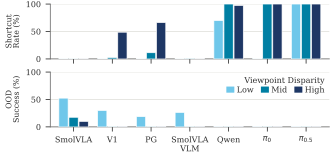
- We focus on vision-language-action (VLA) models and discover that different vision-language model backbones exhibit substantially different levels of susceptibility to visual shortcut learning.
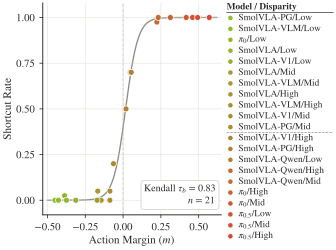
- We find that model behavior correlates with our proposed representation-level metric, action margin, which requires no policy rollouts.
Problem Formulation and Analysis
We first establish a formal definition of visual shortcut learning. Let $T$ denote the task specified by language, $U$ denote the task-relevant visual information needed to execute the task, $Z$ denote a task-irrelevant visual cue, and $A$ denote the desired action. The complete visual observation is $X=(U,Z)$.
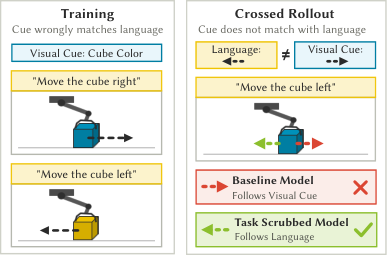
In the training distribution, task and cue identity are statistically dependent such that $I_{\mathrm{train}}(T;Z)>0.$ In our case, shortcut learning refers to cases where the learned policy mistakenly relies on $Z$ rather than $T$.
Task Scrubbing
Task scrubbing is a training-time intervention that makes visually encoded task identity less stable and thus less convenient for the model to exploit during policy training. As summarized in Figure 5 , it attaches an adversarial task classifier to the visual pathway: the classifier learns to recover task identity, while the visual pathway learns to frustrate that classifier.
Because the resulting visual representations continually change, they provide the policy with a less stable signal for task identity.
Results
We evaluate task scrubbing on three separate experimental setups ( Figure 6 ), involving three types of visual shortcut. Returning to the setup from Section III-B , we evaluate task scrubbing on the high-disparity LIBERO [ 22 ] setting, where the two viewpoints differ by the largest rotation and the visual shortcut is the strongest.
We compare the baseline policy with task scrubbing and report mean and sample standard deviations across three seeds. Each seed uses 40 rollouts for each of the four task–viewpoint configurations.
Sources and Demonstrations
Figures are reproduced from Gerigk et al. See the full paper for experimental details and the project page, when the paper links one, for demonstrations and videos.
Related Papers

A Sim-to-Real Integration Pipeline for Training and Deployment of Chunk-Based VLA Manipulation Policies
Mathilde Kappel, Clémence Grislain, Mohamed Chetouani et al.
Vision-Language-Action (VLA) models have become a prominent paradigm for mapping multimodal inputs, including semantic instructions, visual observations of the scene, and proprioceptive observations, to robot actions.
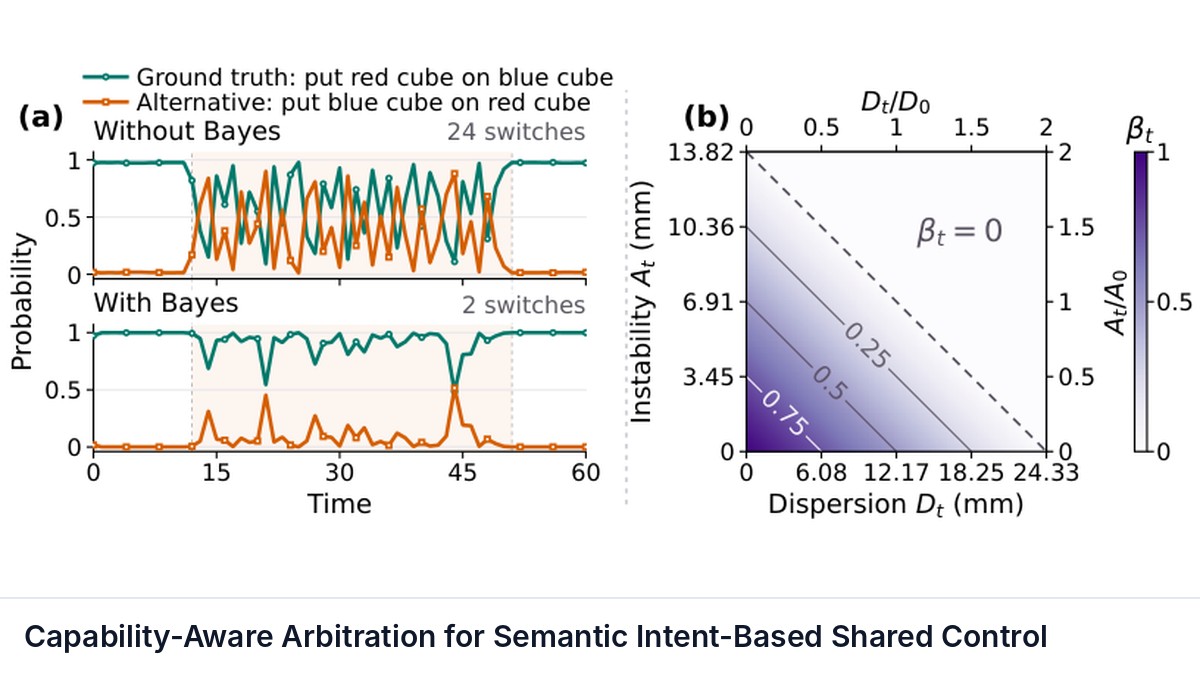
Capability-Aware Arbitration for Semantic Intent-Based Shared Control
Zhaoda Du, Michael Bowman, Xiaoli Zhang
Shared control often allocates robot authority based on confidence in inferred human intent, assuming reliable autonomous execution. When this assumption fails, high intent confidence can cause over-helping.
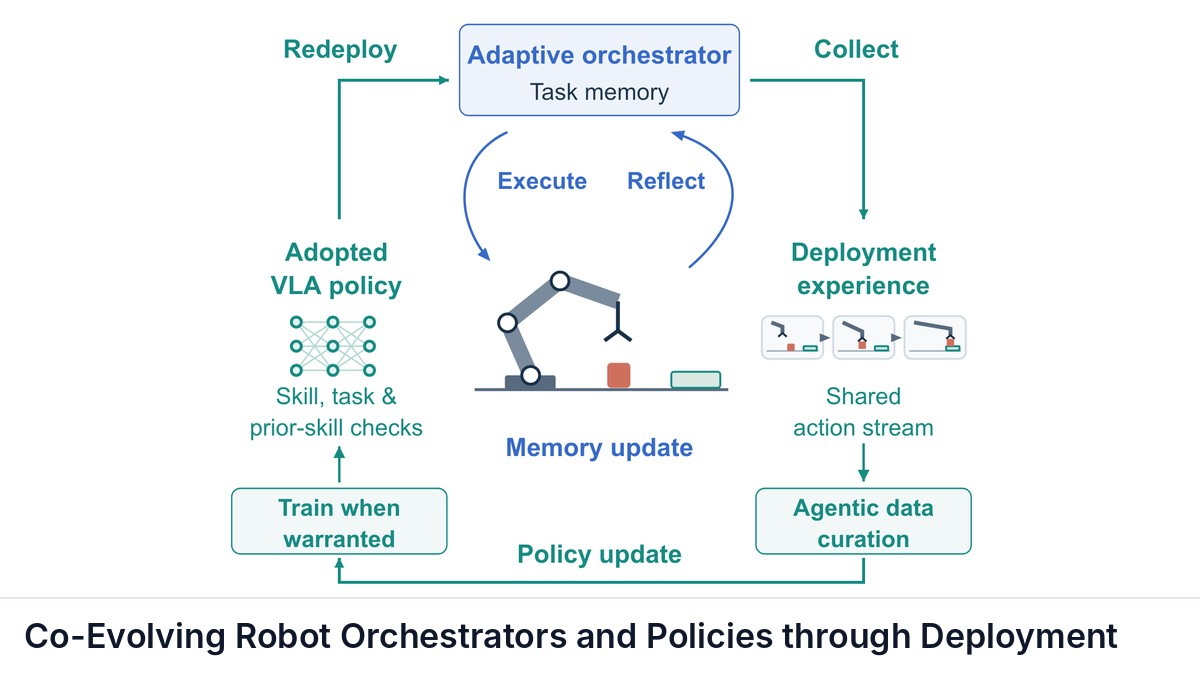
Co-Evolving Robot Orchestrators and Policies through Deployment
Xilun Zhang, Maggie Wang, Erik Bauer et al.
Vision-language-action (VLA) policies trained on large datasets are capable within their training domains, yet they still fail to generalize to the variety of situations a robot meets in real-world deployment.
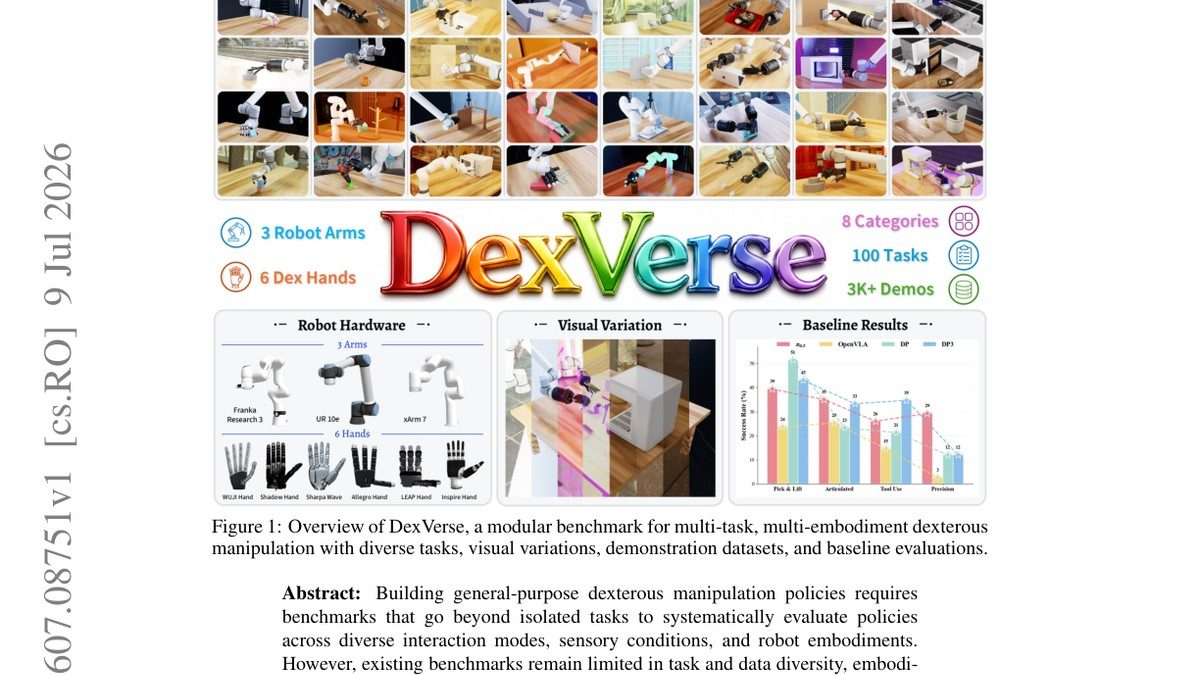
DexVerse: A Modular Benchmark for Multi-Task, Multi-Embodiment Dexterous Manipulation
Yunchao Yao, Zhuxiu Xu, Tianqi Zhang et al.
Building general-purpose dexterous manipulation policies requires benchmarks that go beyond isolated tasks to systematically evaluate policies across diverse interaction modes, sensory conditions, and robot embodiments.