
OCC4M: Object-Centric 4D Memory for Spatiotemporal Reasoning in Long-Horizon Manipulation
Jack B. Jedlicki, Tanguy Dieudonn\'e, Heng Yang · N/A · 2026
Framework
N/A
License
N/A
Stars
N/A
Summary
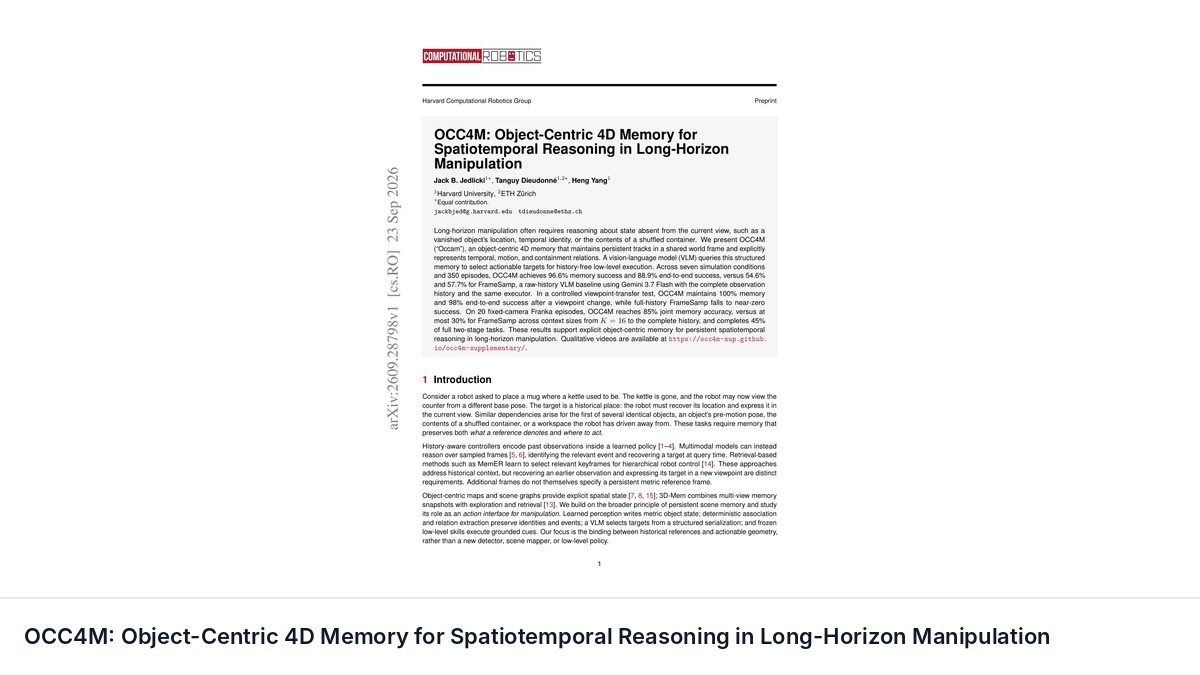
Long-horizon manipulation often requires reasoning about state absent from the current view, such as a vanished object's location, temporal identity, or the contents of a shuffled container.
Abstract Summary
Key Points
- Long-horizon manipulation often requires reasoning about state absent from the current view, such as a vanished object's location, temporal identity, or the contents of a shuffled container.
- We present OCC4M ("Occam"), an object-centric 4D memory that maintains persistent tracks in a shared world frame and explicitly represents temporal, motion, and containment relations.
- A vision-language model (VLM) queries this structured memory to select actionable targets for history-free low-level execution.
- Across seven simulation conditions and 350 episodes, OCC4M achieves 96.6% memory success and 88.9% end-to-end success, versus 54.6% and 57.7% for FrameSamp, a raw-history VLM baseline using Gemini 3.7 Flash with the complete observation history and the same executor.
- In a controlled viewpoint-transfer test, OCC4M maintains 100% memory and 98% end-to-end success after a viewpoint change, while full-history FrameSamp falls to near-zero success.
Method
Perception and geometry SAM 3 detections + calibration Object-centric 4D memory World tracks, times, motion, containment Memory-based target selection Goal + JSON object history One skill-sequence prediction Current-view grounding Reproject target + frozen VLA skills Classical base control updates JSON state selected targets live location new observations Figure 1: Persistent memory as an action interface.
Perception and calibration update object tracks in a shared frame.

Experiments
We evaluate a single-arm mobile Panda in ManiSkill3 [ 10 ] , using egocentric shoulder and wrist RGB cameras. Each episode has a scripted observation phase followed by a manipulation query requiring historical information. We evaluate seven conditions spanning six task families (Table 1 ) on the same $N=50$ evaluation seeds.
Each observation phase is recorded once and replayed to every method, providing identical RGB histories and goals; the same recorded camera poses are used for geometric conversion.

Results
Across the seven conditions, OCC4M achieves 96.6% memory success and 88.9% end-to-end success, compared with 54.6% and 57.7% for FrameSamp given the full $K=32$ observation history (Table 2 ). The raw-history baseline is competitive when the relevant state can be recovered directly from the recorded observations: it reaches 100% memory success on T1 and T5 and 80% on T2.

Sources and Demonstrations
Figures are reproduced from Jedlicki et al. See the full paper for experimental details and the project page, when the paper links one, for demonstrations and videos.
Related Papers
A Phenomenology of Neural Geometry in Vision-Language-Action Models
Mozes Jacobs, Aiden Swann, Mathilde Papillon et al.
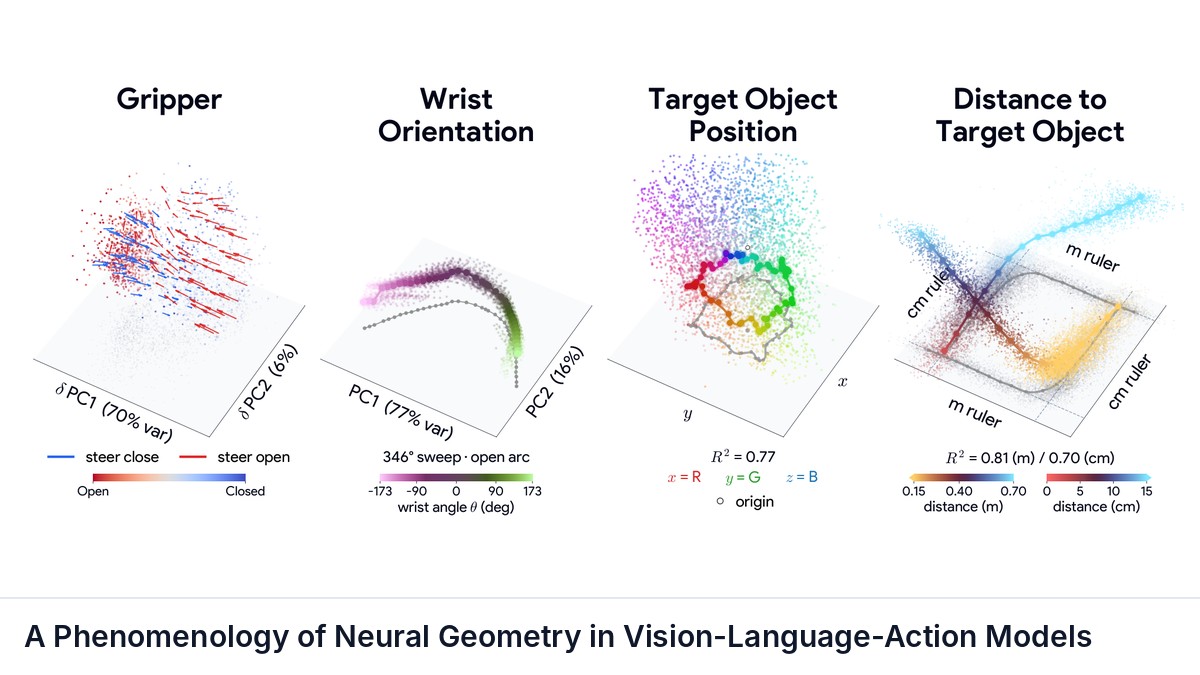
Robotic manipulation is inherently geometric, but what shape does the world take inside the policy that performs it?

A Sim-to-Real Integration Pipeline for Training and Deployment of Chunk-Based VLA Manipulation Policies
Mathilde Kappel, Clémence Grislain, Mohamed Chetouani et al.
Vision-Language-Action (VLA) models have become a prominent paradigm for mapping multimodal inputs, including semantic instructions, visual observations of the scene, and proprioceptive observations, to robot actions.
Beyond Reconstruction: What Matters in Action Tokenization for Robot Policies?
Haoran Chen, Jingtian Ji, Samuel Wheeler et al.
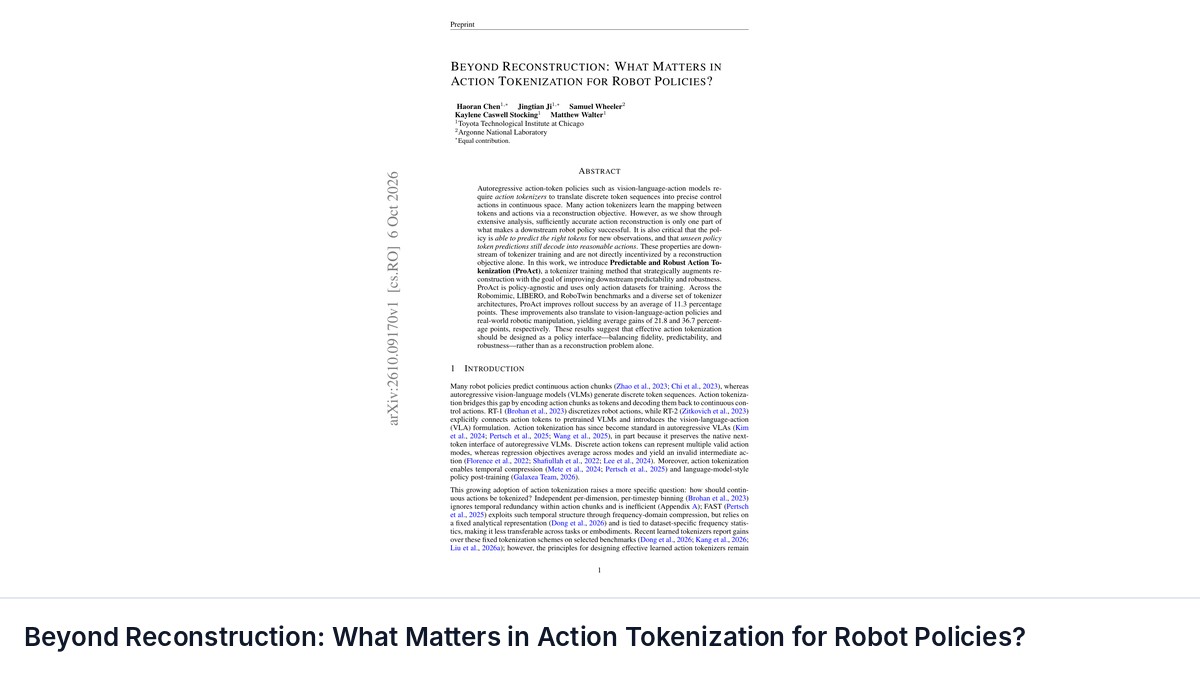
Autoregressive action-token policies such as vision-language-action models require action tokenizers to translate discrete token sequences into precise control actions in continuous space. Many action tokenizers learn the mapping between tokens and actions via a reconstruction objective.

Capability-Aware Arbitration for Semantic Intent-Based Shared Control
Zhaoda Du, Michael Bowman, Xiaoli Zhang
Shared control often allocates robot authority based on confidence in inferred human intent, assuming reliable autonomous execution. When this assumption fails, high intent confidence can cause over-helping.