
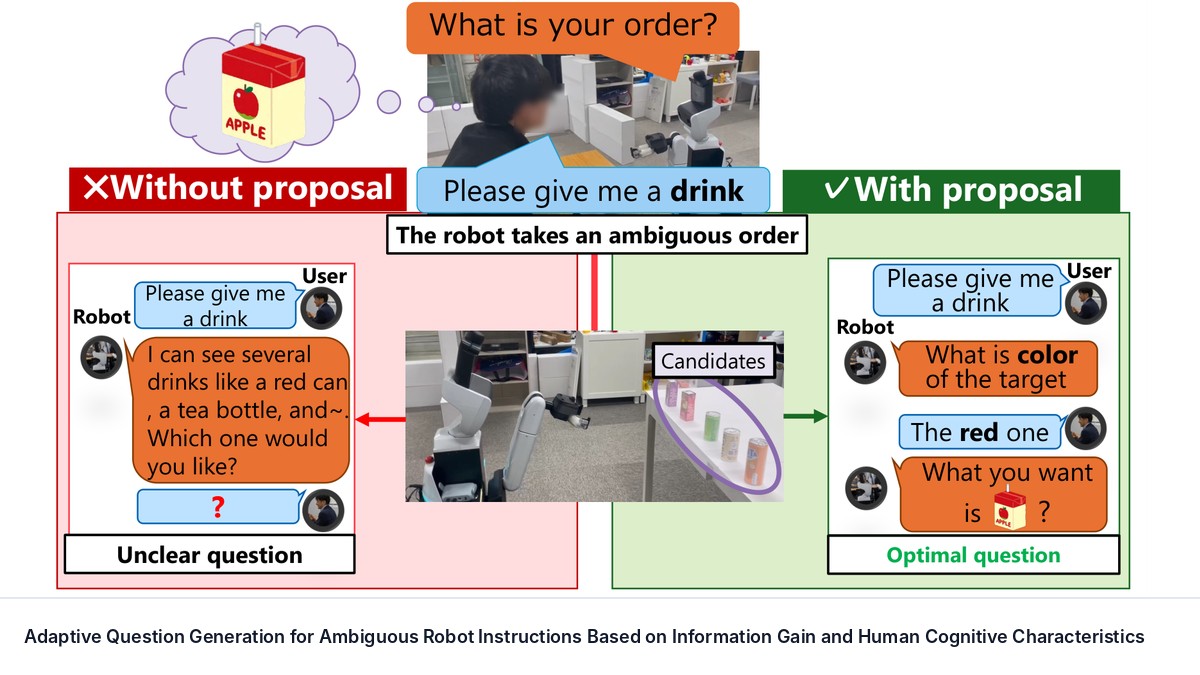
Adaptive Question Generation for Ambiguous Robot Instructions Based on Information Gain and Human Cognitive Characteristics
Ryo Terashima, Yuga Yano, Hakaru Tamukoh · N/A · 2026
Framework
N/A
License
N/A
Stars
N/A
Summary
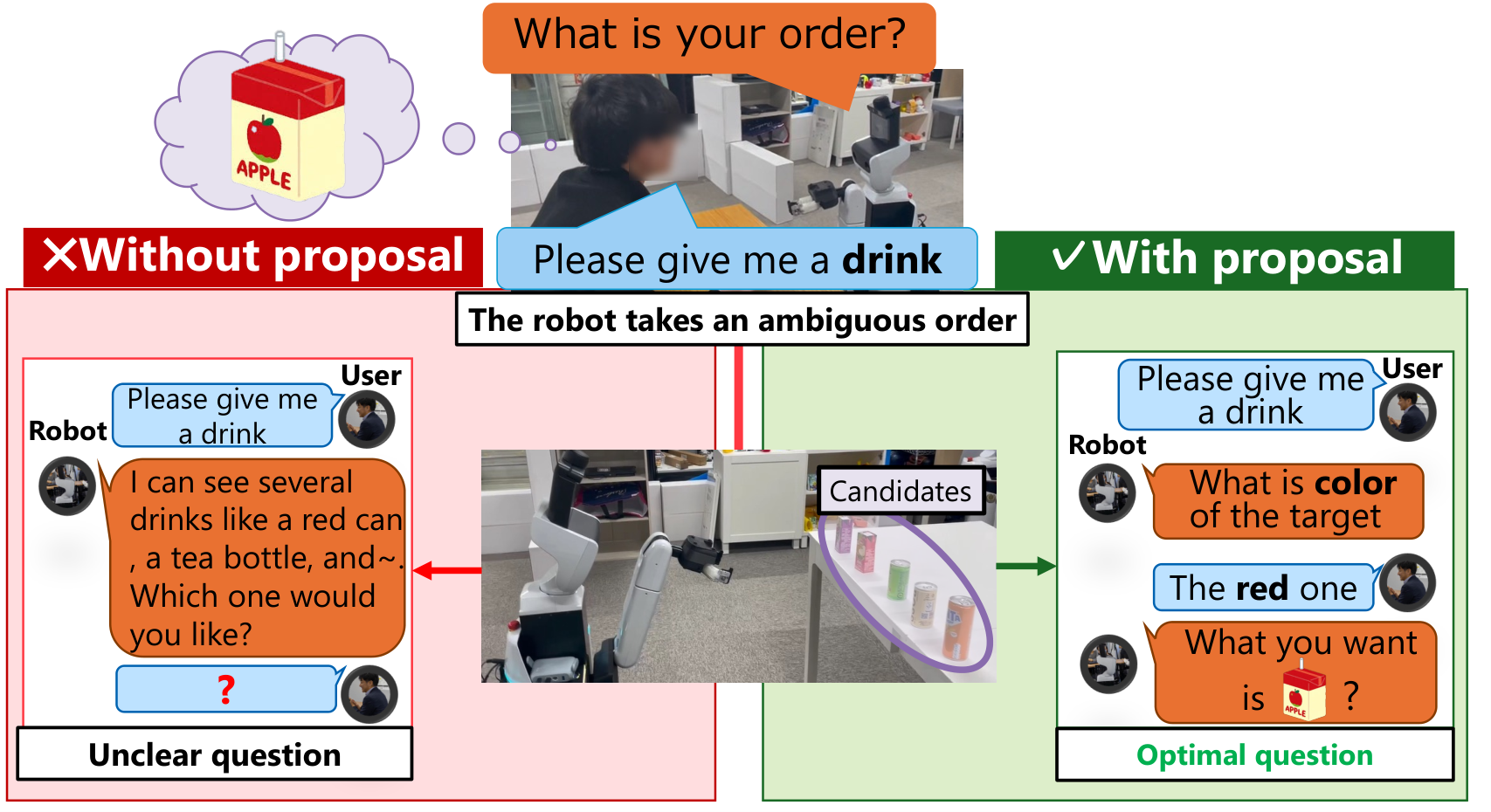
In this study, we propose an adaptive question generation mechanism that addresses uncertainty arising from ambiguous instructions. Natural-language instructions for service robots often contain ambiguities.
Abstract Summary
Key Points
- In this study, we propose an adaptive question generation mechanism that addresses uncertainty arising from ambiguous instructions.
- Natural-language instructions for service robots often contain ambiguities
- In scenes with multiple similar objects, the robot must identify the target object by asking questions.
- However, existing question generation methods focus on probabilistic discrimination efficiency and do not sufficiently account for user ease of response.
- Asking questions without considering the user's ease of response may cause incorrect or uncertain answers.
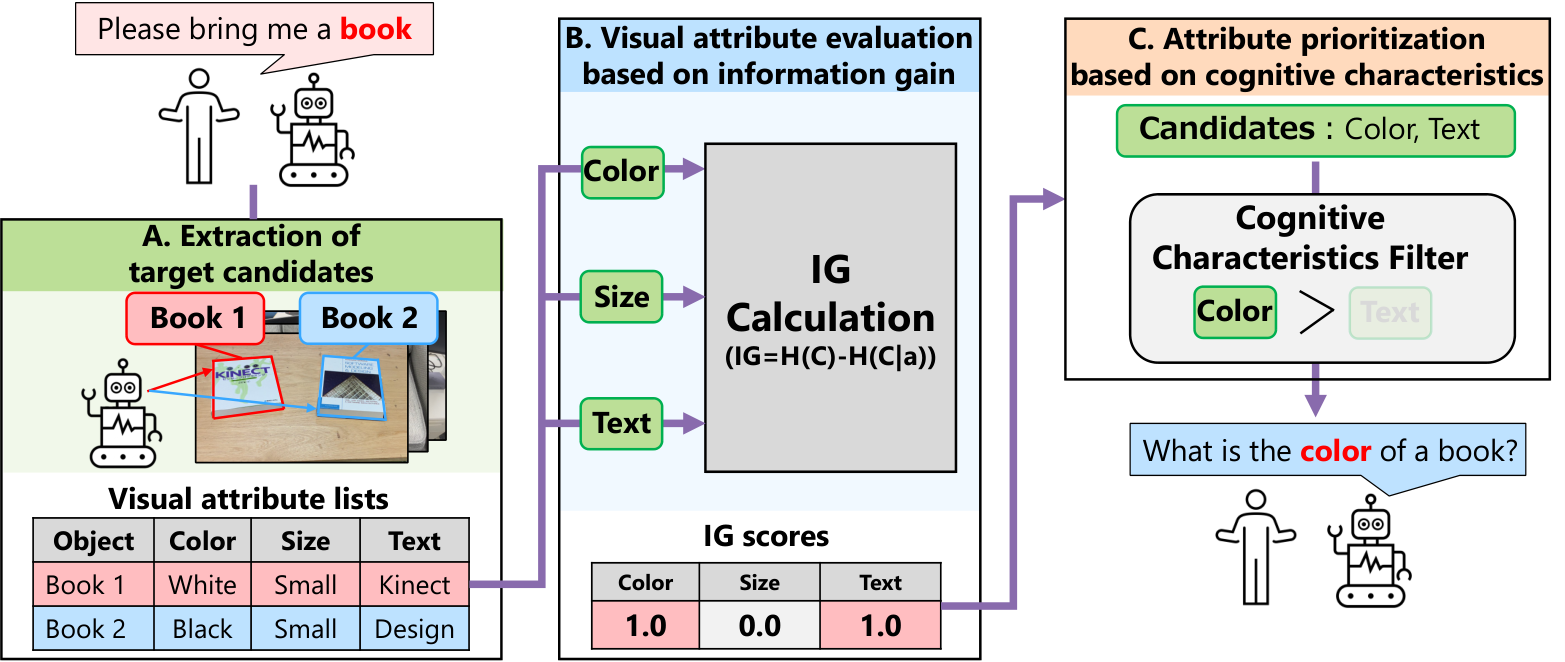
PROPOSAL
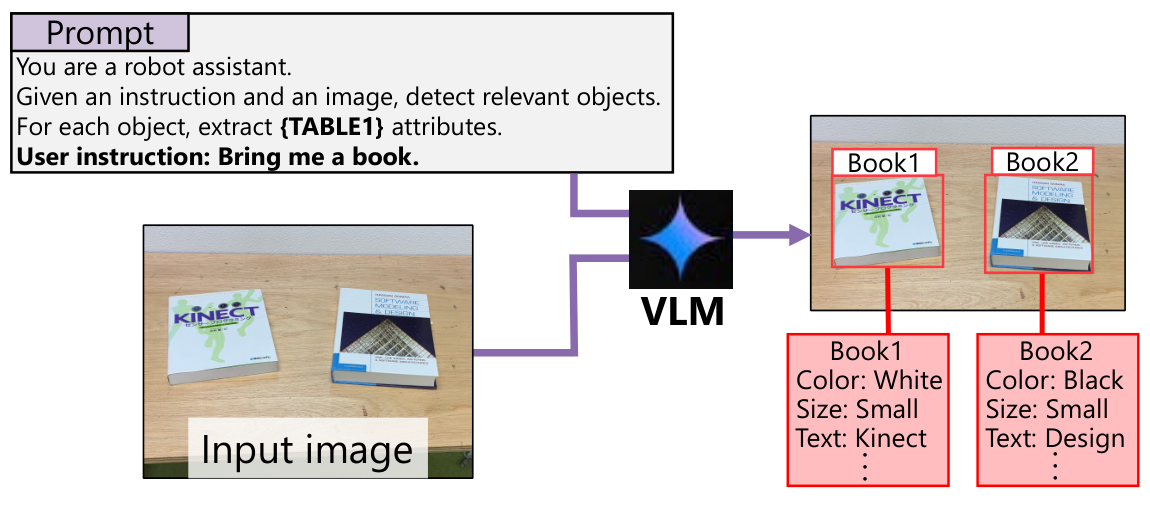
The proposed mechanism aims to uniquely identify the target object through conversation in response to ambiguous object search instructions, given only the target category. In this section, we define the visual attributes used in the proposed mechanism, then describe the details of each component. Visual attributes are features extracted from the appearance of objects that distinguish among candidate objects.
EXPERIMENTAL SETTINGS
This section describes the experimental setup for evaluating the effectiveness of the proposed adaptive question generation mechanism. We demonstrate the effectiveness of the proposed mechanism from two perspectives, assuming ambiguous natural language instructions: (1) the efficiency of ambiguity resolution through dialogue, and (2) the ease of response to questions for users.
We conducted large-scale user experiments targeting a broad range of general users through crowd-sourcing.
EXPERIMENTAL RESULTS
Attributes that users can intuitively recall are considered to enable prompt responses when asked about them. Therefore, we use the questionnaire’s ranking as an indicator of ease of response. Table II shows the mean rank of each visual attribute computed from the questionnaire responses. Overall, Text and Color ranked highly across many categories. This ordering is consistent with prior accounts of saliency.
Perceptually salient features such as color and text are recalled preferentially [ 16 , 19 ] .
Sources and Demonstrations
Figures are reproduced from Terashima et al. See the full paper for experimental details and the project page, when the paper links one, for demonstrations and videos.
Related Papers

A Sim-to-Real Integration Pipeline for Training and Deployment of Chunk-Based VLA Manipulation Policies
Mathilde Kappel, Clémence Grislain, Mohamed Chetouani et al.
Vision-Language-Action (VLA) models have become a prominent paradigm for mapping multimodal inputs, including semantic instructions, visual observations of the scene, and proprioceptive observations, to robot actions.
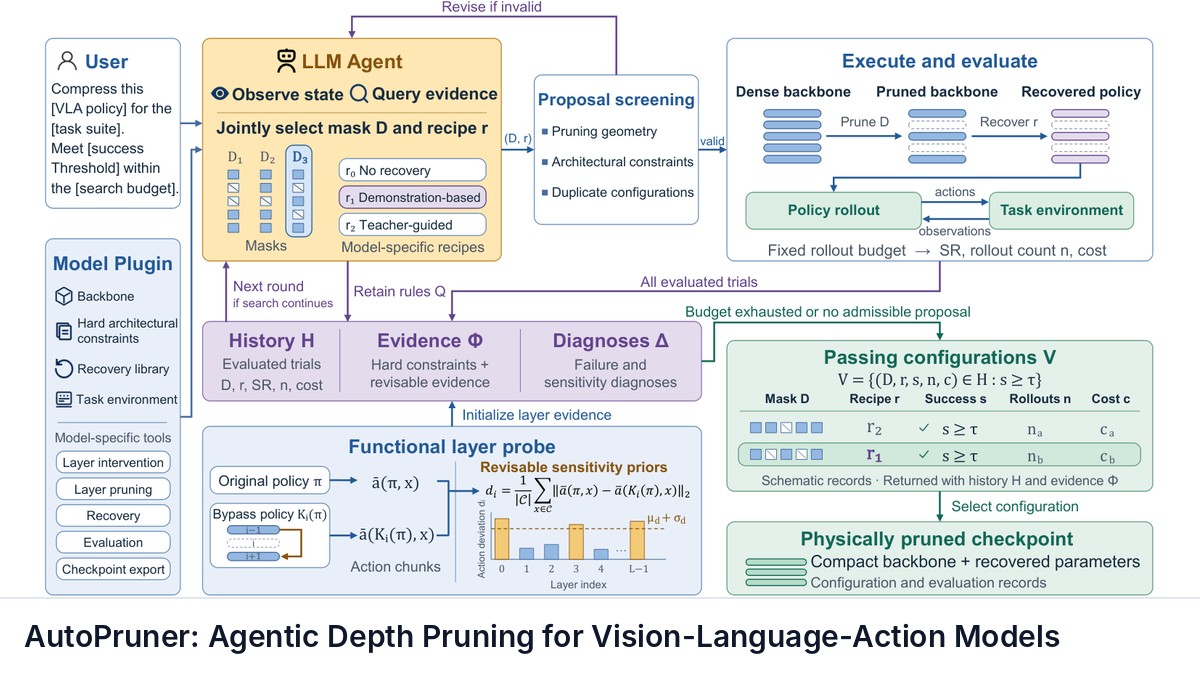
AutoPruner: Agentic Depth Pruning for Vision-Language-Action Models
Tao Lin, Yikeng Chen, Qiwei Liang et al.
Layer pruning reduces the size and inference cost of vision-language-action (VLA) models, but selecting a deployable configuration requires deciding both which layers to remove and how to recover task performance.

AXIS: A Growable Community-Driven Data Engine for Scalable Robot Manipulation
Mengfei Zhao, Dihong Huang, Yikai Tang et al.
Learning effective robot manipulation policies requires diverse, high-quality demonstrations, yet existing data pipelines are often difficult to scale because they rely on specialized hardware, centralized operators, or fixed task suites.
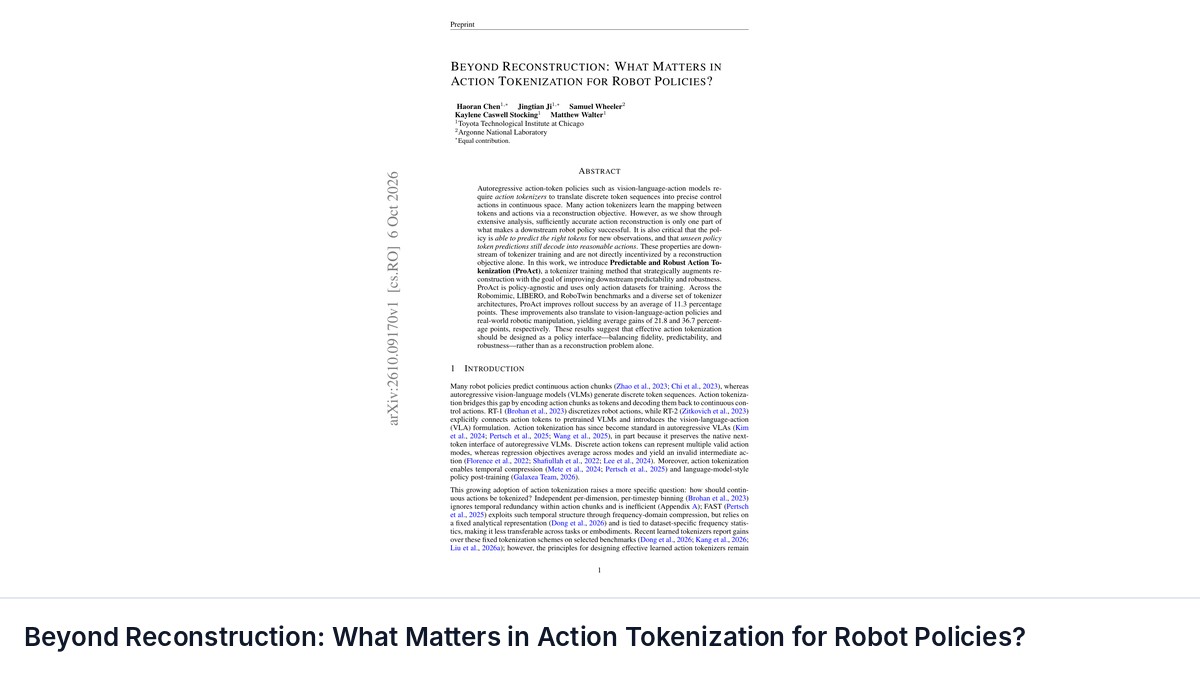
Beyond Reconstruction: What Matters in Action Tokenization for Robot Policies?
Haoran Chen, Jingtian Ji, Samuel Wheeler et al.
Autoregressive action-token policies such as vision-language-action models require action tokenizers to translate discrete token sequences into precise control actions in continuous space. Many action tokenizers learn the mapping between tokens and actions via a reconstruction objective.