
AutoPruner: Agentic Depth Pruning for Vision-Language-Action Models
Tao Lin, Yikeng Chen, Qiwei Liang, Zinan Xie, Zhengtu Liang, Renjing Xu · N/A · 2026
Framework
N/A
License
N/A
Stars
N/A
Summary
Layer pruning reduces the size and inference cost of vision-language-action (VLA) models, but selecting a deployable configuration requires deciding both which layers to remove and how to recover task performance.
Abstract Summary
Key Points
- Layer pruning reduces the size and inference cost of vision-language-action (VLA) models, but selecting a deployable configuration requires deciding both which layers to remove and how to recover task performance.
- These decisions depend on the model and task, and a failed trial can reflect either the deletion set or insufficient recovery.
- We present AutoPruner, an agent-driven framework that jointly searches pruning structures and recovery recipes through closed-loop experimentation.
- Offline layer interventions measure changes in action output to provide functional evidence
- An LLM agent combines this evidence with evaluation history and retained diagnoses to propose deletion sets and recovery recipes within a search budget.
Method
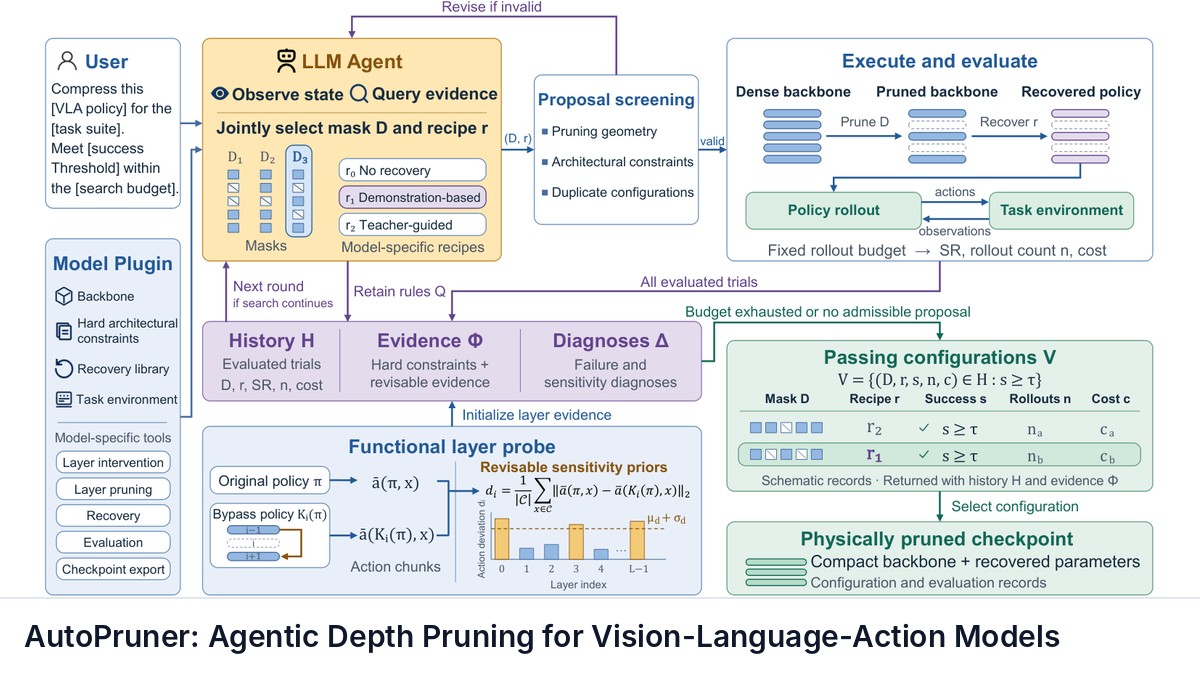
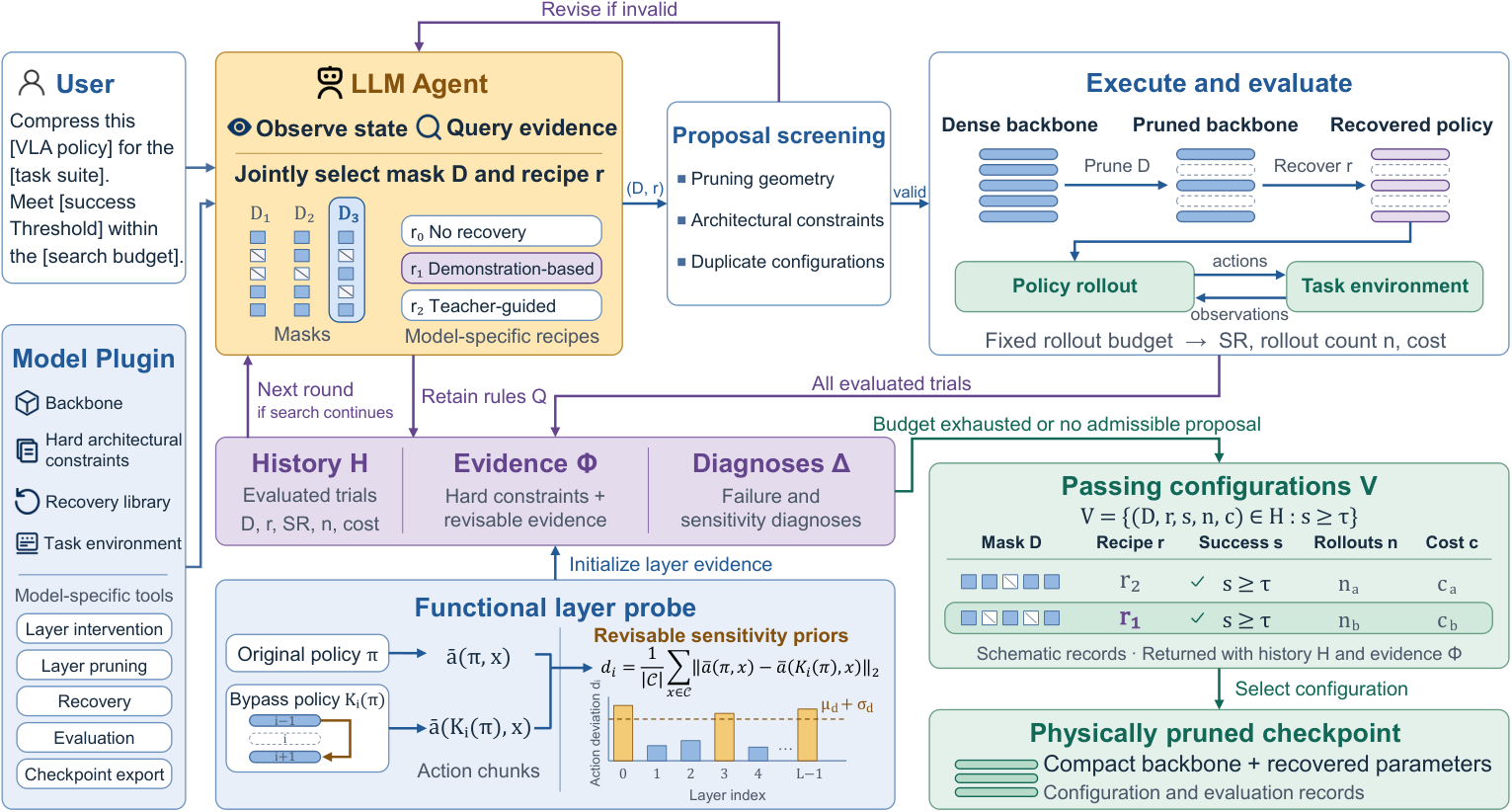
As shown in Figure 2 , AutoPruner closes the pruning and recovery loop with an LLM agent. The LLM agent acts as the proposal controller, selecting the next deletion set and recovery recipe from the accumulated evidence and recovery library. Tools prune, recover, and evaluate each policy. Feedback guides subsequent proposals toward deeper pruning under a success threshold and a round budget.
For a VLA policy $\pi$ with $L$ backbone layers, a deletion set $D\subseteq\{0,\ldots,L-1\}$ produces the pruned policy $\pi_{D}$.
Experiments
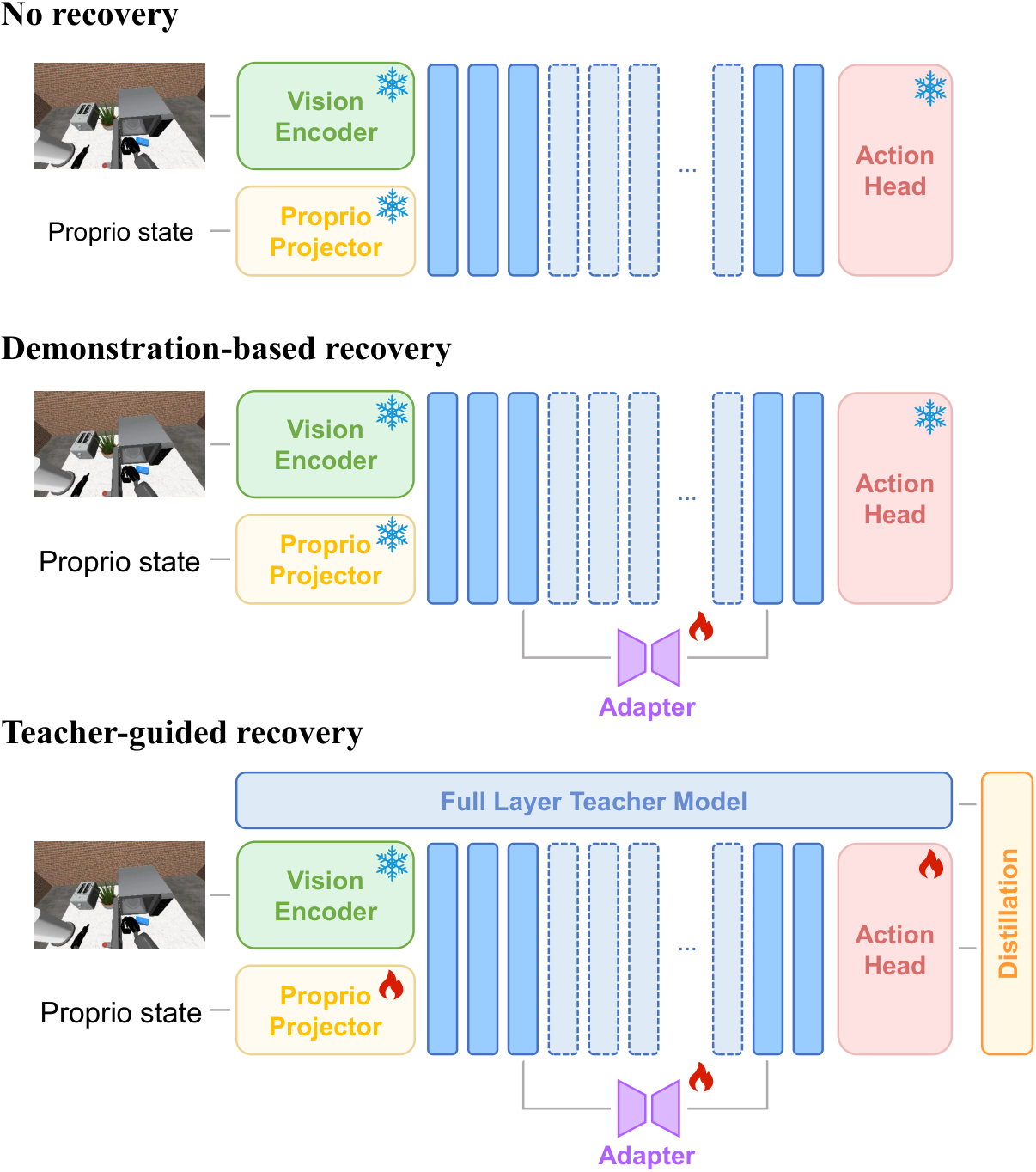
We evaluate pruning and recovery on OpenVLA-OFT [ 9 ] , StarVLA [ 3 ] , and FastWAM [ 10 ] across the Object, Spatial, Goal, and Long suites of LIBERO [ 35 ] . Each model–suite pair is a deployment with its dense policy as the reference. Recorded OpenVLA-OFT agent runs span 4–6 proposal rounds, with GPT-5.5 using evaluation feedback to revise pruning and recovery configurations.
The Object case study evaluates four proposals over 200 episodes each (800 total).
Analysis
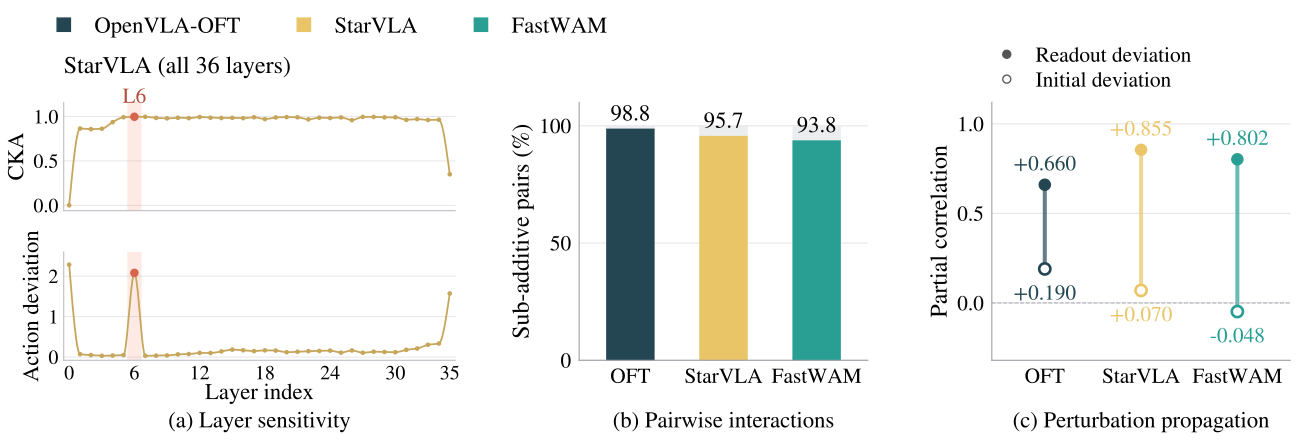
Figure 4 (a) shows how high representation similarity can conceal action-sensitive layers. StarVLA L6 has adjacent-layer CKA of 0.9986 yet produces a large action deviation when bypassed. CKA ranks it first for deletion, which reduces task success below 90%. FastWAM L0 likewise remains action-sensitive at CKA 0.9995.
By measuring action changes directly, functional probes identify sensitive layers that appear redundant under CKA.
Sources and Demonstrations
Figures are reproduced from Lin et al. See the full paper for experimental details and the project page, when the paper links one, for demonstrations and videos.
Related Papers

A Sim-to-Real Integration Pipeline for Training and Deployment of Chunk-Based VLA Manipulation Policies
Mathilde Kappel, Clémence Grislain, Mohamed Chetouani et al.
Vision-Language-Action (VLA) models have become a prominent paradigm for mapping multimodal inputs, including semantic instructions, visual observations of the scene, and proprioceptive observations, to robot actions.
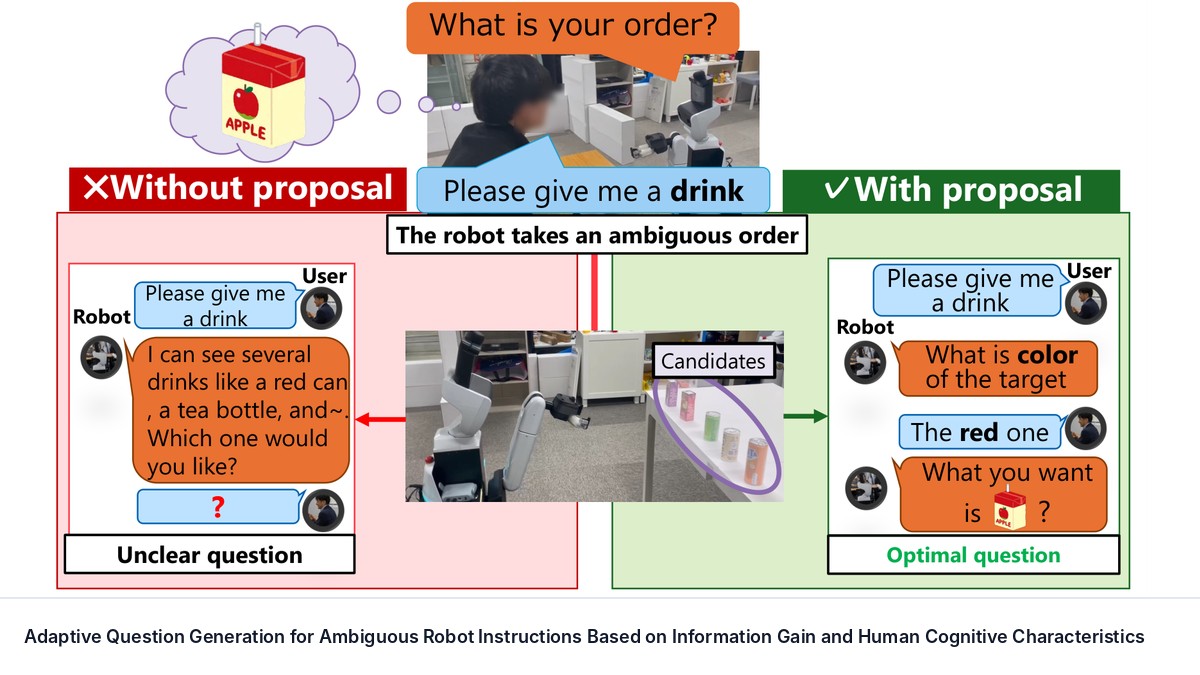
Adaptive Question Generation for Ambiguous Robot Instructions Based on Information Gain and Human Cognitive Characteristics
Ryo Terashima, Yuga Yano, Hakaru Tamukoh
In this study, we propose an adaptive question generation mechanism that addresses uncertainty arising from ambiguous instructions. Natural-language instructions for service robots often contain ambiguities.

AXIS: A Growable Community-Driven Data Engine for Scalable Robot Manipulation
Mengfei Zhao, Dihong Huang, Yikai Tang et al.
Learning effective robot manipulation policies requires diverse, high-quality demonstrations, yet existing data pipelines are often difficult to scale because they rely on specialized hardware, centralized operators, or fixed task suites.
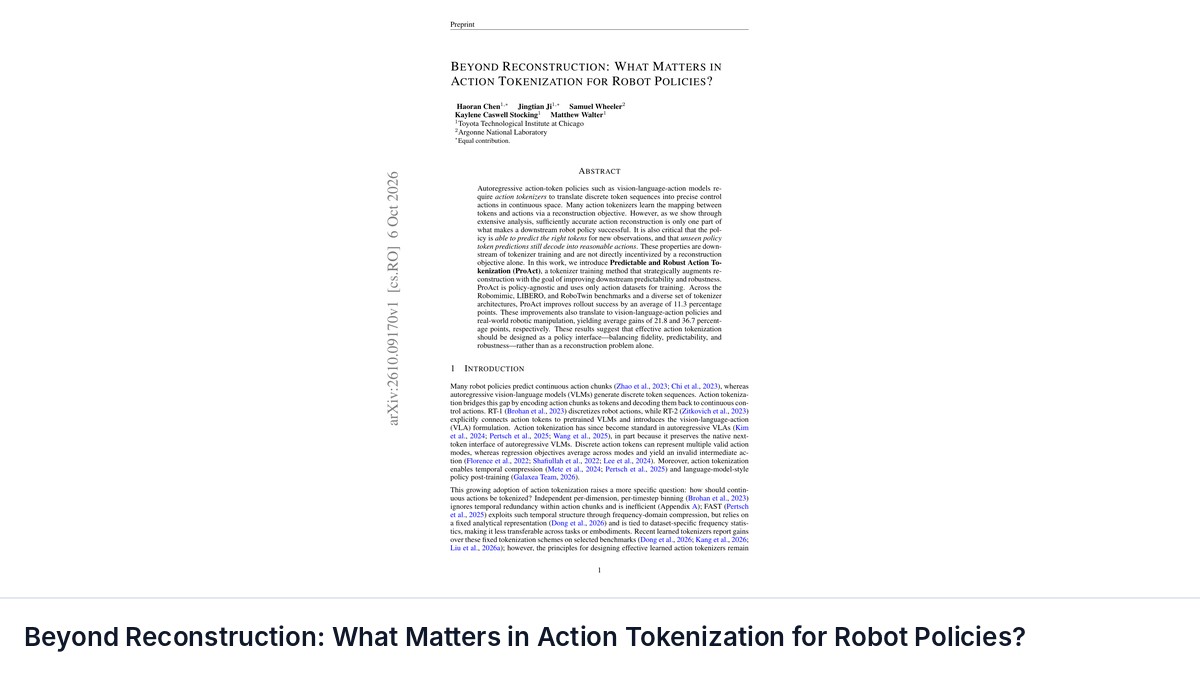
Beyond Reconstruction: What Matters in Action Tokenization for Robot Policies?
Haoran Chen, Jingtian Ji, Samuel Wheeler et al.
Autoregressive action-token policies such as vision-language-action models require action tokenizers to translate discrete token sequences into precise control actions in continuous space. Many action tokenizers learn the mapping between tokens and actions via a reconstruction objective.